

12 Sales Operations Examples That Show What the Job Actually Looks Like
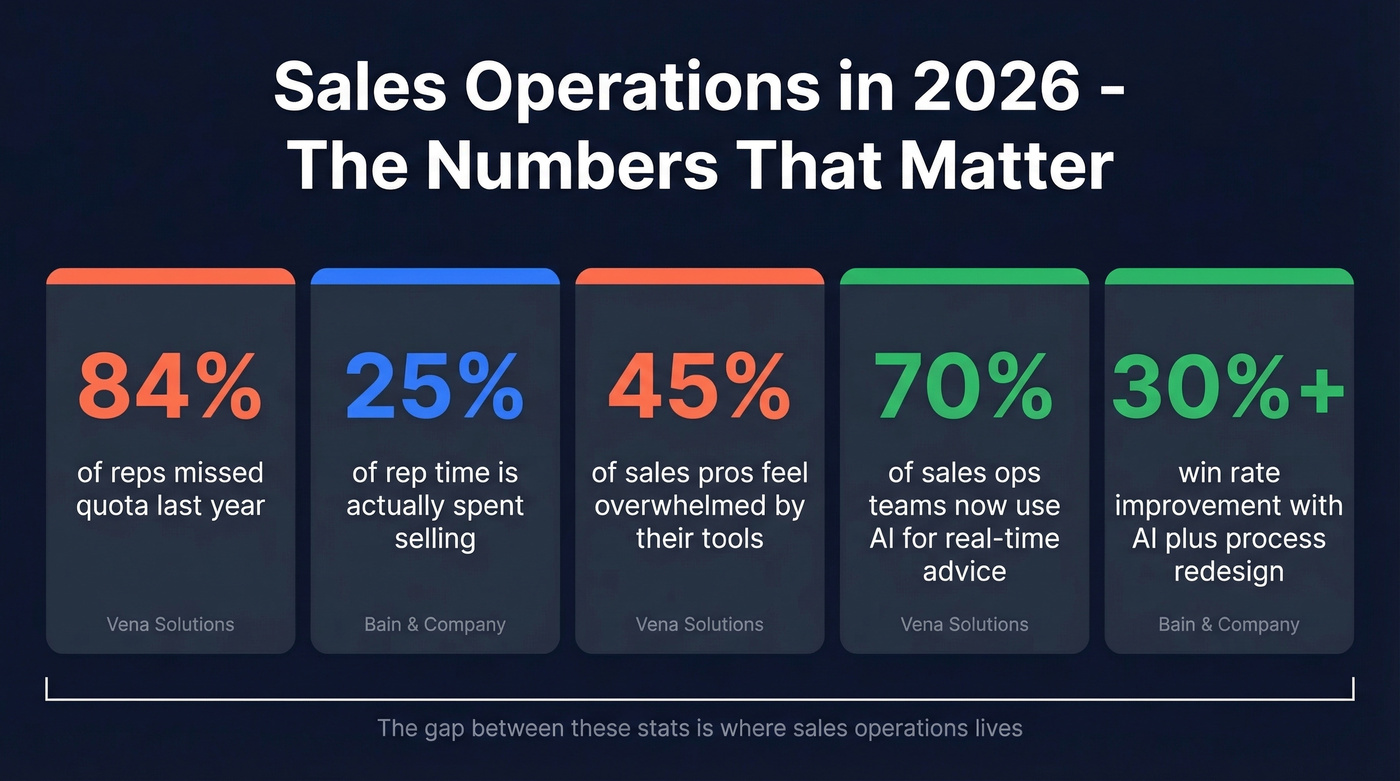
Every guide defines Sales Ops as "the function that improves sales efficiency." That tells you nothing about what to do on Monday morning. Ask any practitioner on r/SalesOperations and they'll tell you the job is roughly 80% CRM cleanup and platform management, 20% analysis and strategy. Meanwhile, 84% of reps missed quota last year.
These sales operations examples live in that gap - the concrete work that actually moves numbers.
What Is Sales Operations?
Sales operations is the team responsible for making revenue teams faster, more accurate, and less buried in process debt. It typically sits across four pillars: strategy, technology, process, and data. The boundaries blur constantly, which is exactly why the role is so hard to pin down in a job description.
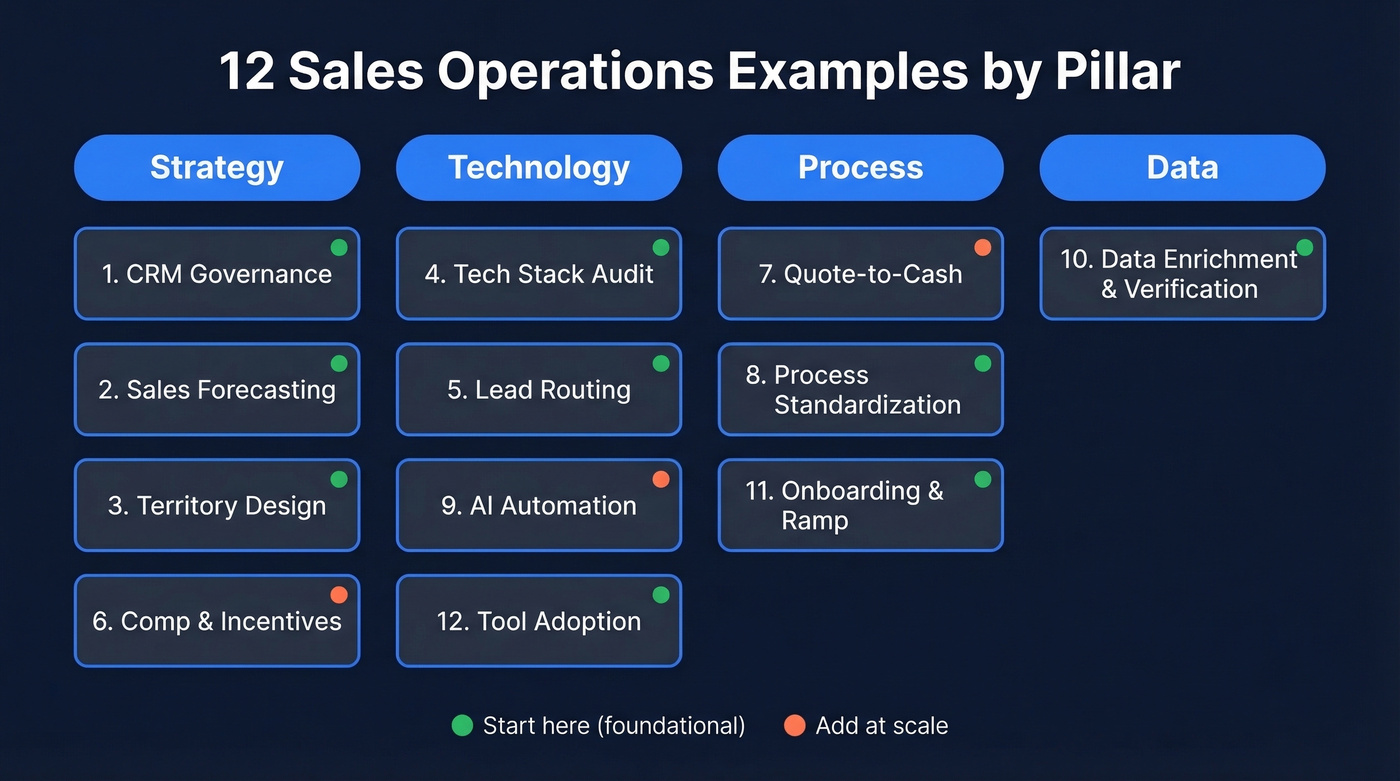
12 Real-World Sales Ops Examples
1. CRM Governance & Data Cleanup
Your CRM is full of missing fields, outdated titles, and duplicate records. Reps stop trusting the data, so they stop using the CRM. It's a death spiral.
Sales operations audits key fields, enforces required inputs at each pipeline stage, and schedules quarterly purges of stale records. Target: bounce rates below 5%, and a CRM reps actually open.
2. Sales Forecasting & Pipeline Analysis
Forecast accuracy dropped to 60% because every rep defines "commit" differently. Sales Ops standardizes stage definitions, implements weighted forecasting models, and tracks accuracy at the rep level. The target is 90%+. Reps spend roughly 25% of their time actually selling - bad forecasts waste what little selling time they have.
Quick formula: Forecast Accuracy = Forecasted Revenue / Actual Revenue x 100
3. Territory Design & Assignment
Top reps cherry-pick the best accounts while new reps get scraps. Quota attainment variance across territories hits 3x what it should be.
Sales Ops carves territories using TAM, industry vertical, and geography - not seniority. The outcome: reducing quota variance by 20%+ and giving every rep a fair shot at hitting number.
4. Tech Stack Audit & Consolidation
45% of sales professionals feel overwhelmed by the number of tools in their tech stacks. We've seen this firsthand - one team we worked with had three different tools doing essentially the same enrichment job, and nobody could tell us which one was the source of truth.
Sales Ops maps actual usage per tool, kills redundancies, and consolidates vendors. Teams typically cut stack costs 15-25% while improving adoption, and automation alone increases efficiency by 10-15%.
5. Lead Routing & Qualification
Inbound leads sit too long before first touch. By then, the prospect's talking to a competitor.
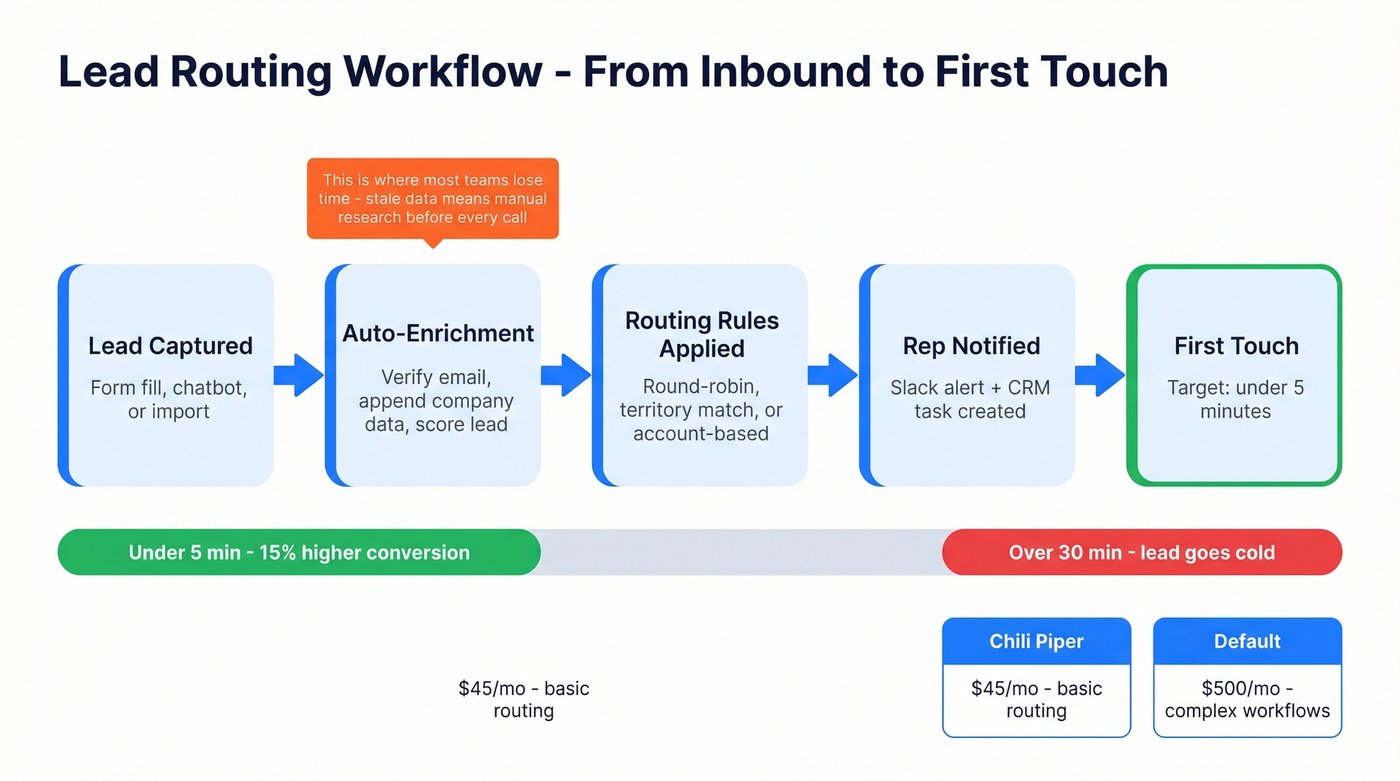
Sales Ops builds automated routing rules - round-robin, territory-based, or account-matched - with SLA tracking. Chili Piper starts at $45/mo for basic routing; Default runs $500/mo for complex workflows. Target: sub-5-minute response time and a 15% lift in lead-to-deal conversion.
6. Compensation & Incentive Design
Skip this one if your team is under 10 reps with a simple comp plan. Come back when reps start gaming accelerators.
Here's what happens at scale: reps sandbag deals into next quarter to hit accelerators. Finance is furious. Sales Ops redesigns the structure with rolling accelerators, SPIFs for strategic products, and clawback clauses for churned deals - aligning rep behavior with company revenue goals, not just individual quota. Getting comp wrong doesn't just cost money; it poisons culture.
7. Quote-to-Cash / Deal Desk
Between $10M and $50M ARR, manual quoting starts to break. Approvals take days, discount logic lives in someone's head, and finance can't reconcile what was sold versus what was billed.
Sales Ops standardizes pricing playbooks, defines a RACI for discount approvals, and implements CPQ tooling. Deal approval cycles drop from days to hours.
8. Sales Process Standardization
Every rep runs their own process. No two deals follow the same stages. Coaching is impossible because there's nothing to coach against.
Sales operations documents a stage-by-stage playbook with exit criteria, enforces it in the CRM, and reviews adherence weekly. Target: 20% reduction in sales cycle duration. This is also the foundation that makes everything else on this list work - you can't forecast accurately or route leads intelligently if your pipeline stages mean different things to different people.
9. AI-Powered Workflow Automation
It's 2026 and reps are still copy-pasting call notes. Sales Ops deploys AI for call summaries, email drafting, and activity auto-logging. 70% of sales operations professionals now use AI for real-time selling advice, and early adopters see 30%+ improvement in win rates when paired with process redesign.
Let's be honest: AI without process redesign is just faster chaos. If your CRM stages are a mess and your data's stale, an AI assistant will automate the garbage at higher speed. Fix the foundation first.
10. Data Enrichment & Contact Verification
Your CRM has tens of thousands of contacts but a big chunk are stale - wrong titles, dead emails, missing phone numbers. Every campaign starts with a data fire drill.
Bounce rates drop under 4% when you run CRM enrichment on a 7-day refresh cycle versus the 6-week industry average. In our experience, Prospeo's enrichment API handles this well at roughly $0.01/lead with 98% email accuracy, turning weekly manual cleanup into a quarterly batch job. That kind of data freshness changes how confidently reps can prospect.

11. Onboarding & Ramp Optimization
Before Sales Ops: New reps take 6+ months to hit quota. Training eats 5+ hours per week and none of it's structured.
After Sales Ops: A 30-60-90 onboarding program with shadowing rotations, certification checkpoints, and CRM proficiency gates. Ramp time drops 30-50%. One thing we've noticed is that the CRM proficiency gate matters more than most teams realize - if a rep can't navigate the system by day 30, they're going to build bad habits that haunt the org for quarters.
12. Tool Adoption & Change Management
"The majority of sales reps don't use the tools we give them on a regular basis."
That's a direct quote from Pure Storage's GTM Systems AVP. It's the dirty secret of every tech stack investment. Sales Ops tracks adoption metrics per tool, runs targeted enablement sessions, and sunsets anything below a usage threshold. By 2026, 75% of high-growth companies have deployed RevOps - adoption tracking is how they make it stick.

Example #10 is where most sales ops teams bleed time. Stale contacts, bounced emails, weekly fire drills before every campaign. Prospeo's enrichment API returns 50+ data points per contact at a 92% match rate - on a 7-day refresh cycle that turns your quarterly CRM purge into a set-it-and-forget-it workflow.
Stop cleaning data manually. Let enrichment run on autopilot at $0.01/lead.
Sales Ops Tech Stack
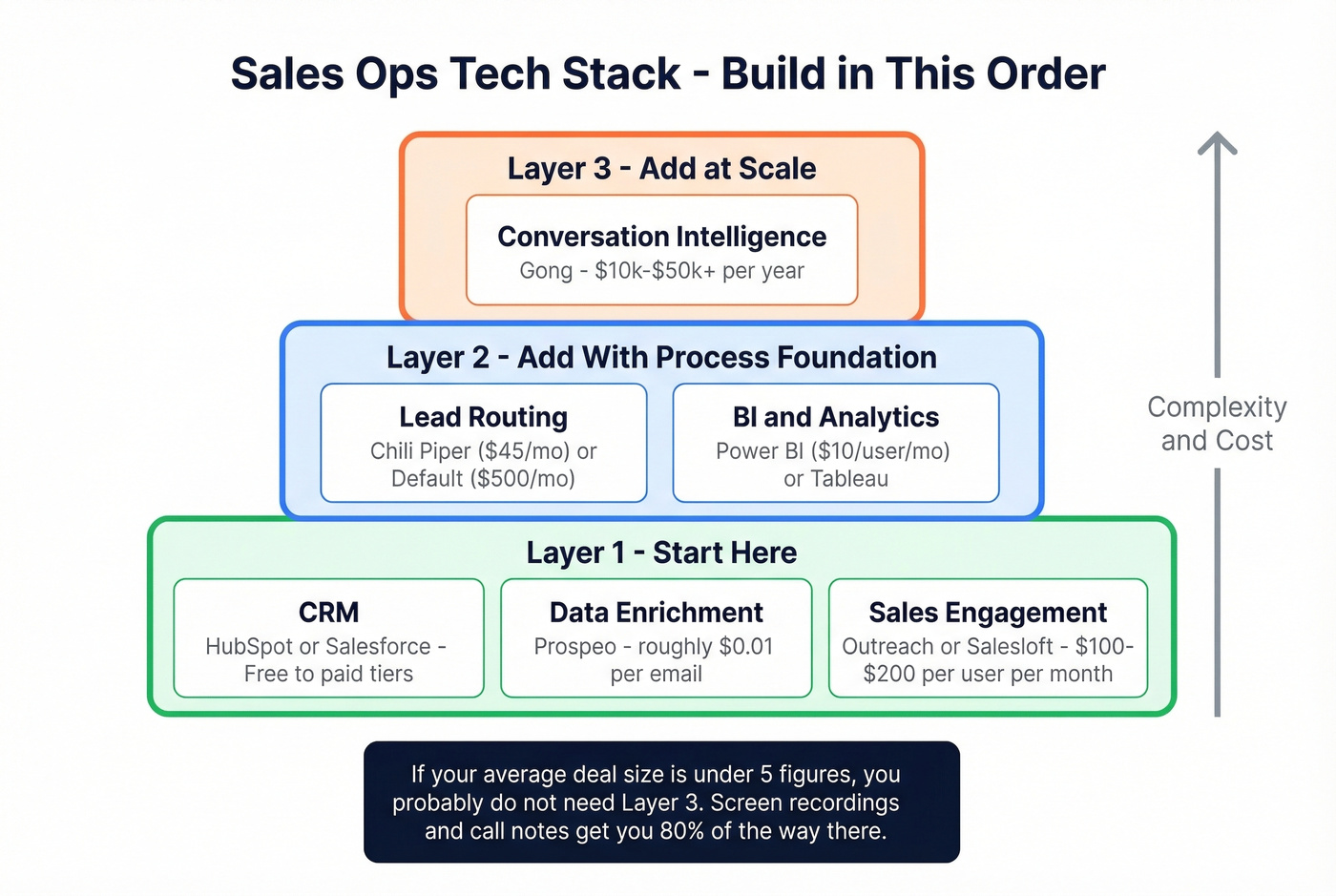
A sales operations team's job isn't buying tools - it's consolidating them. Here's what a lean, functional stack looks like.
| Category | Tool | Starting Price |
|---|---|---|
| CRM | HubSpot / Salesforce | Free / paid tiers |
| Data Enrichment | Prospeo | ~$0.01/email, free tier |
| Conversation Intel | Gong | Custom (~$10k-$50k+/year) |
| Sales Engagement | Outreach / Salesloft | Custom (~$100-$200/user/mo) |
| Lead Routing | Chili Piper / Default | $45/mo / $500/mo |
| BI & Analytics | Power BI / Tableau | ~$10/user/mo / annual license |
Most teams don't need all six categories on day one. Start with CRM, data enrichment, and engagement. Add conversation intelligence and routing once you've got the sales process foundation in place. If your average deal size is under five figures, you probably don't need Gong-level conversation intelligence at all - screen recordings and call notes will get you 80% of the way there.
Key Sales Operations Metrics
These are the numbers your leadership team cares about. Benchmark your current state before launching any initiative.
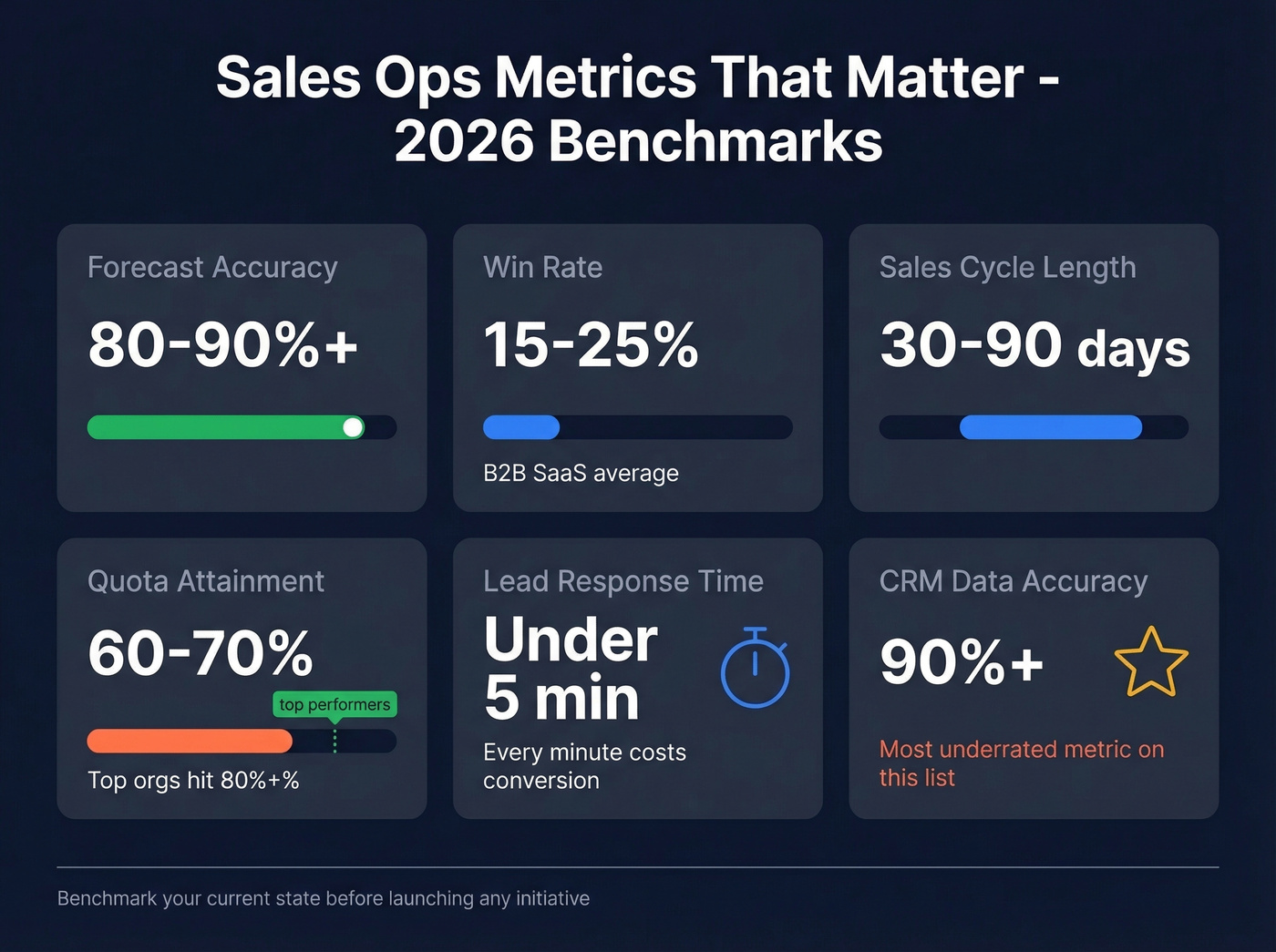
| Metric | Benchmark Range |
|---|---|
| Forecast Accuracy | 80-90%+ |
| Win Rate | 15-25% (B2B SaaS) |
| Sales Cycle Length | 30-90 days |
| Quota Attainment | 60-70% of reps (top orgs: 80%+) |
| Lead Response Time | Under 5 minutes |
| CRM Data Accuracy | 90%+ records complete |
I'd argue CRM Data Accuracy is the most underrated metric on this list. When it's low, every other number on the table becomes unreliable. You can't forecast what you can't measure, and you can't measure what isn't in the system.
If you want a deeper benchmark set, see our full breakdown of sales operations metrics and how to operationalize them.
You just read 12 examples of sales ops done right. Half of them depend on one thing: accurate contact data. Prospeo delivers 98% email accuracy and 125M+ verified mobile numbers - the foundation that makes your forecasting, lead routing, and rep onboarding actually work.
Every sales ops workflow breaks when the data underneath it is wrong.
FAQ
What are common sales operations examples?
The core responsibilities include CRM governance, sales forecasting, territory design, tech stack consolidation, lead routing, compensation design, deal desk management, process standardization, AI automation, data enrichment, onboarding optimization, and tool adoption tracking. Most teams start with CRM cleanup and forecasting before expanding scope.
When should you hire your first sales ops person?
Hire when your team hits 5-8 reps. The standard ratio is roughly 1 ops pro per 30 reps, but hire before processes break - not after. Waiting until 15+ reps means months of cleanup before any strategic work begins.
How do sales operations differ from revenue operations?
Sales operations focuses specifically on the sales team's processes, tools, and data. Revenue operations spans sales, marketing, and customer success under one umbrella. Companies under $20M ARR typically start with sales ops; RevOps makes sense once cross-functional alignment becomes a bottleneck.