

How to Set Sales Pipeline Goals That Actually Predict Hitting Plan
It's week 8 of the quarter. Your dashboard shows 3.5x coverage. Your VP is smiling. Then the quarter ends and you miss by 18%.
Phantom pipeline happened - deals that looked real but were never going to close. 84% of reps missed quota last year, and most of them had "enough" pipeline on paper. The problem isn't setting sales pipeline goals. The problem is tracking the wrong ones.
The Three Numbers That Actually Matter
Three metrics predict plan attainment with 78% accuracy in the $5M-$50M band:
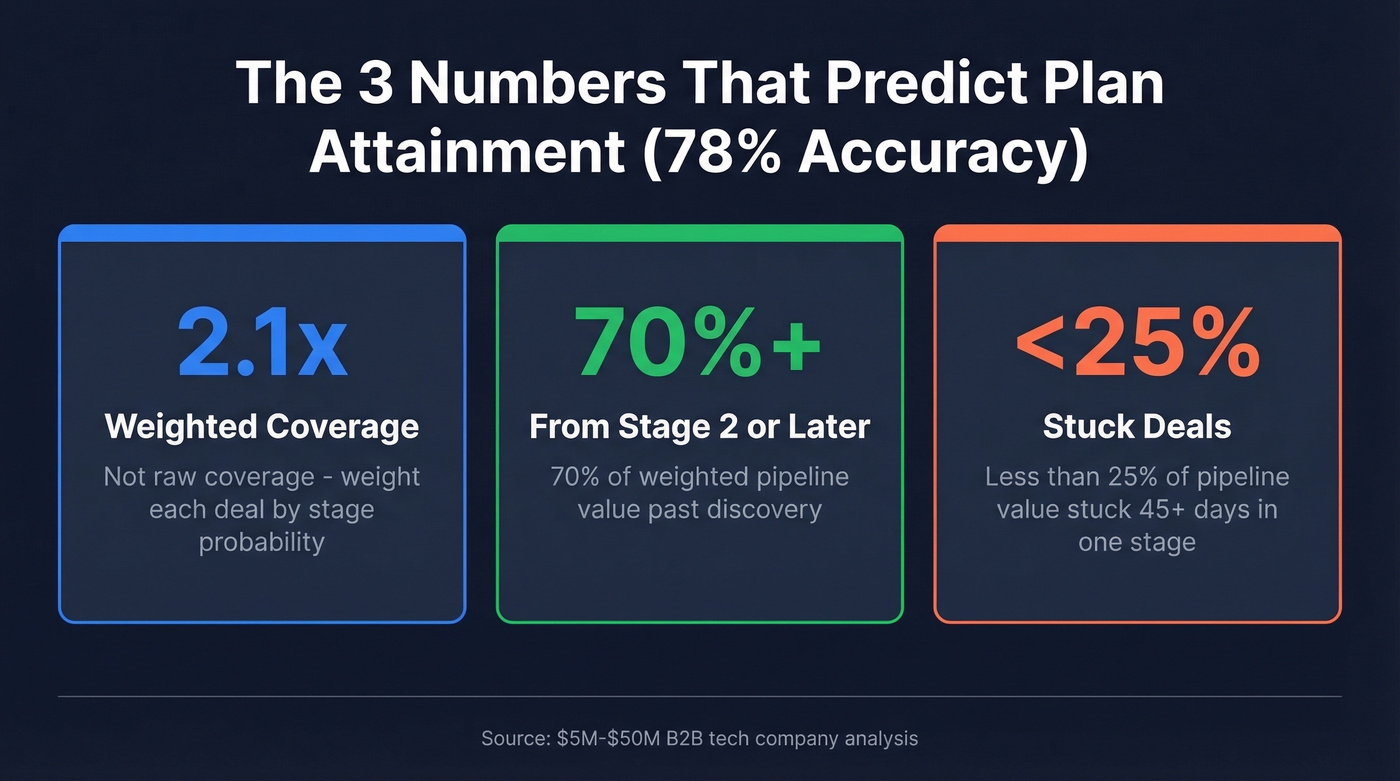
- Weighted coverage of 2.1x or higher - not raw coverage
- 70%+ of weighted pipeline from Stage 2 or later
- Less than 25% of pipeline value stuck more than 45 days in the same stage
If you only track three numbers, track these. Below is the math behind each one.
What Pipeline Goals Actually Are
Your quota is a rep-level financial target. Sales pipeline goals are the leading indicators that predict whether you'll hit that number before the quarter's already lost. There are five goal types worth setting: coverage, weighted coverage, stage mix, velocity, and activity.
Five Pipeline Metrics That Matter
Coverage Goals (Raw)
Pipeline divided by quota. The common "3x rule" assumes a ~33% close rate, which is lazy math - it ignores your actual win rate. Close at 25%? You need 4x. Close at 40%? 2.5x is plenty.
Segment benchmarks from Forecastio: enterprise needs 3-5x, mid-market 2.5-4x, SMB 2-3x. But raw coverage is where most teams stop, and it's where most teams get burned. Your pipeline size at any given moment tells you far less than the quality of what's inside it.
Weighted Coverage Goals
This is the single most predictive pipeline metric we've found. Median raw coverage across $5M-$50M B2B tech companies runs 3.4x, but median weighted coverage is just 1.8x. That 1.6x gap? That's your phantom pipeline. If you want a broader set of reference points, compare against sales pipeline benchmarks.
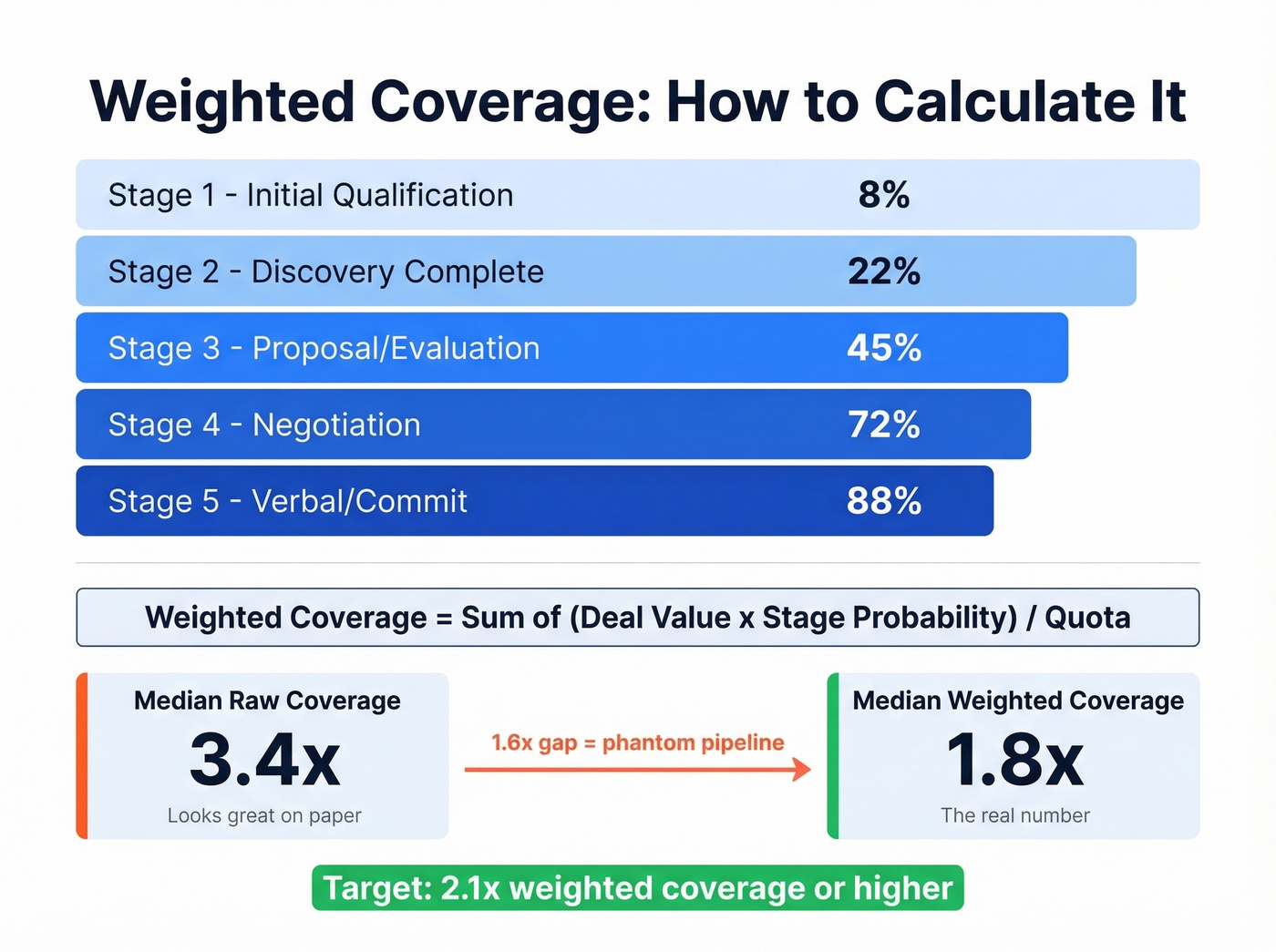
Multiply each deal's value by its stage probability:
- Stage 1 (Initial Qualification): 8%
- Stage 2 (Discovery Complete): 22%
- Stage 3 (Proposal/Evaluation): 45%
- Stage 4 (Negotiation): 72%
- Stage 5 (Verbal/Commit): 88%
Sum those weighted values, divide by quota. Your target: 2.1x weighted coverage or higher.
Stage Mix Goals
If 80% of your pipeline sits in Stage 1 at 8% probability, you effectively have nothing. 70%+ of your weighted pipeline value should come from Stage 2 or later. Early-stage-heavy pipeline is a coverage illusion - it looks impressive on a dashboard and collapses on a forecast call. This is one of the most common sales pipeline challenges teams run into.
Pipeline Velocity Goals
The formula: (# Opportunities x Avg Deal Size x Win Rate) / Sales Cycle Length. A study of 247 B2B organizations found the SaaS benchmark sits at $1,847/day with a median deal of $12,400, 22% win rate, and 67-day cycle.
Here's the kicker: teams that track velocity weekly see 34% revenue growth and 87% forecast accuracy. Ad-hoc trackers? 11% growth and 52% accuracy. Weekly reviews aren't optional - they're the difference between forecasting and guessing. If you're evaluating tooling, start with sales forecasting solutions that support stage-weighting and aging.
Activity Goals
Work backward from quota. Using SBI Growth's framework: a $1M annual goal at $50K average deal size means 20 closed deals. At a 25% win rate, that's 80 qualified opportunities. At 5:1 conversations-to-meetings, that's 400 conversations per year - roughly 8 per week.
One thing we've learned watching teams run this math: referrals and existing customers convert at 3-4x the rate of cold leads. Your activity goals should account for channel mix, not just raw dials. A rep doing 8 warm conversations a week will outperform one doing 30 cold calls, and the pipeline they create will actually hold up under scrutiny. If you need a repeatable outbound motion, use these sales prospecting techniques to keep activity tied to real ICP fit.

Activity goals only work when conversations actually happen. At 98% email accuracy and a 30% mobile pickup rate, Prospeo turns your 8-conversations-per-week target into real pipeline - not phantom coverage that dies on forecast calls.
Stop feeding zombie pipeline. Start with contacts that convert.
Worked Example: Revenue to Daily Activity
Let's break this down with real numbers. A SMART version of this goal: "Generate $750K in qualified opps in Q4 to support $250K revenue at 3x coverage."
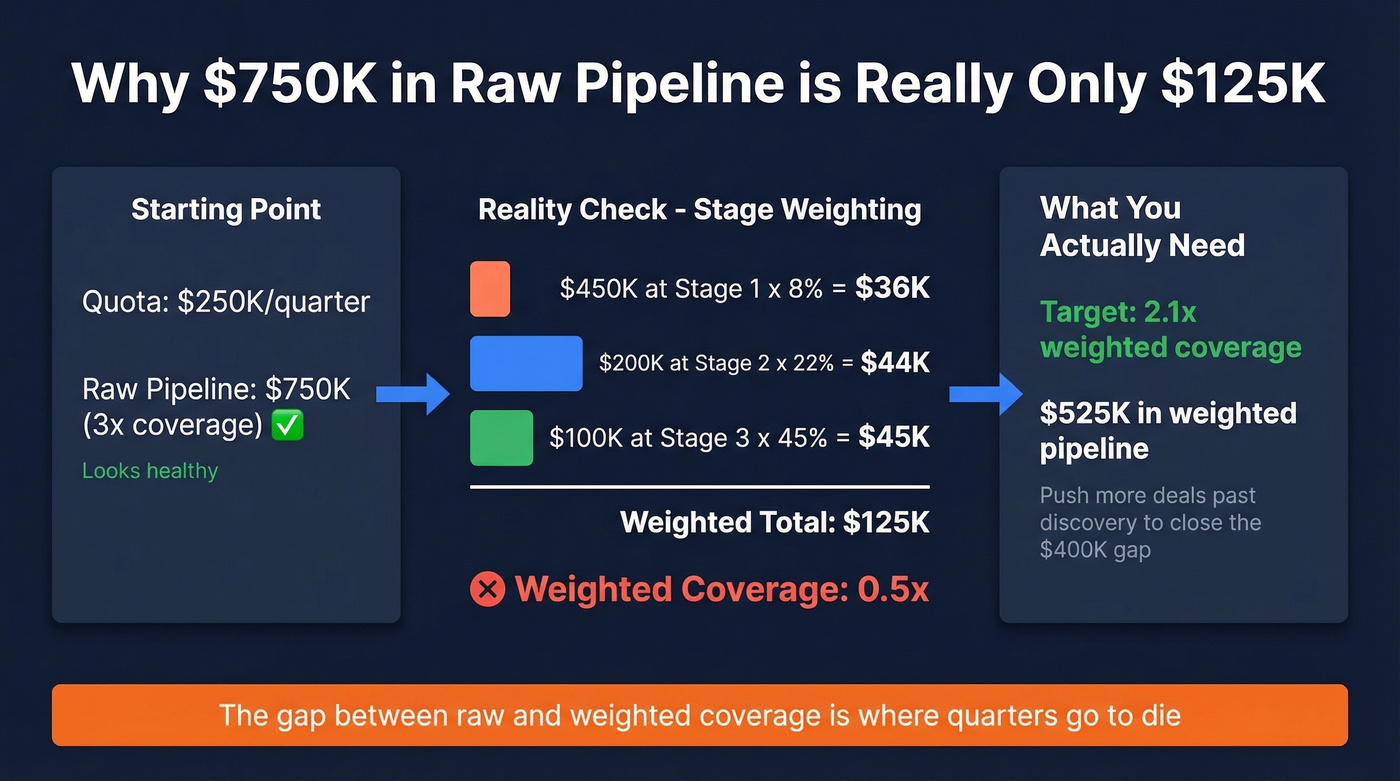
- Quota: $250K/quarter
- Raw pipeline needed at 3x: $750K in qualified opps
- Weighted pipeline check: You have $750K raw, but 60% is Stage 1. Weighted value = ($450K x 0.08) + ($200K x 0.22) + ($100K x 0.45) = $36K + $44K + $45K = $125K. Your weighted coverage is 0.5x. You're massively short.
- Real pipeline needed: To hit 2.1x weighted coverage on $250K, you need ~$525K in weighted pipeline. That means pushing more deals past discovery.
The gap between "raw pipeline says $750K" and "weighted pipeline says $125K" is where quarters go to die. We've seen teams with 5x raw coverage miss by 20% because it was all Stage 1. Run this math before week 1, not week 8.
Kill the Zombies: Aging Rules
Coverage goals without aging rules reward reps for keeping dead deals alive. This is a core part of pipeline health that most teams ignore until it's too late.
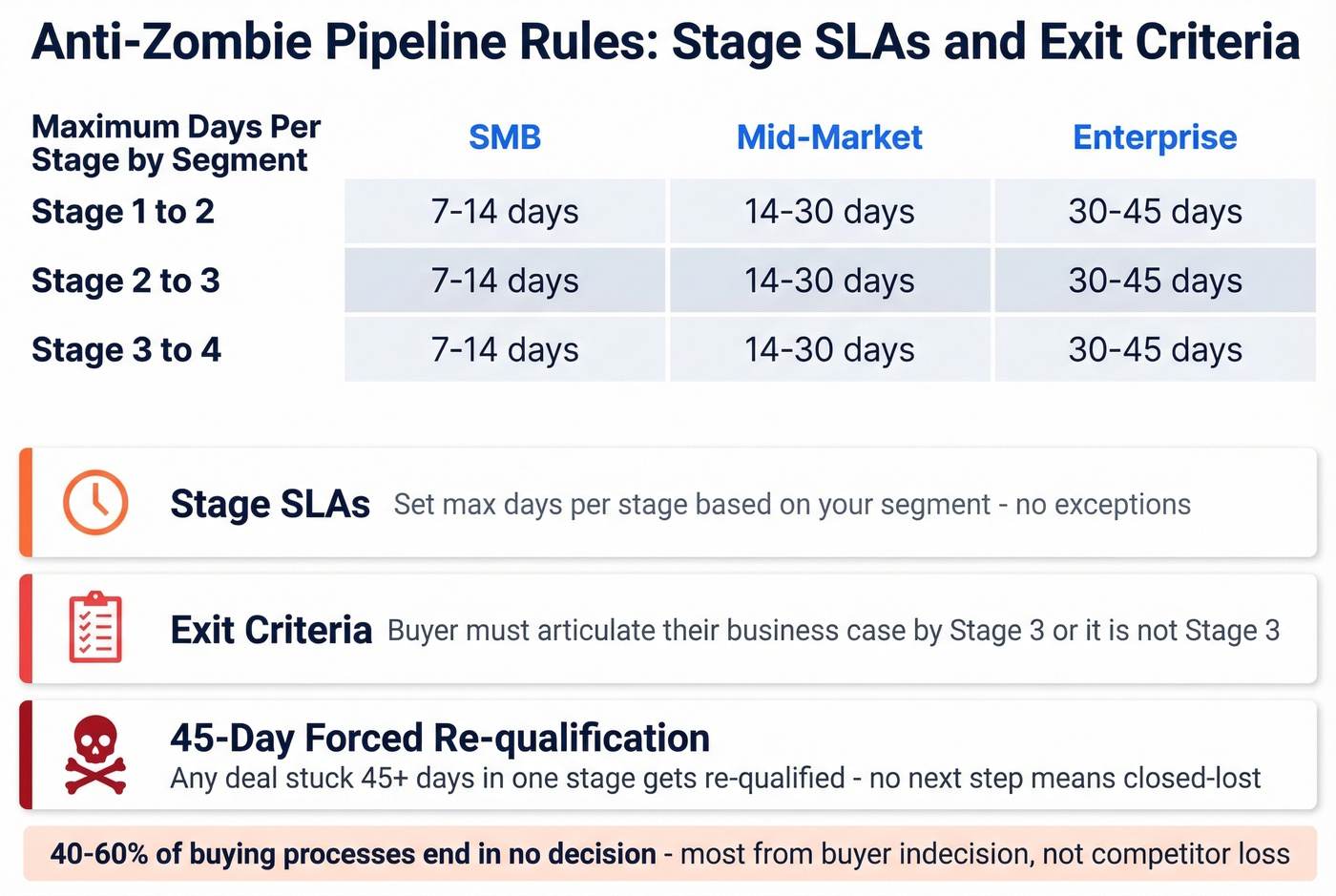
We've all seen it - VP mandates 5x coverage, reps create junk opps to hit the number, and the forecast becomes fiction. 40-60% of buying processes end in no decision, and roughly 60% of those stem from buyer indecision, not competitor loss. Three anti-zombie rules:
- Stage SLAs: SMB deals get 7-14 days per stage, mid-market 14-30, enterprise 30-45.
- Exit criteria per stage: If the buyer can't articulate their business case by Stage 3, it's not Stage 3.
- Forced re-qualification at 45 days: Any deal stuck more than 45 days in the same stage gets re-qualified. No next step? Closed-lost.
Look, most teams would hit plan more often with 2x of real, well-qualified pipeline than 5x of unverified junk. The obsession with raw coverage is actively hurting forecast accuracy across the industry.
Right-Sizing Your Target Pipeline
Your pipeline goals are only as good as the pipeline you create. High-ICP accounts represent just 23% of total pipeline in many orgs - the rest is filler that inflates pipeline size and tanks conversion. If contacts bounce, pipeline is fiction regardless of how carefully you set your targets.
This is where data quality directly determines pipeline quality. Prospeo delivers 98% email accuracy on a 7-day refresh cycle, with intent data across 15,000 topics to help you prioritize accounts that are actually in-market. The free tier gives you 75 emails/month plus 100 Chrome extension credits/month to test the approach before committing. If you're comparing vendors, start with data enrichment services and map them to your ICP and stage requirements.

Weighted coverage of 2.1x requires deals built on real buyer engagement - and that starts with reaching the right people. Prospeo's intent data tracks 15,000 topics so you fill pipeline with in-market accounts, not Stage 1 filler that inflates your dashboard and tanks your quarter.
Fill your pipeline with buyers who are already looking.
FAQ
What's a good pipeline coverage ratio?
Use weighted coverage of 2.1x or higher as your real target. Raw coverage benchmarks - 3-5x enterprise, 2.5-4x mid-market, 2-3x SMB - mislead without stage weighting. Always pair coverage with stage-mix and aging checks.
How often should I review pipeline goals?
Weekly. Teams that track weekly see 34% higher revenue growth and 87% forecast accuracy versus 11% and 52% for ad-hoc reviewers. Build a 15-minute Monday pipeline review into your cadence - it's the single highest-ROI meeting on your calendar.
How do I set a realistic sales target pipeline?
Start with your quota, apply your actual win rate to determine the raw coverage multiple, then weight by stage probability. A realistic target accounts for deal aging and stage mix, not just top-line dollar value. Skip this step and you're forecasting with a blindfold on.
How do I stop phantom pipeline from wrecking my forecast?
Enforce stage exit criteria, re-qualify any deal stuck over 45 days, and use verified contact data with a short refresh cycle. The consensus on r/sales is that most phantom pipeline comes from two sources: deals with no real champion and contacts that were never reachable in the first place. Fix both and your forecast gets dramatically more reliable.