

How to Coach Your Team's Sales Pitch (So They Actually Hit Quota)
You've run three roleplay sessions this quarter. Reps groan every time. The feedback is always the same vague "be more consultative." Nothing changes because there's no scoring rubric, no progressive difficulty, and no data showing what "better" actually looks like.
That's what real sales pitch coaching fixes.
Quota attainment cratered from 53% in 2012 to just 16% by 2024. The sales training industry is worth $10.32 billion, yet only 18% of buyers think salespeople show up prepared. Training events don't stick. Structured coaching does.
The Quick Version
- Pick one framework. Five D's for structured pitch development, or Challenger for complex B2B. Don't mix three methodologies.
- Run weekly drills with progressive difficulty. Elevator pitch, then common objections, then hard objections, then multi-stakeholder curveballs.
- Use a conversation intelligence tool to review real calls. Gong, Hyperbound, or Chorus - budget determines which.
And before any of it, verify your contact data so coached reps aren't delivering perfect pitches to dead numbers.
Why Most Pitches Fail
When salespeople dominate 65%+ of talk time, win rates drop hard. 90% of B2B buyers won't engage with reps who deliver irrelevant pitches, and 58% of deals stall because reps fail to address objections properly. The pattern is always the same: reps pitch before they've earned the right to pitch. They skip discovery, lead with features, and talk past the buyer's actual problem.
Without a real discovery sequence, even polished delivery falls flat - whether it's a cold call, a video pitch, or a prospecting email. If you need a refresher on what “good” discovery looks like, start with a tight set of discovery questions.
Frameworks That Actually Move the Needle
Pick one methodology and coach to it. Blending three frameworks just leaves reps confused about which playbook they're running.
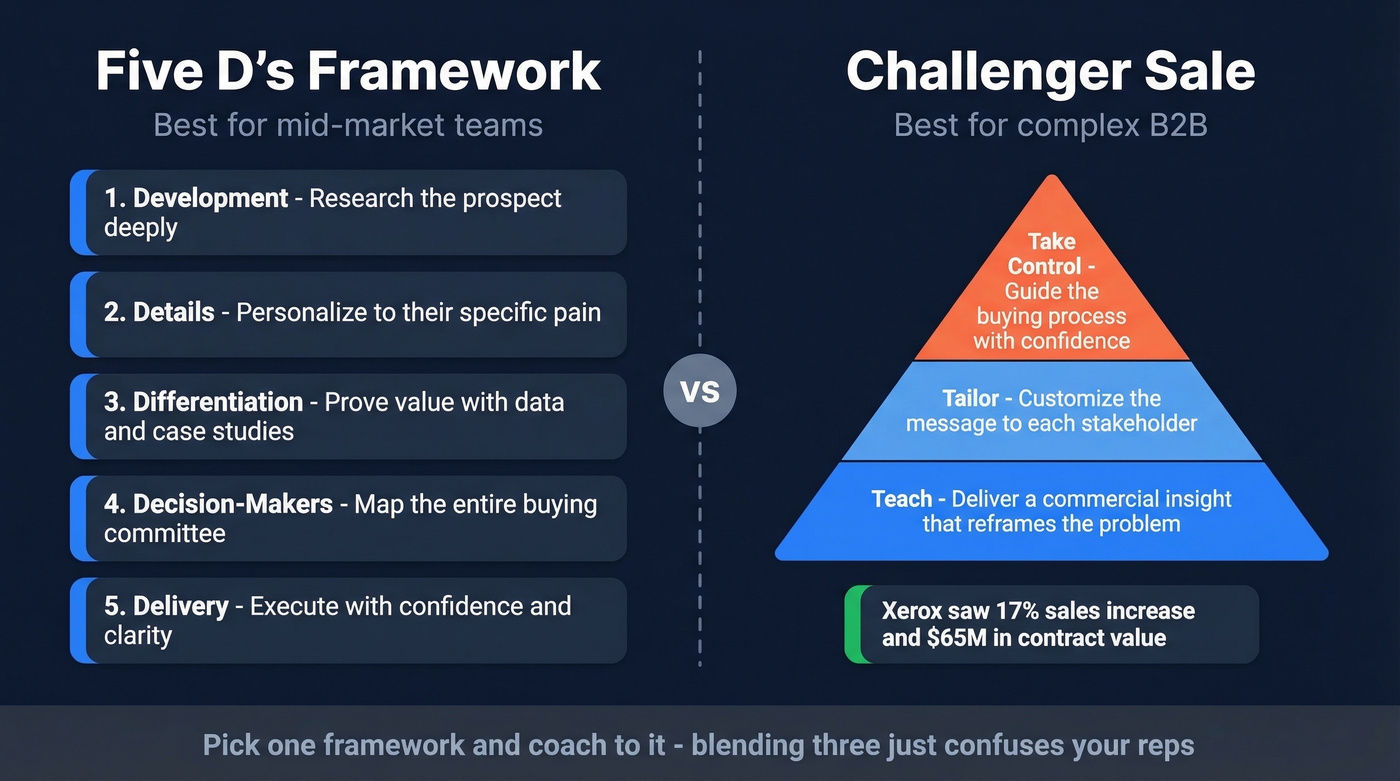
The Five D's framework gives you a repeatable structure: Development (research the prospect), Details (personalize to their pain), Differentiation (prove value with data and case studies), Decision-Makers (map the buying committee), and Delivery (execute with confidence). Reps can internalize it in a week, and it works especially well for teams selling into mid-market accounts where the buying committee is small enough to map but large enough to require real preparation.
For complex B2B, Challenger is one of the most research-backed options available. Built on CEB research across 6,000+ reps, the core behaviors - Teach, Tailor, Take Control - center on delivering a commercial insight that reframes how the buyer thinks about their problem. Xerox reported a 17% sales increase and $65M in contract value after implementing it.
For objection handling specifically, drill the CRAC micro-framework: Cushion (acknowledge), Reformulate (restate the real concern), Argue (address with evidence), Check (confirm resolution). Four steps. Muscle memory beats improvising under pressure every time. If objections are a recurring blocker, pair this with a system to reduce sales objection rate.
One distinction worth borrowing from Outreach's coaching model: split coaching into strategic and tactical. Strategic means best-in-class call examples and competitive trend analysis. Tactical means weekly 1:1s, call reviews, and technique practice. Most managers default to tactical only and never zoom out. If you want a broader enablement system around this, use a sales training tips playbook as the backbone.

Coaching frameworks fix how reps pitch. But 90% of B2B buyers won't engage if the pitch isn't relevant - and it's never relevant if you're reaching the wrong person. Prospeo gives your coached reps 98% accurate emails and 125M+ verified mobiles so every perfected pitch lands on a real decision-maker.
Stop wasting coached reps on dead leads. Fix the data first.
Drills That Build Muscle Memory
Here's the thing about roleplay: reps hate it because it's usually unstructured and awkward. Fix the structure and the cringe factor drops.
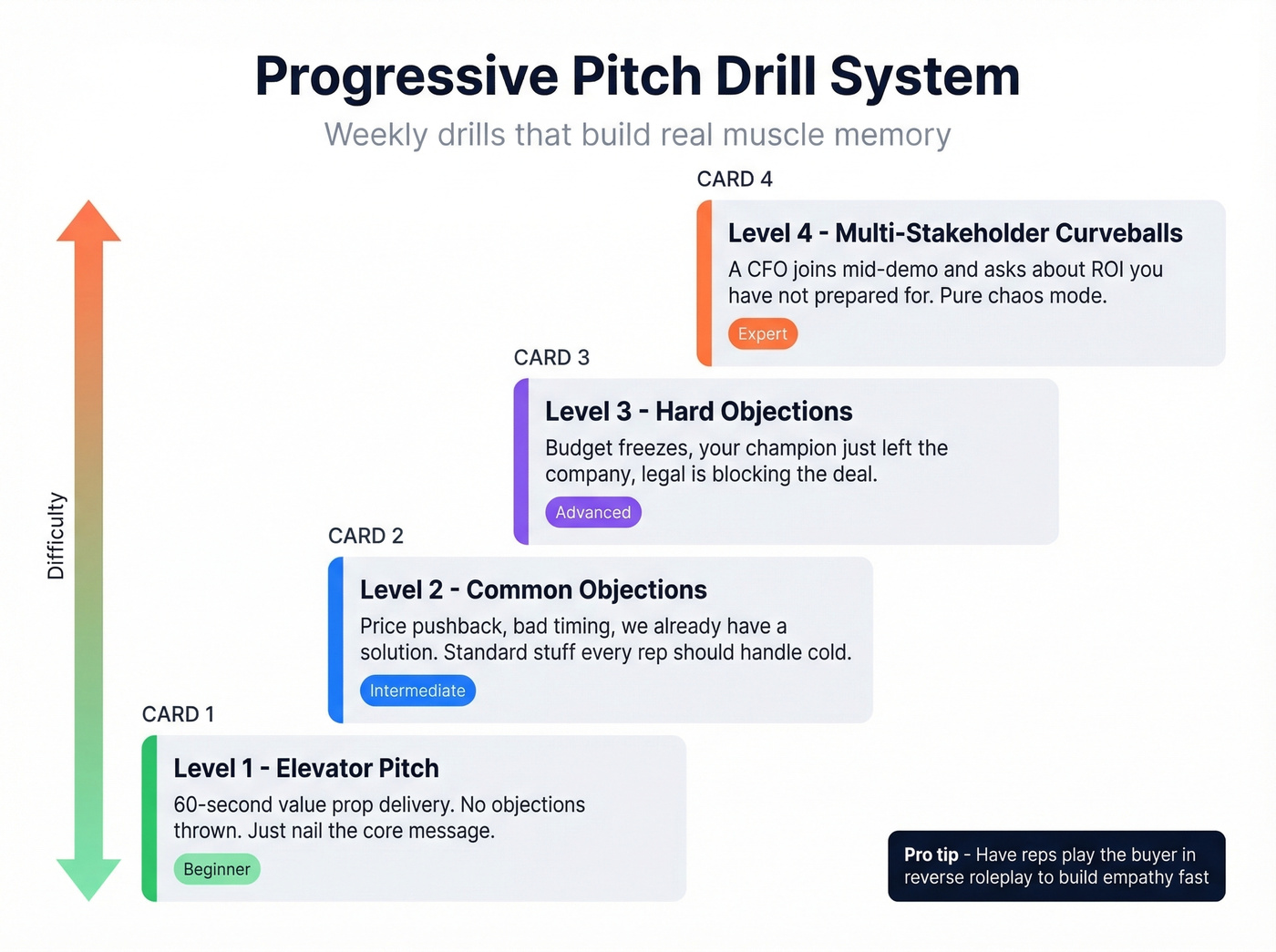
Build a progressive difficulty system:
- Level 1: 60-second elevator pitch. No objections, just nail the value prop. (If your team needs examples, pull from these sample elevator pitches.)
- Level 2: Common objections - price, timing, "we already have a solution."
- Level 3: Hard objections - budget freezes, a champion leaving the company, legal pushback.
- Level 4: Multi-stakeholder curveballs where a CFO joins the call mid-demo and asks about ROI you haven't prepared for.
Reverse role-play is underrated. Have the rep play the buyer. It builds empathy fast and helps them identify what feels pushy from the other side of the table - we've found this single drill changes how reps handle discovery more than almost anything else.
Keep sessions to 30-45 minutes, weekly or biweekly, with one framework focus and one live drill. Record every session. To keep practice tied to pipeline, align drills to real sales activities your reps are running that week.
How to Score a Sales Pitch
Without a rubric, coaching feedback stays vague. Score reps across five dimensions:
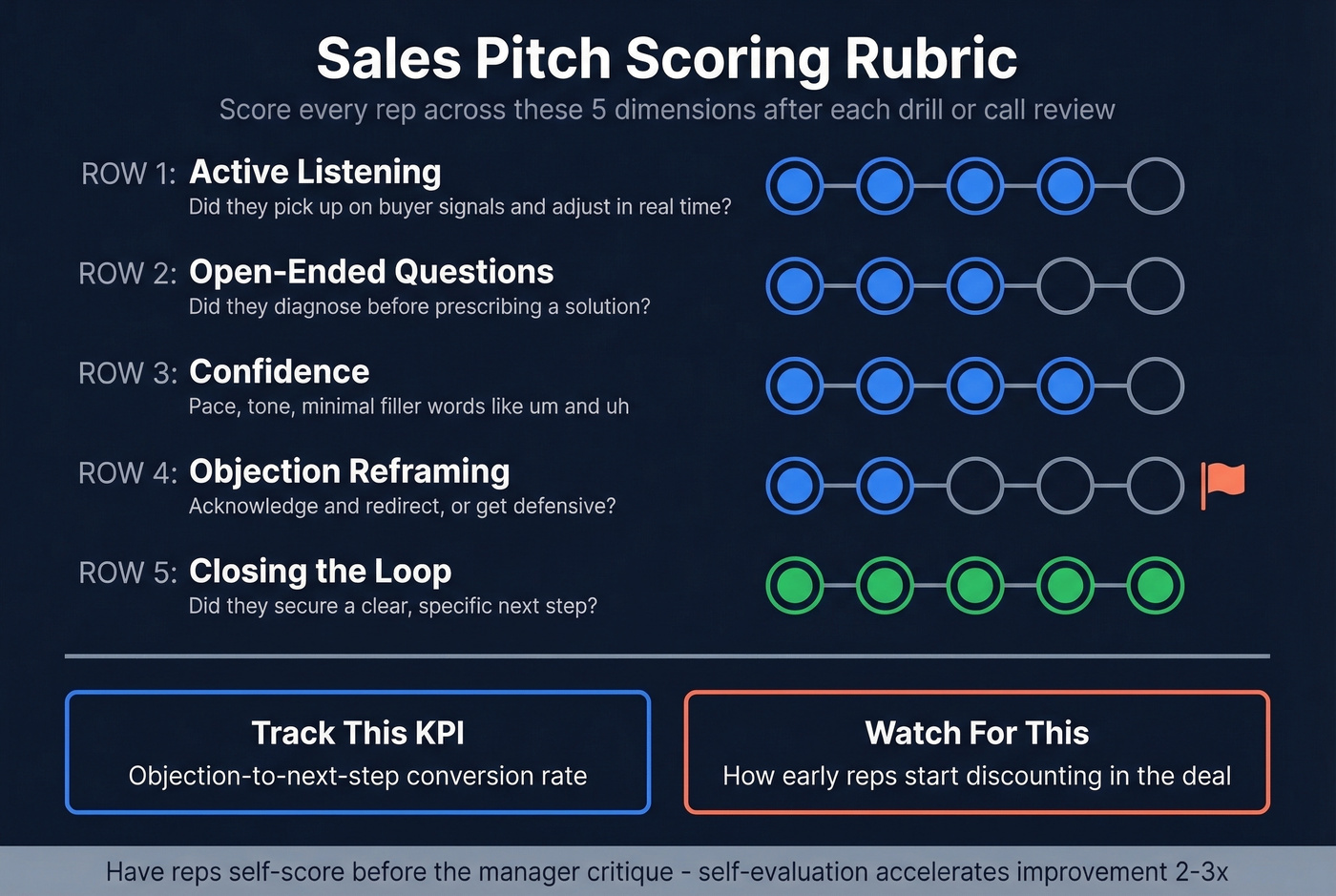
- Active listening - did they pick up on buyer signals and adjust? (This gets easier when reps know how to spot buying signals.)
- Open-ended questions - did they diagnose before prescribing?
- Confidence - pace, tone, filler words
- Objection reframing - acknowledge and redirect, or get defensive?
- Closing the loop - did they secure a clear next step?
Track two KPIs over time: objection-to-next-step conversion rate and how early in the deal reps start discounting. Both reveal whether coaching is actually changing behavior. Have reps self-score before the manager critique - self-evaluation accelerates improvement significantly, and in our experience, reps who self-assess first improve 2-3x faster than those who only receive top-down feedback.
AI Tools for Pitch Coaching
AI coaching tools can drive 20-25% improvement in rep proficiency and 15% faster ramp time. Teams implementing these programs see win rates improve by 32%. The best tools track talk-to-listen ratios, flag filler words, and surface coaching moments so every session is data-driven instead of gut-feel.
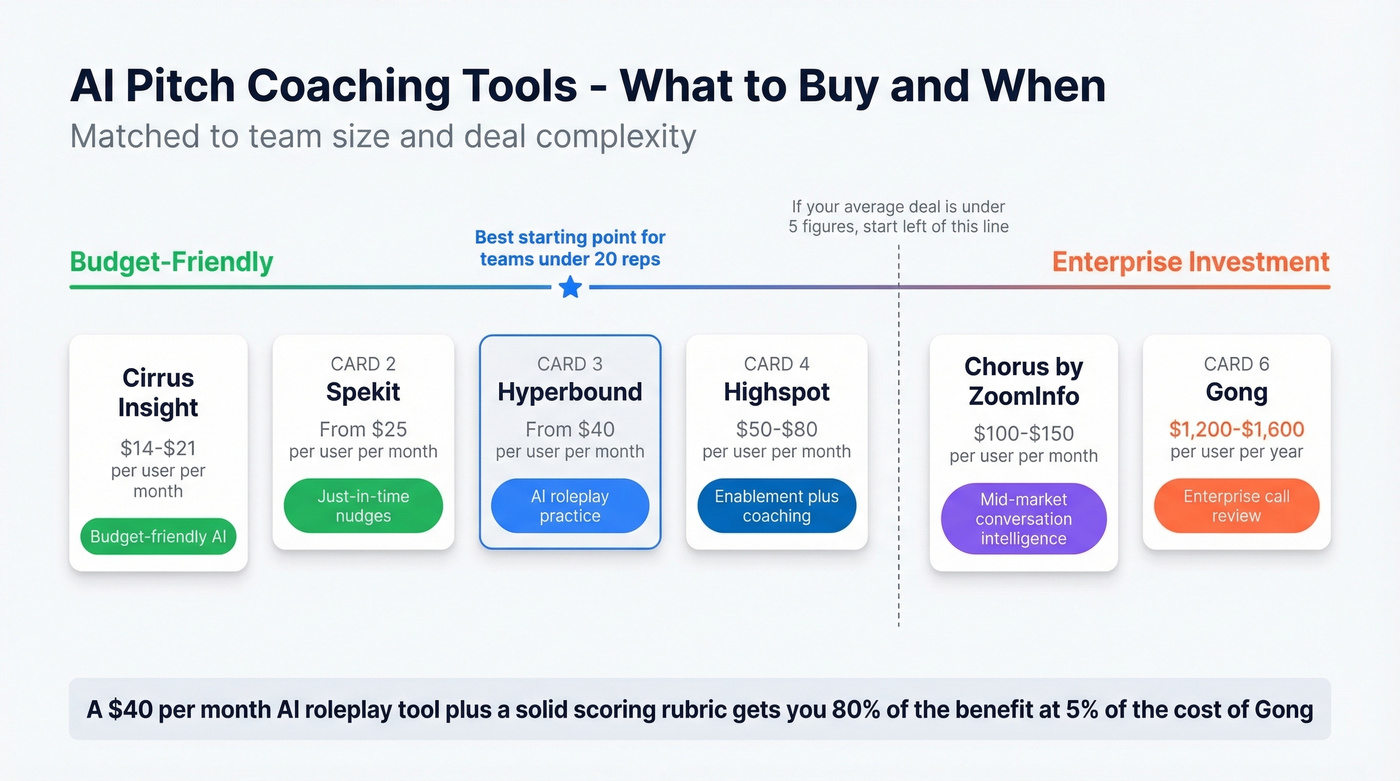
Gong is the gold standard for conversation intelligence, but at ~$1,200-$1,600/user/year plus a platform fee, it's priced for enterprise. Hyperbound at $40/user/month is the smarter starting point for teams under 20 reps - AI roleplay practice without the six-figure commitment.
| Tool | Starting Price | Best For |
|---|---|---|
| Gong | ~$1,200-$1,600/user/yr | Enterprise call review |
| Chorus (ZoomInfo) | ~$100-$150/user/mo | Mid-market conv. intel |
| Hyperbound | From $40/user/mo | AI roleplay practice |
| Highspot | ~$50-$80/user/mo | Enablement + coaching |
| Spekit | From $25/user/mo | Just-in-time nudges |
| Cirrus Insight | ~$14-$21/user/mo | Budget-friendly AI |
Let's be honest: if your average deal size is under five figures, you probably don't need Gong-level tooling. A $40/month AI roleplay tool plus a solid scoring rubric will get you most of the benefits. Skip Gong until you're closing six-figure deals consistently. If you’re building a broader stack around this, start with a ranked list of SDR tools.
The Data Problem Nobody Talks About
Everyone focuses on what to say in a pitch. Almost nobody talks about who you're saying it to.
We've seen this pattern repeatedly: a team invests in Gong, runs weekly drills, builds a scoring rubric - and pipeline still doesn't move because reps are burning hours on bounced emails and disconnected numbers. GreyScout cut rep ramp time from 8-10 weeks to 4 weeks partly by fixing this upstream data problem with Prospeo, which delivers 98% email accuracy and 125M+ verified mobile numbers on a 7-day refresh cycle. Their bounce rate dropped from 38% to under 4%, and pipeline jumped 140%.
The free tier gives you 75 verified emails per month - enough to test whether contact quality is actually your bottleneck before committing budget. Even the best sales pitch coaching program falls apart when reps can't reach decision-makers. Fix the data layer first, then layer on frameworks and drills. If you’re diagnosing deliverability issues, start with email bounce rate benchmarks and fixes.
GreyScout cut rep ramp time in half by pairing structured coaching with clean prospect data. Bounce rates dropped from 38% to under 4%, and pipeline jumped 140%. At $0.01 per email with a 7-day refresh cycle, Prospeo ensures your reps spend drill time on technique - not chasing bad numbers.
Give your reps contacts worth pitching to.
FAQ
How often should you run coaching sessions?
Weekly sessions produce the best results. Reps who receive weekly coaching show 25% higher quota attainment. Keep each session to 30-45 minutes with one framework focus and one live drill - consistency beats marathon workshops every time.
What's the ROI of structured pitch coaching?
PwC research shows coaching delivers an average 7x return on investment. The key word is "structured" - a scoring rubric, progressive drills, and recorded sessions. Ad hoc feedback after random calls doesn't move the needle.
How do you make sure reps pitch the right prospects?
Start with verified contact data to eliminate bounced emails and dead numbers. Then layer in intent data to prioritize prospects actively researching your category so reps reach real decision-makers, not voicemail.
What's the fastest way to improve a rep's pitch?
Record a live call, score it against a five-dimension rubric (listening, questions, confidence, objection handling, next steps), and have the rep self-evaluate first. That self-assessment step is the single biggest accelerator we've found - it forces reps to internalize the rubric instead of passively receiving feedback.