

Sales Pitch Email Templates That Actually Get Replies (2026)
You sent 200 pitch emails this week and got two replies. The instinct is to rewrite the template. But the template isn't your biggest problem - your infrastructure is. Most sales pitch email template guides hand you 50 templates and zero deliverability advice. That's like giving someone a Ferrari and no gas.
Why Most Pitch Emails Fail
The average cold email reply rate sits at 3.43%. For every 100 emails, roughly 97 people ignore you. Elite campaigns crack 10%, but most teams hover between 2-4% and blame their copy.
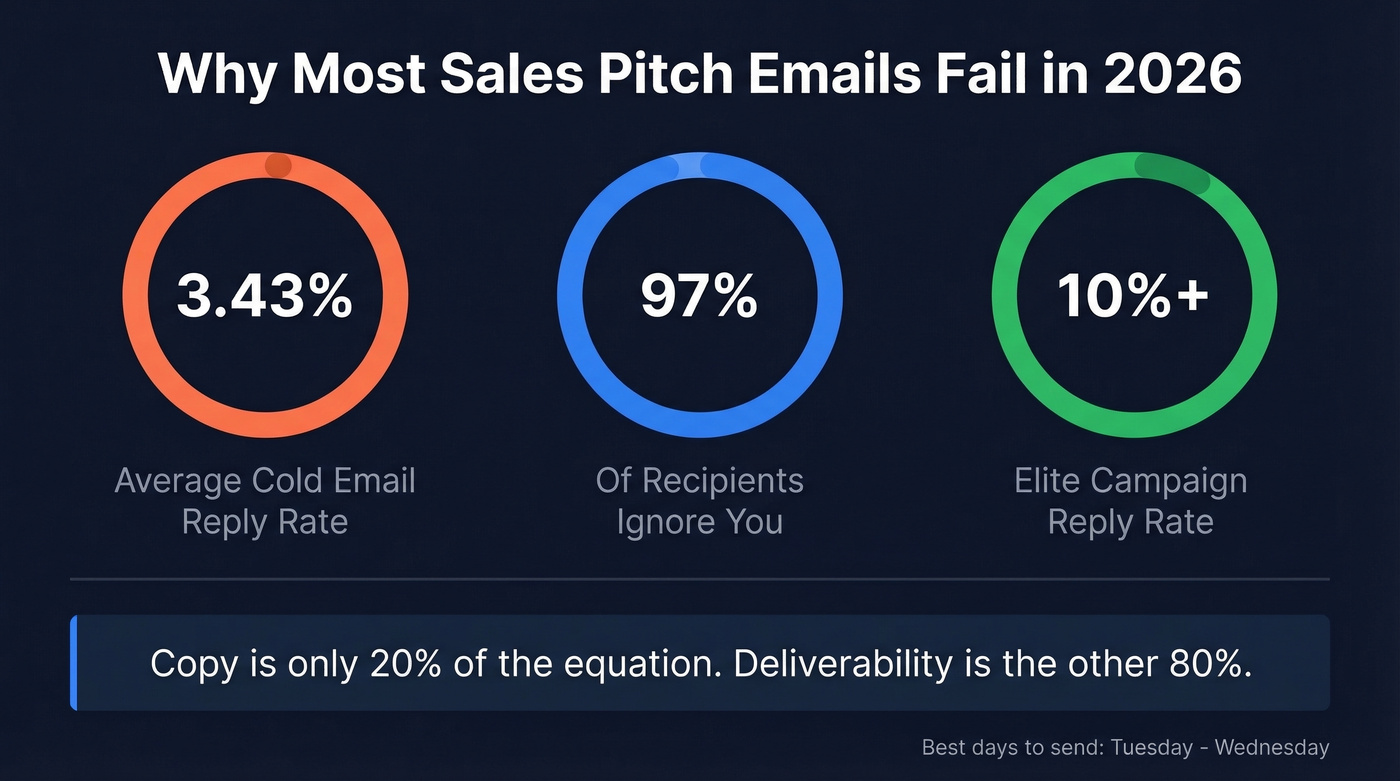
Here's the thing: copy matters less than you think. One practitioner on r/Entrepreneur doubled their reply rate from 3% to 6% - not by rewriting templates, but by rebuilding their sending infrastructure, cleaning their list, and cutting email length from 141 words to under 56. The template was maybe 20% of the equation. Deliverability was the other 80%.
Peak reply days? Tuesday through Wednesday. Email still delivers $36 for every $1 spent. The channel works. Your setup might not.
What You Need Before Sending a Single Pitch
You don't need 52 templates. You need five good ones and the infrastructure to deliver them.
- Keep emails under 80 words with one clear ask. 58% of replies come from the first email - make it count.
- Verify every email address before sending. One bad list torches your sender reputation. We use Prospeo for this - 98% accuracy across 143M+ verified emails, catching spam traps, honeypots, and catch-all domains before they do damage.
- Set up SPF, DKIM, and DMARC. Warm up your domain before you send a single pitch. Skip this and nothing else matters.
What Makes a Great Sales Pitch Email
Every high-performing email pitch follows five parts: a short subject line, a personalized opener that proves you did research, a value proposition tied to their specific problem, social proof, and a single CTA. No company history. No feature dumps. No "I hope this email finds you well."
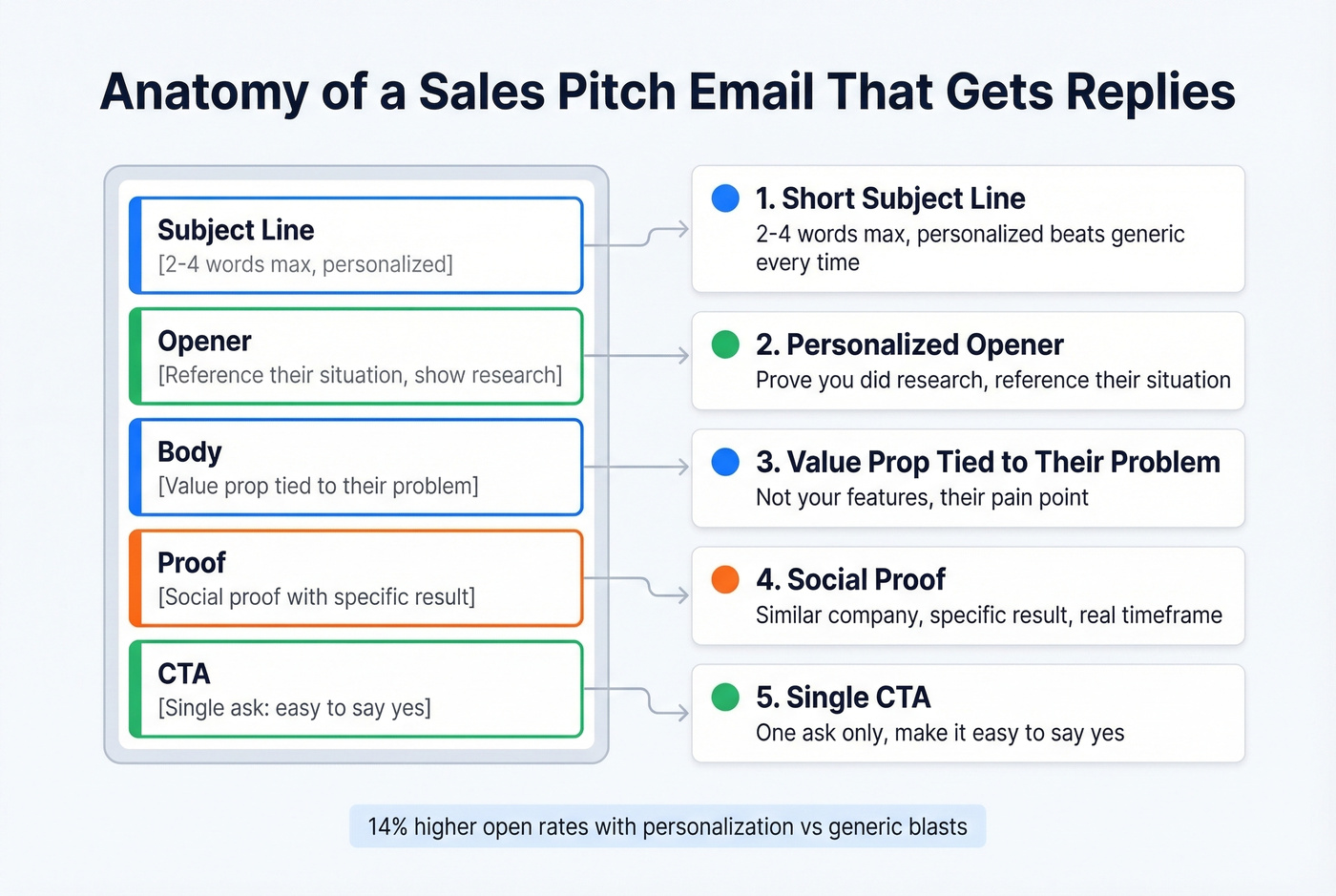
Personalized B2B emails achieve 14% higher open rates and 10% higher click-through rates than generic blasts. A consistent complaint across outbound teams in 2026 is automation that pretends to be personal but isn't actually relevant. Tailor each template to a specific scenario rather than writing one generic pitch for everyone.
Hot take: Trigger-based emails outperform cold pitches 2:1 in our experience. If you only have time to master one template, start there - not with the cold pitch everyone defaults to.

Every template above is worthless if it bounces. Prospeo verifies 143M+ emails at 98% accuracy - catching spam traps, honeypots, and catch-all domains before they torch your sender reputation. At $0.01 per email, cleaning your list costs less than a single bounced reply costs your domain.
Stop rewriting templates. Start fixing your list.
7 Proven Email Templates for Sales Outreach
Each template below is under 80 words. Copy, customize the bracketed fields, and send.
1. Cold Pitch to a New Prospect
Use when: First touch. PAS framework - problem, agitate, solve.
Subject: [Specific problem] at [Company]?
Hi [First name],
[Company] is [scaling/hiring/expanding into X] - which usually means [specific pain point].
We helped [similar company] solve that in [timeframe], cutting [metric] by [result].
Worth a 15-minute call this week to see if we can do the same?
Opens with their situation, not yours. That single shift is what separates a reply from a delete.
2. Warm Pitch: Trigger-Based
Use when: After a job change, funding round, or hiring signal. This is the one we'd start with if we could only pick one template - the timing does half the selling for you.
Subject: Congrats on the [trigger]
Hi [First name],
Saw [Company] just [raised Series B / hired 10 SDRs / opened a new office]. That usually creates [specific challenge].
We work with [similar companies] on exactly that - [one-line result].
Open to a quick chat about how we'd approach it for [Company]?
The trigger proves relevance and timing. A VP of Sales who just closed a Series B and posted three SDR roles doesn't need you to explain why outbound matters - they need to know you can help them move fast.
3. Referral / Mutual Connection
Use when: Someone you both know can vouch for you.
Subject: [Mutual connection] suggested I reach out
Hi [First name],
[Mutual connection] mentioned you're working on [initiative]. We helped them [specific result] and they thought we could do the same for [Company].
Would you be open to a 15-minute call this week?
Borrowed trust cuts through the noise instantly.
4. Follow-Up After No Response
Use when: 3-5 days after your first email. Style it as a reply, not a new pitch.
Subject: Re: [Original subject]
Hi [First name],
Just bumping this up. I know [day of week]s get buried.
Would [specific day] work for a quick call?
Short. Low-pressure. No repeated pitch.
5. Follow-Up: New Value Add
Use when: Second or third follow-up. Bring something new instead of just nudging again.
Subject: Re: [Original subject]
Hi [First name],
Thought this might be useful - we just published [resource/case study] on [their challenge]. [One-line takeaway].
Happy to walk through how it applies to [Company] if you're interested.
Gives before asking. If you don't have a relevant resource to share, skip this template and go straight to the breakup.
6. The Breakup Email
Use when: Final follow-up after 4+ touches. Skip this if your sequence is shorter than four emails - you haven't earned the right to "close the file" yet.
Subject: Should I close your file?
Hi [First name],
I've reached out a few times and haven't heard back - totally understand if the timing's off.
I'll assume this isn't a priority right now and close out your file. If anything changes, just reply to this thread.
Loss aversion. People respond to things going away.
7. Quick Question (Curiosity-Based)
Use when: You want maximum opens. "Quick question" hit ~39% open rates in one practitioner's A/B tests.
Subject: Quick question
Hi [First name],
Who handles [function - like outbound, demand gen, or vendor selection] at [Company]?
Trying to connect with the right person about [one-line value prop].
Low commitment, high curiosity, easy to reply to. Let's be honest - most people can't resist answering a direct question, even from a stranger.
Subject Lines That Get Opened
64% of recipients decide to open or delete an email based solely on the subject line. Get this wrong and nothing else matters.
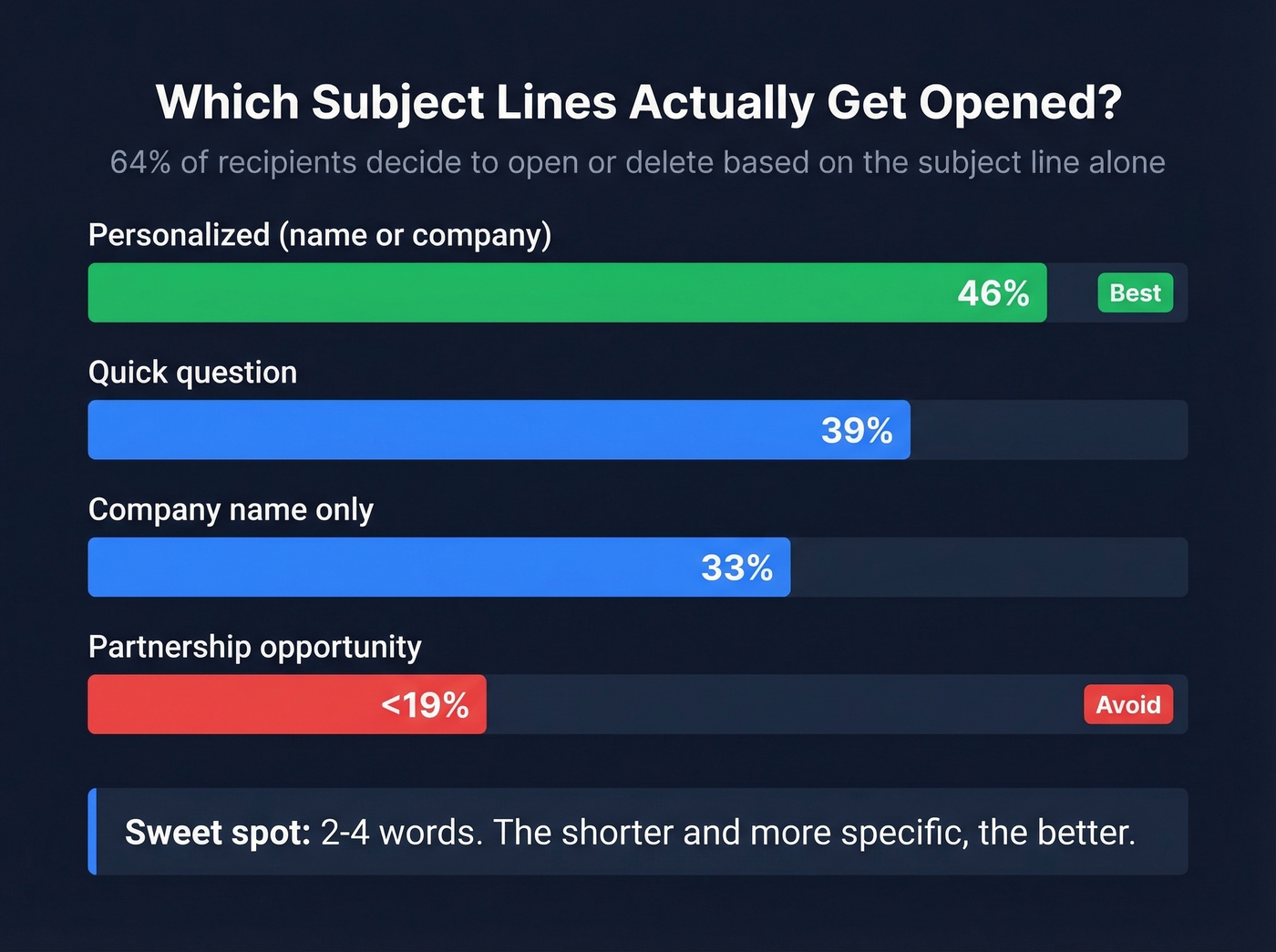
| Subject Line Type | Open Rate | Verdict |
|---|---|---|
| "Quick question" | ~39% | Best single phrase |
| [Company name] only | ~33% | Strong, simple |
| Personalized (name/company) | ~46% | Highest overall |
| "Partnership opportunity" | <19% | Avoid entirely |
The sweet spot is 2-4 words. "Partnership opportunity" is the worst-performing subject line in cold email - it screams mass blast and recipients treat it accordingly. If you want more options, pull from these subject line examples.
Deliverability Checklist
If your bounce rate is above 2%, stop writing new templates and fix your list. The practitioner who doubled their reply rate didn't start with copy - they moved from 3 domains to 7, capped sends at 26/day per domain, and dropped their bounce rate from 11% to under 2%. Their entire cold email stack ran about $420/month.
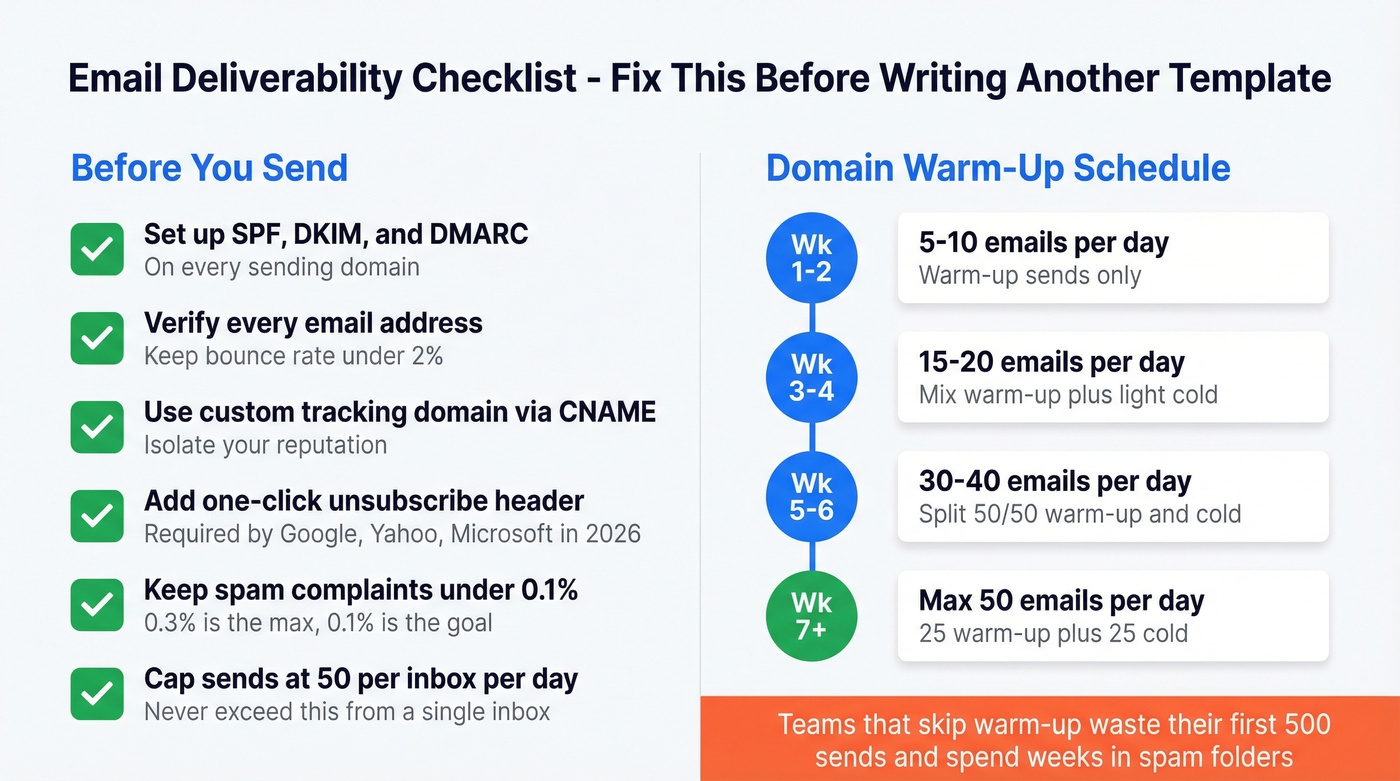
As of 2026, Google and Yahoo enforce bulk-sender rules requiring SPF, DKIM, and DMARC plus RFC 8058 one-click unsubscribe headers, with Microsoft aligning to similar requirements. Keep your bounce rate under 2% and spam complaints under 0.3% - if you can hold 0.1%, even better. Verify every address before sending. Set up SPF, DKIM, and DMARC on every sending domain, and use a custom tracking domain via CNAME for reputation isolation (more on tracking domain setup).
If you’re still troubleshooting, use an email deliverability checklist and monitor email bounce rate patterns before you scale. Also keep an eye on email velocity so you don’t spike volume and tank reputation.
Warm-up schedule:
| Week | Emails/Day | Notes |
|---|---|---|
| 1-2 | 5-10 | Warm-up only |
| 3-4 | 15-20 | Mix warm-up + light cold |
| 5-6 | 30-40 | Split 50/50 |
| 7+ | Max 50 | 25 warm-up + 25 cold |
Never exceed 50 emails/day from a single inbox. In our experience, teams that skip warm-up waste their first 500 sends and spend weeks digging out of spam folders. We've seen it happen to agencies running client campaigns where one bad week of bounces meant two months of recovery.
Template #2 works because timing does half the selling. Prospeo tracks job changes, funding rounds, and hiring signals across 300M+ profiles with a 7-day refresh cycle - so your trigger-based pitches land while the trigger is still fresh, not six weeks late.
Catch the trigger before your competitors do.
Compliance Quick-Reference
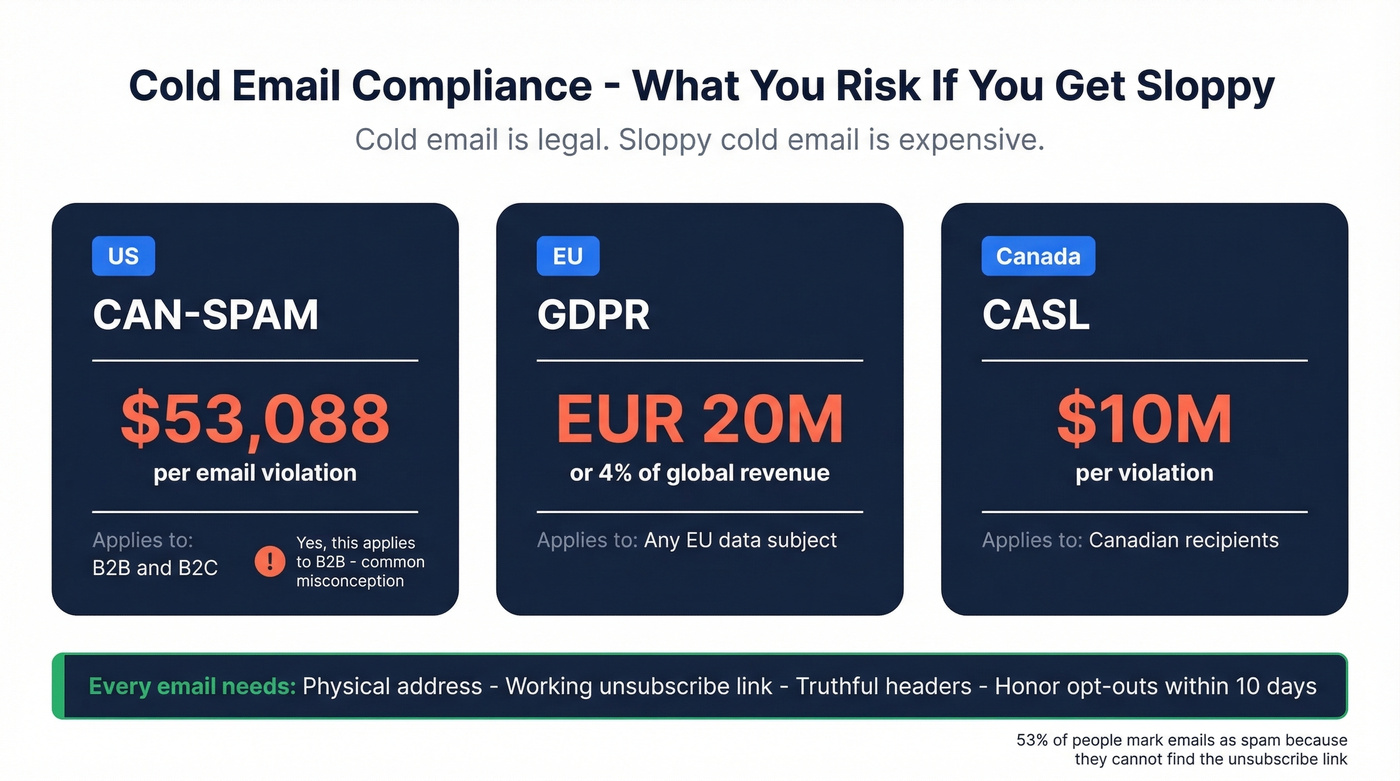
Cold email is legal. Sloppy cold email is expensive.
| Regulation | Max Penalty | Applies To |
|---|---|---|
| CAN-SPAM (US) | $53,088/email | B2B + B2C |
| GDPR (EU) | EUR 20M or 4% of revenue | Any EU data subject |
| CASL (Canada) | $10M/violation | Canadian recipients |
CAN-SPAM applies to B2B - that's a common misconception that gets teams in trouble. Every email needs a physical address, a working unsubscribe link, and truthful headers. Honor opt-outs within 10 business days. 53% of people mark emails as spam because they can't find the unsubscribe link. Make it visible.
FAQ
How long should a sales pitch email be?
Under 80 words. The best-performing cold emails use three short paragraphs with a single ask. Writing more than 80 words means you're pitching too hard for a first touch - save the detail for the call.
How many follow-ups should I send?
Four to seven touchpoints. 58% of replies come from the first email, but 42% come from follow-ups - quitting after one or two emails leaves nearly half your potential replies on the table.
How do I stop sales emails from going to spam?
Set up SPF, DKIM, and DMARC on every sending domain. Keep your bounce rate under 2% by verifying every email address before sending. Warm up new domains for 4-6 weeks before scaling, and cap sends at 50 per inbox per day.