

8 Sales Process Mistakes That Kill Your Pipeline (and How to Fix Each One)
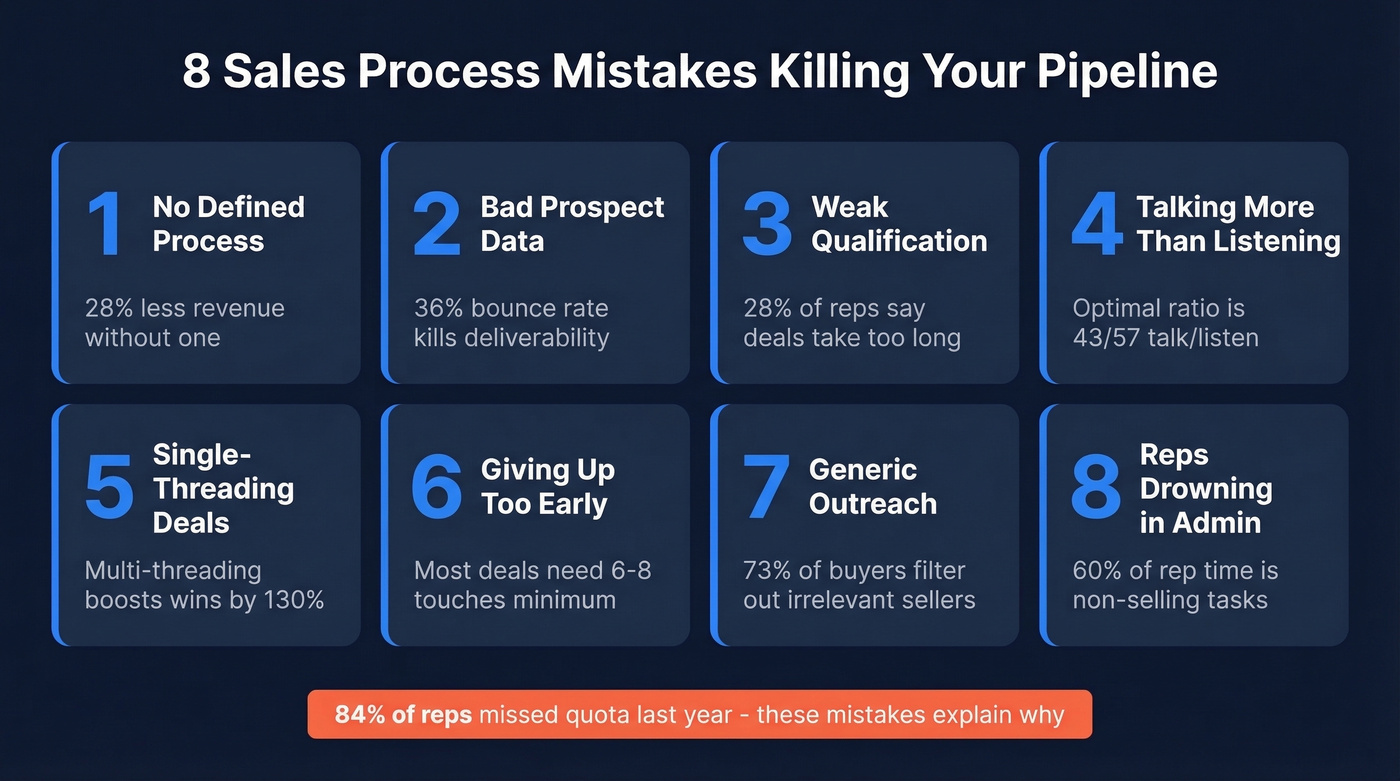
Last year, 84% of reps missed quota. Not because they weren't grinding. The problem is process - and 55% of sales teams have lost revenue because they don't have a clearly defined one. These eight sales process mistakes explain where pipelines actually break, and each comes with a concrete fix.
Quick diagnostic: If your pipeline looks full but nothing closes, start with qualification(#skipping-qualification-or-using-the-wrong-framework). If outreach gets ignored, it's a data(#prospecting-with-bad-data) or personalization(#generic-irrelevant-outreach) problem. Reps busy but unproductive? Audit their non-selling time(#letting-reps-drown-in-admin).
8 Costly Mistakes That Kill Your Quota
No Defined (or Documented) Process
Companies with a formalized sales process see up to 28% higher revenue than those running ad hoc workflows - a widely cited HBR benchmark. Yet playbook adoption at many orgs sits below 20%. The playbook exists in a Google Doc somewhere. Nobody opens it.
For most teams, the process is a black box where reps do their own thing and managers can't diagnose what's actually breaking.
The fix isn't writing a longer playbook - it's writing a shorter one. Keep it to 10-15 pages covering roughly 80% of your common sales motions. Structure it in tiers: Level 1 is what every rep needs day one, Level 2 is situational plays, Level 3 is edge cases. Then integrate it into weekly coaching, not a shared drive nobody visits.
Prospecting With Bad Data
Your SDR sends 500 emails on Monday. By Wednesday, 180 have bounced. That's a 36% bounce rate, and 79% of sales leaders say lead generation is the stage that slows deals the most. Bad data is the root cause.
Snyk's SDR team faced this exact problem - bounce rates running 35-40%, AEs wasting 4-6 hours a week on dead leads, sender domain reputation cratering. After switching to Prospeo for real-time email verification, bounces dropped to under 5% and AE-sourced pipeline jumped 180%.
If your bounce rate isn't under 5%, your data provider is usually the bottleneck - not your reps.

Skipping Qualification (or Using the Wrong Framework)
75% of B2B buyers now take longer to decide than they did in 2023, and 28% of reps say "the sales process taking too long" is the #1 reason prospects back out. That's a qualification failure. You're filling the pipe with deals that were never going to close on your timeline.
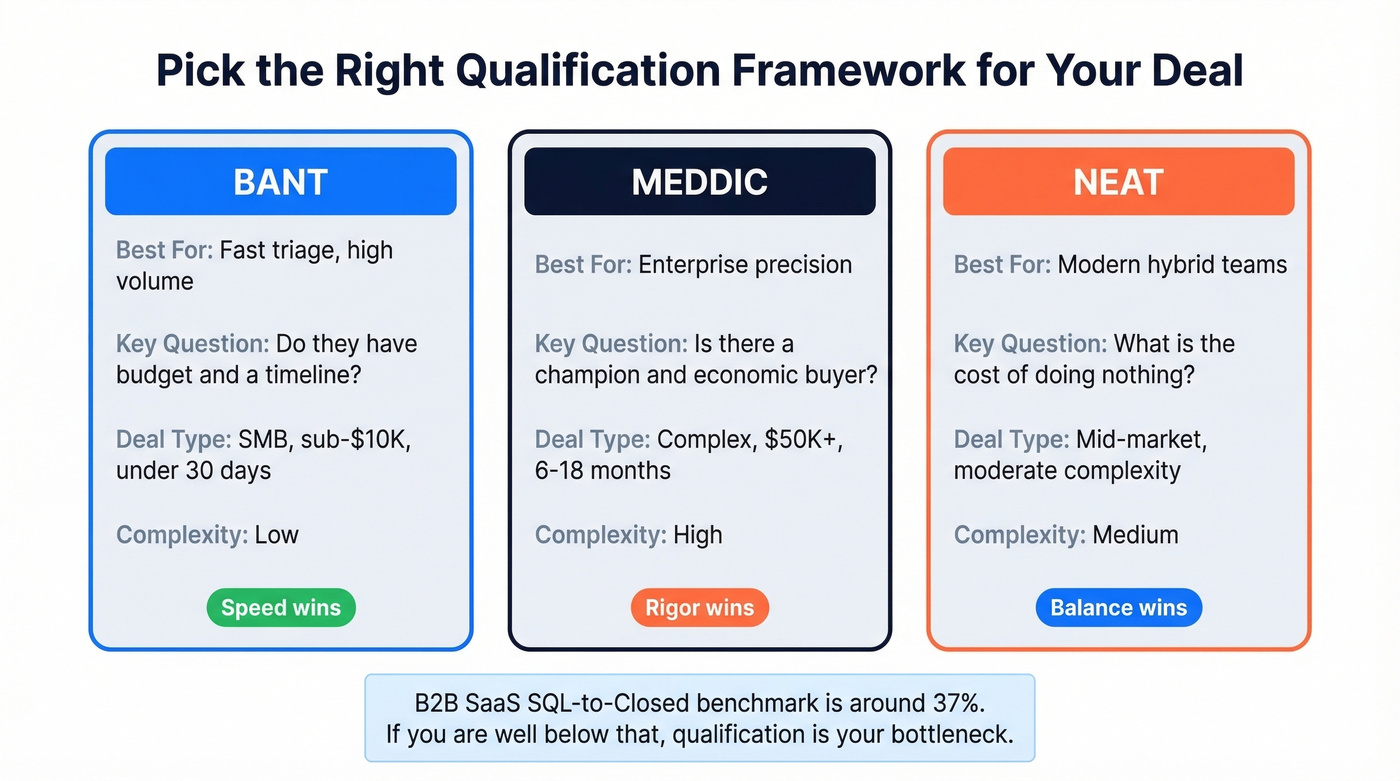
| Framework | Best For | Key Question | Deal Type |
|---|---|---|---|
| BANT | Fast triage | Budget + timeline? | SMB / sub-$10K / <30 days |
| MEDDIC | Enterprise precision | Champion + econ buyer? | Complex / $50K+ / 6-18 mo |
| NEAT | Modern hybrid | Impact of inaction? | Mid-market |
B2B SaaS SQL-to-Closed conversion benchmarks sit around 37% per First Page Sage's 2026 funnel report. If you're well below that, qualification is your bottleneck. Pick a framework. Train on it. Enforce it in deal reviews.
Talking More Than Listening
Gong's analysis of 1.8M+ sales calls puts the optimal talk/listen ratio at 43/57. But the real insight isn't the ratio - it's consistency. Low performers swing wildly between 54% talk time on won deals and 64% on lost deals. They get nervous and start pitching harder when the deal feels shaky. Top performers hold steady regardless of how the conversation is going.

Snyk cut bounce rates from 35% to under 5% and grew AE-sourced pipeline 180% - by fixing the data mistake first. Prospeo's 98% email accuracy and 7-day refresh cycle mean your reps stop wasting hours on dead leads and start filling pipeline with verified contacts.
Stop letting bad data sabotage your sales process.
One tactical fix: kill "Did I catch you at a bad time?" from your cold call opener. That phrase drops meeting-booking success by 40%. Replace it with something that earns a micro-commitment - even "How have you been?" produced a 6.6x higher success rate.
Single-Threading Your Deals
This is the silent pipeline killer. Analysis of 1.8M opportunities found that closed-won deals have 2x as many buyer contacts as closed-lost. For deals over $50K, multi-threading boosts win rates by 130%. The average buying committee is around 7 people, and strategic enterprise deals average roughly 17 contacts on the buying side.
We've seen this pattern repeatedly: a rep builds a great relationship with one champion, that champion changes roles or loses internal influence, and the deal evaporates overnight. No backup. No other relationships in the account.
The fix is systematic. After every discovery call, ask "Who else on your team would need to weigh in?" Map the org chart early. Bring your own team, too - selling teams on closed-won deals are 67% larger than on losses.
Giving Up After Follow-Up Two
Most B2B deals require 6-8 touches minimum. Larger enterprise deals can take 20+ interactions. Yet most reps tap out after one or two follow-ups because they "don't want to be annoying."
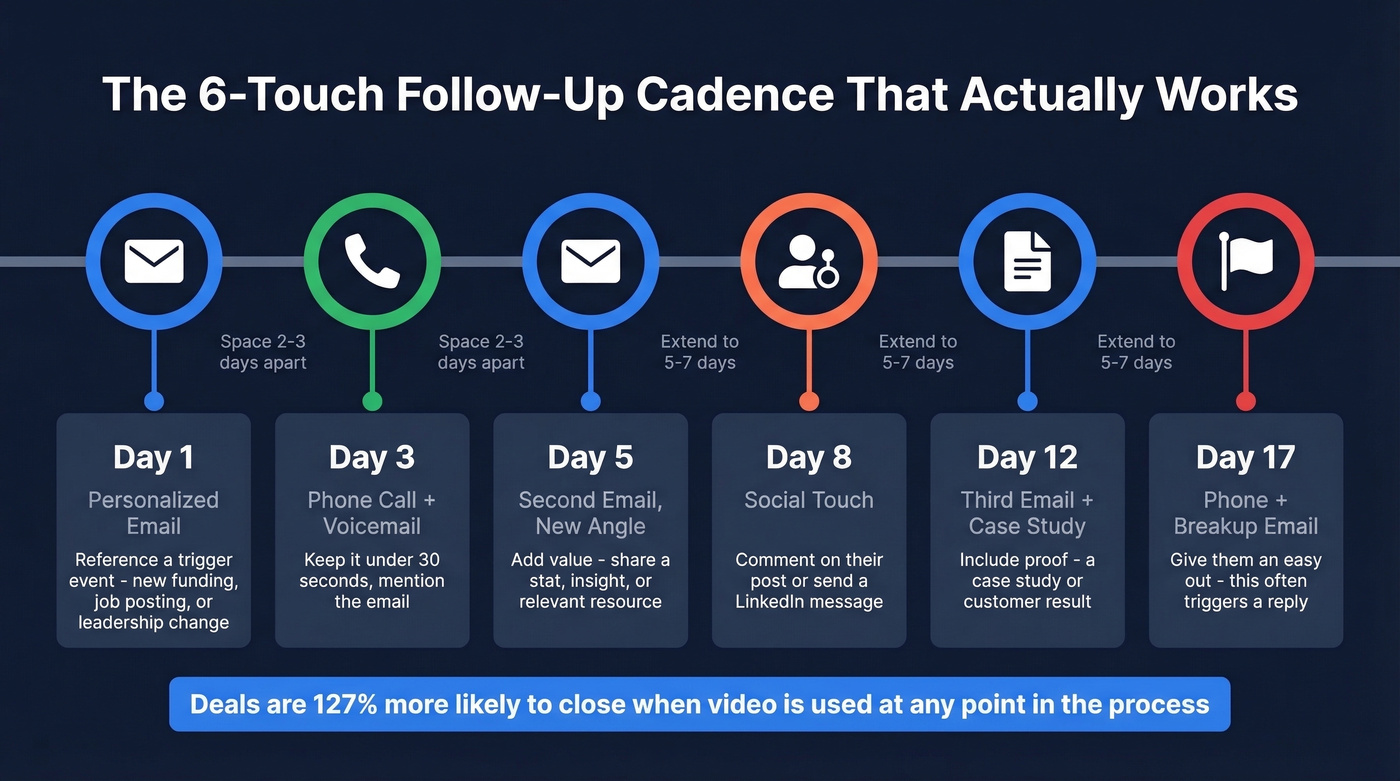
Here's the thing - persistence isn't annoying when each touch adds value. Here's a cadence that works:
- Day 1 - Personalized email referencing a trigger event
- Day 3 - Phone call + voicemail
- Day 5 - Second email, different angle, add value
- Day 8 - Social touch
- Day 12 - Third email with a case study or relevant insight
- Day 17 - Phone + breakup email
Start spacing at 2-3 days, then extend to 5-7 as the sequence progresses. Rotate channels. Deals are 127% more likely to close when video is used at any point in the process, so don't skip it.
Generic, Irrelevant Outreach
73% of B2B buyers actively avoid sellers who send irrelevant outreach. They aren't just "preferring personalization" - they're filtering you out. A first-name merge field and a company name aren't personalization anymore. That bar was cleared in 2019.
Real personalization means referencing the buyer's specific pain, their industry context, or a trigger event like new funding, a leadership change, or a job posting that signals a problem you solve. Teams that use trigger events in outreach see materially higher reply rates. If you can't personalize at volume, send fewer emails to better-targeted prospects.
Hot take: If your average deal size is under $10K, you probably don't need a 14-step personalization workflow. You need clean data, a sharp value prop, and enough volume to let the math work. Save the deep research for enterprise deals where one meeting is worth $50K+ in pipeline.
Letting Reps Drown in Admin
Reps spend 60% of their time on non-selling tasks - data entry, CRM updates, internal meetings, searching for contact info. That leaves 40% for the thing they were hired to do.
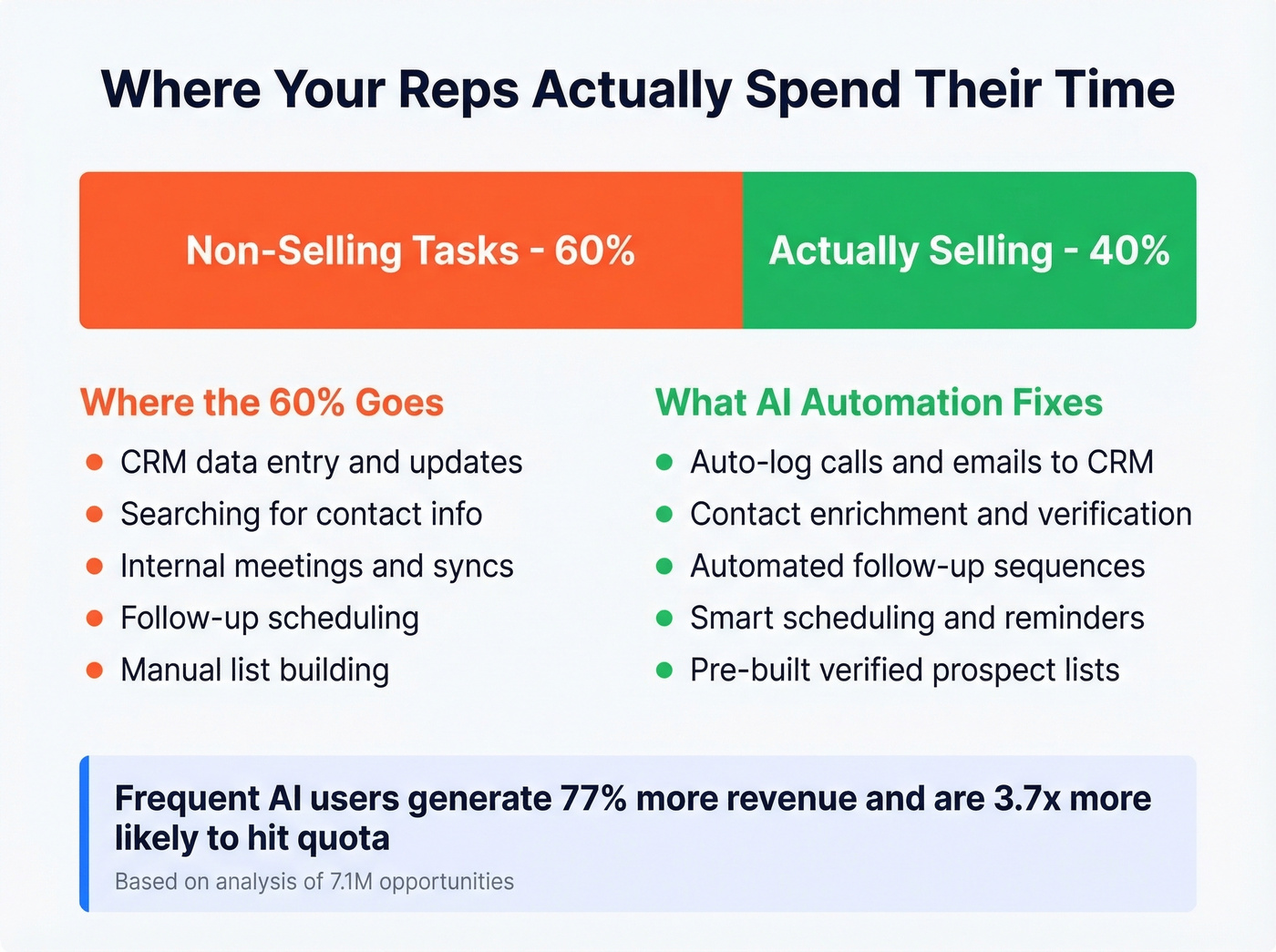
The result is sales plate spinning: reps juggling dozens of low-value tasks instead of advancing the deals that actually matter. Analysis of 7.1M opportunities found that frequent AI users generate 77% more revenue and are 3.7x more likely to meet quota. The highest-leverage automation targets are CRM data entry, follow-up scheduling, and contact enrichment - tasks that eat hours but don't require human judgment.
Eliminating this admin overhead also reduces decision fatigue, freeing reps to spend their mental energy on high-stakes choices like which deals to prioritize and how to navigate a complex buying committee. In our experience, the reps who hit quota aren't working more touches - they're working cleaner data and letting automation handle the rest.
Where to Start
You can't fix all eight at once. Let's be honest - trying to overhaul everything simultaneously is how process improvements die in committee.
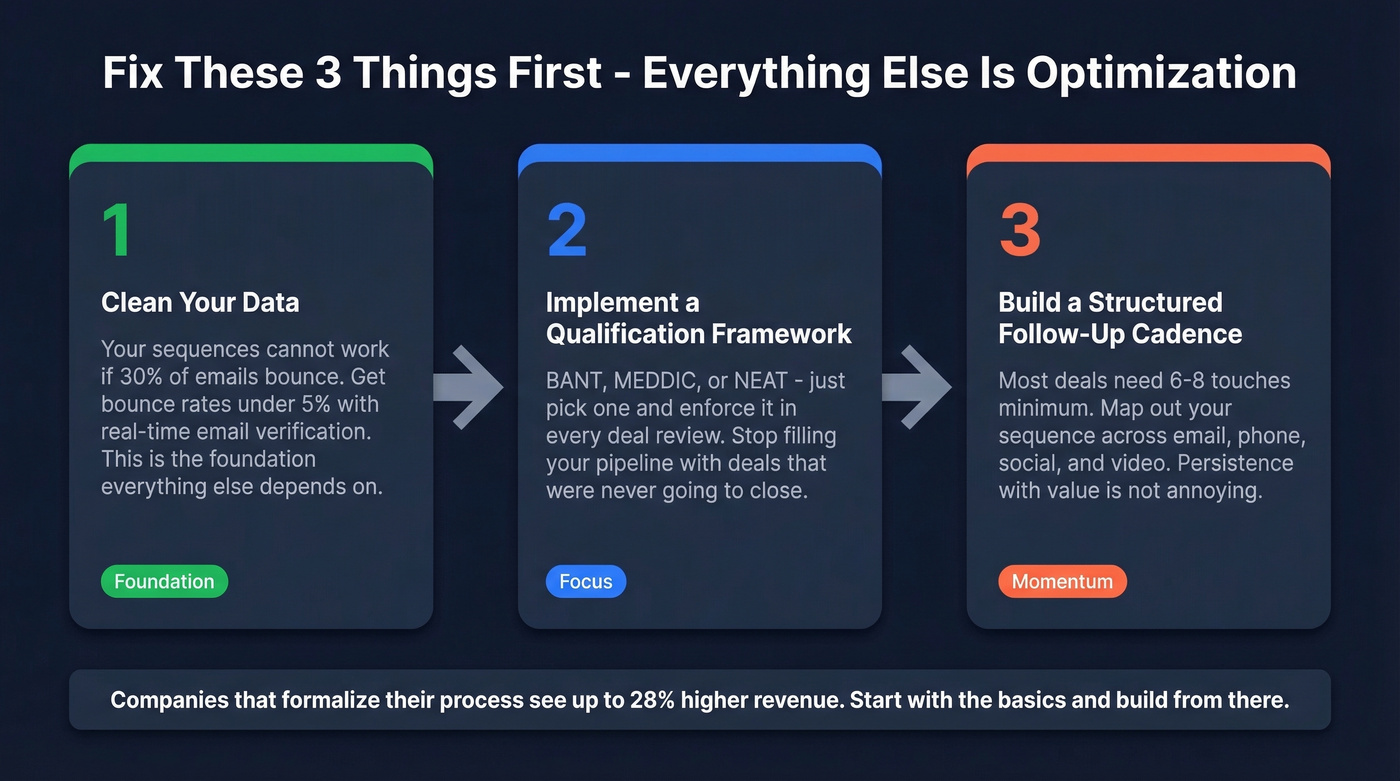
Fix three things first: clean your data (your sequences can't work if 30% of emails bounce), implement a qualification framework (BANT, MEDDIC, or NEAT - just pick one), and build a structured follow-up cadence. Everything else is optimization on top of those fundamentals.
That 84% quota miss rate isn't destiny. It's the result of fixable sales process mistakes. Companies that formalize their process see up to 28% higher revenue. Start with the basics and build from there. If you want a broader framework for tightening stages and handoffs, use a sales process optimization checklist.
Your reps spend 60% of their time on non-selling tasks - and hunting for accurate contact info is a huge chunk of that. Prospeo gives you 300M+ verified profiles with 30+ filters so reps spend minutes building lists, not hours. At $0.01 per email, fixing this mistake costs less than one lost deal.
Give your reps their selling time back.
FAQ
What's the most common sales process mistake?
Poor lead qualification. Reps fill pipelines with unqualified deals that stall indefinitely - 89% of B2B buyers report a deal stalled in the past year. Pick a framework like BANT or MEDDIC and enforce it in every deal review.
How many follow-ups does it take to close a B2B deal?
Most B2B deals require 6-8 touches across multiple channels. Start spacing at 2-3 days, then extend to 5-7 days as the sequence progresses. Enterprise deals routinely require 20+ interactions, so build cadences that account for longer timelines.
How does bad contact data hurt sales performance?
When 30-40% of emails bounce, reps waste hours chasing dead leads and destroy sender domain reputation - which tanks deliverability for your entire team. Real-time verification drops bounce rates to under 5%, giving every downstream process a clean foundation.
What tools help fix a broken sales process?
A CRM like Salesforce or HubSpot handles pipeline visibility. Conversation intelligence tools like Gong diagnose talk/listen ratios and call patterns. For data quality - the foundation everything else depends on - you need a provider with real-time verification and frequent data refresh cycles so reps aren't burning time on stale contacts.