

The 7 Sales Process Steps (With Benchmarks, Exit Criteria, and Templates)
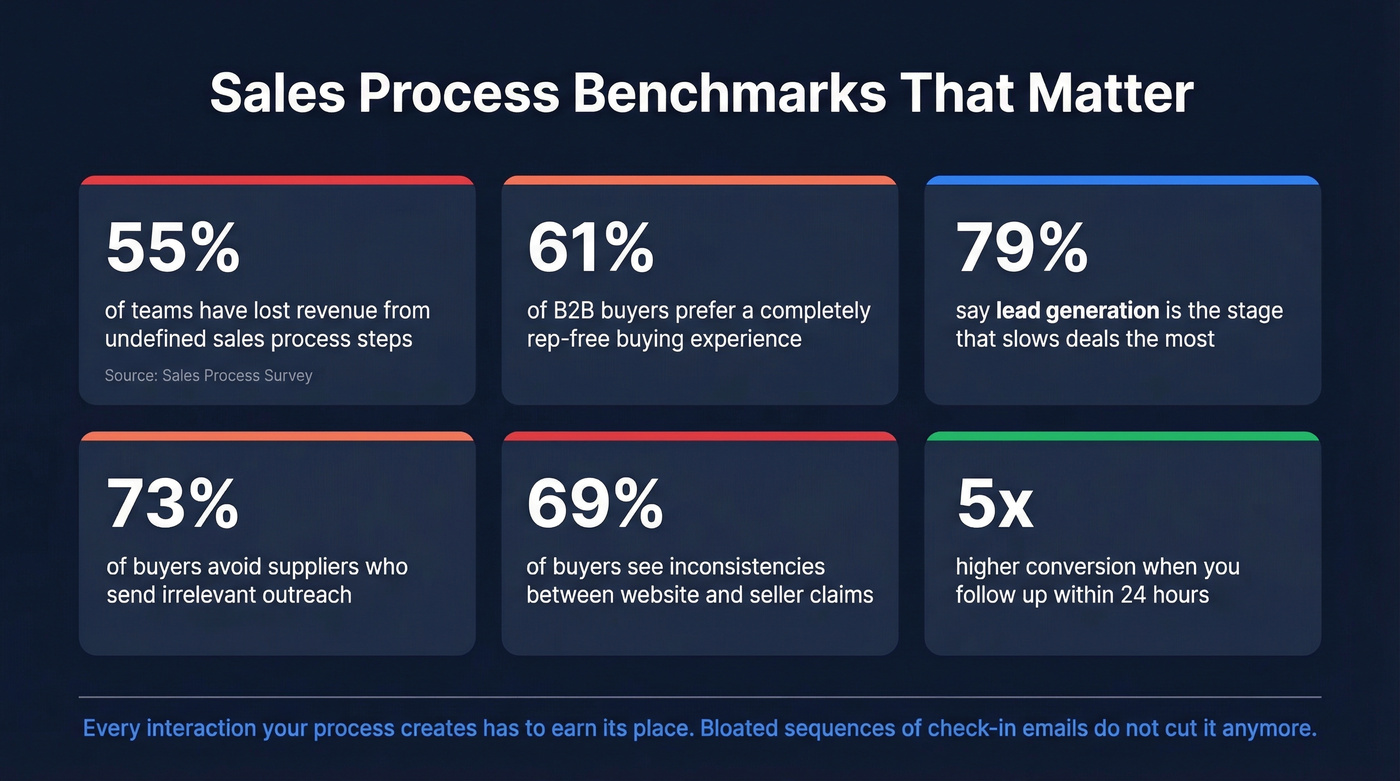
Most teams say they have a sales process. Ask them to walk through a real deal, and it becomes "well, it depends" and "we usually just figure it out." That gap between what's documented and what actually happens is where revenue dies - 55% of teams have lost revenue because they lack defined sales process steps.
Here's what makes this worse: 61% of B2B buyers now prefer a completely rep-free buying experience. Every interaction your process creates has to earn its place. A bloated, ad-hoc sequence of "let me check in" emails doesn't cut it anymore.
Most guides give you the steps and stop. This one gives you the exit criteria that make each step enforceable, the benchmarks that tell you where your funnel is leaking, and the qualification frameworks that match your deal size.
The Quick Version
Seven steps. Each one has a clear exit gate - a defined action or piece of information required before a deal moves forward.
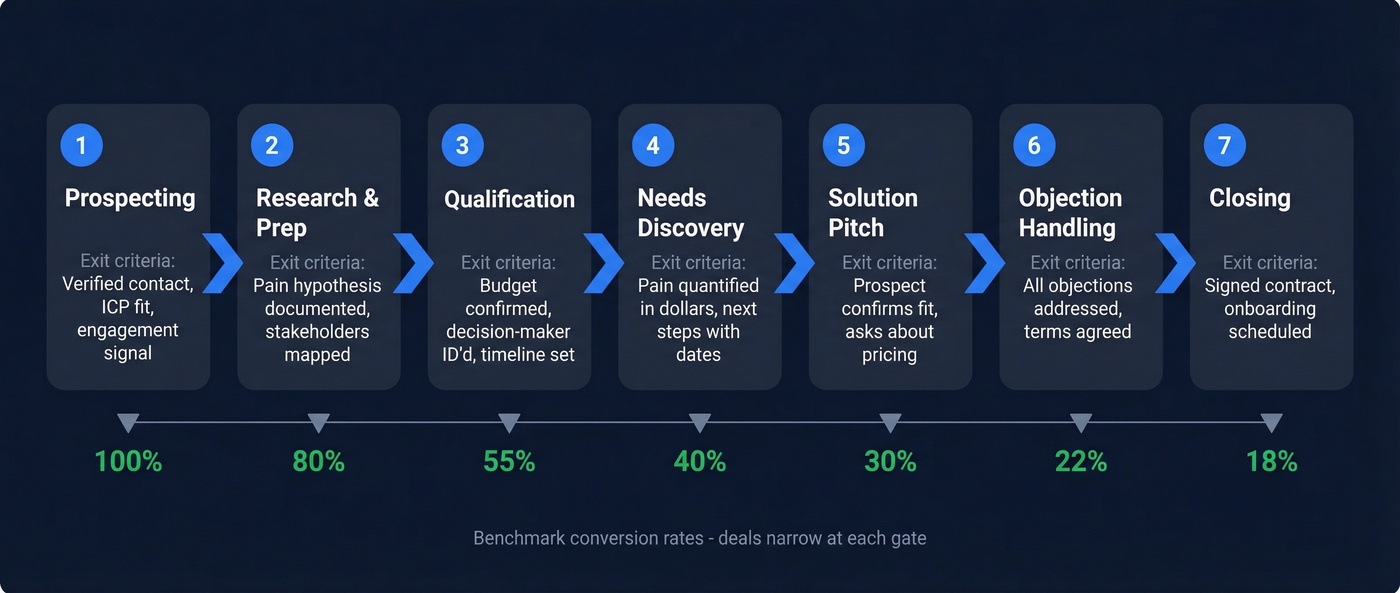
- Prospecting - find and verify the right contacts
- Research & Preparation - build a pain hypothesis before you reach out
- Qualification - apply a framework, disqualify fast
- Needs Discovery - quantify pain in dollars and time
- Presentation / Solution Pitch - tailor the demo to stated problems
- Objection Handling & Negotiation - lead with data, not pressure
- Closing - navigate procurement, get the signature
The number of steps matters far less than whether each one has exit criteria your reps actually follow. Some teams run five stages, some run eight. The teams that win are the ones where "qualified" means the same thing to every rep on the floor.
What Is a Sales Process?
Three terms get used interchangeably, and they shouldn't.
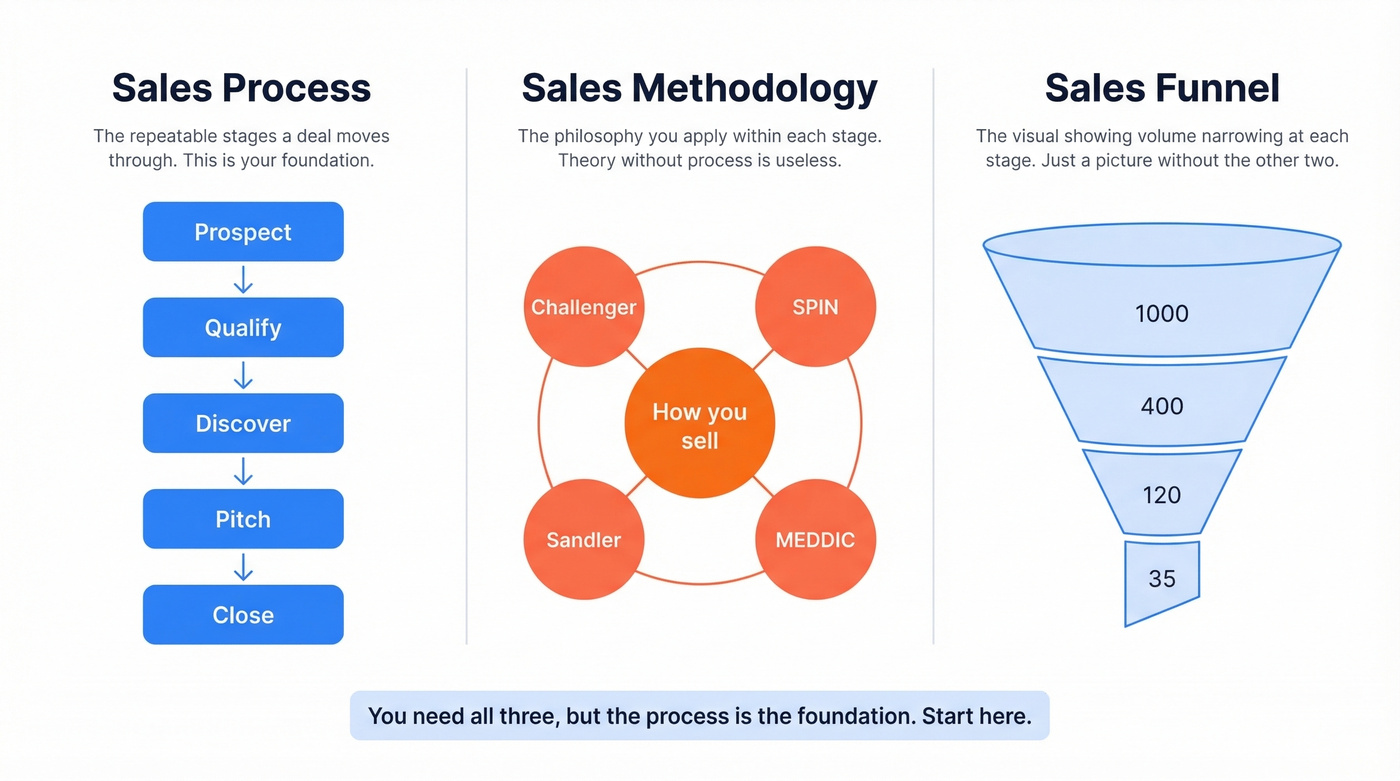
A sales process is the repeatable sequence of stages a deal moves through - from first touch to signed contract. A sales methodology is the philosophy you apply within those stages: Challenger, SPIN, Sandler, MEDDIC. A sales funnel is just the visual representation of volume narrowing at each stage.
You need all three, but the process is the foundation. Without it, methodology is just theory and your funnel is just a picture. Whether you use five steps or eight doesn't matter - the 8-step crowd separates rapport-building into its own stage, while the 5-step crowd collapses qualification and discovery. Both work. What kills deals is stages without exit criteria, where "qualified" means whatever the rep feels like it means that day.
The 7 Stages in Detail
Each step below includes the activities that matter, the exit criteria that prevent deals from slipping through, and the mistakes we see teams make repeatedly.
Step 1: Prospecting
Prospecting is where you identify and reach out to potential buyers who fit your ideal customer profile. Define your ICP, build targeted lists, run initial outreach sequences, and verify contact data before anything goes out.
Exit criteria: Verified contact info obtained, prospect fits ICP criteria, initial engagement signal received - a reply, a click, or a booked meeting.
Most teams blow this step by blasting unverified lists. 79% of sales teams say lead generation is the stage that slows deals the most, and the root cause is usually bad data, not bad messaging. Meanwhile, 73% of buyers actively avoid suppliers who send irrelevant outreach. If your list is wrong, your process is broken before it starts.
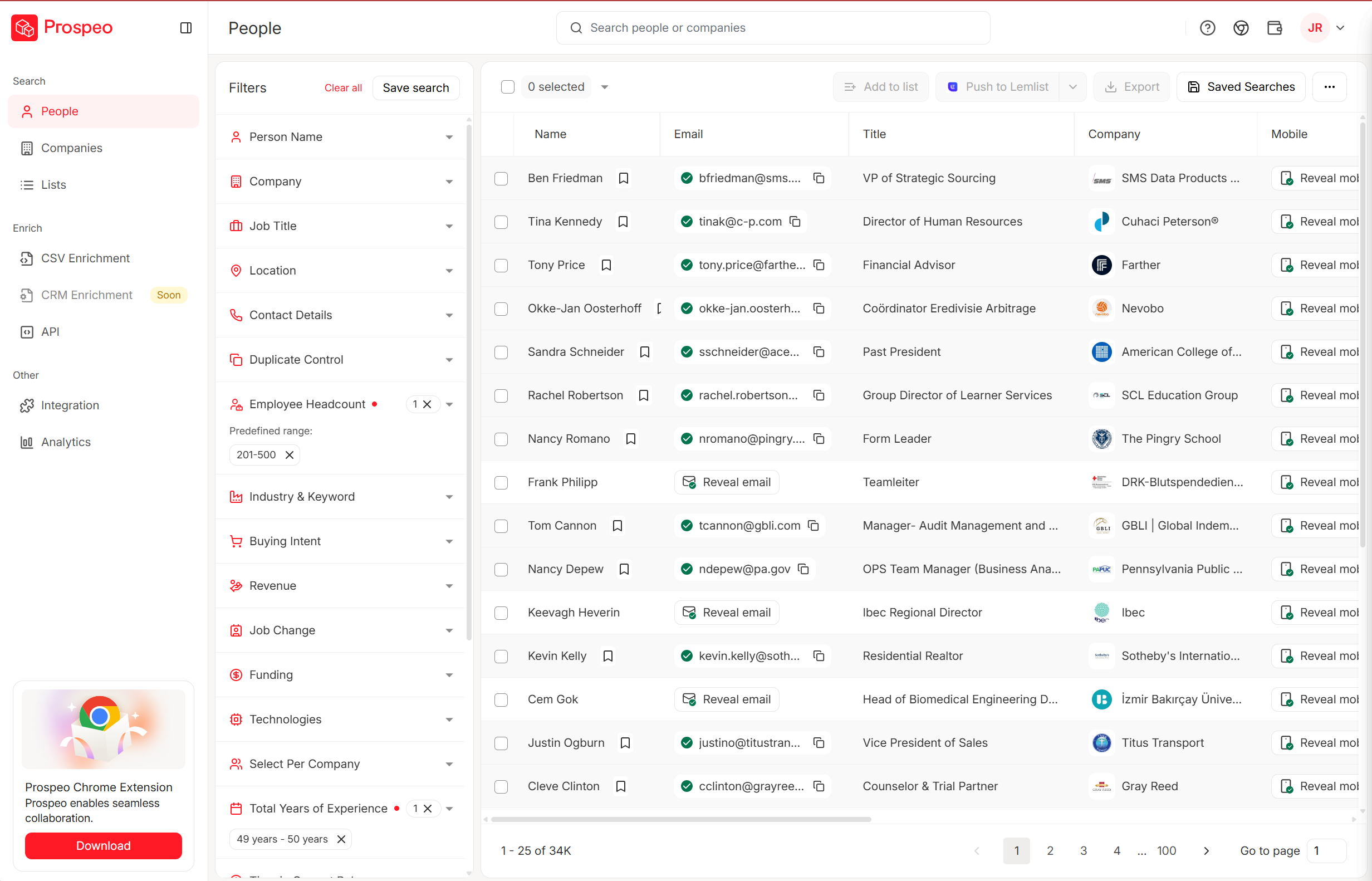
The prospecting step lives or dies on data quality. If half your emails bounce, nothing downstream matters. Prospeo's database covers 300M+ professional profiles with 98% email accuracy and a 7-day refresh cycle, which means SDRs spend time selling instead of cleaning spreadsheets.
Primary KPI: Conversations per day (dials x connect rate) and contact attempts per account.
Step 2: Research & Preparation
Before you reach out - or before that first real conversation - you need a pain hypothesis. Research the company's recent news, tech stack, hiring patterns, and competitive landscape. Map the stakeholders you'll likely encounter. Build a personalized talk track that references something specific to their situation.
Exit criteria: Pain hypothesis documented, key stakeholders identified, personalized talk track ready.
Here's the thing: reps skip this step constantly and default to a generic script. In our experience, 3 minutes of research per prospect is the sweet spot - enough to personalize, not enough to slow your cadence. Glance at their hiring page, their latest earnings call, or their tech stack before you pick up the phone.
Primary KPI: Percentage of outreach personalized to specific, documented pain points.
Step 3: Qualification
Qualification is where you apply a structured framework - BANT, MEDDIC, SPICED, CHAMP - to determine whether this deal deserves your pipeline. Run discovery questions against framework criteria, score the opportunity, and make a go/no-go decision. This is the stage where most teams either build a real pipeline or fill their CRM with wishful thinking.
Exit criteria: Framework criteria met - budget confirmed, decision-maker identified, timeline established, need validated. If any are missing, the deal doesn't advance.
We've seen teams with 300 "opportunities" in their pipeline where fewer than 40 have a confirmed budget and an identified decision-maker. That's not a pipeline. It's a wish list.
One distinction that separates good teams from great ones: a champion shares internal information, maps the org chart, and brings detractors to the table. If your contact isn't doing that, they're a fan, not a champion. Fans feel good. Champions close deals.
Primary KPI: SQL conversion rate (SQLs / MQLs).
Step 4: Needs Discovery
Forget the definition - here's the discovery call structure that actually works:
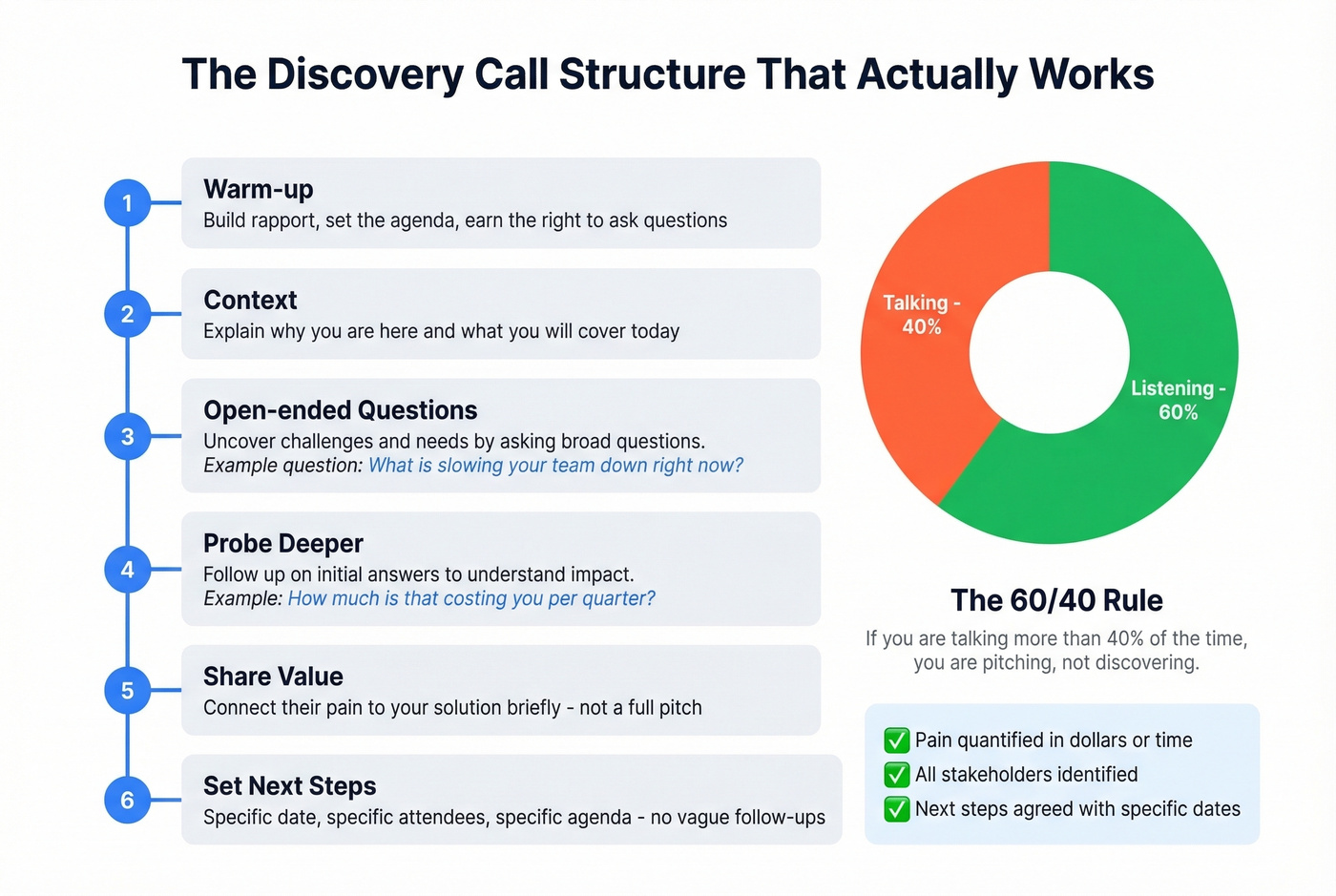
- Warm-up - build rapport, set the agenda
- Context - explain why you're here and what you'll cover
- Open-ended questions - "What's slowing your team down right now?"
- Probe deeper - "How much is that costing you per quarter?"
- Share value - connect their pain to your solution briefly
- Set next steps - specific date, specific attendees, specific agenda
The goal isn't to pitch. It's to quantify pain in dollars and time, identify all stakeholders who'll influence the decision, and agree on next steps with specific dates attached.
Exit criteria: Pain quantified in dollars or time, all stakeholders identified, next steps agreed with specific dates.
A widely recommended rule of thumb is a 60/40 split in favor of listening - if you're talking more than about 40% of the time, you're pitching, not discovering.
Primary KPI: Discovery-to-proposal conversion rate.
Step 5: Presentation / Solution Pitch
69% of buyers report inconsistencies between what a company's website says and what the seller tells them. If your demo contradicts your marketing site, you've destroyed trust in 30 minutes.
Everything you show should map directly to the pain they articulated in discovery. Build an ROI case using their numbers, not yours. Generic feature tours are where deals go to die.
Exit criteria: Prospect confirms the solution addresses their stated pain and asks about implementation or pricing.
A "good process" from the buyer's side feels predictable: helpful collateral that isn't distracting, a presentation focused on the buyer's specific problem, and clear next steps before every meeting. That's the bar.
Primary KPI: Demo-to-proposal rate.
Step 6: Objection Handling
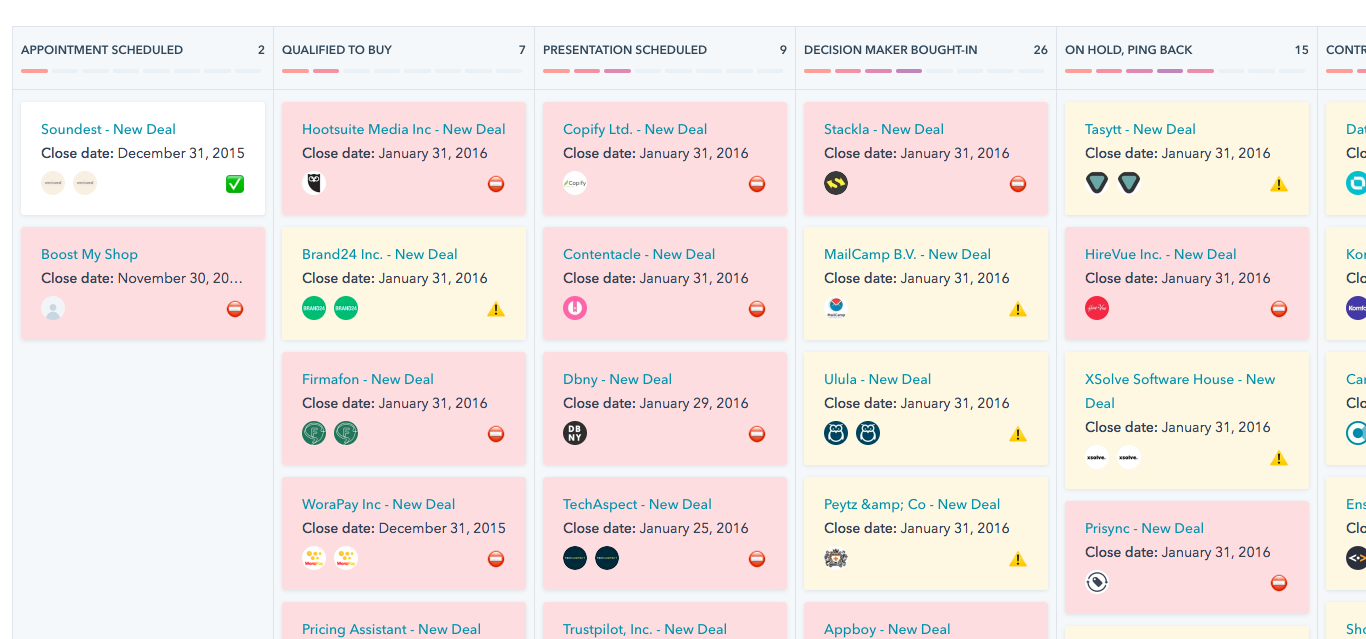
One HubSpot case study documented a team that replaced urgency-based CTAs with data-backed proposals and tailored value maps. The result: a 20% win rate lift over two quarters. Trust-first selling isn't just ethical - it converts better.
Anticipate objections before they come up. Prepare data-backed responses for the top five objections your team hears most frequently. Negotiate terms with a clear understanding of your walk-away point. The worst thing a rep can do here is resort to fake scarcity and aggressive urgency - buyers see through it instantly, and it poisons the relationship.
Exit criteria: All stated objections addressed, commercial terms agreed in principle.
Primary KPI: Proposal-to-close rate.
Step 7: Closing
Closing is procurement navigation, final proposal delivery, contract execution, and onboarding scheduling. Enterprise deals commonly involve 7-10 stakeholders. Introduce a Mutual Action Plan early - not at contract stage - to prevent stalls and keep every stakeholder aligned on timelines.
Exit criteria: Signed contract, onboarding scheduled.
The mistake that kills enterprise deals is speaking to the wrong stakeholders at close. If you've been selling to a director for three months and procurement needs VP sign-off, you've wasted a quarter. Multi-threading earlier in the process prevents this entirely.
Primary KPI: Win rate and sales cycle length.
Bonus: Post-Sale Follow-Up
Follow up within 24 hours of key moments like signature, onboarding kickoff, and first value milestone. Aggregated client data from MarketJoy shows that contacting leads within 24 hours can increase conversion by 5x. Set a review cadence at 30, 60, and 90 days, and identify expansion opportunities before the renewal conversation.
Exit criteria: Onboarding complete, first value milestone achieved, expansion conversation scheduled.
Primary KPI: Retention rate and expansion revenue.
Which Qualification Framework?
Let's settle this. BANT is a pre-filter, not a qualification system. It works for transactional deals where the buyer already knows what they want. Stop using it for enterprise.
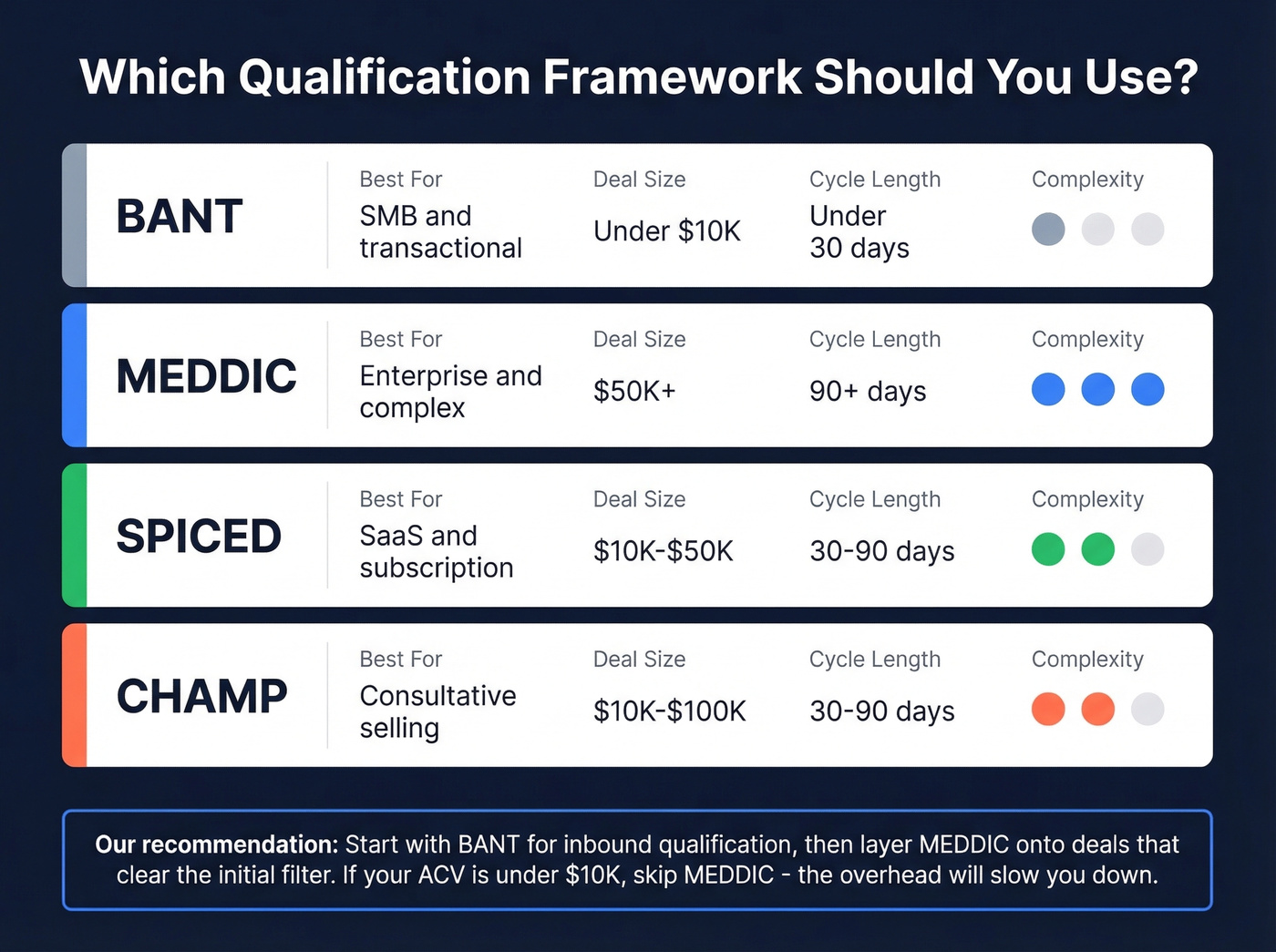
| Framework | Best For | Deal Size | Cycle Length | Complexity |
|---|---|---|---|---|
| BANT | SMB / transactional | Under $10K | Under 30 days | Low |
| MEDDIC | Enterprise / complex | $50K+ | 90+ days | High |
| SPICED | SaaS / subscription | $10K-$50K | 30-90 days | Medium |
| CHAMP | Consultative selling | $10K-$100K | 30-90 days | Medium |
BANT vs. MEDDIC vs. SPICED comes down to deal complexity. If your average deal is under $10K with a sub-30-day cycle, BANT keeps things moving. Once you're above $50K with 90+ day cycles and multiple stakeholders, you need MEDDIC or MEDDPICC - the added "Paper Process" and "Competition" dimensions prevent late-stage surprises.
SPICED fits SaaS and subscription models where ongoing value matters more than one-time budget approval. CHAMP flips the script by starting with challenges instead of budget, which works well for consultative discovery where the buyer doesn't yet know what they need to spend.
Our take: most teams should start with BANT for inbound qualification and layer MEDDIC onto deals that clear the initial filter. If your average contract value is under $10K, you probably don't need MEDDIC at all - the overhead will slow you down more than the rigor helps.

Your sales process breaks at Step 1 when contact data is wrong. Prospeo's 300M+ profiles with 98% email accuracy and a 7-day refresh cycle mean your SDRs spend time selling - not cleaning bounced lists.
Stop losing deals before your process even starts.
Pipeline Conversion Benchmarks
Here's where most articles on this topic get vague. Let's put numbers on it.
Average Pipeline Conversion Rates
| Stage Transition | Benchmark Rate |
|---|---|
| Lead to MQL | 22% |
| MQL to SQL | 15% |
| SQL to Opportunity | 11% |
| Opp to Closed-Won | 7% |
The biggest drop-off is MQL to SQL. That 15% conversion means 85% of your marketing-qualified leads never become sales-qualified. The root cause is almost always bad data - stale contacts, wrong titles, bounced emails. If your contact database refreshes every six weeks, you're prospecting with outdated information by the time reps follow up.
Industry benchmarks tell a different story depending on your vertical:
Industry-Specific Benchmarks
| Industry | Lead to MQL | MQL to SQL | SQL to Opp | SQL to Closed |
|---|---|---|---|---|
| B2B SaaS | 39% | 38% | 42% | 37% |
| Cybersecurity | 24% | 40% | 43% | 46% |
| Manufacturing | 26% | 41% | 46% | 51% |
Notice how manufacturing has the highest SQL-to-Closed rate at 51% but one of the lowest Lead-to-MQL rates. That's because manufacturing deals self-select hard - fewer leads enter the funnel, but the ones that do are serious. If your numbers are significantly below these benchmarks at any stage, that's where your process needs surgery.
Adapt Your Process by Deal Size
Your seven steps don't change, but the weight you put on each one does.
| Dimension | SMB | Enterprise |
|---|---|---|
| ACV | $1.2K-$25K | $50K-$500K+ |
| Cycle Length | 1-4 weeks | 6-18 months |
| Stakeholders | 1-3 | 7-10 |
| Qualification | BANT | MEDDIC/MEDDPICC |
| Key Difference | Speed + self-serve | Multi-threaded + MAP |
For SMB deals, keep it fast and frictionless. Self-serve demos, quick qualification, minimal back-and-forth - the buyer often is the decision-maker. For enterprise, every step gets heavier. Discovery might take three calls instead of one. You'll need a Mutual Action Plan tracking timelines across procurement, legal, IT security, and the economic buyer. Introduce the MAP during qualification, not when you're already trying to close.
Skip the enterprise playbook if your average deal is under $15K. The overhead isn't worth it - you'll spend more time on process than on selling.
KPIs to Track at Each Stage
Every stage needs a number attached to it. Otherwise you're flying blind.
| Stage | Primary KPI | Formula / Definition |
|---|---|---|
| Prospecting | Conversations/day | Dials x connect rate |
| Qualification | SQL conversion rate | SQLs / MQLs |
| Discovery | Discovery-to-proposal | Proposals sent / discovery calls |
| Presentation | Demo-to-proposal | Proposals / demos |
| Closing | Win rate | Closed-won / total opps |
| Post-Sale | Expansion revenue | Upsell + cross-sell revenue |
The metric that ties everything together is pipeline velocity: (number of opportunities x average deal size x win rate) / average sales cycle length. This single number tells you how fast revenue moves through your funnel. If velocity drops, one of those four variables changed - and your stage-by-stage KPIs will tell you which one.
Don't track everything. Pick one primary KPI per stage, review it weekly, and dig into the underlying metrics only when the primary number moves.
How to Build Your Process
Look, the gap isn't knowing the sales process steps. It's getting reps to follow them. 51% of teams report improved forecast accuracy after implementing a structured process - but "implementing" means more than a PDF in the shared drive.
Map stages into your CRM with required fields and exit criteria. Every CRM stage should have a clear name, a set of required fields like a "Budget Confirmed" checkbox and a "Decision Maker" contact link, and an exit gate that prevents advancement without the data. Pipedrive's process mapping guide has a solid starter template for this. Teams consistently increase adoption when exit criteria are embedded as required CRM fields rather than buried in a playbook PDF.
Surface guidance inside the tools reps use daily. If your process lives in a wiki or a Notion doc, it's already dead. Embed stage-specific prompts, required questions, and next-step suggestions directly in your CRM or sequencer. Reps don't go looking for process docs - the process has to come to them. HubSpot's sales process documentation walks through how to set this up in their CRM, and the principles apply to any platform.
Review and update quarterly. Buyer behavior shifts. Your conversion rates will tell you when a stage is broken. Build a quarterly process review into your RevOps calendar and treat it like a product sprint - identify the weakest stage, hypothesize a fix, test it, measure. The consensus on r/sales is that even a basic process with enforced exit criteria will outperform a sophisticated one that nobody follows, and we've found that to be true across every team we've worked with.
The teams that win aren't the ones with the fanciest process diagram. They're the ones where every rep can walk you through a real deal, stage by stage, and tell you exactly what happened at each gate. Salesforce's State of Sales report backs this up - structured processes correlate with higher win rates across every segment they measured.
Research and qualification require real data - tech stack, hiring signals, verified decision-maker contacts. Prospeo gives you 30+ search filters, intent data across 15,000 topics, and direct dials with a 30% pickup rate.
Give every sales process step the data it actually needs.
FAQ
How many steps should a sales process have?
Most teams use 5-8 steps. The exact number matters less than having clear exit criteria at each stage. A five-step process with strict gates outperforms an eight-step process where reps skip stages at will. Start with seven and adjust based on your deal complexity and cycle length.
What's the difference between a sales process and a methodology?
A sales process is the sequence of stages a deal moves through, from prospecting to closing. A methodology - Challenger, SPIN, MEDDIC - is the approach used within those stages. The process is the track; the methodology is how you run on it. You need both.
How often should you update your process?
Review quarterly at minimum. Update when conversion rates drop at a specific stage, when your buyer persona shifts, or when you enter a new market segment. 51% of teams report improved forecast accuracy after implementing a structured process, so the investment pays off.
What's the biggest bottleneck in most pipelines?
Lead generation - 79% of sales teams say it slows deals the most, usually because reps work with unverified or stale contact data. A weekly data refresh cycle and high email accuracy eliminate this bottleneck before it compounds downstream.
Which qualification framework should I use?
BANT for transactional deals under $10K with sub-30-day cycles. MEDDIC for complex deals over $50K with 90+ day cycles and multiple stakeholders. SPICED for SaaS models where ongoing value matters more than one-time budget approval. Layer MEDDIC onto deals that clear an initial BANT filter.