

How to Generate Pipeline When Everything You've Tried Isn't Working
84% of sales reps missed quota last year. Buyers spend just 17% of their time meeting suppliers, and 36% of B2B tech companies cut SDR headcount in the past twelve months. If you're still running the same playbook you used in 2022, you're fighting a losing battle against buyers who've learned to ignore anything that looks like spray-and-pray outreach.
Here's the thing: most pipeline problems aren't tactics problems. They're data problems dressed up in a targeting costume. We've watched teams overhaul their sequences, rewrite their copy, hire consultants - and still miss quota because a third of their list was bouncing. Let's break down what actually works.
The Pipeline Math You Can't Skip
Say your quarterly quota is $500K. Using a generous 25% win rate - the B2B average is closer to 21%, so adjust downward if that's you - you need $2M+ in pipeline. That's a 4x coverage ratio. If your average deal is $50K, that means 40 opportunities. If 30% of meetings convert to opportunities, you need roughly 130 meetings. And if 2-3% of prospects agree to a meeting, you're looking at 4,000-6,500 well-targeted prospects per quarter.
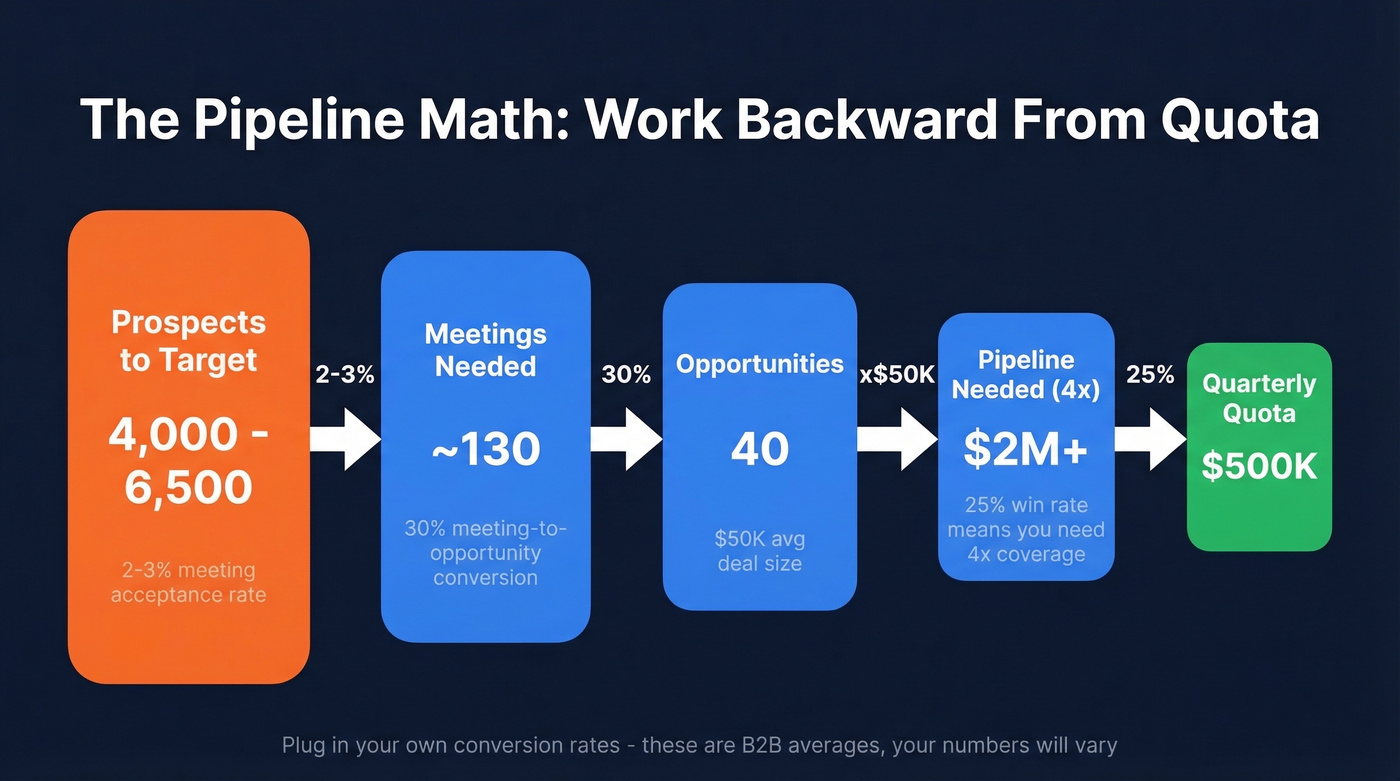
These numbers shift by industry. In B2B SaaS, about 39% of leads become MQLs and roughly 37% of SQLs convert to Closed Won. Plug your industry's actual conversion rates into this model before you build anything - the standard 3-5x pipeline coverage guidance assumes you know your own funnel, and most teams don't until they sit down and calculate it.
Five Tactics That Actually Work
1. Fix Your Data First
B2B contact data decays 22-30% per year. In high-turnover industries, that number hits 70%. Bad data doesn't just mean bounced emails - reps waste 546 hours per year dealing with it, chasing contacts who've changed jobs and dialing numbers that ring into nothing.
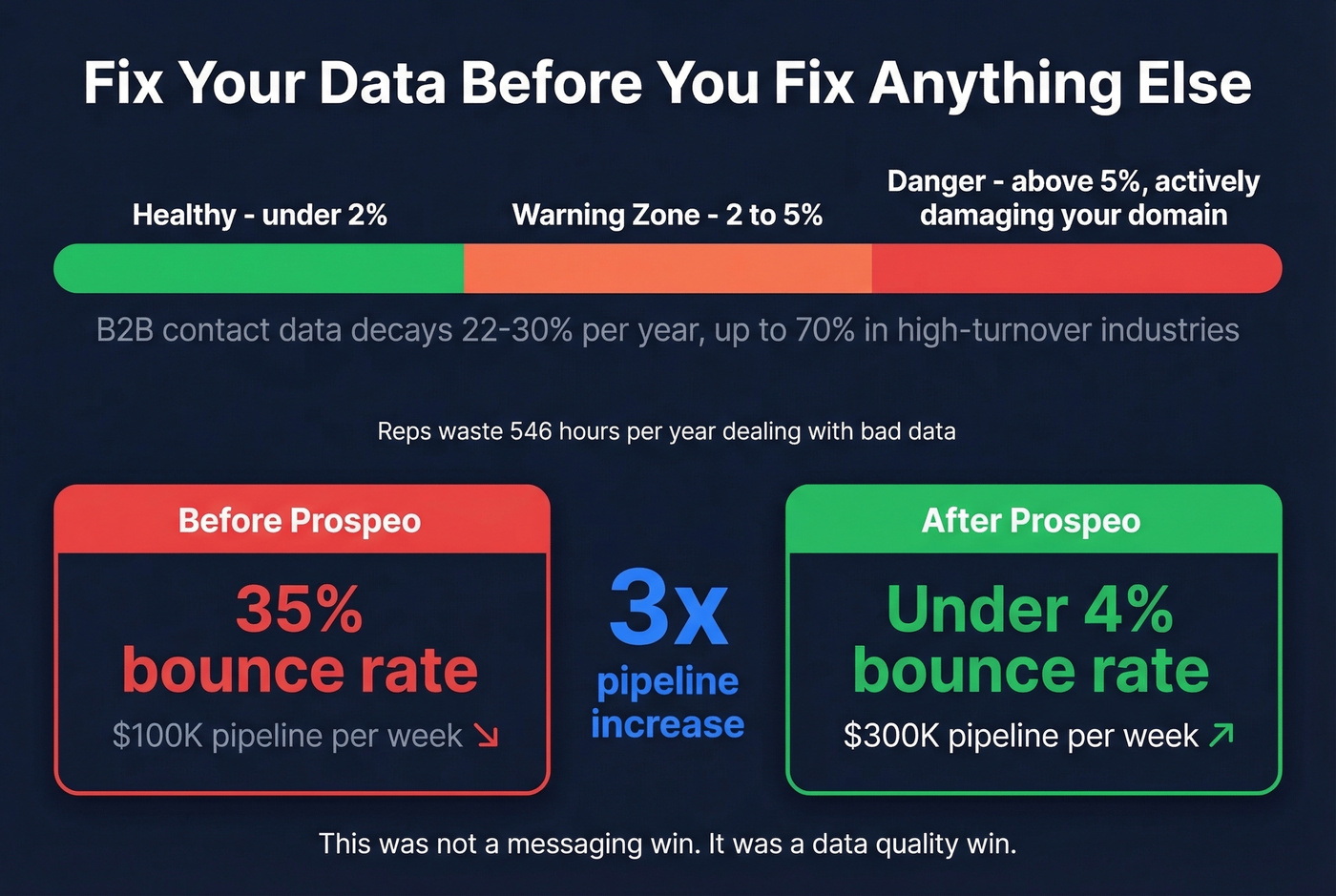
We've seen this pattern over and over: teams blame their sequences when the real problem is a third of their list has bounced. If your bounce rate is above 5%, you're actively damaging your sending domain. Below 2% is healthy. Anything in between is a warning sign you can't afford to ignore. (If you want benchmarks and fixes, start with bounce rate and the full email deliverability checklist.)
Meritt experienced this firsthand - after switching to Prospeo for verified contact data, their bounce rate dropped from 35% to under 4%, and pipeline tripled from $100K to $300K per week. That wasn't a messaging win. It was a data quality win.
2. Run Multi-Channel Cadences
The effective cadence in 2026 is 6-8 touchpoints over 2-3 weeks across multiple channels. Cognism's internal data shows their outbound teams run a 55% phone / 30% social / 15% email split, and SDRs using verified contact data hit a 13.3% cold-call answered rate - nearly matching AEs calling warm leads at 14.4%.
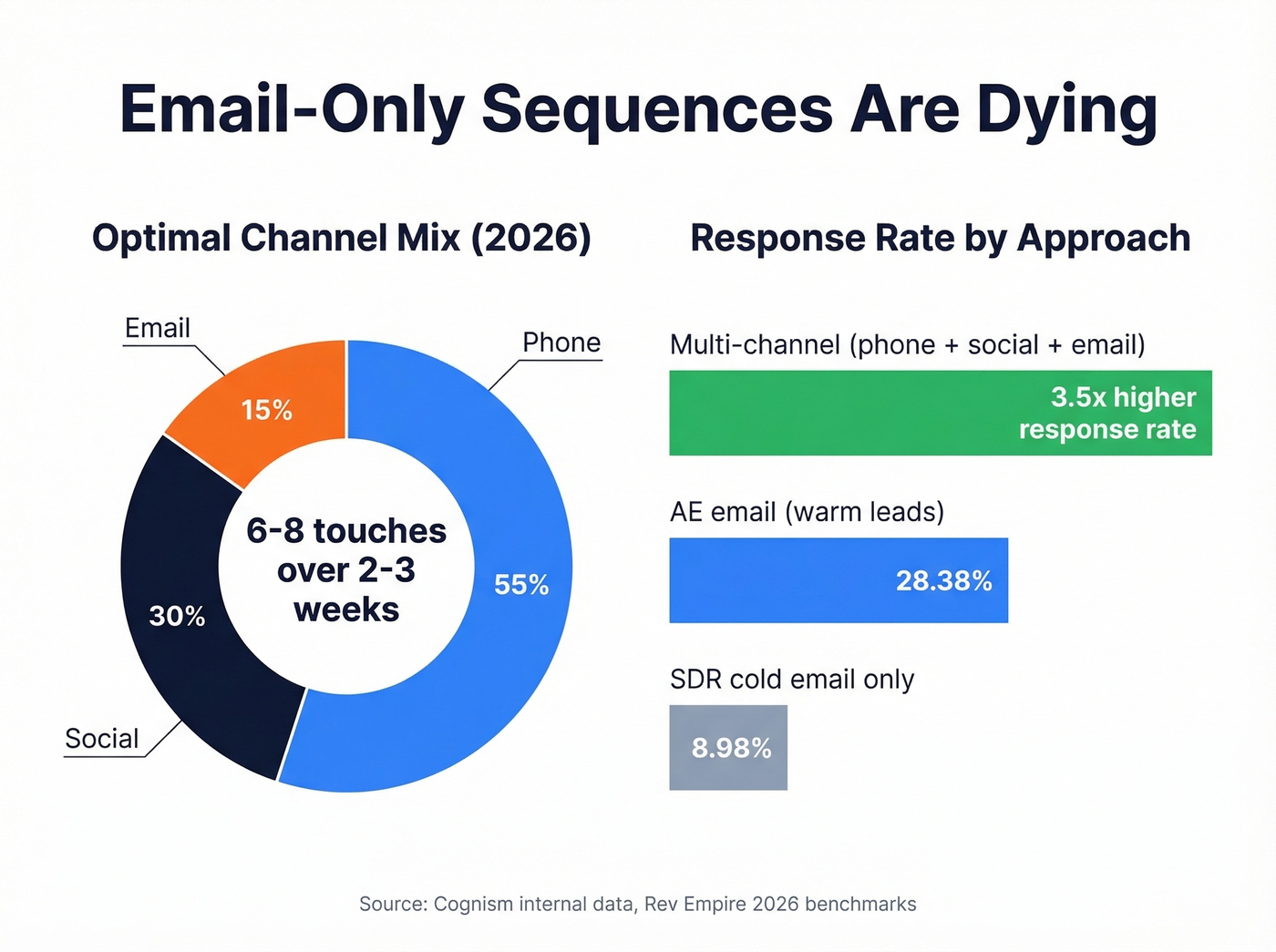
Email-only sequences are dying. Inboxes are flooded, reply rates keep dropping, and buyers ignore anything that smells like a template. AE email reply rates average 28.38% while SDR cold emails sit at 8.98%. The difference isn't writing skill - it's that warm, signal-driven outreach outperforms cold blasts by a factor of three. If you need a refresher on what to run, start with sales prospecting techniques and sequence management.
For teams that don't have budget for a full multi-channel platform, start simple: email to open the door, a phone call the next day referencing the email, then a social touch two days later. That three-channel loop alone produces 3.5x higher response rates than email-only sequences. (Also worth tightening: follow-up templates and cold email follow-up templates.)
3. Target Signals, Not Lists
Only 3-5% of your total addressable market is actively buying at any given time. The other 95% isn't ignoring you because your copy is bad. They just don't have the problem yet. If your ICP is fuzzy, fix it first with an ideal customer profile.
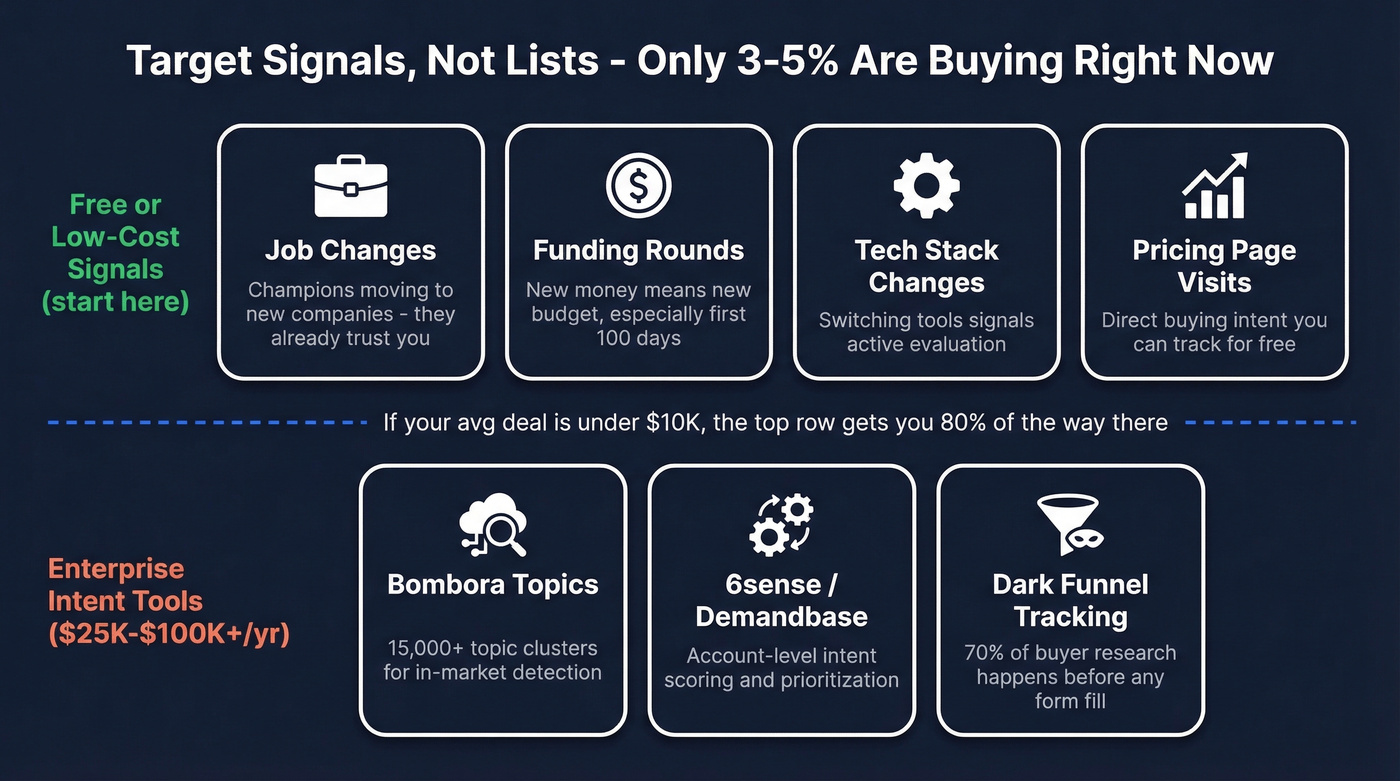
Up to 70% of the buyer journey happens in the "dark funnel" - untracked research before anyone fills out a form. Signal-based selling means watching for pricing page visits, job changes, funding rounds, and tech stack shifts, then reaching out when the timing is right. To operationalize this, use a simple framework for identifying buying signals and a process for tracking sales triggers.
If your average deal size is below $10K, you probably don't need a $50K intent data platform. Job changes and funding rounds are free signals that get you 80% of the way there. Start with 2-3 high-impact signals and build plays around each one before investing in enterprise intent tools.
4. Reactivate Closed-Lost Deals
Replace "Closed Lost" in your CRM with "Closed Lost - Nurture." This comes from the Predictable Revenue co-founder's playbook, and it works because it keeps dead deals visible instead of burying them in a graveyard tab nobody opens.
Alumni champions - people who bought from you at a previous company - are the warmest pipeline source most teams aren't working. New executives spend 70% of their budget in their first 100 days. When a champion changes jobs, that's your window. They already trust you, they already know the product, and they're actively spending money. Skip this tactic if your ACV is under $5K and your churn is high - the math won't work. But for mid-market and enterprise deals, closed-lost reactivation is one of the fastest paths to new opportunities without increasing top-of-funnel spend.
5. Create Content That Generates Signals
Demand gen in 2026 isn't about gating a whitepaper and calling the download a "lead." The allbound framework integrates inbound and outbound into one system: demand gen creates signals, a scoring engine filters and enriches them, and outbound follows up with relevant, personalized outreach. If you're building this system, align it with lead scoring so sales works the right accounts first.
33% of buyers prefer a completely seller-free experience. Your content needs to do the selling before your reps ever get involved. The consensus on r/sales is that ungated, genuinely useful content builds more pipeline than gated assets with inflated download numbers - and the data backs that up. When someone reads your breakdown of a problem they're actively facing, they remember your name when budget opens up.

You just did the pipeline math: 4,000-6,500 prospects per quarter, and every bounce shrinks that funnel. Prospeo delivers 98% email accuracy with a 7-day refresh cycle - so the contacts you're building plays around actually connect. Meritt tripled pipeline from $100K to $300K/week after switching.
Stop blaming your sequences when your data is the problem.
Pipeline Mistakes That Kill Your Numbers
Misaligned sales-marketing handoffs. If marketing's MQLs don't match sales' definition of "qualified," you're generating pipeline that goes nowhere. Fix this with shared SLAs tied to revenue, not volume.
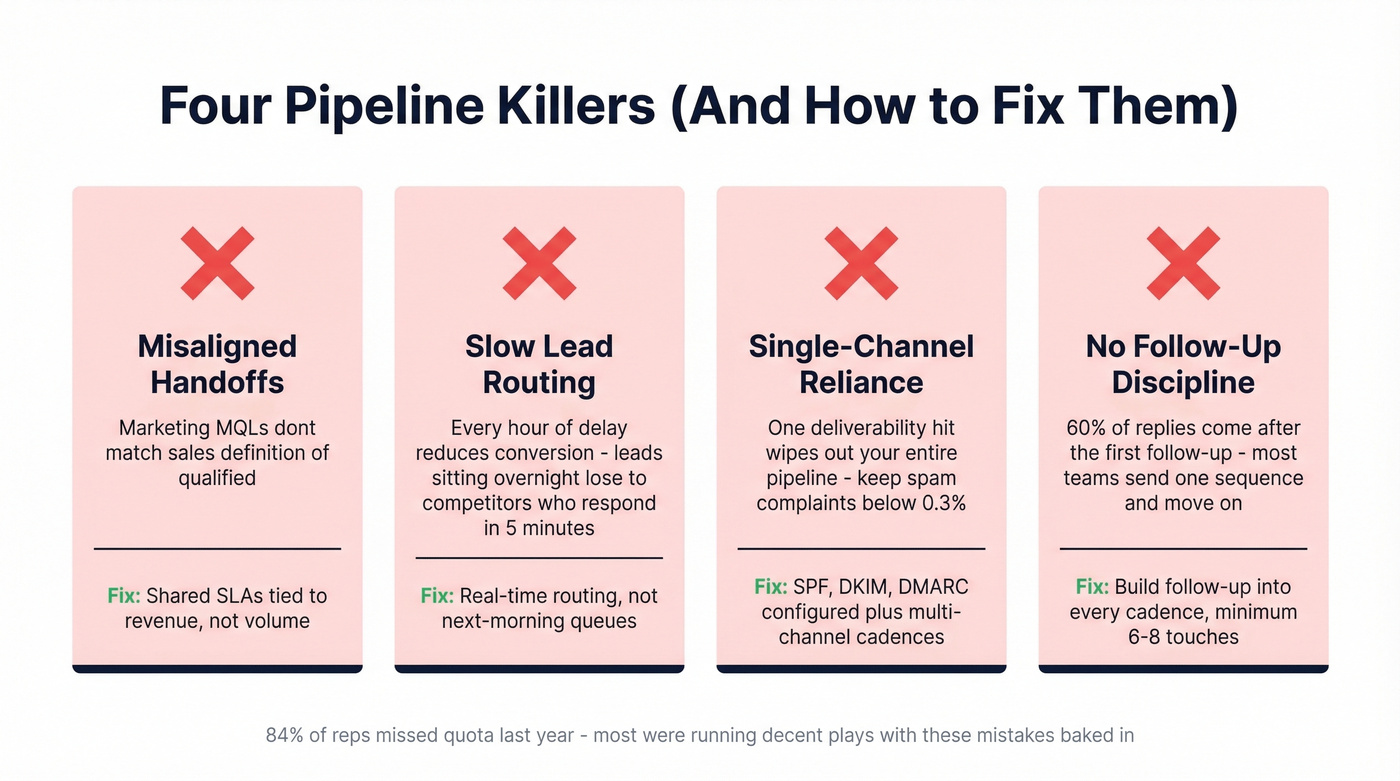
Slow lead routing. Every hour of delay reduces conversion. Real-time routing isn't optional - it's the minimum. If your leads sit in a queue overnight, you've already lost to the competitor who responded in five minutes.
Single-channel reliance. If your entire pipeline depends on email, one deliverability hit wipes you out. Make sure SPF, DKIM, and DMARC are configured, and keep spam complaints below 0.3%. (If you need the technical setup, start with DMARC alignment and a working SPF record.)
No follow-up discipline. Most teams send one sequence and move on. Roughly 60% of replies come after the first follow-up. Those are meetings you're leaving on the table.
The Pipeline Generation Stack
| Category | Tool | Starting Price | Best For |
|---|---|---|---|
| Contact Data & Verification | Prospeo | Free tier; ~$0.01/email | Verified emails + mobiles with 98% accuracy |
| Contact Data & Verification | Apollo | Free-$99/mo/user | All-in-one prospecting |
| Contact Data & Verification | ZoomInfo | $15K+/yr | Enterprise with budget |
| CRM | HubSpot | ~$20+/user/mo | SMB / mid-market |
| CRM | Salesforce | ~$25+/user/mo | Enterprise |
| Sequencing | Instantly | $30+/mo | Cold email at scale |
| Sequencing | Salesloft | ~$100+/user/mo | Multi-channel enterprise |
| Intent Data | Bombora / 6sense / Demandbase | $25K-$100K+/yr | In-market signal detection |
You don't need 15 tools. You need a verified data source, a CRM, a sequencer, and an intent layer if budget allows. In our experience, teams that fix data quality first see results within weeks, not months - the stack matters far less than the accuracy of what feeds it. If you're auditing your process end-to-end, map it to pipeline health metrics so you can see where it’s leaking.
Pipeline generation isn't a tactics problem. It's a data quality problem wrapped in a targeting problem. The 84% of reps who missed quota last year weren't lazy - most of them were running decent plays on terrible data against prospects who weren't in-market. Fix the data layer, add signals, go multi-channel, and the pipeline follows.
Signal-based selling only works when you can act on signals fast. Prospeo combines intent data across 15,000 Bombora topics with job change tracking, funding alerts, and 30+ filters - so you reach the 3-5% actively buying right now, not the 95% who'll ignore you. At $0.01 per email, the math works at any deal size.
Target buyers in-market today, not prospects who moved on six weeks ago.
FAQ
What's the difference between pipeline generation and lead generation?
Lead generation captures interest - form fills, downloads, webinar signups. Pipeline generation converts that interest into qualified sales opportunities with real revenue attached in your CRM. The full process includes outbound prospecting, signal-based selling, and closed-lost reactivation, not just inbound capture.
How much pipeline coverage do I need?
Standard guidance is 3-5x your quota target. At a 25% win rate, you need $4 in qualified pipeline for every $1 in quota. Lower win rates push that ratio higher - some enterprise teams run 6x or more to account for deal slippage and longer sales cycles.
How do I generate pipeline from scratch?
Start with the math: work backward from quota to determine how many opportunities, meetings, and prospects you need. Then build a verified contact list targeting your ICP, run multi-channel cadences, and layer in buying signals to prioritize in-market accounts. The biggest mistake we see is teams skipping the math step and just "doing more outreach" without knowing their conversion rates.
What's a good cold email response rate?
Average cold email response rates run 7-10%. With tight ICP targeting and verified data, 20%+ is achievable. Keep bounce rates below 2%, and follow up - roughly 60% of replies come after the first follow-up email.
How many touchpoints does it take to book a meeting?
Expect 6-8 touchpoints over 2-3 weeks across multiple channels. Multi-channel cadences - phone, social, and email combined - produce 3.5x higher response rates than email-only sequences. The days of a three-email sequence converting are long gone.