

Sales Process vs Sales Funnel: What's Actually Different (and Why It Matters)
Your funnel's leaking. Leads stall, go dark, or vanish between stages - and nobody can tell you exactly where or why. The problem usually isn't the funnel itself. It's that teams conflate three distinct concepts and end up fixing the wrong thing.
The Short Version
Your sales process is the repeatable set of steps your reps follow to move a deal forward. Your sales funnel measures how buyers move - and drop off - through stages. Your pipeline is the dashboard of active deals. Build the process first, measure the funnel second. If you can't sell manually, no funnel will save you.
Process vs Funnel vs Pipeline
These three aren't interchangeable, even though most teams use them like synonyms.
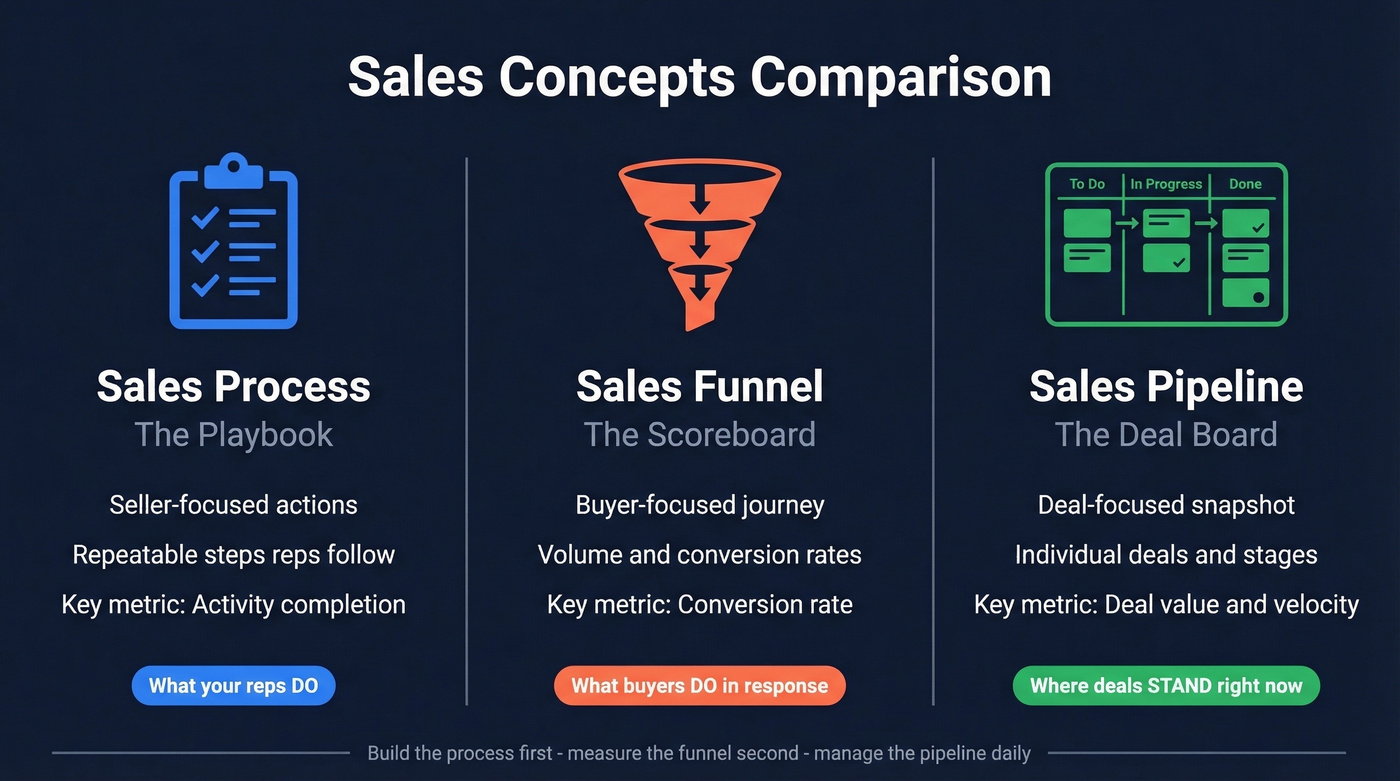
| Sales Process | Sales Funnel | Sales Pipeline | |
|---|---|---|---|
| Perspective | Seller actions | Buyer journey | Deal snapshot |
| Tracks | Recurring steps reps take | Volume & conversion rates | Individual deals & stages |
| Analogy | The playbook | The scoreboard | The deal board |
The process is what your reps do. The funnel measures what buyers do in response - where they engage, where they disengage, and where they disappear. The pipeline is your dashboard of active deals: which ones are moving, which are stuck, and what they're worth.
Here's a concrete way to think about it. The funnel can show you that 1,000 leads turned into 200 qualified prospects, then 50 opportunities, then 10 late-stage deals, then 8 closed customers. The pipeline shows you which late-stage deals are live right now and who owns them. The process defines what reps actually do at each transition - the emails sent, the discovery calls booked, the proposals delivered.
What Is a Sales Process?
A sales process is the repeatable sequence of actions your team follows to take a prospect from "never heard of us" to "signed contract." A typical model runs seven stages: prospecting, preparing, approaching, presenting, handling objections, closing, and following up.
The average B2B sales cycle runs 60 to 120 days. That's a long time for reps to wing it. Organizations with a formalized process see 18% higher revenue growth than those without one, and with six to ten stakeholders involved in a typical B2B purchase, a structured approach isn't optional. We've seen teams double their SQL conversion rates just by documenting what reps actually do versus what the CRM says they do.
One distinction worth making: the sales cycle vs the sales process. The cycle measures how long a deal takes from first touch to close. The process defines the specific actions reps execute during that window. They're related but not the same - you can shorten the cycle by removing friction from the process.
The process starts with prospecting, and prospecting starts with data. If your first touchpoint is an email that bounces or a phone number that's disconnected, the rest of the process doesn't matter. Prospeo's 98% email accuracy and 7-day data refresh cycle mean your reps aren't wasting the first step on stale contacts.
Methodologies That Shape It
Different sales motions call for different frameworks. A two-call SMB sale doesn't need MEDDIC. A six-figure enterprise deal probably does.
- Challenger: Insight-led selling that teaches the buyer something new and reframes the problem.
- MEDDIC: Qualification-heavy, built for enterprise deals where rigor matters and buying committees are large.
- Sandler: A questioning-first approach focused on qualification, pain, and mutual fit.
- Account-Based Selling: Identify target accounts, gather intelligence, execute a coordinated engagement plan, then demonstrate value to close.
If you're selling sub-$10K deals with a single decision-maker, skip MEDDIC. It'll slow you down more than it helps.
What Is a Sales Funnel?
A sales funnel measures how many prospects convert through each stage of the buyer journey. The classic model is AIDA: Attention, Interest, Desire, Action.
The funnel is buyer-focused. It doesn't care what your reps are doing - it cares how many people showed up, how many engaged, how many evaluated, and how many bought. Every transition point between stages is a potential leak, and according to Forrester research, 68% of companies lack formal funnel measurement. They can't tell you where deals die because they've never instrumented the stages.
Let's be honest: the funnel is an imperfect model. Buyer journeys aren't linear anymore - people loop back, skip stages, go dark for months, then reappear ready to buy. But it's still the best diagnostic tool most teams have. Replacing it with nothing is worse than using a flawed framework.

Your funnel can't convert what your process never reaches. 98% email accuracy and a 7-day data refresh mean reps start every sales process with contacts that actually connect - not bounces that kill momentum and skew your funnel metrics.
Fix the first step and every stage after it improves.
Key Differences at a Glance
| Dimension | Sales Process | Sales Funnel | Sales Pipeline |
|---|---|---|---|
| Focus | What reps do | What buyers do | Where deals stand |
| Stages | Prospecting to Close | AIDA or similar | Custom deal stages |
| Key metric | Activity completion | Conversion rate | Deal value & velocity |
| Owner | Sales manager | Marketing + Sales | Individual reps |
| Purpose | Consistency | Diagnosis | Forecasting |
A related question teams ask: should I optimize the process or the cycle? The process is the playbook of repeatable steps. The cycle is the time dimension. Shortening the cycle usually means removing friction from the process - eliminating unnecessary approval steps, cutting a demo that nobody watches, or front-loading qualification so reps stop chasing dead deals for weeks.
Funnel Conversion Benchmarks
Numbers make the funnel useful. Without benchmarks, you can't tell if a 30% MQL-to-SQL rate is healthy or hemorrhaging.
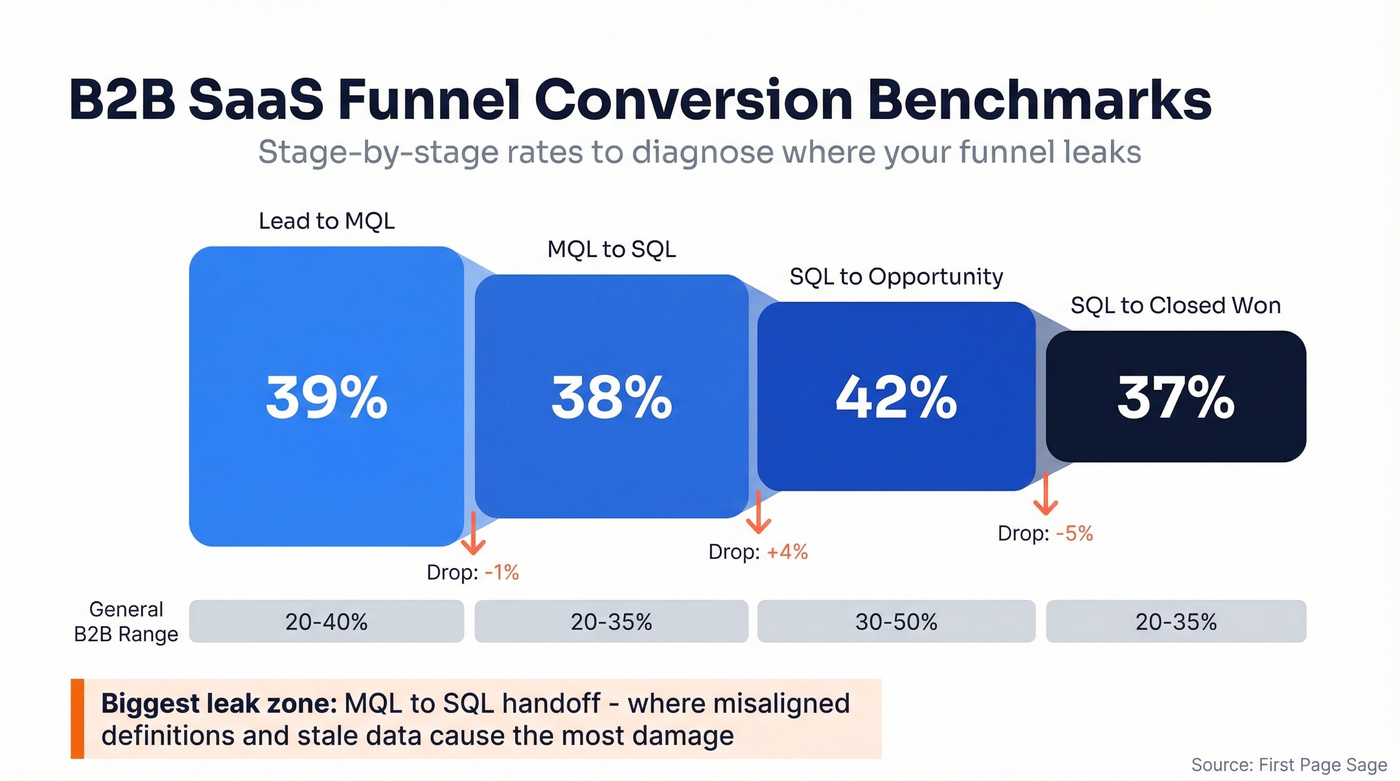
B2B SaaS benchmarks from First Page Sage:
| Stage | B2B SaaS | General B2B Range |
|---|---|---|
| Lead to MQL | 39% | 20-40% |
| MQL to SQL | 38% | 20-35% |
| SQL to Opportunity | 42% | 30-50% |
| SQL to Closed Won | 37% | 20-35% |
In our experience, MQL-to-SQL is where the biggest drop-off happens. That's the handoff between marketing and sales - where misaligned definitions, stale data, and poor qualification create the most damage. If your MQL-to-SQL rate is significantly below 15-20%, the leak isn't in your funnel design. It's in your lead quality or your qualification criteria.
How to Use Both Together
The process and funnel aren't competing frameworks. They're complementary. Here's the sequence that actually works:
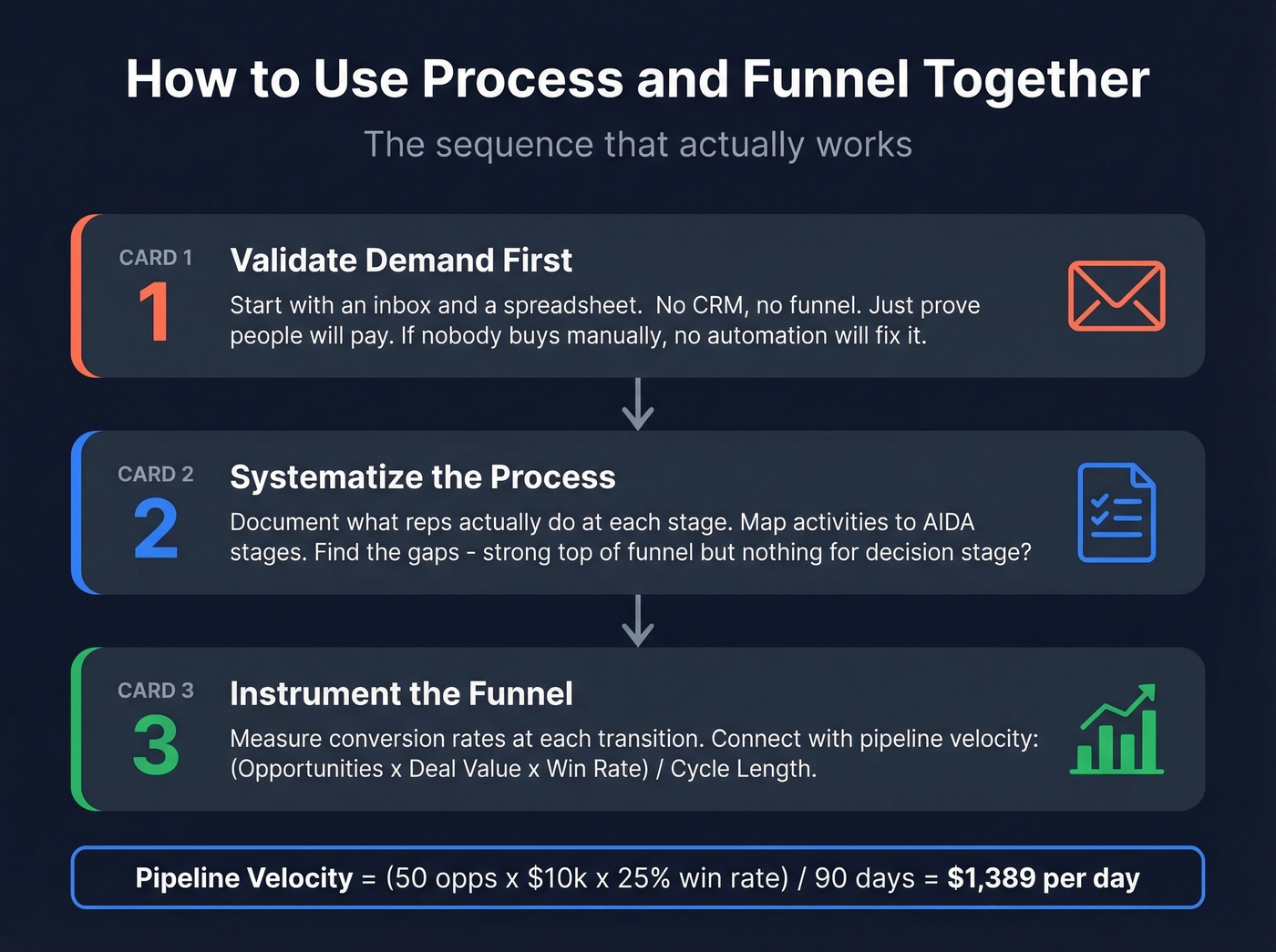
1. Validate demand first. The consensus on r/sales is pretty clear on this: your first sales motion should be an inbox and a spreadsheet. No CRM, no funnel. Just proving people will pay.
2. Systematize the process. Once you have repeatable demand, document what reps actually do at each stage. Map activities to AIDA stages. This exercise usually reveals gaps - strong top-of-funnel content but nothing for the decision stage, for example, or reps who crush discovery calls but have no follow-up cadence for stalled deals.
3. Instrument the funnel. With enough volume, measure conversion rates at each transition. Connect everything with pipeline velocity: (Opportunities x Avg Deal Value x Win Rate) / Sales Cycle Length. Fifty opportunities worth $10k each, 25% win rate, 90-day cycle = roughly $1,389/day in pipeline throughput. Now you know what to optimize.
Common Mistakes
Mapping the ideal process instead of the real one. Document what reps actually do, not what you wish they did. Aspirational process maps fail on contact with reality. Sit with your top performer for a day and write down every step - you'll be surprised how different it looks from the slide deck.
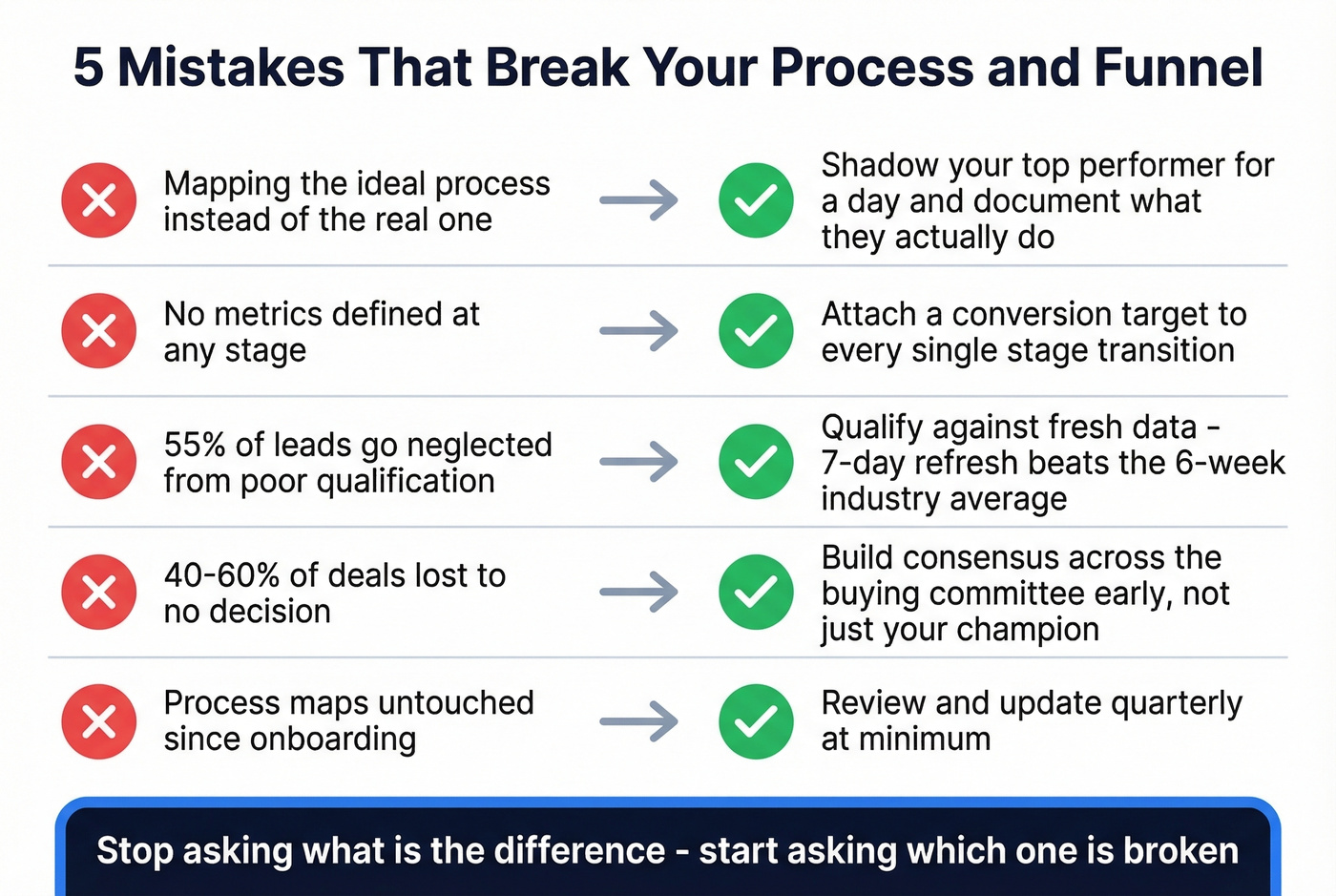
No metrics defined. A process without conversion targets is just a checklist. Attach a number to every stage transition or you're flying blind. (If you need a starting point, use funnel metrics benchmarks.)
Neglecting leads through poor qualification. Up to 55% of leads go neglected because teams don't qualify properly - or they're qualifying against bad data. Data freshness matters: if contacts haven't been verified in weeks, your reps are qualifying ghosts. This is where a 7-day refresh cycle makes a real difference versus the 6-week industry average.
Speaking to the wrong stakeholders. With 40-60% of qualified deals lost to "no decision", talking only to your champion is a recipe for stalled revenue. Build consensus across the buying committee early.
Never updating process maps. Your process should be living documentation, not a slide deck nobody's touched since onboarding. Review quarterly at minimum. (If you're formalizing this, a 30-60-90 day plan helps keep it operational.)
Stop asking "what's the difference between process and funnel?" Start asking "which one is broken?" That's the question that actually moves revenue.
MQL-to-SQL is where most funnels bleed out - and stale data is usually the cause. Prospeo enriches your pipeline with 50+ data points per contact at a 92% match rate, so reps qualify faster and your funnel metrics actually mean something.
Stop diagnosing funnel leaks caused by bad data.
FAQ
Is a sales pipeline the same as a sales funnel?
No. A pipeline is a seller-focused dashboard of active deals used for forecasting revenue. A funnel measures how many prospects convert through buyer-journey stages. Pipeline tracks individual deals by owner and value; the funnel tracks aggregate volume and stage-by-stage conversion rates.
Which should I build first - a process or a funnel?
Build the process first. You need repeatable, documented steps before you can meaningfully measure conversion rates at each stage. If you can't close deals manually with a consistent approach, no funnel visualization will fix the underlying execution gaps.
How do I know if my sales funnel is working?
Measure stage-by-stage conversion rates against industry benchmarks - for B2B SaaS, Lead-to-MQL around 39% and MQL-to-SQL around 38% are solid targets. If any single stage drops more than 10 points below those ranges, that's your leak to diagnose first.
How does the sales cycle relate to the process?
The sales cycle is a time-based metric measuring days from first contact to signed deal. The process is the structured sequence of actions reps take during that window. A long cycle doesn't necessarily mean a broken process; it could reflect deal complexity, committee size, or budget timing. Diagnose which dimension needs fixing before you start optimizing.