

The Sales Productivity Formula: 3 Calculations Every Sales Leader Needs
Your CEO asks why revenue is flat when headcount is up 30%. You pull up the dashboard - 14 metrics, none answering the actual question. What you need is a sales productivity formula that connects effort to output. Not another vanity metric. Here are the three calculations that actually matter.
Three Formulas at a Glance
Revenue per Selling Hour = Revenue / Selling Hours. Rep-level diagnostics.
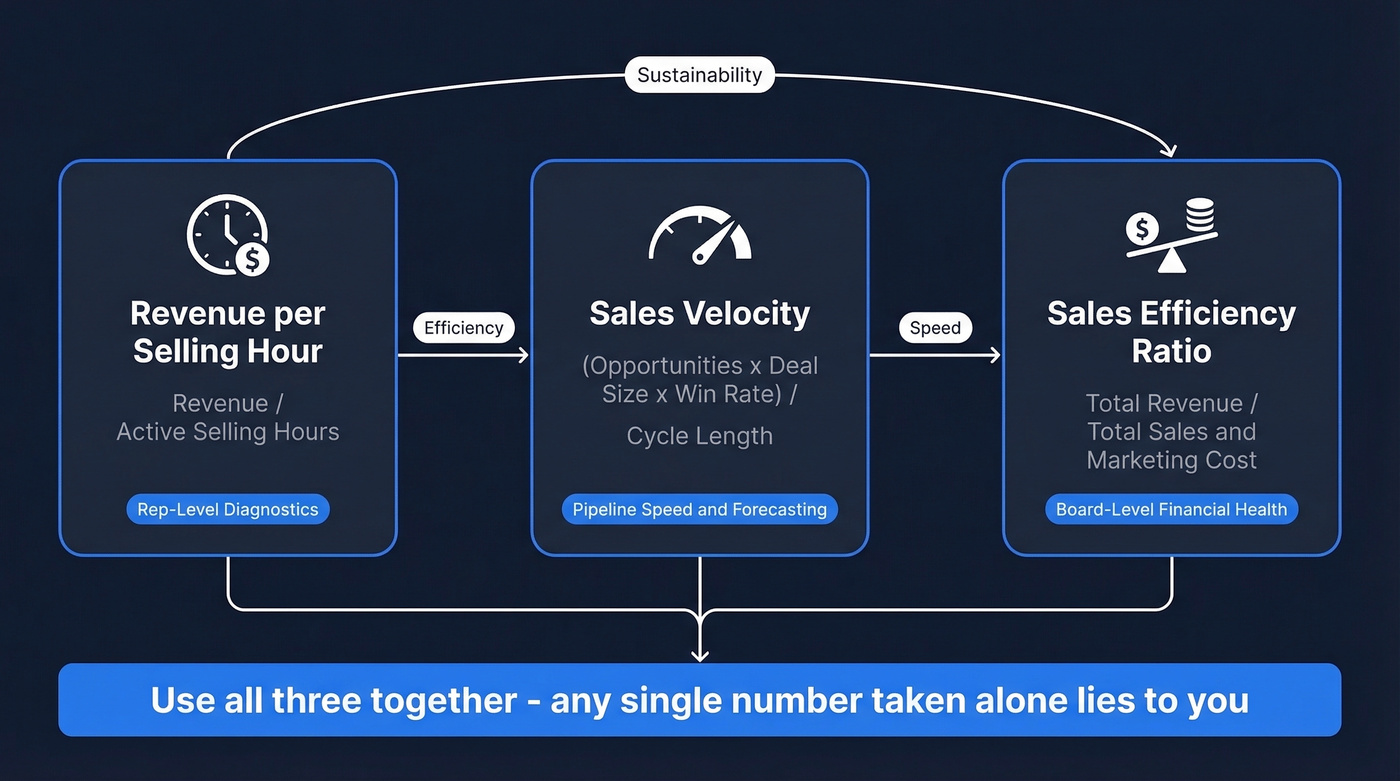
Sales Velocity = (Opportunities x Deal Value x Win Rate) / Sales Cycle Length. Pipeline speed and forecasting.
Sales Efficiency Ratio = Total Revenue / Total Sales & Marketing Cost. Board-level financial health.
Productivity tells you efficiency. Velocity tells you speed. The ratio tells you sustainability. You need all three because any single number, taken alone, lies to you.
Formula #1: Revenue per Selling Hour
Most people get this wrong - not the math, but the denominator.
Revenue per Selling Hour = Revenue / Active Selling Hours
Salesforce's data shows reps spend 60% of their time on non-selling tasks. A rep working 50-hour weeks has roughly 20 hours of actual selling time - that's your denominator. Run it: a rep closes $200K in a quarter across 260 selling hours. Revenue per selling hour: $769. Forecastio's benchmark puts $500+/hour as the target for strong performance.
Here's the thing: quota attainment is an outcome, not a productivity metric. A rep closing $1M in 60-hour weeks is less productive than one closing $800K in 35 hours. The formula exposes that difference. Quota doesn't.
Formula #2: Sales Velocity
Sales Velocity = (Opportunities x Avg Deal Size x Win Rate) / Sales Cycle Length
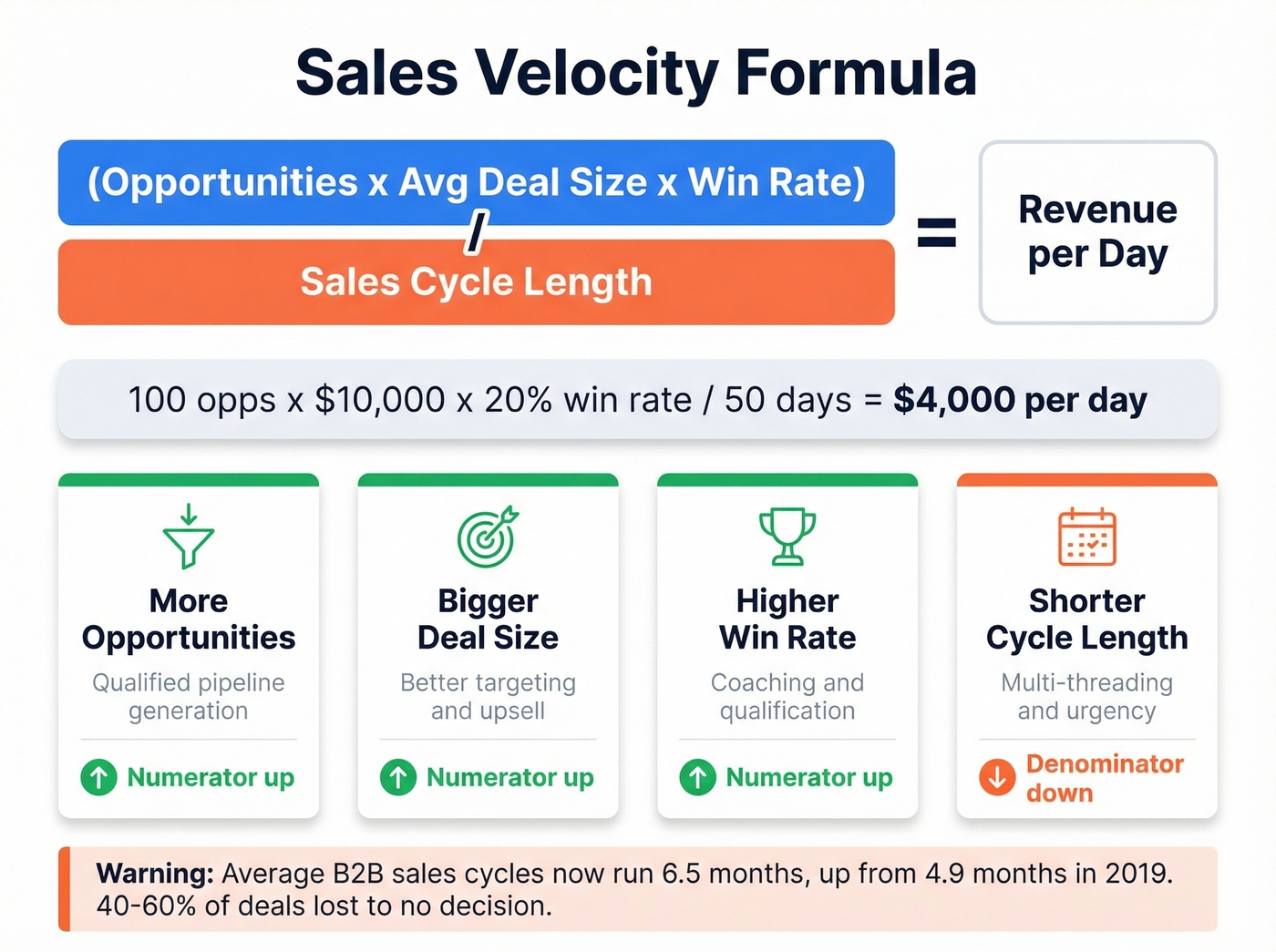
This tells you how much revenue your pipeline generates per day. Forecastio's worked example: 100 opportunities x $10,000 x 20% win rate / 50 days = $4,000/day.
| Variable | Lever | Impact |
|---|---|---|
| Opportunities | More qualified pipeline | Numerator up |
| Deal size | Better targeting / upsell | Numerator up |
| Win rate | Coaching + qualification | Numerator up |
| Cycle length | Multi-threading + urgency | Denominator down |
The denominator is where most teams bleed. Average B2B sales cycles now run 6.5 months, up from 4.9 months in 2019, and 40-60% of deals are lost to no decision at all. HubSpot recommends calculating velocity by segment - a 15-day SMB cycle and a 180-day enterprise cycle averaged together tells you nothing useful. We've seen teams completely misread their pipeline health because they didn't segment this number, and it's one of the most common mistakes in sales forecasting.

Sales velocity has four levers - but bad data drags all of them down. Wrong emails kill opportunities, bounced contacts inflate cycle length, and unverified numbers tank win rates. Prospeo's 98% email accuracy and 7-day data refresh keep every variable in your velocity formula working in your favor.
Stop letting stale data bleed $4,000/day from your pipeline.
Formula #3: Efficiency Ratio
Sales Efficiency = Total Revenue / Total Sales & Marketing Expenses
$1M in revenue on $500K in spend = a ratio of 2. Outreach puts the favorable range between 1 and 3. Below 1 means you're spending more to sell than you earn - a problem that compounds fast at scale.
High productivity with low efficiency usually means your reps are good but your GTM motion is expensive. High efficiency with low velocity means you're profitable but slow. Pairing all three formulas is the only way to get the full picture.
2026 Benchmarks Worth Knowing
| Metric | Benchmark | Source |
|---|---|---|
| Quota attainment | 43.5% hit quota | RepVue Cloud Sales Index |
| Win rate | ~20-28% | HubSpot / Everstage |
| Sales cycle | 6.5 months avg | Kondo |
| Revenue/selling hour | $500+ is strong | Forecastio |
| Efficiency ratio | 1-3 favorable | Outreach |
| Buying committee | 25 stakeholders | Kondo |
| Hero rep skew | 17% generate 81% of revenue | Ebsta x Pavilion |
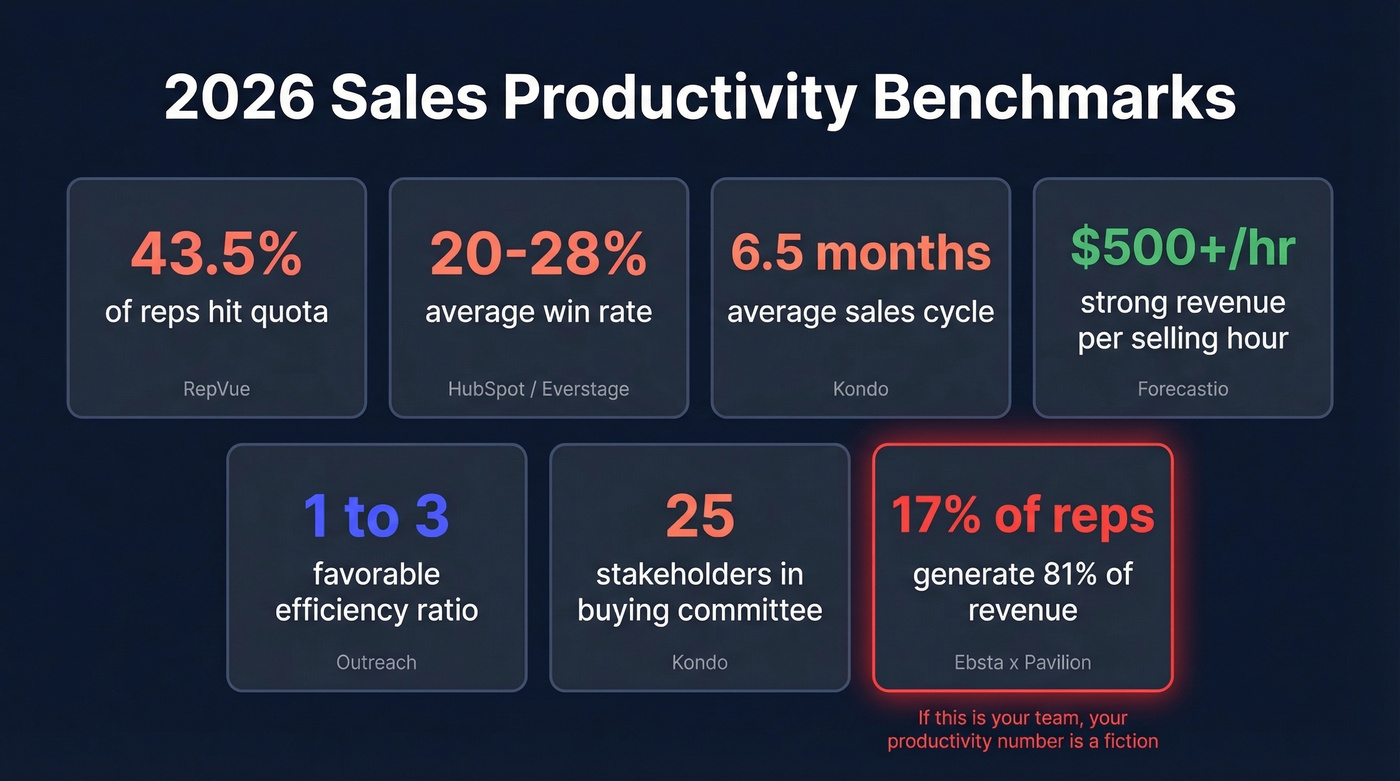
That hero rep line should keep you up at night. If 17% of your reps drive 81% of revenue, your "team productivity" number is a fiction - it's a handful of closers masking a systemic problem.
The Productivity Formula Trap
A Reddit thread in r/sales shared a real company's "effort" formula: (2.5 x emails sent) + (1 x calls made) + (1 x minutes of talk time) / available minutes. Reps needed 80% to be "productive." The poster ran the math: 50 emails, 100 calls, and 2 hours of talk time in an 8-hour day scored 72%. Below threshold. Despite a full day of outbound.
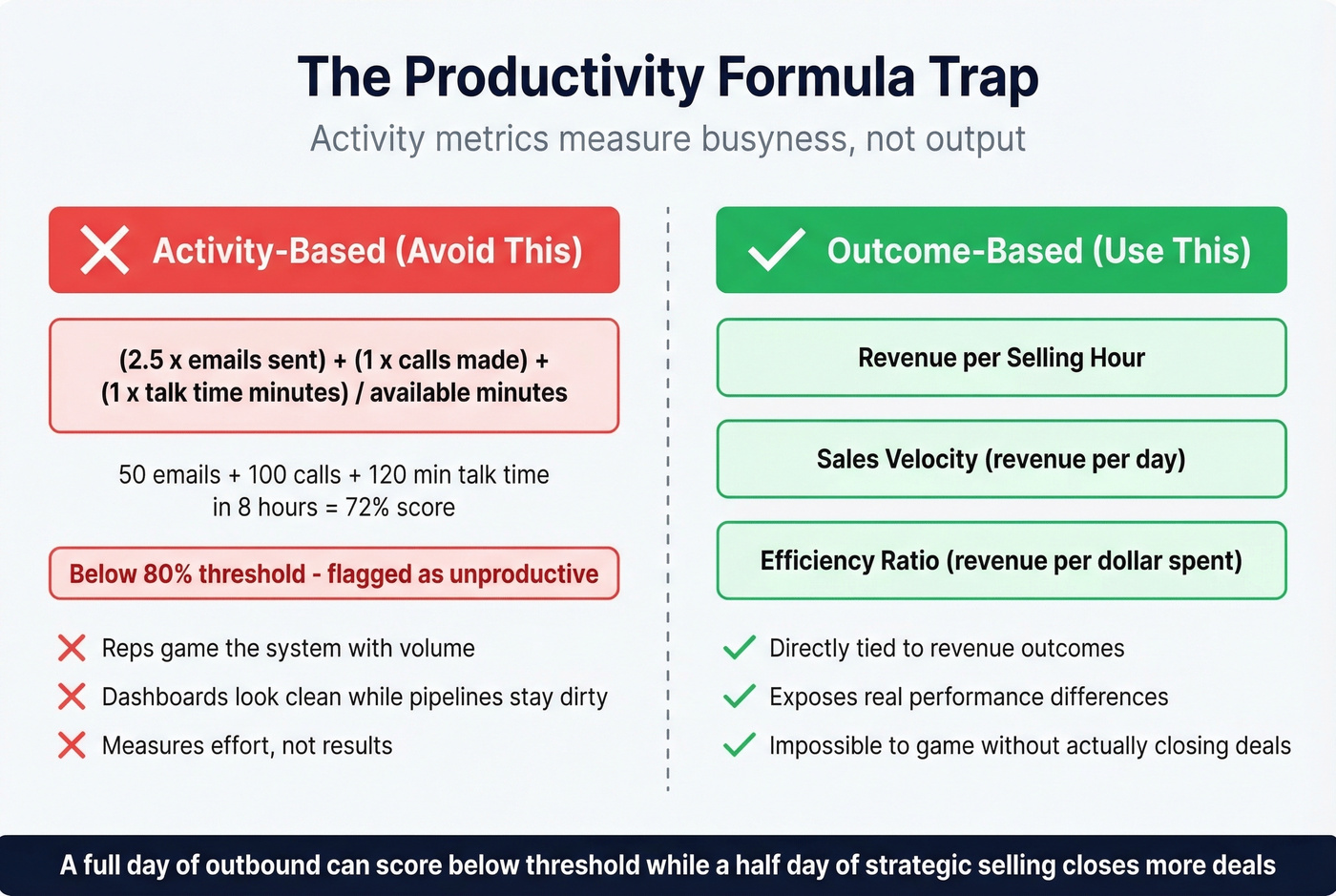
Activity-weighted productivity scores are management theater. They measure busyness, not output. Companies incentivize volume, reps game the system, dashboards look clean while pipelines stay dirty. Skip any formula that counts activities instead of outcomes (and audit your sales activities while you're at it).
How to Improve Your Results
Let's be honest: most teams trying to boost output start with coaching or new tools. They should start with data quality. Fixing bad contact data is the fastest, cheapest lever you can pull - and it compounds across every formula because it directly increases selling time while improving win rates.
Increase selling time
Reps juggle roughly 10 tools on average, and 66% report feeling overwhelmed by fragmentation. Shadow a rep for a full day before you automate anything - you'll find the real time sinks aren't where you think. Then automate CRM updates, kill meetings that don't advance deals, and stop asking reps to build their own lists (or standardize your sales prospecting techniques so list-building isn't reinvented weekly).
Fix your data quality
Every hour spent calling wrong numbers or emailing bounced addresses gets subtracted from selling time - directly worsening the denominator in your sales productivity formula. Prospeo's 98% email accuracy and 7-day data refresh cycle keep reps from wasting outreach on dead contacts. Snyk saw bounce rates drop from 35-40% to under 5%, and AE-sourced pipeline jumped 180% once reps had verified data feeding their workflow (especially when paired with solid data enrichment).

Improve win rates and shorten cycles
With buying committees averaging 25 stakeholders, single-threading is a death sentence. Multi-thread into the committee early. Better qualification upfront also kills deals that were never going to close, which paradoxically improves your velocity numbers. In our experience, teams that combine multi-threading with tighter qualification cut cycle length by 20-30% within a quarter (a good time to revisit sales process optimization).
Set this up in a spreadsheet
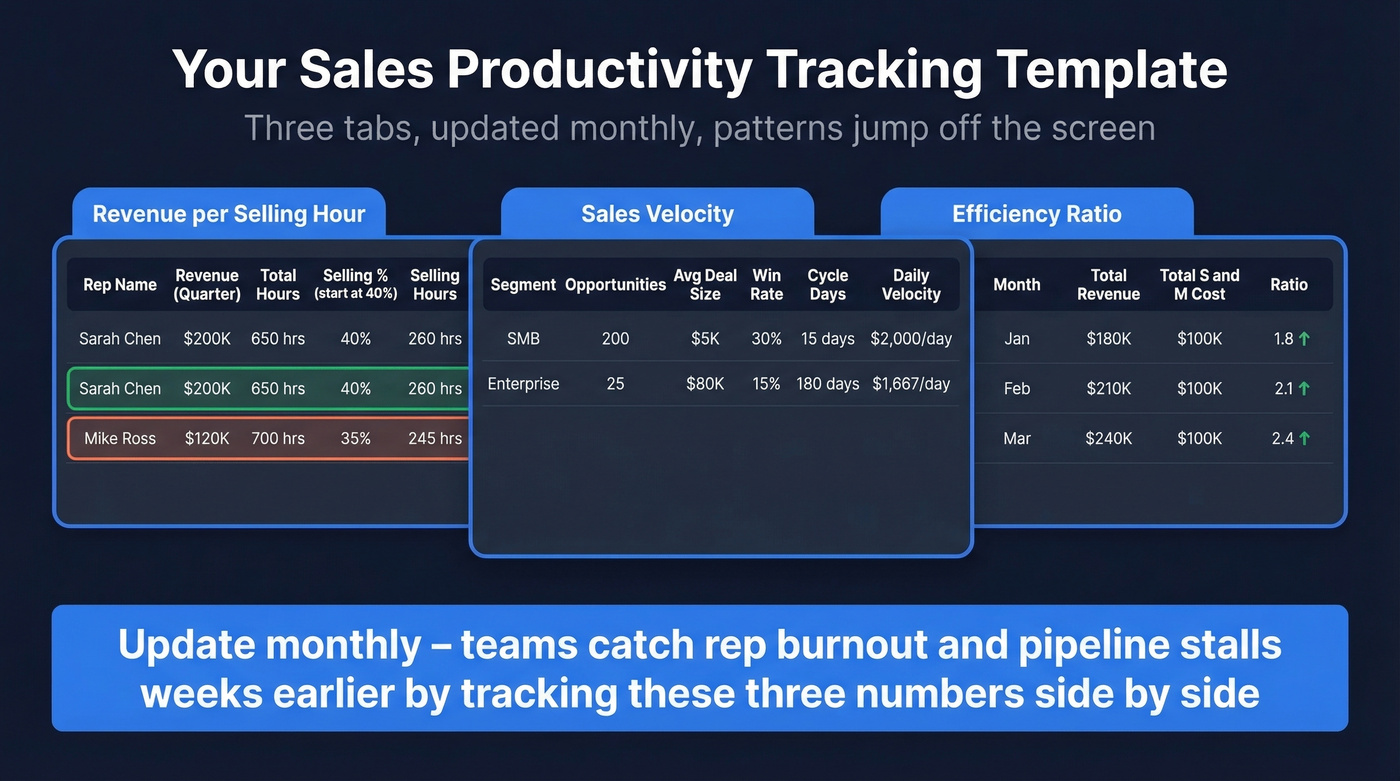
Create three tabs - one per formula. For Revenue per Selling Hour: columns for Rep Name, Revenue (Quarter), Total Hours, Selling % (start with 40%), Selling Hours (calculated), and Revenue/Hour. For Sales Velocity: Segment, Opportunities, Avg Deal Size, Win Rate, Cycle Days, Daily Velocity. For Efficiency: Month, Total Revenue, Total S&M Cost, Ratio. Update monthly. The patterns will jump off the screen - we've watched teams catch rep burnout and pipeline stalls weeks earlier just by tracking these three numbers side by side (and tying them back to pipeline health).
Reps spend 60% of their time on non-selling tasks - and hunting for valid contact data is one of the biggest culprits. Snyk cut bounce rates from 35-40% to under 5% with Prospeo and saw AE-sourced pipeline jump 180%. At $0.01 per verified email, fixing your denominator is the cheapest productivity lever you'll ever pull.
Give your reps 20 real selling hours back every week.
FAQ
What's the difference between sales productivity and sales efficiency?
Productivity measures output per selling hour - how much revenue each hour of active selling generates. Efficiency measures output per dollar spent - whether your total sales and marketing investment produces a positive return. Track both: productivity diagnoses rep-level performance, efficiency diagnoses team-level financial health.
How do I calculate sales productivity for SDRs vs. AEs?
SDRs don't close revenue, so use meetings booked per selling hour as the numerator instead. For AEs, use revenue per selling hour. For account managers, use expansion revenue per selling hour. Same formula structure, different numerator based on the role's core output.
What tools help improve sales productivity?
A CRM like Salesforce or HubSpot for pipeline tracking, a conversation intelligence tool like Gong for coaching insights, and a verified data platform for eliminating wasted outreach. Prioritize data quality first - bad contact data inflates your denominator and deflates every metric above.