

Sales Productivity Tips: Concrete Habits, Not Generic Advice
It's 7pm. You've been at your desk since 7:30 this morning. You keyed 103 quotes this week - while the rest of your team combined keyed 99 - and you still haven't touched your follow-up list. That's not a hypothetical. It's a real inside sales rep describing their week on Reddit.
Sales reps spend 60% of their time on non-selling tasks. Only 43.5% hit quota. And 57% say the sales cycle is getting longer. The problem isn't effort. It's where the effort goes.
The Three Moves That Matter Most
If you take nothing else from this article:
- Block your first 90 minutes for outbound every day. No email, no Slack, no CRM. Just calls and sequences.
- Do a 15-minute call review every evening. Listen to your worst call, write three fixes, note one win.
- Verify your prospect data before you touch the phone. Every bounced email and dead number is selling time you'll never get back.
Where Your Day Actually Goes
Most reps blame meetings. The real damage is subtler - constant context-switching across 15+ apps, reactive firefighting, and chasing contacts who changed jobs six months ago.
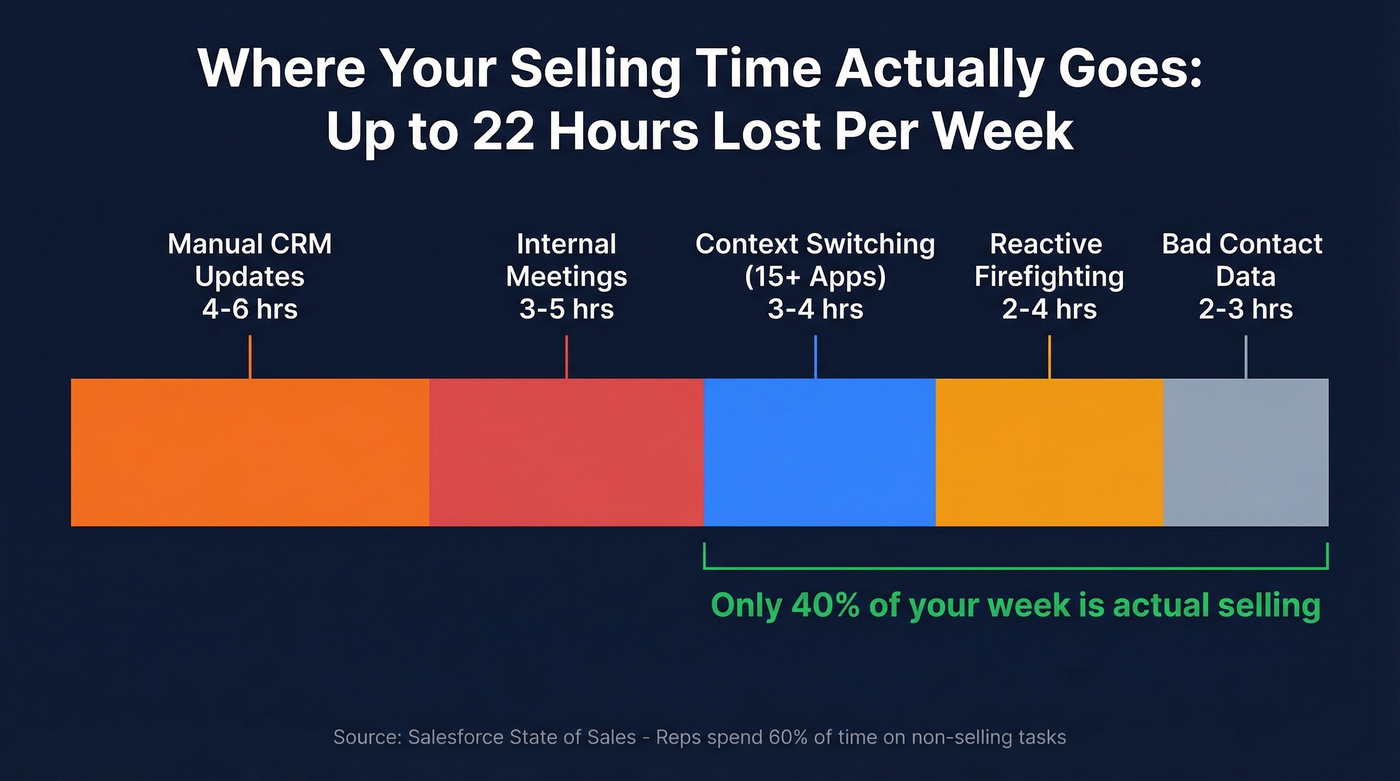
Be honest about which ones hit home.
| Time Drain | Hrs Lost/Week | Fix |
|---|---|---|
| Manual CRM updates | 4-6 | Auto-capture or batch EOD |
| Internal meetings | 3-5 | Decline if no agenda |
| Context-switching (15+ apps) | 3-4 | Consolidate stack, batch tasks |
| Reactive firefighting | 2-4 | Time-block proactive work first |
| Bad contact data | 2-3 | Verify before every call block |
That's up to 22 hours a week - over half your job - spent on things that don't generate pipeline. A channel sales rep on Reddit nailed it: when you're "the go-to guy in the middle," everything becomes reactive. You stop selling and start administrating.

You just read that bad data costs reps 2-3 hours every week. Snyk's 50 AEs dropped bounce rates from 35-40% to under 5% with Prospeo - reclaiming hours of selling time. At 98% email accuracy on a 7-day refresh cycle, your call blocks stay productive.
Stop burning your morning outbound block on dead contacts.
Habits That Actually Move the Needle
Block Your Morning for Outbound
Your best cognitive hours are the first ones. Protect them. Block 8:00-9:30am - no email, no Slack, no CRM updates. Treat it like a meeting with your most important prospect, because functionally it is.
Here's the thing: if you wouldn't cancel a demo with a qualified buyer, don't cancel your outbound block for an internal sync. We've seen reps reclaim 7-10 hours of selling time per week just by defending this single window.
If you need a repeatable structure for that block, start with a few proven sales prospecting techniques and keep the rest of your day flexible.
Review Your Worst Call Every Day
A 15-minute end-of-day routine that compounds fast. Listen to your worst call, write down three things you'd do differently, note one thing you did well. One team that adopted this reported tripling their close rate over six months. The mechanism is straightforward - most reps never analyze what went wrong, so small daily improvements stack into something significant.
Talk Less on Calls
Gong's data shows top closers speak 43%. Average performers hit 65%.
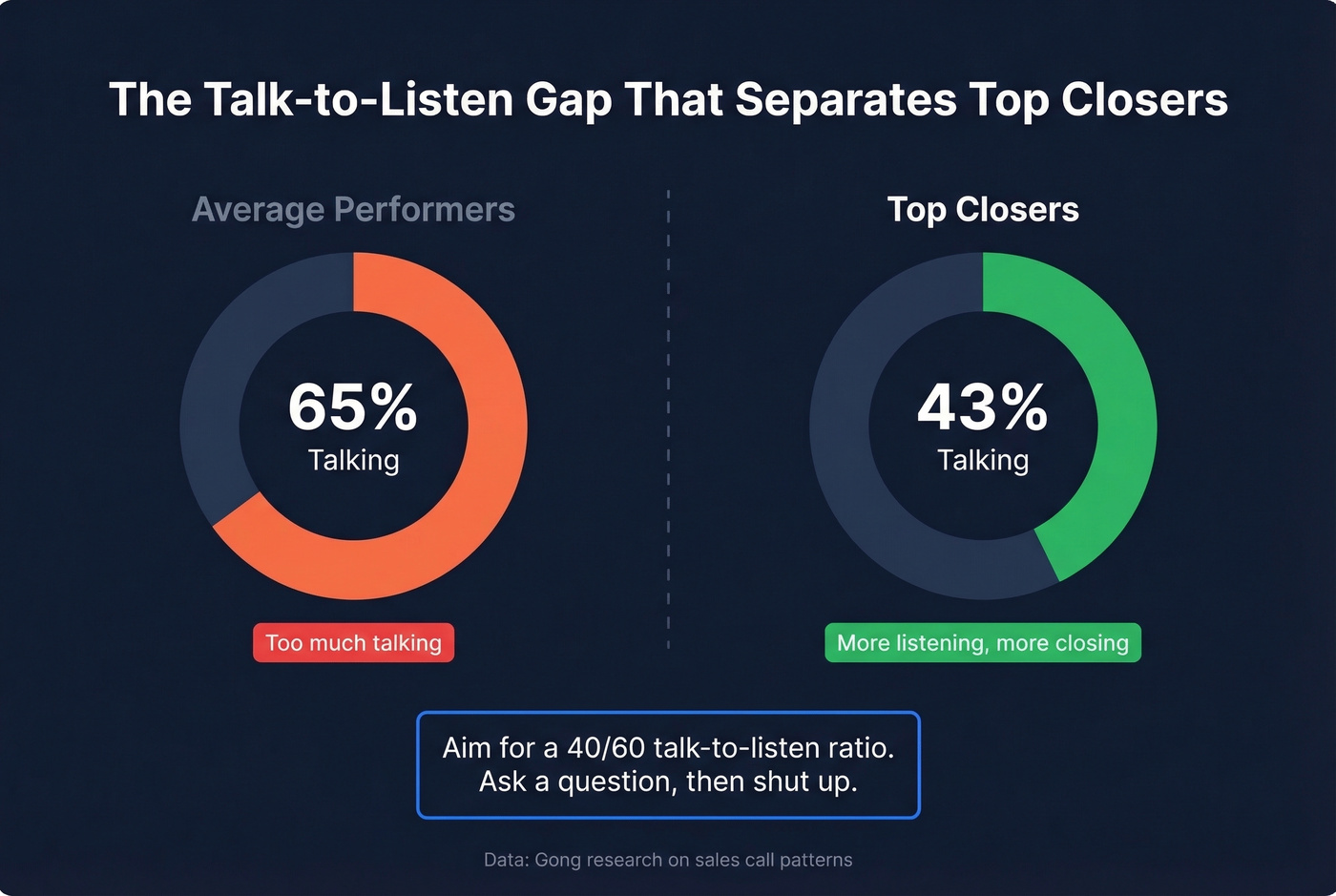
That gap is entirely within your control. By the time prospects pick up the phone, 57% of their [buying journey is already done](https://www.linkedin.com/business/sales/blog/b2b-sales/this-popular-stat-is-wasting-your-time - the-57 - engagement-myth). They want to be heard, not pitched. Aim for a 40/60 talk-to-listen ratio. Ask a question, then shut up.
If you're tightening your discovery, a simple set of discovery questions can keep you from defaulting to pitching.
Cap Every Email at Five Sentences
Business professionals receive 85 emails a day. Guy Kawasaki's formula works: who you are, what you want, why them, why now, next step. Done.
Short emails make follow-ups sustainable - and that matters because 80% of sales require five follow-ups while 44% of reps give up after one. If your emails are running long, you're giving people a reason to defer instead of respond.
To make follow-ups faster, keep a few high-performing sales follow-up templates ready to customize.
Build a Playbook You'll Actually Use
42% of best-in-class companies use sales playbooks versus 14% of laggards. But let's be clear: a playbook isn't a 50-page PDF nobody reads. It maps your best reps' moves to the buyer's process. Keep it short. Update it quarterly. If your newest rep can't find the right talk track in under 30 seconds, the playbook is too long.
If you're standardizing messaging, a library of talk track examples helps you document what actually works.
Verify Data Before You Dial
You've got a 200-contact call block queued up. You start dialing. Forty numbers are disconnected. That's momentum burned on dead air - and once your rhythm breaks, your output drops for the rest of the session.
Bad data is the productivity leak nobody talks about. In our experience, it's the single biggest hidden time-killer on outbound teams. Snyk's 50 AEs cut bounce rates from 35-40% to under 5% after switching to verified data, getting hours back every week. Prospeo's email verification runs at 98% accuracy on a 7-day data refresh cycle, compared to the 6-week industry average. The free tier gives you 75 emails per month - enough to pressure-test your current list quality and see how much garbage you've been dialing through.
If you're cleaning lists at scale, pairing verification with data enrichment services can reduce rework later.
Cut Your Tool Stack
Most reps don't need more than five or six core tools. Modern AEs juggle 15+ apps daily, and every tab switch costs cognitive load. The answer is fewer tools with better data feeding them - not another dashboard.
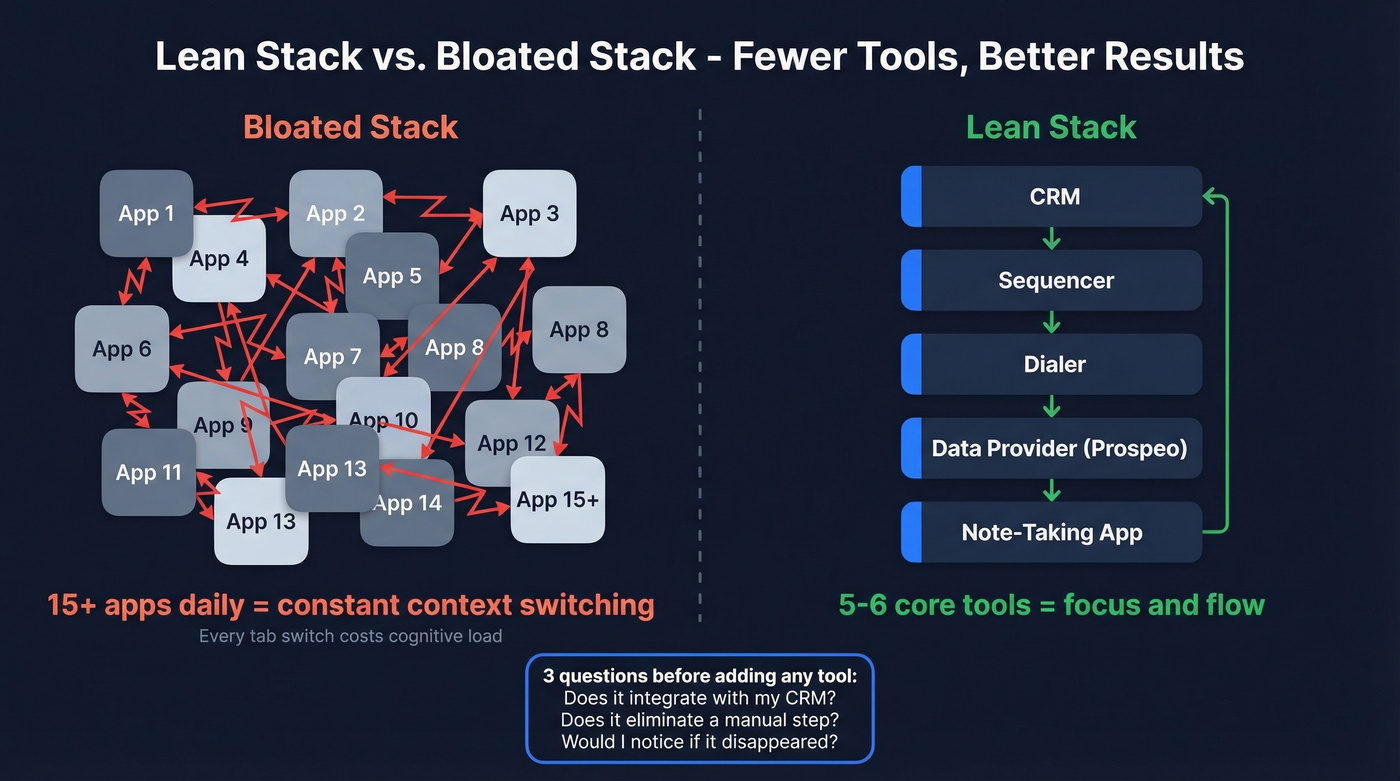
Before adding anything, ask three questions: Does it integrate with my CRM? Does it eliminate a manual step? Would I notice if it disappeared? If you can't answer yes to all three, skip it. Bain found that companies redesigning workflows around AI see 30%+ win-rate lifts, while those bolting AI onto broken processes get almost nothing. Fix the process first. Then choose tools that serve it.
If you're auditing your stack, start with a shortlist of core SDR tools and cut anything that doesn't remove manual work.
A Sample High-Output Sales Day
You won't hit this perfectly every day. The point is having a default structure that keeps selling time protected - so when something breaks the schedule, you know exactly what you're trading away.
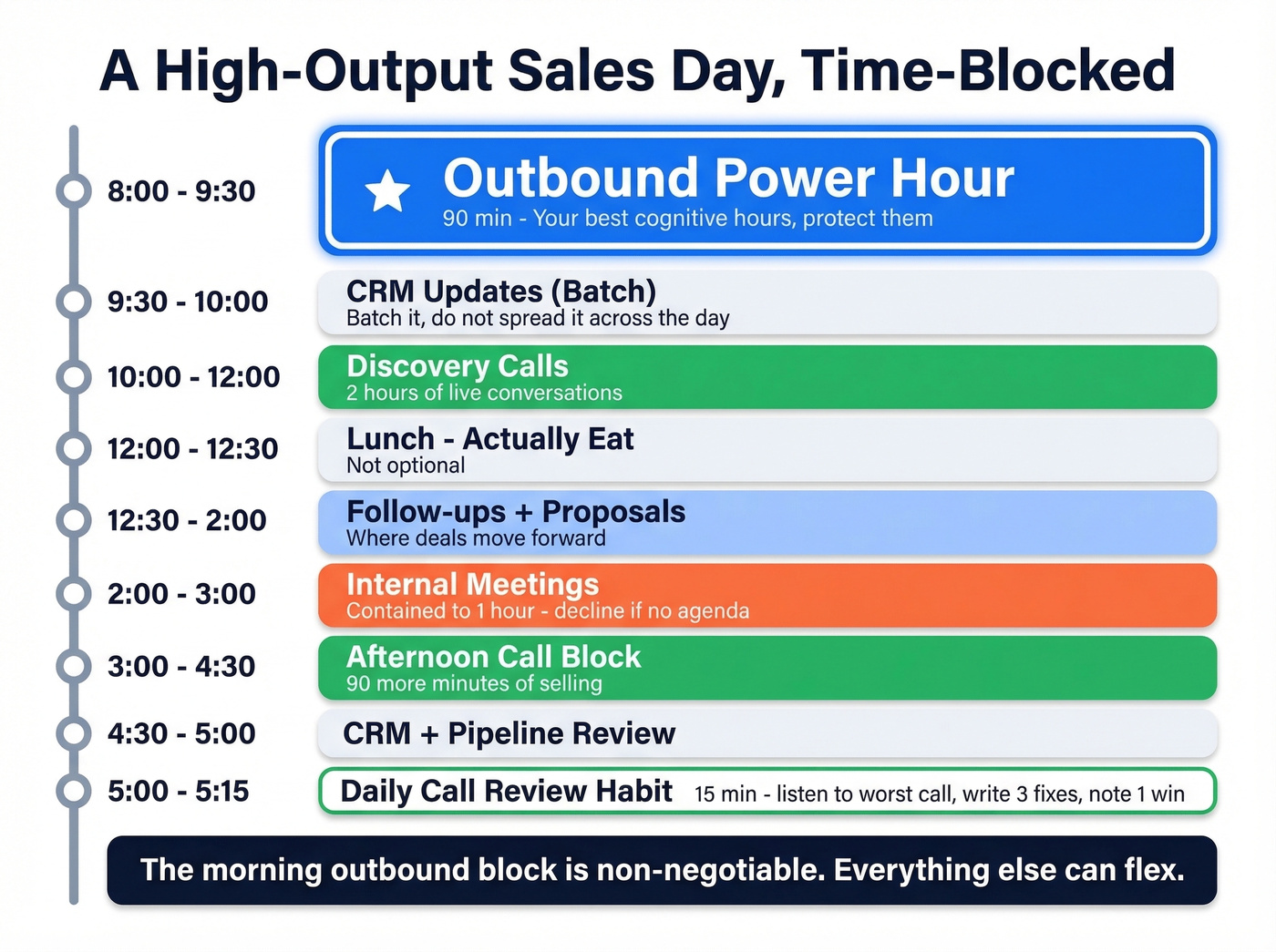
| Time | Block |
|---|---|
| 8:00-9:30 | Outbound Power Hour |
| 9:30-10:00 | CRM updates (batch) |
| 10:00-12:00 | Discovery calls |
| 12:00-12:30 | Lunch (actually eat) |
| 12:30-2:00 | Follow-ups + proposals |
| 2:00-3:00 | Internal meetings |
| 3:00-4:30 | Afternoon call block |
| 4:30-5:00 | CRM + pipeline review |
| 5:00-5:15 | Call review habit |
We've tested variations of this schedule across different team sizes, and the non-negotiable piece is always the morning outbound block. Everything else can flex. That can't.
If you want more ideas for what to do inside each block, borrow a few proven sales activities and rotate them weekly.
Every disconnected number breaks your rhythm. Every bounced email wastes a follow-up slot. Prospeo verifies 143M+ emails at 98% accuracy and refreshes every 7 days - so your 200-contact call block actually connects. Free tier: 75 emails/month, no contracts.
Reclaim 2-3 hours a week by fixing the data before you dial.
FAQ
How do you measure sales productivity?
Output divided by input - revenue per rep, deals closed per hour worked, or pipeline generated per outbound session. Track quota attainment and percentage of time spent actively selling as your two north-star metrics. Most CRMs can report both natively.
What's the biggest killer of rep efficiency?
Non-selling admin work. Reps spend 60% of their time on tasks that don't generate revenue - CRM updates, internal meetings, and chasing outdated contact data. Time-blocking and batching admin to end-of-day reclaims 10+ hours weekly.
Can better contact data improve sales productivity?
Yes, and the impact is immediate. Bad data wastes dials and burns emails. Snyk's 50 AEs dropped bounce rates from 35-40% to under 5% after cleaning up their data pipeline, reclaiming hours of selling time every week. Clean data compounds: fewer bounces, better deliverability, more live conversations.
How many tools should a sales rep use daily?
Five to six core tools is the sweet spot. Beyond that, context-switching costs outweigh any feature gains. Consolidate around your CRM, a sequencer, a dialer, a data provider, and a note-taking app - then ruthlessly cut everything else.