

How to Price Your Sales Proposals So They Actually Close
A RevOps lead we work with spent three weeks last quarter chasing internal approvals on a pricing proposal. By the time the PDF hit the buyer's inbox, the deal was cold. That story plays out constantly - and it's not just about speed. Bidsketch analyzed 25,000 proposals and found that how you structure sales proposal pricing matters more than the number itself: bundled pricing proposals get accepted 47% of the time, while traditional pricing proposals land at 34%. The gap isn't price sensitivity. It's presentation.
The Three Moves That Matter Most
If you're short on time, here's the cheat sheet.
Bundle your pricing instead of itemizing every line. Bundled proposals convert 13 percentage points higher than traditional ones. Offer exactly three tiers - it triggers the Goldilocks effect and lifts revenue 25-40% versus single-option proposals. Present pricing live on a call, not buried in an email attachment. Prospects skip straight to the price page. If you're not there to frame the number, you've already lost control of the conversation.
Now let's break down each of these, plus the tools and psychology that make them work.
What Proposal Pricing Strategy Actually Means
Sales proposal pricing isn't the dollar figure at the bottom of a document. It's the structure, timing, and presentation of your costs - how many options you show, whether you bundle or itemize, when you reveal the number, and how you frame it relative to value.
Here's the thing: understanding how to price a business proposal is what separates reps who close from reps who quote. Quoting is math. Proposal pricing is strategy.
Pricing Models That Work
Not every deal calls for the same model. Here's a quick comparison of the four most common approaches in B2B proposals:
| Model | Best For | Key Tradeoff |
|---|---|---|
| Value-based | High-ACV B2B | Harder to justify early in the relationship |
| Cost-plus | Services, agencies | Commoditizes your work |
| Competitive | Crowded markets | Race to the bottom |
| Fixed vs. T&M | Projects, consulting | Scope creep risk with T&M |
Value-based pricing wins for most B2B scenarios because it anchors the conversation around outcomes - revenue generated, time saved, risk reduced - rather than hours worked or cost of goods. Cost-plus is the default for agencies and services firms, but it invites line-by-line scrutiny and trains buyers to negotiate on inputs instead of results. That's a losing game.
Competitive pricing makes sense in a bake-off, but it's reactive by nature. Fixed-fee versus time-and-materials is really a risk allocation question: who absorbs scope creep? If you're selling anything with measurable ROI, lead with value-based. Structure your proposal around outcomes, not deliverables.
Bundled vs. Line-Item Pricing
When you itemize every line in a proposal, you're handing the buyer a menu of things to cut. Each line becomes a negotiation point. "Do we really need the onboarding package?" "Can we skip the training hours?" Suddenly you're defending individual components instead of selling a solution.
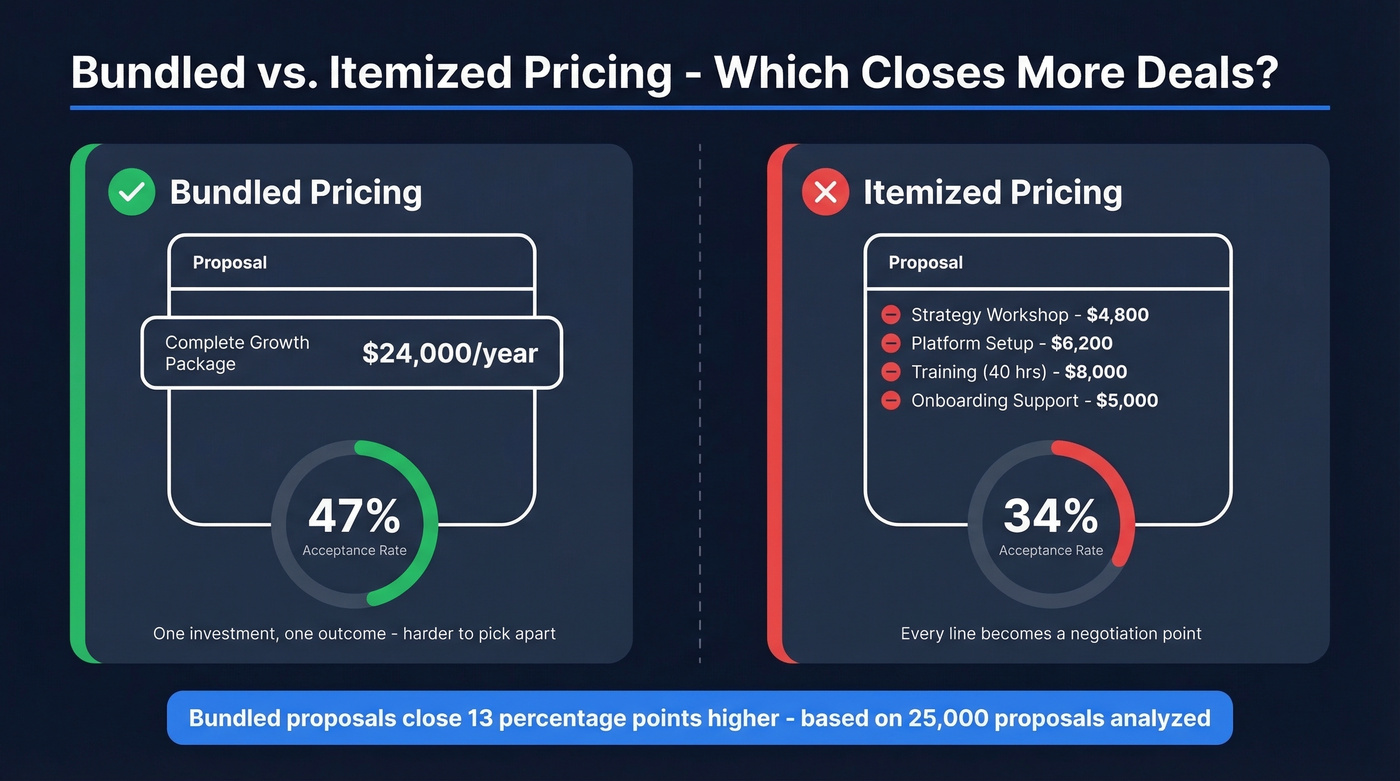
The Bidsketch dataset backs this up clearly. Bundled pricing proposals - where fees are rolled into a single solution price - get accepted 47% of the time versus 34% for itemized ones. The mechanism is loss aversion. Itemizing triggers a mental calculation where every line feels like a separate expense, and the buyer's instinct is to start trimming. Bundling reframes the total as one investment tied to one outcome, which is much harder to pick apart.
Bundle by default. If the buyer asks for a breakdown, provide it - but lead with the package.

Bundled pricing converts 47% of the time - but only when it lands in the right inbox. Prospeo gives you 98% verified emails and 125M+ direct dials so your carefully crafted proposal reaches the decision-maker, not a gatekeeper.
Stop perfecting proposals that never reach the buyer.
Why Three Tiers Wins
The average SaaS company offers around 3.5 pricing tiers. Three options hit the psychological sweet spot: enough choice to feel empowered, not enough to cause paralysis.
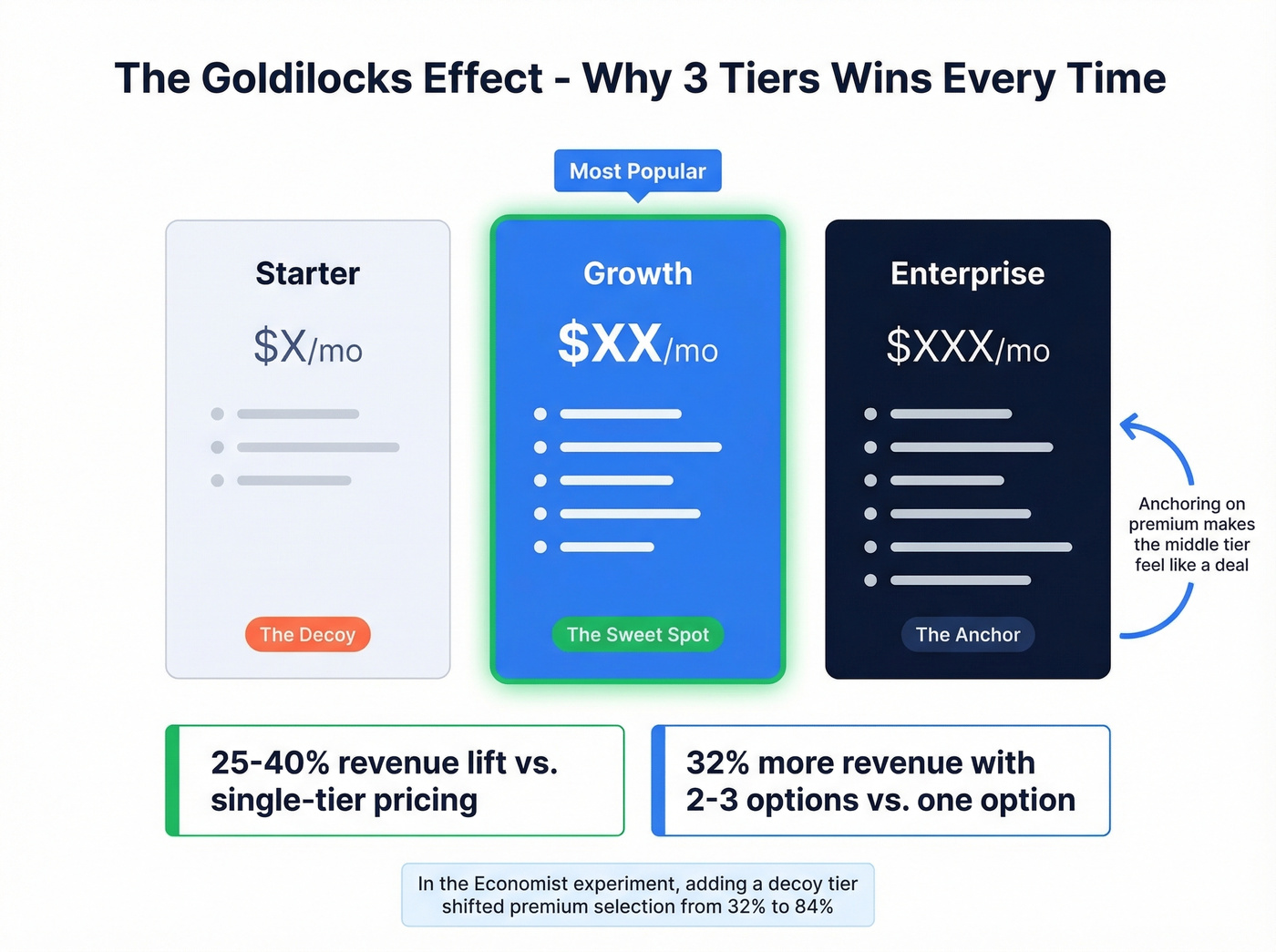
Proposals with two to three options generate 32% more revenue than single-option proposals, and tiered pricing can drive 25-40% revenue lifts versus single-tier models. One option is a take-it-or-leave-it ultimatum. Two options create a binary that feels limiting. Three options let the buyer self-select into the tier that matches their budget and ambition - and the middle tier almost always wins. When you add a decoy tier, a deliberately less attractive option that makes the premium look reasonable, the effect compounds. In the classic Economist subscription experiment, the share choosing the premium option jumped from 32% to 84%.
Show your premium tier first. Anchoring the buyer on the highest number makes the middle tier feel like a deal. Name the tiers clearly - "Starter," "Growth," "Enterprise" beats "Plan A, B, C." Load the middle tier with the features most buyers actually need so it becomes the obvious choice.
When to Reveal Pricing
Not every prospect deserves the same pricing conversation. We use an ICP-based framework:
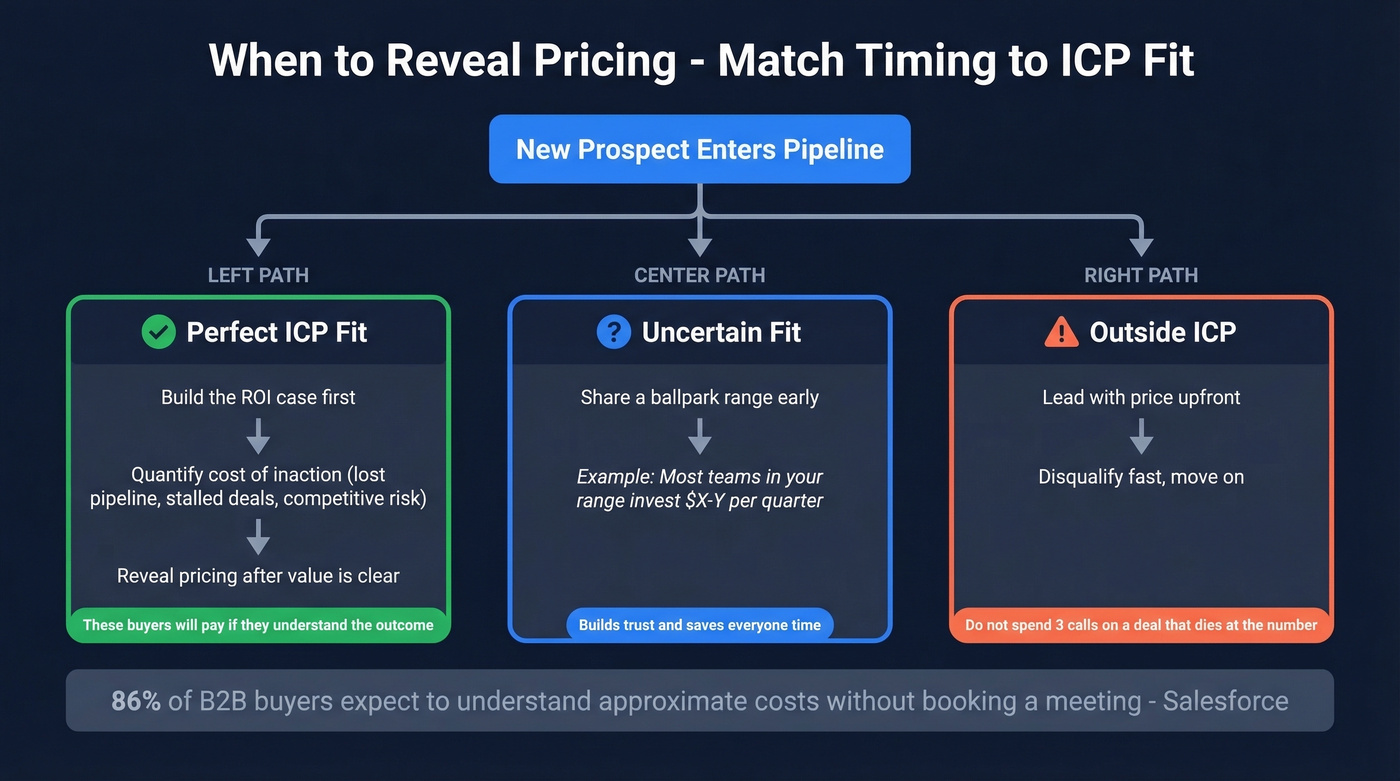
Perfect ICP fit: Value-sell first. Build the ROI case before revealing price. These buyers will pay if they understand the outcome. Quantify the cost of inaction - lost pipeline, stalled deals, competitive displacement all make the status quo expensive.
Uncertain fit: Share a ballpark early. "Most teams in your range invest $X-Y per quarter." This builds trust and saves everyone time.
Outside ICP: Price upfront to disqualify fast. Don't spend three calls on a deal that dies at the number.
Salesforce reports that 86% of B2B buyers expect self-service options, including being able to understand approximate costs without booking a meeting. Buyers hate being forced into a call just to get a ballpark. If you're going to delay pricing, have a talk track ready: "I want to make sure you see how this solves your core challenge first - then the number will make a lot more sense."
Present Pricing Live
We've all done it - skipped straight to the price page of a proposal without reading a single word of context. That's exactly why you should present your proposal on a call instead of emailing a PDF into the void.
When you present live, you control the narrative. You frame the investment before the buyer sees the number, handle objections in real time, and gauge reactions through tone and body language. The first 24 hours after sending a proposal matter most. Presenting live compresses that window to zero.
Two framing tactics that work in our experience: reframe annual pricing as monthly ("that's roughly $X per month per rep") and replace "cost" language with "investment." If you're selling to the C-suite, treat the pricing slide as the centerpiece of a broader ROI presentation - connect every dollar to a measurable business outcome they already care about.
Proposal Software Worth Using
33% of sales teams still don't use proposal software. That's wild, given that teams adopting these tools save up to 70% of creation time. The proposal management software market is projected to hit $9B by 2035 at 11.1% CAGR - the category is maturing fast.
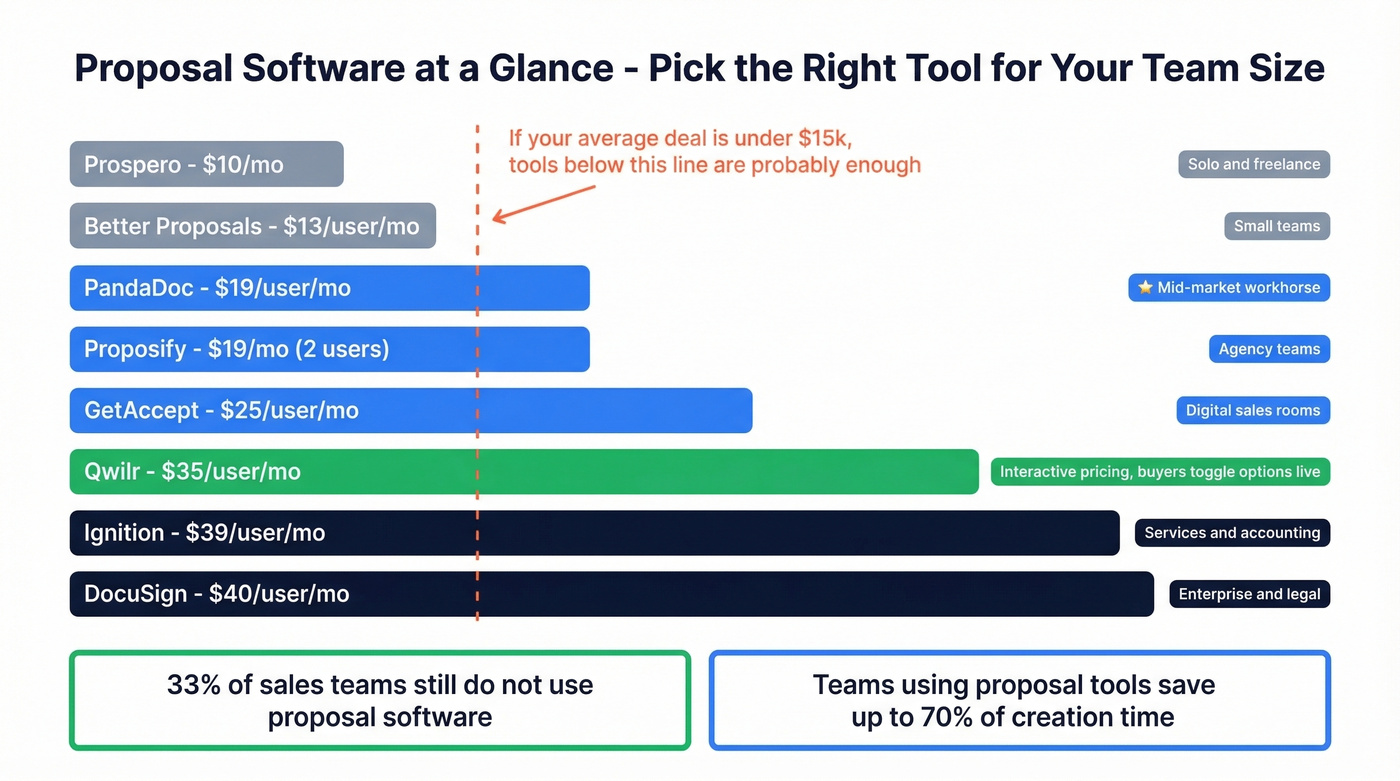
Let's be honest: if your average deal size is under $15k, you probably don't need a $40/user/mo proposal tool. PandaDoc or Proposify will cover you. Save the budget for data quality - that's where deals actually die.
PandaDoc (from $19/user/mo) is the workhorse for mid-market teams with strong templates, CRM integrations, and built-in e-signatures. It's the safe pick. Qwilr (from $35/user/mo) is better if interactive pricing is your priority - buyers can toggle options and see totals update in real time, which pairs well with the tiered pricing approach we covered above. Arrows reports a 44% higher win rate with digital sales rooms versus its average over the last 12 months.
Skip Prospero and Better Proposals if you're running a team of five or more - they're built for freelancers and solo operators, and you'll outgrow them fast.
| Tool | Starting Price | Best For |
|---|---|---|
| Prospero | $10/mo | Solo/freelance |
| Better Proposals | $13/user/mo | Small teams |
| PandaDoc | $19/user/mo | Mid-market |
| Proposify | $19/mo (2 users) | Agency teams |
| GetAccept | $25/user/mo | Sales rooms |
| Qwilr | $35/user/mo | Interactive pricing |
| Ignition | $39/user/mo | Services/accounting |
| DocuSign | $40/user/mo | Enterprise/legal |
Prices reflect published rates as of early 2026 and can change.
Before You Send: Verify the Right Inbox
You can nail the pricing structure, build a beautiful interactive proposal, and still lose the deal because it bounced or landed in the wrong inbox. We've seen it happen on six-figure deals. Before you hit send, verify you're reaching the actual decision-maker with a valid email.
Prospeo checks emails against 300M+ professional profiles with 98% accuracy on a 7-day refresh cycle. The free tier covers 75 email verifications per month - enough to pressure-test your proposal list before a big send. When a single proposal can be worth five or six figures, spending ten seconds on email verification is the highest-ROI step in your entire workflow.

You're timing your pricing reveal based on ICP fit - smart. Prospeo's 30+ filters including buyer intent, funding signals, and headcount growth let you segment perfect-fit prospects before you even draft the proposal. At $0.01 per email, your proposal ROI starts before the first slide.
Know exactly who deserves your best pricing tier.
FAQ
Should I include pricing in the first sales proposal?
Match timing to ICP fit. For perfect-fit prospects, value-sell first and reveal pricing after building the ROI case. For uncertain fits, share a ballpark range early to build trust and save time. For prospects outside your ICP, lead with price to disqualify fast - don't burn three calls on a deal that dies at the number.
What's the ideal number of pricing tiers?
Three. Proposals with two to three options generate 32% more revenue than single-option proposals, and tiered structures drive 25-40% revenue lifts. Anchor with the premium tier first, load the middle tier with must-have features, and use the lowest tier as a decoy that makes the middle option obvious.
Is bundled or itemized pricing better for proposals?
Bundled pricing wins. Across 25,000 analyzed proposals, bundled pricing proposals were accepted 47% of the time versus 34% for itemized ones. Bundling reframes line items as a single investment tied to one outcome, reducing the buyer's urge to negotiate individual components.
How do I make sure my proposal reaches the decision-maker?
Verify contact data before sending. Tools like Prospeo check emails against 300M+ profiles with 98% accuracy on a 7-day refresh cycle, so your proposal doesn't bounce or sit unread in the wrong inbox. The free tier covers 75 verifications per month - more than enough for most proposal workflows.