

The Only Sales Qualification Framework Guide That Tells You Which One to Pick
It's Thursday afternoon. You're staring at a pipeline review that shows $2.4M in "Stage 3" opportunities, and you already know half of them are dead. The reps know it too. They just haven't updated the CRM because nobody wants to be the one who shrinks the number.
That's not a pipeline problem - it's a qualification framework problem. 32% of sales teams admit they waste time on unqualified leads, and the real number is higher. Most teams don't even realize they're doing it. And that "67% of lost sales come from poor qualification" stat you've seen everywhere? It traces back to a LinkedIn post by Steven Tulman, not a peer-reviewed study. The real benchmarks are more useful - and more sobering.
Quick Version: Match Framework to Deal Size
- Deals under $10K, cycles under 30 days: BANT. It's a triage tool, not a strategy.
- SaaS deals $10K-$50K, recurring revenue: SPICED. Built for subscription businesses and clean handoffs.
- Enterprise deals $50K+, 90+ day cycles, 6+ stakeholders: MEDDPICC. Nothing else comes close.
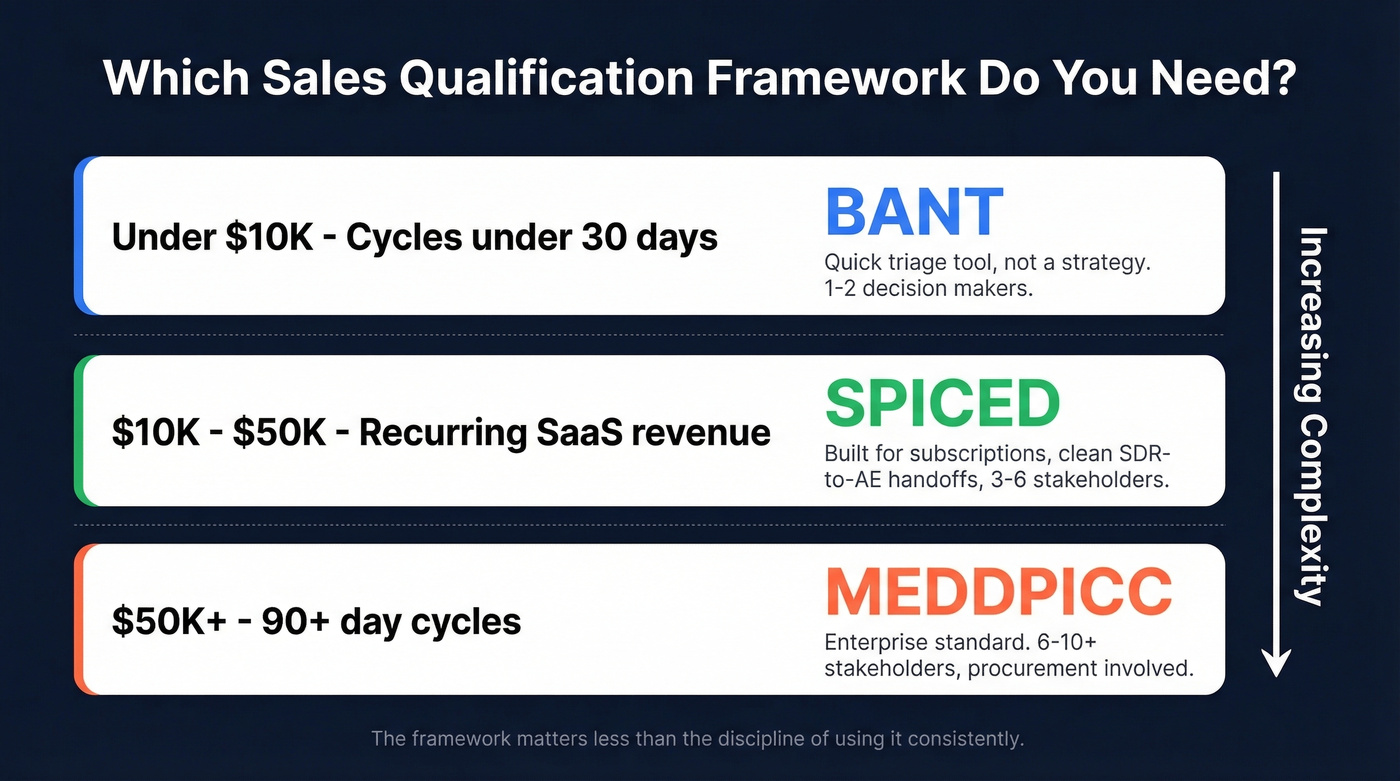
Here's the thing most framework articles won't tell you: the framework matters less than the discipline of using it. We've seen teams triple their SQL-to-close rate just by enforcing one framework consistently - not by picking the "perfect" one. Pick one. Implement it. Stop collecting acronyms.
Qualification by the Numbers
Before we compare methods, let's ground this in funnel math. First Page Sage's benchmark data across B2B SaaS companies shows:
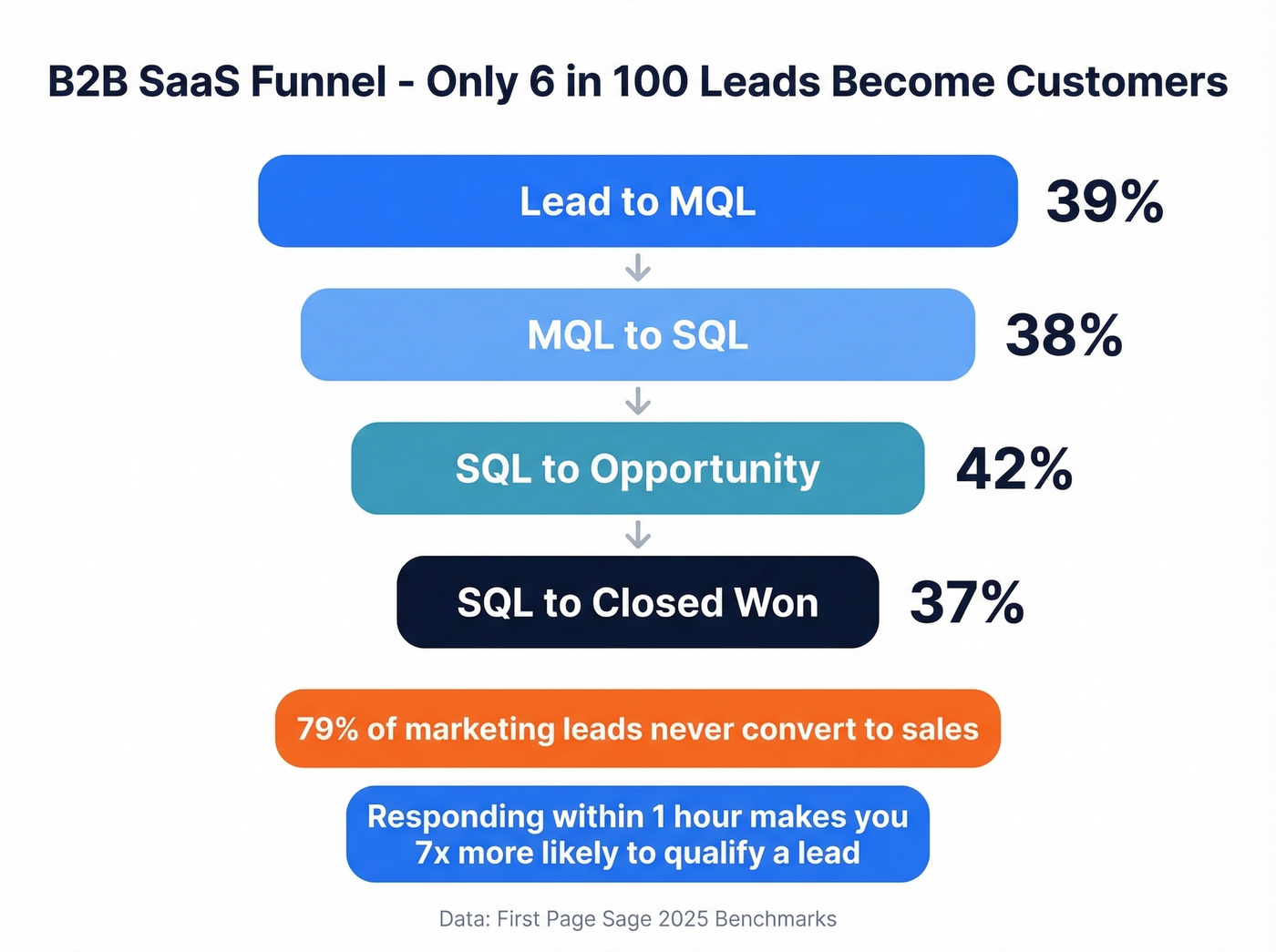
| Stage | Conversion Rate |
|---|---|
| Lead to MQL | 39% |
| MQL to SQL | 38% |
| SQL to Opportunity | 42% |
| SQL to Closed Won | 37% |
Roughly 6 out of every 100 leads become customers. And 79% of marketing leads never convert to sales at all. Qualification is where most of the filtering should happen - not at the proposal stage when you've already burned three discovery calls and a custom demo.
One stat worth internalizing: responding to a lead within one hour makes you 7x more likely to qualify them. Speed and qualification aren't separate problems. They're the same problem.
Methods That Actually Matter
BANT: Budget, Authority, Need, Timeline
IBM introduced BANT in the 1950s, and it still works as a quick triage filter for high-volume, transactional deals under $10K with short cycles and one or two decision-makers. But it's shallow. It doesn't account for buying groups of 6-10+ stakeholders, it ignores competitive dynamics entirely, and it encourages reps to interrogate rather than discover.
Skip BANT if you're selling into enterprise accounts where budget gets created after you build a business case. In complex deals, "they already have budget" is often a red flag - it means they're comparing you to an incumbent, not building a new initiative.
Discovery questions:
- "What's your timeline for having a solution in place - and what happens if that slips?"
- "Who else needs to sign off before this moves forward?"
CHAMP: Challenges First
CHAMP is BANT reordered with a buyer-first lens. Zorian Rotenberg's contribution was putting Challenges first, which changes the entire conversation dynamic. Instead of leading with "do you have budget," you lead with "what's broken."
This methodology shines when your buyers don't know they have a problem yet and pain discovery matters more than budget confirmation. It falls short when you need rigorous multi-stakeholder mapping, and like BANT, it doesn't map competitive positioning - a gap worth noting if you're in a crowded market.
Discovery questions:
- "What's the biggest operational challenge your team is trying to solve this quarter?"
- "If you don't fix this, what does Q3 look like?"
MEDDPICC: The Enterprise Standard
A thread on r/sales put it bluntly: "MEDDIC is a CRM exercise where reps fill out fields to make managers happy." That critique isn't wrong - it's just incomplete. Without deal rooms, manager coaching, and CRM integration, MEDDPICC does become busywork. But with the right infrastructure, nothing else comes close for deals over $50K with 90+ day cycles and procurement involvement.
Dick Dunkel and Jack Napoli developed MEDDIC at PTC in the 1990s, and John McMahon later popularized it across enterprise SaaS. Its eight elements - Metrics, Economic Buyer, Decision Criteria, Decision Process, Paper Process, Implicate the Pain, Champion, Competition - cover every angle of a complex deal. The element most teams get wrong is Champion. A real Champion isn't someone who likes your product. A real Champion has internal juice and will spend political capital: sharing internal decks, mapping the org chart, bringing detractors into the conversation, and pulling procurement in early. In our experience, teams that can't identify a true Champion by Stage 3 close those deals less than 15% of the time.
Discovery questions:
- "What metrics would your CFO use to evaluate whether this investment paid off?"
- "Walk me through what happens after your team says yes - who else touches the contract before it's signed?"
- "Who on your side has the most to gain from this project succeeding?"
SPICED: Built for SaaS
Imagine this: your SDR qualifies a lead, writes up notes, hands it to an AE - and the AE asks the same questions on the first call. The prospect checks out. Winning by Design built SPICED specifically to kill this problem. Situation, Pain, Impact, Critical Event, Decision. The same format works for discovery, SDR-to-AE handoffs, and forecasting summaries. One structure, multiple use cases.
SPICED is the right choice for SaaS deals in the $10K-$50K range, especially with a PLG motion or complex handoffs between SDR, AE, and CS. Where MEDDPICC is a deal qualification checklist, SPICED is a buyer-centric narrative structure that forces reps to understand the story behind the deal.
Discovery questions:
- "What changed in the last 6 months that made this a priority now?"
- "If you solve this, what does that unlock for the broader team?"
FAINT, GPCTBA/C&I, and NEAT
FAINT from RAIN Group works when prospects don't have existing budget - common in greenfield enterprise selling. GPCTBA/C&I is HubSpot's framework; it's thorough but complex enough that most teams simplify it within weeks. NEAT from Richard Harris is a lightweight alternative for mid-market teams who find MEDDPICC too heavy.
Quick filter: if your reps can't remember the acronym without looking it up, the framework is too complex for your motion.
The 3-Criteria Checklist
A 20-year practitioner on r/sales offers a stripped-down alternative: Requirements, Budget, Competition. That last element is what makes this interesting. Most frameworks ignore competitive dynamics entirely, and this one puts it front and center.
The budget discovery language is worth stealing regardless of your framework. Direct approach: "Let my team design the most comprehensive solution tailored to your budget." Indirect: "What was the investment for your existing setup or projects of a similar scale?" Both normalize the money conversation instead of making it an interrogation.

Your qualification framework is only as good as the data behind it. If 79% of leads never convert, start with contacts that are verified, current, and reachable. Prospeo's 98% email accuracy and 7-day data refresh mean your reps qualify real buyers - not ghosts.
Feed your framework verified leads, not dead-end contacts.
Framework Selection Matrix
| Framework | Deal Size | Cycle Length | Stakeholders | Best For |
|---|---|---|---|---|
| BANT | Under $10K | Under 30 days | 1-2 | High-volume triage |
| CHAMP | $5K-$25K | 30-60 days | 2-4 | Pain-led discovery |
| MEDDPICC | $50K+ | 90+ days | 6-10+ | Enterprise complex deals |
| SPICED | $10K-$50K | 30-90 days | 3-6 | SaaS with PLG or handoffs |
| 3-Criteria | Under $25K | Under 60 days | 1-3 | Teams allergic to acronyms |
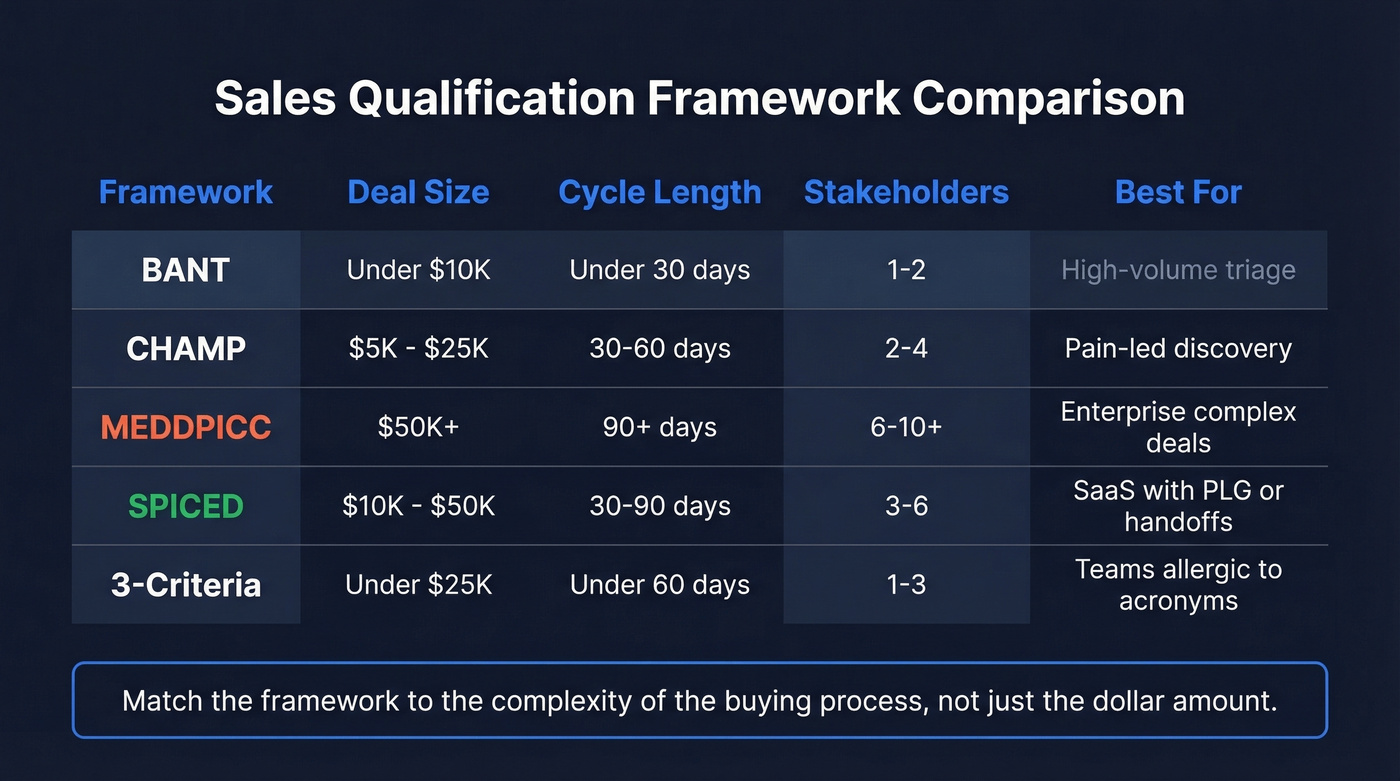
A $30K deal with one decision-maker and a 2-week cycle doesn't need MEDDPICC. Match the framework to the complexity of the buying process, not just the dollar amount.
Modern Qualification Signals
Frameworks give you structure for conversations. But in 2026, qualification starts before the first call. The distinction that matters is passive versus active signals:
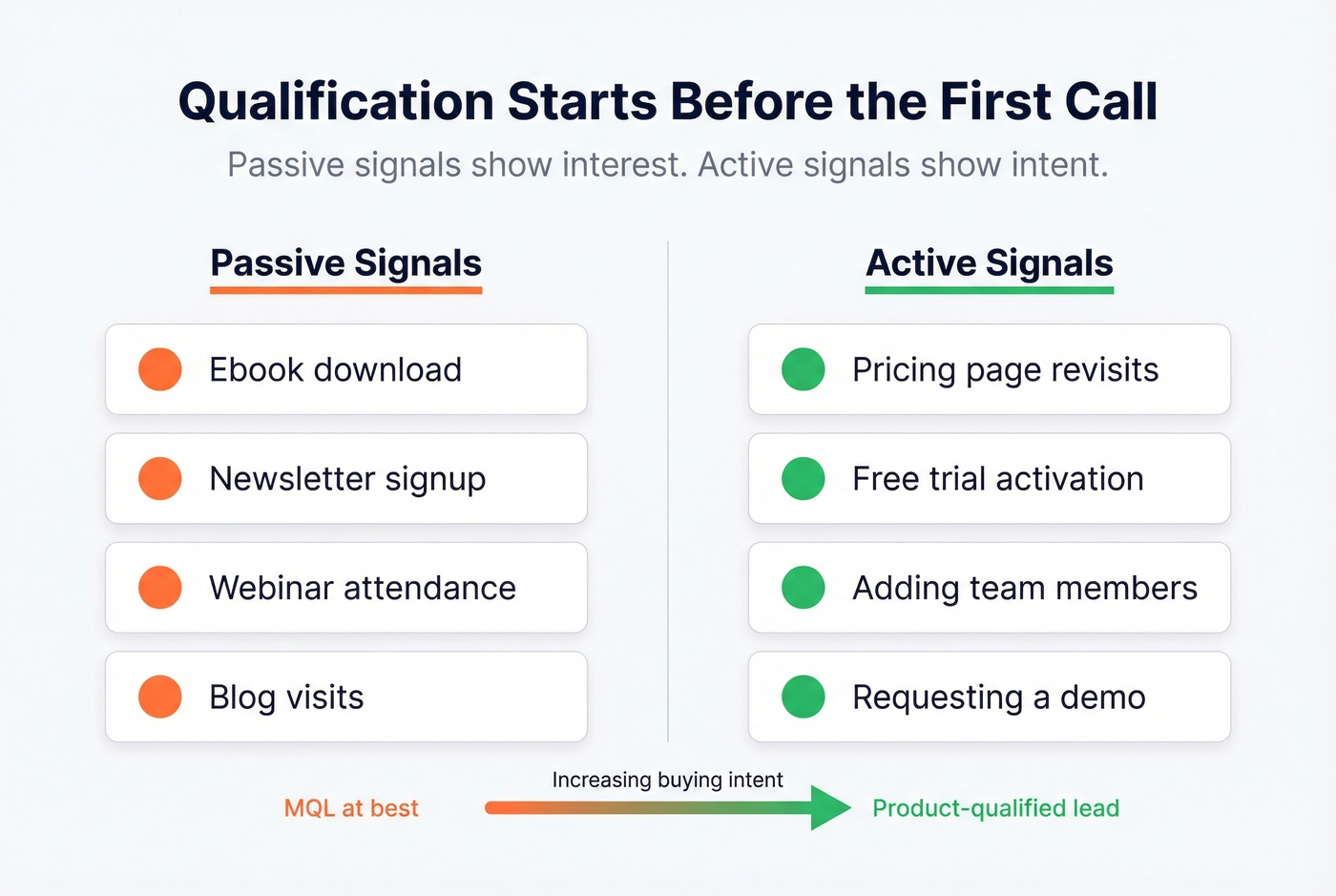
| Passive Signals | Active Signals |
|---|---|
| Ebook download | Pricing page revisits |
| Newsletter signup | Free trial activation |
| Webinar attendance | Adding team members |
| Blog visits | Requesting a demo |
A prospect who downloaded your ebook is an MQL at best. A prospect who visited your pricing page three times, activated a trial, and invited two colleagues? That's a product-qualified lead who's already experienced value. The qualification conversation with that person is entirely different.
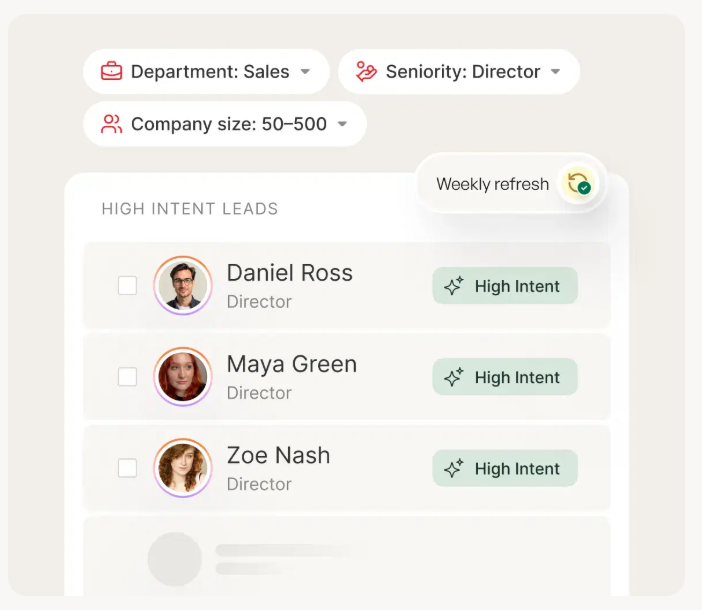
Your sales qualifying criteria should evolve alongside these signals. Any framework is only as good as the data feeding it. If your contact database refreshes every six weeks, you're qualifying ghosts - people who've changed jobs, shifted roles, or gone dark. Tools like Prospeo refresh data every 7 days and verify emails at 98% accuracy, so reps spend discovery calls qualifying real buyers instead of bouncing emails. Layer in intent data across 15,000 topics, and reps start every day knowing which accounts are actively researching solutions before anyone picks up the phone.
Recalibrate your scoring model quarterly. What counted as high intent six months ago might be noise today - webinar signups that once predicted pipeline might now just mean your marketing team runs great ads.
Implementing Without Busywork
Most framework rollouts fail not because the framework is wrong, but because the implementation creates busywork. Here's how to avoid that:
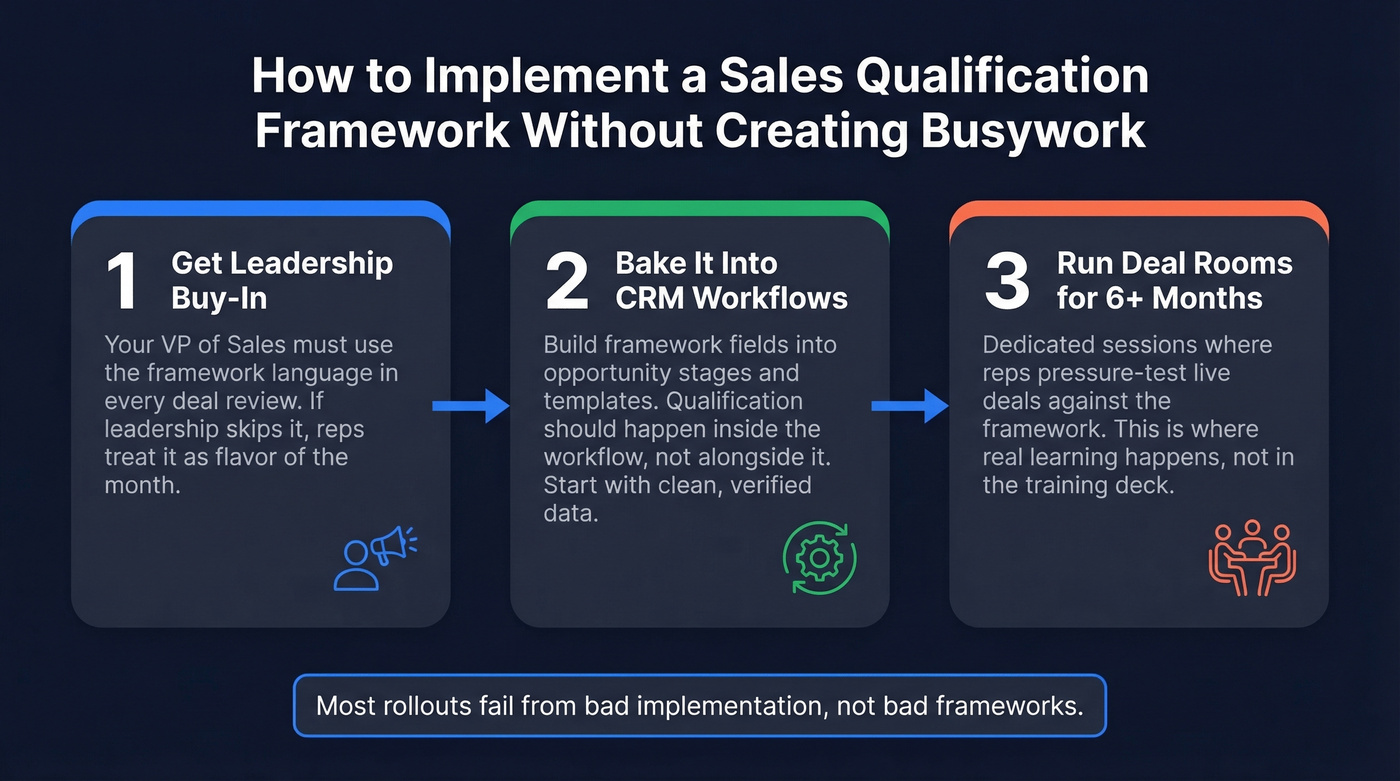
Get visible leadership buy-in first. If your VP of Sales doesn't use the framework language in deal reviews, reps will treat it as flavor of the month. Full stop.
Bake it into CRM workflows. Don't rely on reps remembering. Build framework fields into opportunity stages, templates, and talk tracks so qualification happens inside the existing workflow, not alongside it. Start with clean data - layer intent signals, technographics, and job-change signals so reps qualify against real buying behavior, not stale records.
Run deal rooms for at least 6 months. These are dedicated sessions where reps pressure-test live deals against the framework. This is where the real learning happens - not in the training deck. We've watched teams that skip deal rooms abandon MEDDPICC within three months.
Measure quality, not activity. If your KPIs reward calls-per-day over qualification accuracy, reps will game the framework. Track SQL-to-close rates, not CRM field completion.
A/B test before you commit. Run two frameworks across different segments for two quarters and compare SQL-to-close rates before declaring a winner. And spot-check call recordings - the gap between what reps write in CRM fields and what they actually ask on calls is often enormous.
Let's be honest about one more thing: if your reps lack foundational selling skills - credibility, active listening, value articulation - they'll populate any framework with garbage data. MEDDPICC doesn't teach reps how to sell. It teaches them how to evaluate a deal. Those are different skills.
MEDDPICC won't save a deal built on bad contact data. When you need to reach the Economic Buyer or confirm a Champion, you need direct dials that actually connect. Prospeo delivers 125M+ verified mobiles with a 30% pickup rate - so your reps spend discovery calls qualifying, not chasing.
Reach the decision-makers your framework tells you to find.
FAQ
What's the best sales qualification framework for SaaS?
SPICED, built by Winning by Design specifically for recurring-revenue businesses. It handles SDR-to-AE handoffs cleanly and works across discovery, forecasting, and CS transitions. For enterprise SaaS deals over $50K, switch to MEDDPICC.
Can I combine multiple frameworks?
Don't. Most teams fail because they implement poorly, not because they chose the wrong framework. Pick the one that matches your deal size and sales motion, customize it to your ICP, and commit for at least six months before evaluating.
How do I qualify leads before the first call?
Use ICP fit scoring, intent signals like pricing page visits and trial activations, and verified contact data to pre-qualify. Combine firmographic filters - headcount growth, funding stage, tech stack - with 30+ search filters and verified emails, and you'll disqualify 60-70% of your list before a rep touches it. Defining clear qualifying criteria at this stage ensures reps only spend time on prospects who match your ideal buyer profile.