

The Sales Qualification Process Your Team Actually Needs in 2026
You just burned 45 minutes on a discovery call with someone who has no budget, no timeline, and no authority to sign anything. Meanwhile, three real opportunities sat untouched in your pipeline. 67% of lost sales stem from improper qualification - and most teams know this but still don't have a repeatable sales qualification process to fix it.
Here's the thing: the fix isn't complicated. It's just rarely enforced.
The Short Version
Pick one framework based on deal size: BANT for deals under $10K, MEDDIC above $50K, and CHAMP or SPICED when you need a more consultative, pain-first approach in the middle. Then enforce it consistently. The average MQL-to-SQL conversion rate is just 13%, and bad contact data makes that number worse.
Why Qualification Matters More Than Pipeline Volume
Qualified opportunities close at roughly 29%, while the average B2B win rate hovers around 21%. Speed compounds the advantage: deals that close within 50 days hit a 47% win rate, but anything beyond that window drops to 20% or lower. And responding within the first hour yields 7x higher qualification odds compared to waiting 24 hours.
Companies with mature qualification workflows see 9.3% higher quota attainment, 26% higher conversion rates, and up to 50% more revenue. One lead scoring implementation generated $170,000 in incremental revenue within four months. A BANT-qualified lead campaign increased marketing ROI by 45%. These aren't theoretical gains - they're what happens when reps stop chasing ghosts and start spending time on real buyers.
Qualification also benefits buyers. It helps them define their problem, build internal consensus, and avoid wasting their own time on solutions that won't fit.
| Metric | Qualified Pipeline | Unqualified Pipeline |
|---|---|---|
| Win Rate | ~29% | ~21% |
| Close in <50 Days | 47% win rate | 20% or lower |
| Speed-to-Lead (1 hr) | 7x higher odds | Baseline |
Three Stages of Qualification
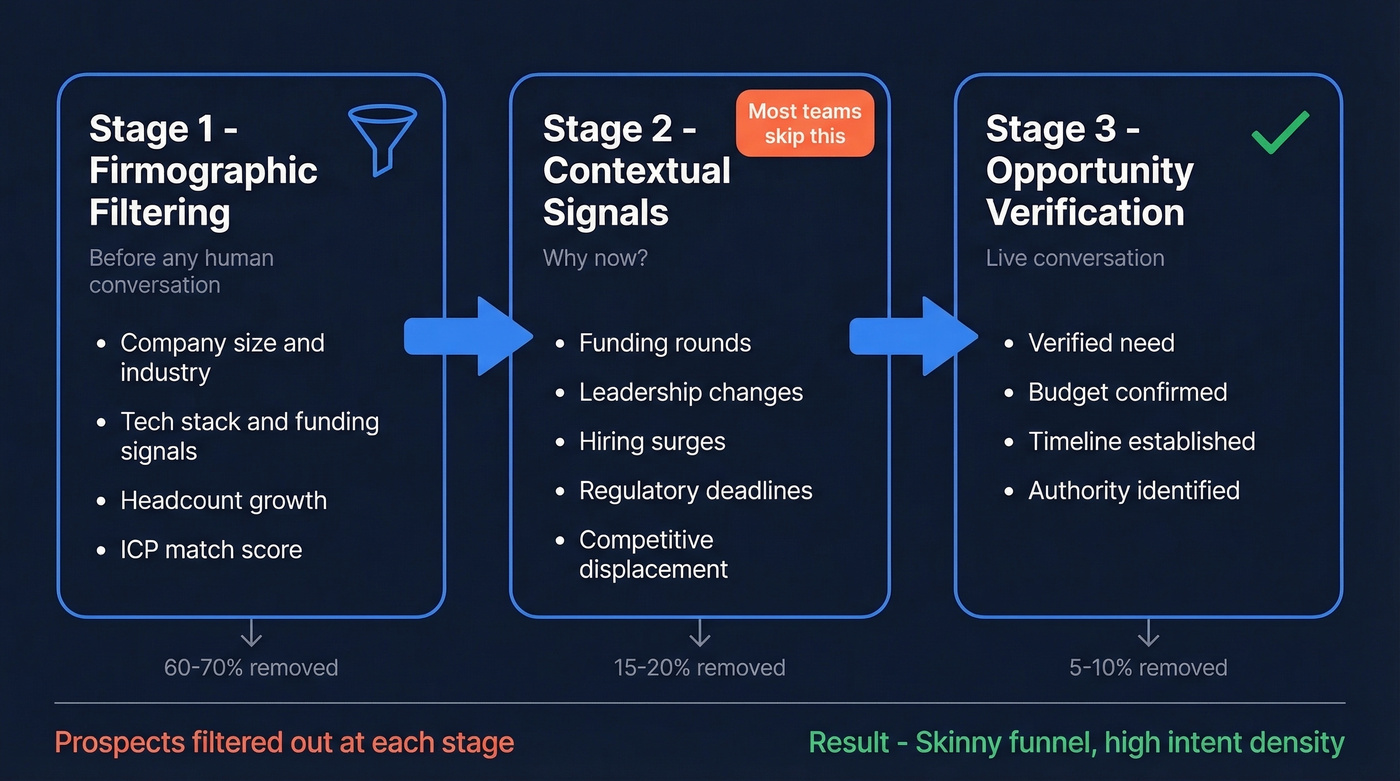
Qualification isn't a single conversation. It's three distinct stages, each filtering out bad-fit prospects before you invest more time.
Stage 1 - Firmographic Filtering
This is list-level filtering before any human conversation happens. You're matching prospects against your ICP: company size, industry, tech stack, funding signals, headcount growth. If a prospect doesn't clear these basics, no amount of charm on a discovery call will close the deal.
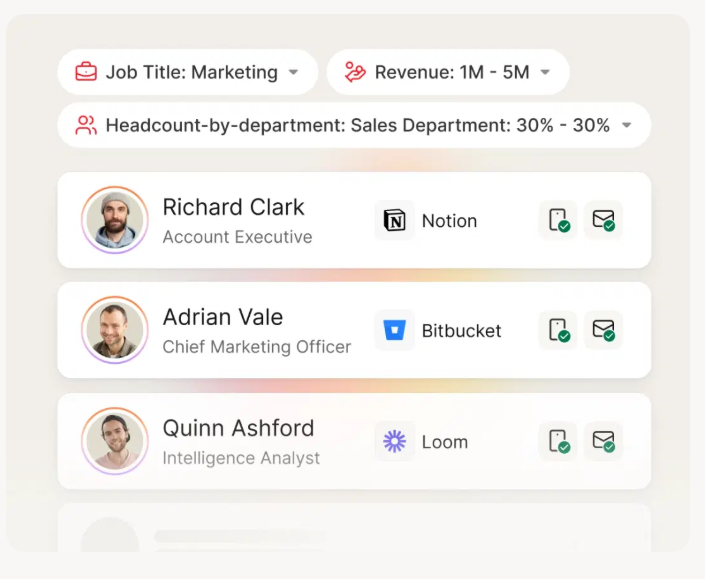
Prospeo's B2B database filters by 30+ criteria including buyer intent, technographics, and headcount growth - with 98% verified email accuracy on a 7-day refresh cycle. Reps start conversations with real people, not bounced emails.
Stage 2 - Contextual Signals
This is the hardest stage, and practitioners on r/sales agree. You're trying to answer "why now?" - and the signals are often indirect. Look for funding rounds, leadership changes, hiring surges, regulatory deadlines, or competitive displacement events.
Most teams skip this entirely and jump straight to opportunity verification. That's how you end up with a pipeline full of prospects who fit your ICP on paper but aren't buying anything this quarter.
Stage 3 - Opportunity Verification
Now you're in a live conversation. Verify need, budget, timeline, and authority - in that order. The skinny funnel philosophy - high intent density over raw volume - consistently outperforms bloated pipelines. Every deal you disqualify early gives you time back for one that'll actually close.
Most teams don't have a pipeline problem. They have a disqualification problem. A 50-deal pipeline where 30 are dead weight will lose to a 20-deal pipeline where every prospect is real.

Your qualification process is only as good as the data behind it. Prospeo's 30+ firmographic filters - buyer intent, technographics, headcount growth, funding - let you complete Stage 1 filtering before a single rep picks up the phone. 98% email accuracy on a 7-day refresh means every contact is current and real.
Stop burning discovery calls on prospects who were never qualified to begin with.
Pick Your Framework (Then Stick With It)
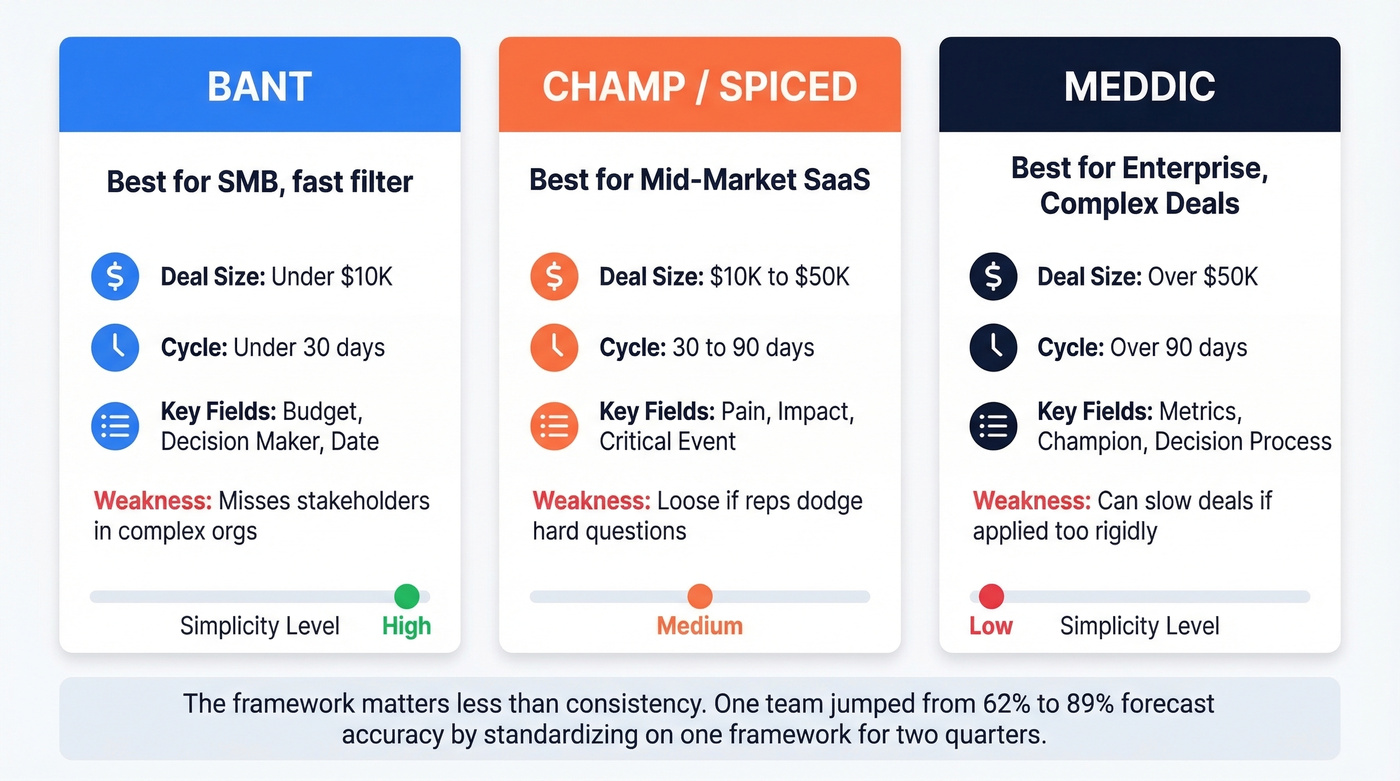
The framework matters less than consistency. We've seen teams jump from BANT to MEDDIC to SPICED in a single year and wonder why their forecast accuracy is garbage. One team cited a jump from 62% to 89% forecast accuracy simply by standardizing on MEDDIC and enforcing it for two quarters straight.
| Framework | Best For | Deal Size | Cycle | Key CRM Fields | Weakness |
|---|---|---|---|---|---|
| BANT | SMB, fast filter | <$10K | <30 days | Budget, decision maker, date | Misses stakeholders |
| CHAMP/SPICED | Mid-market, SaaS | $10K-$50K | 30-90 days | Pain, impact, critical event | Loose if reps dodge hard Qs |
| MEDDIC | Enterprise, complex | >$50K | >90 days | Metrics, champion, process | Can slow deals if rigid |
Map these fields into your CRM as required fields on opportunity records. If reps can advance a deal without filling them in, your framework is decoration, not process. A shared framework also eliminates the classic sales/marketing blame game - "crap leads" vs. "sales aren't closing."
Scripts That Actually Work
A 20-year practitioner framework from r/sales boils qualification down to three criteria: Requirements, Budget, and Competition.
For budget discovery - where junior reps freeze up: "We'll tailor this to your budget - what range are you working within?" Or the indirect route: "What's the expected cost for a project of this kind at your org?"
For requirements probing: Ask about regulatory deadlines, upcoming audits, or top-down mandates. Don't stop digging just because you've uncovered the first reason - there's usually a second, more urgent one underneath.
Skip this section if your reps already ask about money comfortably. Use it if budget conversations consistently stall or if new hires are ramping.
Lead Scoring and Pipeline Health
Assign point weights based on buying signals: demo request = 100 points, pricing page visit = high-intent, webinar attendance = 30. Subtract points for inactivity or bad-fit titles. AI-driven scoring models improve accuracy by roughly 40% over manual methods, and behavioral scoring alone can boost MQL-to-SQL conversion up to 40%.
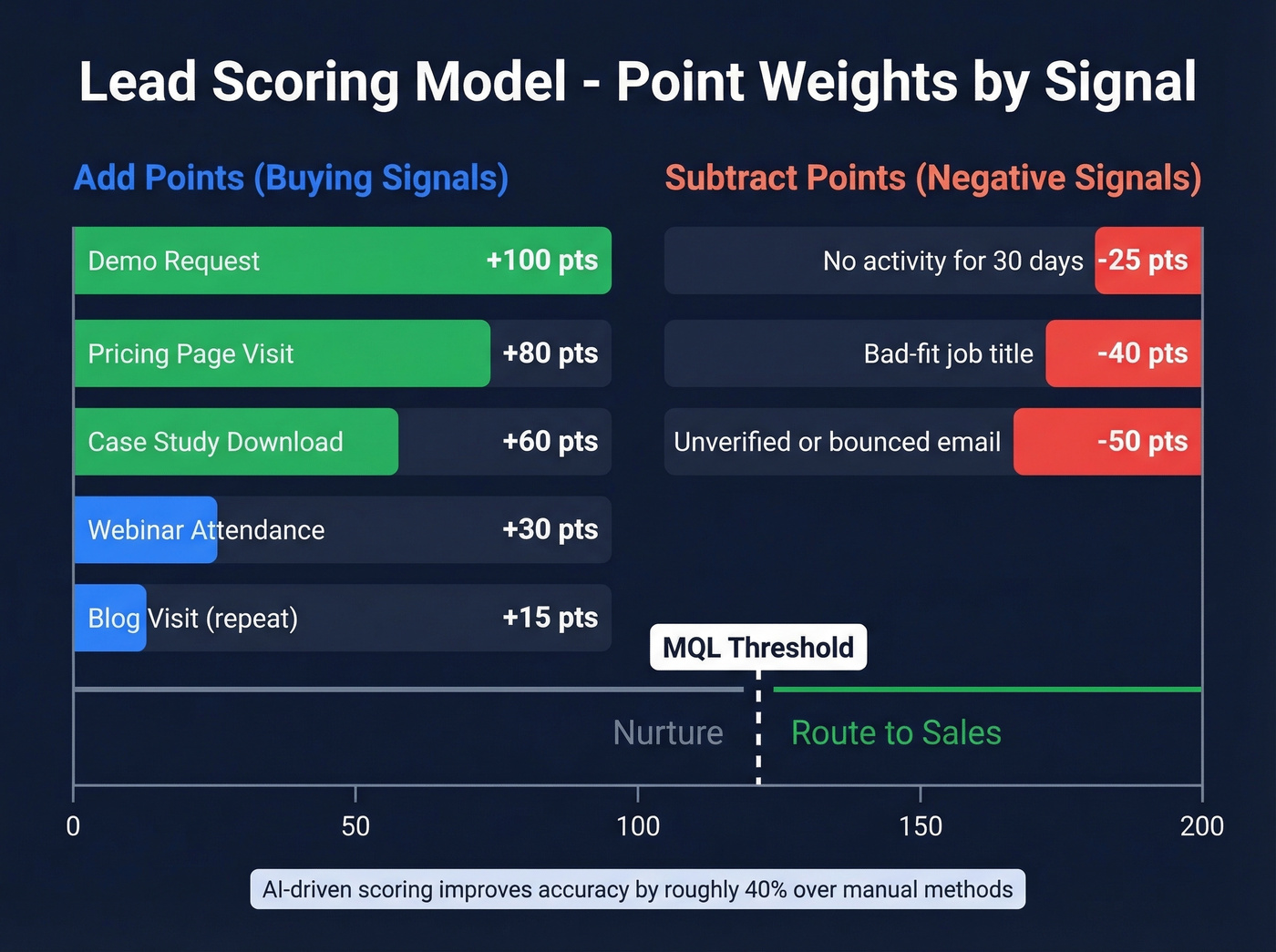
Your MQL threshold should be driven by sales capacity, not a magic number. In our experience, teams that tighten title filters while loosening activity thresholds see the fastest MQL-to-meeting improvement - one team boosted their rate by 13% doing exactly that.
| Industry | MQL-to-SQL Rate |
|---|---|
| Consumer Electronics | 21% |
| FinTech | 19% |
| Healthcare | 13% |
| Oil & Gas | 12% |
Five Mistakes Killing Your Pipeline
1. Inconsistent conversations. Make framework fields required in your CRM before a deal advances. No exceptions.
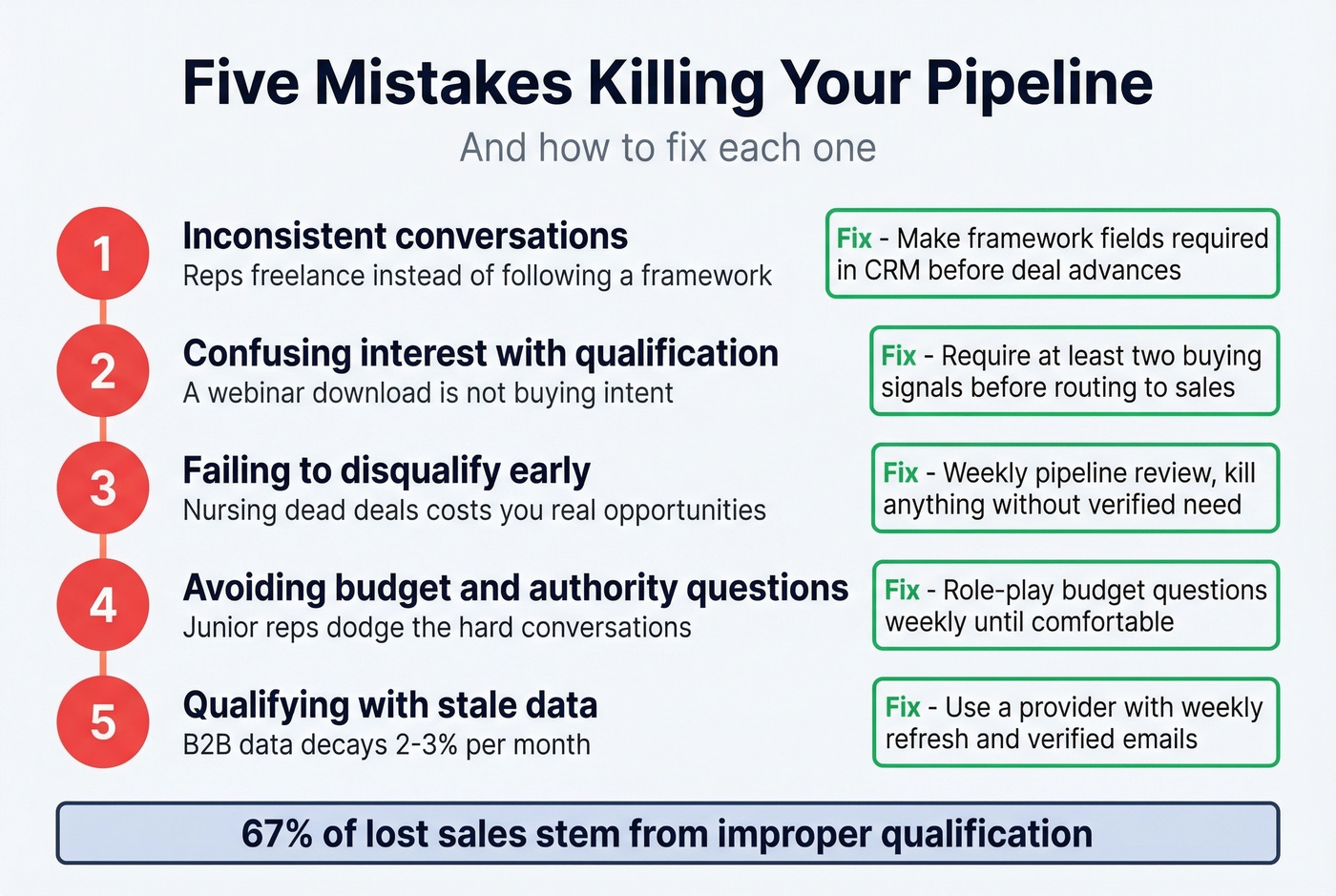
2. Confusing interest with qualification. A webinar download isn't intent. Require at least two buying signals before routing to sales.
3. Failing to disqualify early. Every week you nurse a bad-fit deal costs you a real opportunity. Let's be honest - most reps hold onto dead deals because an empty pipeline feels scarier than a small one.
4. Avoiding budget and authority questions. Junior reps dodge these. Role-play them weekly until they don't.
5. Qualifying with stale data. B2B contact data decays at roughly 2-3% per month. If your database hasn't been refreshed in six weeks, a meaningful chunk of leads are unreachable. Your reps can't qualify someone they can't reach - use a provider with a weekly refresh cycle and verified emails. For context, one of our customers saw bounce rates drop from 35% to under 4% after switching to weekly-refreshed data, which freed their reps to actually spend time qualifying instead of chasing dead addresses.
If bounce is a recurring issue, track it as a first-class metric alongside pipeline health so it shows up in weekly reviews.
Bad contact data is the silent killer of every qualification framework. BANT, MEDDIC, SPICED - none of them work when 35% of your emails bounce. Prospeo's 5-step verification and weekly data refresh cut bounce rates below 4%, so your pipeline reflects real opportunities, not ghosts.
Fix your data and your win rate fixes itself. Start at $0.01 per verified email.
FAQ
What's the difference between MQL and SQL?
An MQL has shown enough engagement - content downloads, webinar attendance, repeat site visits - to warrant a sales conversation. An SQL has verified fit: confirmed need, budget range, and decision-making authority. The gap between the two is where your sales qualification process either creates or destroys pipeline value.
Is BANT still relevant in 2026?
For SMB deals under $10K with sub-30-day cycles, BANT remains the fastest qualification filter. It's simple and it works. For enterprise deals above $50K, switch to MEDDIC to map multiple stakeholders and quantified metrics - BANT just doesn't capture enough complexity at that deal size.
How do I qualify leads when contact data keeps bouncing?
You can't run a reliable qualification process on stale lists. B2B data decays 2-3% monthly, so a 6-month-old database has roughly 15% dead contacts. Start with a provider that refreshes weekly and verifies emails before delivery. Tools like Prospeo maintain a 7-day refresh cycle and 98% email accuracy, which keeps bounce rates under 4% so reps spend time qualifying instead of troubleshooting deliverability.