

Sales Qualified Leads: 2026 Playbook With Benchmarks, Frameworks, and Scoring Templates
Your marketing team passed 200 MQLs last quarter. Sales accepted 30 and closed 4. Now both teams are in a meeting arguing about lead quality, and nobody can agree on what "qualified" even means.
That gap between marketing's definition and sales' definition of sales qualified leads is where pipeline goes to die. You don't need another glossary entry - you need a scoring model, a handoff SLA, and clean data. Let's build all three.
What Is a Sales Qualified Lead?
A sales qualified lead (SQL) is a prospect that marketing has passed to sales and that a salesperson has vetted as having genuine buying potential - budget, authority, need, and timeline to purchase. The key word is vetted. An MQL raised their hand. An SQL has been confirmed as a real opportunity by a human on your sales team.
Here's the thing: if your team treats every MQL like an SQL, reps waste cycles on prospects who downloaded a whitepaper and will never buy. Too strict, and you starve the pipeline. The 200-MQLs-to-4-closed scenario above is what B2B teams look like when qualification criteria aren't standardized.
The Numbers You Need First
The average MQL-to-SQL conversion rate sits between 13% and 26% depending on industry. Below 13%, your qualification criteria are too tight or your lead sources are weak. Above 26%, you're under-qualifying and inflating your pipeline.
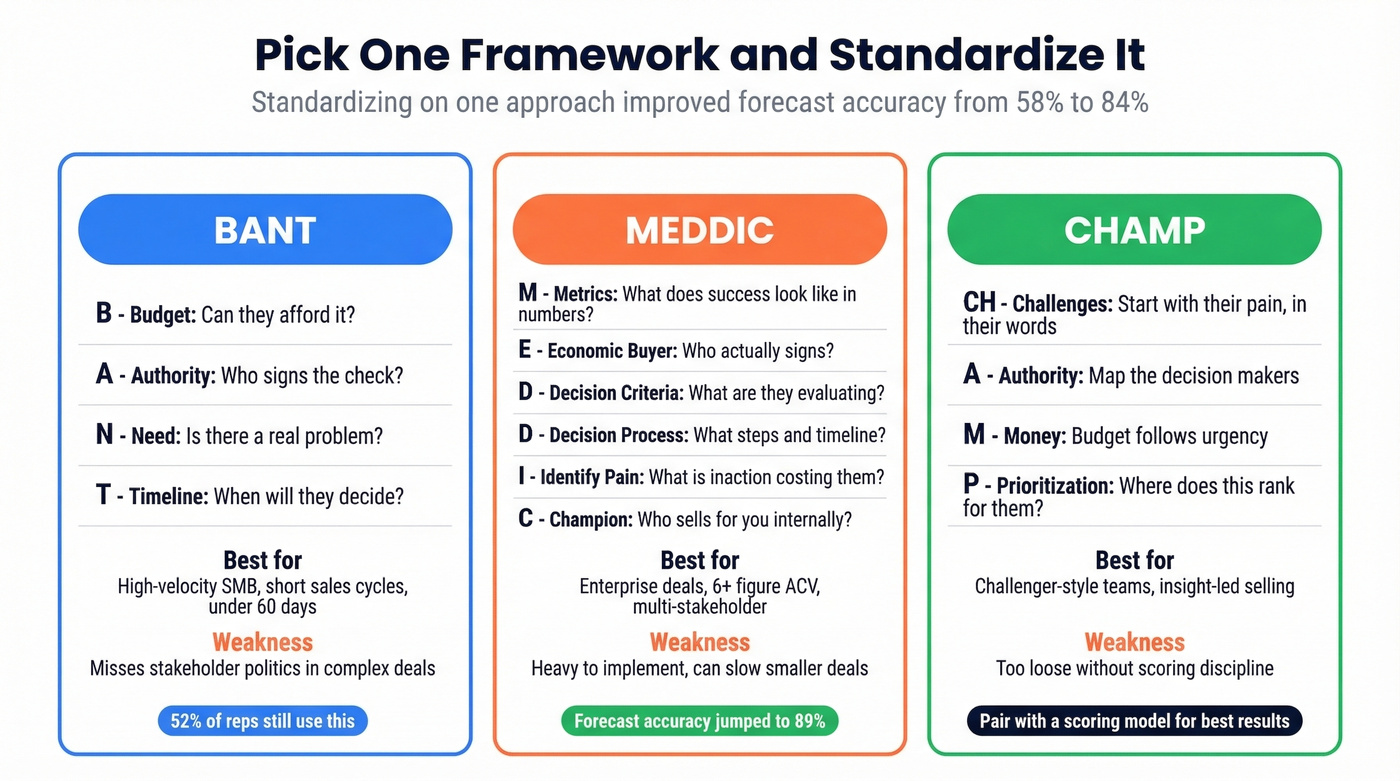
Three frameworks worth knowing: BANT for high-velocity SMB deals, MEDDIC for enterprise with multi-stakeholder complexity, and CHAMP for pain-first selling. Pick one and standardize - mixed frameworks destroy forecast accuracy.
The single most important operational stat: responding to a high-intent lead within 5 minutes makes you 21x more likely to convert than waiting 30 minutes. The average B2B response time? 42 hours. Fix that before you fix anything else.
Where SQLs Fit in the B2B Funnel
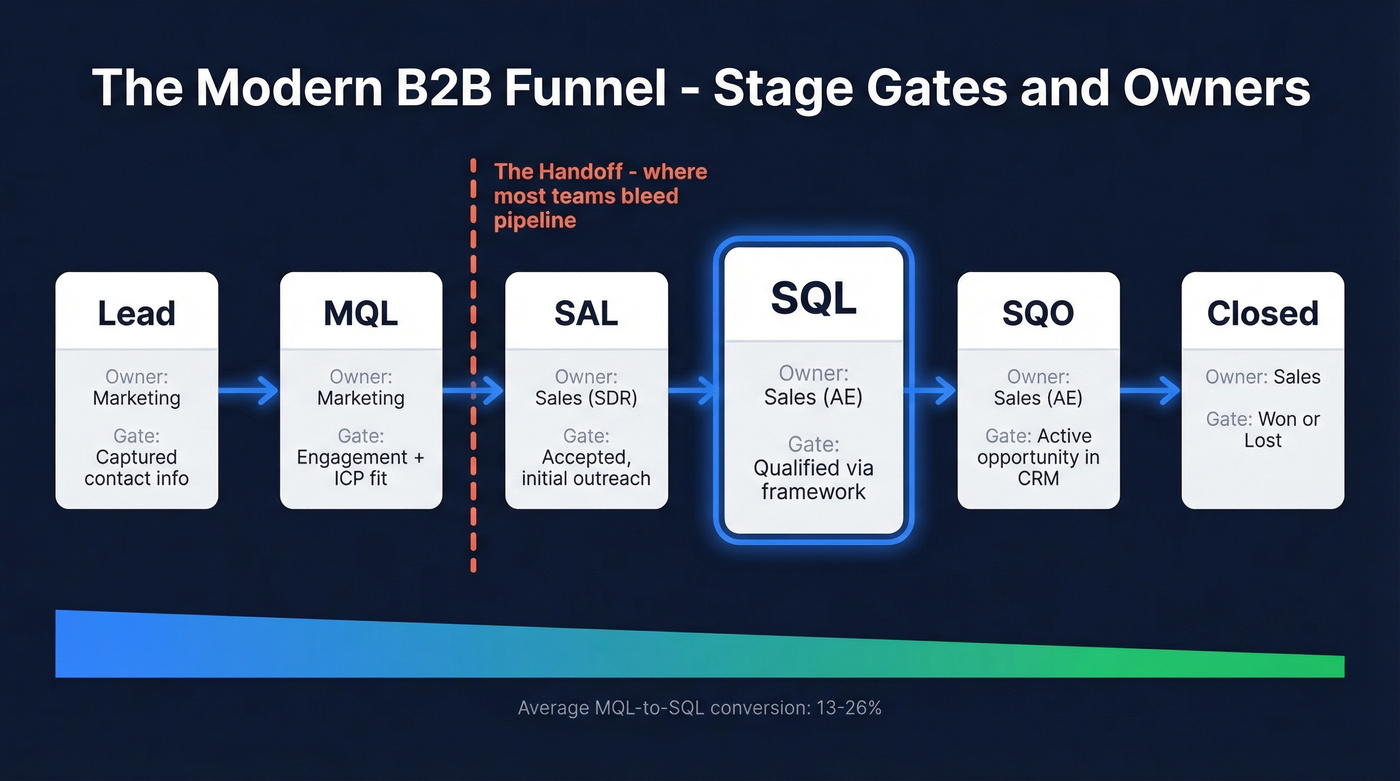
The modern B2B funnel isn't a simple top-to-bottom slide. It's a series of stage gates, each with its own criteria and owner:
| Stage | Owner | Gate Criteria |
|---|---|---|
| Lead | Marketing | Captured contact info |
| MQL | Marketing | Engagement + ICP fit |
| SAL | Sales (SDR) | Accepted, initial outreach |
| SQL | Sales (AE) | Qualified via framework |
| SQO | Sales (AE) | Active opportunity, CRM stage |
| Closed | Sales | Won or lost |
The gap between MQL and SQL is where most B2B teams bleed. Modern B2B deals involve 8-13 stakeholders and sales cycles that run 3-12 months. Roughly prefer to research independently before engaging sales, which means that by the time someone reaches the SQL stage, they're deep into evaluation - not at the beginning of their journey.
Ask any RevOps lead about their MQL-to-SQL handoff and you'll hear the same complaint: marketing says the leads are qualified, sales says they're garbage, and nobody's looking at the same scorecard. SQLs aren't leads you educate. They're leads you help buy. Your qualification process needs to reflect that distinction, or you'll waste AE time on prospects still in research mode.
SQL vs MQL vs PQL
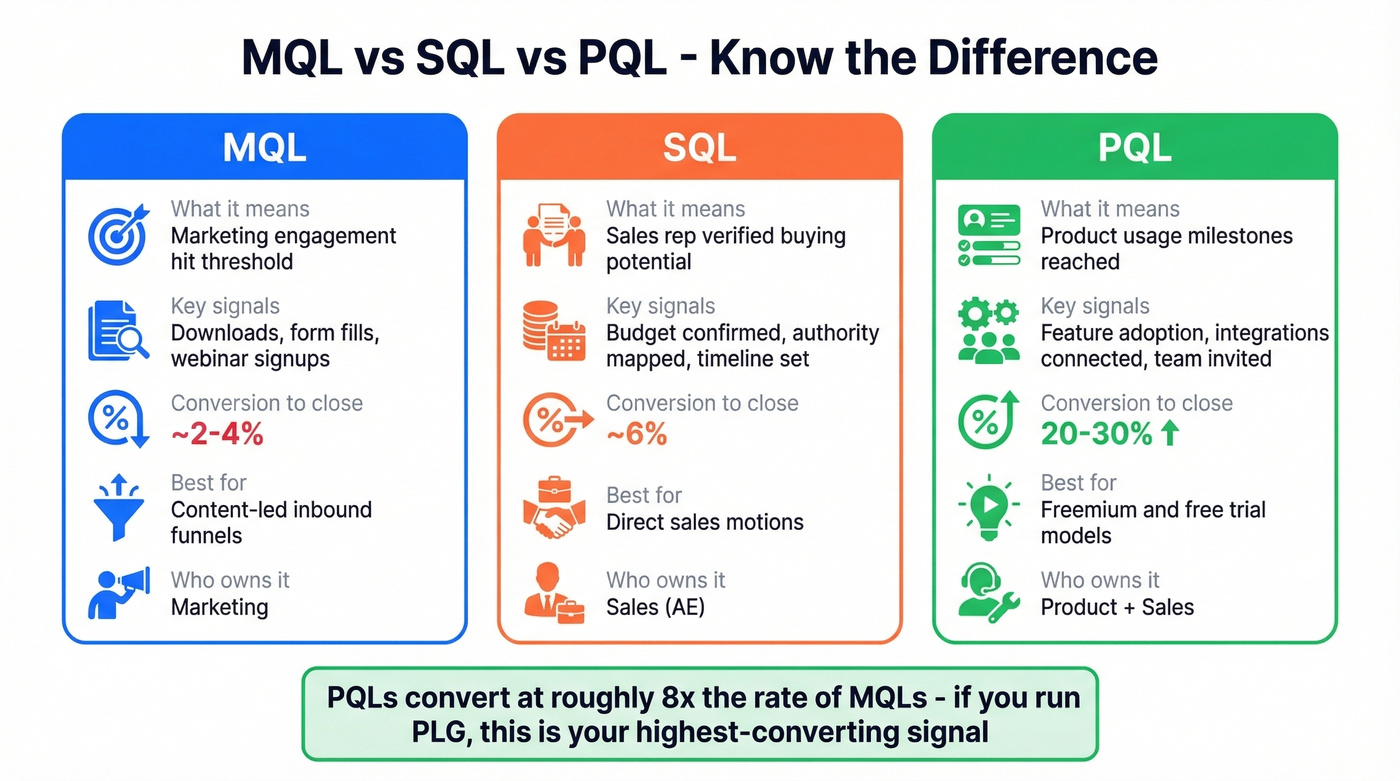
Most articles stop at MQL vs SQL. That's incomplete. Product qualified leads have become the third pillar, especially for PLG companies.
| Dimension | MQL | SQL | PQL |
|---|---|---|---|
| Definition | Marketing engagement | Sales-vetted opportunity | Product usage milestones |
| Key signals | Downloads, form fills | Budget, authority, timeline | Feature adoption, integrations |
| Conversion rate | 13% to SQL | ~6% to close | 20-30% to close |
| Best for | Content-led funnels | Direct sales motions | Freemium / free trial models |
PQLs convert at roughly 8x the rate of MQLs. That's not a marginal improvement - it's a fundamentally different conversion engine.
A PQL isn't just a signup. It's a free trial or freemium user who's hit meaningful usage milestones and matches your ICP. For an email platform, that might mean connecting a sending domain, importing contacts, and sending at least one campaign. For a project management tool: creating a project, inviting a teammate, and moving tasks across columns. The concept extends to Product Qualified Accounts when three or more users at the same company are active and sessions are recurring - an account-level signal far stronger than any individual MQL action.
If you're running a PLG motion and still routing leads based on lead scoring alone, you're ignoring your highest-converting signal.

Your MQL-to-SQL rate tanks when contact data is wrong. Prospeo delivers 98% email accuracy and 125M+ verified mobiles - so every SQL your reps work has a real path to a conversation.
Fill your pipeline with SQLs that pick up the phone.
MQL-to-SQL Conversion Benchmarks
By Industry
First Page Sage analyzed client data from 2019-2025 to produce industry-specific MQL-to-SQL conversion rates - some of the only segmented benchmarks available with explicit definitions:
| Industry | MQL-to-SQL Rate |
|---|---|
| B2B SaaS | 13% |
| Cybersecurity | 15% |
| Construction | 12% |
| Business Insurance | 26% |
| eCommerce | 23% |
| Aerospace & Aviation | 17% |
The overall average range sits at 12-21% across sectors, with top performers reaching up to 40%. B2C and D2C companies typically outperform B2B at 18-22% versus 13-15%. If you're at 13% in B2B SaaS, you're average. At 8%, something is broken - either your lead sources, your scoring model, or your handoff process.
By Channel
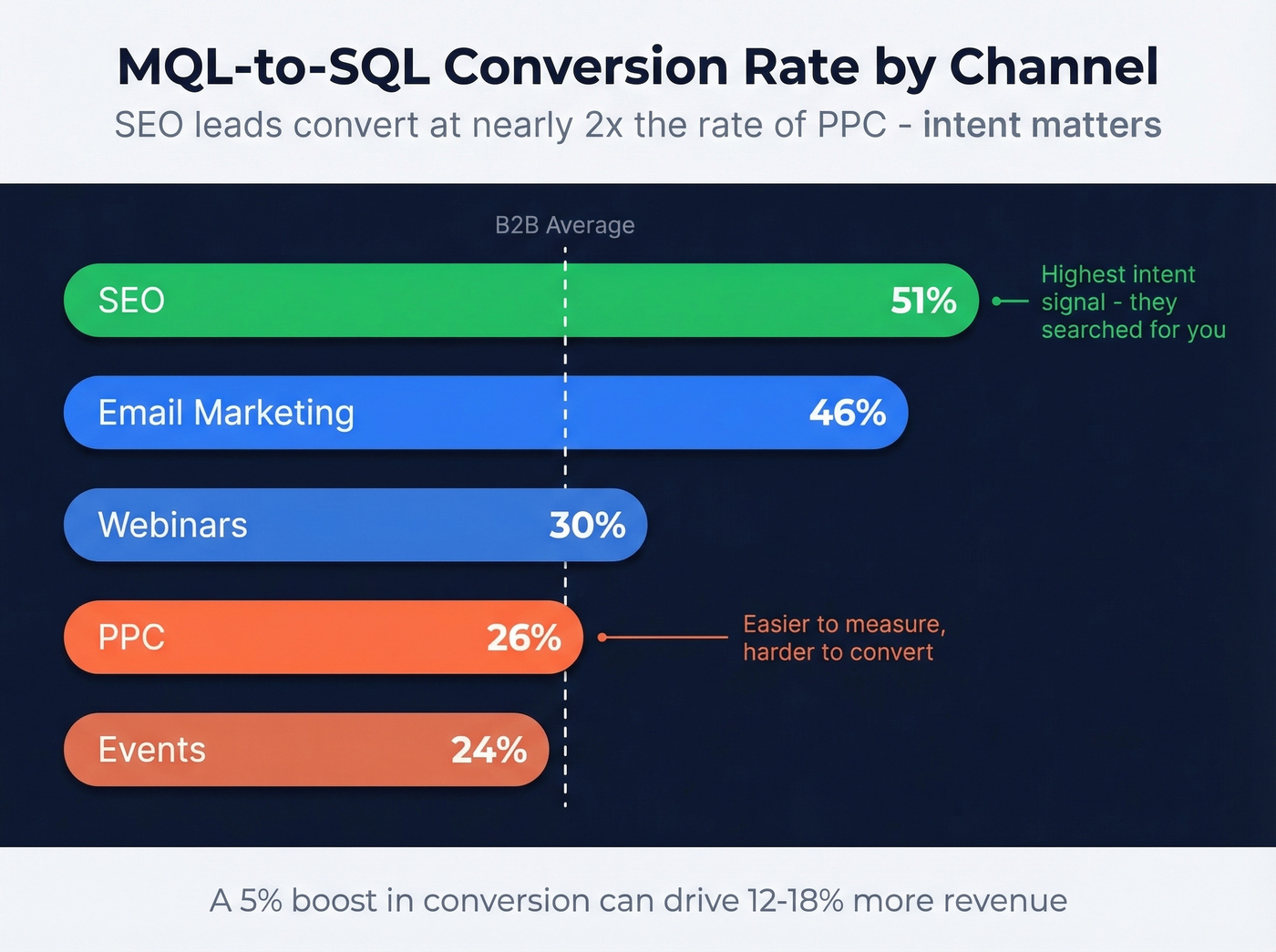
Channel matters more than most teams realize. Data-Mania's 2026 benchmarks show dramatic variation:
| Channel | MQL-to-SQL Rate |
|---|---|
| SEO | 51% |
| Email Marketing | 46% |
| Webinars | 30% |
| PPC | 26% |
| Events | 24% |
If you're dumping budget into PPC without maxing out SEO and email, you're leaving pipeline on the table. SEO leads convert at nearly double the rate of PPC leads because the intent signal is fundamentally different - someone searching for your category is further along than someone who clicked an ad. Even a 5% boost in conversion rates can drive a 12-18% increase in revenue.
Look, most B2B teams over-invest in paid channels because they're easier to measure, not because they convert better. If your SEO pipeline is underfunded, that's your biggest missed opportunity - not another $20K in LinkedIn ads.
How to Qualify SQLs: 3 Frameworks
| Framework | Best For | Weakness | When to Use |
|---|---|---|---|
| BANT | High-velocity SMB | Ignores stakeholder complexity | Lower-ACV deals, short cycles |
| MEDDIC | Enterprise, 6+ figure deals | Can slow deals if applied rigidly | Multi-stakeholder enterprise |
| CHAMP | Challenger-style teams | Too loose without discipline | Pain-first discovery |
BANT
BANT was invented by IBM in the 1950s. Budget, Authority, Need, Timeline - check three of four, and the lead qualifies. About 52% of sales reps still use it as their primary framework.
BANT is a starting point, not a strategy. It works for high-velocity inbound where you're triaging dozens of leads per week and deals close in under 60 days. For anything involving 8+ stakeholders and a 6-month evaluation, BANT will miss the political dynamics that actually kill deals. Use it as a bouncer at the door, not as your entire qualification methodology.
MEDDIC
MEDDIC goes deeper: Metrics (what does success look like quantified?), Economic Buyer (who signs the check?), Decision Criteria (what are they evaluating against?), Decision Process (what are the steps and timeline?), Identify Pain (what's the business cost of inaction?), and Champion (who's selling internally for you?).
We've seen teams switch from BANT to MEDDIC and improve forecast accuracy from 62% to 89% (https://docbeacon.io/blog/sales-qualification-frameworks). That's the difference between a pipeline you can trust and one that collapses every quarter. MEDDIC is heavier to implement, but for enterprise deals with six-figure ACVs, it's the standard for a reason.
CHAMP
CHAMP flips the script: start with Challenges, then map Authority, Money, and Prioritization. The logic is that if you can't articulate the prospect's pain in their language, nothing else matters. Budget and timeline are downstream of urgency.
CHAMP works well for challenger-style teams that lead with insight rather than discovery questions. The risk is that without discipline, it becomes too loose - reps qualify based on "they seemed interested" rather than concrete criteria. For teams running CHAMP, pair it with a scoring model that enforces minimum thresholds.
The framework matters less than consistency. Standardizing on one approach improved forecast accuracy from 58% to 84% in one case study. Pick one, train on it, enforce it.
Build a Lead Scoring Model
Scoring Template
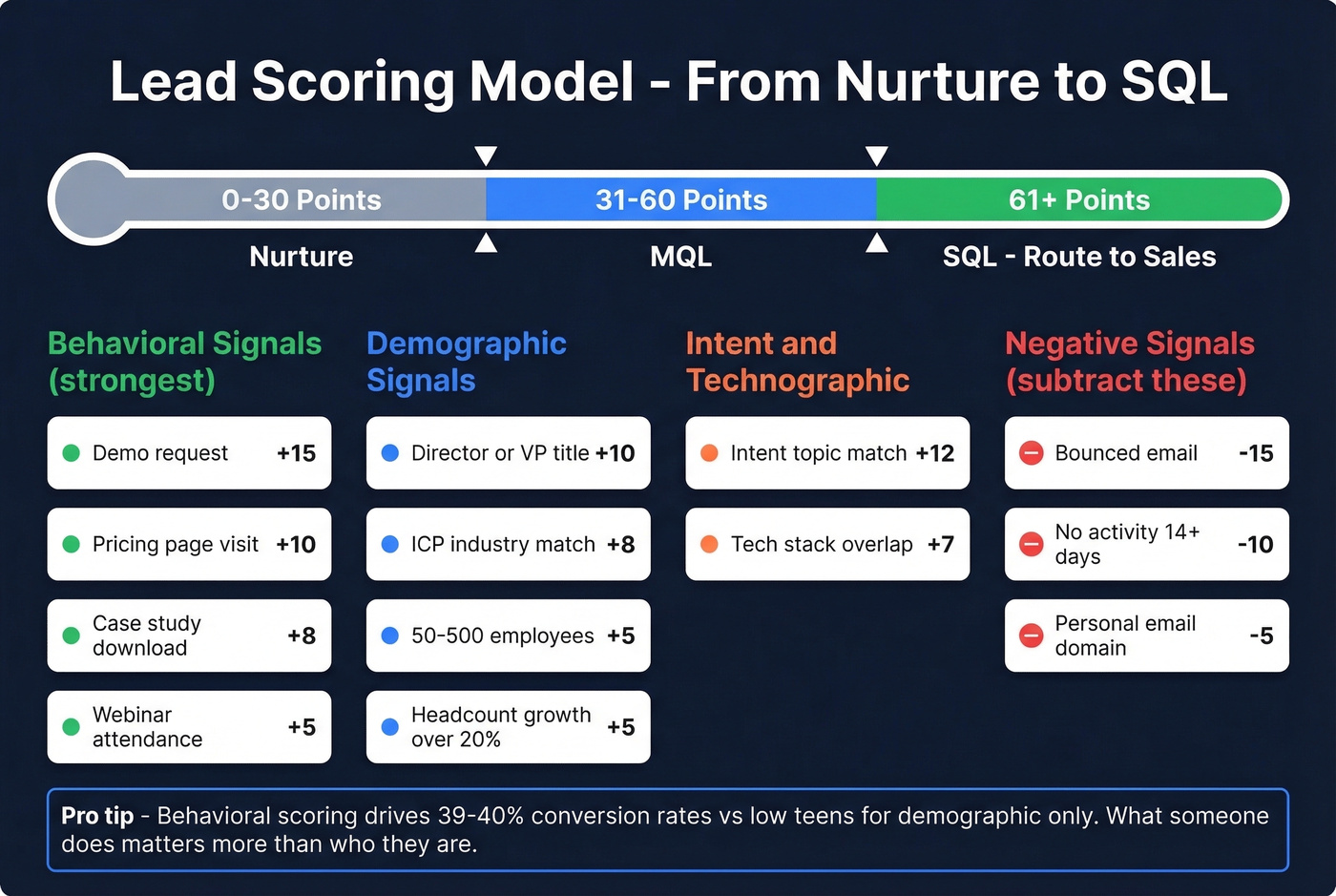
A scoring model translates qualification criteria into numbers your CRM can automate. Here's a template based on common RevOps implementations:
| Signal | Points | Type |
|---|---|---|
| Demo request | +15 | Behavioral |
| Pricing page visit | +10 | Behavioral |
| Case study download | +8 | Behavioral |
| Webinar attendance | +5 | Behavioral |
| Intent topic match | +12 | Intent |
| Tech stack overlap | +7 | Technographic |
| Director/VP title | +10 | Demographic |
| ICP industry match | +8 | Demographic |
| 50-500 employees | +5 | Demographic |
| Headcount growth >20% | +5 | Growth signal |
| No activity 14+ days | -10 | Decay |
| Bounced email | -15 | Negative |
| Personal email domain | -5 | Negative |
Threshold ranges: 0-30 points = nurture, 31-60 = MQL, 61+ = SQL. Calibrate these against your historical conversion data - if 80% of your closed-won deals scored above 55, your SQL threshold at 61 is probably too high.
Behavioral vs Demographic Scoring
Behavioral scoring dramatically outperforms demographic-only models. B2B SaaS teams using behavioral scoring see 39-40% conversion rates versus low-teens for demographic-only approaches. What someone does is a stronger signal than who they are.
Predictive and AI-powered scoring takes this further. In one survey, 98% of sales teams said AI scoring improves prioritization. Salesforce Einstein, for example, refreshes lead scores every 10 days based on historical conversion patterns. But AI scoring is only as good as the data feeding it - enrich CRM records before scoring so that title, company size, industry, and tech stack fields are accurate, not stale. Prospeo's CRM enrichment returns 50+ data points per contact with a 92% API match rate, which gives your scoring model inputs it can actually trust.
The Marketing-Sales Handoff
42 hours. That's the average B2B response time to an inbound lead. Your prospect has already booked a demo with two competitors by then.
The numbers are brutal: 47% of businesses fail to respond within 24 hours. Following up within one hour yields a 53% conversion rate versus 17% after 24 hours. 78% of deals go to the vendor that responds first. Web leads are 9x more likely to convert with a 5-minute response.
This is why you need a formal SLA between marketing and sales - not a handshake, but a documented agreement with teeth.
Definition agreement. Both teams sign off on what constitutes an MQL, SAL, and SQL. Use your scoring model thresholds so there's no ambiguity about when a lead is truly sales-ready.
Response time commitments. Demo requests get a response within 5 minutes. High-score MQLs (61+ points) within 1 hour. All other MQLs within 4 hours during business hours.
Feedback loop. Sales reports back on lead quality weekly. Every disqualified lead gets a reason code - wrong ICP, no budget, bad timing, bad data. This closes the loop so marketing can adjust targeting.
Disqualification criteria. Define what makes a lead unqualifiable and require reps to log the reason. Without this, leads disappear into a black hole and nobody learns anything.
60% of inbound leads are lost due to slow follow-up. An SLA doesn't fix culture, but it gives you a metric to hold people accountable.
5 SQL Mistakes That Kill Pipeline
Relying on Stale Data
Contact data decays 22% per month in fast-moving sectors. We've all seen it play out: rep spends 45 minutes prepping an account, dials a disconnected number, sends an email that bounces, and moves on. That's not prospecting - that's archaeology.
If your scoring model flags a lead as qualified but the phone number is dead, you've wasted the entire qualification process. Use data providers with refresh cycles measured in days, not months, and build negative scoring rules that flag bounced emails and disconnected numbers automatically.
Chasing Volume Over Quality
Pipeline inflation is the silent killer of B2B forecasts. When reps are incentivized on SQL volume rather than quality, they'll qualify marginal leads to hit their numbers. The result: a pipeline that looks healthy in the CRM but collapses at the forecast review.
Here's a diagnostic. If your SQL-to-opportunity rate is below 20%, you're over-qualifying on volume. If your SQL-to-close rate is below 4%, the problem runs deeper. Tighten your scoring thresholds and reward conversion rates, not raw counts.
Inconsistent Qualification
When one AE uses BANT, another uses gut feel, and a third asks two questions and calls it qualified, your forecast is fiction. We've seen teams standardize on a single framework and watch forecast accuracy jump from 58% to 84%. The framework itself matters less than the consistency. Pick one, build it into your CRM stages, and make it non-negotiable.
Ignoring Buyer Intent Signals
A prospect who visited your pricing page three times this week, downloaded a case study, and attended a webinar is a fundamentally different lead than someone who filled out a gated content form six months ago. Intent signals - pricing page visits, high-intent content engagement, competitor comparison searches - should be a qualification layer, not an afterthought.
Layer intent data into your scoring model as a multiplier, not just an additive signal. Tracking thousands of topics across your ICP lets you catch accounts that are actively researching your category before they ever fill out a form.
Slow Follow-Up
This one deserves repeating because it's the single highest-leverage fix for most B2B pipelines. 21x more likely to convert within 5 minutes. 60% of inbound leads lost to slow follow-up. If your team doesn't have automated routing and alerts for high-score leads, you're handing deals to competitors. Speed isn't a nice-to-have. It's table stakes.
If you need a system for what happens after the first touch, use sales follow-up templates and standardize your sales activities so reps don't improvise under pressure.
Responding in 5 minutes means nothing if you're dialing dead numbers. Prospeo refreshes data every 7 days - not 6 weeks - so your sales team reaches real decision-makers, not outdated contacts.
Stop bleeding pipeline to stale data at $0.01 per verified email.
FAQ
What is a sales qualified lead?
A sales qualified lead is a prospect vetted by a salesperson as having real buying potential - confirmed budget, authority, need, and timeline - not just marketing engagement like downloads or form fills. Unlike an MQL, an SQL has passed a human verification step where a rep determined the prospect represents a genuine, pursuable opportunity.
What's the difference between an MQL and an SQL?
An MQL shows marketing engagement - downloads, form fills, webinar attendance. An SQL has been vetted by a salesperson and confirmed as having budget, authority, need, and timeline. The key difference: an MQL expressed interest; an SQL has been qualified as a real opportunity with a path to close.
What's a good MQL-to-SQL conversion rate?
The average ranges from 13-26% depending on industry. B2B SaaS averages 13%, while business insurance hits 26%. Top-performing teams using behavioral scoring reach 35-40%. If you're below 10%, audit your lead sources and scoring thresholds before blaming sales.
Which qualification framework should I use?
Use BANT for high-velocity SMB deals closing in under 60 days, MEDDIC for enterprise deals with 6+ stakeholders and six-figure contracts, and CHAMP for pain-first challenger selling. Standardizing on one framework improved forecast accuracy from 58% to 84% - consistency matters more than the specific choice.
How do I keep SQL data from going stale?
Contact data decays up to 22% per month in fast-moving sectors. Use enrichment tools with weekly refresh cycles and build negative scoring rules that auto-flag bounced emails and disconnected numbers. Stale data corrupts your entire scoring model, so treat data freshness as a pipeline health metric, not an IT problem.