

Best Sales Software for SMBs in 2026 - 7 Tools That Actually Work
You signed up for a free CRM six months ago. Your pipeline has 200 contacts. Forty have bounced emails, sixty haven't been touched since import, and your reps are Googling phone numbers between calls. The CRM isn't the problem - it's what you put into it.
Here's the thing: every "best sales software for SMBs" list is written by a CRM company selling you their CRM. This one isn't. We've spent years helping small teams fix their outbound data, and the pattern is always the same - teams buy a shiny CRM, fill it with garbage contacts, then blame the tool when nothing converts.
CRM delivers $8.71 for every $1 spent, and common benchmarks show sales can rise by 29% and productivity by 34%. But only if the data inside it is worth something. Right now, 50% of micro-businesses don't use a CRM at all - partly because the ones they tried were full of dead contacts.
Our Picks at a Glance
| Tool | Best For | Paid From | Free Tier |
|---|---|---|---|
| Prospeo | Prospecting data & email accuracy | ~$0.01/lead | ✅ 75 emails/mo |
| Pipedrive | Visual pipeline management | $14/user/mo | ❌ 14-day trial |
| Freshsales | AI-powered CRM on a budget | $9/user/mo | ✅ 3 users |
| Close | Outbound calling teams | $9/user/mo | ❌ 14-day trial |
| HubSpot CRM | Getting started for free | $20/seat/mo | ✅ 5 users |
| Zoho CRM | All-in-one on a shoestring | $14/user/mo | ✅ 3 users |
| Less Annoying CRM | "Just make it simple" | $15/user/mo | ❌ 30-day trial |
3 Categories That Matter
"Sales software" isn't one thing. It's three things working together, and most SMBs only buy one.
CRM is where you manage deals, track pipeline, and forecast revenue. Prospecting data is where you find contacts worth managing - tools that fill your CRM with verified emails and direct dials. Outreach is how you actually reach people: sequencers, dialers, email automation.
91% of companies with 11+ employees use a CRM. Far fewer have a real prospecting data layer. That's the gap that kills pipeline.

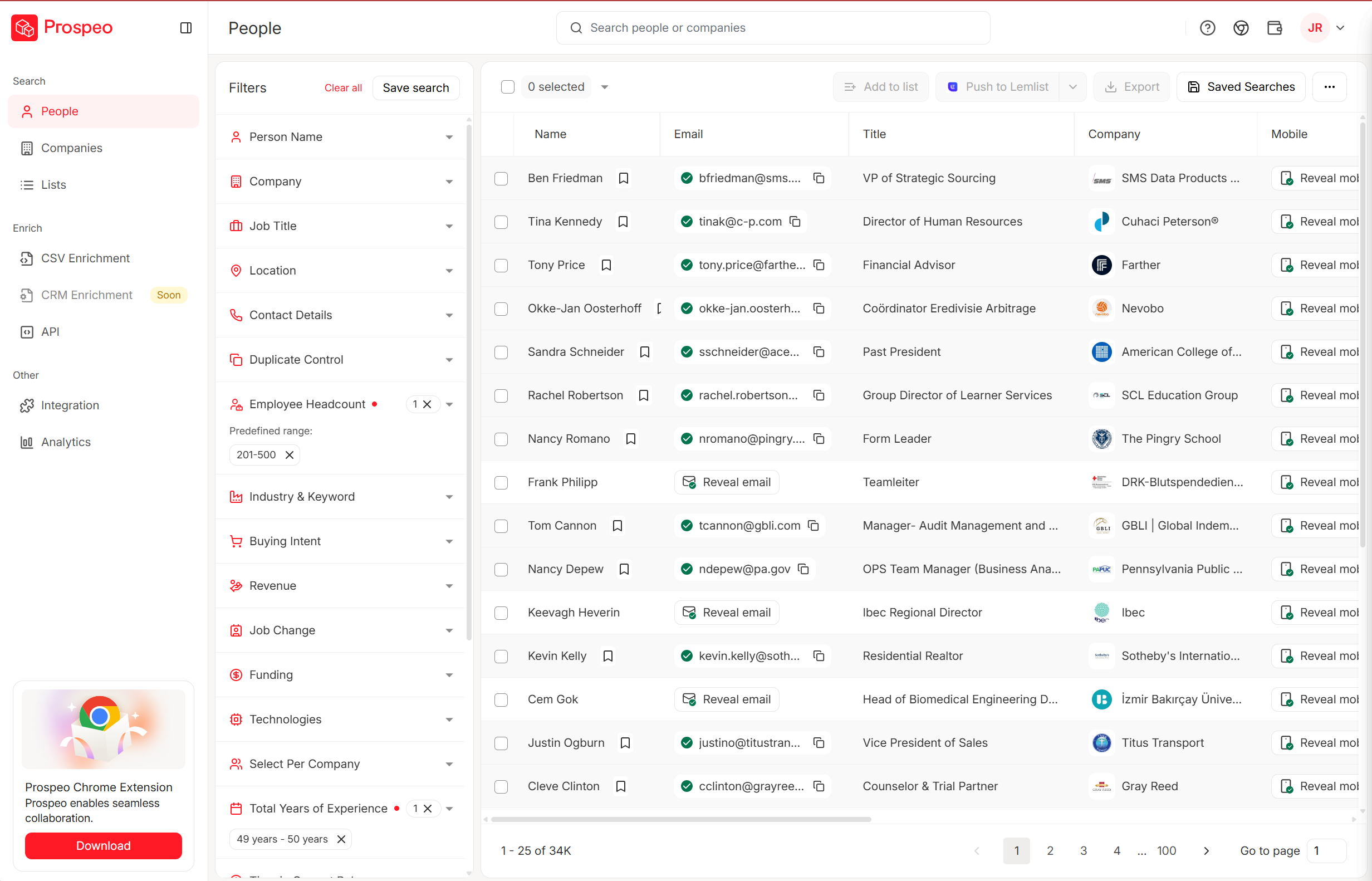
Every CRM on this list is an empty container. Prospeo fills it with 300M+ verified contacts at ~$0.01/lead - 90% cheaper than enterprise data tools. 98% email accuracy, 7-day refresh, and native integrations with HubSpot, Salesforce, and every sequencer your team uses.
Stop Googling phone numbers. Start closing deals with verified data.
7 Best SMB Sales Tools for 2026
Prospeo
Use this if: you need verified contacts to fill your pipeline and you're tired of bounced emails tanking your sender reputation.
Every CRM on this list is an empty container until you fill it with contacts. Prospeo is the data layer that makes the container useful. It covers 300M+ professional profiles, 143M+ verified emails, and 125M+ verified mobile numbers - all refreshed on a 7-day cycle, roughly six times faster than the 6-week industry average. The 5-step verification process, including catch-all handling and spam-trap removal, pushes email accuracy to 98%.
Enterprise data tools like ZoomInfo typically cost $15-40K/year depending on seats and modules. Prospeo delivers comparable quality at ~$0.01/lead with a free tier of 75 verified emails per month. Meritt saw bounce rates drop from 35% to under 4% after switching their data source, and their pipeline tripled from $100K to $300K per week. The Chrome extension with 40K+ users lets you pull verified contact data from any website in one click, and native integrations with HubSpot, Salesforce, Smartlead, Instantly, and Lemlist mean contacts flow straight into whichever CRM you pick below.
Pipedrive
Use this if: your team thinks visually and you want a CRM that feels like a Kanban board, not a spreadsheet.
Skip this if: you need marketing automation or solid reporting without paying for add-ons.
Pipedrive is the CRM most small sales teams actually enjoy using. The drag-and-drop pipeline is intuitive, onboarding takes hours instead of weeks, and it consistently earns praise on G2 for ease of use - though it gets dinged for limited reporting at lower tiers. Pricing starts at $14/user/mo on Lite, billed annually. Growth runs $39, Premium $59, Ultimate $79.
The catch is add-ons. LeadBooster costs $32.50/mo, Web Visitors $41/mo, Campaigns $13.33/mo - all billed per company, not per user. A 5-person team on Growth with LeadBooster and Campaigns pays ~$241/mo, not the $195 you'd expect from the sticker price. Budget accordingly.

Freshsales
Let's be honest about the pricing reality most reviews skip. Freshsales has a generous free tier - $0 for up to 3 users - and a 21-day trial on paid plans. Growth starts at $9/user/mo, Pro at $39, Enterprise at $59, all billed annually.
The marketing says "AI-powered CRM," but Freddy AI - contact scoring, deal insights, sales email features - lives behind the Pro tier. The real starting price for AI-powered selling is $39/user/mo, not $9. That's still reasonable for what you get, but don't sign up for Growth expecting the AI demos you saw on the website.
If you just need a solid free CRM with room to grow, Freshsales delivers. If you need AI on day one and $39/user/mo stings, look at Zoho's higher tiers instead.
Close CRM
Best for: teams making 20+ outbound calls per day. Skip this if your reps send more emails than they dial - you're paying for a dialer you won't use.
Close has built-in calling and SMS across all plans, plus a power dialer. Solo runs $9/user/mo on annual billing, Essentials $35, Growth $99, Scale $139. Pricing is refreshingly transparent. Where costs creep: premium phone numbers run $19/line/mo, and Call Assistant adds $50/org/mo plus $0.02/min. Model the phone costs before you commit, because a 5-rep team doing heavy outbound can easily add $200/mo in telephony charges that don't show up on the pricing page.
HubSpot CRM
Use this if: you're pre-revenue and need free. Skip this if: you expect to grow past 5 users within a year.
HubSpot's free tier is genuinely generous - 5 users, contact management, deal tracking, basic email templates. On the paid side, Starter Customer Platform starts at $20/seat/mo, and Sales Hub Starter is commonly priced at $50/month for 2 paid users. Professional is $500/mo for 5 users. Enterprise hits $4,300/mo for 7 users.
That cliff from free to Professional is brutal. We've seen SMBs build their entire workflow around HubSpot free, then face a painful migration decision 12-18 months later when they need features locked behind a $500/mo paywall. Go in with eyes open.
Zoho CRM
Free for 3 users, Standard at $14/user/mo billed annually. Zoho packs an absurd amount of functionality into a low price - email, automation, reporting, even AI at higher tiers. The tradeoff is a 250 mass emails/day limit on Standard and an interface that feels cluttered next to Pipedrive. For teams that prioritize features-per-dollar over polish, it's hard to beat.
Less Annoying CRM
One plan, one price: $15/user/mo. No tiers, no annual contracts, no upsell pressure. PCMag named it an Editors' Choice for budget-conscious startups. If your team has fewer than 10 people and just needs contact management that works, this is it. Don't overthink it.
The Real Cost of SMB Sales Tools
Sticker price is never the real price. Add-ons, integrations, and onboarding typically inflate CRM costs by 20-40% beyond the per-seat number. That Pipedrive example - ~$241/mo real vs. $195 sticker for a 5-person team - is the norm, not the exception.
Our take: if your average deal size is under $8K, you probably don't need a CRM that costs more than $20/user/mo. Spend the savings on better data instead. We've benchmarked these tools across dozens of small business deployments, and the teams that invest in data quality consistently outperform the ones that invest in fancier CRM features. A $15/user CRM with 98% accurate contact data will outsell a $79/user CRM full of bounced emails every single time.
Plan for $10-30/user/mo as your CRM baseline, then add a buffer.
SMBs don't lose deals because of their CRM - they lose deals because 40% of their contacts are dead on arrival. Prospeo's 5-step verification drops bounce rates below 4% and pushes connect rates to 20-25%. Meritt tripled their pipeline from $100K to $300K/week with the same team.
Fix your data layer and every other sales tool starts working.
3 Mistakes That Kill Your CRM Rollout
No team buy-in. If reps don't see value in the first week, they'll revert to spreadsheets. The consensus on r/sales is pretty clear: the best CRM is the one your team actually opens. Pick accordingly.
Configuring everything at once. Start with pipeline stages and contact fields. Add automation after the team is comfortable. We've watched founders spend two weeks building elaborate Zapier workflows before a single rep has logged a call. Don't be that founder. If you need a clean rollout plan, borrow a 30-60-90 day plan structure.
Skipping training. Even "simple" CRMs need 30 minutes of onboarding. Most CRM failures are people problems, not software problems. If you're still deciding what "CRM" even means in practice, skim a few examples of a CRM first.
FAQ
What's the best free sales tool for small businesses?
HubSpot CRM gives you 5 free users with deal tracking and email templates; Freshsales gives you 3. For free prospecting data, Prospeo's free tier delivers 75 verified emails per month - pair it with either free CRM for a complete stack at $0.
How much should an SMB budget for sales software?
Plan for $10-30 per user per month for CRM, then add 20-40% for integrations and add-ons. A 5-person team should realistically budget $100-250/mo total, not counting prospecting data costs.
Do small businesses actually need a CRM?
Companies with 11+ employees adopt CRM at a 91% rate - there's a reason. If more than 5 people are selling, yes. Under 5, a spreadsheet plus a solid prospecting tool can be enough until you outgrow it.
What's the biggest mistake SMBs make with sales software?
Buying a CRM before fixing data quality. If 20-30% of your contacts have invalid emails, no pipeline tool will save you. Start with verified data, then layer on CRM and outreach automation once your foundation is clean.