

Sales Stats for 2026: Benchmarks You Can Actually Use
Your SDR manager is blaming the templates. The VP wants new subject lines. Meanwhile, 11% of your list is bouncing, you're emailing people who left the company six months ago, and nobody's looked at the actual numbers.
Most sales stats roundups give you 50 context-free numbers and call it a day. This one gives you the benchmarks that matter, the myths you should stop repeating, and what to actually change this week.
2026 Benchmark Cheat Sheet
Every stat below is broken down in the sections that follow.
| Metric | Benchmark | Context |
|---|---|---|
| Cold email reply rate | 3.43% avg | Top performers: 10%+ |
| Interested reply rate | 0.64% | 1 in 157 contacts |
| Replies from step 1 | 58% | Follow-ups add 42% |
| Cold call success rate | 2.7% | Definitions vary by source |
| Best call days | Tue & Wed | 44% of all demos |
| Irrelevant outreach penalty | 73% of buyers avoid you | Salesforce data |
| Quota attainment | ~43% | Stuck in low 40s, 8 qtrs |
| Average win rate | 17-21% | Top performers: 30%+ |
| Sales cycle (avg) | 84 days | $200K+ deals: 230+ days |
| Buying committee size | 6-10+ | Enterprise: 15+ |
| Non-selling time | 60% | Admin, CRM, meetings |
| AI + quota lift | 3.7x | More likely to hit quota |
| Top rep win rate | 72% vs 47% | RAIN Group delta |
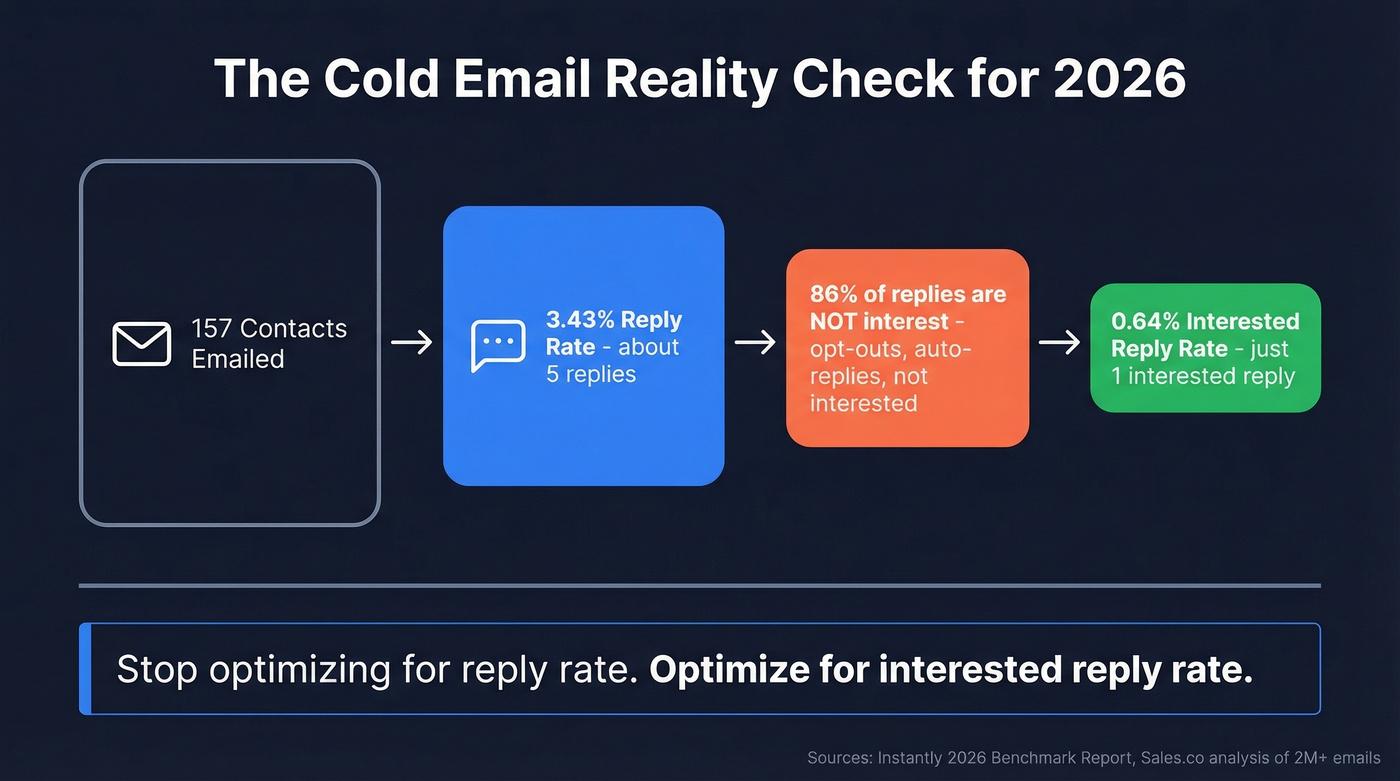
One editorial note: reply rate is a vanity metric. Interested reply rate is the KPI that matters. Only 1 in 157 contacts becomes an interested reply. Keep that ratio in your head as you read everything below.
Cold Email Benchmarks
Instantly's 2026 benchmark report analyzed billions of cold email interactions and landed on a 3.43% average reply rate. Top-performing campaigns clear 10%. The data also shows that 58% of all replies come from the first email in a sequence - follow-ups contribute the remaining 42%, with a sweet spot of 4-7 touchpoints before diminishing returns. Sales.co's separate analysis of 2M+ emails found an even higher first-message share at 79.4%. The discrepancy comes down to methodology: Instantly measures across billions of multi-step sequences, while Sales.co's dataset skewed toward shorter ones. Either way, the first email does the heavy lifting.
Here's where it gets interesting. Sales.co broke replies into total (2.09%) and positive/interested (0.64%). Only 14.1% of all replies expressed genuine interest. The rest? Opt-outs, auto-replies, and "not interested" responses. A 3% reply rate sounds decent until you realize about 86% of those replies aren't interest. The interested reply rate - 0.64% - is the number your sequences should be optimized against.
Salesforce data reinforces why this matters: 73% of B2B buyers actively avoid sellers who send irrelevant outreach. That's not a soft preference. Nearly three-quarters of your market will blacklist you for bad targeting.
Tactical findings from Sales.co: informal tone produced a 78% higher positive reply rate (10.36% vs 5.83% for formal). The CTA "Want to see it in action?" hit a 30.05% positive rate. Tuesday and Wednesday drive the most total replies, but Thursday actually produces the highest positive reply rate at 10.5% - worth testing if you're optimizing for quality over quantity.
One practitioner on r/Entrepreneur documented their journey from 3% to 6% reply rates over 62 days. The changes weren't about copy. They cut bounce rates from 11% to under 2% through manual verification, shortened emails to under 56 words, expanded to 7 sending domains capped at 26 emails/day each, and shifted sends to Tuesday through Thursday mornings. The biggest lever in that story wasn't the subject line. It was the bounce rate.
Cold Calling Benchmarks
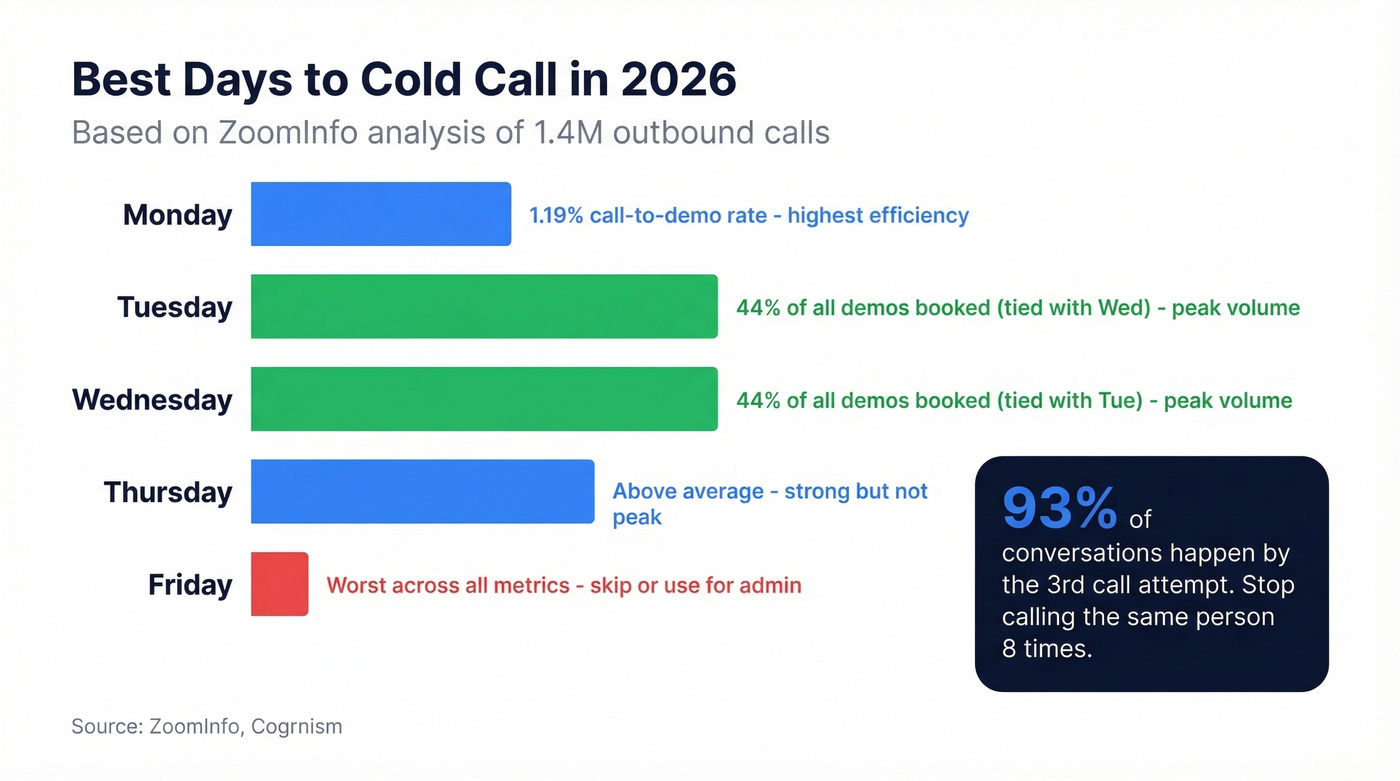
Cold calling isn't dead - it's just poorly timed. ZoomInfo analyzed 1.4M outbound calls and found that Tuesday and Wednesday generate 44% of all demos booked. Monday shows the highest call-to-demo efficiency at 1.19%, while Friday consistently performs worst across every metric.
The broader industry cold calling success rate sits at 2.7% in 2026. Cognism's own SDR team reported an 11.3% success rate across 200,000+ calls - roughly 4x the industry average, which tells you what's possible with tight targeting and good data.
On average, it takes 1.55 calls to connect with a prospect. By the third attempt, 93% of conversations have already happened. Stop calling the same person eight times.
| Day | Performance | Detail |
|---|---|---|
| Monday | Highest efficiency | 1.19% call-to-demo |
| Tuesday | Peak demo volume | Best for high-activity blocks |
| Wednesday | Peak demo volume | Tied with Tuesday |
| Thursday | Above average | Strong but not peak |
| Friday | Worst across all metrics | Skip or use for admin |
The buyer side is encouraging. RAIN Group's research shows 82% of B2B buyers accept cold call meetings at least sometimes, and 57% of C-level and VP buyers actually prefer phone over other channels. The problem isn't that buyers hate calls. It's that most calls reach the wrong person at the wrong time with the wrong pitch.
What Top Reps Do Differently
Gong Labs' behavioral analysis quantifies the gap between top performers and everyone else - and the findings are counterintuitive.
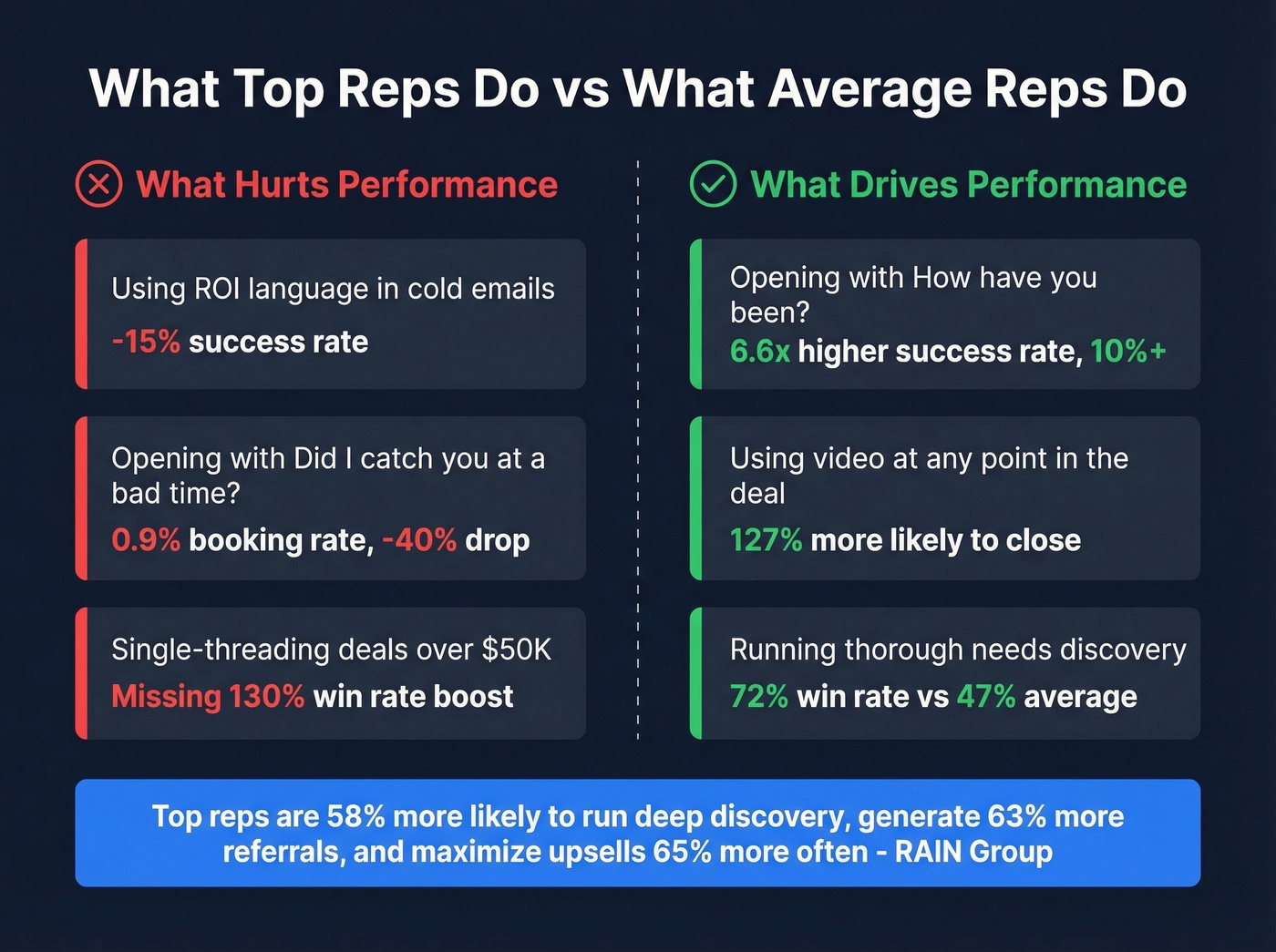
What hurts: Using "ROI" language in cold emails decreases success rates by 15%. Opening a cold call with "Did I catch you at a bad time?" drops meeting-booking chances by 40%, producing a dismal 0.9% success rate. These phrases feel professional. They're actually performance killers.
What helps: Opening with "How have you been?" - even to strangers - produced a 6.6x higher success rate than baseline, clearing 10%. Deals are 127% more likely to close when video is used at any point in the sales process. Win rates jump 94% when sellers sell with video on.
RAIN Group's data draws an even sharper line. Top-performing sellers are 58% more likely to run thorough needs discovery, and that single habit cascades into everything else. They average a 72% win rate on proposed deals versus 47% for the rest, generate referrals at a 63% higher clip, and maximize cross-sells and upsells 65% more often. The pattern is clear: top reps don't just work harder. They ask better questions, build broader relationships, and stay visible through video and referrals.
In our experience, the teams that improve fastest aren't rewriting subject lines - they're coaching reps on discovery calls and fixing their data upstream. None of these behaviors require expensive tools. They require coaching and awareness.

That 11% bounce rate from the Reddit case study? It's the silent killer behind every stat on this page. Prospeo's 5-step verification and 7-day data refresh cycle keep bounce rates under 2% - so your reply rates reflect your copy, not your data quality.
Stop blaming templates when the real problem is stale data.
Pipeline, Quota, and the Buying Journey
Quota attainment has been stuck in the low 40s for eight consecutive quarters. The average sits around 42.69% across cloud sales, down from 53% in Q1 2022. A Gong analysis of 7.1M opportunities across 3,613 companies showed attainment dropping from 52% in 2024 to 46% in 2025. Less than half of your reps are hitting their number. That's not a coaching problem - it's a structural one.
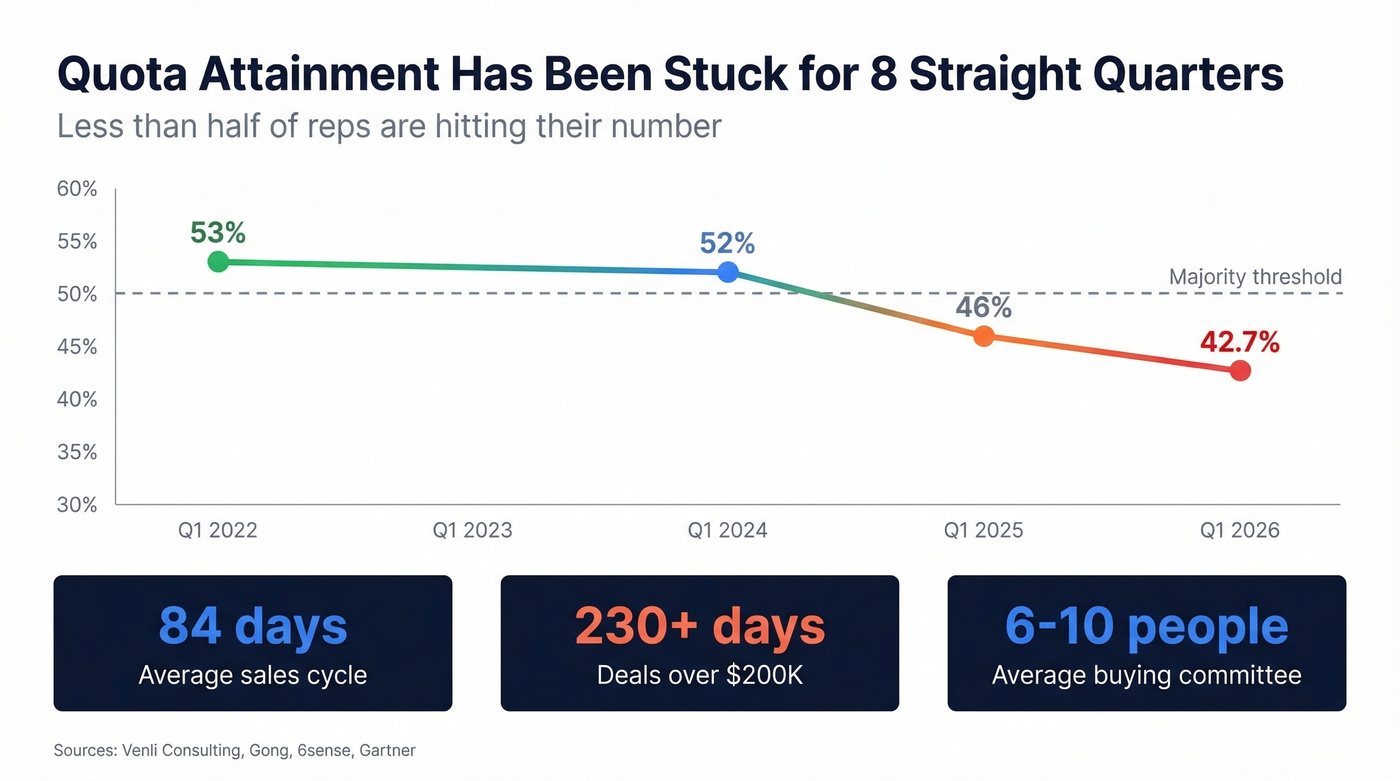
Cycle length has stretched 22% since 2022. The average deal takes 84 days to close; deals over $200K stretch past 230 days. There's a small bright spot: 6sense data shows the average cycle actually compressed from 11.3 months to 10.1 months between 2024 and 2025, with 49% of buyers saying economic conditions shortened buying cycles. First contact has moved from 69% of the journey to 61%, pulling outreach forward by roughly six weeks. But buyers still define purchase requirements 83% of the time before ever speaking to sales.
The buying committee problem is where deals go to die. Gartner pegs the average buying group at 6-10 people. Enterprise deals routinely involve 15+ stakeholders. An analysis of 1.8M opportunities found that closed-won deals have roughly 2x as many buyer contacts as lost deals. For deals over $50K, multi-threading boosts win rates by 130%.
And yet, Forrester reports that 86% of B2B purchases stall and 81% of buyers end up dissatisfied with the provider they chose. The buying process is broken on both sides. Sellers aren't reaching enough stakeholders, and buyers aren't getting the information they need to decide confidently.
Let's be honest: if your average deal size is under $25K and you're only single-threading, you're leaving more revenue on the table than any AI tool will recover. Multi-threading is the highest-leverage skill in B2B sales right now, and almost nobody trains for it.
AI in Sales - Hype vs. Reality
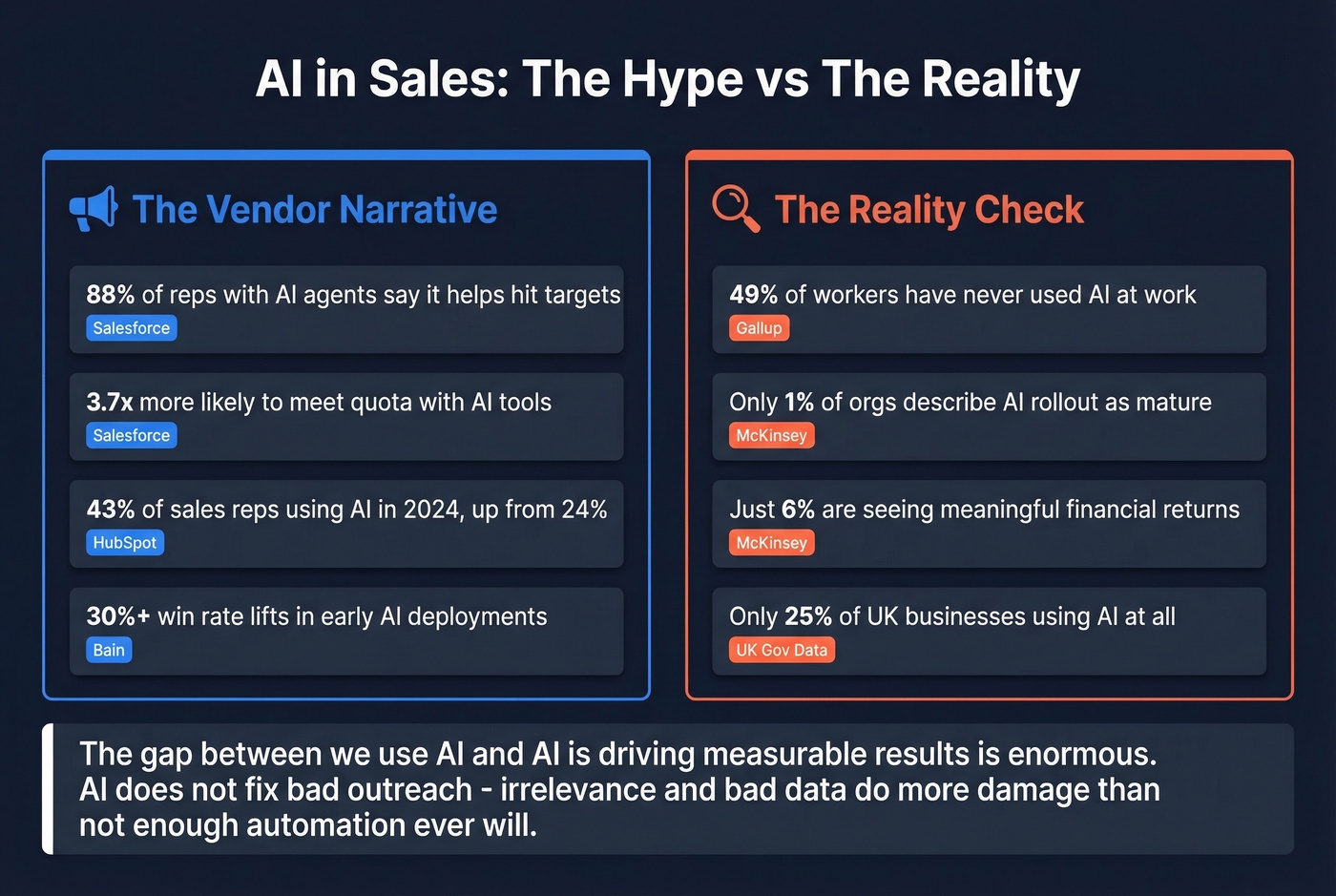
The vendor narrative is compelling. Salesforce reports that 88% of reps with AI agents say the technology increases their odds of hitting targets, and sellers using AI tools are 3.7x more likely to meet quota. HubSpot tracked AI adoption among sales reps rising from 24% in 2023 to 43% in 2024. LinkedIn found 56% of sales professionals using AI daily, with daily users 2x as likely to exceed targets. Bain reported 30%+ win rate lifts in early AI deployments.
Now the reality check.
Gallup's late 2025 survey found that 49% of workers had never used AI at work. Only 12% were daily users. McKinsey's State of AI report showed that while 88% of organizations say they use AI in some form, only 1% describe their rollout as "mature" and just 6% qualify as high performers seeing meaningful financial returns. In the UK, only 25% of businesses were using AI at all.
The gap between "we use AI" and "AI is driving measurable results" is enormous. We've seen this pattern before - teams buy an AI tool, use it for email drafts for two weeks, then revert to their old workflow. AI doesn't fix bad outreach. Irrelevance and bad data do more damage than "not enough automation" ever will.
Debunked: Sales Statistics to Stop Repeating
"2% of sales happen on the first contact, 80% happen on the 5th-12th follow-up." This stat is attributed to the "National Sales Executive Association." VentureBeat investigated and found that the NSEA doesn't exist. The numbers are completely fabricated. They've been circulating since at least 2014, and they still show up in sales decks every week.
"57% of the buying journey happens before a buyer talks to sales." This one is real - but wildly misused. It originated from a CEB (now Gartner) and Google study that surveyed 1,500 customer contacts across 22 organizations. The 57% is an average that varies enormously by industry, deal size, and buyer sophistication. It's not a universal law. Treating it like one leads to bad strategy - specifically, the assumption that sellers should wait for buyers to come to them. The 6sense data above shows first contact is actually pulling earlier, not later.
"It takes 8 cold call attempts to reach a prospect." This number gets passed around without clear sourcing, and it contradicts the benchmark showing 93% of conversations happen by the third attempt. The "8 attempts" figure likely conflates different contact methods and time periods. Use the real benchmark: 1.55 calls to connect, 3 attempts for 93% of conversations.
Stop citing all three. Use the real benchmarks in this article instead.
What to Change This Week
Every stat above is useless if it doesn't change behavior. Here are the specific actions these sales statistics point to.
Three metrics to start tracking:
- Interested reply rate (not total reply rate) - target 0.8%+ as your first milestone
- Bounce rate - anything above 3% is actively damaging your sender reputation
- Meetings per 1,000 contacts - this connects data quality to revenue
Three changes to make:
- Tighten targeting before touching copy. 73% of B2B buyers avoid sellers who send irrelevant outreach. If your ICP filters are loose, no subject line saves you.
- Shorten emails to under 80 words. Instantly's data confirms this moves the needle.
- Verify and enrich your list before every send. That Reddit operator cut bounces from 11% to under 2% and watched reply rates double. The upstream cause of bad outreach benchmarks isn't messaging - it's data.
On that last point: enterprise data platforms run $10K-$40K+/year. But the verification step doesn't need to cost that much. Prospeo's 5-step email verification with catch-all handling, spam-trap removal, and honeypot filtering delivers 98% email accuracy on a 7-day refresh cycle - at roughly $0.01 per email.
The math is straightforward. If you're sending 5,000 emails a month with a 10% bounce rate, that's 500 bounces eroding your sender reputation every cycle. Cut that to under 2% and you're not just improving deliverability - you're making every other number in this article achievable.
Only 43% of reps hit quota, and 60% of their time is lost to non-selling tasks. Prospeo gives your team 300M+ verified profiles with 30+ filters - intent data, job changes, headcount growth - so reps spend less time building lists and more time in discovery calls that actually close.
Move your team from the 43% average to the top-performer column.
FAQ
What's a good cold email reply rate in 2026?
Average is 3.43% per Instantly's data, with top performers exceeding 10%. The more meaningful metric is interested reply rate - only 0.64% of contacts reply with genuine interest, meaning roughly 86% of "replies" are opt-outs or auto-responses.
What percentage of sales reps hit quota in 2026?
Around 43%, stuck in the low 40s for eight consecutive quarters and down from 53% in early 2022. Reps using AI tools are 3.7x more likely to hit their number, though only 12% of workers use AI daily.
What's the best day to make cold calls?
Tuesday and Wednesday generate 44% of all demos booked, per ZoomInfo's analysis of 1.4M calls. Monday has the highest call-to-demo efficiency at 1.19%. Friday is worst across every metric - use it for admin instead.
Which popular sales statistics are fake?
The "80% of sales happen after the 5th follow-up" stat comes from the "National Sales Executive Association," which VentureBeat confirmed doesn't exist. Use real benchmarks instead: 58% of replies come from the first email, and 93% of call conversations happen by the third attempt.
How does data quality affect outreach performance?
Directly and measurably. One practitioner cut bounce rates from 11% to under 2% through verification and saw reply rates double from 3% to 6%. Clean data at scale doesn't require enterprise budgets - tools like Prospeo deliver 98% email accuracy at $0.01/lead, making verified lists accessible to any team size.