

How to Build a Sales Structure That Actually Scales
Every CEO eventually says it: "We need to restructure for scale." What follows is usually a reshuffled org chart, a new VP, and the same pipeline problems three months later.
Here's the thing: most reorgs fail not because the model is wrong, but because leaders rearrange reporting lines without touching the three things that actually matter - account assignment, comp alignment, and data quality. The org chart is the easy part. The operating system underneath it is what separates companies that scale from companies that stall and blame "execution."
If more than a third of your salespeople are underperforming on your top three metrics, your structure is probably broken. If reps can't explain their comp plan in one sentence, it's definitely broken. And if your SDRs are prospecting with contacts that bounce at 15%, no reorg will save you.
The Short Version
Under $5M ARR, run an assembly line - founder closes, then hand off to AEs, layer in SDRs, add CS. Between $5-20M, build pods for your top accounts and hire dedicated RevOps. Above $20M, segment by account size with overlay specialists. Your comp plan is your real org chart - design them together or both will fail.
What Sales Structure Actually Means
Sales structure isn't an org chart pinned to a wall. It's the operating system for your revenue team - the combination of roles, reporting lines, segmentation logic, handoff protocols, comp design, and territory rules that determine how deals actually move through your pipeline. Two companies can have identical headcounts and wildly different results. The one that wins is the one where every rep knows which accounts they own, how they get paid, and who picks up the deal after they close it.
Three signs your current setup needs surgery: more than a third of your team is underperforming on core metrics, handoff complaints surface in every deal review, and reps can't explain in plain English what moves their paycheck. If all three are true, stop reading and start planning.
Three Models That Matter
Stop reading articles that list seven or more models. You need three. Everything else is a variation.
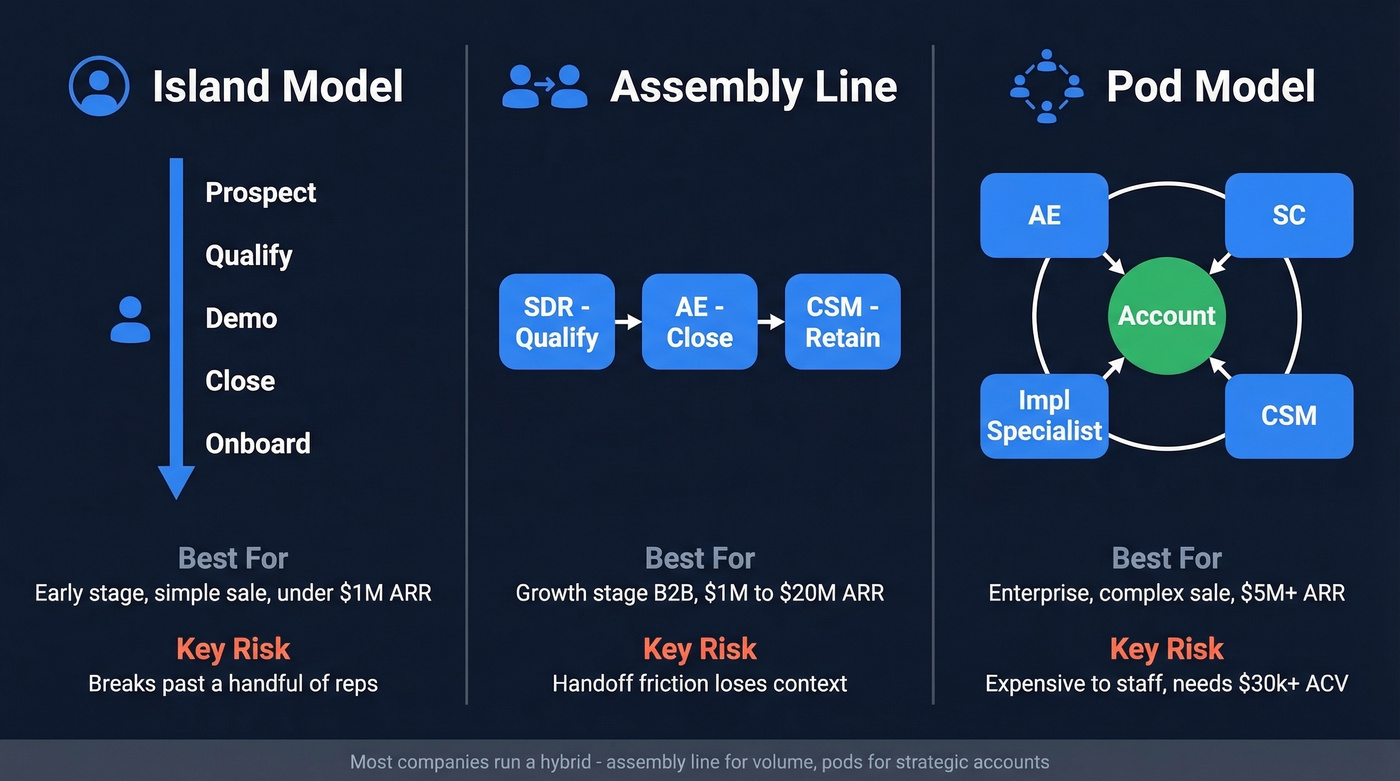
| Model | Best For | Key Risk |
|---|---|---|
| Island | Early-stage, simple sale | Doesn't scale |
| Assembly Line | Growth-stage B2B | Handoff friction |
| Pod | Enterprise, complex sale | Expensive to staff |
The Island Model
Each rep handles the entire cycle - prospecting, qualifying, demoing, closing, and sometimes even onboarding. It's how most startups begin, and it works when you've got a handful of strong sellers and a straightforward product. Close runs a blend of island and assembly line internally, with reps following leads end-to-end until CS takes over.
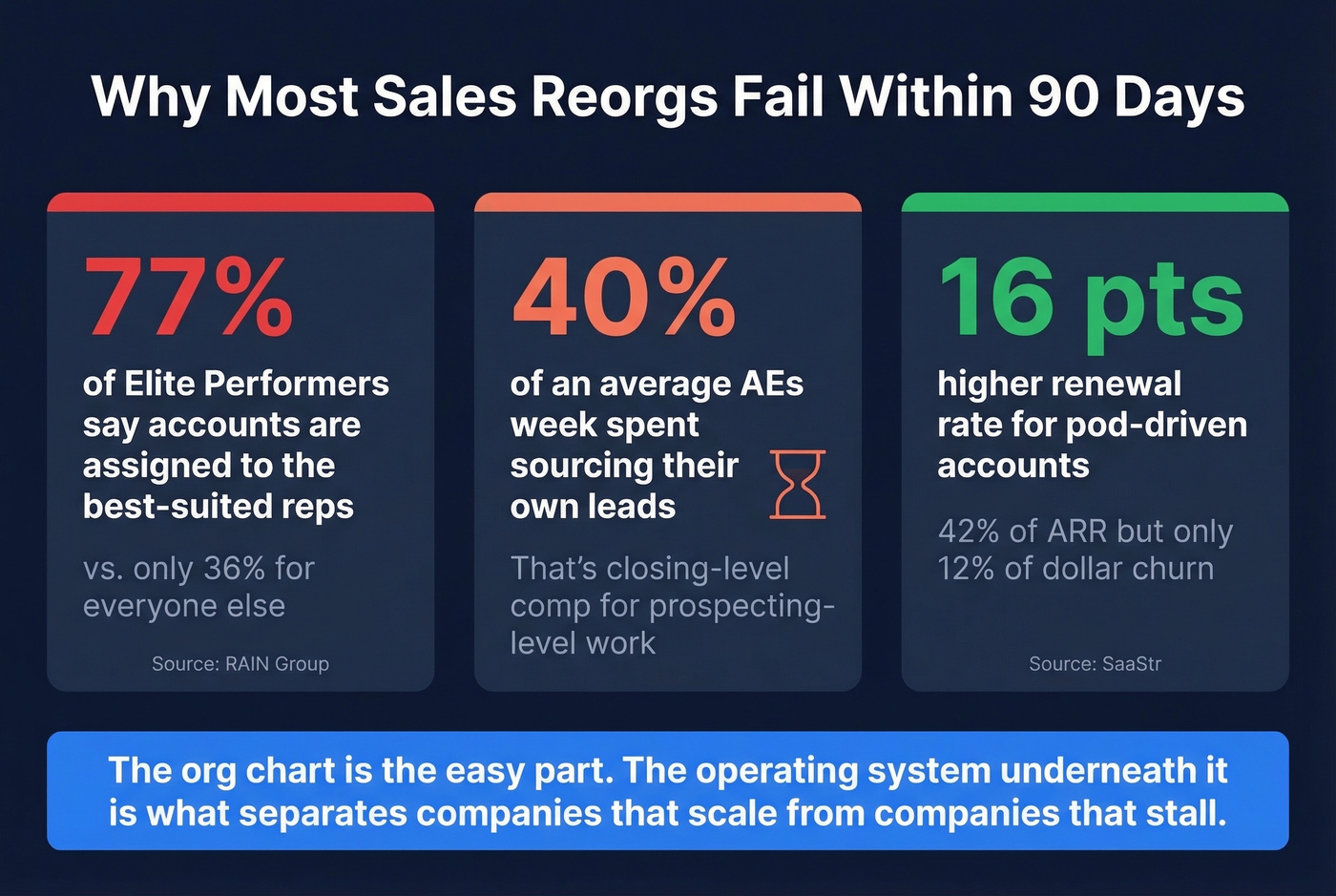
The problem is obvious: it breaks once you move beyond a handful of reps. You end up with inconsistent processes, no specialization, and zero leverage on your best closers' time. If your AEs are spending 40% of their week sourcing their own leads, you're paying closing-level comp for prospecting-level work.
The Assembly Line
This is the default for companies in the $1M-$5M ARR range, and it often remains the backbone through $20M. SDRs generate and qualify leads, AEs close, CSMs retain. Each role develops deep expertise in one phase of the cycle.
The tradeoff is handoff friction - every transition from SDR to AE to CS is a moment where context gets lost and the buyer experience degrades. For most B2B companies, the assembly line's scalability outweighs its coordination costs. It remains the most widely adopted sales team model for a reason: it works, even when it's messy.
The Pod Model
Pods group a cross-functional team - AE, solutions consultant, implementation specialist, CSM - around a set of accounts. The customer gets a dedicated team instead of a relay race.
In one documented case from SaaStr, customers with "Verified Outcomes" - a pod-driven engagement metric - renewed at 16 percentage points higher than those without. That cohort represented 42% of ARR but only 12% of dollar churn. Those numbers are hard to argue with, but in our experience, the pod model only pays off when you've got the headcount and revenue to support it - most often once you're solidly past $5M ARR and can justify dedicated coverage for your highest-value accounts. Skip this model if your average deal size is under $30k; the staffing math won't work.

You just read that AEs spend 40% of their week sourcing leads - that's a structural failure, not a work ethic problem. Prospeo gives SDRs and AEs instant access to 300M+ verified profiles with 98% email accuracy and 125M+ direct dials, so your assembly line actually assembles.
Stop paying closing-level comp for prospecting-level work.
Why Geography-Based Segmentation Is Dying
The traditional playbook segments by geography: East Coast, West Coast, EMEA. That made sense when reps flew to meetings. It makes far less sense now. Hybrid selling drives up to 50% more revenue by enabling broader engagement, and two-thirds of buyers prefer remote interactions at most purchasing stages. Over 90% of enterprises plan to sustain their hybrid sales force changes.
If your ACV is under $50k, geography-based territories are actively costing you deals. The better segmentation axes are account size (SMB vs. mid-market vs. enterprise), industry vertical, or product line. Geography can be a secondary overlay, but it shouldn't be the primary organizing principle. The talent pool argument alone should settle this - why limit your best enterprise AE to accounts within driving distance?
Scaling by Company Stage
The right structure depends on where you are, not where you want to be.
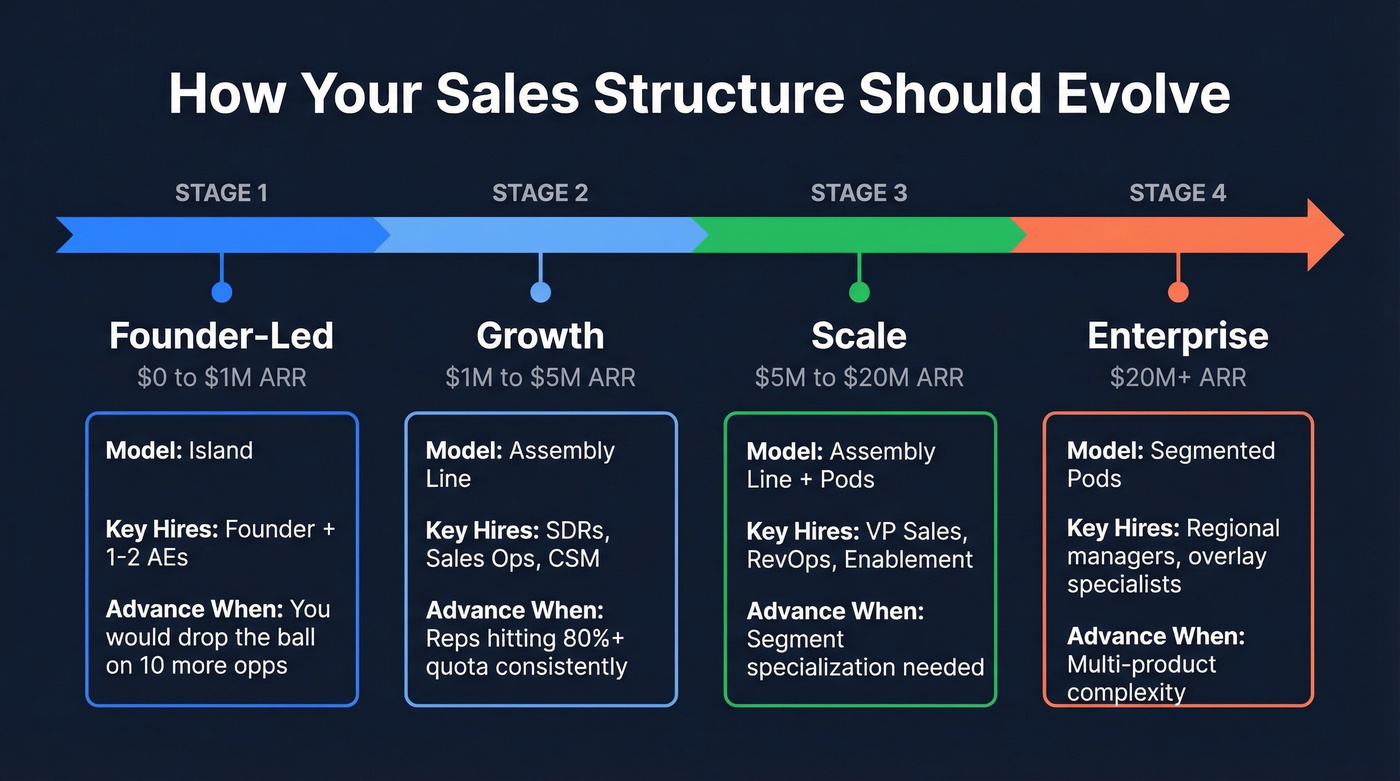
| Stage | ARR Range | Key Hires | Model | Trigger to Advance |
|---|---|---|---|---|
| Founder-Led | $0-$1M | Founder + 1-2 AEs | Island | Can't handle 10 more opps |
| Growth | $1M-$5M | SDRs, Sales Ops, CSM | Assembly Line | Reps at 80%+ quota |
| Scale | $5M-$20M | Enablement, VP Sales, RevOps | Assembly + Pods | Segment specialization needed |
| Enterprise | $20M+ | Regional managers, overlays | Segmented Pods | Multi-product complexity |
Founder-Led ($0-$1M ARR)
You're the sales team. The priority isn't hiring - it's building systems. As one r/sales practitioner described it, the sequence is founder-led sales first, then systems and process (CRM, deal stages, decks), then your first AE. The practical trigger for that first AE hire: ask yourself, "If we got 10 more opportunities this month, how many would we drop the ball on?" If the answer is most of them, it's time.
Growth Stage ($1M-$5M ARR)
This is where the assembly line takes shape. Expand your AE bench, add SDRs to scale pipeline, bring on a Sales Ops manager to keep the CRM from becoming a junk drawer, and hire your first CSM before churn eats your growth. A Head of Sales or Sales Director should come in here to build playbooks, onboarding, and KPIs.
Your first SDRs need a prospecting stack on day one. Expect AEs to still handle roughly 30% of their own outbound, even with SDR support.
Scale Stage ($5M-$20M ARR)
Add sales enablement to formalize training and content. Sales Ops evolves into a true RevOps function focused on metrics, forecasting, and process optimization. Bring in a VP of Sales if you haven't already.
This is also where pods start making sense for your highest-value accounts - dedicate cross-functional teams to strategic segments while keeping the assembly line running for mid-market. Expand CS and consider dedicated Account Managers for upsell and cross-sell. Sales managers at this stage should own 6-10 direct reports; go above 10 and coaching quality drops fast. Choosing between organizational models at this stage often means running a hybrid - assembly line for volume, pods for strategic accounts.
Enterprise ($20M+)
Regional or segment sales managers, director-level enablement, a RevOps leader with real headcount, and specialized account teams for strategic, mid-market, and commercial segments. Overlay specialists - solutions engineers, industry consultants - become critical.
AI is reshaping role design at this tier faster than most leaders realize. The SDR title isn't disappearing, but the job description is changing fast. Expect AI to handle more of the initial outreach sequencing and lead scoring while humans focus on the conversations that require judgment and relationship-building. Companies that redesign roles around AI capabilities rather than bolting AI onto existing workflows will have a structural advantage through 2027 and beyond.
The org chart gets complex, but the principle stays simple: every account has a clear owner, every handoff has a defined protocol, and every rep knows exactly how they get paid.
Compensation Must Match the Org Design
Your comp plan is your real org chart. You can draw any reporting structure you want, but reps will follow the money. If you incentivize AEs to hoard accounts, they'll hoard accounts. If you pay SDRs purely on meetings booked, they'll book garbage meetings.
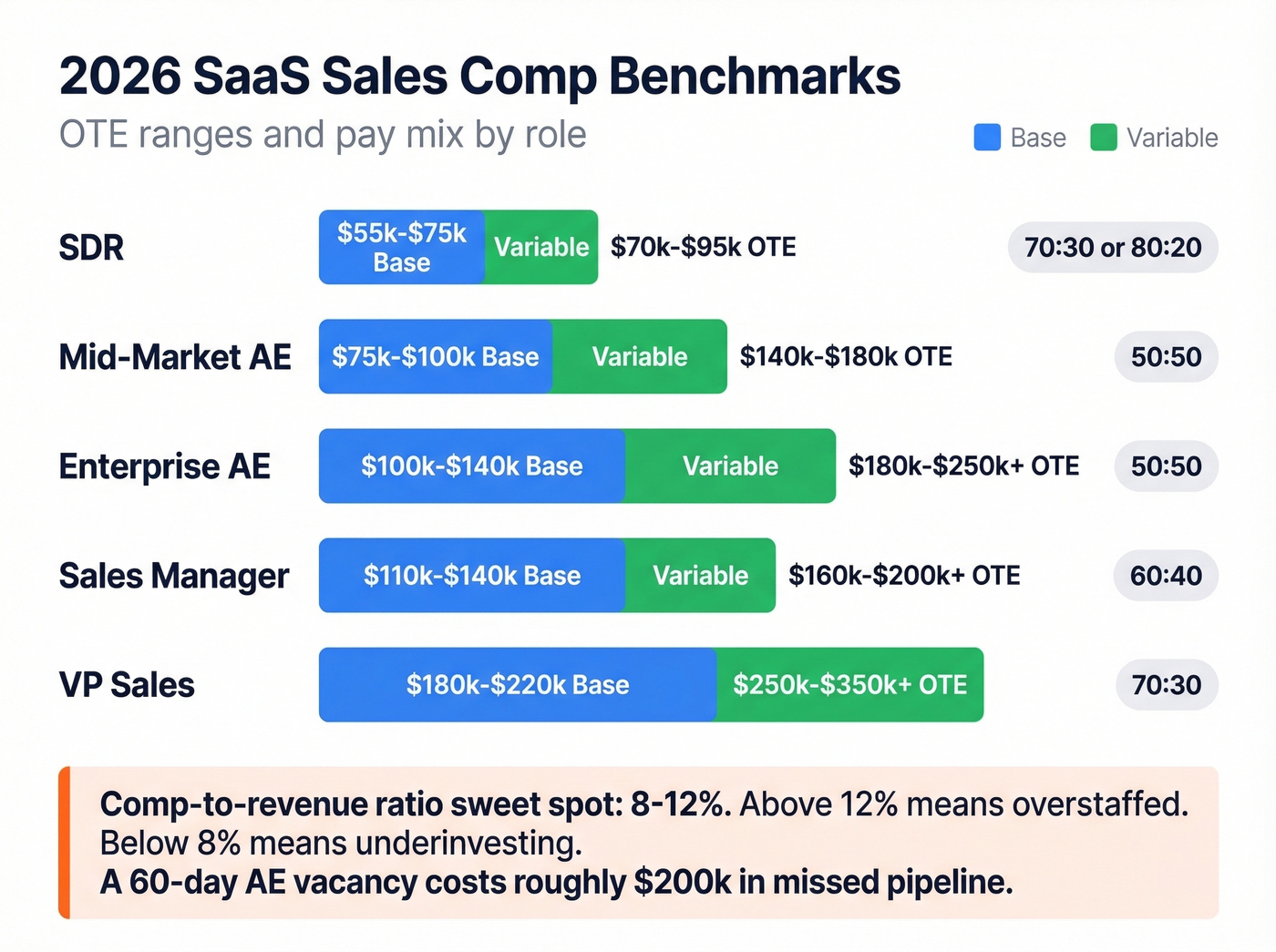
| Role | Base Salary | OTE | Pay Mix |
|---|---|---|---|
| SDR | $55k-$75k | $70k-$95k | 70:30 or 80:20 |
| Mid-Market AE | $75k-$100k | $140k-$180k | 50:50 |
| Enterprise AE | $100k-$140k | $180k-$250k+ | 50:50 |
| Sales Manager | $110k-$140k | $160k-$200k+ | 60:40 |
| VP Sales | $180k-$220k | $250k-$350k+ | 70:30 |
Benchmarks reflect 2026 SaaS compensation data from Betts Recruiting and Pavilion surveys.
The 50/50 pay mix for AEs is the US norm. In Europe, expect closer to 80/20 - reps want more base security, and employment law often constrains variable structures. Neither is wrong; they reflect different market expectations.
For budgeting, the comp-to-revenue ratio for SaaS companies typically runs 8-12%. Above 12%, you're either early-stage (expected) or overstaffed (problem). Below 8%, you're probably underinvesting in sales talent.
The sequencing matters as much as the numbers. Define your structure and territories first, then design comp. You can't build an effective incentive plan without clarity on who owns what. Keep it simple - max two core drivers per plan. We've seen plans with five or six KPIs where reps couldn't tell you what actually moved their paycheck. Every additional metric you add dilutes focus.
One number that should scare every sales leader: a 60-day AE vacancy costs roughly $200k in missed pipeline, and that's before you factor in ramp time. Hire ahead of need, not behind it.
Three Mistakes That Kill Reorgs
Most reorgs look great on a slide deck and fall apart within 90 days. The failure modes are predictable.
Wrong Reps, Wrong Accounts
This is the silent killer. RAIN Group's research found that 77% of Elite Performers agree their accounts are assigned to the best-suited reps. For everyone else? Just 36%.
I've seen this exact scenario play out at three different companies: an AE closed a $200k account two years ago, that account is now a $2M opportunity, but the original rep doesn't have the enterprise selling skills to grow it. Nobody reassigns it because "she owns the relationship." That's how you leave millions on the table. In every case, the account stalled until leadership forced the reassignment.
Bad Data Undermines Everything
You can redesign your entire org, but if reps inherit territories full of stale contacts and bounced emails, the new structure fails before it starts. The average enterprise runs 897 applications with only 29% integrated. Only about 35% of sales pros fully trust their company's data accuracy, and a third of sales ops teams say they lack the resources to fix it.
Let's be honest: if your bounce rate is above 5%, you're burning pipeline and deliverability from day one. Audit your contact database before reassigning territories - not after. Prospeo's 7-day refresh cycle and 98% email accuracy mean new territory owners don't inherit bounced emails and disconnected numbers, which is the foundation that makes every other structural decision work. (If you need a baseline, start with email bounce rate benchmarks and fixes.)
Comp Plans That Fight the Org Chart
You restructured into pods, but AEs are still comped on individual quota with no team component. You split territories, but the comp plan rewards account hoarding. You hired SDRs, but they're gaming meeting quality because that's all the plan measures. 74% of AE groups are now supported by outbound SDRs - if your comp plan doesn't account for that handoff, you're building friction into every deal.
If your incentives contradict your structure, the incentives win every time. Rearranging the org chart while leaving comp untouched is rearranging deck chairs.
Every handoff in your sales structure is a moment where bad contact data kills momentum. When SDRs pass leads with emails that bounce at 15%, no pod model or territory redesign will save the deal. Prospeo's 7-day data refresh and 5-step verification keep bounce rates under 4% - so your structure scales without the friction.
Your org chart is only as good as the data feeding it.
FAQ
How often should you restructure a sales org?
Most companies restructure every 2-3 years as they cross ARR thresholds. The trigger should be consistent quota miss across a large portion of the team, not a new VP arriving with a different playbook. If the majority of your team is hitting number, look at process and enablement before redrawing the org chart.
What's the right SDR-to-AE ratio?
For outbound-heavy motions with mid-market ACV, plan on 1 SDR per 2-3 AEs. Enterprise motions with longer cycles often need 1:1 or even 2:1 SDR-to-AE ratios. 74% of AE groups are supported by outbound SDRs, so running without them puts you in the minority. Adjust based on inbound volume - if marketing sources around 40% of pipeline, you can run leaner on SDR headcount.
Pod model vs. assembly line - which is better?
Assembly line for most B2B companies under $20M ARR. Pods work when you have the headcount to staff them and a clear account ownership model. The pod renewal lift of +16 percentage points is real but expensive - you're dedicating four or five specialists to each account cluster. The decision almost always comes down to deal complexity and average contract value.
How do you fix bad data after a reorg?
Audit your contact database before reassigning territories, not after. Reps who log in on day one and see 30% bounce rates will lose faith in the entire change before making a single call. Clean and re-verify territory lists in bulk so new owners start with contacts they can actually reach - that single step prevents more reorg failures than any amount of change management training.