

Sales Team Incentives: What the Data Says Actually Works
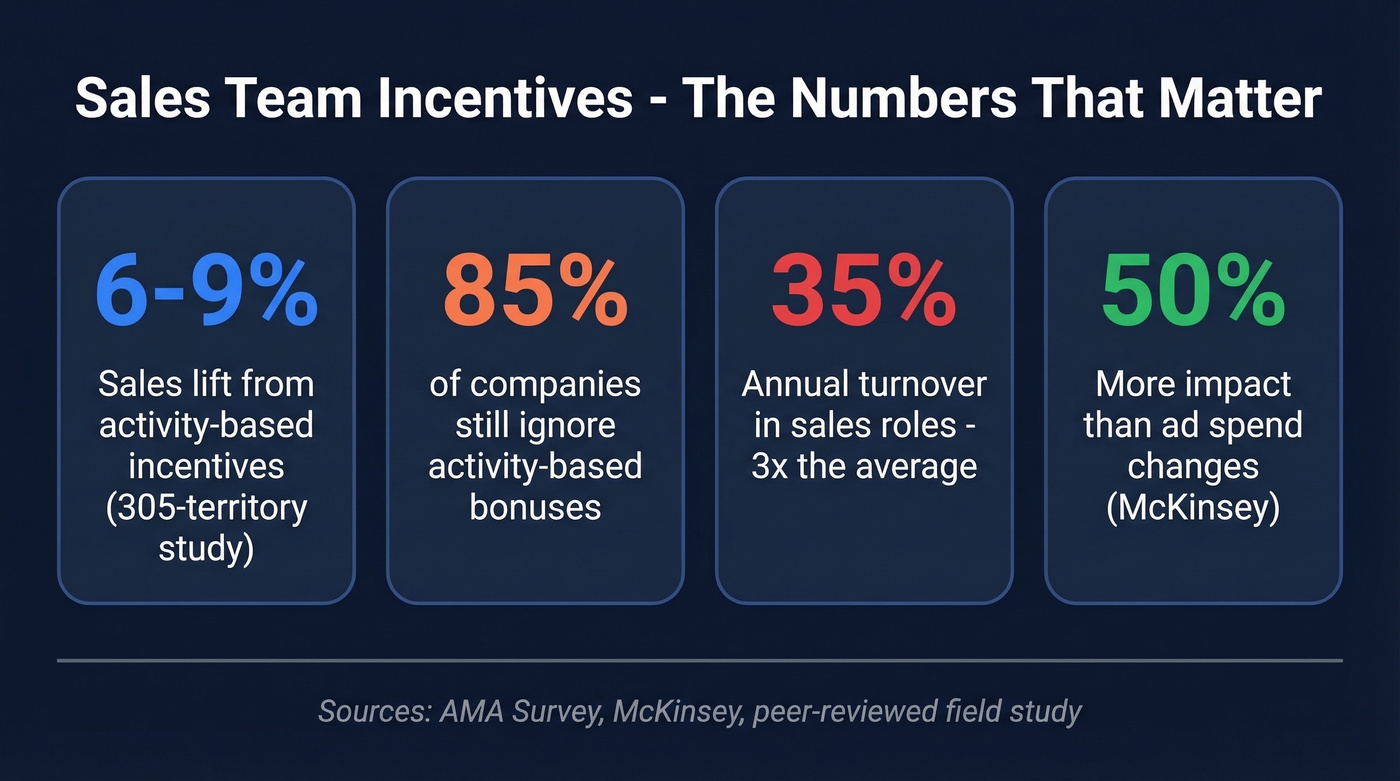
Your Q3 contest just ended and the same three reps won again. The middle of your team - the 15 people who actually determine whether you hit plan - checked out by week two. Sales-role turnover runs around 35%, nearly triple the average across other functions, and poorly designed incentive plans are a leading cause. McKinsey research shows smart revisions to compensation models have a 50% higher impact on sales than changes in advertising investments. And yet 70% of organizations don't allow any customization in their incentive plans.
That's the gap. Let's close it.
The Quick Version
- Add activity-based incentives. A peer-reviewed field study across 305 territories found a 6-9% sales lift, and only 15% of companies use them.
- Design for your middle 70%, not your top 10%. That's where incremental revenue lives. Contests that only reward top performers create animosity and disengage everyone else.
- Balance team and individual rewards. Pair personal SPIFFs with team-based kickers so reps don't hoard deals or sabotage each other's pipelines.
- Use non-cash, operationally meaningful rewards - lead priority, manager help, leaving early. They often hit harder than generic prizes and cost almost nothing.
- Apply the calculator test. If a rep can't figure out their payout with a calculator, the plan is too complex. Simplify.
Activity-Based Incentives - The Most Underused Lever
Most comp plans reward outcomes: closed revenue, booked meetings, expansion ARR. But a three-year field intervention across 305 sales territories found that paying reps for activities - not just results - produced 6-9% sales gains over a no-incentive baseline. When only supervisors received activity-based bonuses, profits ran 3% higher and supervisors drove 7.6% more calls from their teams.
Here's the kicker: an AMA survey found just 15% of companies award bonuses for activities like calls or demos. That means 85% of sales orgs are ignoring a high-leverage tool that's already been validated in controlled research. And 97% of top-performing organizations report strong cross-department collaboration in program design - 40% higher than their peers - which suggests incentive plans work best when sales, marketing, and ops build them together rather than dropping a spreadsheet on the team in January.
Activity-based incentives only work when the activities connect to outcomes, though. Incentivizing 50 calls a day is pointless if half the numbers are dead. This is where data quality becomes a comp plan issue. If your reps are dialing disconnected numbers or emailing bounced addresses, you're paying them to waste time. We've seen teams fix this overnight by switching to verified contact data - Prospeo's 98% email accuracy and 30% mobile pickup rate mean the calls and emails your team is incentivized to make actually reach a human.
Incentive Ideas by Role
SDR / BDR Rewards
SDRs respond to immediate, short-cycle rewards. The consensus on r/salesdevelopment is clear: don't make them wait until month-end. "Book three meetings in a day and leave after the third is booked." A $100 weekly prize for the most meetings booked. A "Most No's" contest that rewards resilience and high activity, not just outcomes.
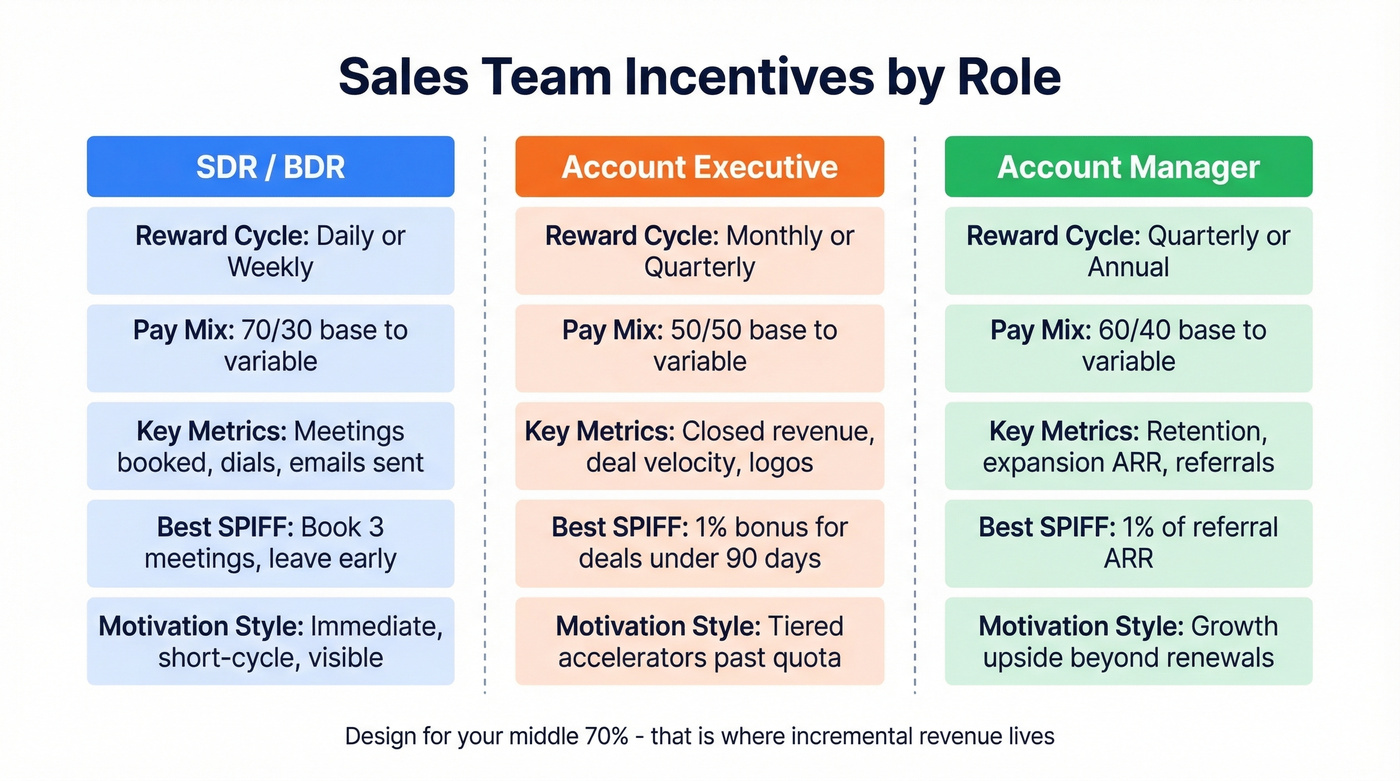
Keep the reward cycle tight - weekly or daily, never quarterly. Even a simple gift card for hitting daily dials can keep energy high during grueling prospecting blocks. The worst thing you can do with SDRs is tie their incentives to a 90-day cycle they can't see the end of. If you need a tighter structure for what to reward, start with a clean list of sales activities that actually move pipeline.
Account Executive Incentives
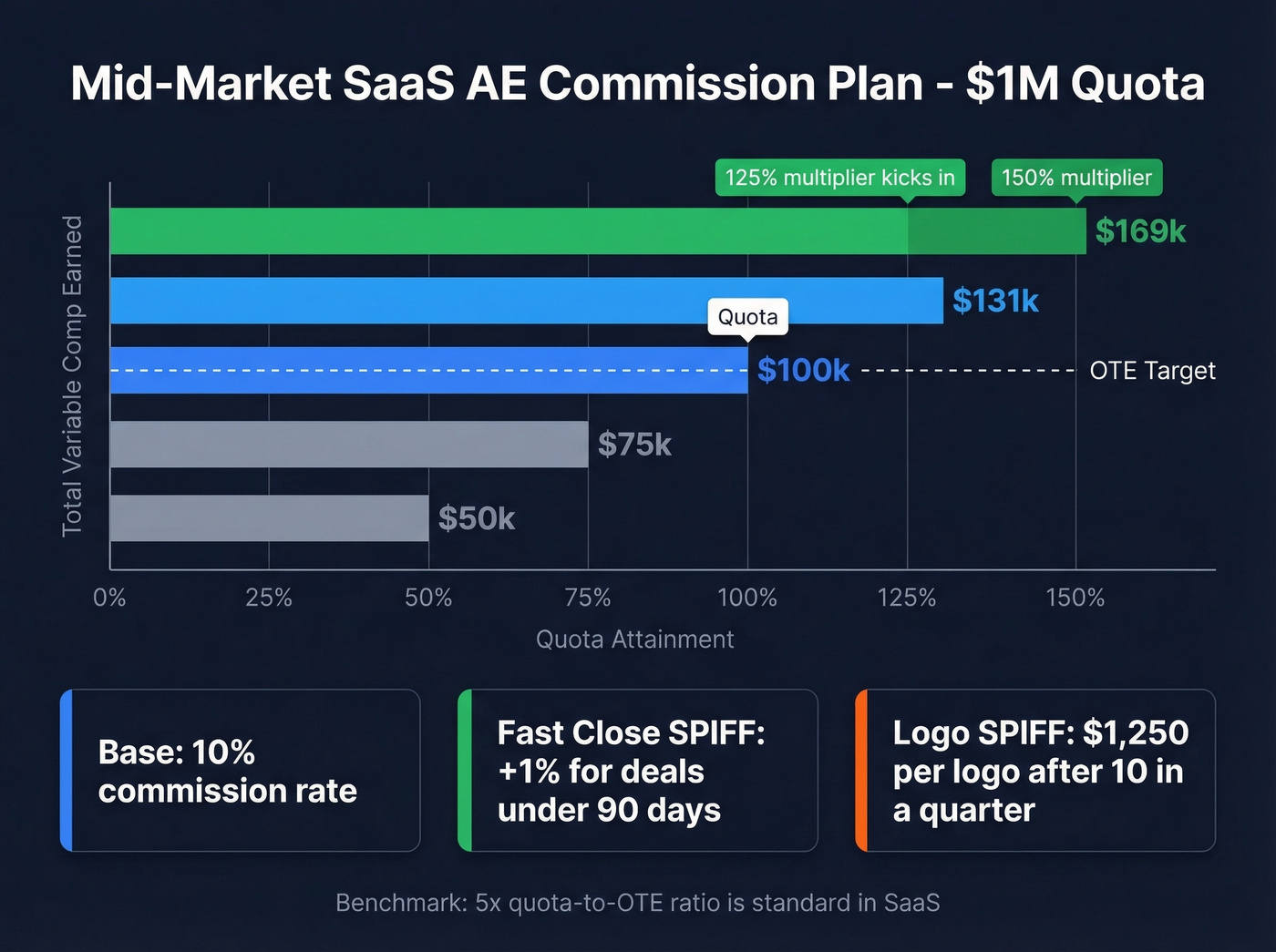
AE variable compensation needs to reward both volume and velocity. Here's a concrete mid-market template: 50/50 pay mix, 10% base commission rate, with tiered accelerators - 125% multiplier at 100-125% attainment, 150% above 125%. Layer in SPIFFs for behaviors you want to encourage: 1% bonus for sales cycles under 90 days, $1,250 per logo when a rep closes more than 10 new logos in a quarter. Total comp for AEs typically lands in the $150k-$250k range, with enterprise closers in SF and NYC pushing past $250k.
Here's the thing: 87% of sales leaders set quota targets without a structured method. The accelerators are what give your middle performers a reason to push past 100%. Without them, hitting quota feels like a ceiling instead of a floor. (If you want a quick refresher on comp math, see OTE.)
Account Manager Incentives
AMs need a split structure rewarding both retention and growth. A proven SaaS model: 1.2% commission on renewals up to $800k ARR, jumping to 5% above that threshold. Expansion ARR at 8%. Services revenue at 4%. Add a referral SPIFF at 1% of referral ARR to turn your install base into a pipeline source. In that template, OTE is $160k with a 60/40 split.
The mistake most companies make is weighting renewal too heavily. If there's no upside for expansion, your AMs become glorified customer success reps who never ask for the upsell. This is also where cross-selling vs upselling clarity matters, because you’ll incentivize different motions.

Activity-based incentives only pay off when the activities connect to real people. If your SDRs are dialing dead numbers, you're burning incentive budget on wasted effort. Prospeo's 125M+ verified mobiles hit a 30% pickup rate - and 98% email accuracy means every send counts.
Stop incentivizing activity against bad data. Fix the foundation first.
Creative Non-Cash Rewards
One of the best incentive structures we've come across was from an r/sales post about a landscape services sales team. They run a monthly poker-style game where reps earn cards for specific metrics - most contacts, highest close rate, most bids submitted. At month-end, the best poker hand wins. The rewards aren't cash. They're operational perks: choice of one inbound lead each Monday, the sales manager handles a sale of your choice in your name, hand off one problem client per week, or choice of site vehicle for the next month.
These perks cost almost nothing but carry real value. IRF's incentive travel research found 81% of companies cite retaining talented employees as a key motivation for incentive travel programs, and branded merchandise shows up in just under 70% of non-cash programs. But the perks that actually move behavior aren't branded water bottles. They're things that make a rep's daily work easier. Lead priority beats a generic prize every time.
One note: in the US, many non-cash rewards are taxable compensation unless they qualify as a de minimis fringe benefit. Check with your finance or tax team before rolling out anything significant.
Sample AE Commission Plan
Here's a concrete template for a mid-market SaaS AE with a $1M annual quota.
| Component | Details |
|---|---|
| OTE | $200,000 |
| Pay mix | 50/50 ($100k base / $100k variable) |
| Annual quota | $1,000,000 |
| Base commission | 10% |
| Tier 1 (100-125%) | 125% multiplier |
| Tier 2 (>125%) | 150% multiplier |
| SPIFF: Fast close | 1% bonus (<90 days) |
| SPIFF: Logo acq. | $1,250/logo (>10 logos) |
Plan your budget around realistic performance distribution: top 10% at 125%+ quota, middle 70% at 40-90%, bottom 20% below 40%. The quota-to-OTE ratio in SaaS runs about 5x, so a $200k OTE maps to a $1M quota. If your ratio is much higher than that, you're setting people up to fail.
How Incentives Get Gamed
Every incentive plan gets gamed eventually. The question is how fast you catch it.
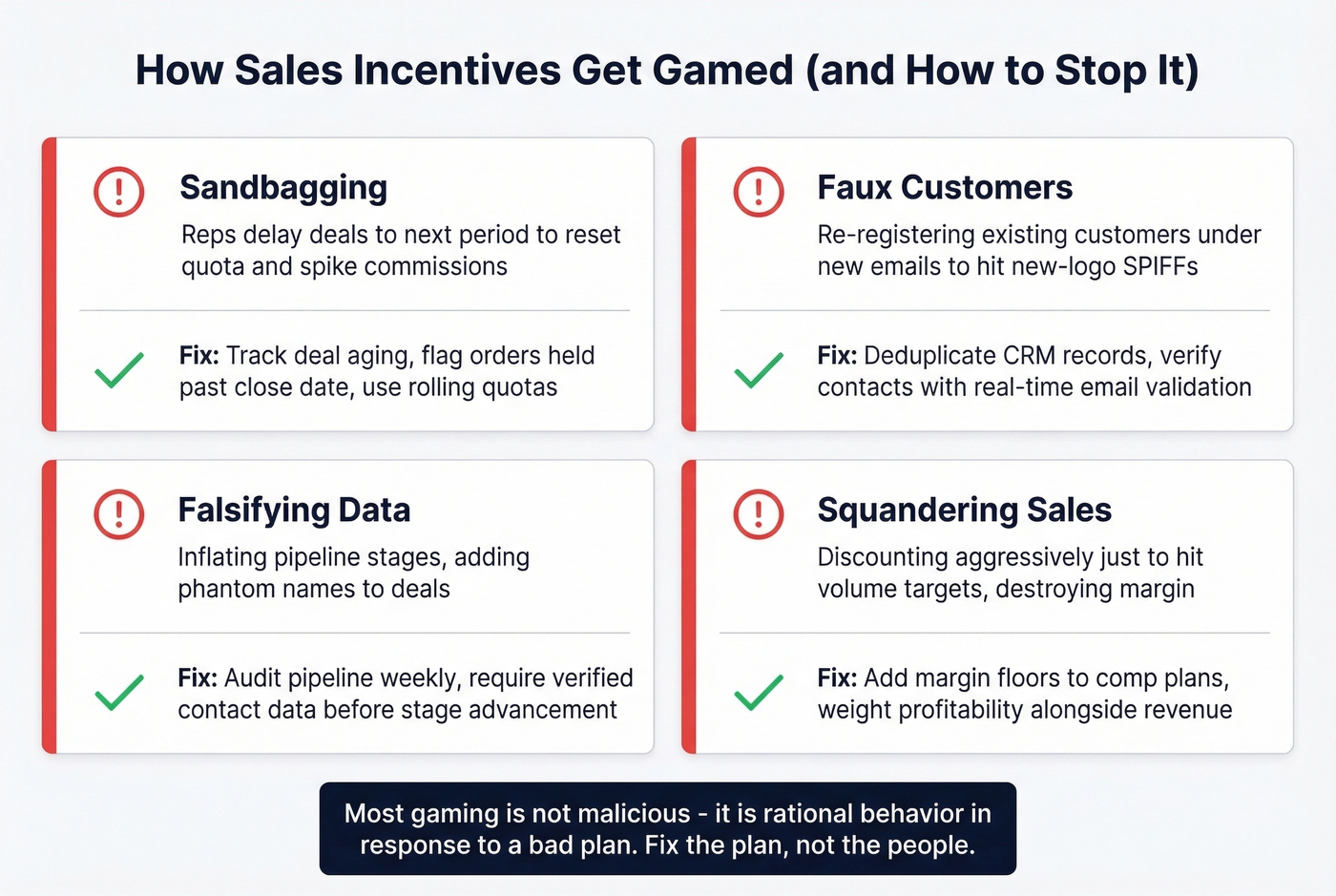
A compliance podcast catalogued eight categories of incentive gaming. The four most common in B2B sales:
- Sandbagging - reps delay orders to the next period to spike commissions on a fresh quota.
- Faux customers - re-registering existing customers under different emails to hit new-logo SPIFFs. Wells Fargo's fake-accounts scandal is the extreme version.
- Falsifying data - inflating pipeline stages, adding phantom names to deals.
- Squandering sales - discounting aggressively just to hit a volume target, torching margin in the process.
The countermeasures: monitor CRM data for irregularities, revise plans to close loopholes as they appear, and educate reps on what's acceptable. About 60% of top-performing organizations treat their incentive programs as living initiatives with continual assessment - roughly 20% more than their peers. The companies that get burned are the ones that set the plan in January and don't look at it again until December. If you want a tighter operational cadence, borrow a few ideas from sales performance management programs that treat comp as a system, not a spreadsheet.
Real talk: Most incentive gaming isn't malicious. It's rational behavior in response to a poorly designed plan. If your reps are gaming, your plan is the problem, not your people.
Measuring Incentive ROI
If you can't measure it, you can't defend the budget. Field experimentation - running a treatment group against a control - gives you the cleanest causal read. Post-hoc measurement using historical data is messier but more practical for teams that can't run controlled tests mid-quarter.
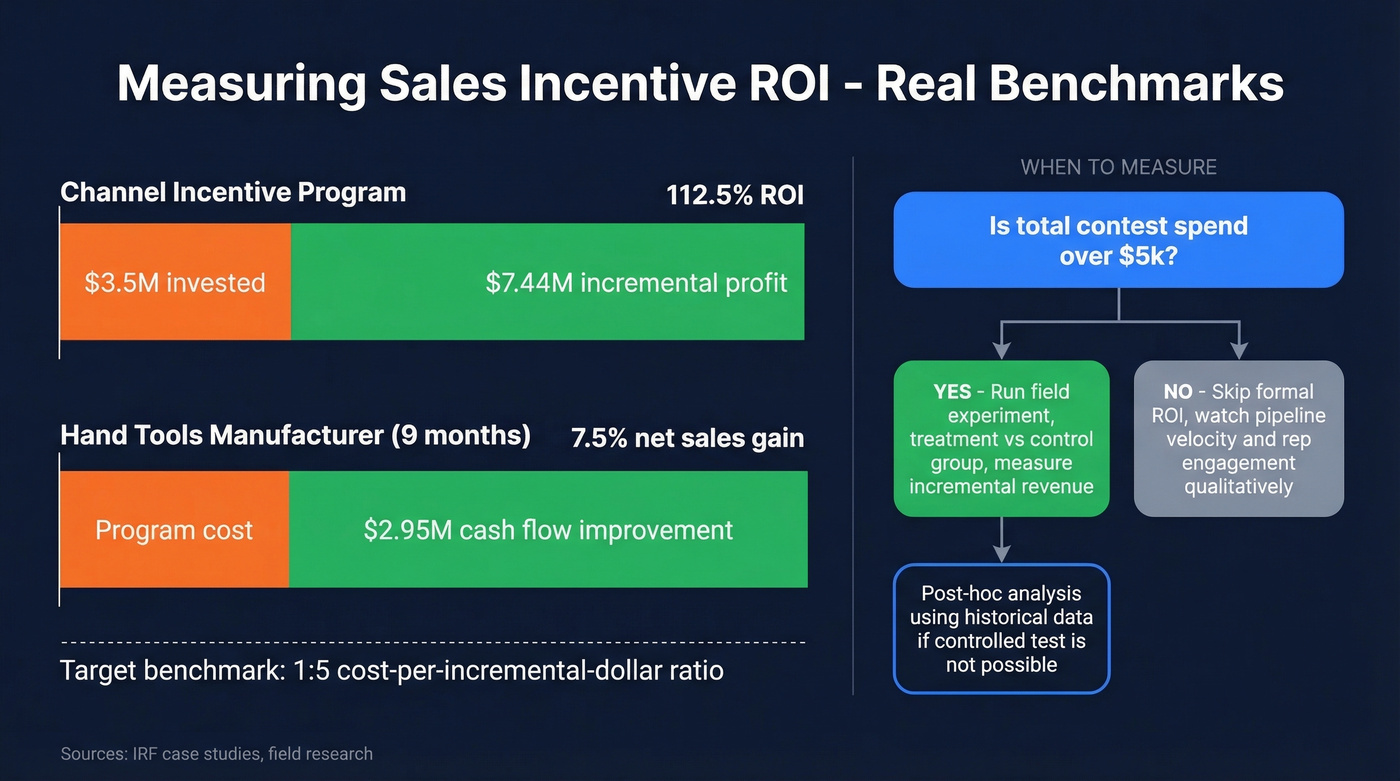
The numbers can be compelling. An IRF case study on a channel incentive program showed $7.44M in incremental profit on a $3.5M investment - 112.5% ROI. A hand tools manufacturer ran a 9-month program that produced a 7.5% net sales gain and an estimated $2.95M in cash flow improvement. A useful benchmark: aim for a 1:5 cost-per-incremental-dollar ratio. If you're spending $1 in incentives and generating less than $3 in incremental revenue, the plan needs reworking. To pressure-test the downstream impact, track pipeline health alongside revenue.
Skip the ROI analysis entirely if you're running a contest under $5k total spend. The measurement overhead isn't worth it at that scale - just watch pipeline velocity and rep engagement qualitatively.
You just designed a comp plan to reward your middle 70%. Now give them contact data that doesn't sabotage their performance. Teams using Prospeo book 26% more meetings than ZoomInfo users - at $0.01 per email with no annual contract.
Give your reps data worth hustling for. Start in two minutes.
FAQ
What percentage of revenue should fund sales team incentives?
1-3% of total sales revenue, or $2,000-$5,000 per rep annually for contests and SPIFFs on top of base commission. That range covers most mid-market SaaS companies. Adjust upward for high-ACV enterprise motions where individual deal impact justifies larger payouts.
Do activity-based incentives beat commission-only plans?
They complement commission - they don't replace it. A peer-reviewed study across 305 territories found 6-9% sales lifts from adding activity incentives on top of existing comp. With 85% of companies not using them, there's clear first-mover advantage for teams that adopt them now.
How do you prevent reps from gaming incentive plans?
Monitor CRM data for irregularities like duplicate accounts or sudden pipeline spikes, close loopholes each quarter, and run ongoing education. Verify that contacts entering your pipeline are real people at real companies - real-time verification catches fabricated records before they inflate numbers.
What non-cash rewards do sales reps actually value?
Operational perks outperform generic swag almost every time. Lead priority, schedule flexibility, manager support on tough deals, and choice of territory rank highest in rep surveys. These cost little but directly reduce daily friction, which is why they drive more behavior change than a $50 gift card.