

Sales Team Roles and Responsibilities in 2026: The Operator's Blueprint
Your best SDR just quit. Not because the pay was bad - because they were doing four jobs. Prospecting, qualifying, demoing, and chasing renewals. That's not a sales role; that's a burnout machine. As one r/sales poster put it: "I'm expected to prospect, qualify, demo, and close - and they call it a promotion."
The fix isn't motivation or a better comp plan. It's structure: defining clear sales team roles and responsibilities so every person knows exactly what they own.
The Short Version
- Your first three hires: SDR, Account Executive, Sales Manager - in that order. Everything else waits until you're past ~$3M ARR.
- Specialize early. If your AEs are still cold-calling past $1M ARR, you're paying closing-level comp for prospecting-level work.
- Use the stage-by-stage framework below to know exactly who to hire next and what to pay them.
| Role | Reports To | Primary Metric | OTE Range |
|---|---|---|---|
| SDR/BDR | Sales Manager | Meetings booked | $70k-$95k |
| Account Executive | Sales Manager/Dir | Revenue closed | $140k-$250k+ |
| Sales Manager | VP Sales/Dir | Team quota attainment | $160k-$200k+ |
| Sales Engineer | Sales Manager | Win rate lift | $160k-$230k |
| Sales Ops Manager | VP Sales/RevOps | Forecast accuracy | $120k-$160k |
| RevOps Leader | CRO/COO | Revenue predictability | $160k-$220k |
| CSM | CS Director | GRR / NRR | $90k-$130k |
| Sales Enablement | VP Sales | Ramp time, quota attainment | $100k-$140k |
| VP of Sales | CRO/CEO | Total revenue target | $250k-$350k+ |
Core Roles Across the Sales Org
SDR / BDR
This is the engine room. SDRs and BDRs fill the top of your pipeline so AEs can focus on closing. The title distinction is simple: SDRs typically work inbound leads, BDRs run outbound prospecting. Many companies use the titles interchangeably - what matters is whether the motion is inbound or outbound.
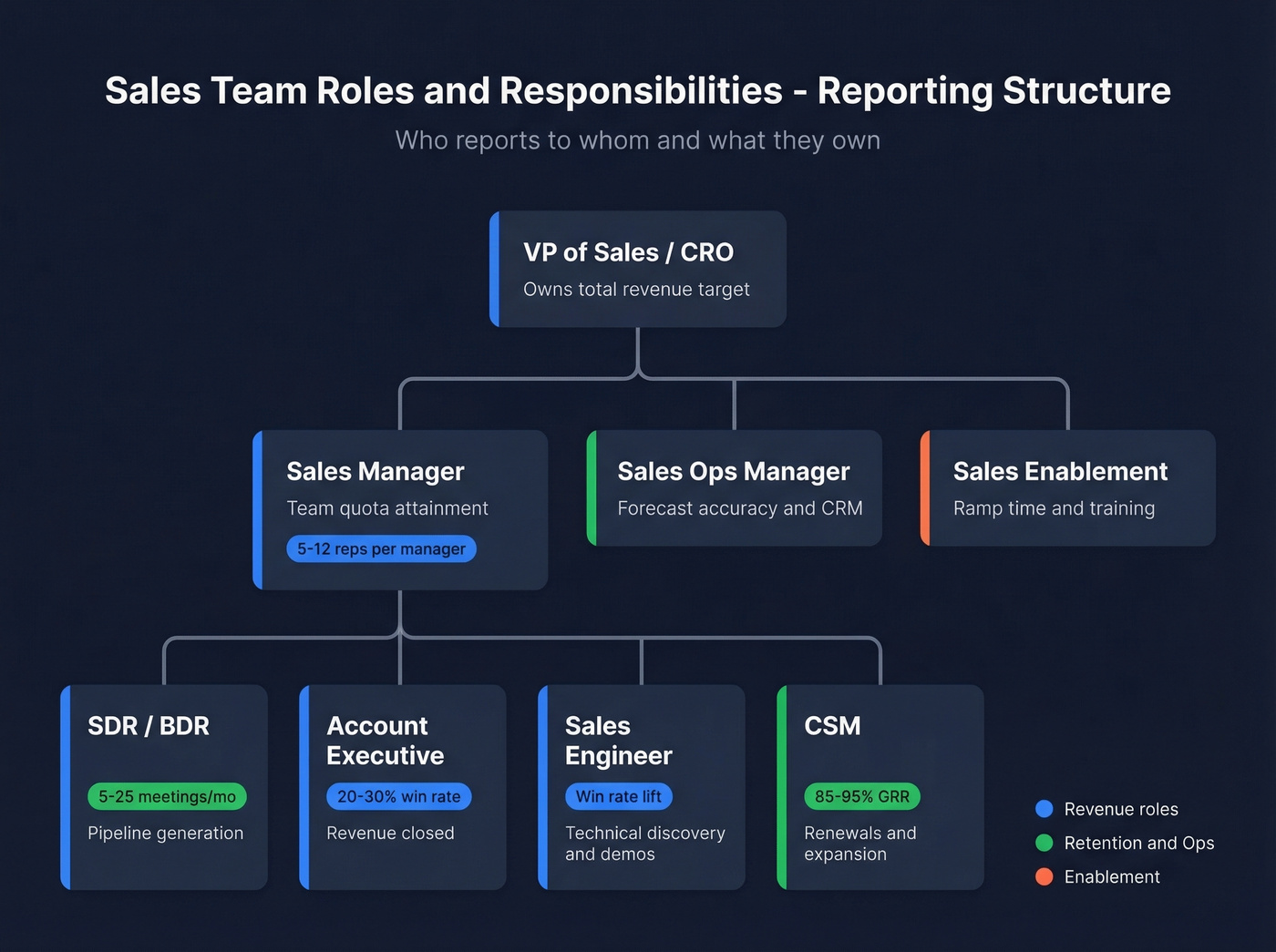
The numbers tell you how hard this job actually is. SDRs average 16 touches per account before getting a response, and it takes 18+ dials to get a single connect. Realistic meetings booked: 5-25 per month. The average SaaS lead-to-opportunity conversion rate sits around 12%, and only 56-60% of SDRs hit quota in a given period. Yet SDRs who do hit those numbers generate 46-73% of total pipeline - that's not a support function, that's the revenue foundation.
Most SDRs manage 75-125 accounts at a time, which means every minute spent chasing a dead email address is a minute not spent on a live prospect. We've seen teams cut prospecting waste in half just by switching to a data provider with verified contact info and a weekly refresh cycle.
The SDR-to-AE ratio across 939 B2B companies averages 1:2.5. SMB teams run tighter at 1:2; enterprise teams stretch to 1:3 or 1:4 because deal cycles are longer and AEs need fewer new opportunities per month.
The key trait for this role is resilience. SDRs hear "no" dozens of times a day. The ones who thrive have high volume tolerance, obsessive follow-up habits, and enough curiosity to personalize outreach at scale. The typical SDR-to-AE promotion path runs 12-18 months - it's the most common entry point into a SaaS sales career.

Account Executive
AEs own the number. They run discovery, manage deals through the pipeline, negotiate, and close. The critical distinction is between SMB AEs handling high-volume, shorter-cycle deals in the $10-30k range and enterprise AEs working fewer deals with longer cycles and six-figure contracts. A healthy win rate for most SaaS AEs falls in the 20-30% range, and pipeline coverage should run 3-5x quota at any given time.
Here's the thing: full-cycle AEs - reps who prospect, demo, and close - are an anti-pattern past $1M ARR. You're paying $140k+ OTE for someone to spend a third of their time doing $70k work. Specialize.
The best AEs combine sharp discovery skills with genuine negotiation ability. They don't just demo features - they map your product to the buyer's specific pain and build urgency around the cost of inaction.
Sales Manager
The first-line sales manager is the most leveraged hire you'll make. One great manager lifts an entire team; one bad one craters it. Span-of-control benchmarks from the Alexander Group put inside sales teams at 8-12 reps per manager, while complex enterprise teams need a tighter 5-8 ratio.
The tension every sales manager faces: coaching versus closing. Managers who jump on deals to "help" end up creating dependency. The best ones spend 60%+ of their time in coaching, pipeline reviews, and deal strategy - not running their own book.
Sales Engineer / Solutions Consultant
Sales Engineers handle technical discovery, custom demos, proof-of-concept builds, and integration planning. Solutions Consultants lean more business-focused - ROI modeling, stakeholder alignment, high-level solution strategy. In practice, many companies blur the line.
SEs are shared across multiple AEs rather than assigned 1:1. Comp splits run 70/30 to 75/25 base-to-variable, with total comp in the $160k-$230k range. At startups, your first SE does everything from demos to implementation support. At scale, you'll split into demo engineers, solution architects, and implementation consultants.
Sales Operations Manager
The most underrated hire in sales. Sales Ops owns CRM hygiene, territory design, quota modeling, reporting, and process optimization. Without this role, your VP of Sales is spending half their time in spreadsheets instead of coaching.
Gartner found that Sales Ops teams now spend 68% of their time on non-sales functions, up from 39% in 2019. That's scope creep eating your operational capacity. Most companies should hire their first Sales Ops person around $10-25M ARR. The ideal candidate is equal parts analyst and systems thinker - someone who can build a territory model and then wire the CRM to enforce it.
Revenue Operations (RevOps)
RevOps aligns sales, marketing, and customer success under one operational umbrella - a single source of truth for the entire revenue engine. Gartner projected that 75% of the highest-growth companies would adopt a RevOps model by 2026, and that prediction has largely played out.
The staffing benchmark is roughly 12:1 - twelve sales reps per RevOps person. Most companies transition from Sales Ops to RevOps around $50-100M+ ARR, when cross-functional misalignment starts causing measurable revenue leakage. Organizations that make the switch report up to 30% reduction in deal slippage. It's not a rebrand of Sales Ops - it's a fundamentally broader mandate.
Customer Success Manager
CSMs own the post-sale relationship: onboarding, adoption, renewals, and expansion. The metrics that matter are gross revenue retention (target 85-95% depending on segment) and net revenue retention (100-130%, with the best PLG and enterprise companies pushing above 120%).
Hire your first CSM after $1M ARR - before that, founders should own renewals directly. Great CSMs are part relationship manager, part product consultant. They need enough technical depth to drive adoption and enough commercial instinct to spot expansion opportunities.
Sales Enablement Specialist
Enablement owns training, content, and onboarding. Their job is to make every rep productive faster and keep them sharp over time. The scope includes playbook development, competitive battle cards, call coaching programs, and new-hire ramp plans.
Hire for this role between $5M and $20M ARR. Before that, your sales manager handles enablement. After that, you need a dedicated function.
VP of Sales / Sales Director
The VP of Sales sets strategy, owns the revenue target, and builds the leadership layer beneath them. The timing matters: hire a Head of Sales (player-coach) at $1M-$5M ARR, and upgrade to a true VP at $10M+.
We've seen the "fancy big-tech VP" mistake too many times. A VP who ran a 200-person org at Salesforce isn't necessarily the right person to build your team from 3 to 15 reps. Look for someone who's built before, not just managed at scale.
Compensation Benchmarks (2026)
These ranges reflect US SaaS compensation - adjust 15-25% down for non-coastal markets.
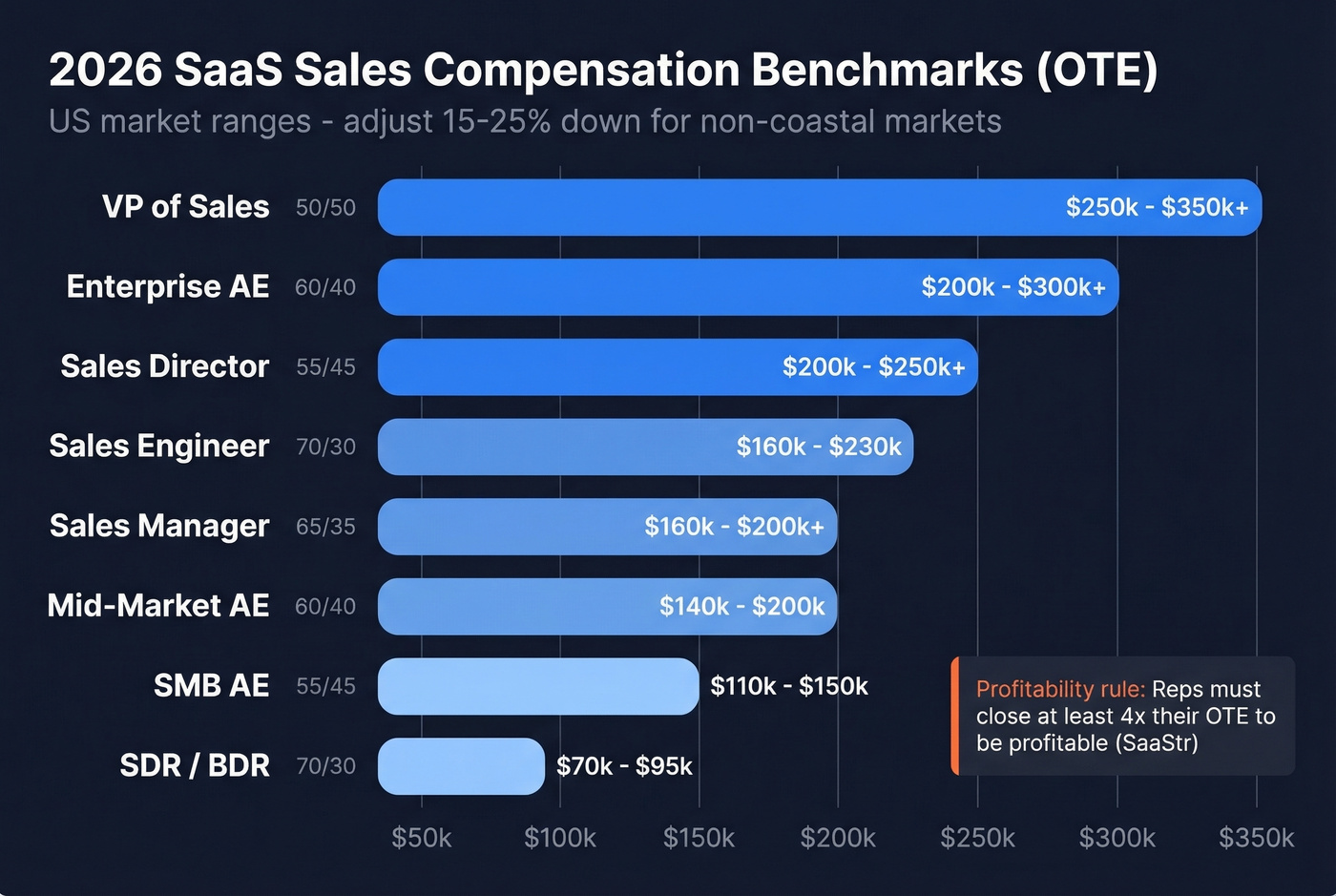
| Role | Base Salary | OTE | Base/Variable Split |
|---|---|---|---|
| SDR/BDR | $55k-$75k | $70k-$95k | 60/40 to 70/30 |
| SMB AE | $65k-$85k | $110k-$150k | 50/50 |
| Mid-Market AE | $75k-$100k | $140k-$200k | 50/50 |
| Enterprise AE | $100k-$140k | $200k-$300k+ | 50/50 |
| Sales Engineer | $80k-$140k | $160k-$230k | 70/30 to 75/25 |
| Sales Manager | $110k-$140k | $160k-$200k+ | 60/40 |
| Sales Director | $140k-$180k | $200k-$250k+ | 65/35 |
| VP of Sales | $180k-$220k | $250k-$350k+ | 60/40 |
The profitability heuristic from SaaStr is simple: a rep needs to close at least 4x their total comp to make the hire profitable. If your AE earns $120k OTE, they need to close $480k+ annually. If they can't, the role isn't the problem - your market, pricing, or enablement is.
One number that should scare you: the cost of vacancy. An AE carrying a $1.2M annual quota who sits empty for 60 days costs you roughly $200k in missed revenue. Hiring speed matters as much as hiring quality.

You just read that SDRs need 16 touches per account and manage 75-125 accounts at a time. Every bounced email is a wasted touch. Prospeo delivers 98% email accuracy with a 7-day refresh cycle - so your SDRs spend time selling, not chasing dead contacts. At $0.01 per email, it costs less than the coffee your reps drink while rebuilding bad lists.
Stop paying closing-level comp for prospecting-level problems.
How Your Sales Org Evolves by Stage
Not every company needs every role. Here's the framework we use to map hiring to ARR:
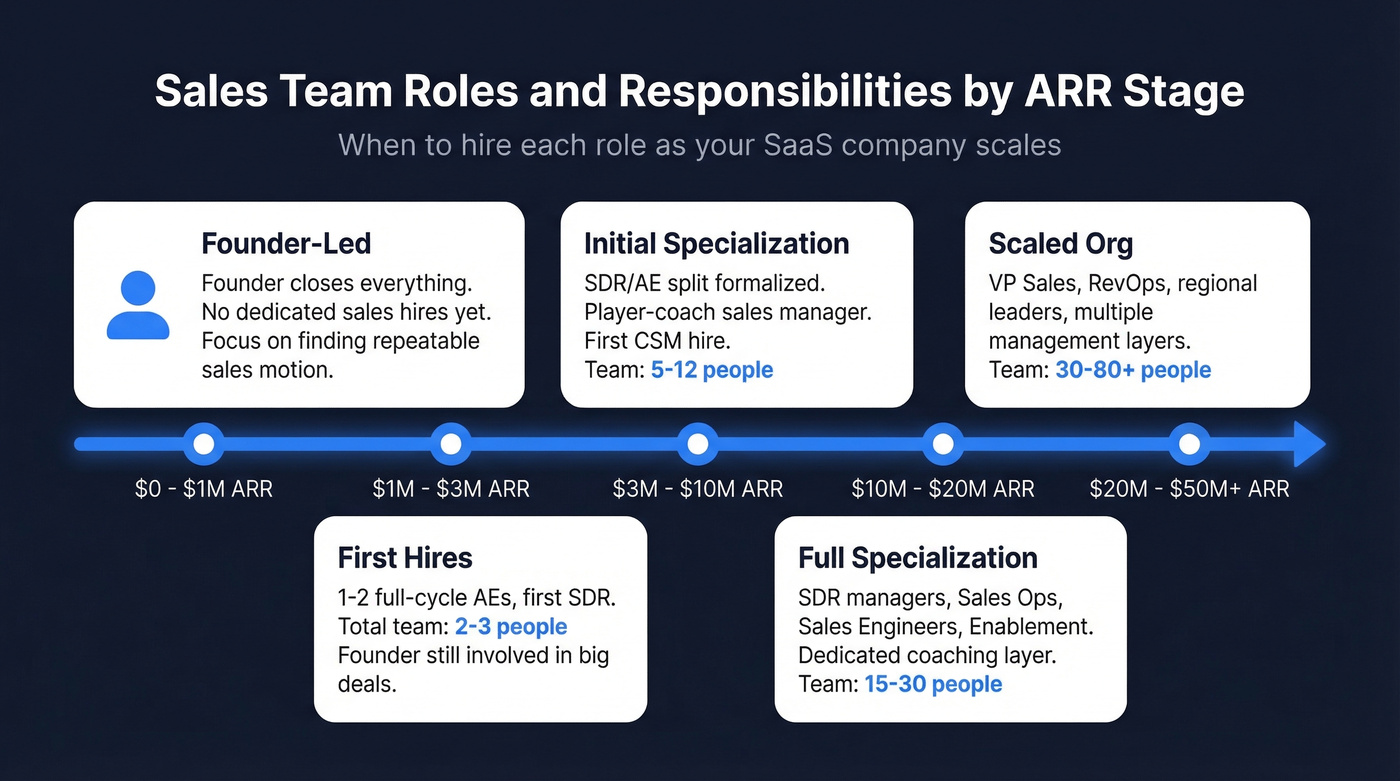
| ARR Stage | Team Shape | Key Hires |
|---|---|---|
| $0-$1M | Founder-led | Founder closes everything |
| $1M-$3M | First hires | 1-2 full-cycle AEs, first SDR |
| $3M-$10M | Initial specialization | SDR/AE split, player-coach manager |
| $10M-$20M | Full specialization | SDR managers, Sales Ops, SEs, Enablement |
| $20M-$50M+ | Scaled org | VP Sales, RevOps, regional leaders, multiple layers |
The practical sizing math works backward from opportunity needs. If an AE needs 15 qualified opportunities per month and an SDR generates 10, you need roughly 1.5 SDRs per AE. Adjust based on your inbound volume - heavy inbound means fewer SDRs per AE.
The biggest mistake at each stage is hiring ahead of your revenue. A RevOps leader at $5M ARR is premature. A VP of Sales at $800k ARR is a luxury you can't afford. Match the org to the stage, not to the org chart you saw at a conference.
Let's be honest: if your average deal size sits below $15k, you probably don't need half the roles on this page. An SDR, two AEs, and a player-coach manager will outperform a bloated org that's burning cash on titles instead of quota capacity.
Sales Team Structures
Three models dominate B2B sales, and each comes with real tradeoffs.
Assembly Line - specialized roles in sequence. SDRs prospect, AEs close, CSMs retain. This is the SaaS default and works best for high-volume, repeatable sales motions. The upside is scalability: you can optimize each stage independently. The downside is handoff friction - leads get dropped between stages, and context gets lost. Most B2B SaaS companies should move to this model by $3M ARR.
Island - each rep runs the full cycle from prospecting to close. Simple. Full ownership of the customer relationship. But it doesn't scale past $3M without burning people out, and you can't optimize any single stage.
Pod - small cross-functional teams (SDR + AE + CSM or SE) working the same accounts. Deep account knowledge, seamless handoffs. The downside is cost - pods are expensive to staff and hard to rebalance when someone leaves. Best for enterprise and complex deals where account depth matters more than volume.
The "right" structure depends on your average deal size and sales cycle length. Sub-$15k deals with 30-day cycles? Assembly line. Six-figure enterprise deals with 6-month cycles? Pods. Everything in between? Start assembly line, add pod elements for your top accounts.
Mistakes That Kill Sales Teams
Reps doing four jobs. The r/sales consensus is clear: forcing AEs to prospect, qualify, demo, and close is the fastest path to turnover. Specialize earlier than you think you need to.
Hiring the "fancy" VP too early. A VP who managed 200 reps at Oracle hasn't built anything from scratch in a decade. Your first sales leader needs to be a builder, not a manager of managers.
No training for reps 3-10. Your first two reps learned from the founder. Reps 3-10 don't get that luxury. Without formal onboarding and enablement, ramp times double and early attrition spikes. One team we spoke with cut new-hire ramp from 10 weeks to 4 just by documenting their discovery call framework and pairing new reps with a buddy AE for the first month.
Overly complex comp plans. If your comp plan has more than three variables, nobody understands it - including the reps. Keep it simple: base + commission on closed revenue + accelerator above quota.
Ignoring the 4x rule. Every rep must close at least 4x their OTE to be profitable. If they can't, don't blame the rep - fix the territory, the pricing, or the product-market fit.
Tools Your Sales Team Needs
| Category | Who Uses It | Example |
|---|---|---|
| CRM | AEs, Managers, Ops | Salesforce, HubSpot |
| B2B Data / Email Finder | SDRs, AEs | Prospeo |
| Sales Engagement | SDRs, AEs | Outreach, Salesloft |
| Intent Data | RevOps, SDRs | Bombora |
| Conversation Intelligence | Managers, Enablement | Gong, Chorus |
CRM adoption has been linked to 29% sales increases and 34% productivity gains. But the CRM is only as good as the data inside it. Bad emails and disconnected phone numbers make every other tool in the stack less effective - and they're the fastest way to tank your domain reputation.
Prospeo delivers 143M+ verified emails and 125M+ verified mobiles on a 7-day refresh cycle, with intent data tracking 15,000 topics via Bombora so SDRs can prioritize accounts actively researching relevant solutions. It integrates natively with Salesforce, HubSpot, Outreach, Salesloft, and most sequencing tools, so data flows straight into your reps' workflows without manual CSV exports.
Skip the data provider conversation entirely if your team is under five reps and running mostly inbound. You don't need it yet. For outbound-heavy teams, though, bad data is the silent killer - our experience is that bounce rates above 5% start degrading sender reputation fast.
If you're trying to reduce bounces, start with email deliverability basics and a clear email bounce rate target before you scale volume.
Specializing roles only works when every role has the data to do their job. SDRs need verified emails. AEs need direct dials. Sales Ops needs clean CRM data. Prospeo gives you 300M+ profiles, 125M+ verified mobiles, and CRM enrichment returning 50+ data points per contact - one platform powering every seat on your org chart.
Equip every role on your sales team with data that actually connects.
FAQ
What's the difference between an SDR and a BDR?
SDRs typically handle inbound leads while BDRs focus on outbound prospecting. Many companies use the titles interchangeably - the real distinction is the motion (inbound vs. outbound), not seniority or pay grade.
When should I split SDR and AE roles?
Split around $1M-$3M ARR, or whenever AEs spend more than 30% of their time prospecting. You're paying closing-level comp for prospecting-level work - the split pays for itself within one quarter.
What's a good SDR-to-AE ratio?
The average across 939 B2B companies is 1 SDR per 2.5 AEs. SMB teams run 1:2; enterprise teams run 1:3 to 1:4. Outbound-heavy orgs need closer to 1:1.5.
Sales Ops vs RevOps - what's the difference?
Sales Ops optimizes sales-specific processes, tools, and reporting. RevOps aligns sales, marketing, and customer success under one operational umbrella. Most companies transition to RevOps around $50M+ ARR when cross-functional alignment becomes critical.
What tools do SDRs need to hit quota?
A CRM (HubSpot or Salesforce), a B2B data platform for verified emails and direct dials, and a sales engagement tool (Outreach or Salesloft) for sequencing. That three-tool stack covers 90% of daily SDR needs.