

15 Sales Techniques Backed by Data - Not Just Theory
At least 40% of your pipeline will end in "no decision." Not a loss to a competitor. Not a budget cut. The buyer ghosts, the deal stalls, and the forecast line item quietly disappears. The sales techniques that actually move numbers in 2026 aren't about slick closes or objection-handling scripts - they're about breaking through the status quo bias that kills deals before they ever reach a decision.
Quick Version - 5 Behaviors That Move Numbers
If you read nothing else, do these five things:
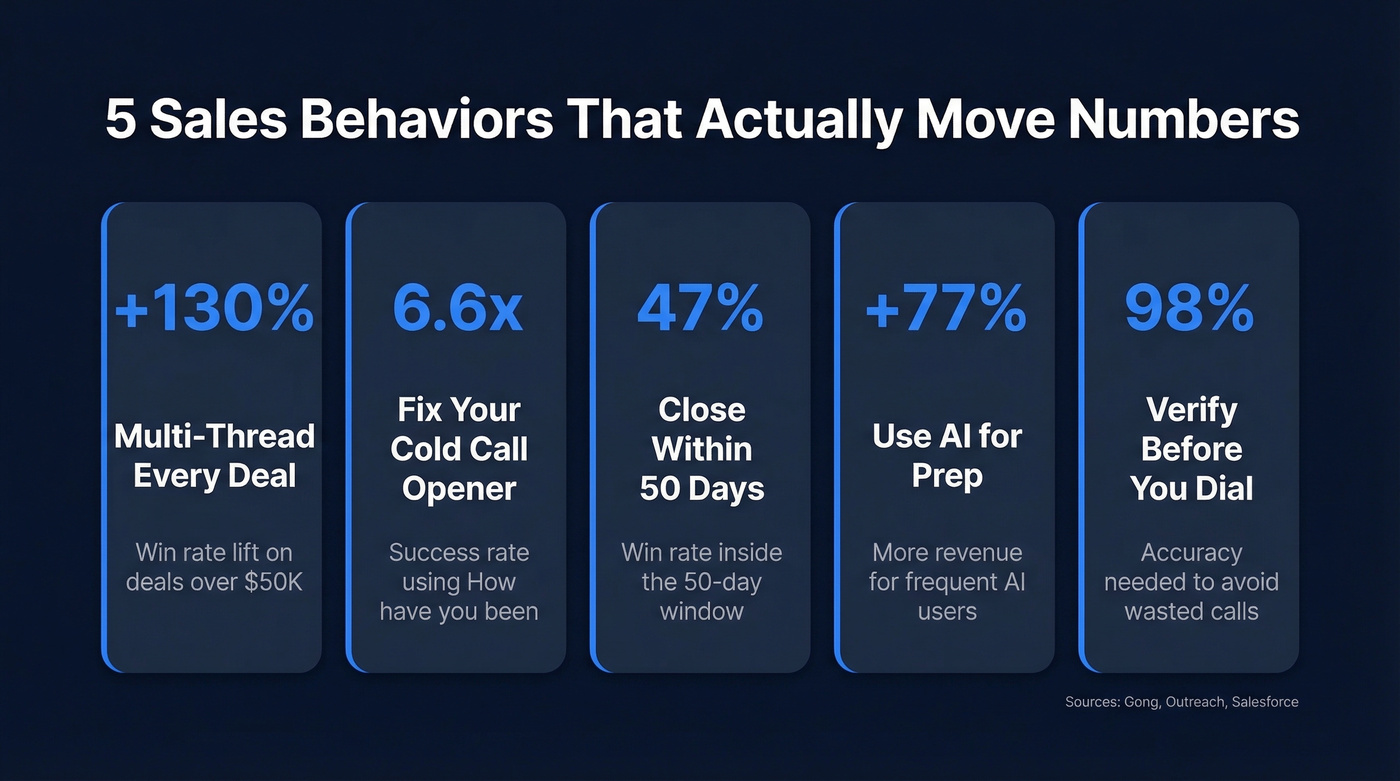
- Multi-thread every deal. Multi-threading lifts win rates by +130% on deals over $50K. Single-threaded deals die in committee.
- Fix your cold call opener. "How've you been?" produces a 6.6x higher success rate than baseline. "Did I catch you at a bad time?" craters it by 40%.
- Close within 50 days or disqualify. Deals closed inside 50 days carry a 47% win rate. After that, you're below 20%.
- Use AI for prep, not just automation. Sellers who frequently use AI generate 77% more revenue than those who don't.
- Verify your data before you dial. None of these techniques work if you're calling wrong numbers or bouncing emails. Verify your list before every call block.
Discovery & Qualification Methods
SPIN Selling (Table Stakes)
SPIN - Situation, Problem, Implication, Need-Payoff - is the framework most reps learn first. It's solid for structuring early discovery conversations, especially when you're new to a vertical and need a systematic way to uncover pain. But SPIN is baseline literacy in 2026, not a competitive advantage. Every halfway-decent rep already asks about problems and implications.
Where you differentiate is in what you do after discovery - how you qualify, position, and multi-thread. Think of SPIN as the foundation, not the house. It remains a reliable starting point, but it's rarely sufficient on its own.
Gap Selling
Gap Selling, introduced by Keenan in 2018, reframes discovery around the distance between a buyer's current state and their desired future state. Instead of just asking "what's your biggest challenge?", you're mapping the literal situation, the type of problem, the business impact, the root cause, and the emotion attached to it. The framework gives you three question types: probing questions to understand the current state, process questions to map how decisions get made, and validating questions to confirm your understanding before proposing anything.
It's a genuinely useful framework for complex deals where you have access to a business stakeholder who can articulate strategic goals.
When to skip it: Practitioners on Reddit consistently flag the same issue - when you're selling through procurement, IT, or facilities contacts who just want the quote, drilling into "numerical goals" and "emotional impact" feels tone-deaf. Too many questions push transactional buyers toward competitors who get to the point faster. Use Gap Selling when you have access to power. Skip it when your contact can't see past the purchase order.
MEDDIC - The Framework Nobody Writes About
Most "sales techniques" articles list SPIN, Challenger, and Sandler, then stop. They skip MEDDIC, which is the qualification framework that actually dominates enterprise SaaS. 73% of SaaS companies selling above $100K ARR use some version of MEDDPICC. Organizations that fully adopt it report 18% higher win rates and 24% larger deal sizes. Other write-ups put the close-rate lift in the 20-30% range.
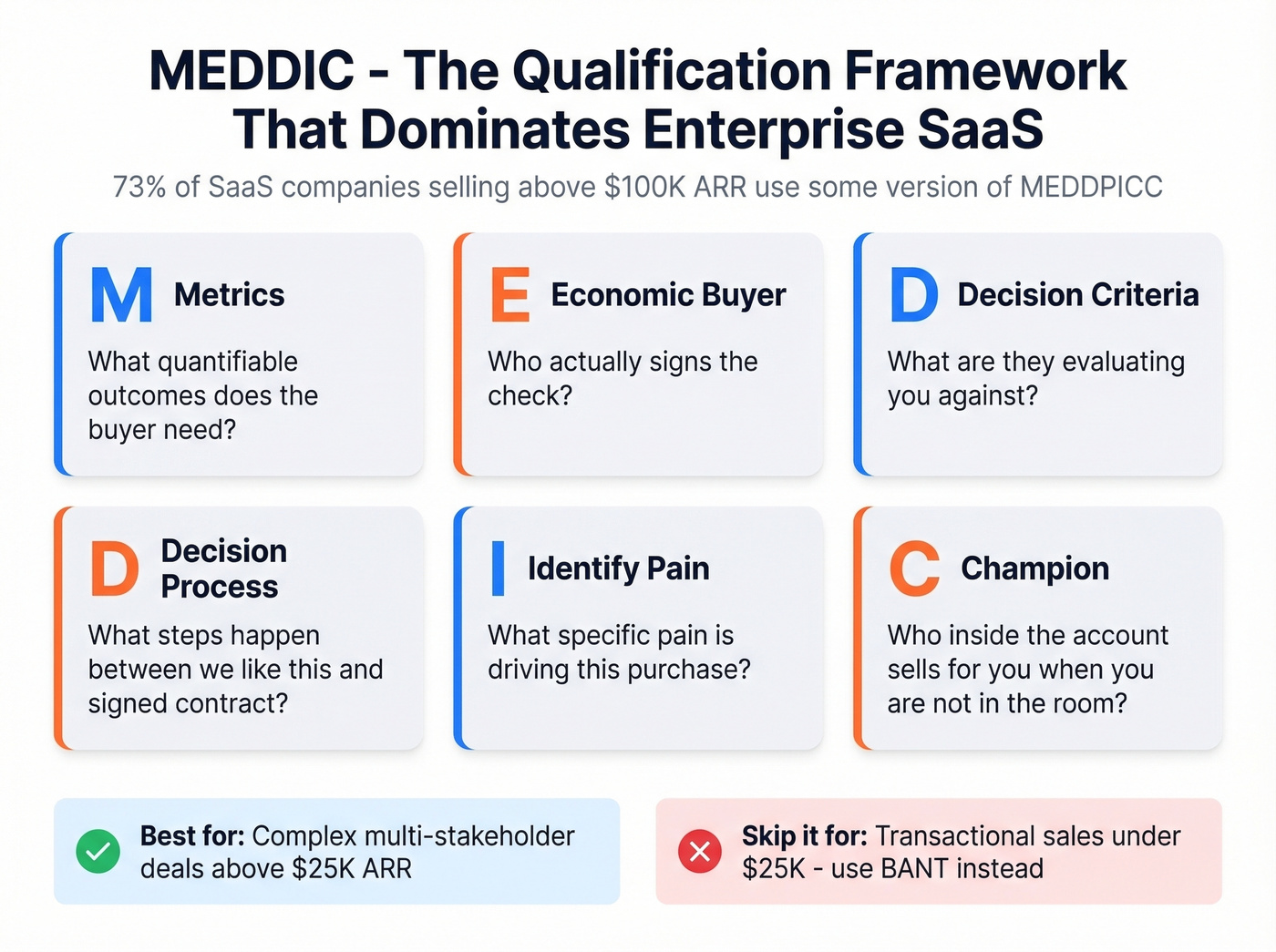
Here's the thing: if your average deal is under $25K, skip MEDDIC. It's overkill. You'll spend more time filling out qualification fields than selling. MEDDIC earns its keep on complex, multi-stakeholder deals where a single missing element - no identified champion, no access to the economic buyer - can silently kill a six-figure opportunity. For transactional sales, a simple BANT check gets you 80% of the way there in a fraction of the time.
Here's what each letter means in practice:
- Metrics - What quantifiable outcomes does the buyer need? "Reduce churn by 15%" beats "improve retention."
- Economic Buyer - Who actually signs the check? Not your champion. The person with budget authority.
- Decision Criteria - What are they evaluating you against? Technical requirements, compliance, price?
- Decision Process - What steps happen between "we like this" and "signed contract"? Legal review? Board approval?
- Identify Pain - What's the specific, quantified pain driving this purchase? No pain, no urgency.
- Champion - Who inside the account is actively selling for you when you're not in the room?
The extended version (MEDDPICC) adds Paper Process and Competition. Teams that adopt MEDDIC as their pipeline review language - scoring every deal against these six criteria and flagging anything missing a champion or economic buyer - consistently report tighter forecasts and fewer late-stage surprises. It's not glamorous, but it's the single best predictor of whether a deal is real or a forecast fantasy.
Messaging & Positioning Techniques
The Challenger Approach
Challenger selling - Teach, Tailor, Take Control - is the most misunderstood framework in sales. Most teams implement it as "be aggressive" or "push back on the buyer," when it's actually about teaching. The core insight is that top performers don't just respond to stated needs; they reshape how buyers think about their problems.
Research from Emblaze found that introducing "Unconsidered Needs" - problems the buyer hasn't identified yet - increases persuasive impact by 10% compared to messages that simply validate known needs. That 10% doesn't sound dramatic until you realize it's the difference between a buyer thinking "we should probably do something" and "we need to do something now."
Challenger works best in complex B2B where the buyer has multiple options and no clear urgency. If your buyer already knows exactly what they want and is comparing three vendors on a spreadsheet, teaching them something new about their problem won't land - they're past that stage. Match the approach to the moment.
Bring Up the Competition Early
The scenario: You're 20 minutes into a demo. The buyer asks, "So how are you different from [Competitor]?" Most reps freeze, deflect, or launch into a defensive feature comparison.
The better move? Bring it up before they do. Analysis of millions of sales conversations shows competitive mentions have increased 57% since 2022, and mentioning competition early in an enterprise deal increases your odds of winning by 32%.
Why it works: proactively naming competitors signals confidence. It tells the buyer you know the market and you're not afraid of comparison. Avoiding the topic signals the opposite. The key is framing - don't trash the competition. Instead, try something like: "You're probably also looking at [Competitor]. They're solid on X. Where we're different is Y, and here's why that matters for your situation." That kind of directness builds trust faster than any amount of feature-dumping.
Prospecting Techniques With Data Behind Them
Cold Call Openers That Book Meetings
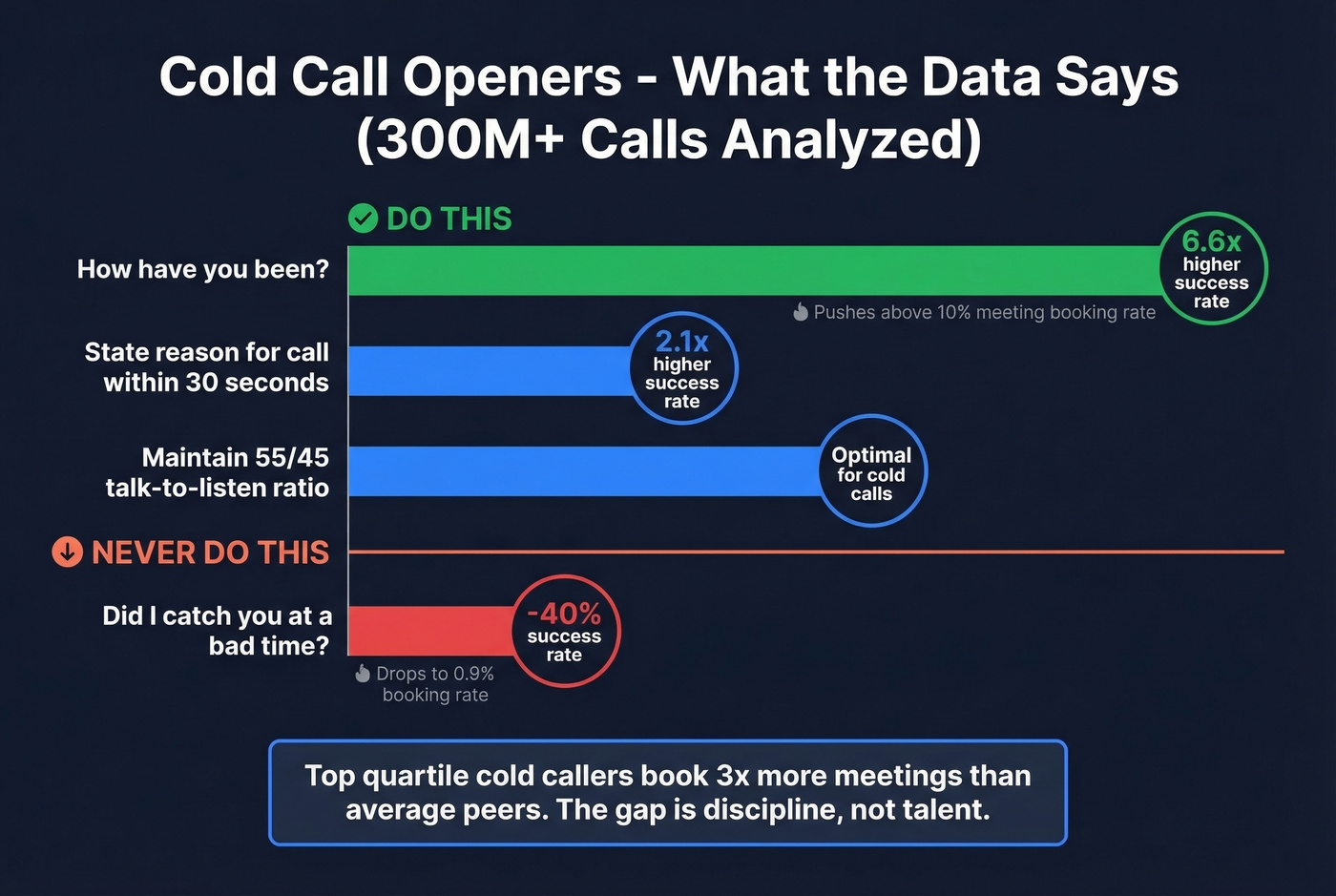
The first 30 seconds of a cold call determine everything. Analysis of 300M+ cold calls makes the right moves surprisingly clear.
Do this:
- Open with "How've you been?" - it produces a 6.6x higher success rate than baseline, pushing above a 10% meeting-booking rate. It works because it mimics a warm relationship, even with strangers.
- State the reason for your call within 30 seconds. This alone increases success rate by 2.1x. Prospects don't want to guess why you're calling.
- Aim for a 55/45 talk-to-listen ratio on cold calls. This is the opposite of discovery calls - on a cold call, you're selling the meeting, not diagnosing the problem.
Never do this:
- "Did I catch you at a bad time?" drops success rate by 40%, landing at a dismal 0.9%. It gives the prospect an easy exit before you've delivered any value.
- Leading with your product name and a feature list. Nobody cares about your platform in the first 10 seconds. They care about their problem.
Top-quartile cold callers book 3x+ more meetings than average peers. The gap isn't talent - it's discipline around these specific behaviors, backed by hundreds of millions of data points.
Voicemail + Email - The Omnichannel Play
Here's a stat that should change how you think about voicemail: cold calling nearly doubles email reply rate, from 1.81% to 3.44%, even without a live connect. Leaving a voicemail specifically pushes email reply rates from 2.73% to 5.87%.
The reframe is important. Voicemail's goal isn't a callback - it's priming the prospect to open your email. Leave a 20-second voicemail that references the email you're about to send, then send it immediately. The combination outperforms either channel alone by a wide margin.
Multi-Threading - The Highest-Impact Technique
If there's one technique in this entire article that deserves disproportionate attention, it's multi-threading.
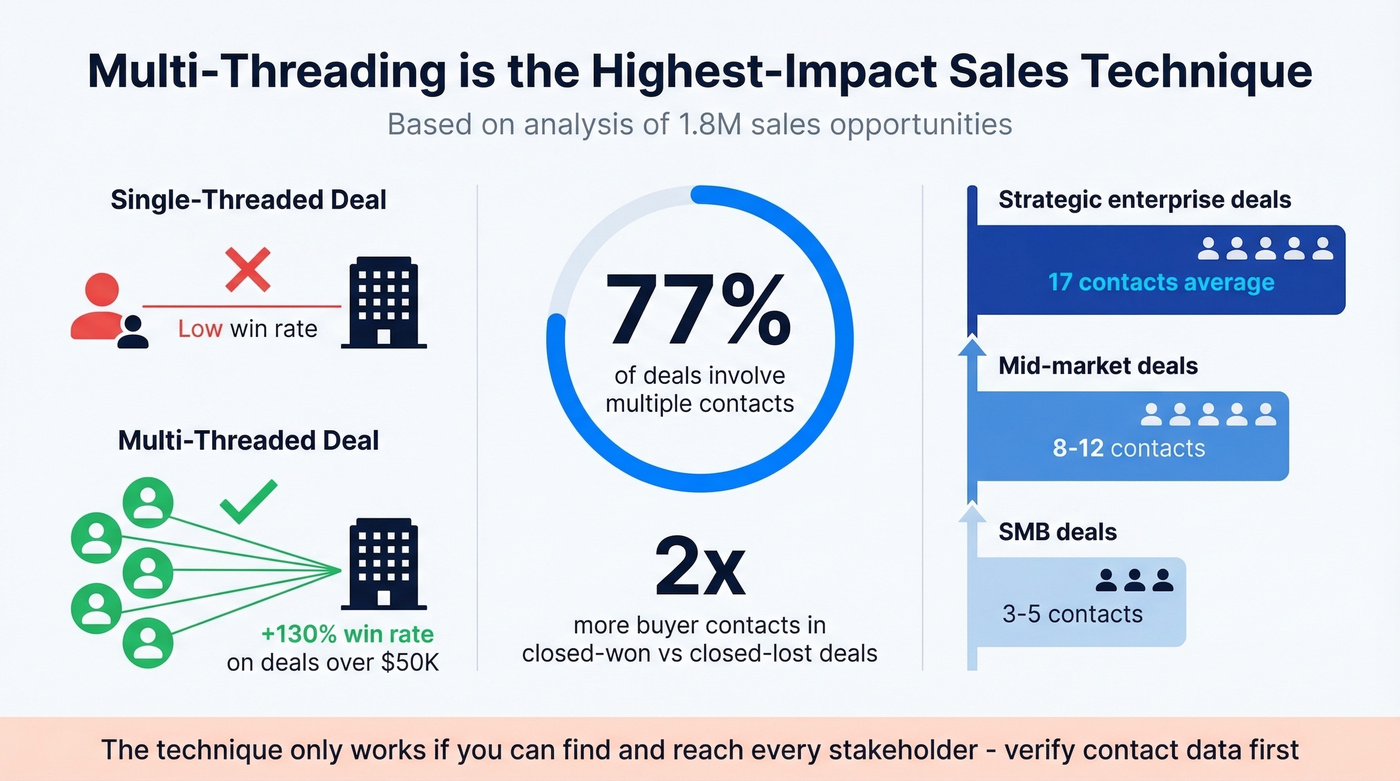
Analysis of 1.8M opportunities found that 77% of deals involve multiple contacts, and closed-won deals have roughly 2x as many buyer contacts as closed-lost deals. Strategic enterprise deals average 17 contacts. The win-rate lift from multi-threading on deals over $50K? +130%.


Multi-threading lifts win rates by +130% - but only if you can actually reach every stakeholder. Prospeo gives you verified emails and direct dials for entire buying committees, not just one contact. 300M+ profiles, 98% email accuracy, 125M+ verified mobiles.
Stop single-threading deals because you can't find the economic buyer.
Conversation & Closing Techniques
Talk-to-Listen Ratio - Consistency Beats the "Rule"
The old wisdom says optimal talk-to-listen ratio is 43% talk, 57% listen. That's not wrong, but Gong's latest analysis reveals something more interesting: the real separator isn't the ratio itself - it's consistency. High performers maintain similar ratios whether they win or lose. Low performers swing roughly 10%, talking 54% on won deals but ramping up to 64% on lost deals. They talk more when they're losing, which makes them lose more.
The takeaway isn't "talk less." It's "be consistent." If you catch yourself over-talking on a deal, it's probably already in trouble - and the extra talking is a symptom, not a cure.
Video Selling
Deals are 127% more likely to close when video is used at any point in the sales process. Win rates jump 94% higher when the seller has their camera on, and another 96% when the buyer turns theirs on too.
This data dates to 2020, but the behavior has only intensified - remote and hybrid selling is now the default, not the exception. The underlying psychology of accountability, rapport, and nonverbal cues hasn't changed. If anything, the advantage of camera-on selling has grown as buyers have become more comfortable with video and more suspicious of sellers who hide behind audio-only calls. Virtual body language - eye contact with the camera, visible nodding, leaning in - matters more than most reps realize. If you're still running discovery calls with your camera off, you're leaving money on the table. Among methods that require zero budget, simply turning on your camera ranks near the top.
Team Selling
Team selling is the most underinvested technique on this list. Winning sales teams are 67% larger than losing teams. Bringing a sales engineer into enterprise deals can increase win rates by up to 30%.
This isn't about headcount for its own sake - it's about matching the complexity of the buying committee with the right expertise on your side. A solo AE trying to handle technical, financial, and strategic questions across 17 stakeholders is outgunned. Pair up deliberately: bring the SE for technical deep-dives, bring your VP for executive alignment, bring customer success for implementation concerns. Every role serves a purpose.
Close Within 50 Days or Disqualify
Opportunities closed within 50 days carry a 47% win rate. After 50 days, that drops to roughly 20% or lower. Look - if a deal hasn't moved in 30+ days, it's probably already lost. The buyer just hasn't told you yet.
This is where pipeline discipline matters more than closing technique. Roughly 60% of deals in a typical pipeline are stalled. The fix isn't a better close - it's a better disqualification process. At every pipeline review, ask: "What specific next step is scheduled?" If the answer is "I'm going to follow up next week," that's not a next step. That's hope. Specific next steps - a scheduled demo with the economic buyer, a technical evaluation with IT, a pricing review with procurement - are the only reliable indicators of deal momentum.
Technique Benchmarks at a Glance
| Technique | Key Metric | Source |
|---|---|---|
| Multi-threading | +130% win rate (>$50K) | Gong 2026 |
| "How've you been?" opener | 6.6x success rate | Gong 2021 |
| Voicemail + email | Reply: 2.73% -> 5.87% | Gong 2024 |
| Video selling | 127% more likely to close | Gong 2020 |
| Close within 50 days | 47% vs ~20% win rate | Outreach 2026 |
| AI-assisted selling | 77% more revenue | Gong 2026 |
| Team selling (with SE) | Up to +30% win rate | Gong 2026 |
| MEDDIC adoption | 18-30% higher win rates | SalesMotion |
What to Stop Doing - Anti-Patterns With Data
Fake scarcity and urgency. "This price expires Friday" works in B2C. In B2B buying committees with 17 stakeholders, it's a trust-killer. One Head of Sales reported on HubSpot's blog that replacing urgency-based CTAs with data-backed proposals and tailored value maps increased their win rate by 20% over two quarters. Real urgency comes from quantified cost of inaction, not artificial deadlines.
Rushing to pitch before connection. Sending a pitch deck two minutes into a call tells the buyer you don't care about their problem - you care about your quota. The data on talk-to-listen consistency backs this up: reps who over-talk early are the same ones whose ratios swing wildly between won and lost deals.
"Did I catch you at a bad time?" A 0.9% success rate. Forty percent worse than saying nothing special at all. Kill this phrase permanently.
Sending the same demo to every persona. Your CFO cares about ROI and payback period. Your IT lead cares about integration complexity and security. Your end users care about daily workflow impact. Running the same 45-minute feature tour for all three signals that you didn't bother to learn what each stakeholder actually needs. Tailor the demo to the audience or don't bother booking it.
AI as a Revenue Multiplier
AI isn't a standalone selling method - it's a multiplier on every technique in this article. Analysis of 7.1M opportunities found that sellers who frequently use AI generate 77% more revenue than those who don't. Bain's 2026 research puts it in context: sellers spend only about 25% of their time actually selling. AI gives the rest of that time back - or at least a meaningful chunk of it.
Early AI adopters are seeing 30%+ improvement in win rates. AI coaching assistants close deals 11 days faster on average and lift win rates by 10 percentage points on deals over $50K. And 45% of teams already use a hybrid AI-SDR model where AI handles research, personalization, and initial outreach while humans handle conversations.
Let's be honest about the limitations, though. AI isn't replacing sellers. It's exposing who was already underperforming. Reps who relied on volume over quality are getting outpaced by reps who use AI for account research, call prep, and follow-up personalization. But the gains require process redesign, not just bolting AI onto existing workflows. Data cleanliness is the major blocker - if your CRM is full of garbage data, AI just processes garbage faster. The consensus on r/sales echoes this constantly: the teams seeing real AI ROI are the ones that cleaned their data and redesigned their workflows first, not the ones that bought a shiny tool and expected magic.
From Techniques to Playbooks - Making It Stick
Knowing these sales techniques and executing them consistently are two different things. 42% of best-in-class companies use formal sales playbooks, compared to just 14% of laggard firms. Meanwhile, 70% of reps report that sales processes are getting more complex year over year.
The gap between "I know MEDDIC" and "every rep on my team qualifies deals the same way" is a playbook. Document your discovery questions by persona. Write out your objection responses for the top five objections you actually hear, not the theoretical ones. Build sales follow-up sequences with specific next-step templates for each deal stage. Then drill them - in onboarding, in weekly role-plays, in pipeline reviews. The difference between a team that knows different selling frameworks and a team that executes them is repetition and accountability, and playbooks provide both.
You just read that deals closed within 50 days win at 47%. Every hour spent chasing bad numbers or bounced emails burns that window. Prospeo refreshes data every 7 days - not 6 weeks - so your cold call openers hit real people at real numbers.
Close faster when every dial connects. Start at $0.01 per verified email.
FAQ
What's the single most effective sales technique?
Multi-threading delivers the largest measurable impact: +130% win rate on deals over $50K when multiple stakeholders are engaged, based on analysis of 1.8M opportunities. No single conversation tactic comes close. Start by adding two more contacts to every active deal.
Do sales techniques differ for B2B vs B2C?
The core psychology - urgency, trust, pain - is the same, but execution differs significantly. B2B involves buying committees of 5-17 people, sales cycles measured in months, and qualification frameworks like MEDDIC. B2C relies more on emotional triggers and shorter decision windows.
How do I choose between SPIN, Challenger, and MEDDIC?
Don't choose one - layer them by deal stage. Use MEDDIC to qualify whether a deal is real, Challenger to position your solution so the buyer can't default to the status quo, and SPIN-style questions for early discovery when you're mapping the buyer's situation. Top performers combine frameworks rather than following one religiously.
What tools help these techniques actually work?
A CRM like Salesforce or HubSpot for pipeline management, a conversation intelligence tool for coaching, and a B2B data platform like Prospeo for verified emails and direct dials. You can't multi-thread a deal if you can't find the buying committee's contact information.
Which techniques can I implement today?
Three you can start this afternoon: open cold calls with "How've you been?" for a 6.6x success rate lift, leave a voicemail then immediately send a follow-up email to double reply rates, and add at least two more contacts to every active deal to start multi-threading. No new tech stack required - just sharper execution.