

Sales Training Programs: Pricing, Methodologies, and What Actually Works in 2026
Your CEO just approved a $50K training budget after a brutal Q3. The VP of Sales wants Sandler. The CRO heard Challenger is "what the best teams use." Marketing forwarded a LinkedIn post about AI roleplay. And you're the one who has to figure out which sales training program actually moves the number - or explain in six months why it didn't.
The global sales training market hit $10.32 billion in 2024 and is racing toward $19 billion by 2032. Companies are spending more than ever. Yet only 1-in-5 reps actually change their on-the-job behavior from standalone training. That's not a content problem - it's a system problem. Most companies treat training as an event instead of an operating system.
What You Need (Quick Version)
If you're short on time:
- Best enterprise methodology: Sandler (behavior change focus) or Challenger (complex deals where the status quo is your competitor) - budget $15K-$50K+ for team engagements
- Best for SaaS teams: Winning by Design (process-driven) or PClub (tactical, on-demand) - budget $1,500-$4,000 per rep
- Best free starting point: HubSpot Inbound Sales Certification - about 3h 6m, certificate included, genuinely useful for foundations
But the program matters less than what happens after. The Wall Street Journal put it bluntly: 90% of new skills are lost within a year without reinforcement. And your reps still need accurate prospect data to execute whatever they learn. The best Challenger pitch in the world doesn't help if you're dialing a number that's been disconnected for six months.
How Much Sales Training Costs in 2026
Let's start with the question everyone asks first and most vendors dodge. The fact that Challenger, Richardson, and most enterprise providers still won't publish pricing tells you everything about how they sell.
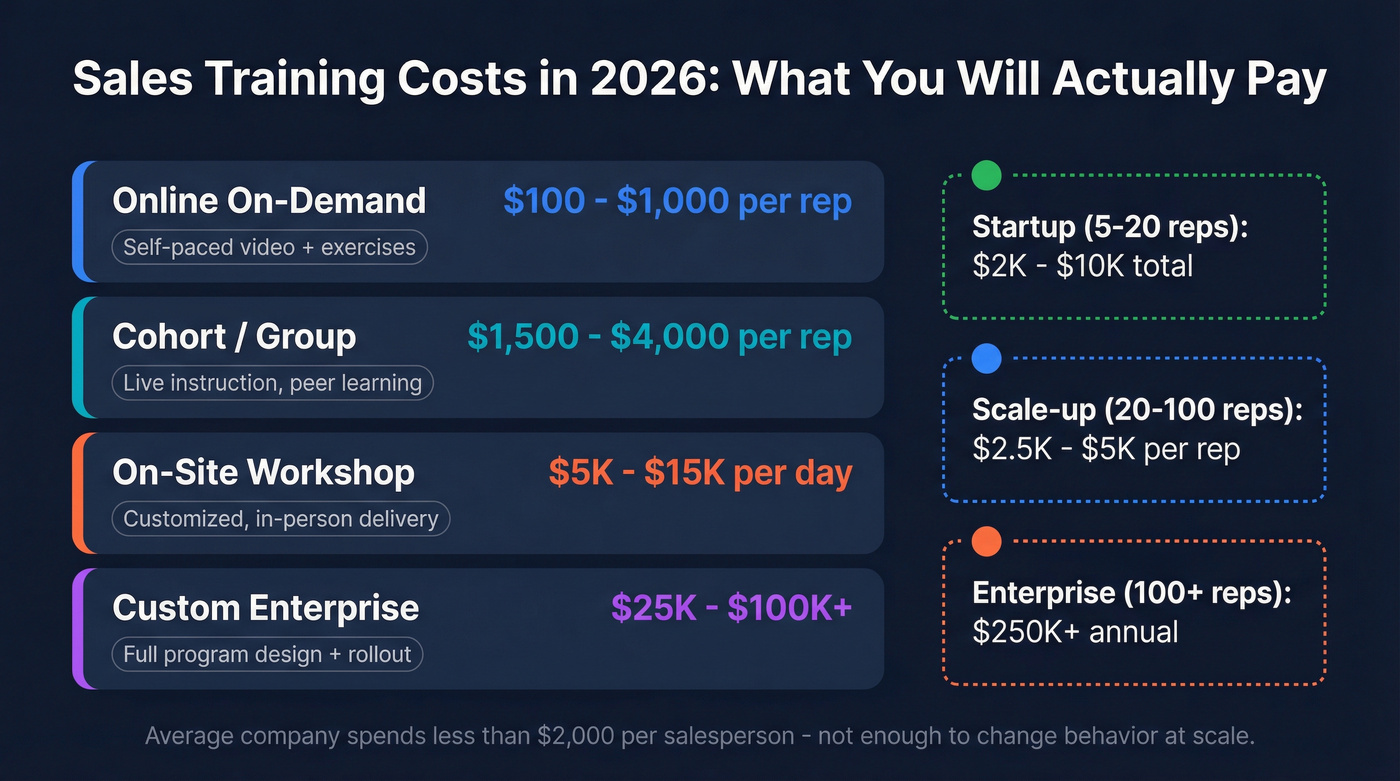
| Format | Price Range | What You Get |
|---|---|---|
| Online on-demand | $100-$1,000/rep | Self-paced video + exercises |
| Cohort/group | $1,500-$4,000/rep | Live instruction, peer learning |
| On-site workshop | $5K-$15K/day | Customized, in-person delivery |
| Custom enterprise | $25K-$100K+ | Full program design + rollout |
Those are the vendor invoices. The real cost is higher. Expect a 10-15% productivity dip while reps adopt new techniques - they're thinking about frameworks instead of selling. And without reinforcement, 70% of the knowledge is forgotten in 24 hours. Ebbinghaus's forgetting curve doesn't care how good your facilitator was.
We've tested several of these platforms and the pricing ranges hold up. Here's how budget guidance breaks down by company size:
- Startup (5-20 reps): $2,000-$10,000 total. Start with on-demand or a single cohort program. Don't overspend before you've nailed your ICP.
- Scale-up (20-100 reps): $2,500-$5,000 per rep. Cohort-based programs like Winning by Design or JB Sales hit the sweet spot - structured enough to create consistency, affordable enough to cover the team.
- Enterprise (100+ reps): $250,000+ annual enablement budgets. At this level, you're building a curriculum, not buying a course. Expect to layer methodology training, manager coaching, AI roleplay, and ongoing reinforcement.
The average company spends less than $2,000 per salesperson on training. That's enough for an on-demand course and maybe a half-day workshop. It's not enough to change behavior at scale.
The ROI Case for Training Investment
The headline stat: sales training returns $4.53 for every $1 spent, roughly 353% ROI. While that's an average across industries, it's directionally right for well-implemented programs.
Here's the framing that makes the business case click. Objective Management Group analyzed 318 sales teams and found that 30% relied on one salesperson for more than half of revenue. That's not a sales team - that's a single point of failure with a quota. If that person leaves, you're rebuilding pipeline from scratch.
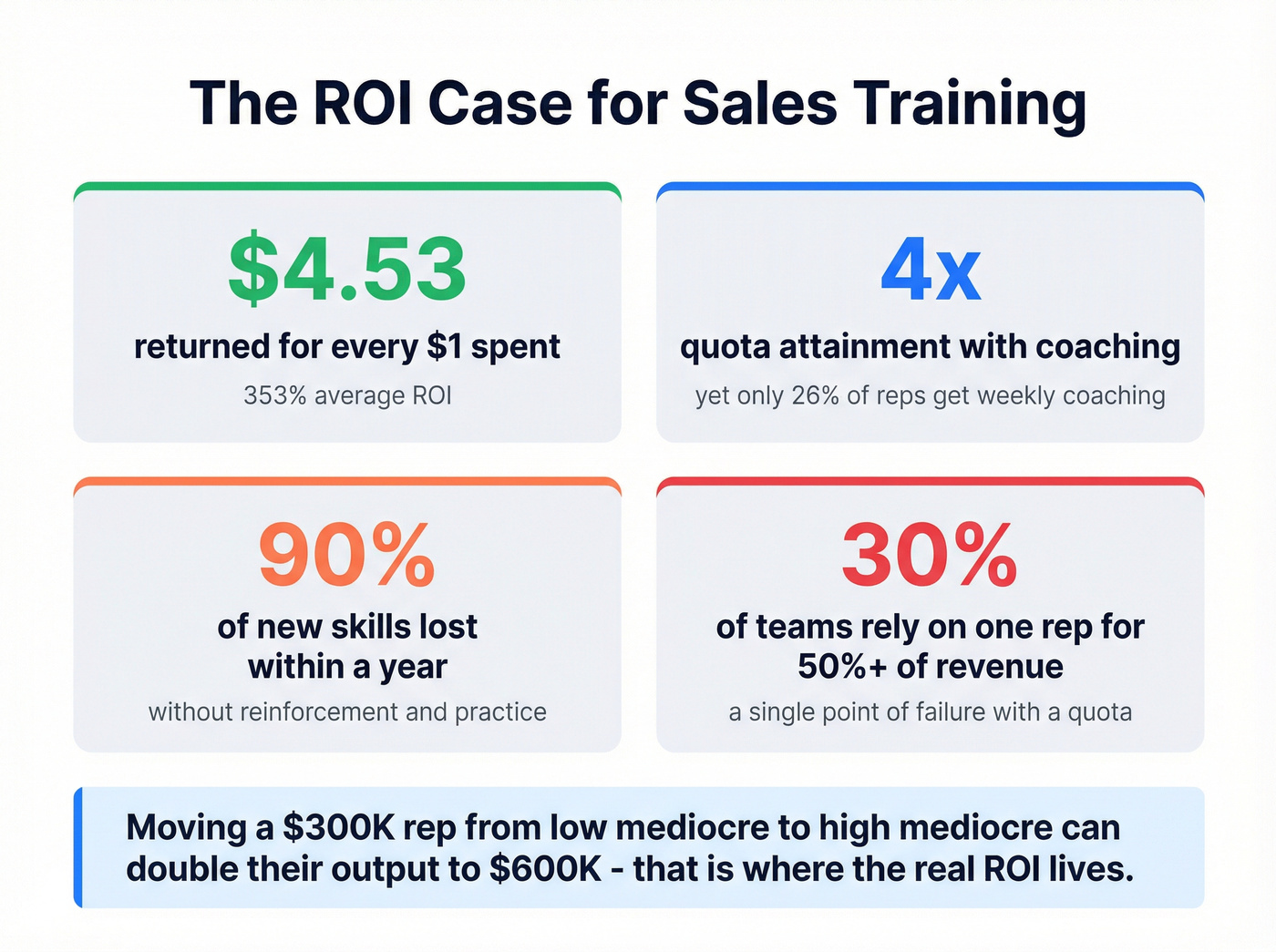
The real ROI isn't making your top rep 5% better. It's moving your middle performers up. OMG's heuristic: if a rep producing $300K moves from low mediocre to high mediocre, their contribution could rise to $600K - double the output from a single rep. A company seeking 10x ROI on that lift should be willing to invest up to $30K per salesperson. Structured onboarding programs also reduce ramp time by up to 34%, which translates to weeks of earlier productivity from every new hire.
The coaching multiplier makes this even clearer. Per LSA Global's research, reps receiving regular structured coaching outperform peers 4-to-1 in quota attainment. Yet only 26% of reps receive weekly coaching. The gap between what works and what companies actually do is enormous.
One more stat that should bother every sales leader: only 18% of buyers believe salespeople are well-prepared. Your buyers can tell when your reps are winging it. Training closes that perception gap - if it sticks.
Sales Methodologies Compared
Not all methodologies solve the same problem. Picking the wrong one is like prescribing antibiotics for a broken bone - the medicine is fine, but it's treating the wrong condition.
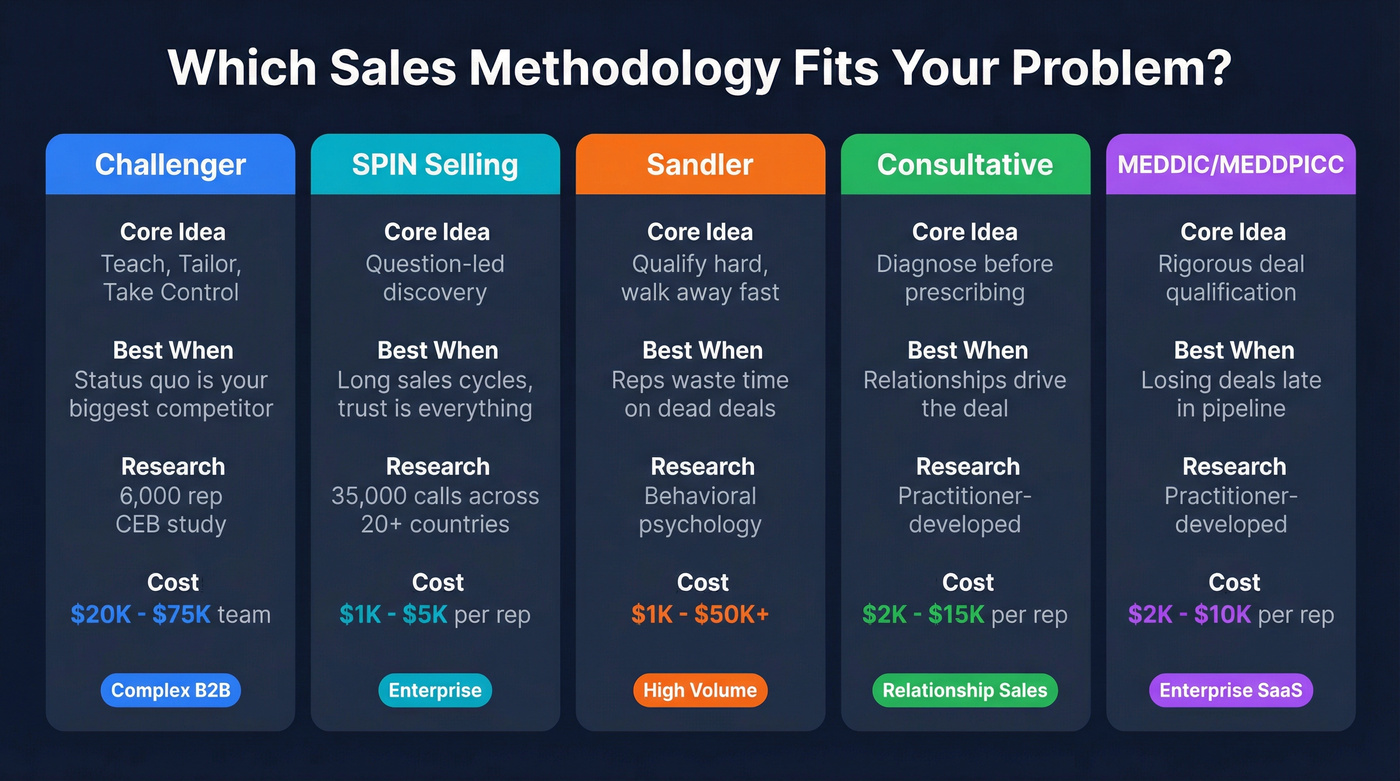
| Methodology | Core Approach | Best For | Research Basis | Typical Cost |
|---|---|---|---|---|
| Challenger | Teach, Tailor, Take Control | Complex deals, status quo | 6K-rep CEB study | $20K-$75K team |
| SPIN Selling | Question-led discovery | Long-cycle enterprise | 35K calls, 20+ countries | $1K-$5K/rep |
| Sandler | Qualify early, walk away | High-volume, fast disqualify | Behavioral psych. | $1K-$50K+ |
| Consultative | Diagnose before prescribing | Relationship-heavy sales | Practitioner-developed | $2K-$15K/rep |
| MEDDIC/MEDDPICC | Deal qualification rigor | Enterprise SaaS, $50K+ deals | Practitioner-developed | $2K-$10K/rep |
Challenger is built on CEB's research across 6,000 sales reps. The core insight: the best reps don't just build relationships - they teach customers something new about their business, tailor the message to the stakeholder, and take control of the commercial conversation. It works best when the status quo is your biggest competitor and the buyer doesn't know they have a problem yet. Xerox reported a 17% increase in sales and $65M in contract value after implementing Challenger.
SPIN Selling comes from Neil Rackham's analysis of 35,000 sales calls across 20+ countries over 12 years. The framework - Situation, Problem, Implication, Need-payoff - is deceptively simple. The magic is in the Implication and Need-payoff questions, which force the buyer to articulate the cost of inaction. It's right for long-cycle, trust-heavy enterprise deals where rushing the close kills the deal.
Sandler takes the opposite approach. Where Challenger leads with insight and pushes the buyer, Sandler qualifies the buying stage early and walks away if the prospect isn't ready. No chasing. No free consulting. The salesperson presents buying criteria upfront and requests commitment - without it, they pull the deal off the table.
MEDDIC/MEDDPICC isn't a selling methodology so much as a deal qualification framework. It fixes a specific problem: reps losing deals late in the pipeline because they can't identify the economic buyer or quantify the decision criteria. It's table stakes for enterprise SaaS teams selling into complex buying committees.
How to Choose
Before you compare vendors, answer four questions:
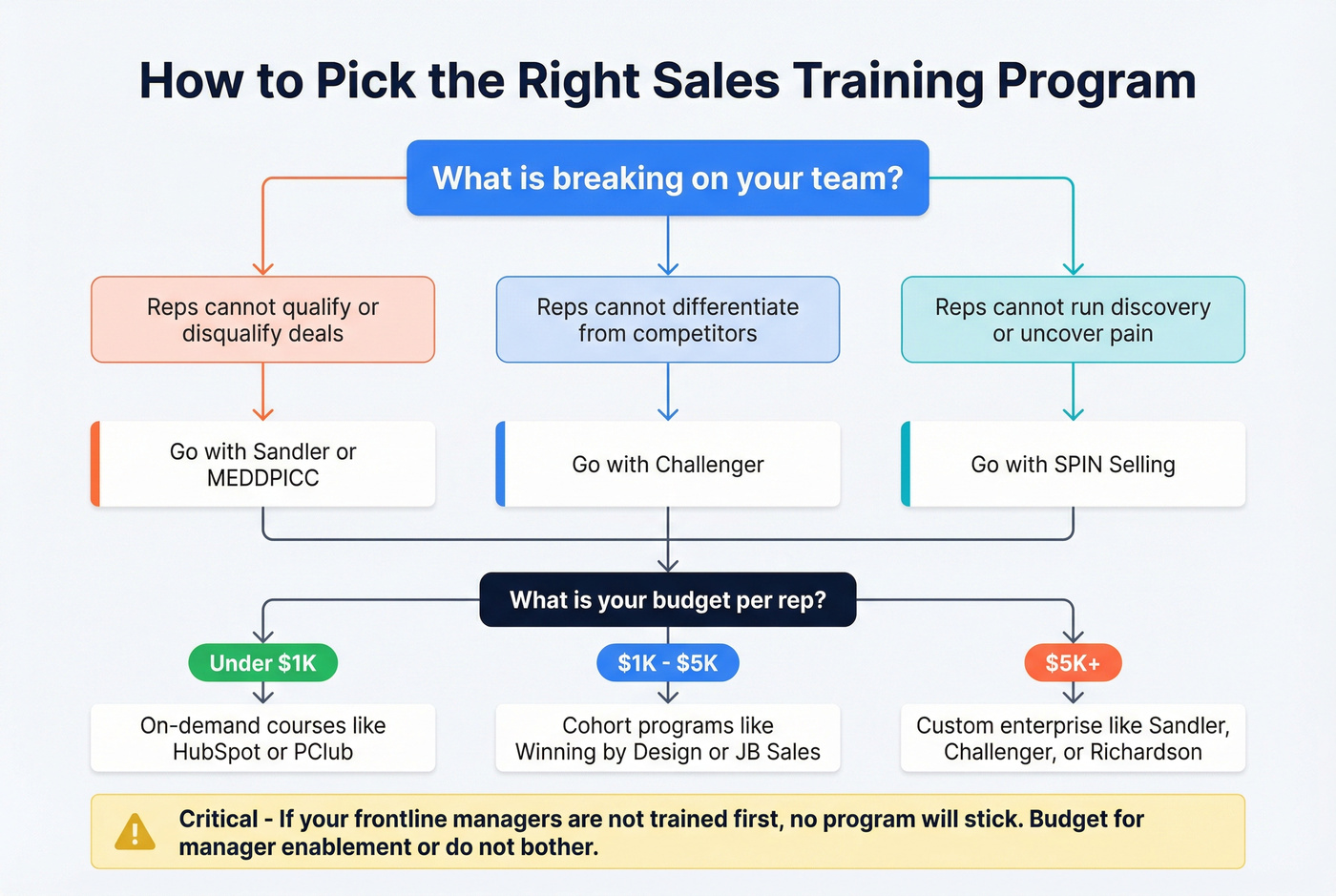
- What's breaking? Reps can't qualify -> Sandler or MEDDPICC. Reps can't differentiate -> Challenger. Reps can't discover -> SPIN.
- What format fits your team? Remote-first teams need cohort or on-demand. Co-located teams get more from on-site workshops.
- What's your budget per rep? Under $1K points to on-demand. $1K-$5K opens up cohort programs. Above $5K unlocks custom enterprise engagements.
- Who will reinforce it? If your frontline managers aren't trained first, no program will stick. Budget for manager enablement or don't bother.

Sales training delivers 353% ROI - but only if reps can reach the right buyers. A Challenger pitch to a disconnected number is wasted enablement budget. Prospeo gives your trained reps 98% accurate emails and 125M+ verified mobile numbers refreshed every 7 days, so new skills hit real prospects.
Stop training reps on skills they can't use because the data is wrong.
Best Sales Training Programs in 2026
Enterprise Methodology Programs
Sandler Training remains the gold standard for behavior-change-focused development. Open enrollment runs $1,000-$3,000 per person; corporate engagements start at $15,000 and scale to $50,000+ depending on team size and customization. Sandler's reinforcement model - ongoing coaching sessions rather than one-off workshops - is a genuine differentiator. If your problem is reps who can't disqualify and waste cycles on dead deals, Sandler fixes that.
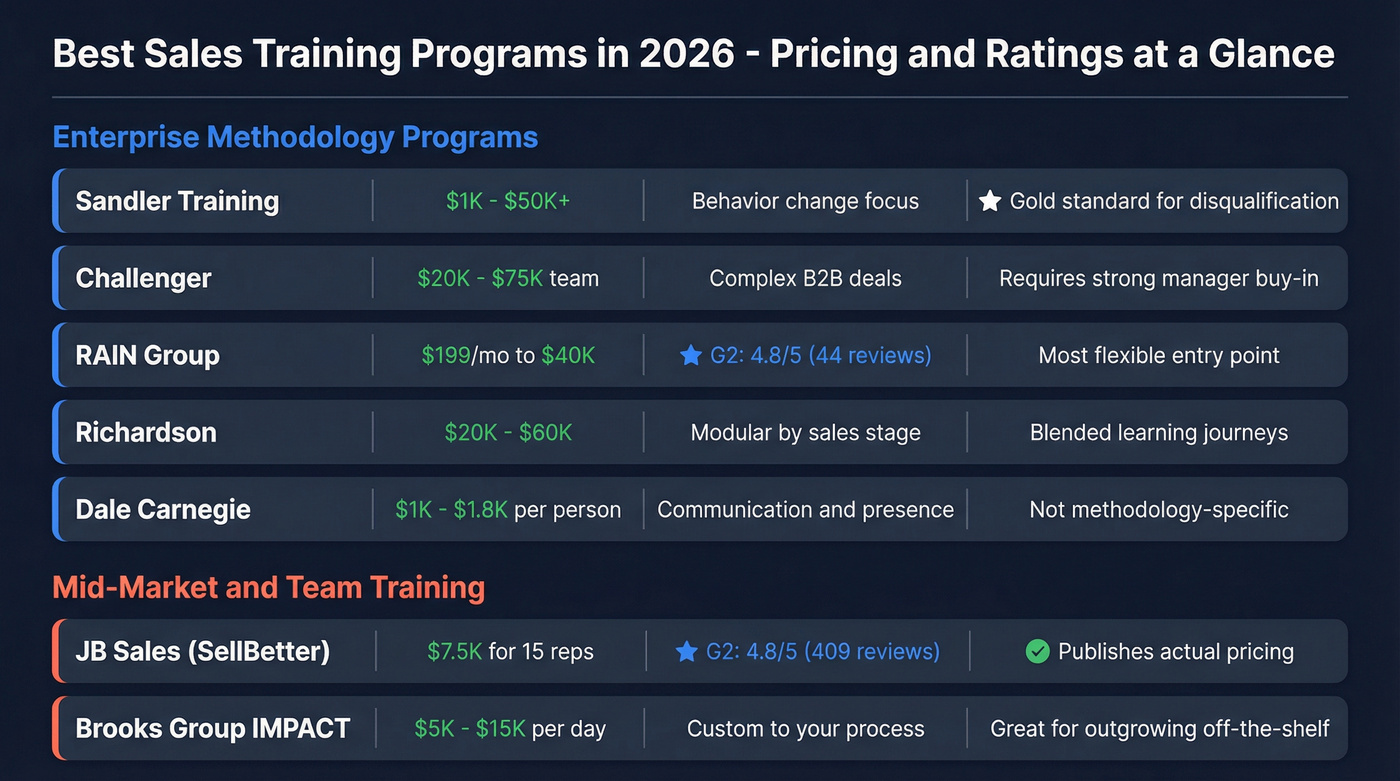
Challenger runs team engagements in the $20,000-$75,000 range. The methodology is powerful for complex B2B sales, but implementation requires serious manager buy-in. We've seen teams adopt Challenger's language without adopting its discipline - that's a recipe for expensive jargon and no behavior change.
RAIN Group offers the most flexible entry point among enterprise providers. Their online platform starts at $199/month; corporate engagements run $15,000-$40,000. G2 rates them 4.8/5 from 44 reviews, with users praising the learning experience but flagging scheduling issues and occasionally confusing quiz structures. For teams that want research-backed methodology without the Sandler or Challenger price tag, RAIN Group is worth a pilot.
Richardson Sales Performance organizes its Connected Selling Curriculum by sales stage: pipeline creation, opportunity winning, account growth, and sales management. You can buy the module you need rather than the whole suite. Expect $20,000-$60,000 for corporate engagements. Richardson's strength is blended learning journeys that combine digital, live, and coaching elements.
Dale Carnegie runs $1,000-$1,800 per person for open enrollment. It's less methodology-specific and more focused on communication, confidence, and relationship skills. If your reps are technically competent but struggle with executive presence, Dale Carnegie fills that gap well - though it won't teach them how to run a MEDDPICC qualification.
Mid-Market and Team Training
JB Sales (SellBetter) publishes actual pricing, which is refreshing. A 15-rep cohort runs $7,500. Scale to 50 reps for $25,000, or bring them onsite internationally for $50,000. G2 rates them 4.8/5 from 409 reviews - that's a massive review base for a training provider. The content is practical and modern, built for the realities of multi-channel outbound.
Brooks Group IMPACT runs $5,000-$15,000 per day for on-site delivery. Their strength is customization - they'll build the program around your sales process rather than forcing you into a generic framework. Good for mid-market teams that have outgrown off-the-shelf courses but aren't ready for a $75K Challenger engagement.
Corporate Visions and ASLAN Training both play in this space at $10,000-$30,000 for team engagements. Corporate Visions focuses on messaging and positioning; ASLAN specializes in "other-centered selling" for teams selling into skeptical buyers.
SuccessCOACHING deserves a mention - G2 rates them 4.6/5 from 932 reviews, more than any other program on this list. Their focus is customer success rather than pure sales, but for teams where retention and expansion revenue matter as much as new logos, it's a strong option at $1,500-$5,000 per rep.
For teams focused on inclusive sales development, organizations like Women Sales Pros and Pavilion offer programs specifically designed to support underrepresented sellers - an area most enterprise vendors ignore entirely.
SaaS-Specific Programs
The consensus on r/sales and r/salesdevelopment is that these programs beat enterprise vendors for SaaS teams - and most don't appear in the listicles that dominate search results.
Winning by Design is the closest thing to a standard SaaS sales operating system. Cohort-based programs run $1,500-$4,000 per rep; enterprise engagements scale to $20,000-$50,000+. With 4.8/5 on G2 from 757 reviews, it's the most reviewed sales training program on the platform. Their strength is process - they don't just teach reps what to say, they redesign your entire revenue architecture from first touch to expansion. If we had to pick one program for a 30-person SaaS sales org, this would be it.
PClub (Chris Orlob) takes a completely different approach. Skip this if you want a structured methodology with certification - PClub is tactical, on-demand content built from real call analysis. Expect to pay $500-$2,000 for access. It's about specific skills: how to run a discovery call, how to handle pricing objections, how to multi-thread. For individual contributors looking to level up fast, PClub delivers more immediate ROI than any methodology program.
Closed Won (Brian LaManna) and SalesLabs (Thibaut Souyris) are practitioner-led programs that punch above their weight, typically running $500-$2,500 per rep. Both focus on modern outbound and SaaS-specific selling motions. Tom Alaimo's TA Sales is another Reddit favorite in this category. These are smaller operations, which means more personalized attention and faster iteration on content. If you're a 10-person SDR team, these programs will feel more relevant than a Sandler engagement designed for 500-rep organizations.
Free and Low-Cost Options
HubSpot Inbound Sales Certification is the obvious starting point - free, about 3h 6m, and it comes with a certificate that actually carries weight with hiring managers. Multiple sales leaders on Reddit have confirmed they look for it on junior candidates' resumes. The content covers inbound methodology, buyer personas, and consultative selling basics. It won't transform an experienced AE, but it's excellent for new hires or career changers.
Salesforce Trailhead offers free learning paths for sales skills, with a $200 exam fee for the official Sales Representative Certification. The target audience is reps with 6 months to 3 years of experience. Coursera's HubSpot Sales Specialization is free to audit and covers similar ground with more depth. Josh Braun and Marcus Chan both offer free content - newsletters, YouTube, social - that's genuinely tactical and modern.
Here's the honest caveat: free programs teach fundamentals but lack live roleplay, coaching, and personalized feedback. If you're an AE closing six-figure deals, a free certification won't get you there. Use free resources to build a foundation, then invest in cohort or live training for the skills that actually move revenue.
Why Most Training Investments Fail
55% of sales leaders say their current training is "effective but offers limited results." That's corporate-speak for "it didn't work."
The Wall Street Journal put it more bluntly: 90% of new skills are lost within a year without practical follow-up and assessments. Nearly every company invests in training - close to 95% of US companies - and nearly half spend up to $5K per rep. The money is flowing. The results aren't.

The problem isn't the content. It's the implementation. 72% of sales leaders say training fails because it's one-size-fits-all. Another 62% cite outdated training as the biggest barrier, and 48% say digital selling skills are the least addressed area in their current programs, even as hybrid work has forced 53% of companies to shift toward virtual training. LSA Global's research identifies five implementation mistakes that kill ROI regardless of how good the program is:
- Misaligned strategy and culture - training teaches one thing, the org rewards another. LSA's data shows alignment between sales strategy and culture accounts for 71% of the performance gap in revenue growth.
- Unprepared participants - reps show up without context on why the training matters or how it connects to their daily workflow.
- Unprepared managers - this is the big one. In our experience, the single biggest predictor of training ROI is whether frontline managers are trained first. If they can't reinforce and coach the new skills, the training dies in week two.
- Ineffective success metrics - only 33% of companies use assessments to measure training ROI. The rest are guessing.
- Inadequate leadership support - the CEO approved the budget but never asked about outcomes.
The fix isn't buying a better program. It's building a complete system: content + delivery + practice + reinforcement + tools + assessments. Skip any layer and the whole thing collapses.
Here's the thing: most companies with fewer than 50 reps don't need a $50K methodology program. They need a $5K cohort course, a manager who coaches weekly, AI roleplay for practice, and clean prospect data so reps can actually execute. The methodology obsession is a distraction from the boring operational work that actually drives results.
Building a Training Program That Sticks
Knowing the methodologies and vendors is only half the equation. The other half is building a reinforcement system that sequences learning, practice, and coaching into something your team will actually follow.
Gartner forecasts that by 2026, 60% of large enterprises will incorporate AI-based simulation tools into employee development, up from less than 10% in 2022. That's not a gradual shift - it's a rapid acceleration.
The data supports the hype on this one. PwC found that simulation-based learners were 275% more confident and completed training 4x faster than classroom learners. Deloitte's research shows immersive learning can reduce time-to-competency by up to 60%. McKinsey's analysis links generative AI in customer-facing roles to 15-20% productivity improvements. These aren't marginal gains.
The tools making this real include Hyperbound (AI-powered cold call simulation), Second Nature (conversational AI roleplay), and Highspot's AI Role Play (integrated into their enablement platform). Each lets reps practice discovery calls, objection handling, and negotiation scenarios against AI buyers that adapt in real time. No scheduling. No awkward roleplay with a manager who's distracted by Slack.
AI roleplay is complementary to methodology training, not a replacement. Challenger teaches your reps the "teach-tailor-take control" framework. AI roleplay lets them practice it 50 times before they use it on a real prospect. The combination creates lasting behavior change - the methodology provides the "what," and simulation provides the reps.
If you're spending $30K on Sandler and $0 on practice infrastructure, you're building a house without a foundation. Budget 15-20% of your training spend on reinforcement tools, including AI roleplay.
Training Without Clean Data Is Waste
Your team just finished a two-day Challenger workshop. Everyone's fired up. The whiteboard is covered in "commercial teaching" frameworks. By week three, half the phone numbers in the CRM are dead and reps are back to sending emails into the void.
This is the execution gap nobody talks about. You invested $15,000 in a sales training program - don't let it evaporate on bad data. Prospeo's database covers 300M+ professional profiles with 98% email accuracy and 125M+ verified mobile numbers that deliver a 30% pickup rate, all refreshed every 7 days. Your newly trained reps call numbers that actually ring and email addresses that actually land.
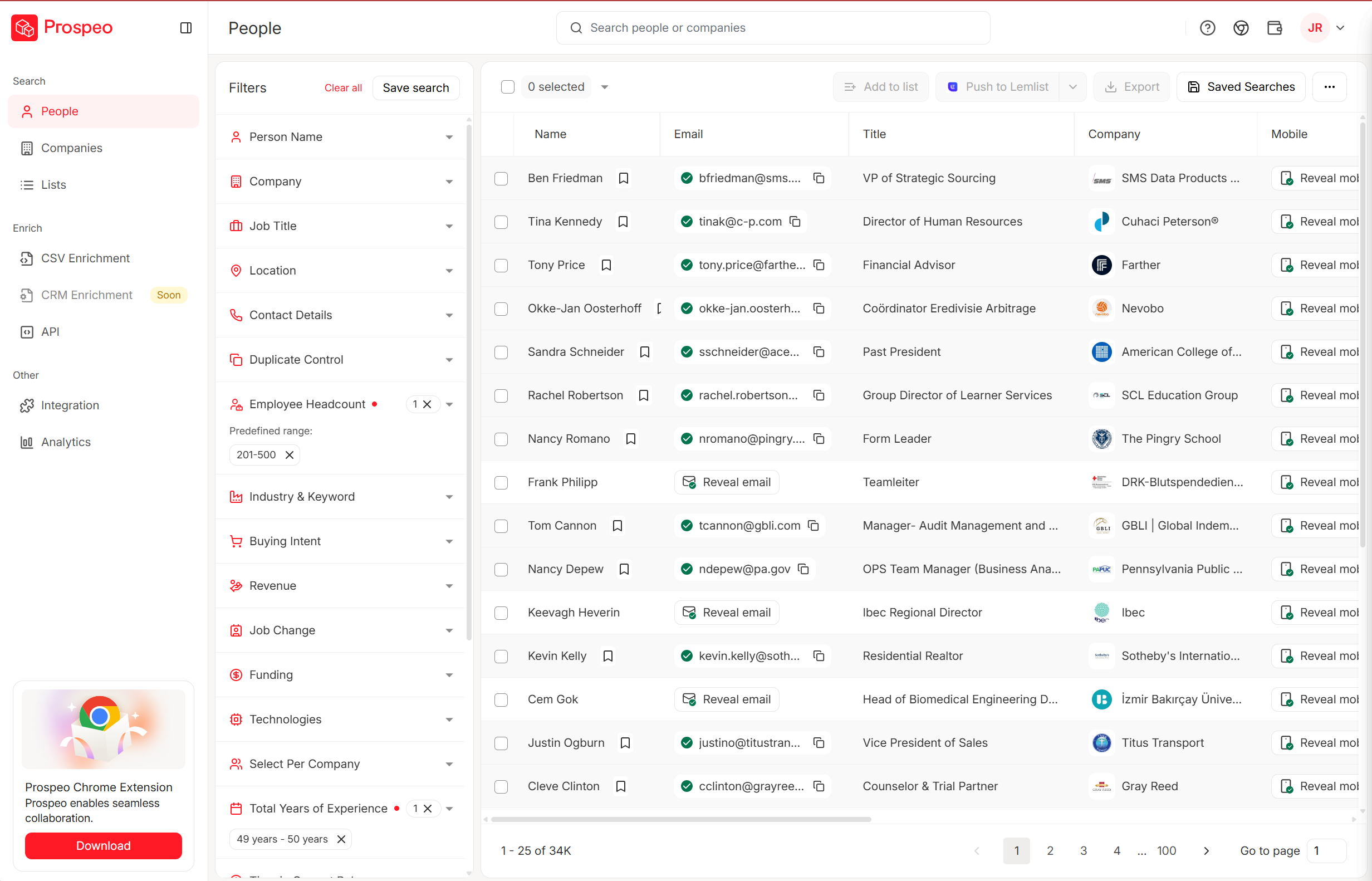
Search by 30+ filters including intent signals, technographics, job changes, and headcount growth. Export verified contacts directly to your sequencer - native integrations with Salesforce, HubSpot, Smartlead, Instantly, Lemlist, Clay, Zapier, and Make mean your reps go from "I learned a new framework" to "I'm using that framework on verified prospects" the same afternoon.
Training teaches the skill. Data enables the execution.
You're investing $2K-$5K per rep on training. Don't let bad contact data bottleneck the return. Prospeo's 300M+ verified profiles at $0.01/email mean your newly ramped reps connect with decision-makers from day one - cutting ramp time even further than training alone.
Pair your training investment with data that actually connects reps to buyers.
FAQ
What's the average cost of a sales training program?
Most mid-market teams spend $1,500-$4,000 per rep for cohort-based programs, which offer the best balance of live instruction and cost efficiency. On-demand courses run $100-$1,000 per rep, on-site workshops cost $5,000-$15,000 per day, and custom enterprise engagements range from $25K to $100K+. Free options like HubSpot's certification cover foundations well.
How long does it take to see ROI from training?
Expect 3-6 months to see measurable results with proper reinforcement, manager coaching, and practice infrastructure. Without follow-up, 90% of skills are lost within a year. Programs that show fastest ROI combine methodology training with weekly coaching cadences and AI roleplay for ongoing practice.
Which sales methodology is best for SaaS?
Winning by Design and PClub are purpose-built for SaaS selling motions - recurring revenue, product-led growth, expansion selling. Challenger works well for enterprise SaaS with complex buying committees. MEDDIC/MEDDPICC is essential for deal qualification when average contract values exceed $50K.
How do I make sure training actually sticks?
Start by training frontline managers first - reps who receive regular structured coaching outperform peers 4-to-1 in quota attainment. Layer in AI roleplay tools like Hyperbound or Second Nature for daily practice. And keep your prospect data clean so reps can immediately apply new skills to live conversations instead of bouncing off dead numbers.