

How to Measure Sales Training ROI (With Actual Math)
Every quarter, someone in leadership asks the same question: "What's the ROI on that training program?" And every quarter, the enablement team scrambles to prove it with a deck that mostly shows completion rates and satisfaction scores. One enablement leader on r/sales described it perfectly: it's "the biggest pain in my ass question."
Up to 30% of companies don't conduct any formal training evaluation at all. Only about 8.5% of training budgets go toward measurement. The other 91.5% funds programs nobody's formally evaluating. Let's fix that.
The Short Version
If you're pressed for time, here's the three-step shortcut:
- Set a pre-training baseline. Measure win rate, deal size, cycle length, and pipeline created before the program starts. No baseline means no comparison.
- Use the attribution percentage method to isolate training's impact from other variables - new tools, market shifts, leadership changes.
- Measure at 90 days, not day one. Satisfaction surveys tell you nothing about revenue. Behavior change needs time to show up in the numbers.
What Companies Actually Spend
U.S. companies spent $102.8 billion on training in 2026, up 4.9% year-over-year. The average spend per learner hit $874, up from $774 the year before - but that average hides a wide range.
| Company Size | Avg. Spend per Learner |
|---|---|
| Small (< 1,000) | $1,091 |
| Midsize (1,000-9,999) | $782 |
| Large (10,000+) | $468 |
| U.S. Average | $874 |
For sales-specific training, most teams budget $1,000-$5,000 per rep per year, depending on whether you're buying external programs, coaching, certifications, tools, or all of the above. Spending on outside training products and services hit $16B, up 29% - a sign that companies are increasingly outsourcing specialized programs rather than building in-house.
Meanwhile, ATD's State of the Industry report found formal learning hours dropped to 13.7 per employee, down from 17.4 the prior year. Companies are spending more per hour of training delivered. That's either efficiency or inflation. Probably both.
The upside can be massive. One case study extrapolated a $100K training investment into $3.1M in revenue over a year - about a 31x return. That ceiling exists, but only if you can measure your way to it.
The ROI Formula (With Numbers)
The core formula is straightforward:
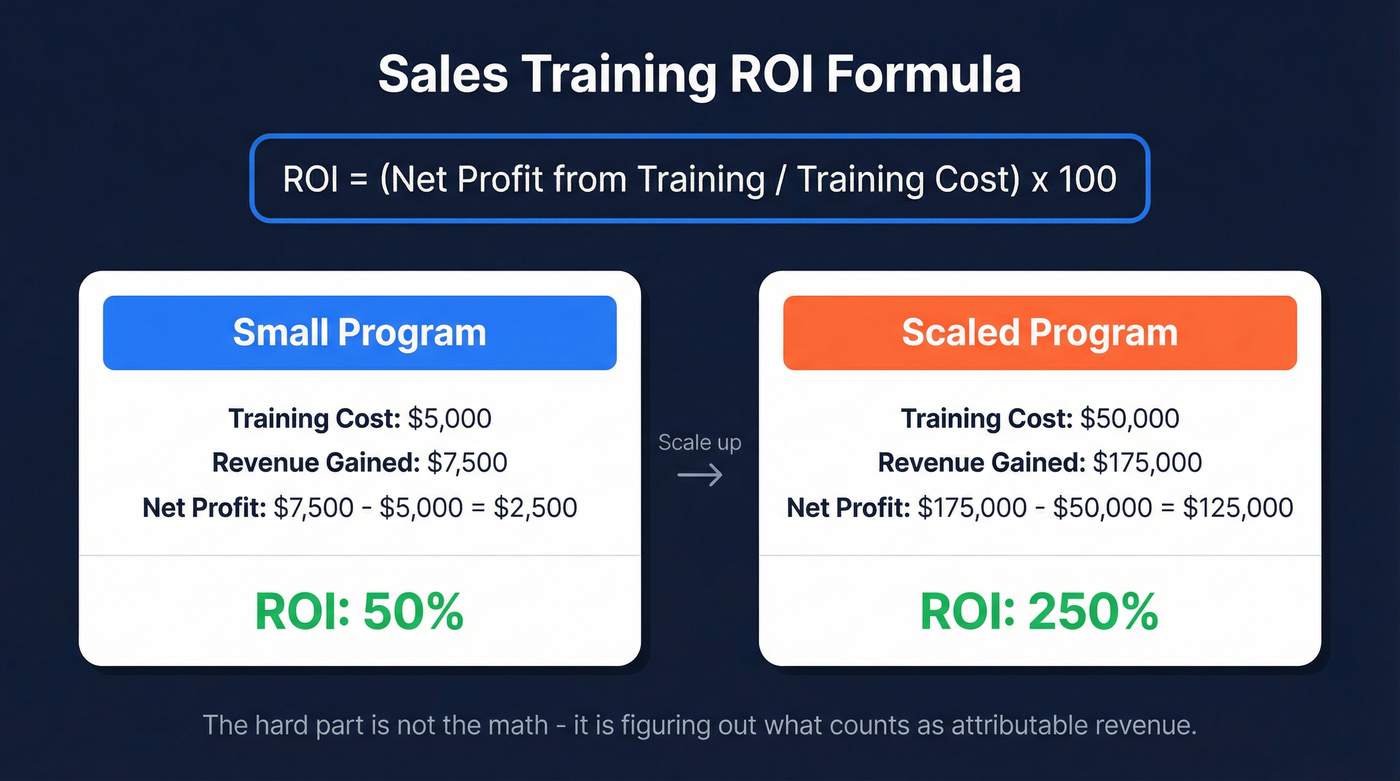
ROI = (Net Profit from Training / Training Cost) x 100
Say you invest $5,000 in a prospecting skills program for a team of five reps. Over the next two quarters, the team generates $7,500 in incremental revenue directly attributable to the training.
- Net Profit: $7,500 - $5,000 = $2,500
- ROI: ($2,500 / $5,000) x 100 = 50%
Scale it up: a $50,000 program generating $175,000 in attributable revenue = 250% ROI.
In a spreadsheet, the formulas are simple: =B2-A2 for net profit, =(C2/A2)*100 for ROI percentage. The hard part isn't the math. It's figuring out what counts as "attributable revenue." That's where isolation methods come in.
Metrics That Actually Predict Impact
The Kirkpatrick model gives you four levels - Reaction, Learning, Behavior, Results - but most teams get stuck at levels one and two. Here's what we've found actually predicts revenue impact:
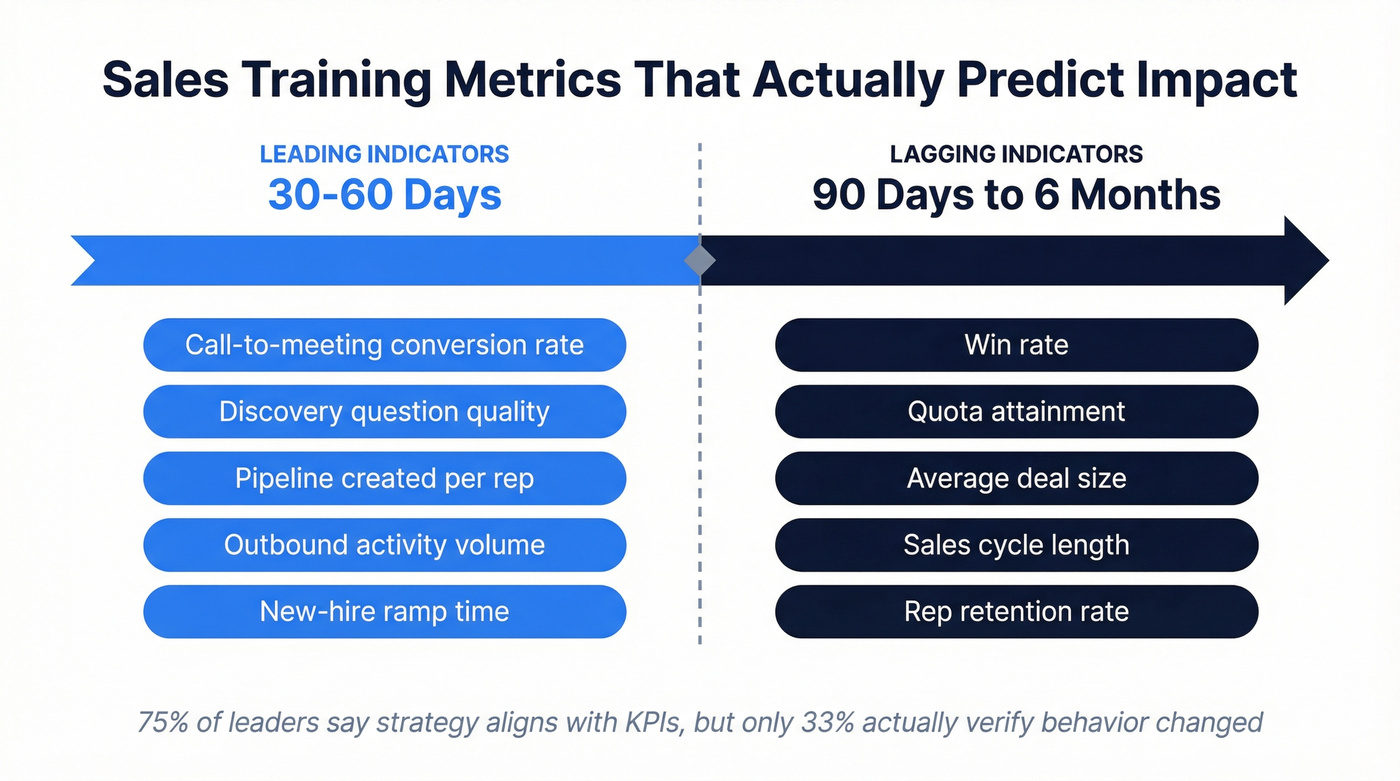
| Leading Indicators (30-60 days) | Lagging Indicators (90 days-6 months) |
|---|---|
| Call-to-meeting conversion rate | Win rate |
| Discovery question quality via call recordings | Quota attainment |
| Pipeline created per rep | Average deal size |
| Outbound activity volume | Sales cycle length |
| New-hire ramp time | Rep retention rate |
75% of HR and L&D leaders say their strategy aligns with KPIs, yet only 33% of organizations use assessments to verify whether training actually changed behavior. That gap between "aligned" and "measured" is where returns disappear.
Don't ignore ramp time. If training cuts new-hire ramp from 8 weeks to 5, that's three extra weeks of productive selling per rep - real money that never shows up in a satisfaction survey.

The fastest way to prove sales training ROI? Give reps data that actually connects them to buyers. Prospeo delivers 98% verified emails and 125M+ direct dials - so trained reps spend time selling, not bouncing.
Better data means faster ramp, higher win rates, and training ROI you can actually measure.
How to Isolate Training's Impact
This is the section most articles skip, and it's the one that matters most.
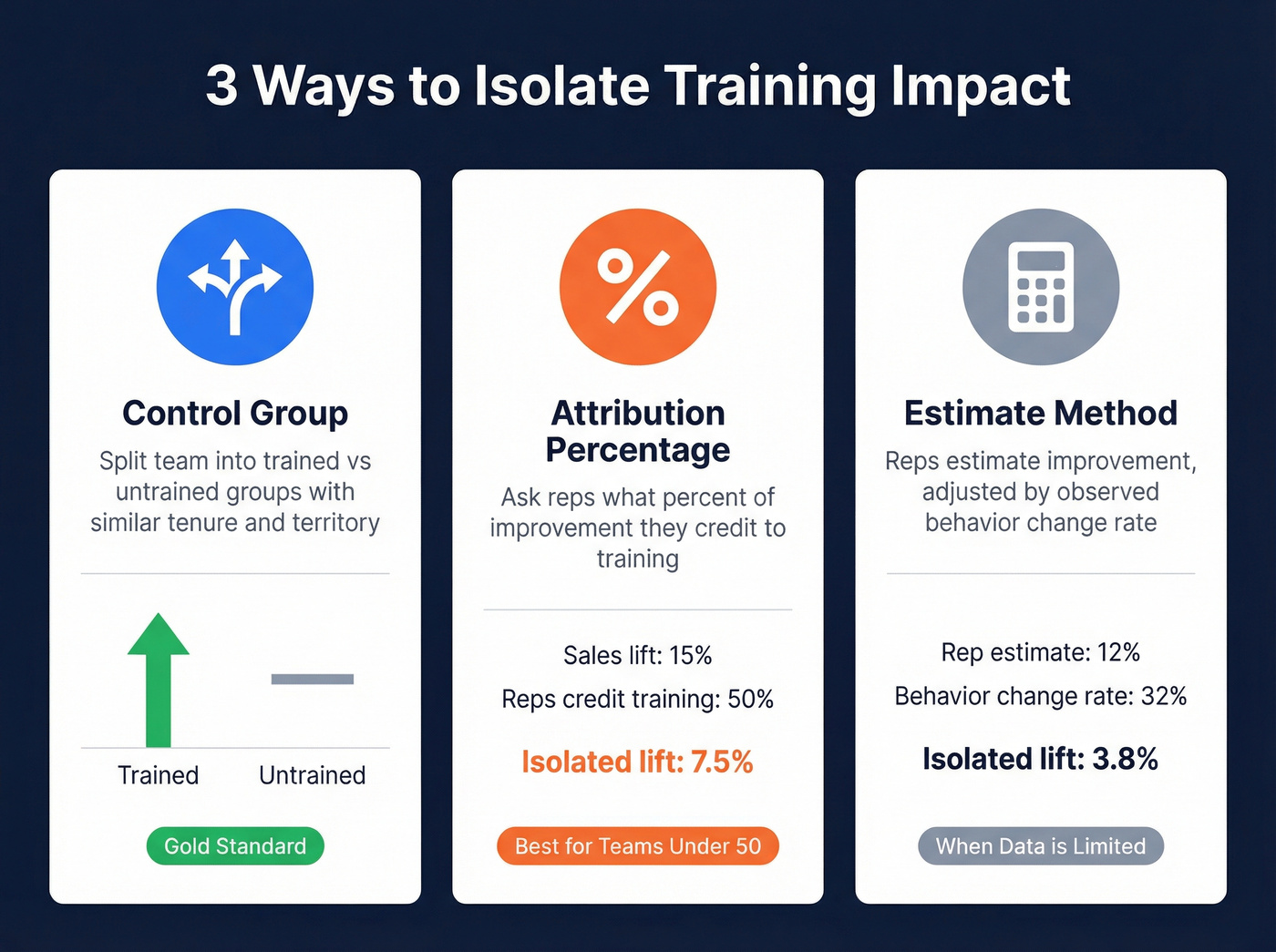
Your sales team's performance is influenced by dozens of variables: new product launches, market conditions, territory changes, better tooling. You need to carve out what training specifically contributed. Here are three proven methods.
Control group. Split your team into trained and untrained "twin samples" with similar tenure, territory size, and market conditions. Compare performance over the same period. This is the gold standard, but it requires enough headcount to create meaningful groups - and the political will to leave some reps untrained.
Attribution percentage. Say sales increased 15% after training. Survey the trained reps and ask what percentage of that improvement they'd attribute to the program. If they say 50%, your isolated training lift is 15% x 50% = 7.5%. Multiply that by revenue to get a dollar figure. In our experience, this method gives the most defensible numbers for teams under 50 reps.
Estimate method. When you lack objective performance data or a control group, ask participants to estimate their improvement, then adjust downward using the Level 3 behavior-change rate. If reps estimate a 12% improvement but only 32% actually changed their behavior based on manager observation, your isolated improvement is 12% x 32% = 3%.
For data-mature organizations with strong CRM hygiene, propensity score matching can further refine attribution. But for most teams, the attribution percentage method hits the sweet spot of rigor and practicality.
The Measurement Timeline
Measuring too early is one of the most common mistakes. Before you even launch, model expected returns to secure budget - leadership is far more receptive to a program that arrives with a forecast attached.
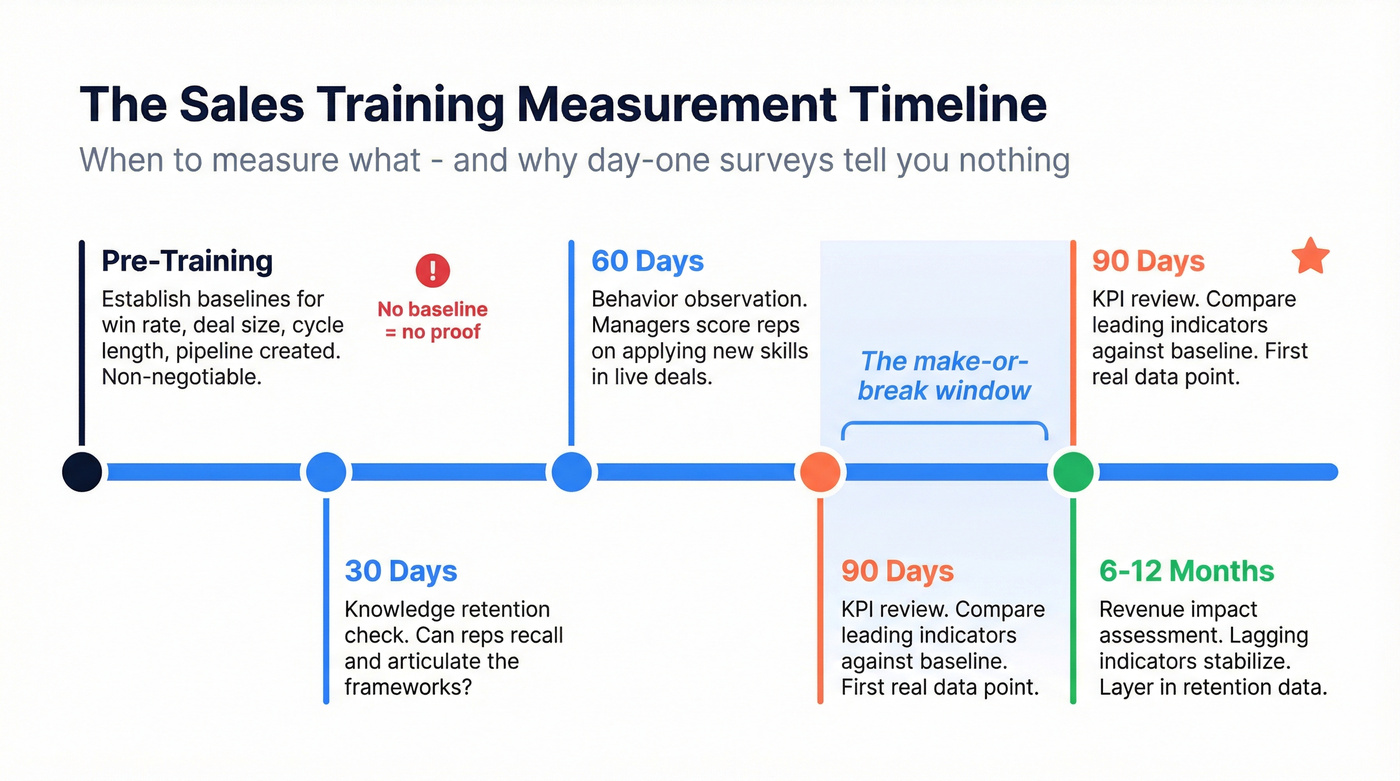
- Pre-training: Establish baselines for every metric you plan to track. Non-negotiable.
- 30 days: Knowledge retention check. Can reps recall and articulate the frameworks?
- 60 days: Behavior observation. Managers score reps on whether they're applying new skills in live deals.
- 90 days: KPI review. Compare leading indicators against baseline. This is your first real data point.
- 6-12 months: Revenue impact assessment. Lagging indicators stabilize. Layer in retention data.
The 60-90 day window is where most programs either prove themselves or don't. Week-one satisfaction surveys are noise. We've seen teams declare a program "successful" based on a 4.5/5 feedback score, then watch win rates stay flat for six months. A structured approach to effectiveness tracking across this timeline is what separates teams that prove impact from teams that guess at it.
Mistakes That Kill Your Returns
No pre-training baseline. If you don't measure before, you can't prove anything after. Up to 30% of companies skip formal evaluation entirely.
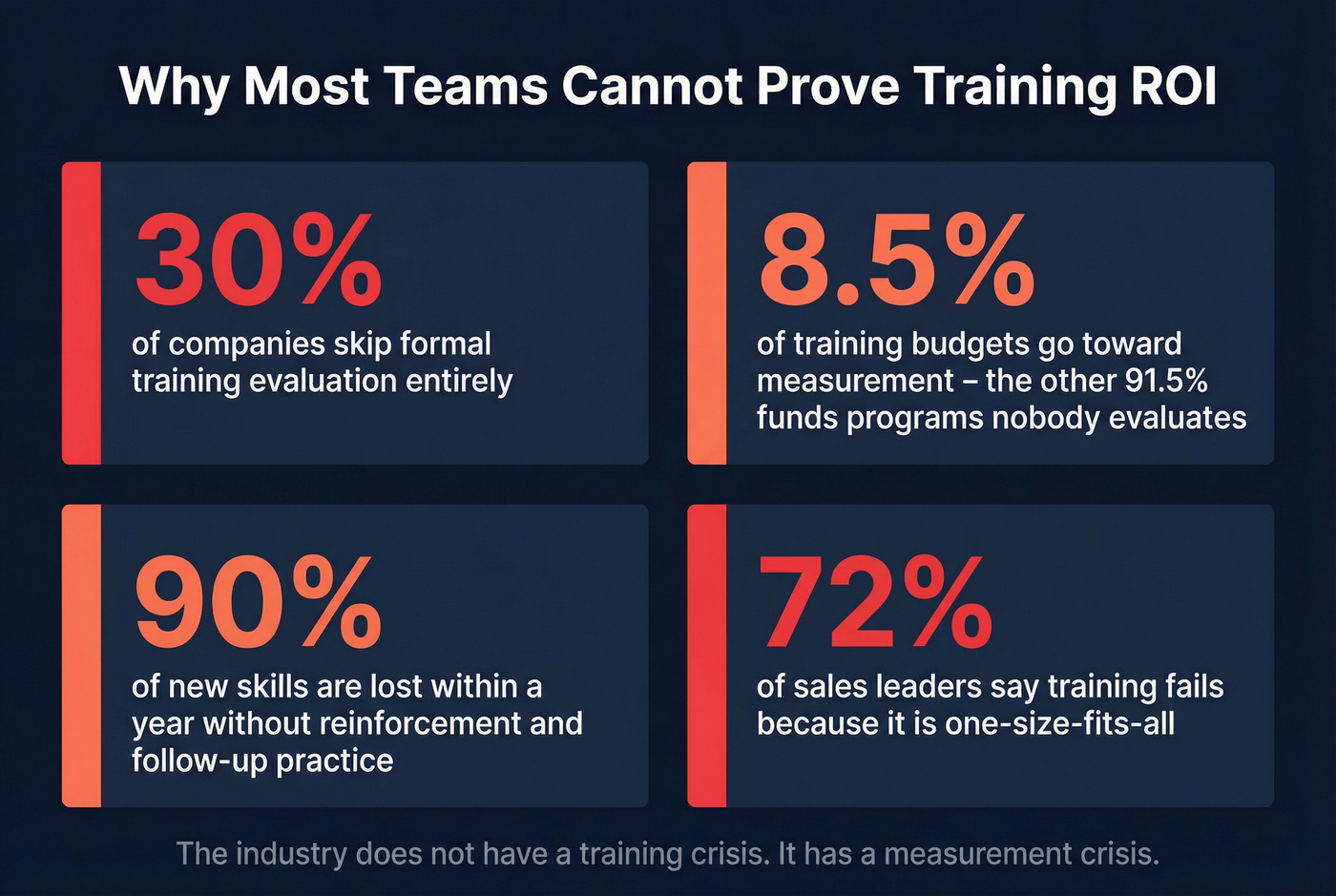
Measuring completion instead of behavior change. A rep can score 95% on a quiz and still lose every deal. 72% of sales leaders say training fails because it's one-size-fits-all - completion rates can't tell you that.
No reinforcement. 90% of new skills are lost within a year without follow-up practice. Real-world scenarios improve retention up to 70% versus lecture-based training. Training isn't an event; it's a system.
Ignoring the behavior gap. The consensus on r/b2bmarketing is that teams keep adding training but win rates don't budge - because the gap is behavioral, not informational. Reps know what to do. They just can't execute it consistently under pressure.
Here's the thing: most sales training programs fail not because the content is bad, but because the surrounding infrastructure is broken. A tenured AE and a week-two SDR don't need the same curriculum. Reps trained on perfect discovery calls still lose when they're calling dead numbers and emailing bounced addresses. Fix the data, segment the audience, reinforce the skills - then measure.
Start With the Baseline
The industry doesn't have a training crisis. It has a measurement crisis. Accenture's analysis found companies can realize 353% ROI from well-executed programs - but you'll never prove that without the math.
Start with the baseline. Use the attribution percentage method to isolate impact. Measure at 90 days. That's the whole playbook for proving sales training ROI. Everything else is refinement.
If you want the training to show up in pipeline, start with better sales prospecting techniques and cleaner inputs like data enrichment services.
One Prospeo customer cut new-hire ramp time from 8-10 weeks to 4 - and grew pipeline 140%. When reps prospect with verified contacts instead of stale lists, every training dollar compounds faster.
Stop letting bad data erase your training investment.
Frequently Asked Questions
What's a good ROI percentage for sales training?
Anything above 100% means the program paid for itself. Accenture's research found well-executed programs can hit 353% ROI. Most organizations should target 150-300% within 12 months, measured using the attribution percentage method against a pre-training baseline.
How long before training shows revenue impact?
Knowledge retention appears at 30 days and behavior change at 60-90 days. Revenue impact takes 6-12 months to fully materialize. Wait at least 90 days before drawing conclusions - satisfaction surveys collected on day one have zero correlation with quota attainment.
Why can't most companies prove training ROI?
No pre-training baseline. Without measuring win rates, deal size, and cycle length before training starts, there's nothing to compare against. Up to 30% of companies skip formal evaluation entirely, and only 8.5% of training budgets go toward measurement.
Can you measure ROI without a control group?
Yes. Use the attribution percentage method: multiply observed performance improvement by the percentage trainees attribute to training. A 15% sales lift where reps credit 50% to training equals a 7.5% isolated gain. This produces defensible numbers without splitting your team.
How does bad contact data affect training outcomes?
Even perfectly trained reps underperform when half their calls hit dead numbers or bounce. Clean, verified data ensures reps actually reach prospects - so training investments translate into pipeline, not wasted dials.