SalesDiary Pricing, Reviews, Pros & Cons (2026)
SalesDiary pricing starts at $12/user/month - cheap enough to trial for a 50-person field team still running on WhatsApp photos and Excel. We cross-referenced 46 reviews across Capterra, SoftwareSuggest, and GetApp and pulled in G2's rating snapshot to give you an honest breakdown before you commit.
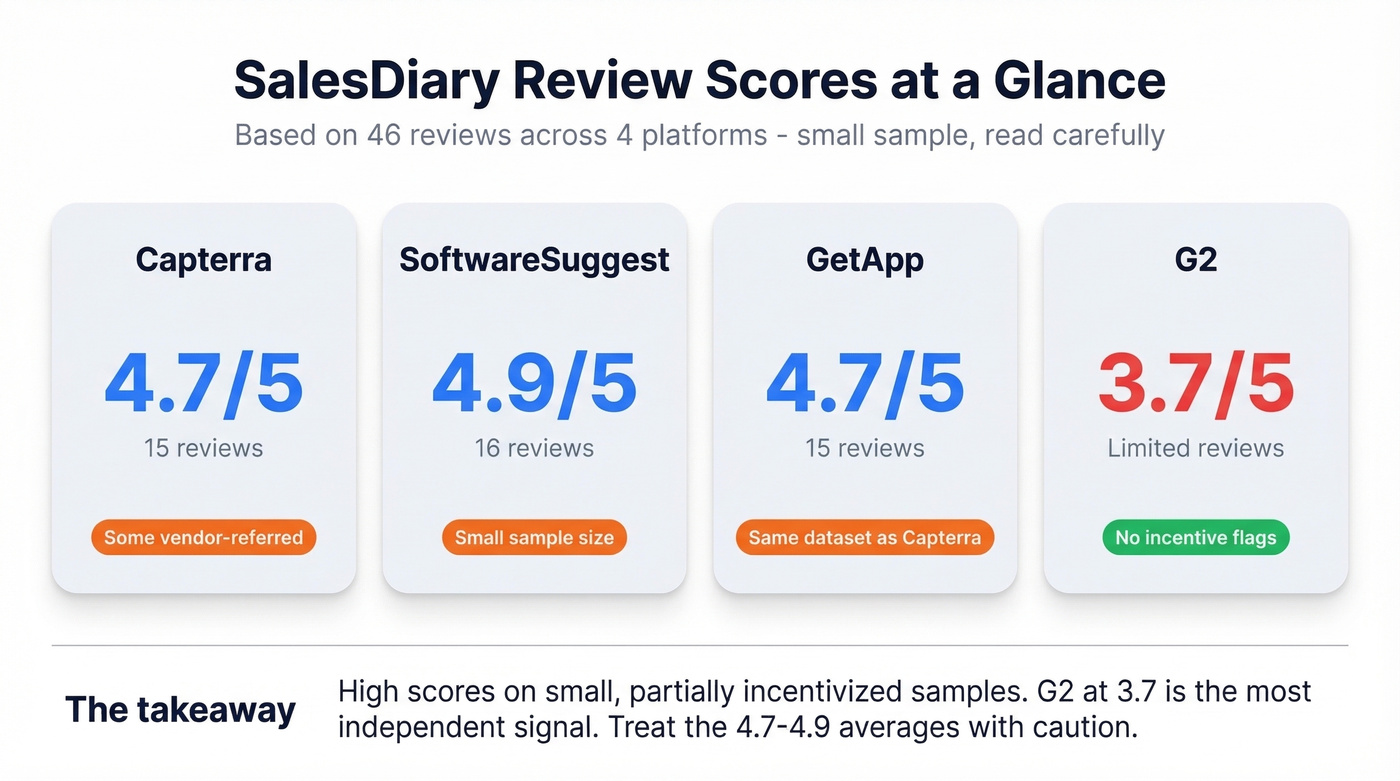
30-second verdict: SalesDiary is a solid budget pick for small FMCG distribution teams. Capterra gives it 4.7/5 and SoftwareSuggest gives it 4.9/5, but those are based on just 15 and 16 reviews respectively, and Capterra shows several reviews marked Vendor Referred or Incentive Offered. G2 paints a different picture at 3.7/5. Field reps love the simplicity. Managers want better dashboards. Morning app instability is a recurring theme. Fewer than 200 reps and a tight budget? Worth a trial. Enterprise teams should look at Bizom or BeatRoute.
SalesDiary Pricing Breakdown
SalesDiary doesn't publish pricing on its own site. Marketplace listings tell a consistent story: $12/user/month on Capterra, GetApp, and SoftwareFinder. Expect the real number to land in the $10-20/user/month range depending on which modules you need, with implementation billed separately.
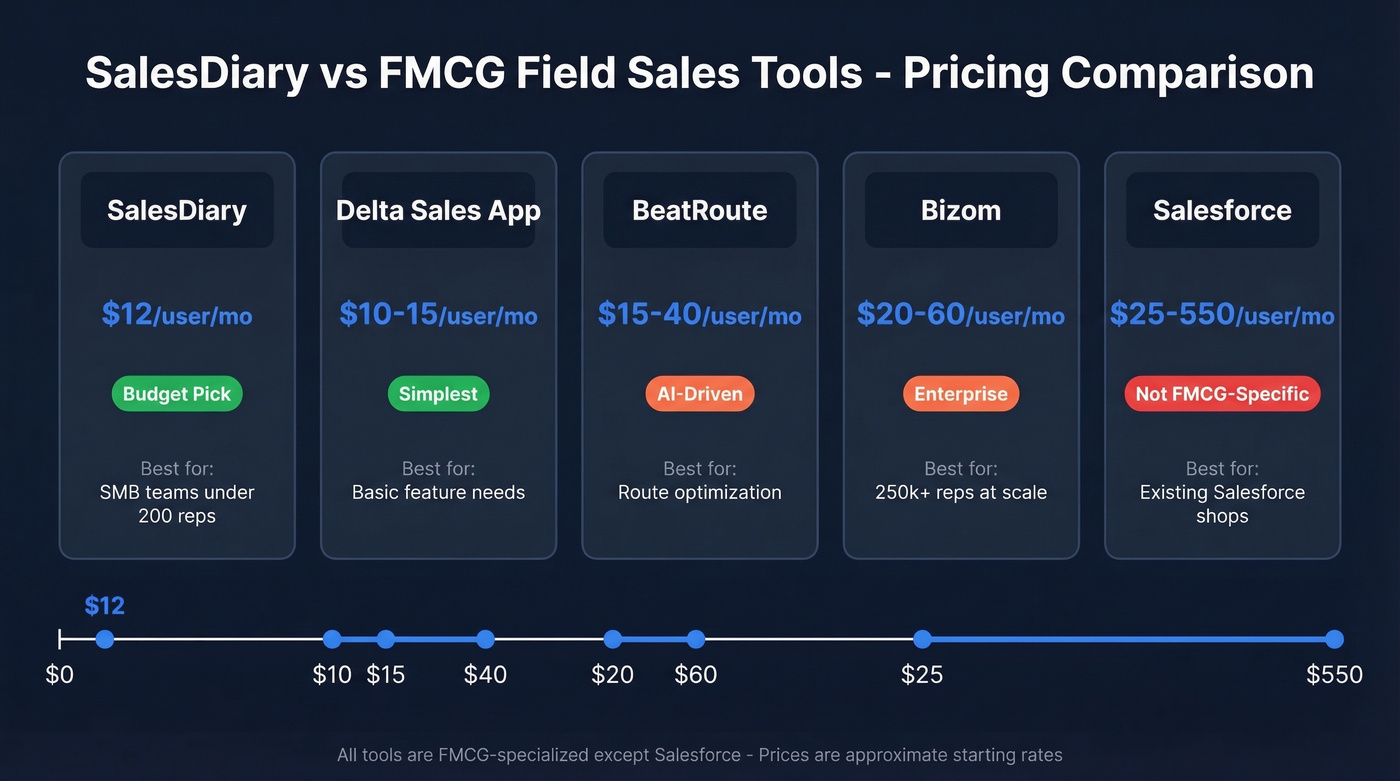
| Tool | Starting Price | FMCG-Specialized? | Best For |
|---|---|---|---|
| SalesDiary | $12/user/mo | Yes | Budget SMB teams |
| Bizom | Custom (~$20-60/user/mo) | Yes | Enterprise scale |
| BeatRoute | ~$15-40/user/mo | Yes | AI-driven route optimization |
| Delta Sales App | ~$10-15/user/mo | Yes | Simpler feature needs |
| [Salesforce | $25-550/user/mo](https://www.salesforce.com/sales/pricing/) | No | Existing Salesforce shops |
SalesDiary sits at the budget end of the spectrum. The question is whether that savings costs you elsewhere.
Pros and Cons From Real Users
What users like
Field reps pick it up fast. "Easy to use" and "simple to understand" show up constantly in positive feedback, which matters a lot when you're onboarding reps who aren't tech-savvy and don't want to sit through a two-hour training session. Reporting is a standout theme for the price point, the support team gets consistent praise for being responsive, and offline/low-connectivity performance is a repeated positive for teams working in areas with spotty coverage.
What users complain about
The small review sample actually makes patterns easier to spot - when 4 out of 15 reviewers mention the same issue, pay attention.
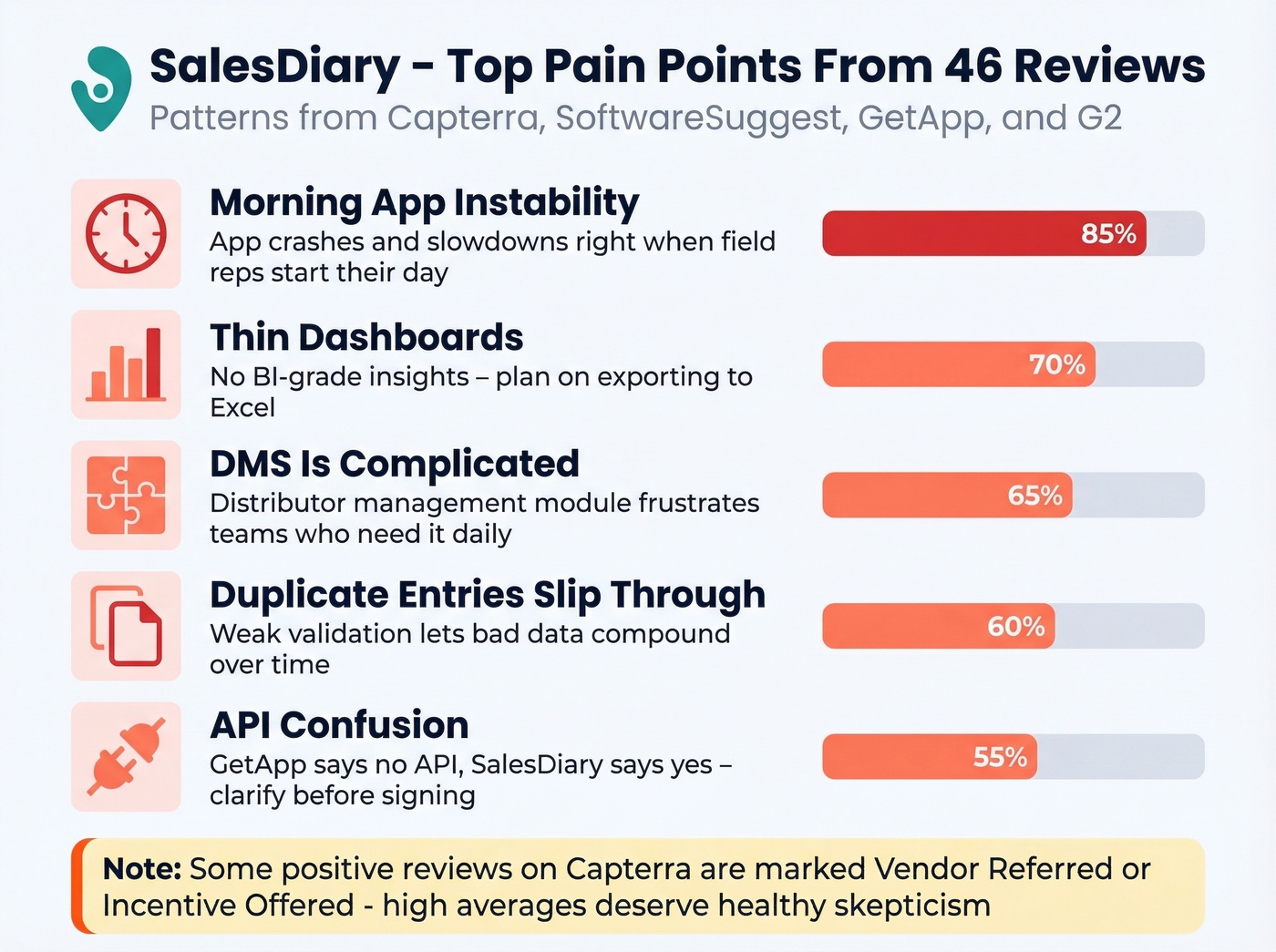
- Morning app instability. One reviewer put it bluntly: "app has many issues in the morning before starting work." For a field sales tool, morning is exactly when reliability matters most.
- Thin dashboards. Multiple reviewers ask for better dashboards and more automated reporting. At $12/user/month, you aren't getting BI-grade insights. Plan on exporting to Excel.
- DMS is complicated. The distributor management module gets called out as "a little complicated," especially for teams that need it as a core workflow rather than a nice-to-have.
- Duplicate entries slip through. Reviews flag that duplicate entries can sneak in without strong validation - a data hygiene problem that compounds over time.
- API confusion. GetApp says SalesDiary has no API, while SalesDiary's own site lists API Integration. In practice, this often means custom ERP/DMS connectors rather than a public developer API. Clarify what "API" means in your contract before signing anything.
Here's the thing: some of those glowing reviews are marked "Vendor Referred" or "Incentive Offered." That doesn't invalidate them, but the high averages deserve skepticism. There's also virtually no Reddit or community discussion around SalesDiary, which itself tells you something about its market footprint outside India.

SalesDiary handles field routes and orders - but your reps still need accurate contact data before every visit. Prospeo delivers 98% verified emails and 125M+ mobile numbers at $0.01/email, so your team stops wasting time on dead leads.
Give your field team contacts that actually pick up.
Who SalesDiary Fits (and Doesn't)
Use this if you're an SMB FMCG company with fewer than 200 field reps, budget is the primary constraint, and your team needs a simple mobile-first tool for route tracking and order management.
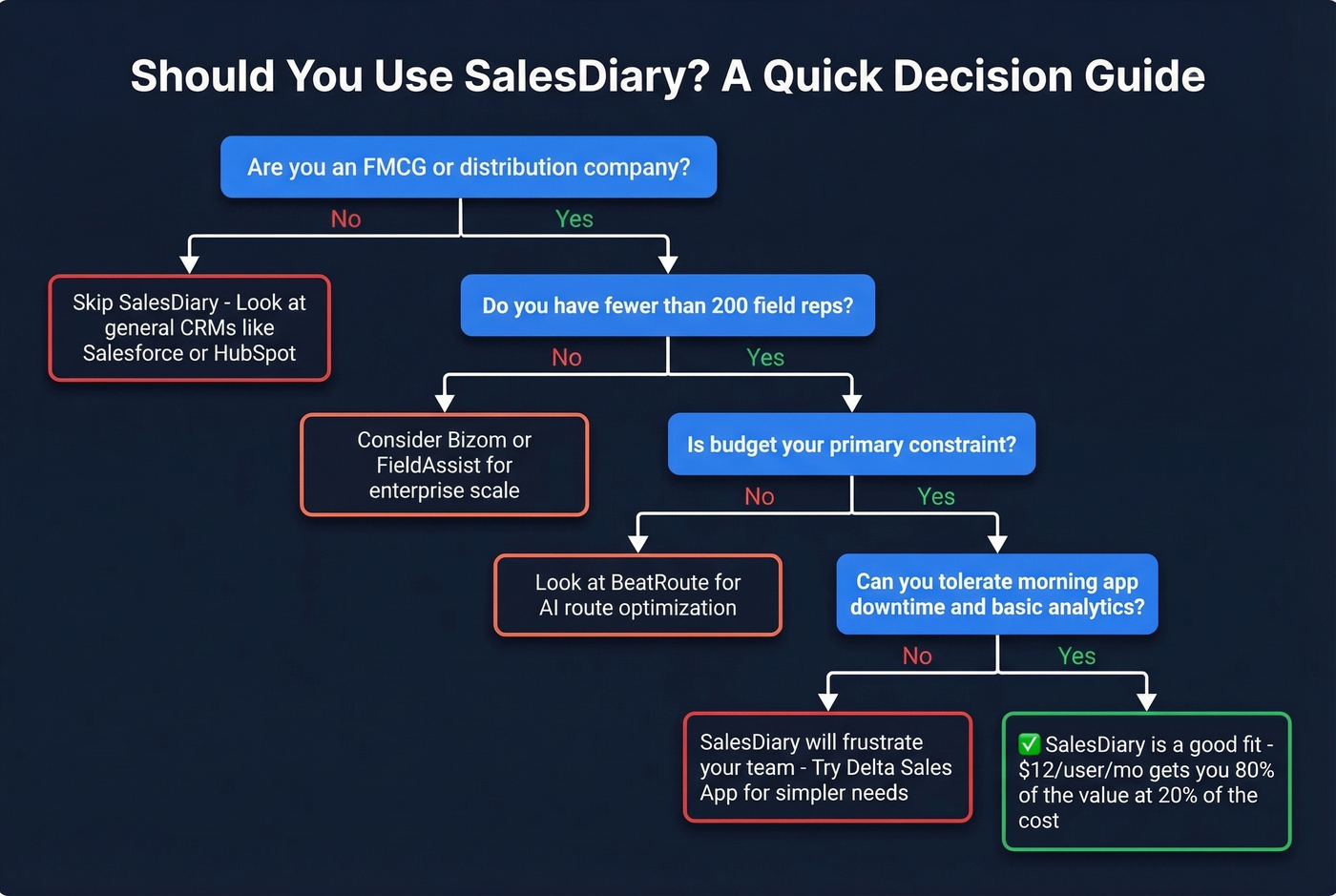
Skip this if you need advanced analytics, real API integration with your ERP, or can't tolerate morning downtime during peak field hours. Those aren't edge cases - they're dealbreakers for teams that depend on first-thing-in-the-morning check-ins.
Let's be honest: most Indian FMCG teams with under 100 reps don't need a ₹50,000/month enterprise SFA. SalesDiary at $12/user gets you 80% of the value at 20% of the cost. The other 20% - analytics, integrations, uptime guarantees - only matters once you've outgrown the basics.
SalesDiary manages routes and orders. It won't help you find or verify decision-maker emails before your reps walk into an outlet. If your team wastes visits on wrong contact info, Prospeo fills that gap with 98% email accuracy and 125M+ verified mobile numbers.
If you're building a cleaner pipeline, start with lead enrichment and a repeatable lead generation workflow so field reps aren't guessing who to ask for.

Duplicate entries and thin analytics are SalesDiary pain points reviewers flag repeatedly. Prospeo's 5-step verification and 7-day data refresh eliminate stale contacts before they hit your CRM - no incentivized reviews needed, just 98% accuracy across 300M+ profiles.
Stop feeding bad data into your field sales workflow.
Alternatives Worth Considering
Bizom is the enterprise benchmark - 750+ brands, 35+ countries, 250k+ field reps. Pricing is custom, and in our experience researching this space, it typically lands around $20-60/user/month before implementation fees. If you need a full route-to-market suite at scale, this is the one. For teams under 200 reps, you're overpaying for capabilities you won't touch.
Skip BeatRoute if you want simplicity. It positions itself as the "goal-driven AI" alternative, with published claims like 12.6% sales uplift and 16% reduction in route-to-market costs. Pricing runs roughly $15-40/user/month. The zero-code configuration sounds appealing, but the AI-driven approach adds complexity that smaller teams won't benefit from.
Delta Sales App vs. SalesDiary is the real comparison for budget buyers. Delta sits at roughly $10-15/user/month with a simpler feature set. If SalesDiary's DMS complexity frustrates your team, Delta strips things back to the essentials.
FieldAssist targets enterprise FMCG teams with custom pricing. Powerful, but implementation is complex and the learning curve is steep.
Salesforce starts at $25/user/month but climbs to $550. It isn't FMCG-specialized, and you'd spend more on customization than a purpose-built tool costs outright. Only makes sense if you're already deep in the Salesforce ecosystem - especially if you're comparing examples of a CRM or evaluating contact management software.
Final Verdict
At $12/user/month, SalesDiary delivers real value for small Indian distribution teams that need basic field sales automation without enterprise complexity. Go in with open eyes: the morning instability is documented, the analytics are thin, and the review sample is small with some incentivized responses. If those tradeoffs are tolerable, it's a smart starting point - just know when you've outgrown it.
If you do outgrow it, you'll want stronger reporting and planning - think sales forecasting solutions and tighter sales operations metrics to keep field execution predictable.