


Saleshandy vs SuperSend: Which Cold Email Tool Should You Pick?
The Saleshandy vs SuperSend decision looks close on paper - same G2 rating, both do cold email sequencing. But the two tools solve fundamentally different problems, and picking the wrong one means you're either overpaying for orchestration you don't need or missing a lead database you absolutely do. We've dug into the real costs, user complaints, and feature gaps so you don't have to.
30-Second Verdict
Pick Saleshandy if you want prospecting and sequencing in one stack, you're budget-conscious, or you're an agency managing lots of sending accounts. It's cheaper, far more battle-tested (773 reviews vs. 18), and Saleshandy's Lead Finder gives you access to a 700M+ contact database.
Pick SuperSend if you're sending 200k+ emails/month, you already source leads elsewhere, and you want deep conditional routing plus Smart Send Timing to squeeze every drop out of your sequences.
Skip both if your real problem is data quality, not sequencing. Feed verified contacts into whichever sequencer you pick and you'll outperform either tool's native data.
Feature Comparison at a Glance
| Feature | Saleshandy | SuperSend | Edge |
|---|---|---|---|
| Entry price | $25/mo (annual) | $99/mo | Saleshandy |
| Typical real cost | $25-$209/mo (no add-ons) | ~$357/mo with inboxes/domains | Saleshandy |
| Email accounts | Unlimited (Outreach plans) | $5/mo per inbox add-on | Saleshandy |
| Emails/mo (base) | 6,000 | 50,000 | SuperSend |
| Built-in database | Lead Finder (700M+) | No | Saleshandy |
| Conditional routing | Subsequences | Advanced branching | SuperSend |
| Reviews (G2) | 773 at 4.6/5 | 18 at 4.6/5 | Saleshandy |
| Warmup included | Yes | Yes | Tie |
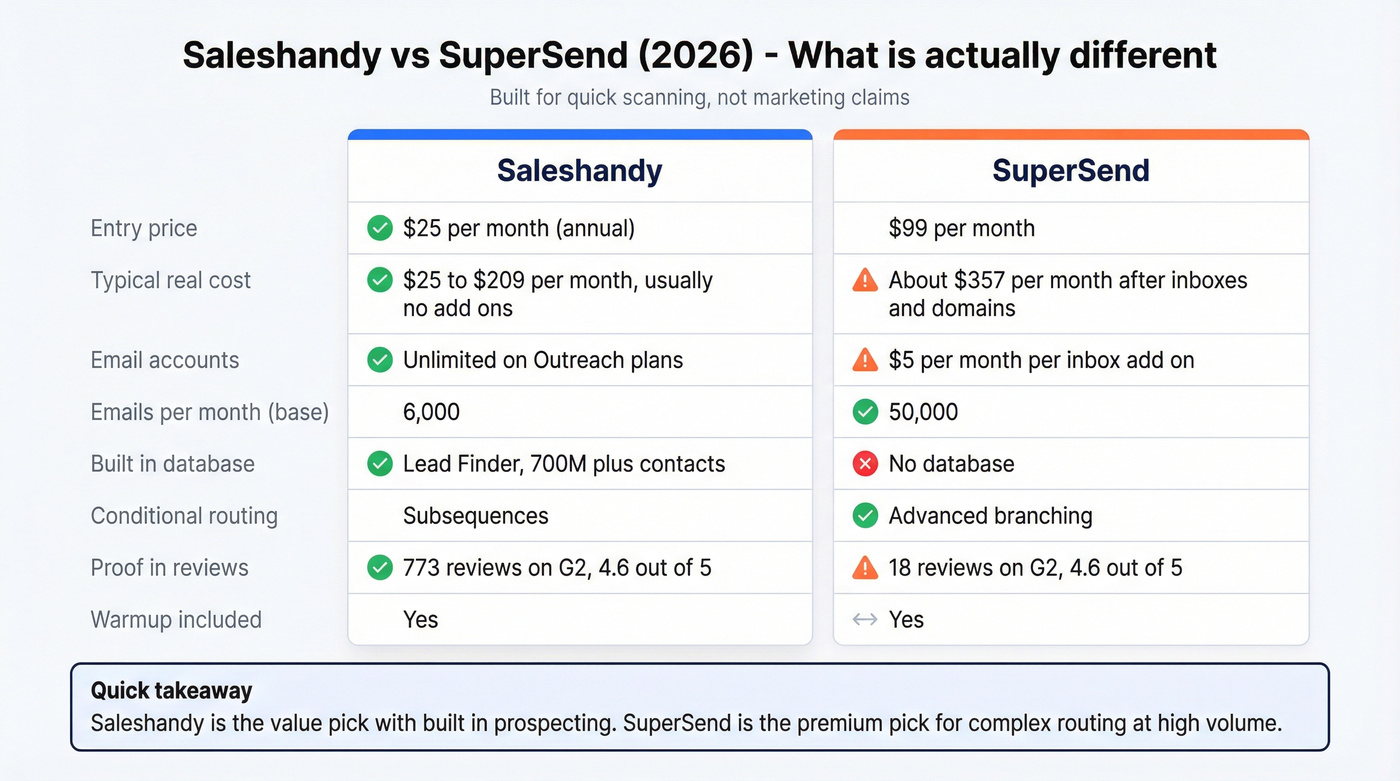
That review count gap tells you more than any feature matrix. 773 reviews means Saleshandy has been stress-tested across hundreds of teams and use cases. 18 reviews means SuperSend is still proving itself.
What You'll Actually Pay
Saleshandy's pricing runs roughly $25 (Outreach Starter), $69 (Outreach Pro), $139 (Outreach Scale), and $209 (Outreach Scale Plus) billed annually. Unlimited email accounts come included on all Outreach plans, which is a big deal for teams running multiple inboxes.
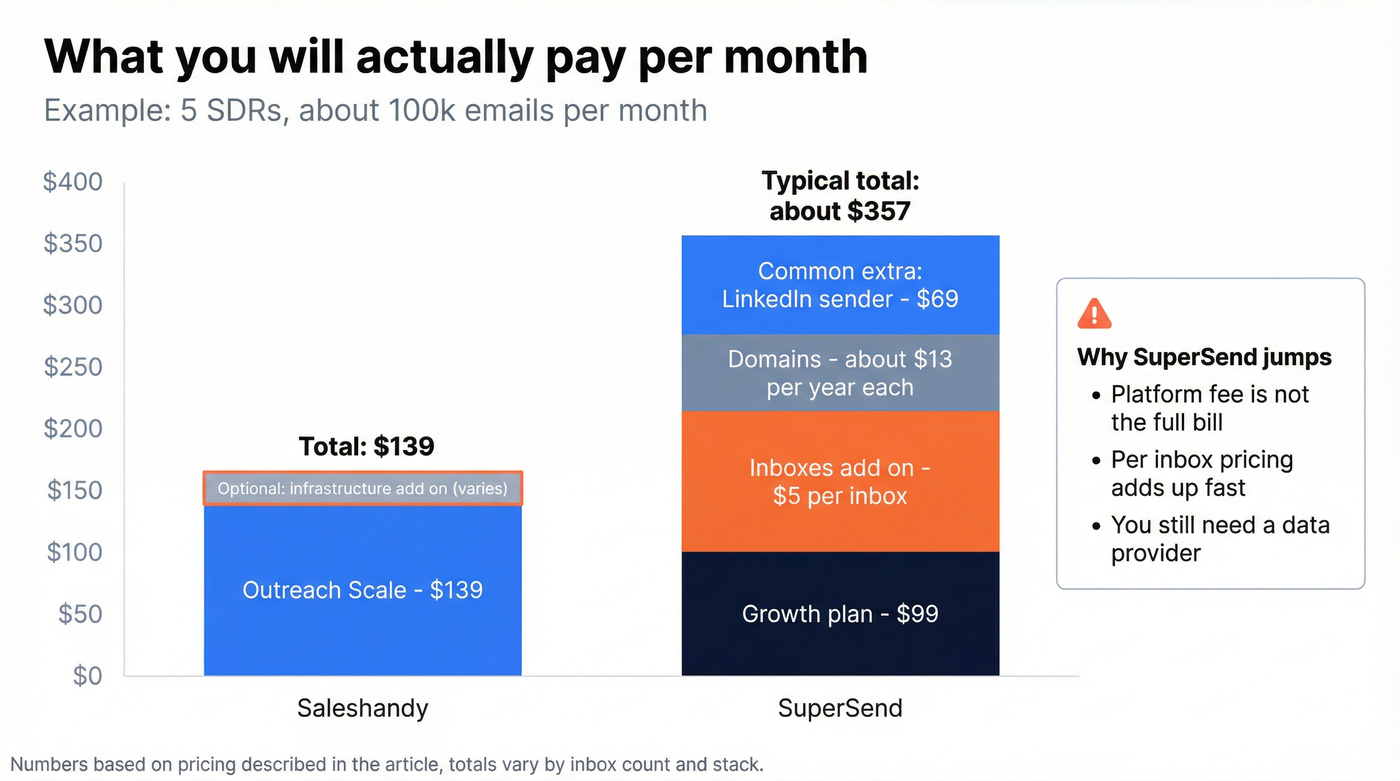
One nuance worth flagging: if you want Saleshandy to handle inbox and domain purchasing/management too, there's an Email Infrastructure add-on priced per account/domain.
SuperSend's sticker price is $99/mo for Growth (50k emails) or $319/mo for Scale (200k emails). But that's just the platform fee. Add Google/Outlook inboxes at $5/mo each, domains at $13/yr each, and a LinkedIn sender at $69/mo - most teams land around $357/mo total.
Here's the math that matters: a 5-person SDR team sending ~100k emails/month can sit on Saleshandy's $139/mo Outreach Scale tier. The same team on SuperSend typically uses Growth ($99/mo) and then stacks inbox and domain add-ons, plus a separate data provider. Once you include those extras, you're easily at a few hundred dollars a month before you've sourced a single lead.

Your sequencer choice matters less than your data. Teams using Prospeo's 98% accurate emails see bounce rates under 4% - protecting domain reputation whether they run Saleshandy or SuperSend. At $0.01/email with a 7-day refresh cycle, it costs less than one bounced campaign.
Stop debating tools. Fix the data feeding them.
Features That Actually Matter
Lead Sourcing + Sequencing in One Stack
The architectural difference is Saleshandy's Lead Finder: a 700M+ contact database you can pull from, then push straight into sequences. If you don't already have a separate data provider, this removes a tool from your stack entirely. If you're building lists from scratch, compare options in our guide to sales prospecting databases.
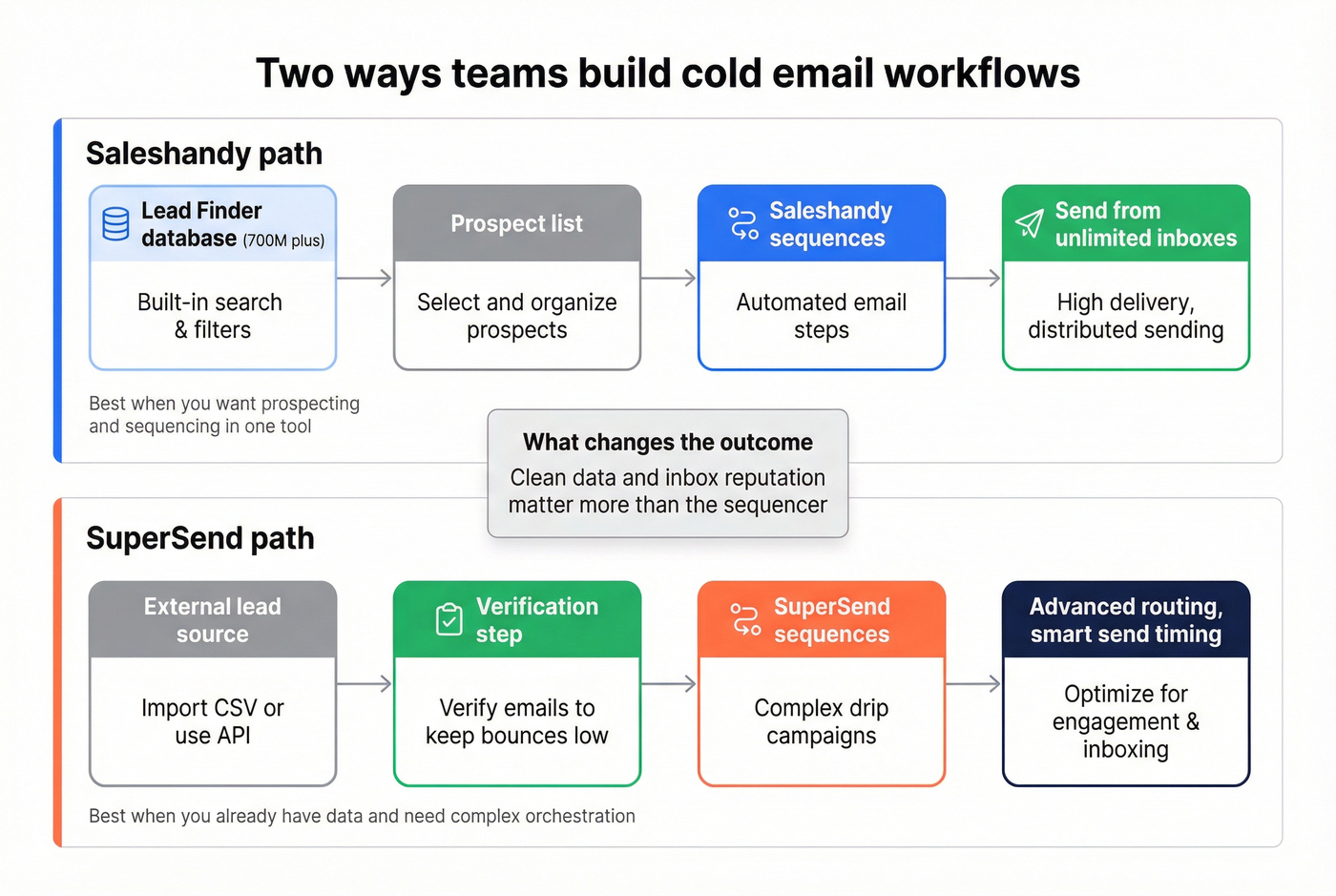
Unlimited email accounts also matters in the real world. Agencies and any team running lots of inboxes can scale sending without per-inbox math on the core Outreach plans. If warmup is a core constraint, see our roundup of unlimited email warmup tools.
Granular Sequence Logic
SuperSend's conditional routing is genuinely deeper. You can branch sequences based on reply type, trigger different follow-up paths, and use Smart Send Timing to reduce spam-trigger patterns. For teams running complex, high-volume campaigns with clean lead data already in hand, this orchestration layer is SuperSend's real selling point.
The catch: reviewers flag SuperSend's LinkedIn automation as needing improvement. And while SuperSend has self-serve tiers at 50k and 200k emails/month, Enterprise starts at 300k+. Teams pushing toward very high volume often run into operational overhead around warmup, reputation, and placement testing that no amount of sequence logic can fix. If you're scaling volume, it helps to understand email velocity and how it impacts deliverability.
Here's the thing - if you're sending under 100k emails/month, SuperSend is overkill. You're paying a premium for orchestration complexity that only pays off at serious volume.
What Users Actually Say
Saleshandy's 773 reviews paint the picture of a mature product. Users praise the automation and responsive support. The common complaints - cluttered UI, missing features, and occasional pricing concerns - are typical growing pains for a tool at this scale. The gripes are about polish, not fundamentals.
SuperSend's 18 reviews tell a different story. Users like the combined warmup + automation workflow, and integrations get called out positively. The recurring con is that LinkedIn automation needs work. There are also complaints about frequent UI changes from rapid launches creating confusion, including a Director of Marketing review from early 2026 that specifically called this out.
The consensus on Reddit threads about cold email tools tends to mirror this split: Saleshandy gets recommended for its value and scale, while SuperSend comes up in conversations about advanced sequencing - but rarely as a first recommendation for teams just getting started. If you're still evaluating your stack, our list of SDR tools can help you map what you actually need.
Pick This If...
Saleshandy: You want lead sourcing + sequencing in one stack, you run an agency, or you need unlimited email accounts without per-inbox fees.
SuperSend: You send 200k+ emails/month, you already have a dedicated data provider, and you want conditional routing worth the premium.
For teams sending under 50k emails/month who just need reliable sequencing and built-in prospecting, Saleshandy is the straightforward pick. Don't overthink it.
Clean Data Makes Either Tool Work
Neither tool is a data accuracy tool. Saleshandy includes a database through Lead Finder, but size doesn't equal quality. SuperSend has no database at all. And SuperSend's own research shows teams without proper infrastructure see deliverability drop from 95% to under 50% within 3-6 months of scaling.
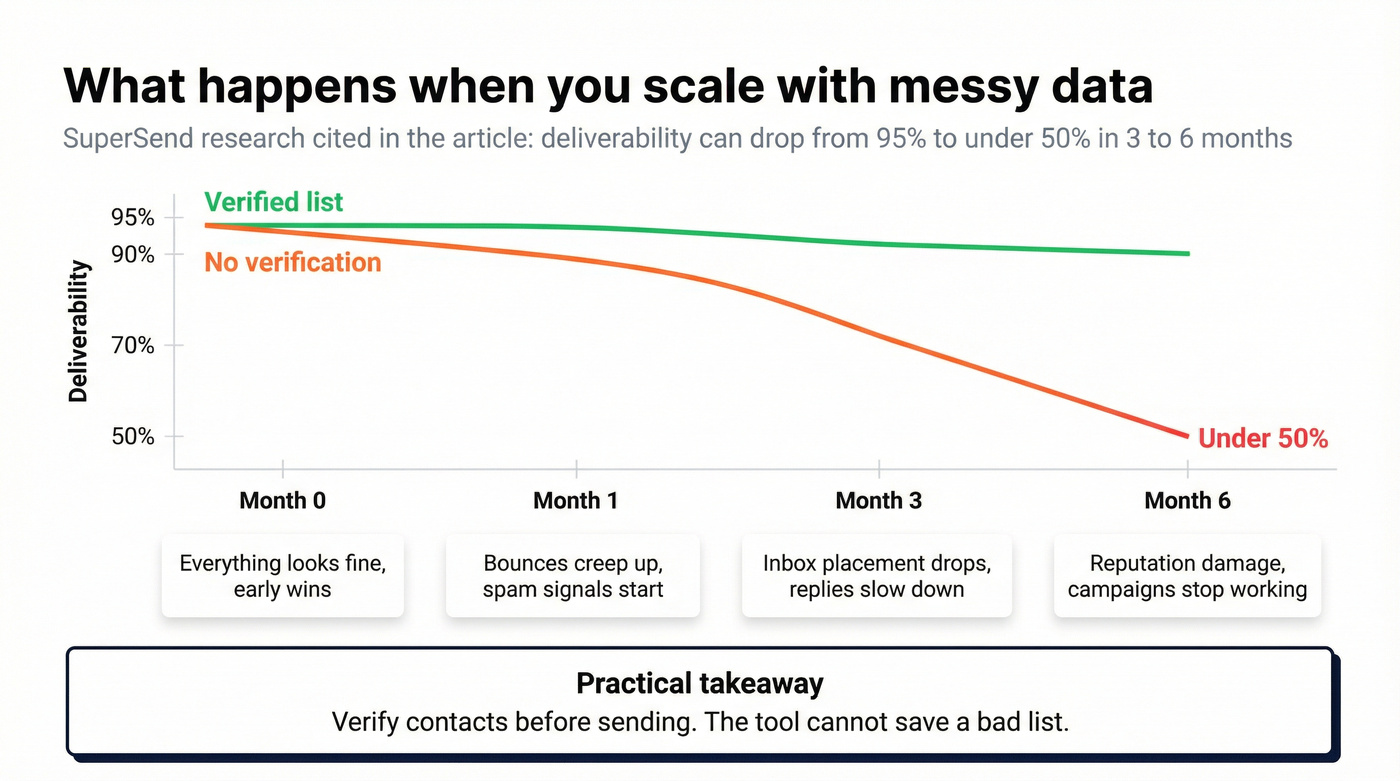
In our experience, this is where most cold email setups actually break. Your SDR team loads 10,000 contacts, 15% bounce, and your domain reputation is damaged regardless of which sequencer you used. We've seen it happen over and over - the tool gets blamed when the data was the problem all along. If you're troubleshooting, start with email bounce rate benchmarks and fixes, then work through a full email deliverability guide.
Prospeo solves this layer with 98% email accuracy on a 7-day data refresh cycle and 300M+ professional profiles. Feed verified contacts into Saleshandy or SuperSend and you're protecting your sending infrastructure from day one. Stack Optimize, for example, built to $1M ARR using this approach - their client deliverability stays above 94% with bounce rates under 3%. If you need to validate lists at scale, compare data enrichment services and verification workflows.

Stack Optimize built a $1M agency sending through cold email tools like these - with 94%+ deliverability and under 3% bounce. Their secret wasn't the sequencer. It was verifying every contact through Prospeo's 300M+ database before hitting send.
Verify your list before your domain pays the price.
FAQ
Is SuperSend good for agencies?
Saleshandy is typically the simpler agency fit because its Outreach plans include unlimited email accounts, while SuperSend charges $5/mo per inbox add-on. For a 10-client agency running 5 inboxes each, that's an extra $250/mo on SuperSend before you send a single email.
How long does email warmup take?
Expect 10-12 weeks before hitting full sending volume on either platform, starting at roughly 10-15 emails per day and ramping gradually. This timeline is an inbox reputation constraint, not a software limitation - no sequencer can shortcut it.
Can I use a third-party data provider with both tools?
Yes. Both Saleshandy and SuperSend accept CSV imports and integrate with external data sources. Pairing either tool with a dedicated verification provider keeps bounce rates under control and protects domain reputation as you scale volume. Let's be honest - this is the step most teams skip, and it's the one that matters most.