

The Sandler Cold Call Script (With Examples)
Sandler's cold call framework is scattered across official blog posts, downloadable PDFs, and training materials that each show a piece of the puzzle. One of the most visible places people go looking for it is a Reddit thread where someone simply asks for the full script. Nobody gives them a clean answer.
So here it is - the full framework assembled in one place, with copy-paste examples for every component.
The quick version: The Sandler cold call follows four parts: Pattern Interrupt -> Mini Up-Front Contract -> 30-Second Commercial -> Hook Question. Below is each part broken down with variants, plus the full assembled script. If you just want the script, jump to The Full Script, Assembled.
The Four-Part Framework
Sandler's recommended prospecting call follows the same sequence every time:
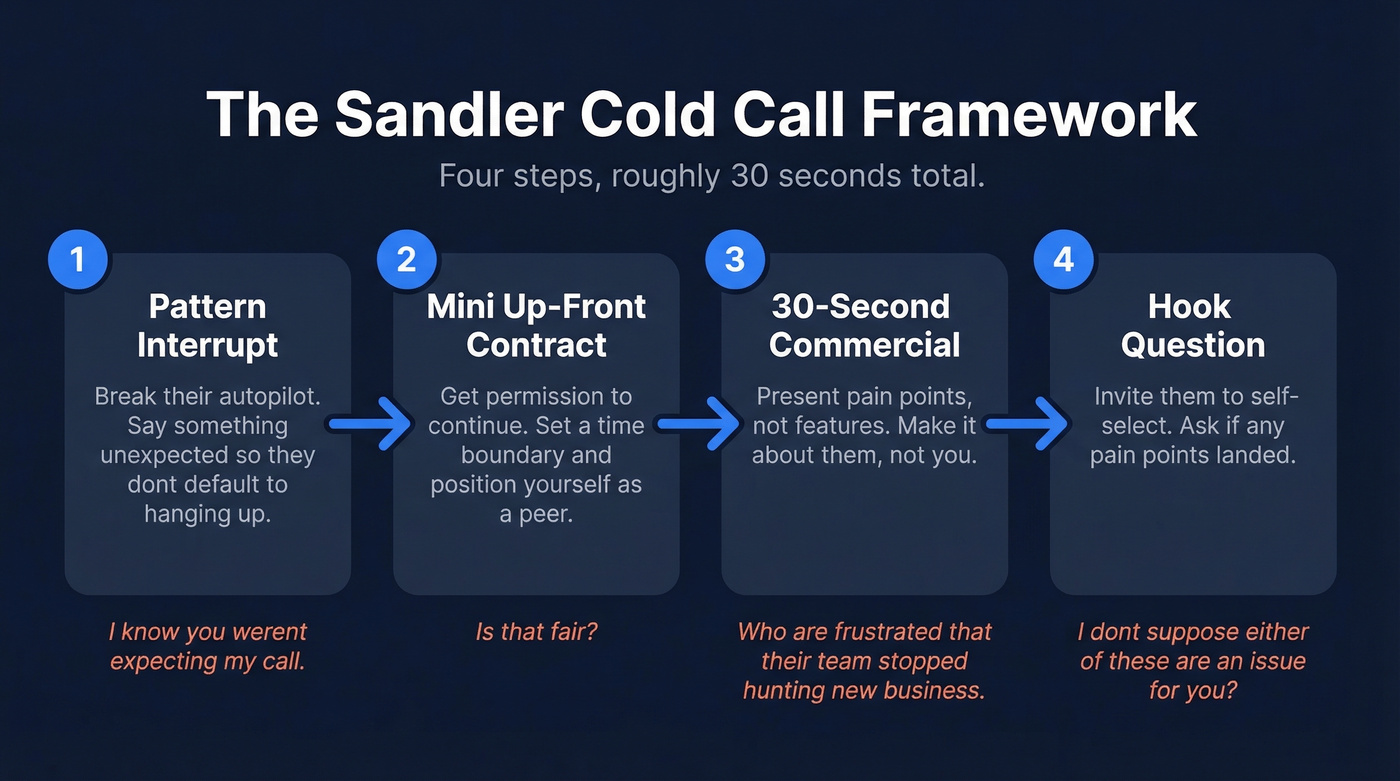
- Pattern Interrupt - break the prospect's autopilot
- Mini Up-Front Contract - get permission to continue
- 30-Second Commercial - present pain points, not features
- Hook Question - invite them to self-identify
Each Part, Broken Down
Pattern Interrupt
A pattern interrupt is typically only a second or two long. Your job is to say something the prospect doesn't expect - something that disrupts the mental script that says "sales call, say I'm busy, hang up."
Five openers that work, ranging from safe to aggressive:
- "Hi, this is Emily. I know that you weren't expecting my call." (pause) - Clean, honest, low-risk. Start here.
- "Is this [name]? ... John Rosso. Sandler Training." (long pause) - The silence forces them to respond.
- "Hey, it's [name] from [company]. We don't know each other, but I've been doing some research on you and your company and I think it makes sense for us to talk."
- "[Name], this is a cold call. Do you want to hang up?" - Disarmingly honest. You name the awkwardness instead of dancing around it.
- "It sounds like you might already have a solution - is this even worth exploring?" - A Negative reverse. Giving them the exit paradoxically makes them stay.
The through-line: you're not pretending to be their friend. You're acknowledging the weirdness and moving past it.
Mini Up-Front Contract
Once they haven't hung up, you need explicit permission to keep talking. The mini up-front contract sets a time boundary and positions you as a peer, not a supplicant.
The classic line: "Let me tell you why I'm calling, and you can tell me whether or not we should chat. Is that fair?"
To build your own, use the ANOT mnemonic - Appreciate, Naturally, Obviously, Typically: "I appreciate you picking up. Naturally you'll have questions. Obviously I'll have a few too. Typically by the end of 30 seconds, we'll both know if this is worth another conversation - or not. Does that sound fair?"
"Is that fair?" matters because it reinforces a peer-to-peer dynamic and gets a micro-commitment. It's a small word choice that changes the entire power balance of the call.
30-Second Commercial
This isn't a pitch. It's a pain statement disguised as an introduction.
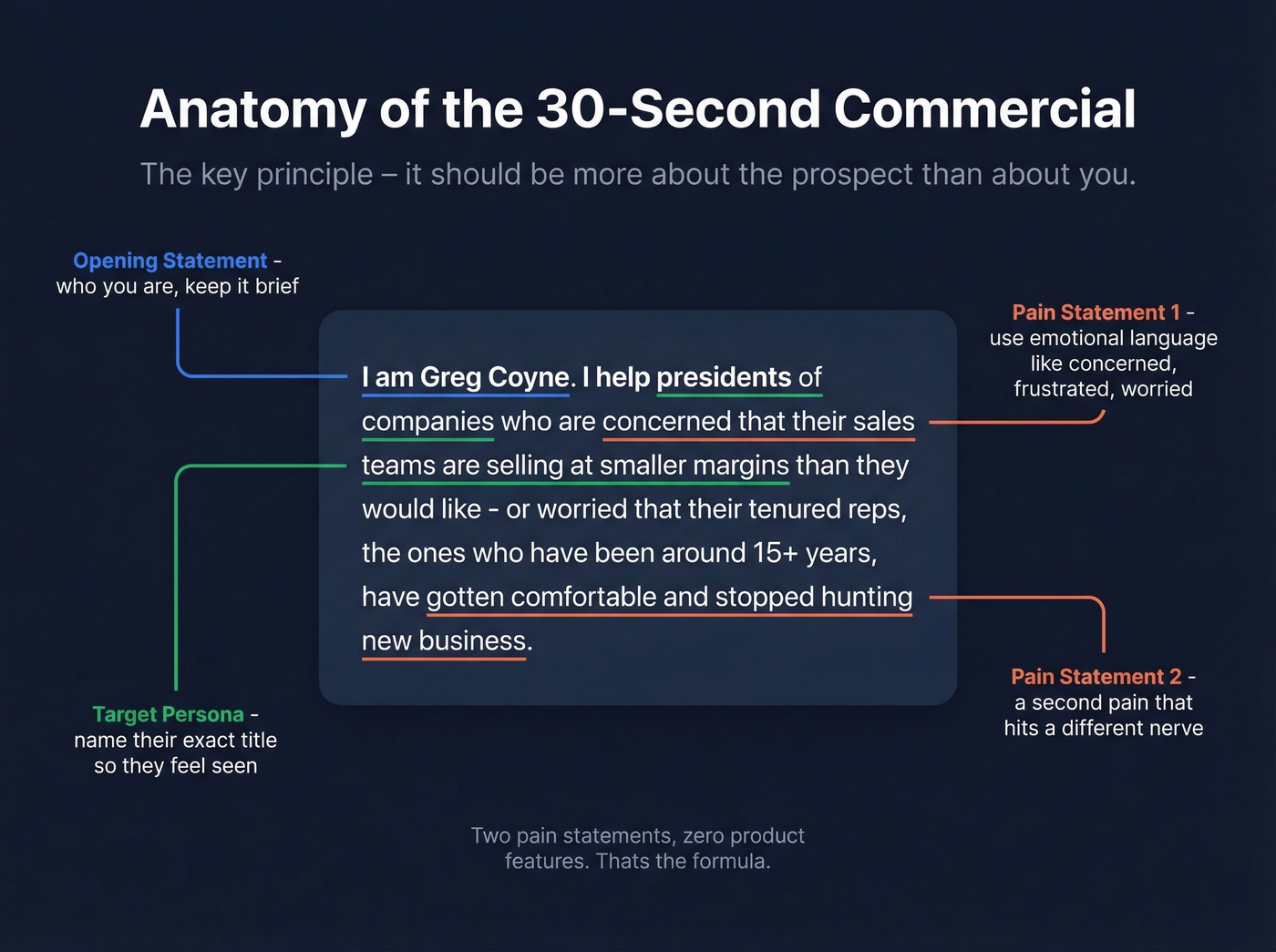
Sandler's official template has five components: an opening statement (who you are), a pain statement, a positioning statement, a value statement, and contact info when appropriate. But the key principle is simple: the commercial should be more about the prospect than about you.
Here's Greg Coyne's example, which nails this:
"I'm Greg Coyne. I help presidents of companies who are concerned that their sales teams are selling at smaller margins than they'd like - or worried that their tenured reps, the ones who've been around 15+ years, have gotten comfortable and stopped hunting new business."
Two pain statements, zero product features. Sandler UK also recommends weaving in a brief third-party success story - something like "we recently worked with a VP of Sales in your space who was dealing with the same issue" - to add credibility without turning it into a case study. Use emotional language that lands: "frustrated," "worried," "sick and tired of." Fill in your own pains and you've got a commercial.
If you want more ways to tighten this into a punchy intro, borrow from these sample elevator pitches.
Hook Question
The hook question is where the prospect self-selects. You've laid out pain points - now you ask if any landed.
Three variants:
- "I don't suppose either of these are an issue for you?" - Negative reverse. Low pressure.
- "Any of these items hitting home for you?" - More direct.
- "Who do you know that might be dealing with any of these?" - Works even if they say no.
If they say yes, your only response is "Tell me more..." Then shut up and listen. We've seen reps blow this moment by jumping into a pitch the second the prospect shows interest. Don't. The call is won or lost in the silence after the hook question.
The Full Script, Assembled
Here's all four parts stitched into one continuous call. Adapt the pain statements to your industry:
"Hi [name], this is [your name]. I know you weren't expecting my call. (Pause.) Let me tell you why I'm calling, and you can tell me whether or not we should chat - is that fair?
I work with [title/role] at [type of company] who are dealing with two things: first, they've got pipeline but can't close enough of it - forecasting feels like guesswork. Second, their team is solid at working inbound but struggles to create new pipeline from scratch.
I don't suppose either of these are an issue for you?"
That's about 30 seconds spoken aloud. If they bite, ask "Tell me more." If they don't, thank them and move on. No begging.
If you want a broader system around this (call blocks, lists, follow-ups), build it into a repeatable cold calling system.

A perfect Sandler script dies the moment it hits a wrong number or a dead email. Prospeo gives you 125M+ verified mobile numbers with a 30% pickup rate - so your pattern interrupt actually reaches a real person. At $0.01 per email, you stop wasting dials and start having conversations.
Stop rehearsing scripts into voicemail boxes that never get checked.
Sandler vs. Jeb Blount's Approach
If you've read Jeb Blount's Fanatical Prospecting, you'll notice his cold call script shares DNA with Sandler's - both use a pattern interrupt and a quick ask for time. The key difference is that Blount's framework leads with a "because" statement naming a specific reason for calling, then pivots to a direct ask for a meeting. Sandler lingers longer on pain discovery through the 30-second commercial and hook question, letting the prospect self-select before any meeting request is made.
If you're newer to the phone, start with a fundamentals-first approach in cold calling for beginners.
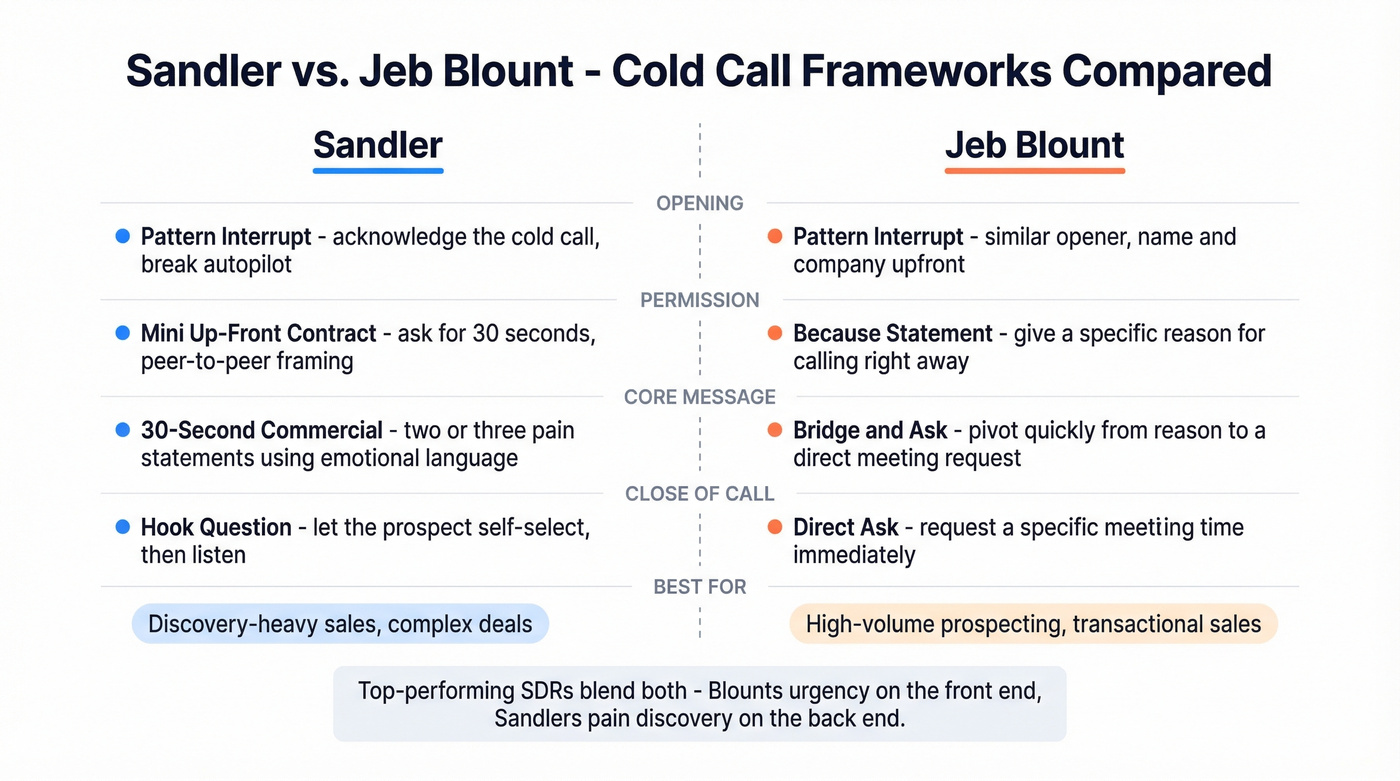
In practice, many top-performing SDRs blend the two: Blount's urgency on the front end, Sandler's pain-focused questioning on the back end. The consensus on r/sales leans the same way - pick the parts that match your selling style and your buyer's patience.
The Dennehy Variant
Benjamin Dennehy - self-titled "UK's Most Hated Sales Trainer" - runs a more aggressive version of this framework. His core twist: don't introduce yourself first. Tell them it's a cold call, ask for 30 seconds with "does that sound fair?", then present three pain points and ask them to pick which one matters most. Once they pick, shift into qualification: "Can you provide specifics? When did you first recognize it? What have you tried? How much has it cost you?"
Skip this if you haven't made at least a few hundred dials on the standard framework. Dennehy's approach requires serious confidence and muscle memory - jumping straight to it without reps is like trying to play jazz before you can play scales.
How Sandler Prevents Objections
Here's the thing most sales training gets backwards: they teach you 15 rebuttal scripts for "send me an email" and "we already have a vendor." Sandler's take is the opposite. You don't need rebuttals if you prevent the objection from happening.
If you want a deeper playbook on reducing pushback across the whole funnel, see how to reduce sales objection rate.
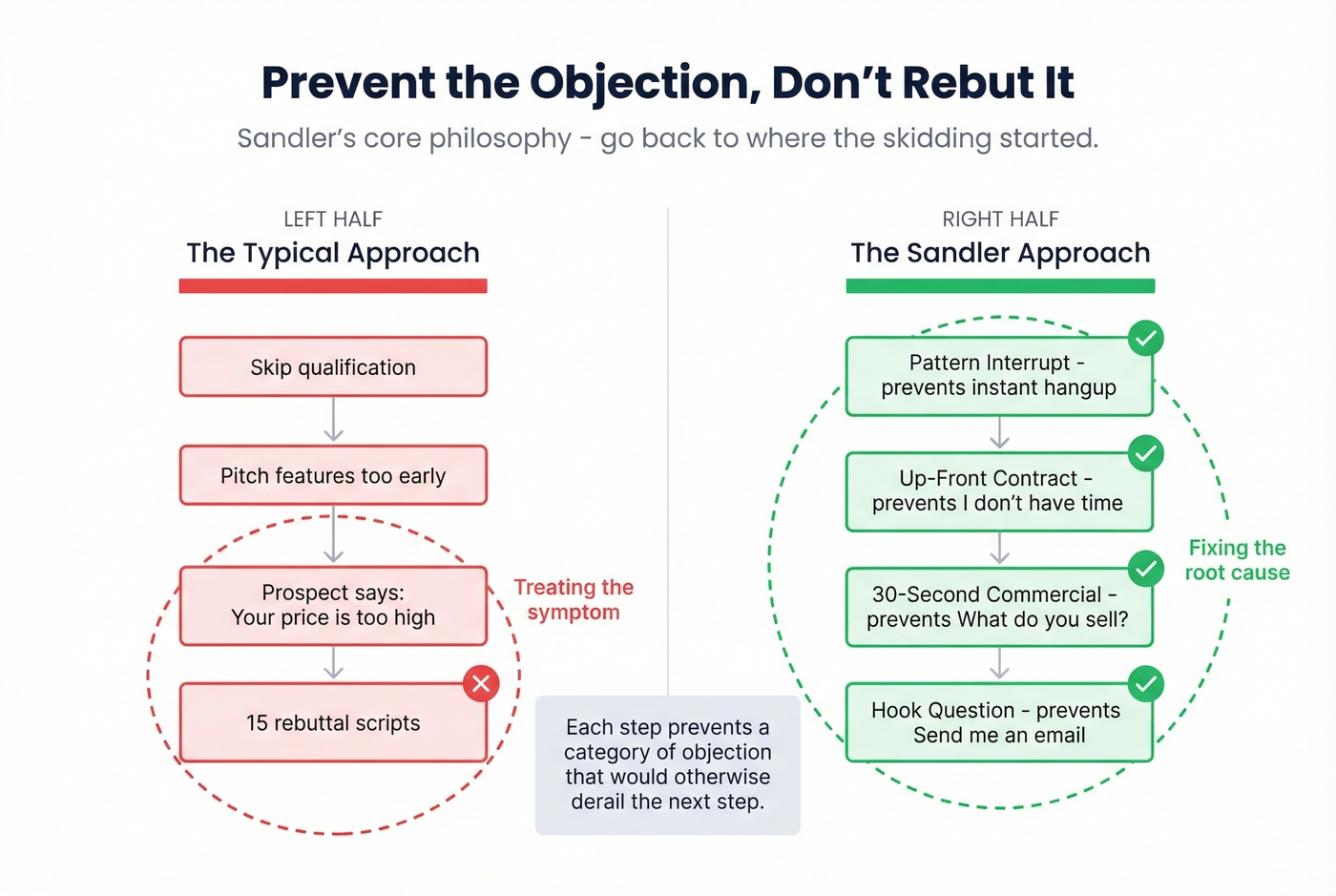
Their analogy: don't examine the car crash - go back to where the skidding started. If a prospect says "your price is too high," the problem isn't your rebuttal. The problem is that you didn't qualify budget three steps ago.
You don't need 15 rebuttal scripts. You need to fix the earlier step that caused the objection. That's the whole philosophy, and it's why the four-part framework exists in the first place - each step prevents a category of objection that would otherwise derail the next step.
Before You Dial - Fix Your Data
Even the best Sandler cold call script is useless if a third of your numbers are wrong. We've watched reps burn entire call blocks before their pattern interrupt even gets a chance - and the frustration of hearing "this number is no longer in service" for the fifth time in a row kills your energy faster than any rejection will.
If you're building lists from scratch, start with these sales prospecting techniques and a reliable sales prospecting database.
Prospeo's mobile finder covers 125M+ verified direct dials with a 30% pickup rate, so you're reaching live humans instead of voicemail graveyards. The free tier gives you 75 emails and 100 Chrome extension credits per month - enough to test it before your next call block.
You just built the perfect 30-second commercial. Now you need a list of the right prospects to deliver it to. Prospeo's 30+ search filters - buyer intent, job changes, headcount growth - let you target exactly the decision-makers whose pain points match your script. 98% email accuracy means your follow-up lands too.
Build a list that matches your pain statements in under 5 minutes.
FAQ
Does Sandler Recommend Using a Script?
Yes and no. Sandler recommends memorizing the four-part structure - pattern interrupt, up-front contract, 30-second commercial, hook question - and internalizing the language until it feels natural. The framework is the script; the specific lines are yours to adapt. Think of it like a jazz standard: you learn the chord changes, then improvise over them.
What's the Best Beginner Opener?
Start with "Hi, this is [name]. I know you weren't expecting my call." It's low-risk, honest, and doesn't require the confidence that Dennehy's variant demands. Master it first, then experiment after a few hundred dials.
Can I Combine Sandler With Other Frameworks?
Absolutely. Many top-performing SDRs use Sandler's pain-focused structure but borrow Blount's direct meeting ask or Dennehy's aggressive three-pain approach. The four-part sequence is flexible enough to absorb elements from other methodologies without breaking. In our experience, the reps who perform best aren't purists - they're remixers.