

The Sandler Pain Funnel: A Practitioner's Guide to Running It Without Sounding Like a Robot
A RevOps lead we work with ran discovery call audits last quarter. The finding that stung: reps were spending under a minute on pain discovery before jumping to a demo. That's not discovery - that's a checkbox. Reps who actually ran the Sandler pain funnel closed 35% more deals and shortened their cycles by 22 days compared to those defaulting to feature-benefit pitches. Meanwhile, 32% of sales teams still burn significant time on unqualified leads. This questioning framework fixes both problems at once.
The Quick Version
Stop memorizing the 7-8 questions - internalize the 3 levels (surface, impact, emotional). Practice the emotional transition with labeling techniques, not scripted phrases. Pair the funnel with an up-front contract or the whole thing gets much harder to run cleanly.
What Is the Sandler Pain Funnel?
In 1966, David Sandler made 87 consecutive sales calls and got 87 noes. Instead of quitting, he teamed up with a clinical psychologist to reverse-engineer why prospects said no - and more importantly, why they said yes. The result was the Sandler Selling System, built on the idea that people buy emotionally and justify logically.
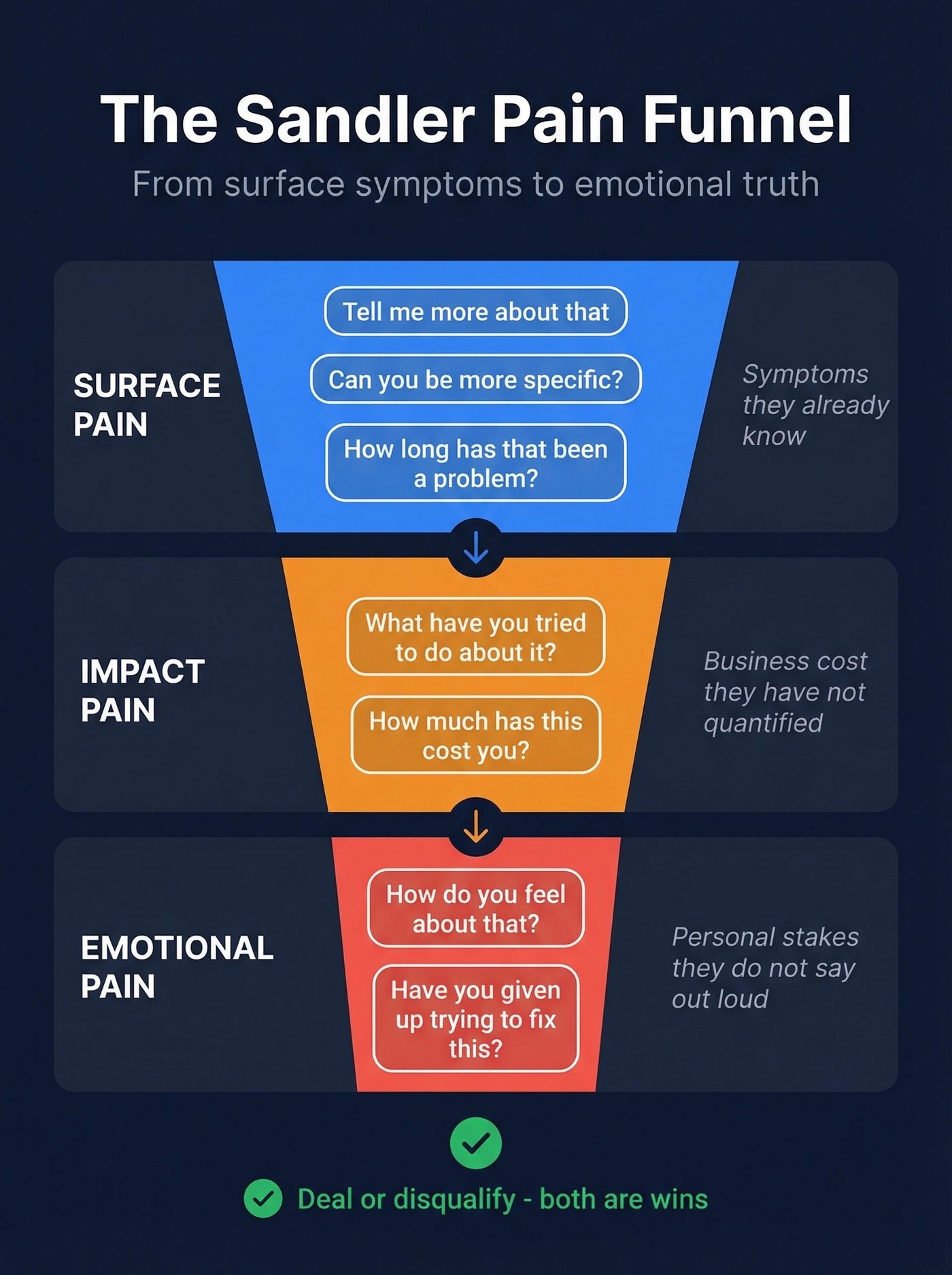
The full system has 7 stages, and the pain funnel lives inside Stage 3:
- Bonding and Rapport - build trust before business
- Up-Front Contract - agree on the rules of the conversation
- Pain - where the pain funnel lives
- Budget - qualify financial fit
- Decision - map the buying process
- Fulfillment - present your solution (only now)
- Post-Sell - prevent buyer's remorse
The structured questioning sequence Sandler developed moves a prospect from surface-level complaints down to the emotional cost of inaction. Sandler's own training materials put it bluntly: "Prescription without diagnosis is malpractice." You don't pitch until you've diagnosed. And you don't diagnose until you've reached the emotional layer.
Three levels are what matter. Surface pain is the symptom the prospect already knows about. Impact pain is the business cost they haven't fully quantified. Emotional pain is the personal toll - the sleepless nights, the career risk, the frustration they don't usually say out loud. Most reps never get past level one.
Here's the thing: the funnel isn't just for closing. It's for disqualifying. If you drill through all three levels and can't find real pain, you don't have a deal. That's a good outcome - you just saved yourself weeks of chasing a prospect who was never going to buy.
The Full Question Sequence
Here's the canonical question progression, mapped to the three levels. The exact wording varies by trainer, but the structure is consistent across Gong's breakdown, Sandler's own materials, and what we've seen work in practice.
| Question | Purpose | Level |
|---|---|---|
| "Tell me more about that." | Open the door wide | Surface |
| "Can you be more specific?" | Force detail over vagueness | Surface |
| "How long has that been a problem?" | Establish duration and urgency | Surface |
| "What have you tried to do about it?" | Expose failed solutions | Impact |
| "How much has this cost you?" | Quantify in dollars or time | Impact |
| "How do you feel about that?" | Bridge to the emotional layer | Emotional |
| "Have you given up trying to fix this?" | Create urgency through resignation | Emotional |
Two bonus questions from practitioners on r/sales that map perfectly to the funnel:
- "Why now?" - forces the prospect to articulate what changed. Sits at the surface-impact boundary.
- "If you didn't solve it, could you live with it?" - this is the emotional killshot. If the answer is "yes," you don't have a deal. If it's "no," you've just heard the prospect sell themselves.
The questions aren't magic. The progression is. Each one pulls the prospect deeper into their own problem until they feel the full weight of it. Skip a level and you'll get polite, surface-level answers that don't drive urgency.
How It Works in Practice
Master the Levels, Not the Script
Memorizing 7-8 questions is the wrong approach. We've watched reps recite the pain funnel like a checklist and get nothing but awkward silences.
Instead, internalize the three levels. Know where you are in the conversation. If you're hearing symptoms ("our current tool is slow"), you're at the surface. If you're hearing business consequences ("we're losing deals because proposals take three days"), you're at impact. If you're hearing personal stakes ("my VP told me if we miss quota again, the team gets restructured"), you're at emotional. Your job is to recognize which level you're on and ask the next question that goes deeper - sometimes that's a canonical question, sometimes it's just "tell me more about that."
Let's walk through a scenario that shows the gap between surface and emotional. A VP of Sales at a mid-market SaaS company opens with "our CRM data is messy." On the surface, that's a data hygiene complaint. A mediocre rep nods and starts demoing. A rep who understands the levels pushes: "How long has it been messy?" (six months). "What have you tried?" (we hired a contractor, it didn't stick). "What's the cost?" (reps are spending two hours a day on manual cleanup instead of selling). "How do you feel about that?" Long pause. "Honestly? I got promoted into this role nine months ago. If pipeline doesn't improve by Q3, the board's going to question whether I was the right hire."
That's the emotional layer. That's where deals get made.
The Emotional Transition
The hardest part of the funnel - and every practitioner admits this - is the transition from impact to emotional. A cybersecurity enterprise rep on Reddit described getting "awesome results" with the pain funnel overall but struggling specifically at this transition point.
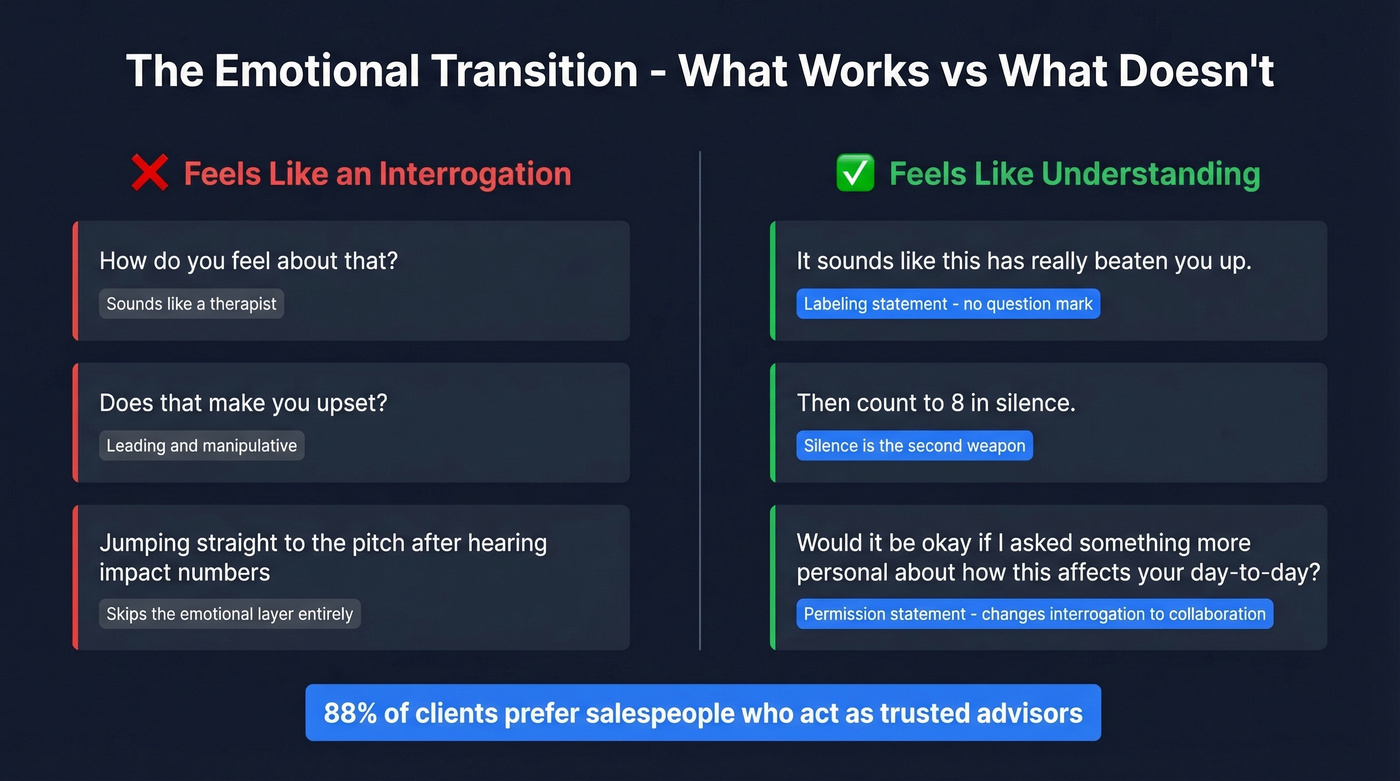
His solution: Chris Voss-style labeling. Instead of asking "how do you feel about that?" (which sounds like a therapist), he'd say:
- "It sounds like this has really beaten you up."
- "It sounds like this has prevented you from delivering on your strategy."
Labeling works because it's a statement, not a question. The prospect doesn't feel interrogated - they feel understood. And when someone feels understood, they open up.
Silence is the other weapon. After a labeling statement, stop talking. Count to eight in your head. The prospect will fill the silence with the emotional truth you're looking for. Eight seconds feels like an eternity on a call. It's supposed to.
Permission statements reduce the manipulation feel that Pipedrive's research flags as a common failure mode. Try: "Would it be okay if I asked you something a bit more personal about how this affects your day-to-day?" The prospect almost always says yes, but the act of asking changes the dynamic from interrogation to collaboration.
88% of clients prefer working with salespeople who act as trusted advisors. The emotional transition is where you earn that status or lose it.
Set the Up-Front Contract First
The pain funnel works best with an up-front contract. This is the step most reps skip, and it's the reason most pain funnels feel awkward.
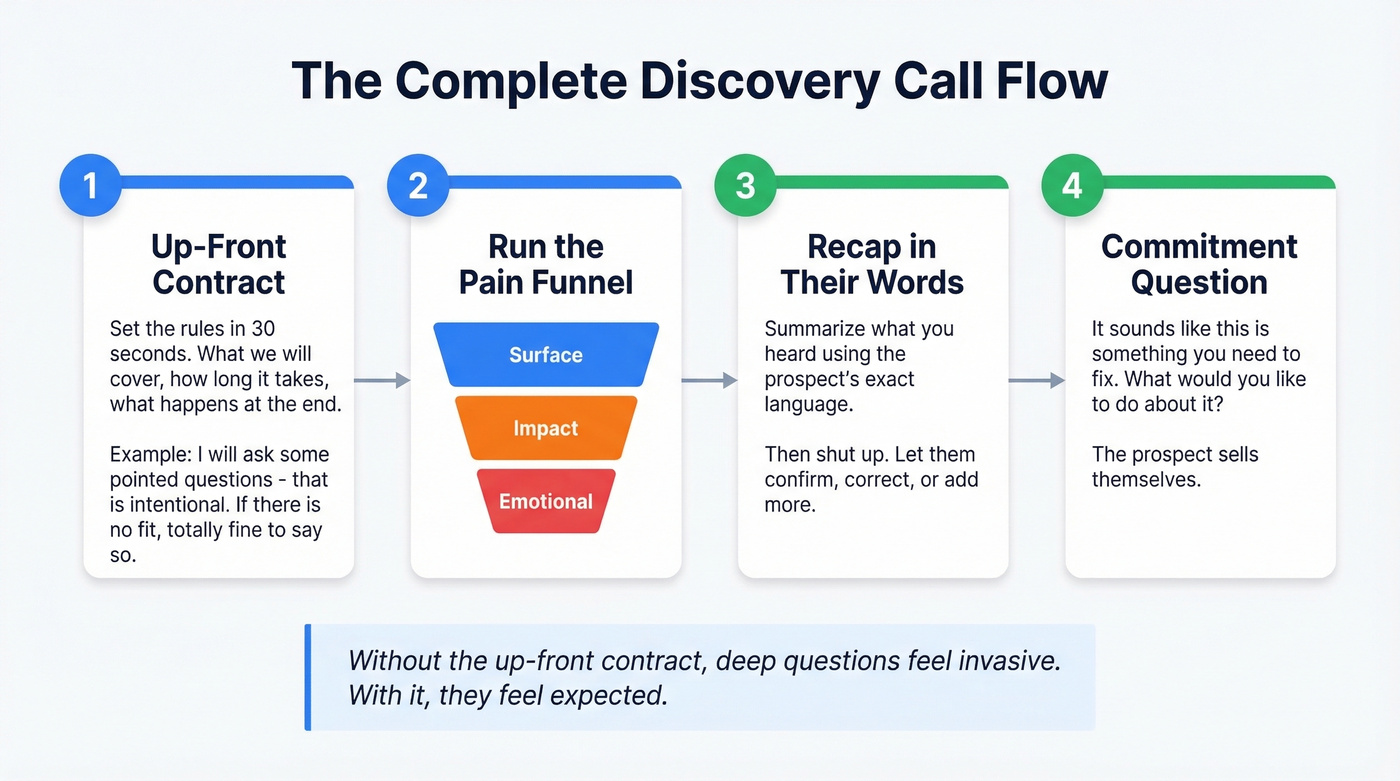
An up-front contract is a 30-second agreement at the start of the call: what you'll cover, how long it'll take, and what happens at the end. Something like: "I'd like to spend 25 minutes understanding your situation. I'll ask some questions that might feel pointed - that's intentional. At the end, if there's a fit, we'll talk next steps. If not, totally fine to say so. Fair?"
Without this, deep questions feel invasive. With it, they feel expected.
After the Funnel: Recap and Commit
Most guides stop at the emotional layer. That's a mistake.
Once you've reached emotional pain, summarize what you heard - in the prospect's own words, not yours. "So if I'm hearing you right: the data issues are costing your team two hours a day, you've tried to fix it twice, and if pipeline doesn't improve by Q3, your role is on the line. Did I get that right?" Then shut up.
The prospect will either confirm, correct, or add more. All three outcomes are good. Once they've confirmed, ask the commitment question: "It sounds like this is something you need to fix. What would you like to do about it?" You're not pitching. You're letting the prospect tell you they want to move forward. That's the Sandler way - the prospect sells themselves.

You just learned how the pain funnel disqualifies bad prospects fast. But the funnel only works if you're talking to real decision-makers with real contact data. Prospeo gives you 300M+ profiles with 98% email accuracy and 125M+ verified mobiles - so your discovery calls actually happen.
Stop running perfect pain funnels on prospects you can't reach.
Real Examples by Industry
SaaS (Project Management to CTO)
Rep: "You mentioned your teams are missing project deadlines. Can you be more specific about what's happening?"
CTO: "We're using three different tools and nothing syncs. Timelines slip because nobody has a single source of truth."
Rep: "How long has that been going on?"
CTO: "At least a year. Maybe longer."
Rep: "What have you tried to fix it?"
CTO: "We evaluated two platforms last quarter but couldn't get buy-in."
Rep: "It sounds like this has been a frustrating cycle - trying to fix it and hitting walls."
CTO: (pause) "Honestly, yeah. My CEO brought it up in our last board prep. If we miss the Q3 launch window because of coordination issues, that's on me."
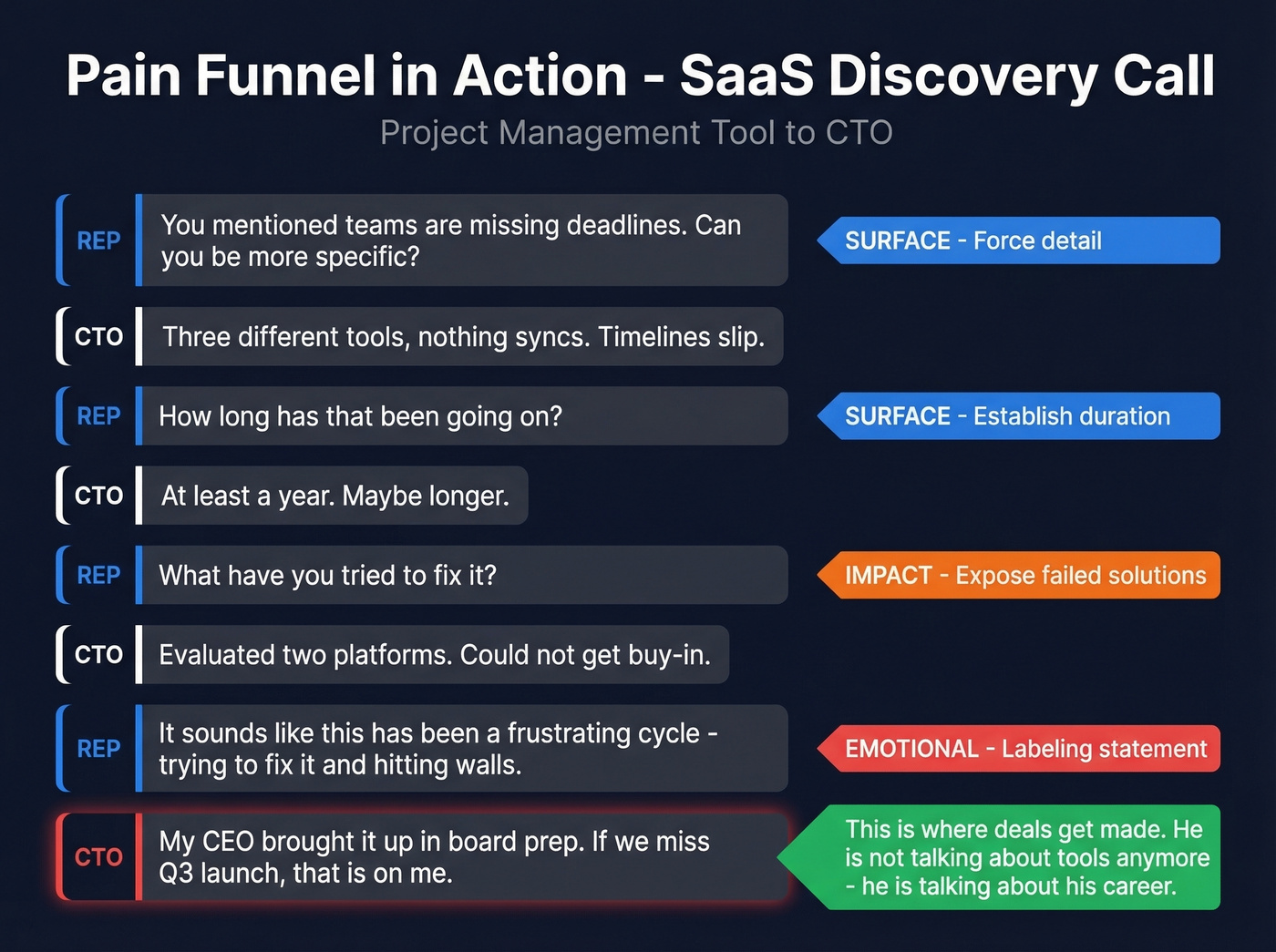
That last line is emotional pain - the CTO isn't talking about tools anymore, he's talking about his career. You don't pitch here. You ask: "What happens if Q3 slips?"
Cybersecurity (Enterprise to CISO)
Rep: "You said your current SIEM isn't catching lateral movement. How long has that been a known gap?"
CISO: "Since the last pen test, so about eight months."
Rep: "What's the impact been?"
CISO: "We had two incidents that should've been caught earlier. Mean time to detect went from hours to days."
Rep: "How much do you think those delayed detections cost?"
CISO: "Hard to quantify exactly, but the remediation on the second one was north of $200K."
Rep: "It sounds like this has really beaten you up."
CISO: "I presented to the board after that second incident. Not a fun conversation. If it happens again, I'm not sure I survive it."
Notice the labeling statement doing the heavy lifting at the emotional transition - no question mark needed.
HR Tech: What Went Wrong (and the Fix)
Here's a real pattern we see in call reviews. The rep hears surface pain and immediately starts solutioning:
HR Director: "Every pay cycle, we're manually fixing errors. Last month it was 47 corrections."
Rep (bad): "Oh, our platform automates all of that. Let me show you--"
Dead. The prospect hasn't felt the weight of the problem yet. Same conversation, run correctly:
Rep: "47 corrections in one cycle. How much time does that eat?"
HR Director: "About 15 hours a month. And that doesn't count the employee complaints."
Rep: "What have you tried?"
HR Director: "We asked the vendor twice. They said it's a 'known issue' on their roadmap."
Rep: "How do you feel about that?"
HR Director: "Frustrated. My team's morale is shot. And honestly, I worry about compliance - one wrong paycheck and we've got a legal problem."
The Pipedrive example this is adapted from shows how "slow system" as a surface complaint unfolds into team morale, compliance risk, and personal accountability when you follow the levels.
Common Mistakes and Fixes
Sounding scripted - Build each question on what the prospect just said. If they mention "missed deadlines," your next question references deadlines, not a generic "can you be more specific?" ripped from a cheat sheet.
Jumping to emotional too fast - You can't ask "how do you feel about that?" two minutes into a call. Spend real time at the surface and impact levels. Rushing emotional questions without earning the right is the fastest way to get a polite "I think we're good, thanks."
Pitching after hearing pain - The most common failure we see. The prospect reveals a deep pain point and the rep's instinct screams "PITCH NOW." Don't. Ask one more question. Let the pain sit.
Prospect shuts down - Almost always a tone or pacing problem. Slow down. Use a permission statement: "I realize that's a personal question - we can skip it if you'd prefer." Giving them an exit paradoxically makes them more likely to stay.
Discomfort with emotional questions - Reframe it: you're helping the prospect articulate something they already feel but haven't said out loud. That's empathy, not manipulation. If your intent is to understand, the technique serves the prospect.
Sandler vs SPIN vs Challenger vs MEDDPICC
Real talk: there's a solid argument on r/sales that all sales methodologies boil down to the same fundamentals - find the need, qualify the budget, map the stakeholders, close. There's truth in that. But the differences in emphasis matter more than the skeptics admit.
| Framework | Core Idea | Research Base | Best For | Weakness |
|---|---|---|---|---|
| Sandler | Drill into emotional pain | 1966, clinical psych roots | Mid-market, $10-100K deals | Less structured for complex orgs |
| SPIN | 4 question types across full call | Rackham: 35K+ calls, 12 yrs | Analytical buyers, consultative | Can feel academic in practice |
| Challenger | Teach, tailor, take control | CEB: 6K+ reps studied | Competitive markets, disruption | Hard to train; needs strong content |
| MEDDPICC | Qualify every deal dimension | Enterprise adoption | Enterprise $100K+, long cycles | Overkill for simpler deals |
SPIN categorizes questions into four types (Situation, Problem, Implication, Need-payoff) and spreads them across the entire call. Sandler drills vertically into one problem until the prospect feels the cost of inaction. SPIN is wider; Sandler is deeper.
Challenger is a different animal entirely - it's about leading with insight and commercial teaching, not discovery questions. The Xerox implementation that generated a 17% increase in sales and $65M in contract value shows what Challenger can do at scale, but it requires serious content investment and rep caliber.
MEDDPICC is a qualification framework, not a discovery technique. It tells you what to validate (Metrics, Economic Buyer, Decision Criteria, Decision Process, Paper Process, Identify Pain, Champion, Competition), but it doesn't tell you how to uncover pain. Pair MEDDPICC with Sandler's pain discovery and you've got both the "what" and the "how."
Our take: If your average deal closes under $10K, skip all of these. A good landing page and clear pricing will outperform the world's best discovery call. The pain funnel earns its keep in the $10K-$100K range where emotional urgency drives the close. Above $100K, layer in MEDDPICC for the structural qualification you'll need.
How to Train Your Team
Teach the "why" before the questions. Reps who understand the psychology behind the three levels adapt naturally. Reps who memorize questions sound robotic. Start by walking through real call recordings, not slide decks.
Weekly role-play is non-negotiable. Sandler's guidance recommends this, and in our experience it's the single highest-ROI training activity. Pair reps up, give them a scenario, and have them run the funnel live. Awkwardness in practice beats awkwardness on a real call every time.
Record and review calls. Use a conversation intelligence tool like Gong to tag pain funnel moments. Show reps what good looks like - and what "jumping to pitch" sounds like from the outside. We've found that one 15-minute call review per week does more than a full-day workshop.
Create a one-page cheat sheet. Three levels, two example questions per level, one labeling statement template. Tape it next to the monitor. That's it.
Reward curiosity over speed. If your incentive structure rewards call volume over call quality, the pain funnel will never take root. Make sure reps are calling verified numbers so you're reviewing real conversations, not voicemail attempts.
Call Prep Before the Funnel
The pain funnel is useless if you can't reach the right person. Bad data kills discovery before it starts - you can't uncover emotional pain from a gatekeeper or a bounced email.
Before every discovery call, run through this:
- Right person: Confirm you're reaching the actual decision-maker or a strong influencer. Title alone isn't enough - verify they're still at the company and in that role. (If you need a repeatable process, start with an ideal customer profile and tighten from there.)
- Company context: Know their size, industry, tech stack, and any recent changes like funding rounds, layoffs, or leadership shifts. These give you surface-level hypotheses to test during the funnel. (This is where firmographic filters and technographics pay off.)
- Up-front contract prep: Mentally draft your opening agreement before you dial. Know what you'll propose for time, agenda, and outcome.
- Contact verification: Verify your prospect's contact data before the call. Prospeo's 7-day refresh cycle and 98% email accuracy mean your discovery call actually happens instead of hitting a dead number or an outdated inbox. (If you're comparing vendors, see our roundup of data enrichment services.)
I've seen teams invest weeks in Sandler training only to have reps spend half their call blocks leaving voicemails at wrong numbers. The pain funnel is a precision instrument. It deserves precision data feeding into it.

That VP scenario above - messy CRM data, reps burning hours on manual cleanup? Prospeo's CRM enrichment returns 50+ data points per contact at a 92% match rate, refreshed every 7 days. Your reps spend time selling, not scrubbing spreadsheets.
Kill the data pain before your prospects ever feel it.
FAQ
How many questions are in the Sandler pain funnel?
Seven to eight, depending on the trainer. The three-level structure (surface, impact, emotional) matters far more than the exact count. Internalize the levels and the right questions emerge naturally in conversation.
What's the difference between SPIN Selling and this approach?
SPIN spreads four question types across the full call. Sandler drills vertically into one problem until the prospect feels the emotional cost of inaction. SPIN is broader; Sandler goes deeper. Use SPIN for analytical buyers, Sandler for deals where urgency drives the close.
Does the pain funnel work for transactional sales?
No - it's overkill below $10K. This framework shines in deals with multiple stakeholders and complex buying processes. For a $50/month self-serve product, invest in a good landing page instead.
How do I avoid sounding manipulative?
Use permission statements, build on what the prospect just said, and genuinely care about the answer. Intent matters more than technique - if you're asking to understand, prospects feel heard rather than interrogated.
What tools help with discovery call prep?
A conversation intelligence tool like Gong for recording and reviewing calls, and a B2B data platform like Prospeo for verified contact data so you're reaching the right decision-maker with a working phone number.