


Scalestack Pricing, Reviews, Pros & Cons (2026)
Quick note: if you're finding reviews for "AI Scale Stack" - a $17-$97 one-time email marketing product - that's a completely different company. This article covers scalestack.ai, the enterprise GTM orchestration platform used by MongoDB, Typeform, and Redis. Here's everything you need to know about Scalestack pricing, reviews, pros and cons before committing budget.
30-Second Verdict
G2 Rating: 4.8/5 (10 reviews) | Pricing: ~$30,000-$120,000/year (custom) | Best for: Enterprise teams managing 50K+ accounts with dedicated RevOps
What Is Scalestack?
Founded in 2019 in Singapore by Elio Narciso and Alessandro Prioni, Scalestack raised $4M at the Series A stage with investors including Ripple Ventures, Forum Ventures, and Flyer One Ventures. The team is small - 1-10 employees - which tells you everything about the business model. This isn't a self-serve SaaS play.
It's a professional services-meets-software hybrid. Scalestack runs thousands of AI agents in parallel across your GTM stack, handling enrichment, scoring, routing, deduplication, and CRM hygiene at scale. MongoDB uses it across 400,000+ targeted accounts, refreshed monthly. Typeform runs millions of inbound PQLs through it in real time. Harness enriched roughly 60,000 accounts to improve data accuracy. Other customers include Redis and Stepstone, and the platform claims to de-anonymize 160,000 monthly sign-ups in real time - serious volume.
The key differentiator: customers don't access the platform directly. Scalestack's customer success team builds, configures, and manages everything. Think of it as hiring a fractional RevOps team that comes with its own software.
What Does Scalestack Cost in 2026?
Scalestack doesn't publish pricing. The G2 pricing page lists a single "Enterprise" edition with a "Contact Us" gate, described as "based on platform and data use." It's structured as a one-time purchase, though most enterprise teams still budget for annual renewals.
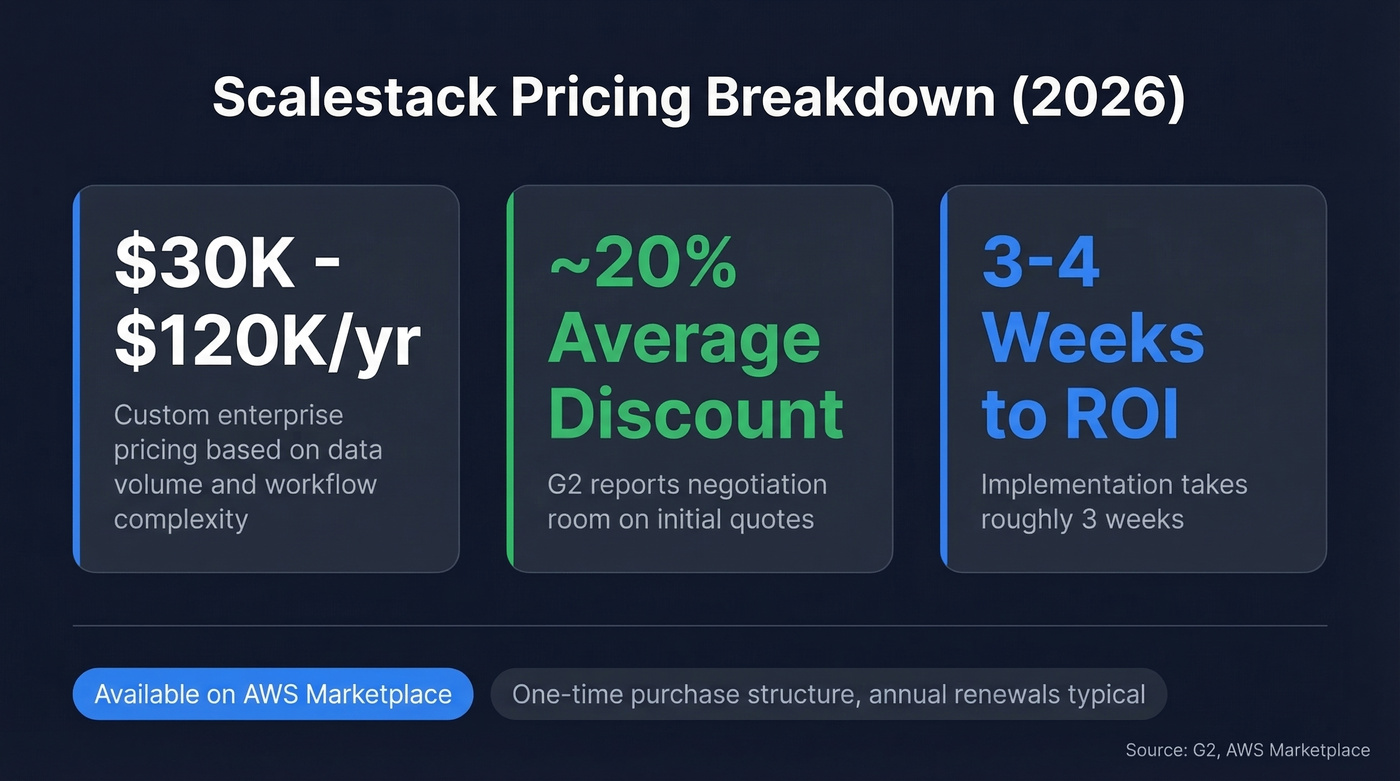
Realistic budgets for this category land in the $30,000-$120,000/year range depending on data volume and workflow complexity. G2 reports an average discount of 20%, so there's negotiation room. Implementation takes roughly 3 weeks, with ROI expected in 3-4 weeks - fast by enterprise standards.
One procurement shortcut worth knowing: Scalestack is available via AWS Marketplace as a private offer. If your company already has AWS committed spend, this can simplify the buying process significantly.

Scalestack charges $30K-$120K/year to enrich and clean your CRM data. Prospeo enriches contacts at 92% match rate with 50+ data points per record - starting at $0.01/email. No custom quotes, no 3-week implementation. Just verified data from 300M+ profiles on a 7-day refresh cycle.
Get enterprise-grade enrichment without the enterprise price tag.
Real User Reviews: Pros and Cons
| Pro | Detail |
|---|---|
| Massive scale | 20K leads to 1M accounts; MongoDB runs 400K+ targeted accounts through it |
| Real time savings | One reviewer saw automated enrichment of 370 rows while a rep manually updated 2 contacts |
| Strong integrations | Airtable, Demandbase One, Ocean.io, Salesforce Agentforce, Salesforce Sales Cloud, Salesloft, ZoomInfo Sales |
| Fully managed | No DIY setup - their team builds and runs everything |
| Con | Detail |
|---|---|
| Opaque pricing | No public numbers; demo required |
| Complexity up front | G2 reviewers flag time needed to understand the platform's capabilities |
| Limited templates | Users want more pre-built workflows |
| Overkill for small teams | Low-volume orgs won't see ROI at this price point |
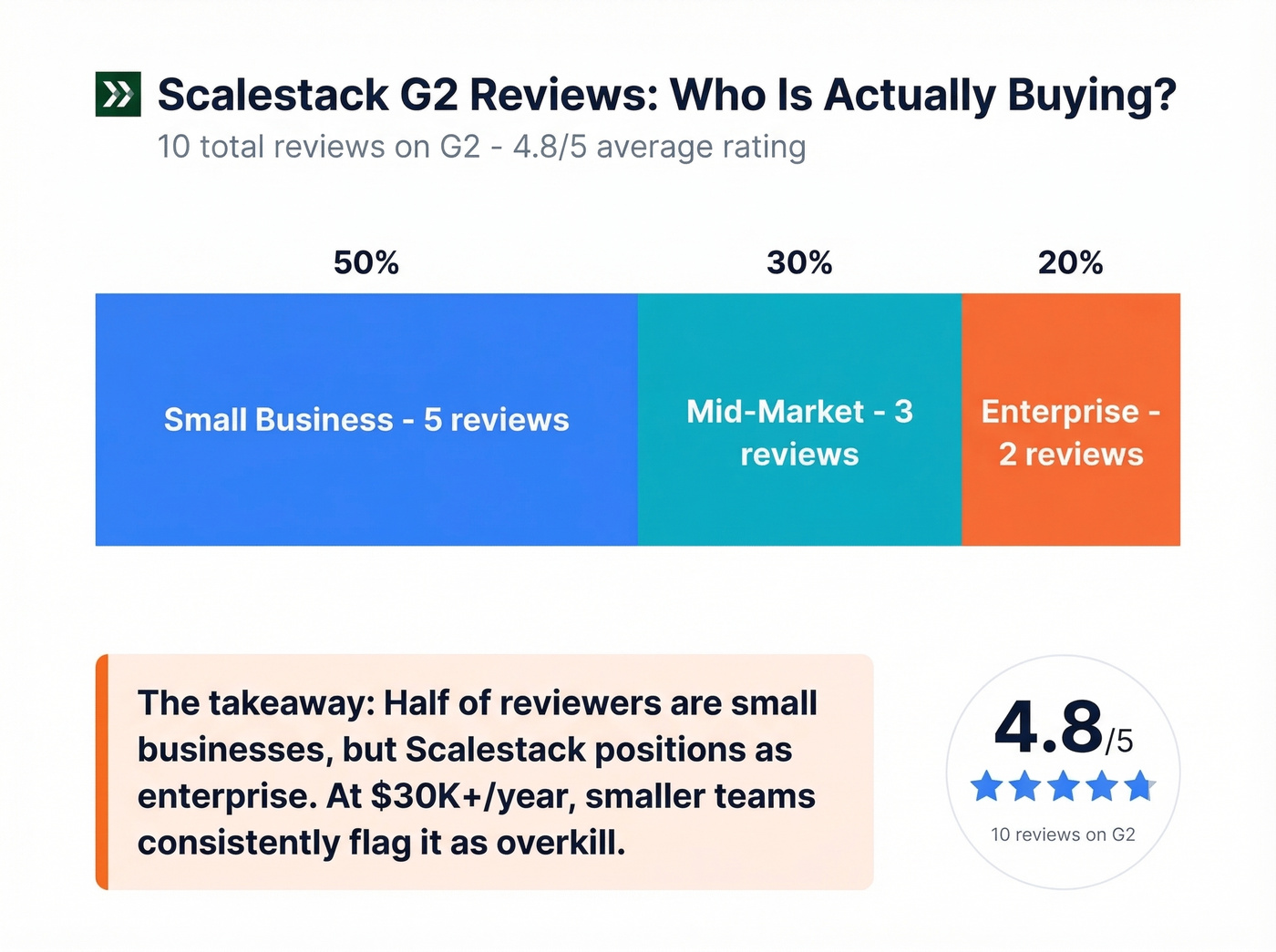
Here's the thing: the review distribution on G2 is telling. Five of the ten reviews come from small businesses, three from mid-market, and only two from enterprise. That suggests Scalestack is selling down-market more than their positioning implies - and the "overkill" concern from smaller reviewers makes sense. At $30K+ per year, you need serious volume to justify the spend.
Let's be honest: most teams researching Scalestack don't actually need managed orchestration. They need clean data piped into a CRM that already works. If you're spending $30K+ to fix a data quality problem, you're over-engineering the solution.
Who Should Use Scalestack?
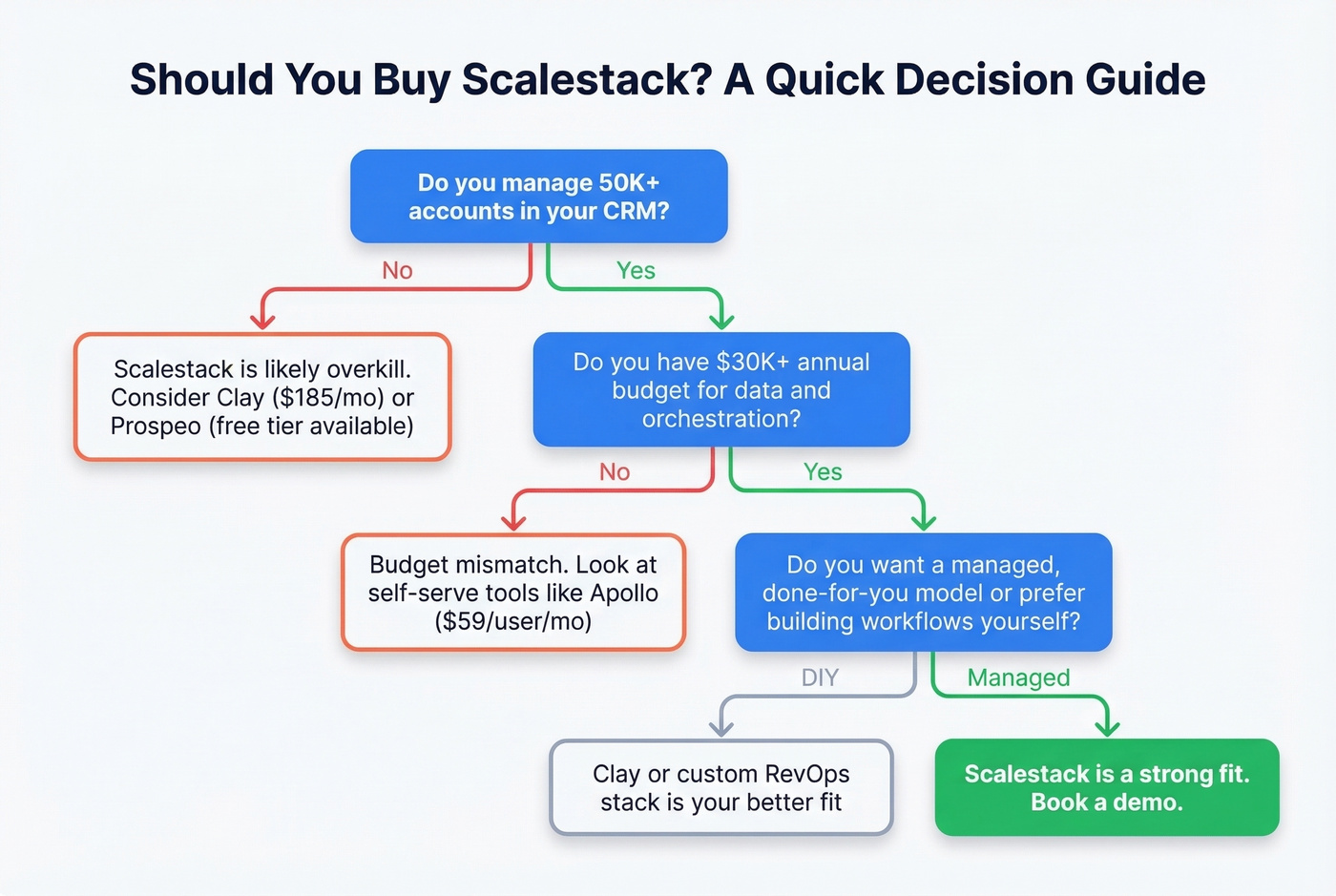
Use Scalestack if you:
- Manage 50,000+ accounts in your CRM
- Have a dedicated RevOps function or need to replace one
- Want a done-for-you orchestration layer, not another tool to configure
- Can commit $30K+ annually and need scale across enrichment, scoring, and routing
Skip it if you:
- Run fewer than 20,000 leads in your pipeline
- Don't have RevOps headcount or budget for managed services
- Need self-serve access to build and iterate on workflows yourself
- Have a budget under $30K/year for data and orchestration
The honest comparison isn't Scalestack vs. Clay. It's Scalestack vs. hiring a fractional RevOps person plus a stack of self-serve tools. If you'd rather buy the outcome than build the system, the managed model makes sense.
Scalestack vs. Alternatives
| Tool | Type | Starting Price | Best For |
|---|---|---|---|
| Scalestack | Managed GTM orchestration | ~$30K-$120K/yr | Enterprise, 50K+ accounts |
| Clay | Self-serve orchestration | $185/mo | Mid-market DIY workflows |
| Apollo.io | Prospecting + enrichment | $59/user/mo | All-in-one sales teams |
| ZoomInfo | Sales intelligence | ~$15K-$40K+/yr | Large orgs, data + intent |
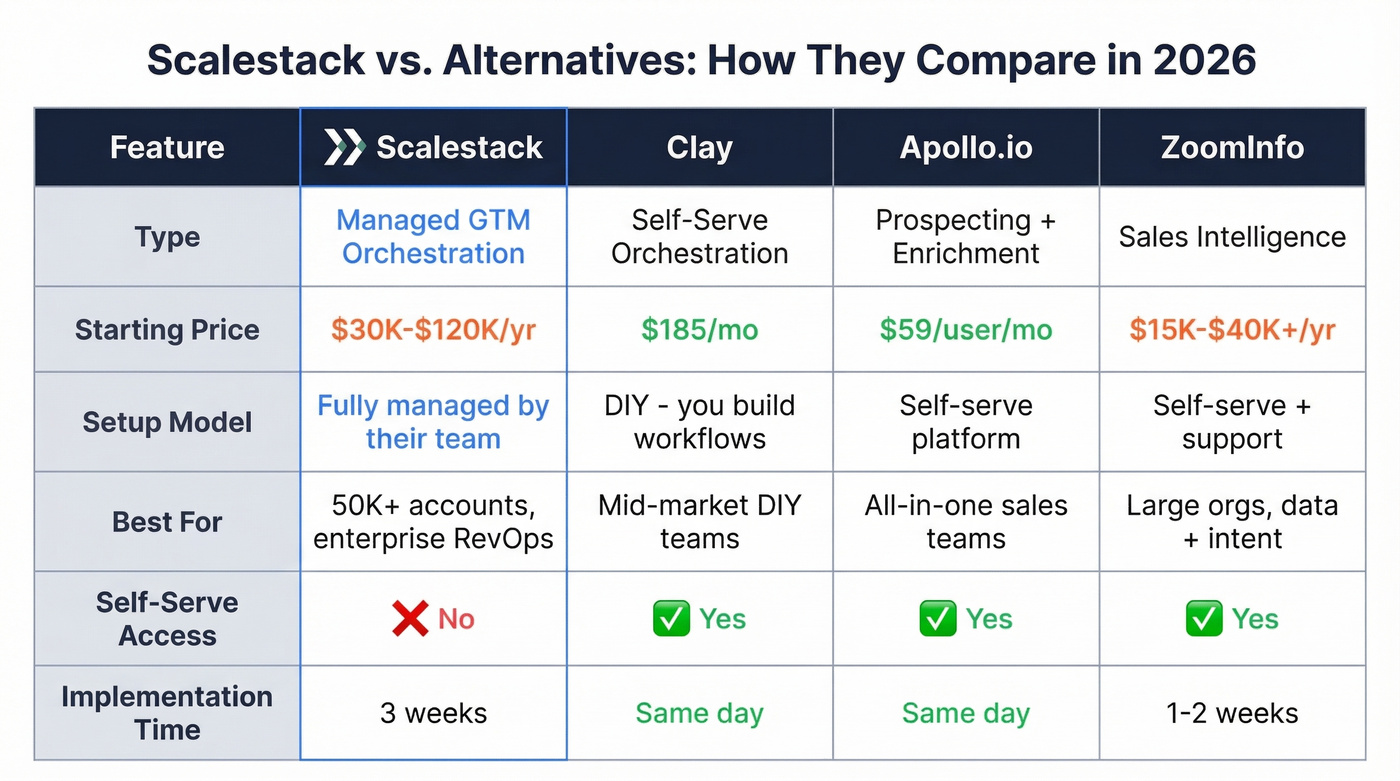
Clay is the obvious middle ground for teams that want orchestration without the managed-service price tag. At $185/mo for Launch or $495/mo for Growth, it's dramatically cheaper - but you're building and maintaining workflows yourself. We've seen practitioners on r/gtmengineering note that Clay's shift to a dual-credit model makes budgeting less predictable for some teams. Without a strong RevOps operator, those workflows break fast.
If you're comparing options mainly for data quality, start with a shortlist of data enrichment services and validate match rate + refresh cadence before you buy orchestration.
Final Verdict
Scalestack is worth a demo if you're managing 50K+ accounts, have $30K+ in budget, and want someone else to build and run your GTM orchestration. We've evaluated dozens of GTM tools, and the fully managed model is genuinely rare - you're buying outcomes, not software. Skip it if you're under that threshold.
If you're under 50K accounts, Scalestack's managed model is overkill. Prospeo gives you 30+ search filters, buyer intent across 15,000 topics, and 98% email accuracy - self-serve, no contracts, with a free tier of 75 emails/month. Teams using Prospeo book 26% more meetings than ZoomInfo users.
Skip the $30K commitment. Start prospecting in minutes.
FAQ
How much does Scalestack cost?
Scalestack uses custom enterprise pricing based on data volume and workflow complexity - expect $30,000-$120,000 per year. G2 reports an average 20% discount off initial quotes. It's also available via AWS Marketplace as a private offer, which can simplify procurement for teams with existing AWS committed spend.
Is Scalestack worth it for small teams?
No. The fully managed model is designed for organizations managing 50,000+ accounts with dedicated RevOps. Smaller teams get better ROI from self-serve tools - Clay at $185/mo for orchestration, or Prospeo starting free with 75 email credits/month and no contracts required.
What are the best Scalestack alternatives in 2026?
Clay ($185/mo) for self-serve GTM orchestration, Apollo.io ($59/user/mo) for prospecting with light enrichment, and ZoomInfo ($15K-$40K+/yr) for enterprise sales intelligence with intent data. For verified B2B contact data specifically, Prospeo delivers 98% email accuracy at ~$0.01/lead with a 7-day data refresh cycle.