

SDR Calculator: What an SDR Actually Costs in 2026
You just got headcount approval for your first SDR. The recruiter says $65k base. Your CFO budgets $65k. Then six months later, the real number is closer to $130k - and you've got three held meetings to show for it.
The gap between "SDR salary" and "SDR cost" is where most outbound programs quietly bleed out. Most SDR calculator tools online are gated lead-gen forms that spit out a single number and ask for your email. This is the ungated version: a full line-item breakdown with real benchmarks, ramp economics, and the cost-per-meeting math that tells you whether your investment is working.
Three Numbers You Need Now
Before we get into the weeds, here's the quick version:
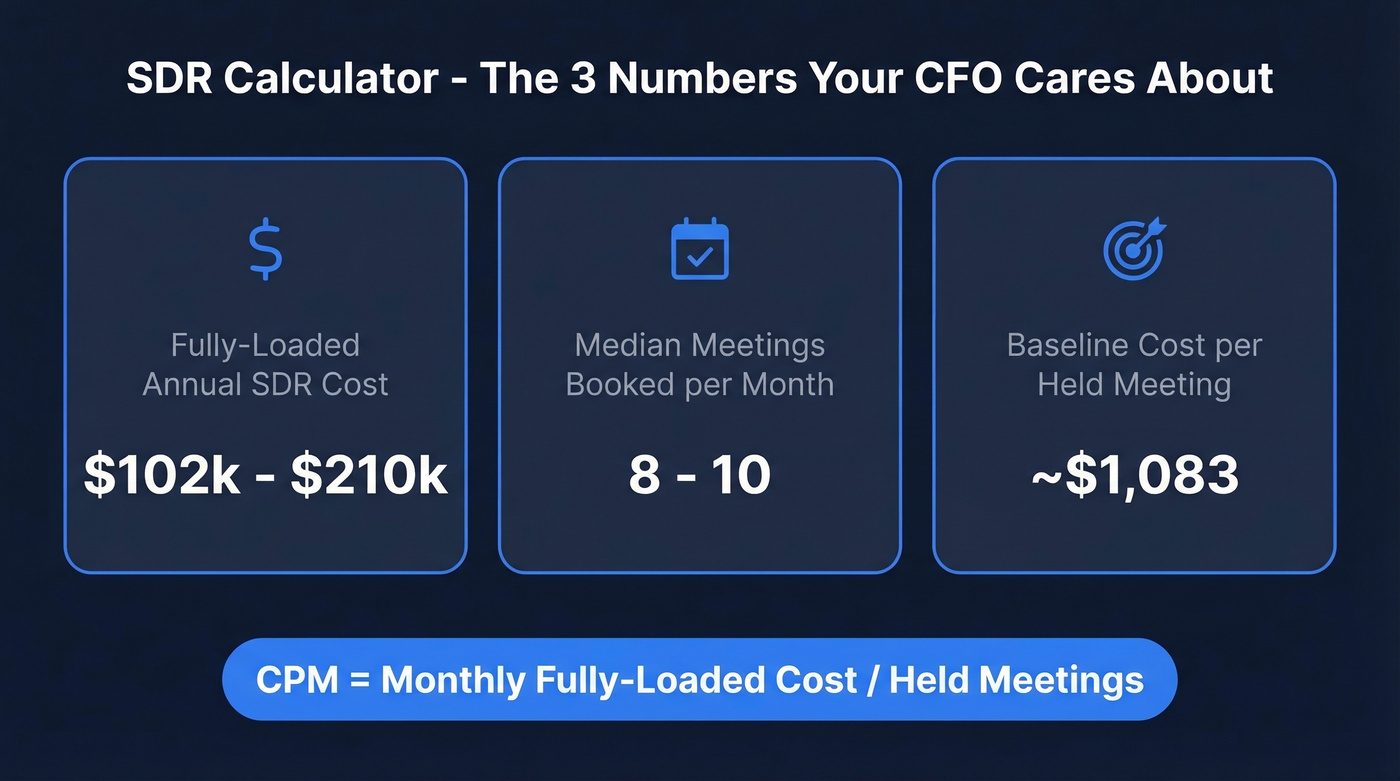
- Fully-loaded annual SDR cost: $102k-$210k, depending on geography, comp plan, and tool stack
- Median meetings booked per month: 8-10 (top quartile hits 12-15)
- Baseline cost-per-held-meeting: ~$1,083
The formula that ties it all together:
CPM = Monthly Fully-Loaded Cost / Held Meetings
That's the number your CFO actually cares about. Everything below helps you calculate each variable with precision. Copy these tables into your own spreadsheet and plug in your numbers - that's more useful than any gated tool.
Not That SDR - Special Drawing Rights
If you landed here looking for the IMF's Special Drawing Rights calculator, you're not alone. "SDR calculator" pulls double duty. Here's what you need.
The Montreal Convention cargo liability limit increased to 26 SDR/kg effective December 28, 2024, up from 22 SDR/kg. Recent SDR-to-USD rates have ranged from ~$1.35-$1.42; check the IMF's daily SDR valuation page for the current rate.
| Convention | Limit | Approx. USD (at ~$1.3586) |
|---|---|---|
| Air (Montreal) | 26 SDR/kg | ~$35.32/kg |
| Road (CMR) | 8.33 SDR/kg | ~$11.32/kg |
| Sea (Hague-Visby) | 666.67 SDR/pkg | ~$905.74/pkg |
Now, back to the SDR your sales team actually needs.
The True Cost of an SDR
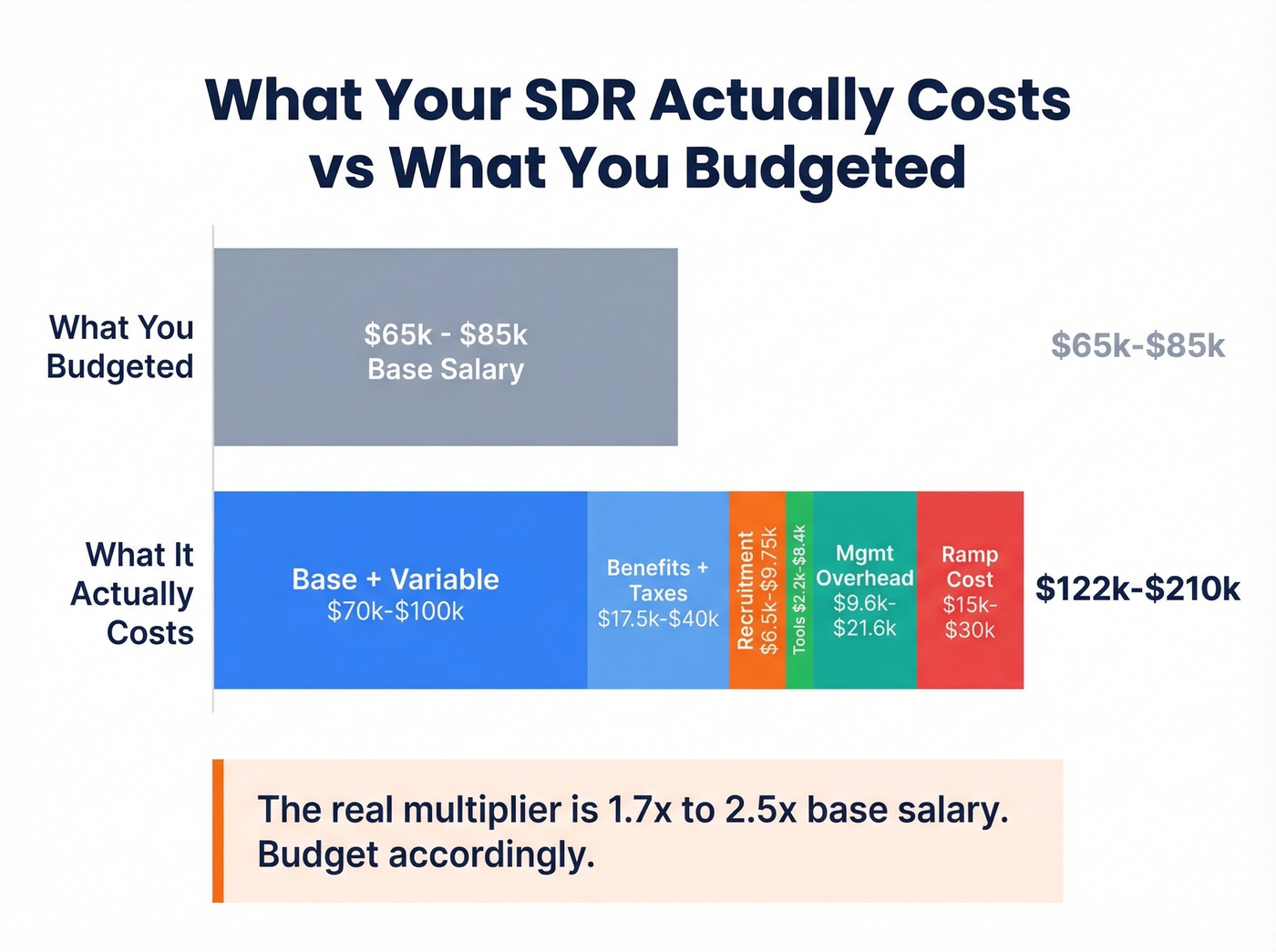
The sticker price on an SDR job posting and the actual cost of that hire are two completely different numbers. A 2026 cost breakdown citing Pavilion 2025 data pegs the fully-loaded range at $102k-$210k per rep per year. The multiplier that matters: expect 1.7-2.5x base salary once you account for everything.
Salary and Comp Defaults
Base salary breaks down by geography:
| Geo Tier | Base Range | OTE Range |
|---|---|---|
| Tier 1 (SF, NYC) | $70k-$85k | $90k-$100k |
| Tier 2 (Austin, Denver) | $60k-$75k | $80k-$95k |
| Tier 3 / Remote | $55k-$65k | $70k-$85k |
Most comp plans run a 60/40 or 50/50 base-to-variable split. Variable is tied to meetings held, SQLs generated, or pipeline influenced - not closed revenue. That's the AE's job.
Costs Everyone Forgets
Benefits and payroll taxes add 25-40% on top of cash compensation. For an $80k OTE, that's $20k-$32k you didn't budget for.
Recruitment fees run $6.5k-$9.75k per hire, roughly 10-15% of first-year base salary. If you're using a recruiting firm, that's paid upfront before the rep sends a single email. Management overhead is the sneakiest line item. An SDR manager spends 5-10 hours per week per rep on coaching, pipeline reviews, and 1:1s. At a manager's loaded cost, that's $800-$1,800/month per rep in management time alone.
The tool stack averages 8.3 tools per rep at a minimum of $187/rep/month, or about $2,244/year. A serious outbound stack - data provider plus engagement platform - can exceed $8,400/year per rep.
Then there's turnover. Average SDR tenure runs 14-16 months. Annual turnover sits around 35%. Replacing a rep - recruiting, onboarding, ramp, lost pipeline - costs roughly $100k. That's not a line item most spreadsheets include, and it's the one that wrecks your annual budget when two reps leave in the same quarter.
| Year 1 (Conservative) | Year 1 (Realistic) | Year 2+ | |
|---|---|---|---|
| Base + Variable | $70k-$85k | $85k-$100k | Same |
| Benefits/Taxes | $17.5k-$34k | $21k-$40k | Same |
| Recruitment | $6.5k-$9.75k | $6.5k-$9.75k | $0 |
| Tools | $2.2k-$8.4k | $2.2k-$8.4k | Same |
| Mgmt Overhead | $9.6k-$21.6k | $9.6k-$21.6k | Same |
| Ramp Cost | $15k-$30k | $15k-$30k | $0 |
| Total | $122k-$191k | $140k-$210k | $114k-$173k |
Ramp Reality
Most cost models assume full productivity from day one. Reality looks nothing like that.
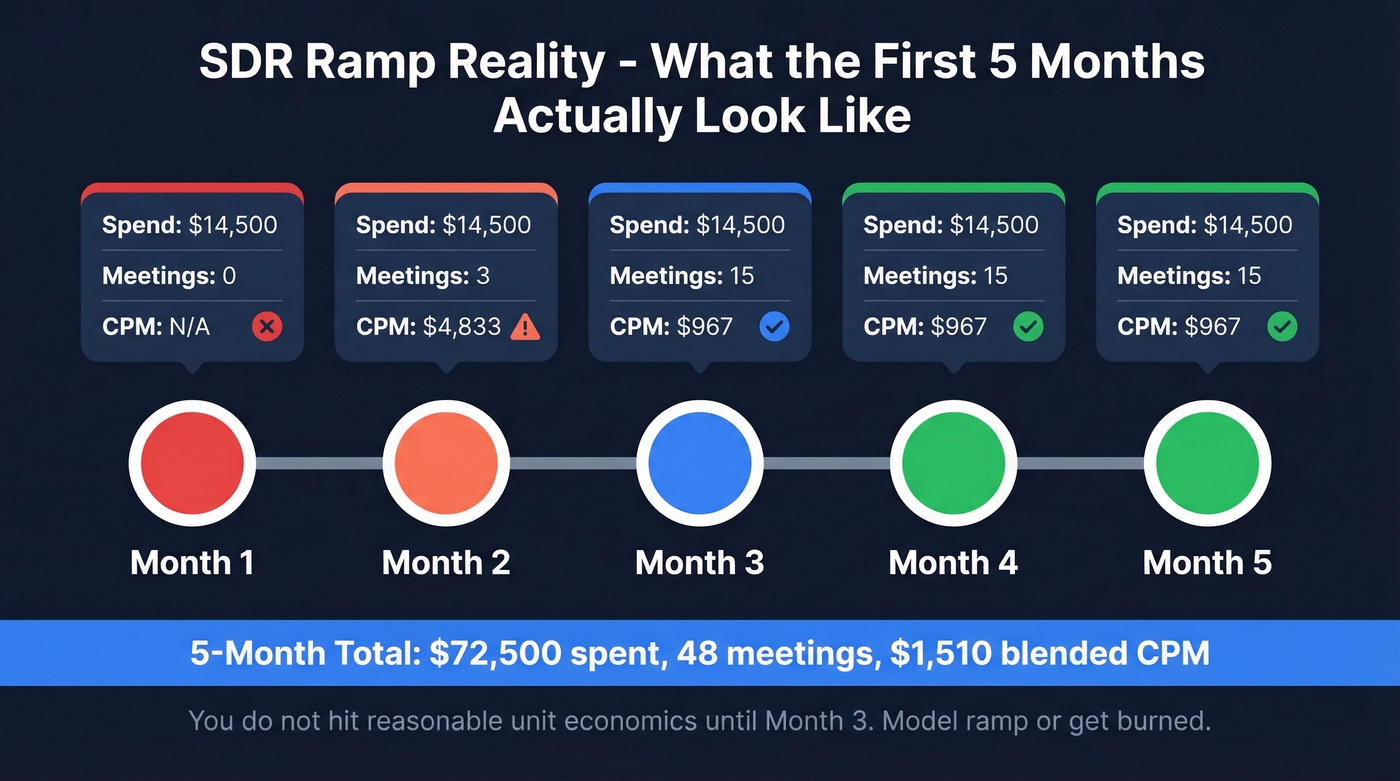
Average ramp time across the industry is 3.1-3.2 months. During ramp, you're paying full cost and getting a fraction of the output - essentially zero meetings in month one, with output not stabilizing until month four. A founder on r/B2BSaaS laid out the month-by-month shock:
| Month | Spend | Meetings | CPM |
|---|---|---|---|
| 1 | $14,500 | 0 | - |
| 2 | $14,500 | 3 | $4,833 |
| 3 | $14,500 | 15 | $967 |
| 4 | $14,500 | 15 | $967 |
| 5 | $14,500 | 15 | $967 |
| 5-Mo Total | $72,500 | 48 | $1,510 |
That $14,500/month includes loaded cost, AE time, and tools. Month 1 is pure investment. Month 2 produces a handful at nearly $5k each. You don't hit reasonable unit economics until month 3, and the five-month blended CPM is still $1,510.
In our experience, teams that don't model ramp costs are always shocked by month-2 CPM. It's the single biggest reason first-time hires get labeled "failures" before they've had a fair shot.
Ramp milestones from a 939-company dataset confirm the pattern: Month 1 delivers 20-30% of quota, Month 2 hits 40-60%, Month 3 reaches 70-90%, and Month 4+ is where reps finally hit 100%+. With average tenure at 14-16 months and turnover at ~35% annually, you're looking at roughly 10-12 months of full productivity before the replacement cycle starts again.

Your SDR calculator shows tools cost $2,244-$8,400/year per rep. Prospeo replaces your data provider at $0.01/email - 90% cheaper than ZoomInfo - with 98% verified accuracy and 125M+ direct dials. Teams using Prospeo book 26% more meetings because reps connect with real buyers, not bounced addresses.
Stop paying $8,400/year for data that bounces 35% of the time.
Productivity Benchmarks per Rep
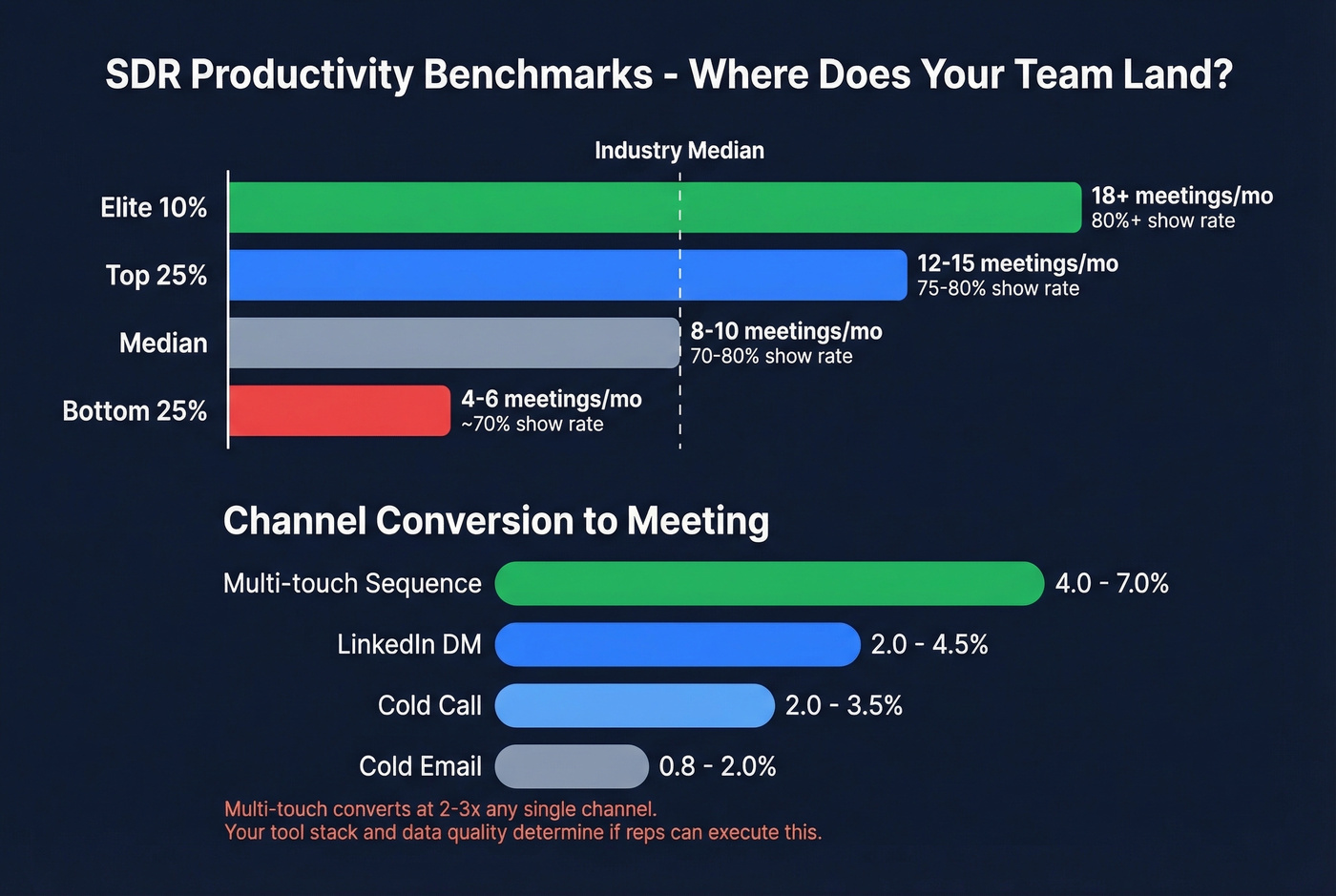
What does "good" actually look like? Numbers from a 939-company B2B SaaS dataset updated in early 2026:
| Performance Tier | Meetings/Month | Show Rate |
|---|---|---|
| Bottom 25% | 4-6 | ~70% |
| Median | 8-10 | 70-80% |
| Top 25% | 12-15 | 75-80% |
| Elite 10% | 18+ | 80%+ |
The gap between star reps and average reps is staggering. Elite performers book 2-3x the meetings of median reps while maintaining higher show rates. When you're building cost assumptions, modeling everyone at median performance will undercount your top performers and overcount your bottom ones - so segment your projections by tier if you can.
Daily activity volumes for top-quartile reps run 70-80 calls, 45-55 emails, and 25-35 social touches. That's roughly 140-170 total touches per day. Here's how each channel converts:
| Channel | Conversion to Meeting |
|---|---|
| Cold call | 2.0-3.5% |
| Cold email | 0.8-2.0% |
| LinkedIn DM | 2.0-4.5% |
| Multi-touch | 4.0-7.0% |
Multi-touch sequences convert at 2-3x the rate of any single channel. That means your rep's tool stack and data quality directly determine whether they can execute multi-channel at volume. Reps spend only 28-39% of their time on revenue-generating activities - admin tasks eat 41% of the day. Median pipeline per rep runs about $3M/year, but that number swings wildly based on account book quality, not just activity volume.
Cost-Per-Meeting Breakdown
CPM is the metric that actually matters. Not total cost, not activities per day, not emails sent. How much are you paying per qualified meeting that actually happens?
CPM = Monthly Fully-Loaded Cost / Qualified Meetings Delivered
Here's how the three main models compare:
| Model | Monthly Cost | Meetings | CPM |
|---|---|---|---|
| In-house (loaded) | $9,800-$14,200 | 10-14 | $821-$1,150 |
| Outsourced retainer | $4,000-$7,500 | 10-14 | $357-$500 |
| Pay-per-meeting | Varies | Varies | $250-$600 |
In-house CPM looks expensive - and it is, especially in Year 1 with ramp factored in. But in-house reps build institutional knowledge, improve over time, and generate pipeline you own. Outsourced models get you meetings faster, but the quality question never goes away.
Here's the thing: if your average deal size is under $15k, you probably don't need an in-house rep at all. The math doesn't pencil out until your deals justify $800+ per meeting. Below that threshold, a DIY infrastructure approach or a pay-per-meeting model will outperform a full-time hire every time.
In-House vs. Outsourced vs. DIY
Three paths to pipeline. Each has different economics, timelines, and failure modes.
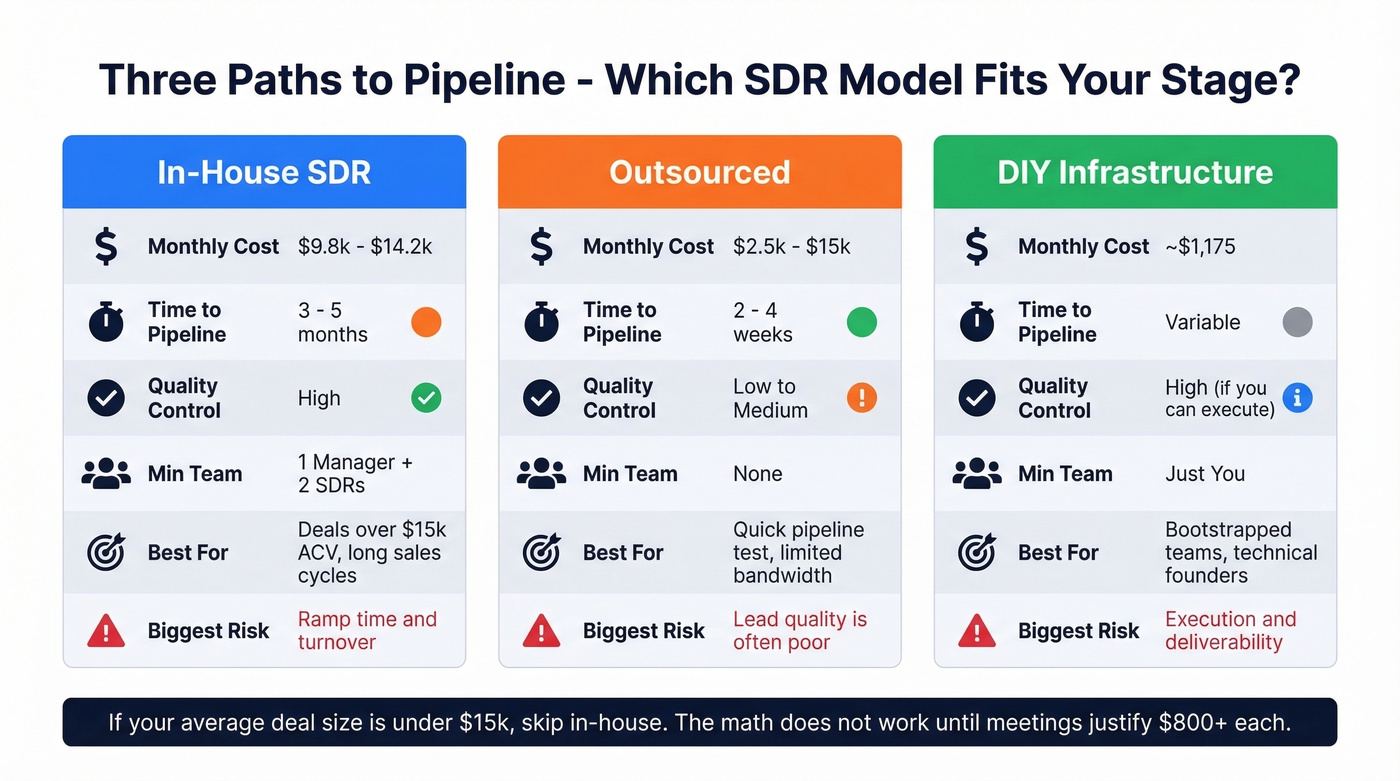
| In-House | Outsourced | DIY Infra | |
|---|---|---|---|
| Monthly cost | $9.8k-$14.2k | $2.5k-$15k | ~$1,175 |
| Time to pipeline | 3-5 months | 2-4 weeks | Variable |
| Quality control | High | Low-Medium | High |
| Minimum team | 1 mgr + 2 SDRs | None | You |
Most teams see pipeline by month 4-5 with in-house reps, though full optimization can take 11+ months. Outsourced retainers range from $2.5k/month for entry-level programs to $15k/month for enterprise. Pay-per-meeting models run $125-$800+ depending on ICP complexity. The consensus on r/sales? "Leads are shit and it's expensive" - harsh, but it captures the quality skepticism most founders feel after their first outsourced engagement.
AI SDR agents ($500-$600/month for tools like Salesforge or Amplemarket) are emerging as a fourth option. They're best suited for high-volume, lower-complexity outbound where personalization matters less than coverage. Skip these for enterprise accounts - they can't handle the nuance a skilled human rep brings to a multi-threaded deal.
The DIY infrastructure path is the underrated option. A Reddit breakdown of cold email infrastructure costs puts 1,000 emails/day at ~$1,175/month: ~50 inboxes across ~17 domains at $3.50/inbox/month, plus $500/month in tools and $500-$1,000/month in data/enrichment. You'll also need to stay compliant with Gmail and Yahoo's 2024 authentication rules - SPF, DKIM, one-click unsubscribe, and sub-0.3% spam rates - which adds real ops overhead. The infrastructure is cheap. The execution - writing sequences, managing deliverability, iterating on targeting - is where it gets hard.
The biggest variable cost in DIY infrastructure? Data. Legacy providers often start at $10k+/year on annual contracts before you send a single email. Prospeo runs ~$0.01/lead with no contracts and a free tier to start, which changes the math on DIY infrastructure entirely.
Predictable Revenue's recommendation still holds for in-house teams: the minimum viable team is 1 dedicated manager plus 2 reps. A single rep has no peer benchmarking, no PTO coverage, and no one to learn from. Two is the floor.
The Data Quality Tax
Bad contact data is the most expensive hidden cost in your SDR budget, and almost nobody models it.
When your bounce rate sits above 5%, you're not just wasting sends - you're destroying domain reputation, which tanks deliverability for every future email. We've seen teams lose 20-30% of their outreach capacity to bad data before they even realize what's happening. Let's be honest: most teams don't discover the problem until their open rates crater and they're scrambling to warm up new domains.
The proof points are stark. Meritt was running a 35% bounce rate before switching providers - they dropped it under 4% and tripled pipeline from $100K to $300K/week. GreyScout cut rep ramp time from 8-10 weeks to 4 weeks by giving new reps clean data from day one. When your reps aren't chasing dead emails and disconnected numbers, ramp compresses and CPM drops across the board.
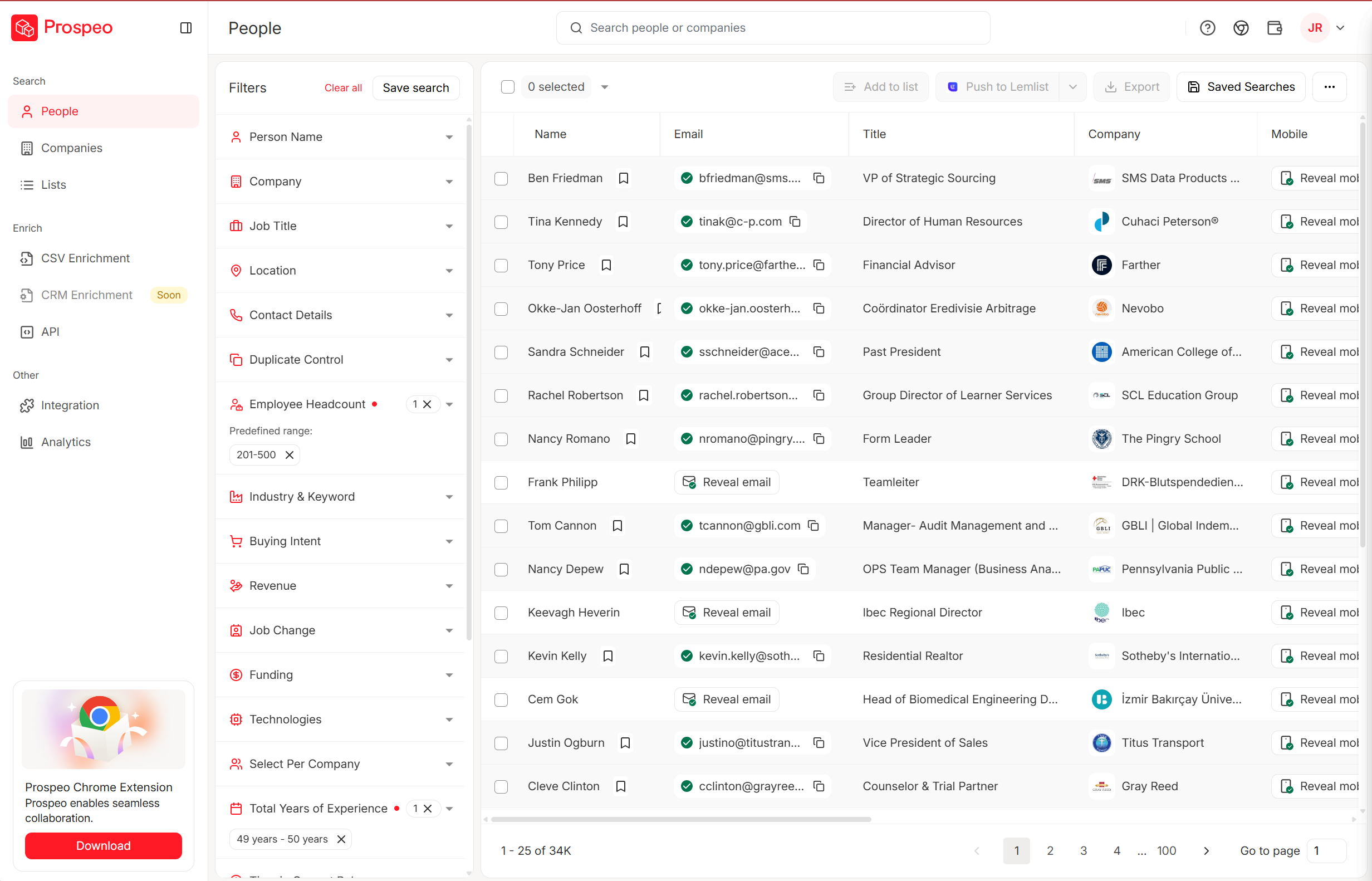
Ramp kills SDR ROI because reps waste months building lists instead of selling. Prospeo's 300M+ profiles with 30+ filters - buyer intent, job changes, headcount growth - let new reps find qualified prospects in minutes, not weeks. Cut ramp from 3 months to weeks with data that's refreshed every 7 days.
Slash ramp time and hit quota by month two, not month four.
How to Calculate SDR ROI
Once you've got your costs modeled, here's how to determine whether the investment is paying off. The same inputs your SDR calculator uses - fully-loaded cost and meetings delivered - extend into revenue attribution:
SDR ROI = (Revenue from SDR-Generated Opportunities - Total Costs) / Total Costs x 100
A median rep generates ~$3M in pipeline per year. At a 20% close rate, that's $600k in revenue. Against a fully-loaded cost of $150k (mid-range), that's an ROI of 300%. Sounds great - except the Reddit math shows you're underwater until month 6-7 because of ramp economics.
The variable that makes or breaks this formula isn't activity volume - it's account book quality. A rep hammering 80 calls/day into a poorly targeted list will always lose to one making 50 calls into accounts that are actually in-market. The "book productivity rate" concept from Gradient Works frames this well: what percentage of accounts in your rep's book need to convert to meetings for the math to work? If that required conversion rate is absurdly high, your targeting is the problem, not your rep.
When you know how to calculate sales capacity - total reps times productive hours times conversion rates - you can forecast pipeline with confidence rather than guessing. Teams that achieve 2x performance typically aren't just working harder. They've optimized targeting, data quality, and multi-channel execution simultaneously, and those improvements compound across every metric in your SDR calculator.
FAQ
What's a good cost-per-meeting for an SDR?
In-house reps run $821-$1,150 per qualified held meeting; outsourced pay-per-meeting models range $250-$600. Below $500 is strong performance. Above $1,200 signals a ramp problem, data quality issue, or poor ICP targeting that needs immediate attention.
How many SDRs do I need?
Start with 2 reps and 1 dedicated manager - that's the minimum viable team. A single rep has no peer benchmarking, no PTO coverage, and no one to learn from. The average AE-to-SDR ratio is 2.6:1, so 5 AEs warrants 2 reps.
How long until an SDR breaks even?
Six to seven months for an in-house hire, accounting for 3+ months of ramp at full cost with minimal output. Outsourced models can deliver meetings within 30-60 days, which is why they're attractive for teams that need pipeline immediately.
What tools does an SDR need?
Three core tools cover 90% of needs: a CRM (HubSpot or Salesforce), a sales engagement platform (Outreach or Salesloft), and an accurate data provider. The average stack has 8.3 tools - most of that is waste adding cost without improving meetings booked.
What should an SDR cost calculator include?
A useful SDR calculator goes beyond base salary. Include benefits and payroll taxes at 25-40% of OTE, recruitment costs, tool stack spend, management overhead, ramp period costs, and a turnover adjustment at ~35% annually. The tables above cover every line item - copy them into a spreadsheet with your own numbers.