

SDR Meaning: What Sales Development Reps Actually Do in 2026
A RevOps lead we know ran a three-tool bake-off last quarter to figure out which data provider would best serve their SDR team. The "best" database created 4,000 duplicate contacts in Salesforce within five days. The cheapest one had better phone connect rates. If you're trying to understand what an SDR actually does - and why the role's changing so fast - that kind of surprise is par for the course.
What Does SDR Stand For?
SDR means different things depending on your world. Three definitions dominate:
- Sales Development Representative - the B2B sales role focused on prospecting and qualifying leads. That's what this guide covers.
- Special Drawing Rights - the International Monetary Fund's reserve asset, based on a basket of five currencies.
- Software-Defined Radio - a radio system where hardware components are handled by software instead.
If you're here for the sales definition, keep reading.
What Is an SDR? Quick Overview
SDR stands for Sales Development Representative - the top-of-funnel role responsible for prospecting and qualifying leads, not closing deals. The SDR finds potential buyers, confirms they're a fit, and hands them off to an Account Executive who runs the deal.
Median OTE (on-target earnings) sits at $91,639. Companies with dedicated SDR teams report 15-20% higher conversion rates from lead to opportunity, per McKinsey's global B2B Pulse survey. Typical tenure before promotion is 12-24 months. And here's the number that should get your attention: 36% of companies cut SDR headcount last year due to AI. The role isn't disappearing, but it's changing fast.
The Sales Development Role Explained
A Sales Development Representative fills the top of your sales funnel. They don't close deals. They don't manage accounts. They prospect, qualify, and hand off.
Here's how it works in practice. An SDR identifies potential buyers through outbound research, inbound lead response, or a combination of both. They reach out via cold calls, emails, and social touches. When a prospect shows genuine interest and meets qualification criteria - budget, authority, need, timeline - the SDR books a meeting and passes that qualified opportunity to an Account Executive.
Why bother splitting the role this way? Because specialization works. McKinsey's B2B Pulse survey found that dedicated sales development teams see 15-20% higher conversion rates from lead to opportunity compared to orgs where AEs do their own prospecting. That lift comes from focus - SDRs get good at opening doors because that's all they do.
Pipeline generation is a full-time job. Asking an AE to prospect, qualify, demo, negotiate, and close is asking one person to be excellent at five different skills simultaneously, and most aren't. Splitting the funnel lets each role specialize.
There's another benefit that rarely gets discussed: SDRs function as a market-feedback loop. They're talking to dozens of prospects daily, which means they pick up on objection patterns, competitive shifts, and messaging gaps faster than anyone else in the org. Smart product teams tap into SDR call notes the way smart marketers tap into search data.
SDR vs. BDR vs. AE vs. AM
Terminology across companies is wildly inconsistent. At one company, SDRs handle inbound leads. At another, they're doing pure cold outbound. Some companies use "BDR" and "SDR" interchangeably. Others draw a hard line. You're not alone if this confuses you.
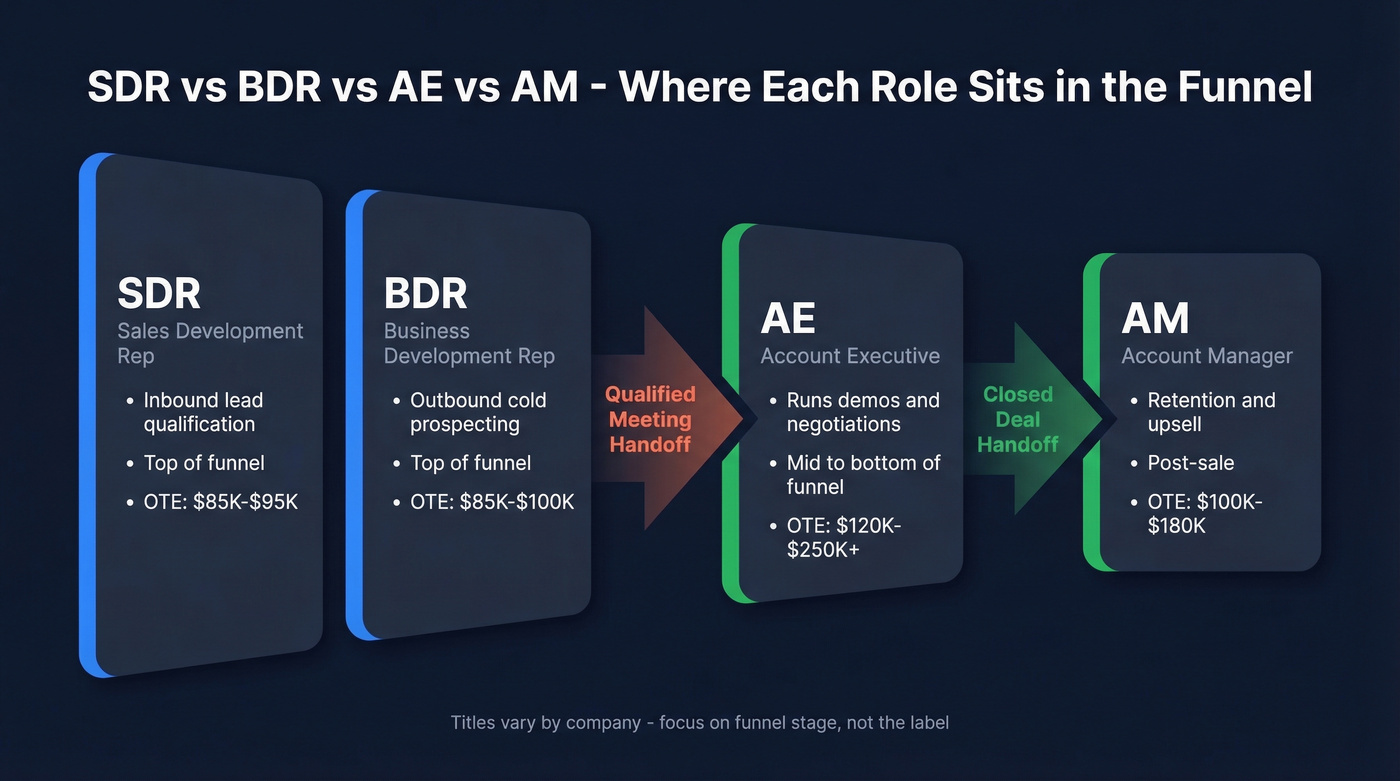
Here's the most common pattern:
| Role | Focus | Funnel Stage | Quota Type | Typical OTE |
|---|---|---|---|---|
| SDR | Inbound qualification | Top | Meetings booked | $85K-$95K |
| BDR | Outbound prospecting | Top | Meetings booked | $85K-$100K |
| AE | Closing deals | Mid-Bottom | Revenue closed | $120K-$250K+ |
| AM | Retention & expansion | Post-sale | Renewal/upsell | $100K-$180K |
The SDR typically works inbound leads - marketing qualified leads that need human follow-up and qualification. The BDR goes outbound, building lists, cold calling, and creating opportunities from scratch. The AE receives qualified meetings from both and runs the sales cycle to close. The Account Manager takes over after the deal is signed, focused on retention and expansion.
Don't get hung up on the labels. What matters is understanding where in the funnel you sit and what your quota measures. If your job is booking qualified meetings, you're doing SDR/BDR work regardless of title.
What SDRs Actually Do Every Day
The typical SDR day breaks into three blocks. Morning is research and preparation - building target lists, reviewing inbound leads, prepping personalized outreach. Midday is reserved for calling blocks. Afternoon shifts to email sequences, social touches, and follow-ups.
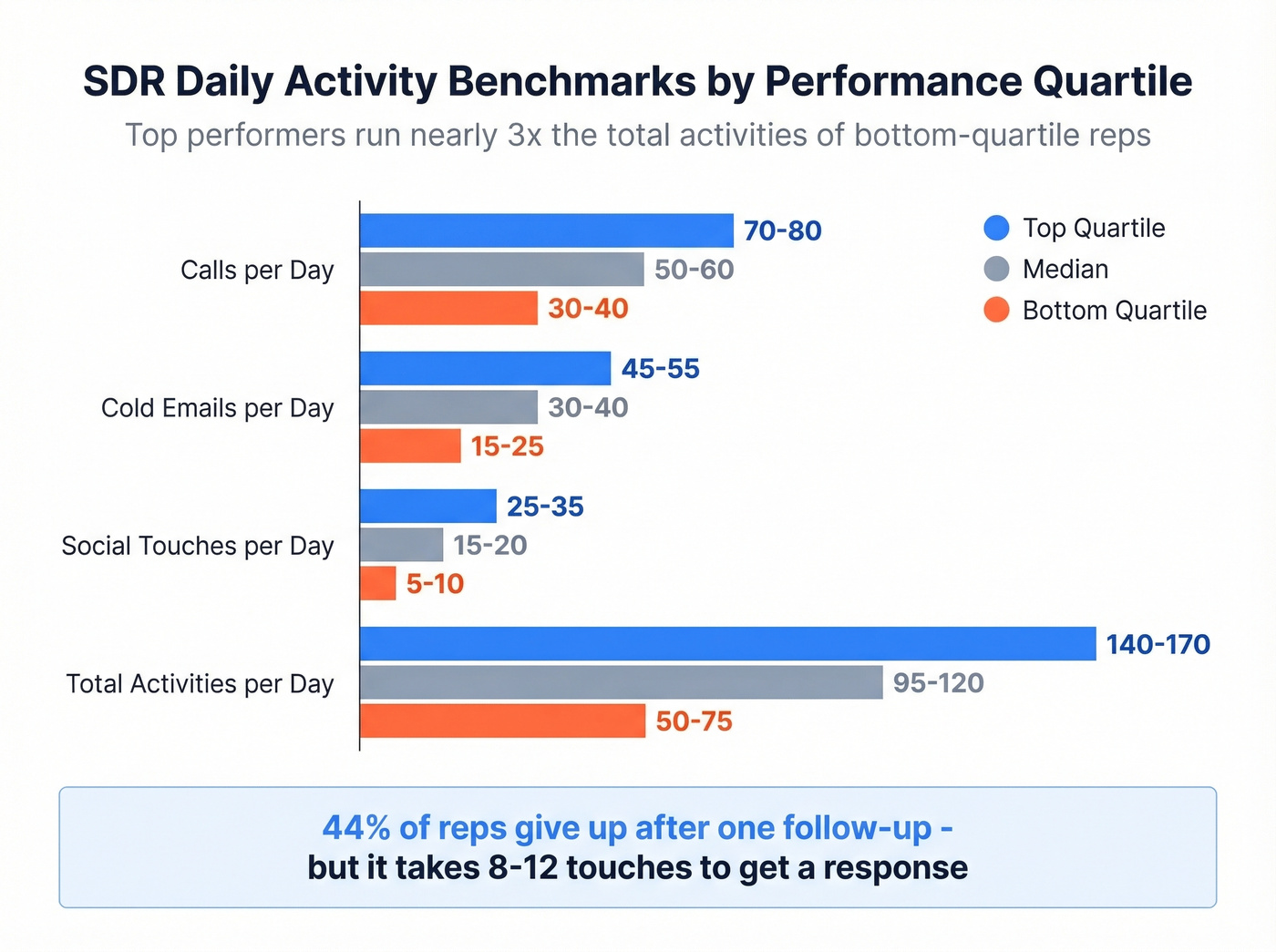
Here's what the activity numbers look like by performance quartile - benchmarks most guides skip:
| Activity | Top Quartile | Median | Bottom Quartile |
|---|---|---|---|
| Calls/day | 70-80 | 50-60 | 30-40 |
| Cold emails/day | 45-55 | 30-40 | 15-25 |
| Social touches/day | 25-35 | 15-20 | 5-10 |
| Total activities/day | 140-170 | 95-120 | 50-75 |
Top-performing SDRs aren't just working harder - they're running nearly double the total activities of bottom-quartile reps. The gap between 140 daily touches and 50 is the gap between someone who books 18 meetings a month and someone who books 4.
Persistence matters enormously. It takes 8-12 touches to get a response from a cold prospect, yet 44% of reps give up after a single follow-up. That stat alone explains why most reps miss quota.
Here's the emotional reality that job descriptions skip: you're making 70+ calls a day, hearing "no" or voicemail on most of them, dealing with no-shows that easily run 15-25% of booked meetings, and constantly wondering "when do I get promoted?" The consensus on r/sales is that SDR work is genuinely grueling - but the skills transfer everywhere in your career. The best teams counteract the grind with structured coaching culture: team call blitzes, live call reviews, and shared objection libraries that turn individual rejection into collective learning.

Top-quartile SDRs make 70-80 calls a day. That volume only works if the data behind it is accurate. Prospeo delivers 98% verified emails and 125M+ mobile numbers with a 30% pickup rate - so your reps spend time talking to buyers, not chasing dead numbers.
Stop burning SDR hours on bad data. Start connecting.
How SDRs Qualify Leads
Qualification is where SDRs earn their paycheck. Booking a meeting is easy. Booking a meeting that actually converts to pipeline - that's the skill.
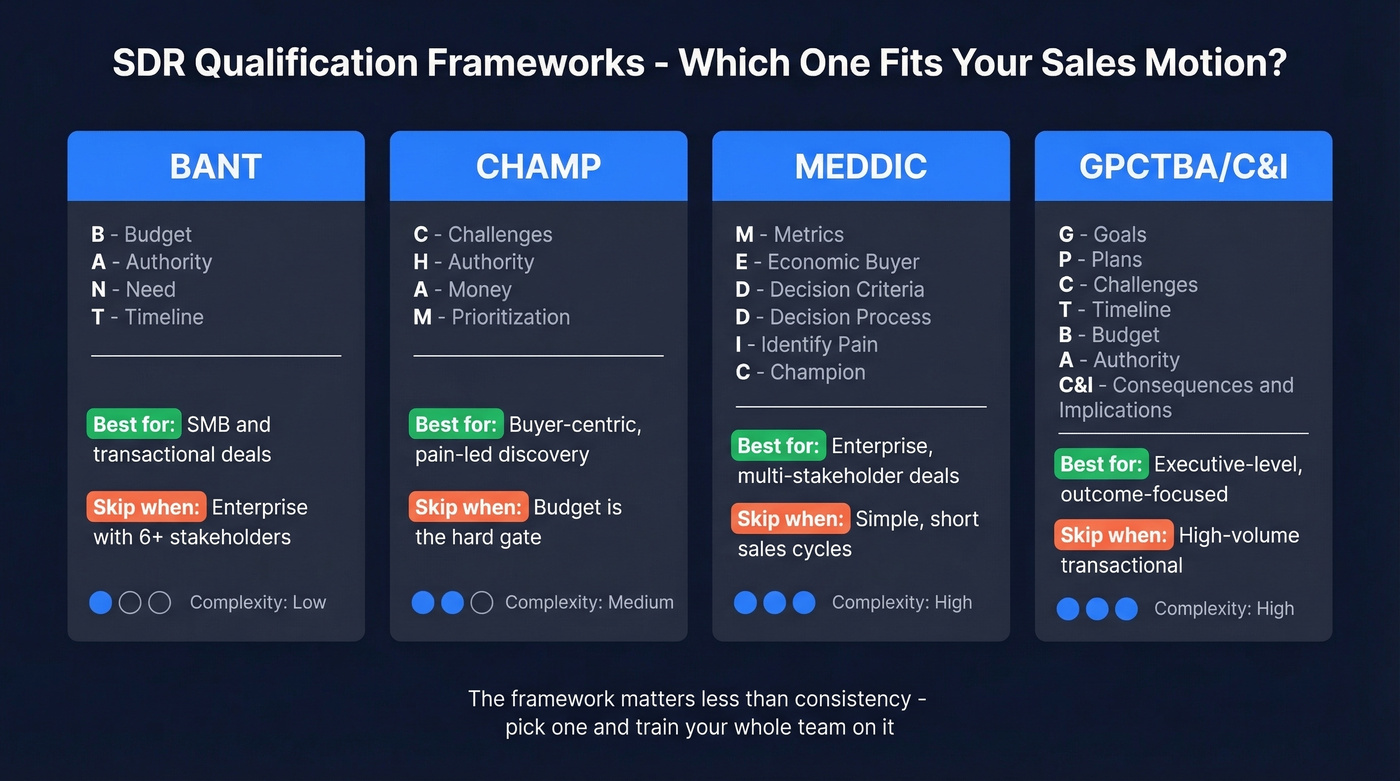
| Framework | Stands For | Best For | When to Skip |
|---|---|---|---|
| BANT | Budget, Authority, Need, Timeline | SMB, transactional | Enterprise, 6+ stakeholders |
| CHAMP | Challenges, Authority, Money, Prioritization | Buyer-centric, pain-led | Budget is the hard gate |
| MEDDIC | Metrics, Economic Buyer, Decision Criteria, Decision Process, Identify Pain, Champion | Enterprise, multi-stakeholder | Simple, short sales cycles |
| GPCTBA/C&I | Goals, Plans, Challenges, Timeline, Budget, Authority, Consequences & Implications | Executive-level, outcome-focused | High-volume transactional |
BANT is fine for SMB. If you're using BANT to qualify enterprise accounts with 6-10+ stakeholders, you're disqualifying good deals. Enterprise buying groups are complex - a prospect might not know their budget yet, but they have a champion, a clear pain point, and decision criteria that favor your solution. MEDDIC catches that. BANT doesn't.
CHAMP flips the script by starting with challenges instead of budget, which feels more natural in discovery conversations because you're leading with empathy rather than interrogation. For reps who struggle with the "so what's your budget?" question on a first call, CHAMP is a better fit.
The framework matters less than consistency. Pick one, train your team on it, and make sure every handoff to an AE includes the same qualification data points. AEs who receive inconsistent handoffs lose trust in the SDR team fast.
KPIs and Benchmarks for 2026
Numbers are what separate "I think we're doing okay" from "we know exactly where we stand."
Meeting volume by source:
| Metric | Outbound | Inbound | Top Performers |
|---|---|---|---|
| Meetings/month | 12-15 | 20-25 | 18-20 (outbound) |
| Show rate | 75-80% | 80-85% | 85%+ |
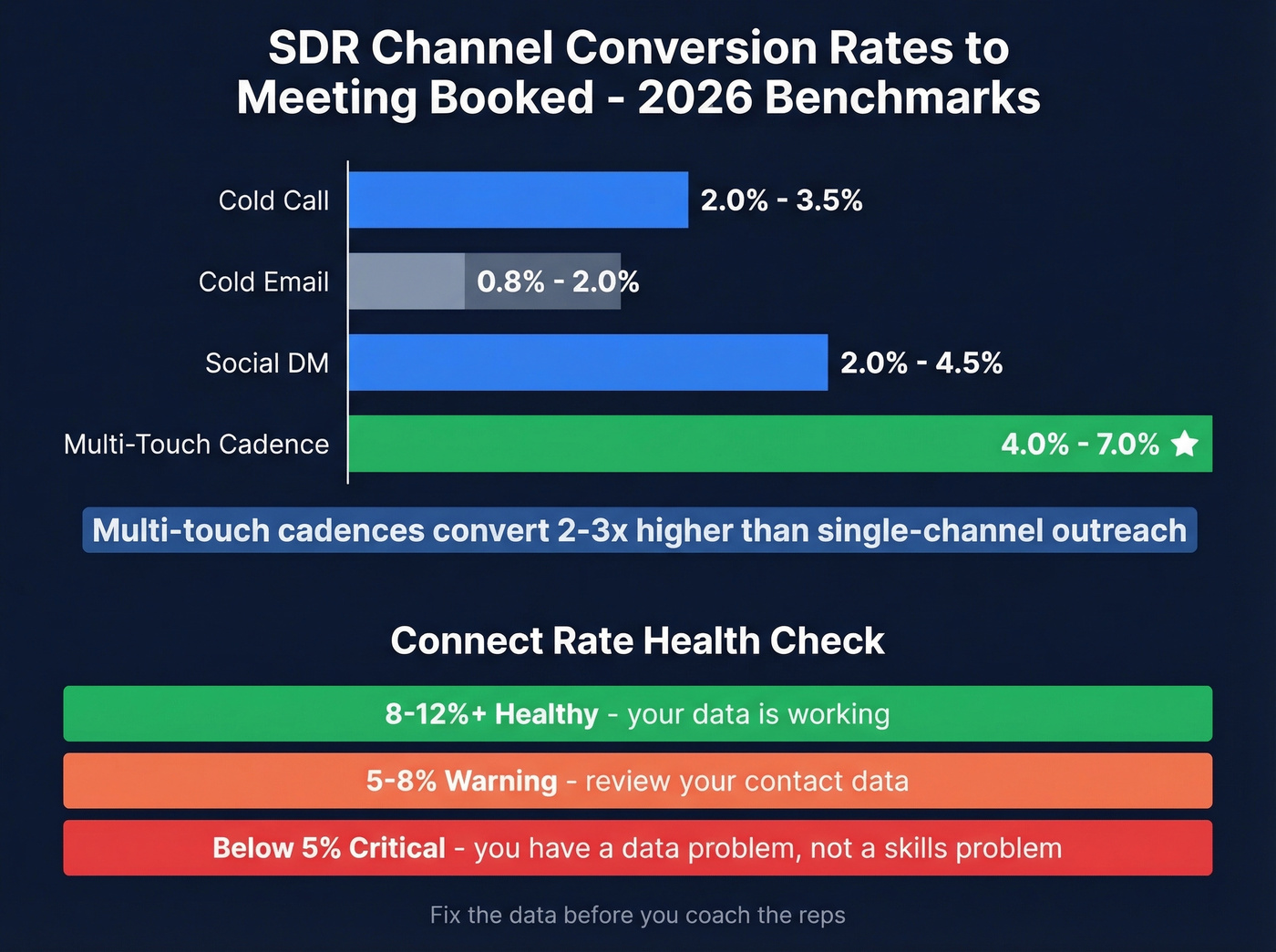
Channel conversion rates to meeting:
| Channel | Conversion Rate |
|---|---|
| Cold call | 2.0-3.5% |
| Cold email | 0.8-2.0% |
| Social DM | 2.0-4.5% |
| Multi-touch cadence | 4.0-7.0% |
Multi-touch cadences convert 2-3x higher than single-channel outreach. Teams still running email-only or call-only motions are leaving meetings on the table.
The connect rate benchmark is critical: 8-12% is healthy. Below 5% means you have a data problem, not a skills problem. If your reps can't reach anyone, the issue is upstream - bad phone numbers, outdated emails, wrong contacts. Fix the data before you coach the reps.
Ramp timeline for new hires:
| Month | Expected Quota Attainment |
|---|---|
| Month 1 | 20-30% |
| Month 2 | 40-60% |
| Month 3 | 70-90% |
| Month 4+ | Full productivity |
The uncomfortable truth about quota attainment: the median across the industry is 57.1%. Plan for 60-70% as your baseline when building capacity models. If you're staffing based on 100% attainment, you'll miss your pipeline number every quarter.
SDR Salary and Compensation
Let's talk money.
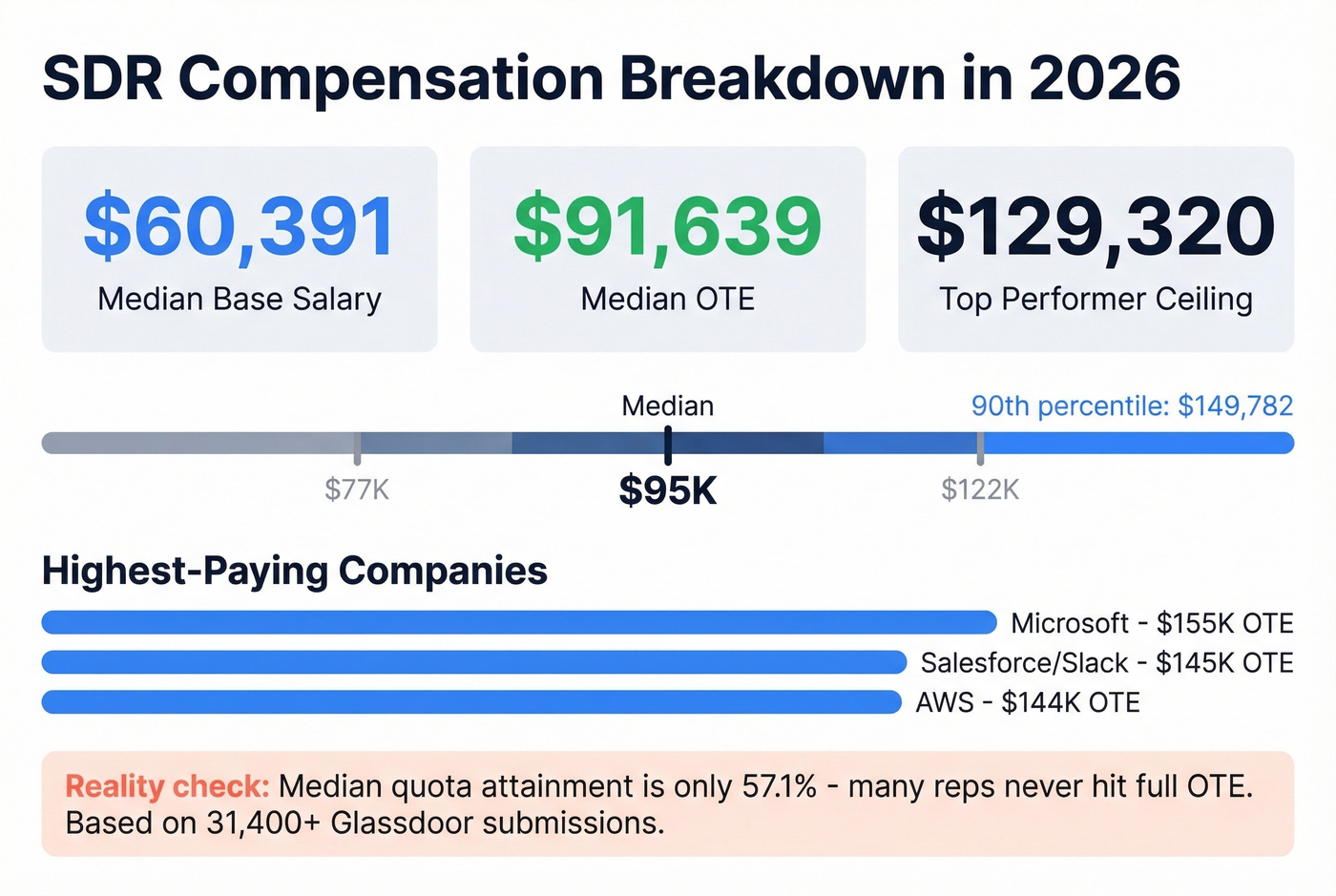
| Metric | Number |
|---|---|
| Median base salary | $60,391 |
| Median OTE | $91,639 |
| Top-performer ceiling | $129,320 |
| Median total pay (Glassdoor, 31.4K submissions) | $95K |
| Total pay range (25th-75th) | $77K-$122K |
| 90th percentile | $149,782 |
The highest-paying companies push OTE well above the median. Microsoft leads at $155K OTE, followed by Salesforce/Slack at $145K and AWS at $144K. These are outliers, but they show what's possible at the top end.
Geography matters too. Base pay ranges from roughly $72K in Alaska to $66K in Massachusetts, with the national average hovering around $51K-$55K for entry-level reps. Experience-based progression is modest - Coursera data shows base pay climbing from $51K at 0-1 years to $64K at 15+ years, which is why most reps promote out rather than stay long-term.
Here's a hot take: 83% of SDRs hold a bachelor's degree, but there's zero meaningful correlation between education level and performance. We've seen reps without degrees outperform MBAs consistently. The role rewards hustle, pattern recognition, and emotional resilience - not academic credentials.
Variable compensation is where the real spread happens. Glassdoor's breakdown shows base pay ranging $49K-$69K, with additional pay adding $28K-$52K on top. At 57.1% median attainment, a lot of reps aren't hitting their full OTE.
SDR Career Path
The Sales Development Representative role is the single best entry point into tech sales - but only if you treat it as a 12-24 month apprenticeship, not a career destination.
The typical path runs SDR to Senior SDR to Account Executive, with the promotion happening somewhere between 12 and 24 months. Top performers move faster. At high-growth companies, we've seen promotions in as little as 9 months. At larger enterprises with structured promotion cycles, 18-24 months is more common. The BLS projects 149,900 annual openings for related sales roles through 2033, though growth is flat at 1% - meaning the opportunity is in turnover and promotion, not net new roles.
One practitioner on r/sales shared a seven-year journey that captures the reality well. After 18 months as an outbound rep, they promoted to AE. The SDR years were described as the best for skill-building and camaraderie - learning to work the phones, developing strategic outbound skills, building real friendships with teammates in the trenches. But the AE role brought a different kind of pressure. "Pressure dials up massively," they wrote. They were fired or laid off three times in seven years as an AE. Higher pay, higher stakes, higher volatility.
The AE path isn't the only option. Reps with technical aptitude move into sales engineering. Relationship builders gravitate toward customer success. The analytically minded land in marketing ops, and those who love systems and data find a home in RevOps. Each path builds on different skills the SDR role develops.
If you're past 24 months without a clear promotion path, it's time for a direct conversation with your manager - or a direct conversation with a recruiter.
The SDR Tech Stack
The average sales development team uses 12-15 tools daily, at a total cost of $2,000-$5,000 per rep per month. That's a staggering number, and most of that spend is wasted. Most reps need 4-5 tools they actually master, not 15 they barely use. I've watched teams spend more time switching between tabs than actually talking to prospects.
| Category | Example Tools | Cost Range |
|---|---|---|
| CRM | Salesforce, HubSpot | $0-$165+/user/mo |
| Prospecting & Data | Prospeo, Apollo, ZoomInfo | $50-$500+/user/mo |
| Sales Engagement | Outreach, SalesLoft | $100-$150/user/mo |
| Dialer | Close, Aircall | $49-$200/user/mo |
| Enrichment | Prospeo, Cognism | ~$0.01/lead-$40K/yr |
| Scheduling | Calendly, Chili Piper | $10-$30/user/mo |
| Intent | Bombora, 6sense | $500-$5,000/mo |
| Conversation Intel | Gong, Chorus | $100-$200/user/mo |
If we were building a stack from scratch, we'd start with three things: a CRM, a sequencing tool, and verified contact data. Prospeo handles the third piece - 300M+ profiles, 98% email accuracy, and a 7-day data refresh cycle versus the 6-week industry average. The free tier gives you 75 verified emails a month to start, no contract required.
If you want a broader shortlist, start with these SDR tools and compare by workflow, not feature count.

The data quality piece deserves special attention. About 30% of workers change jobs annually, which means your database is decaying constantly. If you're not refreshing data every 30-90 days, you're sending emails to people who left the company months ago. That's how bounce rates spike and domain reputation tanks (and why email deliverability is a data problem as much as a copy problem).
Let's be honest about something: if your reps are below 5% connect rate, the problem isn't coaching or scripts. It's data. Bad data costs teams 30%+ of their outreach effectiveness before a single conversation happens. Skip the expensive training program and fix the inputs first with data enrichment and list hygiene.
SDR teams using stale data create duplicates, tank deliverability, and miss quota. Prospeo refreshes every record on a 7-day cycle - 6x faster than the industry average - so your reps always prospect with current contacts at $0.01 per email.
Give your SDRs the cleanest B2B database on the market.
AI and the Future of SDRs
The numbers are dramatic. 36% of companies decreased SDR/BDR headcount last year, according to Emergence Capital's survey of 400+ B2B companies. Only 19% increased - the lowest growth rate across all sales roles.
AI SDRs can send 3,221 emails per month versus 75-285 for a human rep. That's 11-40x the volume. One SaaStr case study showed an AI inbound agent generating $1,010,000 in revenue in its first 90 days, qualifying 1,025 prospects from 45,188 sessions - with 71% of Q4 closed-won sponsorship deals coming from AI-qualified inbound leads.
But context matters. Only 7% of organizations have AI fully scaled across the enterprise, even though 42% of B2B decision-makers say they're implementing genAI use cases. The gap between "we're experimenting with AI" and "AI has replaced our SDR team" is enormous. Most companies are somewhere in the messy middle - using AI for initial list building and email drafting while humans handle the actual conversations and qualification.
If you're building that motion, it helps to start from proven AI cold email outreach workflows and then layer in human QA.
The hybrid model is what's actually winning in 2026. AI handles the repetitive prospecting work - building lists, writing first drafts of outreach, scoring inbound leads, scheduling follow-ups. Humans handle the parts that require judgment: reading a prospect's tone on a call, navigating a complex org chart, building the kind of trust that turns a qualified meeting into a closed deal.
AI won't replace Sales Development Representatives in 2026. It'll replace reps who refuse to use AI. The ones who adopt AI tools for research, personalization, and workflow automation will book more meetings in less time. The ones who insist on doing everything manually will get outpaced by smaller teams running smarter.
FAQ
Is SDR a good career?
Yes - it's the most common entry point into tech sales, with median OTE of $91,639 and a typical promotion path to AE within 12-24 months. The daily grind is real (70+ calls, constant rejection), but the skills - cold calling, objection handling, pipeline discipline - transfer to every revenue role. Treat it as an apprenticeship and it pays off.
What does SDR stand for in business?
SDR stands for Sales Development Representative - the role responsible for the top of the sales funnel. SDRs find potential buyers, qualify their fit, and book meetings for Account Executives to close. They carry a meetings-booked quota, not a revenue quota.
How long should you stay in an SDR role?
Typical tenure is 12-24 months before promotion to AE or a lateral move into customer success, sales engineering, or RevOps. Top performers at high-growth companies can promote in 9-12 months. Past 24 months without a clear path forward, start looking externally.
Do SDRs make good money?
Median total pay is $95K based on 31.4K Glassdoor submissions, with top performers earning $129K+ and companies like Microsoft offering $155K OTE. The catch: only 57.1% of reps hit quota, so actual earnings depend heavily on performance and data quality.
What tools do SDRs need most?
At minimum: a CRM (HubSpot's free tier works), a sequencing tool like Outreach or SalesLoft, and a data provider with verified contacts. Those three cover prospecting, outreach, and pipeline management. Everything else is a nice-to-have until you've mastered the core workflow.