

SDR Playbook: The 2026 Guide With Scripts & Cadences
A RevOps lead we know inherited a 47-page SDR playbook last year. It lived in a shared drive nobody checked, referenced a product line the company sunset in 2023, and included zero actual scripts. Her reps were booking 6 meetings a month. They were winging it - and the "playbook" was giving everyone permission to do exactly that.
Here's the thing: 68% of B2B companies use SDRs, and teams with a structured sales development playbook outperform peers by 30%+ on quota attainment. But "structured" doesn't mean long. It means specific, current, and built around real cadences, real scripts, and real numbers your reps can copy tomorrow morning.
That's what this article is. Seven sections, each with copy-paste frameworks, tables, and benchmarks.
What a Modern SDR Playbook Actually Needs
Seven sections. That's the backbone, adapted from EBQ's proven template structure. Each one earns its place by answering a question your reps ask in their first 30 days:
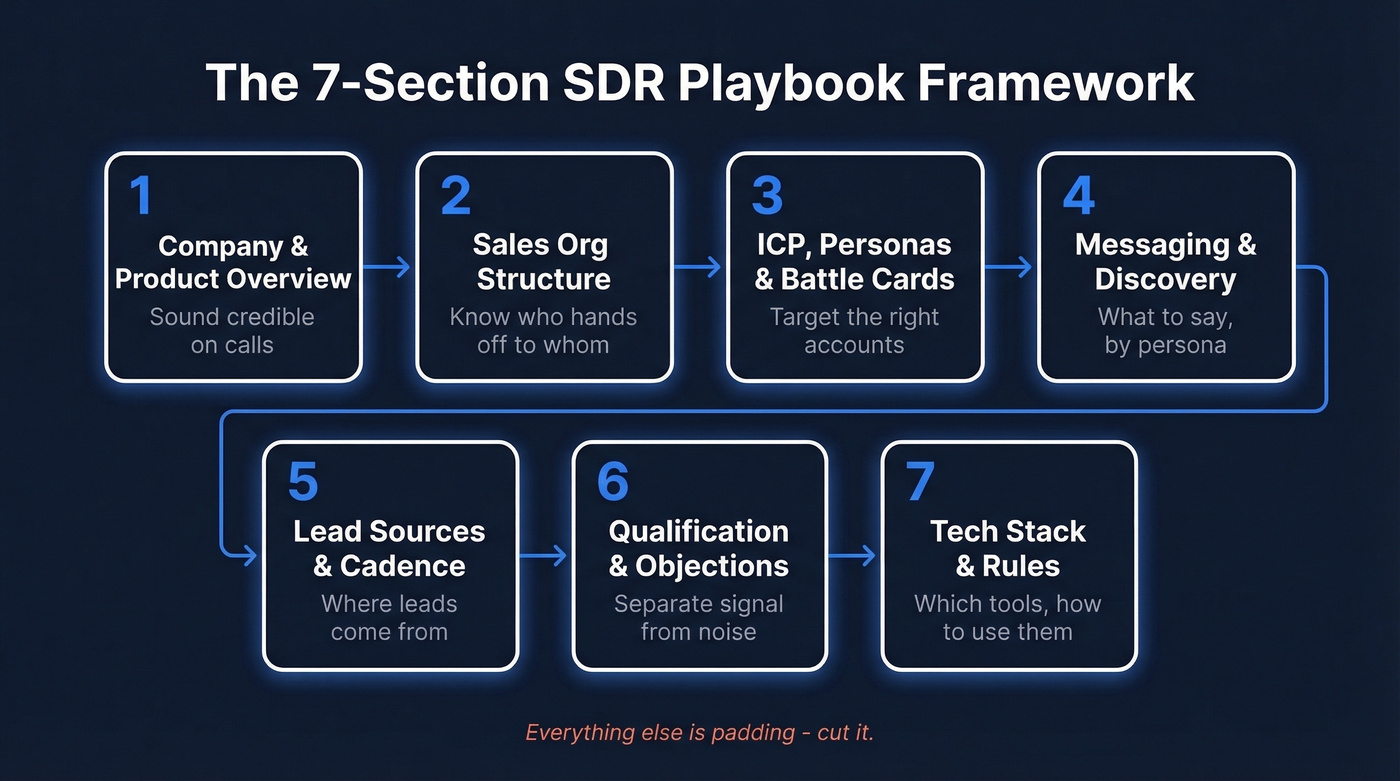
- Company & product overview - just enough context to sound credible on a call
- Sales org structure & SDR role - who hands off to whom, and when
- ICP, buyer personas & competitive battle cards - who to target, who to disqualify, and how you stack against alternatives
- Messaging & discovery questions - what to say, by persona and channel
- Lead sources & cadence - where leads come from and how to work them
- Qualification & objection handling - how to separate signal from noise
- Tech stack & rules of play - which tools to use and how to use them
Everything else is padding. Let's build each one out.
Why Most Playbooks Fail
Nearly 50% of sales teams don't use playbooks consistently. That's not a talent problem - it's a playbook problem. And 20% of new sales hires leave within 90 days due to poor onboarding.
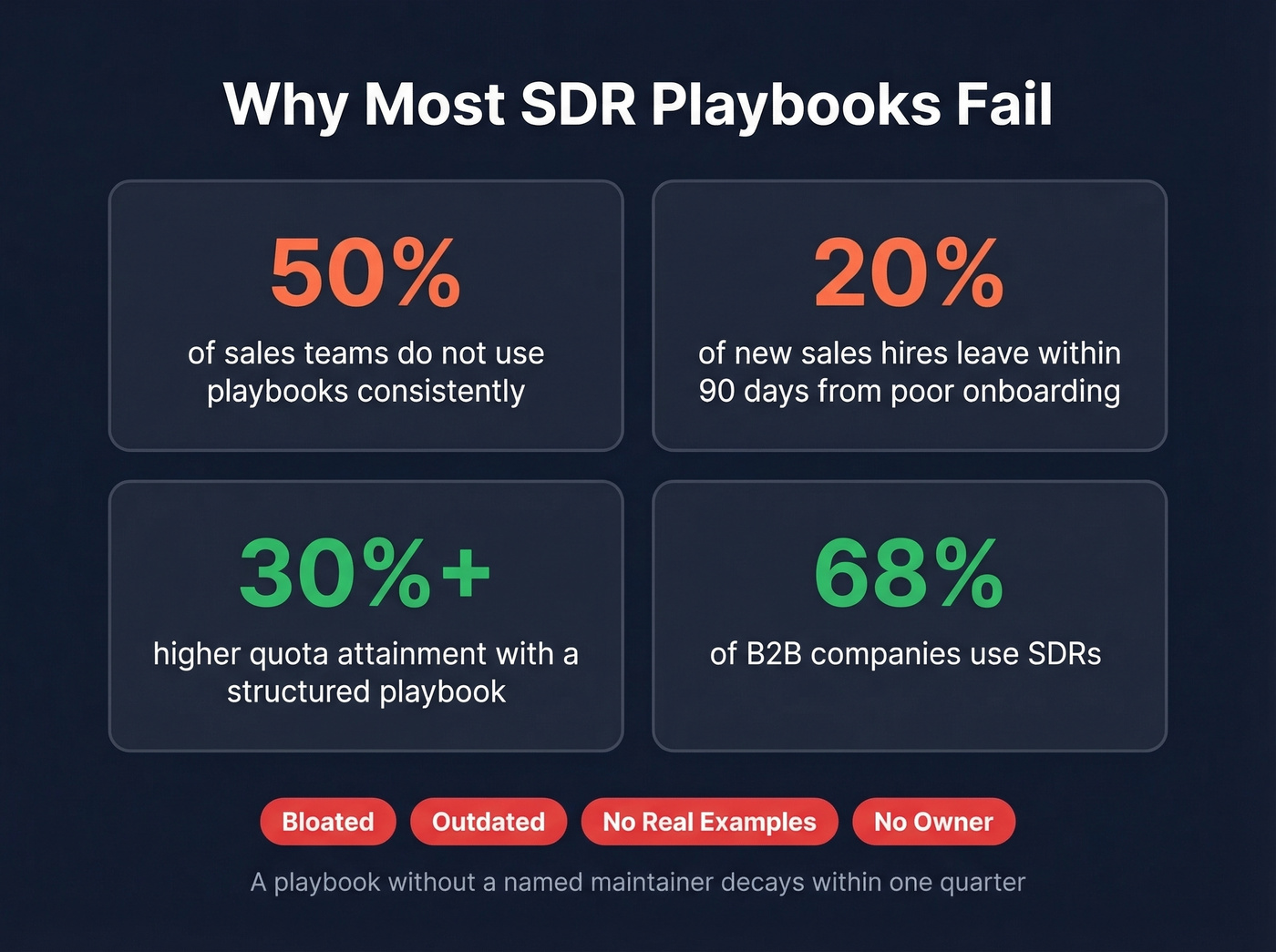
We've seen the same four failure modes over and over:
- Bloated. 50+ pages of theory, org charts, and HR policy nobody reads past day two. If your playbook includes a section on the company's founding story, you've already lost.
- Outdated. Templates referencing last year's pricing, screenshots from a CRM migration ago, competitor battle cards for companies that pivoted or got acquired.
- No real examples. "Be consultative" isn't a script. "Use a multichannel approach" isn't a cadence. Reps need copy-paste language and specific day-by-day sequences they can run right now.
- No owner. A playbook without a named maintainer decays within one quarter. It becomes shelfware - a compliance artifact that exists to check a box during onboarding.
The Vouris philosophy gets it right: keep it tight. Focus on industry knowledge over product knowledge - deep product training belongs with AEs, not SDRs running top-of-funnel.
ICP, Personas & Targeting
Your ICP section shouldn't read like a marketing brief. It should help a rep look at an account and decide in 30 seconds: do I work this, or skip it?
Build an ICP matrix with two columns: positive fit criteria and disqualifiers. Most playbooks only include the first half. The disqualifiers matter just as much - they save reps from burning 20 dials on accounts that'll never close.
| Fit Criteria | Disqualifiers |
|---|---|
| 50-500 employees | Under 10 employees |
| Series A+ or $5M+ rev | Pre-revenue / bootstrapped |
| Uses Salesforce or HubSpot | No CRM in place |
| VP Sales or CRO exists | No dedicated sales function |
| Hiring SDRs (job posts) | Recent layoffs in sales org |
For each persona, include the role title, their top three frustrations, the buying trigger that makes them take a call, and - this is what most playbooks miss - real quotes from actual conversations. Pull snippets from Gong recordings or discovery calls. A line like "I'm spending two hours a day just cleaning data in our CRM" does more for a new SDR than any persona template ever will.
Include a one-page competitive battle card for your top 2-3 competitors. Keep it to three rows: what they claim, what's actually true, and the question your rep should ask to expose the gap. Update these monthly. A strong prospecting playbook treats targeting and disqualification as equally important - knowing who to skip is half the battle.
Multichannel Cadence Design
This is the engine of your playbook. 44% of reps quit after one follow-up, but 80% of sales require five or more touches.
Survey data shows 42% of SDR teams rank email as their top channel, with only 18% favoring LinkedIn - but multichannel outreach drives 287% more engagement than single-channel approaches. McKinsey's research backs this up: systematic sales engagement processes drive 10-20% pipeline improvements.
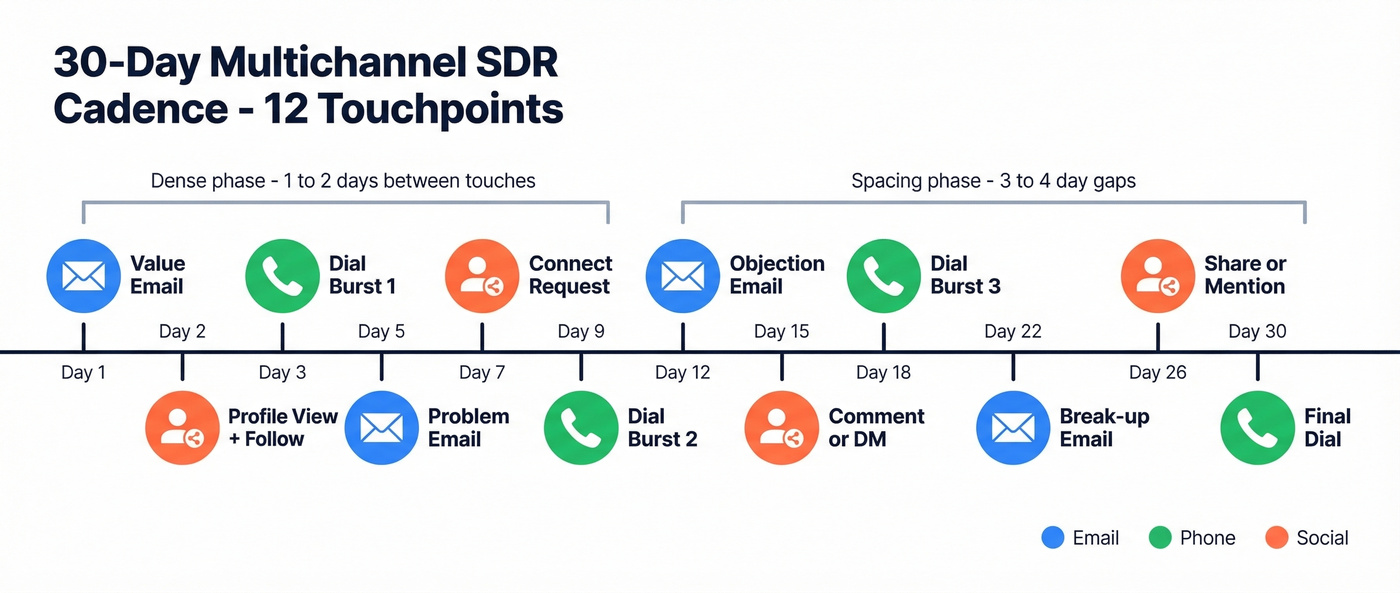
The sweet spot is 17-21 days with 8-12 touchpoints. Here's a 12-step starter cadence you can copy directly:
| Day | Channel | Action | Purpose |
|---|---|---|---|
| 1 | Value + social proof | Open the conversation | |
| 2 | Social | Profile view + follow | Create familiarity |
| 3 | Phone | Parallel dial burst #1 | Catch early awareness |
| 5 | Problem framing | Agitate the pain | |
| 7 | Social | Connection request | Build the relationship |
| 9 | Phone | Parallel dial burst #2 | Follow up on emails |
| 12 | Objection pre-handle | Address likely pushback | |
| 15 | Social | Comment or DM | Stay visible |
| 18 | Phone | Dial burst #3 (exec hours) | Catch decision-makers early |
| 22 | Soft break-up | Create urgency | |
| 26 | Social | Share or mention | Final social touch |
| 30 | Phone | Final dial pass | Last attempt |
A few design principles that make this work:
Channel coordination matters. Send an email, then call within 24 hours. The email warms the call; the call converts the email. These shouldn't be separate tracks - they share a narrative.
Start tight, then space out. Days 1-9 are dense with 1-2 days between touches. Days 12-30 expand to 3-4 day gaps. Early momentum matters; late persistence shouldn't feel like harassment.
Personalization lives in the first and last touch. The middle emails can be templated. The opener and the break-up need to feel human. Any solid outreach playbook bakes this principle into the cadence design itself, not as an afterthought.
Email Templates
Your Day 1 email should follow this structure:
Subject: [Trigger event] at [Company]
Hi [First Name],
Saw [specific trigger - hiring post, funding round, tech adoption]. When [similar company] was at that stage, they were struggling with [specific problem].
We helped them [specific result with number]. Might be worth a 15-minute conversation to see if you're running into the same thing.
Open to it?
Your Day 22 break-up email:
Subject: Should I close your file?
Hi [First Name],
I've reached out a few times and haven't heard back - totally fine. I'll assume the timing isn't right and close out your file.
If [problem] becomes a priority down the road, my calendar's always open: [link].
These two templates will beat the generic "just checking in" sequences most teams run.
Daily SDR Rhythm
A cadence means nothing if your reps don't know how to structure their day around it. This time-blocked schedule turns the playbook into a daily operating system:
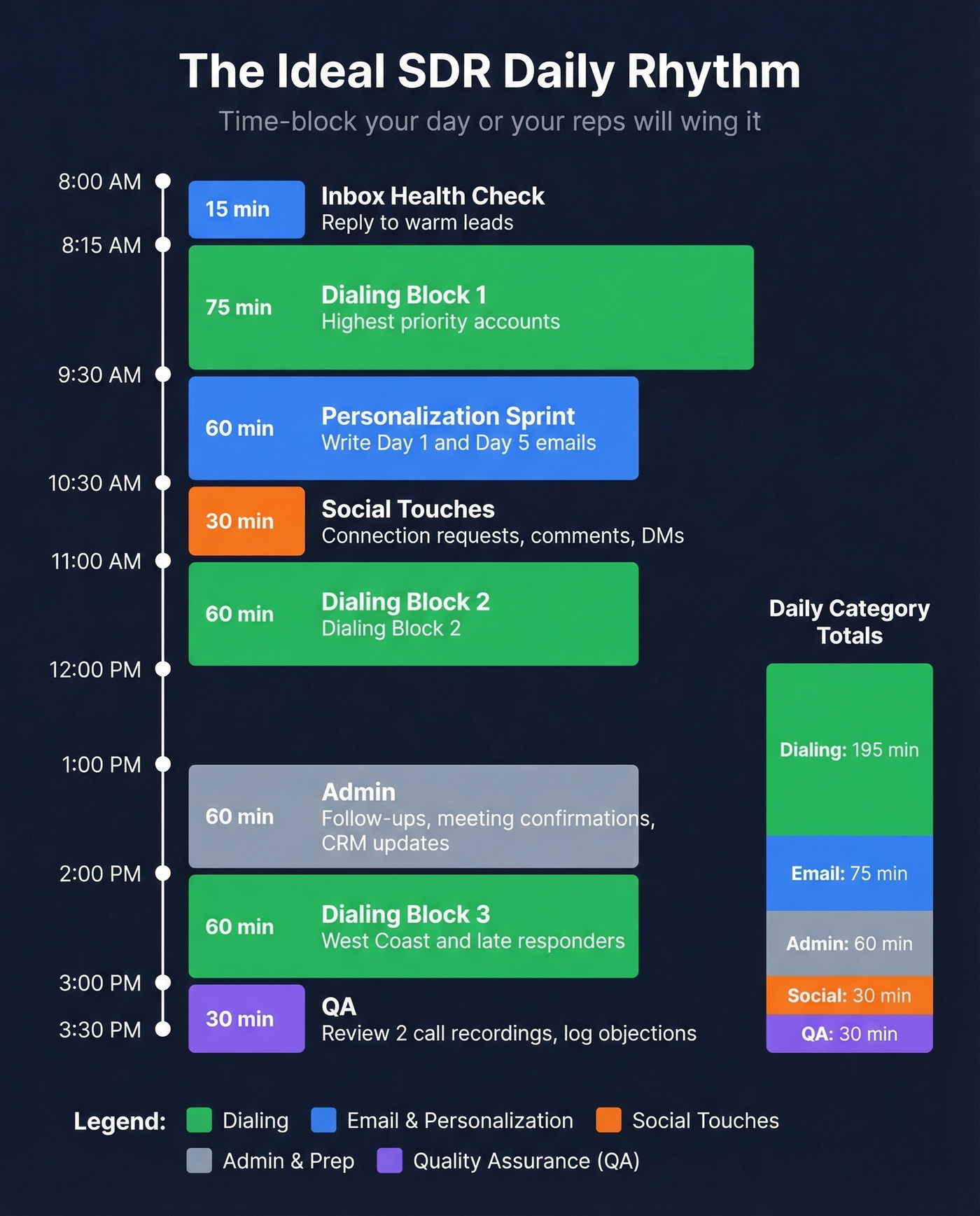
| Time Block | Activity | Duration |
|---|---|---|
| 8:00-8:15 | Inbox health check + reply to warm leads | 15 min |
| 8:15-9:30 | Dialing block #1 (highest-priority accounts) | 75 min |
| 9:30-10:30 | Personalization sprint: write Day 1 & Day 5 emails | 60 min |
| 10:30-11:00 | Social touches: connection requests, comments, DMs | 30 min |
| 11:00-12:00 | Dialing block #2 | 60 min |
| 1:00-2:00 | Follow-ups, meeting confirmations, CRM updates | 60 min |
| 2:00-3:00 | Dialing block #3 (West Coast / late responders) | 60 min |
| 3:00-3:30 | QA: review 2 call recordings, log objections | 30 min |
Post this on the wall. The reps who follow a rhythm like this consistently outperform the ones who "feel out" their day.

Your cadence is dialed in. Your scripts are sharp. But none of it matters if 20% of your emails bounce. Prospeo delivers 98% email accuracy with a 7-day refresh cycle - so every touchpoint in your 12-step cadence actually lands. At $0.01 per email, even a 10-rep SDR team can prospect at scale without blowing budget.
Stop building playbooks on bad data. Start with contacts that connect.
Scripts & Objection Handling
Cold Call Openers
Cold calling success rates average 2.3% across the board. Top teams running targeted lists with structured approaches hit 5-8%. The difference isn't talent - it's frameworks.
Pattern interrupt opener (6.6x higher success rate): Skip "How are you?" and open with something unexpected. "Hey Sarah, this is going to be a cold call - want to hang up or give me 20 seconds?" The honesty disarms. It breaks the pattern of every other sales call they've gotten today.
Reason statement opener (2.1x higher success rate): Lead with why you're calling. "The reason I'm calling is that we help [similar company] cut their SDR ramp time in half, and I wanted to see if that's a problem worth solving for your team." Direct, specific, and gives them a reason to keep listening.
Permission-based opener: Lower resistance by asking for time. "Mind if I take 27 seconds to tell you why I called, and then you can decide if it's worth continuing?" The odd number signals you've actually thought about this.
Trigger-based opener: Tie to a real event. "I saw you just posted an SDR role on your careers page - congrats on the growth. Quick question: how are you handling data quality for the new hire's prospecting?" This one works because it's relevant and timely, but it requires your data provider to surface hiring signals - which is why clean, current data matters so much at this stage.
Objection Handling Framework
The 70/30 rule: your prospect talks 70% of the time, you talk 30%. Most reps invert this when they hit an objection. They start pitching harder. Don't.
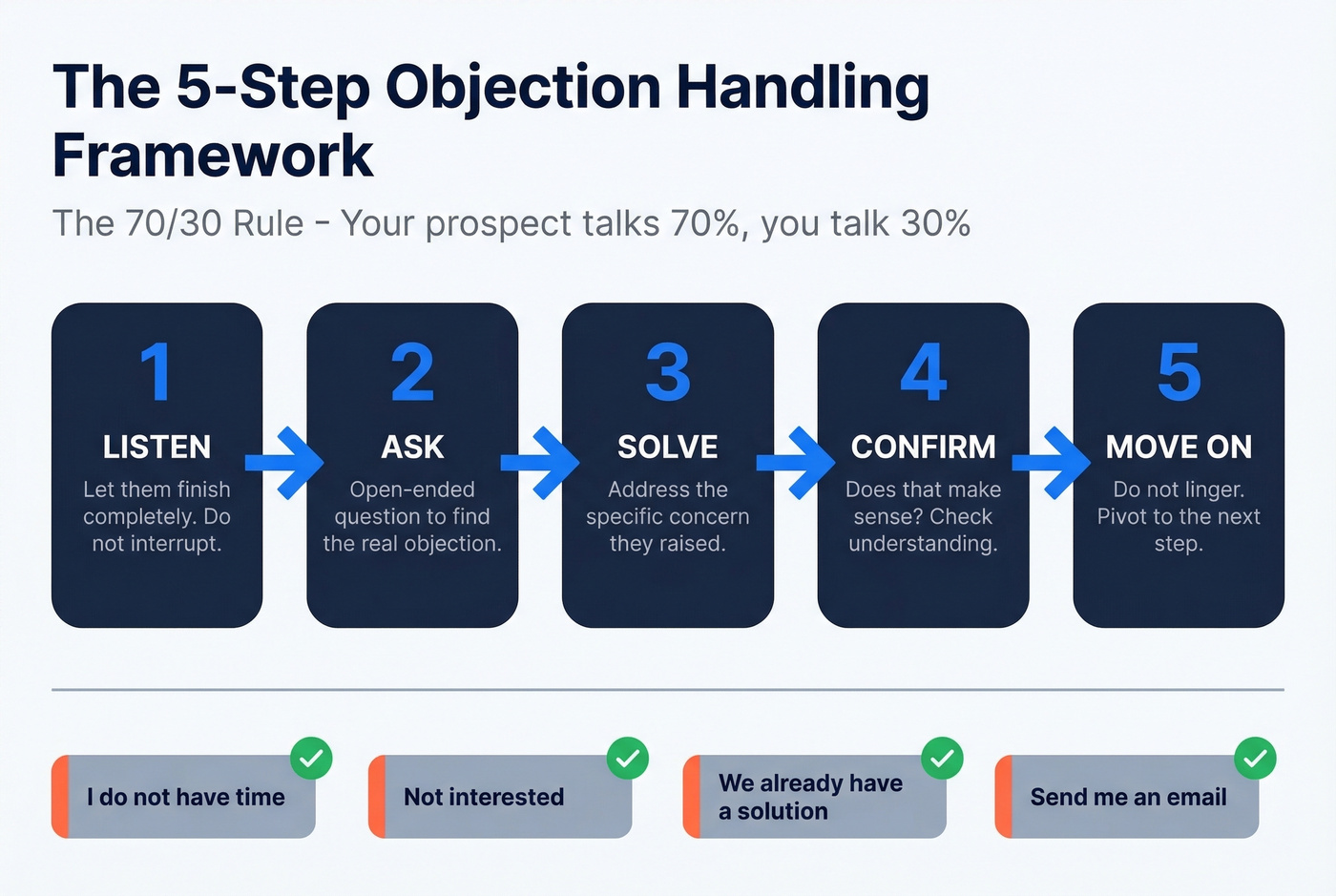
Use this five-step framework:
- Listen - let them finish completely
- Ask - open-ended question to understand the real objection
- Solve - address the specific concern
- Confirm - "Does that make sense?"
- Move on - don't linger; pivot to next step
The five objections your reps will hear most, with scripted responses:
"I don't have time." → "Totally fair - I'll take 30 seconds. If it's not relevant, you can hang up. Deal?"
"Not interested." → "Makes sense. Quick question before I go - how are you currently handling [specific problem]? If it's solved, I'll cross you off my list."
"We already have a solution." → "Good - most teams I talk to do. What I'm hearing from [similar companies] is that [specific gap]. Is that something you've run into?"
"Send me an email." → "Happy to. So I don't waste your time with something generic - what's the one thing that would make it worth reading?"
"Bad timing." → "When would be better? I'll put 15 minutes on the calendar for [specific date] and send a quick recap so you have context."
Benchmarks & KPIs for 2026
Without numbers, your playbook is just opinions. These are the numbers that separate good from great:
| Metric | Outbound | Inbound |
|---|---|---|
| Meetings booked/mo | 12-15 (top: 18-20) | 20-25 |
| Show rate | 75-80% | 80-85% |
| Held meetings/mo | 10-12 | 17-21 |
Beyond meetings, track these conversion benchmarks: MQL-to-SQL conversion averages 52.7%. Cold email response rates run 5.1-8.5% across industries. Connect rates on cold calls sit at 5-8%, which means 50-80 dials per day to generate enough conversations.
The north-star metric that ties it all together: Held Meetings per Rep Hour. This single number punishes busywork and rewards live, qualified conversations. A rep booking 12 meetings a month but spending 9 hours a day to get there has a different problem than a rep booking 8 meetings in 6 focused hours.
Look - if your average deal size is under $10K, you probably don't need a 30-day, 12-touch cadence. A tighter 14-day, 7-touch sequence with verified data and strong scripts will outperform a bloated cadence running on stale contact info every single time. The bottleneck for most teams isn't effort or sequence length - it's data quality. Meritt tripled their pipeline from $100K to $300K per week after switching to verified data. Bad emails and wrong numbers were eating their reps' hours alive.
Tech Stack & Data Quality
The SDR Tech Stack in 2026
The average SDR team uses 12-15 tools daily at a combined cost of $2,000-$5,000 per rep per month. That's insane. The 2026 trend is consolidation down to 3-4 core tools that actually get used daily.
| Category | Tools | Typical Cost |
|---|---|---|
| CRM | Salesforce, HubSpot | $25-300/user/mo |
| Prospecting & Data | Prospeo, ZoomInfo, Apollo | ~$39/mo to $15K+/yr |
| Sales Engagement | Outreach, SalesLoft, Instantly | $30-150/user/mo |
| Dialer | Orum, Nooks | $200-350/user/mo |
| Enrichment | Clearbit, Lusha, LeadIQ | $30-200/user/mo |
| Conversation Intelligence | Gong, Chorus, Clari | $100-200/user/mo |
| Scheduling | Chili Piper, Calendly | $10-30/user/mo |
| Intent & Signals | Bombora, 6sense | $500-5,000/mo |
If you want a tighter shortlist, start with this breakdown of SDR tools by category and use case.
For prospecting and data - the category that makes or breaks everything downstream - here's how the top providers compare:
| Provider | Email Accuracy | Verified Mobiles | Data Refresh | Pricing |
|---|---|---|---|---|
| Prospeo | 98% | 125M+ | 7 days | ~$39/mo, no contract |
| ZoomInfo | 87% | Large, unverified | ~6 weeks | ~$15K/yr, annual lock-in |
| Apollo | 79% | Limited | ~6 weeks | Free-$79/user/mo |
| Cognism | Not public | Strong in EMEA | Not public | ~$1K+/mo, annual |
Prospeo leads this category on the numbers that matter most for SDR teams: 300M+ professional profiles, 98% email accuracy, 125M+ verified mobile numbers with a 30% pickup rate, and a 7-day data refresh cycle when the industry average is 6 weeks. At roughly $0.01 per email with a free tier to start, it's the obvious choice for teams that want enterprise-grade data without the enterprise contract.

Deliverability Guardrails
None of your cadences matter if your emails land in spam.
Before a single email enters a sequence, lock down these fundamentals: SPF, DKIM, and DMARC configured on dedicated, aged sending domains - never your primary domain. Domain warming for at least 2-3 weeks before scaling volume. Inbox rotation across multiple sending accounts to distribute reputation risk. And hard ceilings on bounce rate under 2% and spam placement under 5%.
If you need the full checklist, use this email deliverability guide and keep a close eye on your email bounce rate.
The prerequisite underneath all of this is data verification. Sending to unverified emails is the fastest way to torch a domain. Prospeo's 5-step verification process handles catch-all domains, removes spam traps, and filters honeypots before any address hits your sequencer. Stack Optimize built their agency to $1M ARR using this verification layer - 94%+ deliverability, bounce under 3%, zero domain flags across all clients.
Your ICP matrix filters for tech stack, headcount, and hiring signals - Prospeo's 30+ search filters do the same thing automatically. Layer in buyer intent data across 15,000 topics, job change alerts, and department headcount growth to hand your SDRs accounts that match your playbook's fit criteria from day one. No more burning dials on disqualified prospects.
Give your reps a target list as precise as your playbook.
Onboarding & the 30/60/90 Ramp
Average SDR ramp time is 3.1 months. For SaaS companies, it's stretched to 5.7 months - up 32% since 2020. That's nearly half a year before a new hire is fully productive. Formal onboarding programs boost retention by 82% and productivity by 70%+, which makes your playbook the single highest-leverage onboarding asset you have.
| Month | Quota | Focus | Exit Criteria |
|---|---|---|---|
| 1 | Quota-free | Learn ICP, shadow calls, run first sequences | Complete 50+ dials, send first cadence |
| 2 | ~50% | Own accounts, book meetings with support | 6-8 held meetings |
| 3 | 75-100% | Full autonomy, hit benchmarks | 10-12 held meetings |
If you want a more detailed ramp plan, map this to a 30/60/90 with weekly coaching checkpoints.
The key accelerant is clean data from day one. GreyScout cut their SDR ramp from 8-10 weeks to 4 weeks by giving new reps verified contact data instead of making them build lists manually. When a new hire spends their first week hunting for emails instead of making calls, you've already lost momentum.
Skip the 30/60/90 plan entirely if you don't have a named SDR manager who'll run weekly 1:1s against it. The plan without coaching is just a spreadsheet nobody references after week two.
Keeping Your Playbook Alive
A playbook without a named owner is dead within 90 days. Assign your SDR manager or a senior rep as the maintainer. Build a quarterly update cadence at minimum - monthly reviews of scripts and battle cards are even better.
Format matters more than people think. Use Notion or Google Docs - never a PDF. PDFs can't be updated, searched, or linked to specific sections. Create one-page reference cards for daily use: a cadence cheat sheet, an objection handling card, a qualification checklist. These are what reps actually pull up mid-call.
Build a weekly feedback loop from call recordings and win/loss data. When a rep discovers a new objection or a script variation that books more meetings, it goes into the playbook that week - not next quarter. The consensus on r/sales is pretty clear on this: the teams that treat their playbook as a living document dramatically outperform the ones that treat it as a static onboarding PDF. The document isn't a substitute for active coaching. It's the foundation your coaching builds on.
FAQ
How long should an SDR playbook be?
15-25 pages in a living doc format. If yours is a 50-page PDF, your reps aren't reading past page 5. Every page should contain something a rep can act on during their next dial block or email sprint.
How often should you update it?
Quarterly at minimum with a named owner responsible for revisions. Scripts and competitive battle cards need monthly reviews - competitive landscapes shift faster than quarterly cycles can capture.
What's the difference between an SDR playbook and a sales playbook?
An SDR playbook covers prospecting through qualified meeting handoff. A sales playbook covers discovery, demo, negotiation, and close - typically owned by AEs. Most orgs need both, with a clean handoff protocol connecting them.
What tools do SDRs actually need?
At minimum: a CRM like HubSpot or Salesforce, a verified data provider, and a sequencer like Instantly, Outreach, or SalesLoft. Most teams in 2026 are consolidating to 3-4 core tools rather than the 12-15 tool sprawl that was common a few years ago.
How long does it take to build one from scratch?
A functional v1 takes 1-2 weeks if you have ICP clarity and existing messaging. Ship a living doc and iterate quarterly - don't spend three months building something that's outdated before it launches.