

The SDR Startup Guide: What Reps and Founders Both Need to Know
A RevOps lead we know hired his first SDR last year. Eight weeks later, the rep quit - no playbook, no ramp plan, no coaching. Total cost: roughly $100,000 between recruiting, onboarding, lost pipeline, and the time the founder spent doing the job himself anyway.
The SDR startup experience is brutal on both sides. We've watched reps take "ground floor opportunity" roles and get handed a laptop, a CRM login, and a vague instruction to "go find pipeline." SDR turnover runs 30-35% annually, and at startups without structure, it's worse. Both sides keep making the same mistakes.
What You Need (Quick Version)
If you're a candidate: Look for three things in any startup SDR offer - a documented playbook, even a rough one; a 30/60/90-day ramp plan with realistic quotas; and a comp structure where the variable isn't a fantasy number. Optimize for learning speed, not base salary. A startup that teaches you to prospect, qualify, and close will accelerate your career faster than a Fortune 500 logo on your resume.
If you're a founder: Don't hire an SDR until you've closed deals yourself and can describe a repeatable process. Budget for three tools, not fifteen. You need a CRM like HubSpot's free tier, verified prospecting data at $0.01/lead, and a sequencing tool such as Instantly ($30/month) or Smartlead (around $39-$99/month). Total stack cost: under $200/month. Everything else can wait.
What the Role Actually Looks Like
The startup sales development role looks nothing like the enterprise version. There's no territory carved out by ops, no BDR pod with a team lead running daily standups, no enablement team producing battle cards. You're building the plane while flying it.
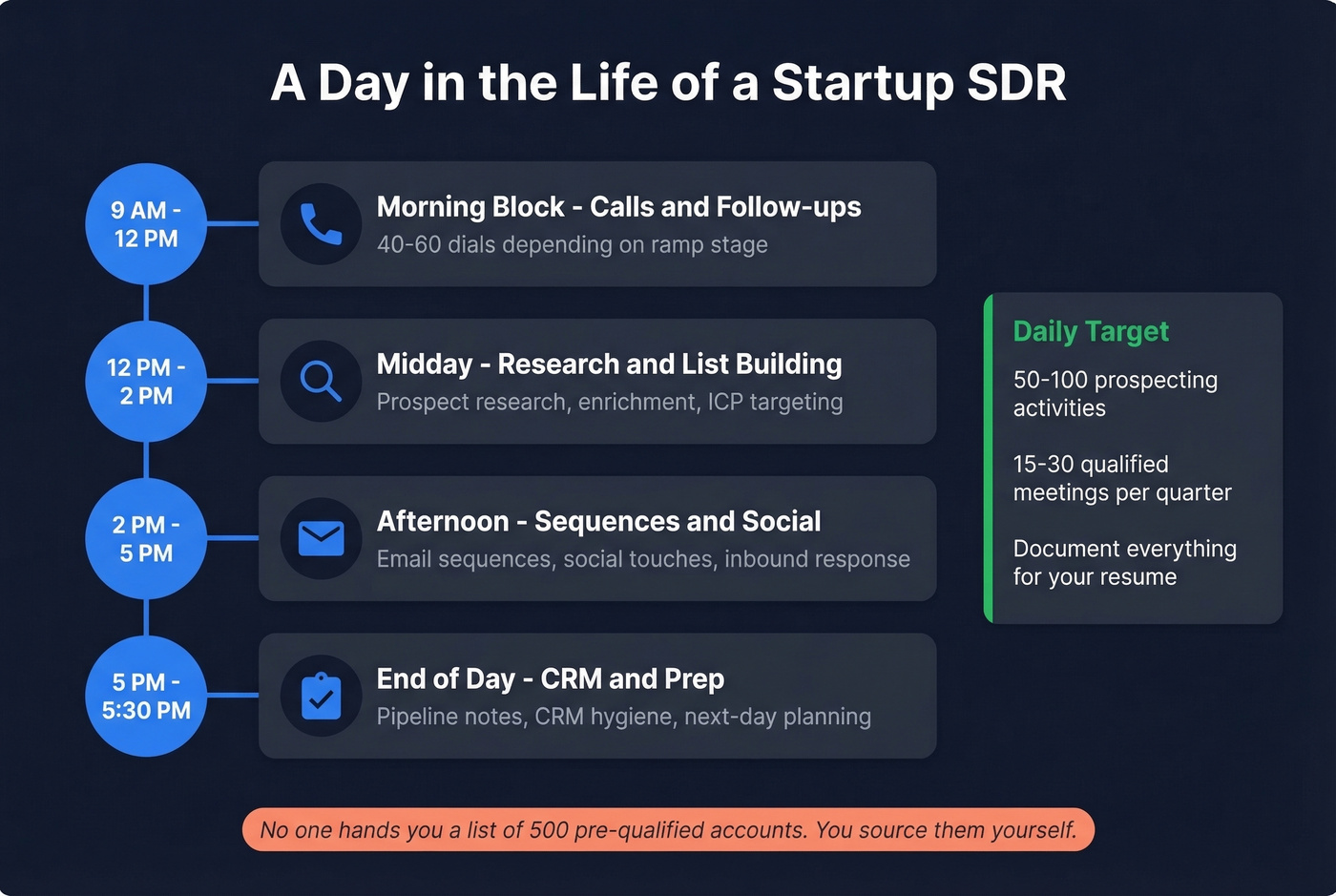
A startup sales rep prospects, qualifies, and books meetings for the founder or a small AE team. The daily reality is 50-100 prospecting activities - calls, emails, social touches, and exploratory conversations - with a target of 15-30 qualified meetings per quarter. Here's what a typical day looks like:
- Morning block (2-3 hours): Cold calls and follow-ups. 40-60 dials depending on ramp stage.
- Midday (1-2 hours): Prospect research, list building, enrichment. This is where your data tool earns its keep.
- Afternoon (2-3 hours): Email sequences, social touches, responding to inbound leads if they exist.
- End of day (30 min): CRM hygiene, pipeline notes, next-day prep.
The difference from enterprise? You'll talk to the founder daily. You'll have input on ICP definition. You'll probably help write the first email templates. And nobody's going to hand you a list of 500 pre-qualified accounts - you're sourcing those yourself.
Career tip for candidates: Document everything. After 12 months as a sales development rep at a startup, you should be able to say "I built the outbound playbook from scratch, booked X meetings per month, and generated $Y in pipeline." Those metric-based resume bullets are what get you promoted to AE in 18 months instead of 30. The skills you build - ICP definition, sequence writing, objection handling without a script - transfer directly to closing roles. No enterprise program teaches that the same way.
Compensation Benchmarks for 2026
Base and OTE Ranges
SDR salaries climbed 5-10% from 2024 to 2025, and the 2026 market remains competitive enough that founders can't lowball and expect to retain talent. Here's what the bands look like:
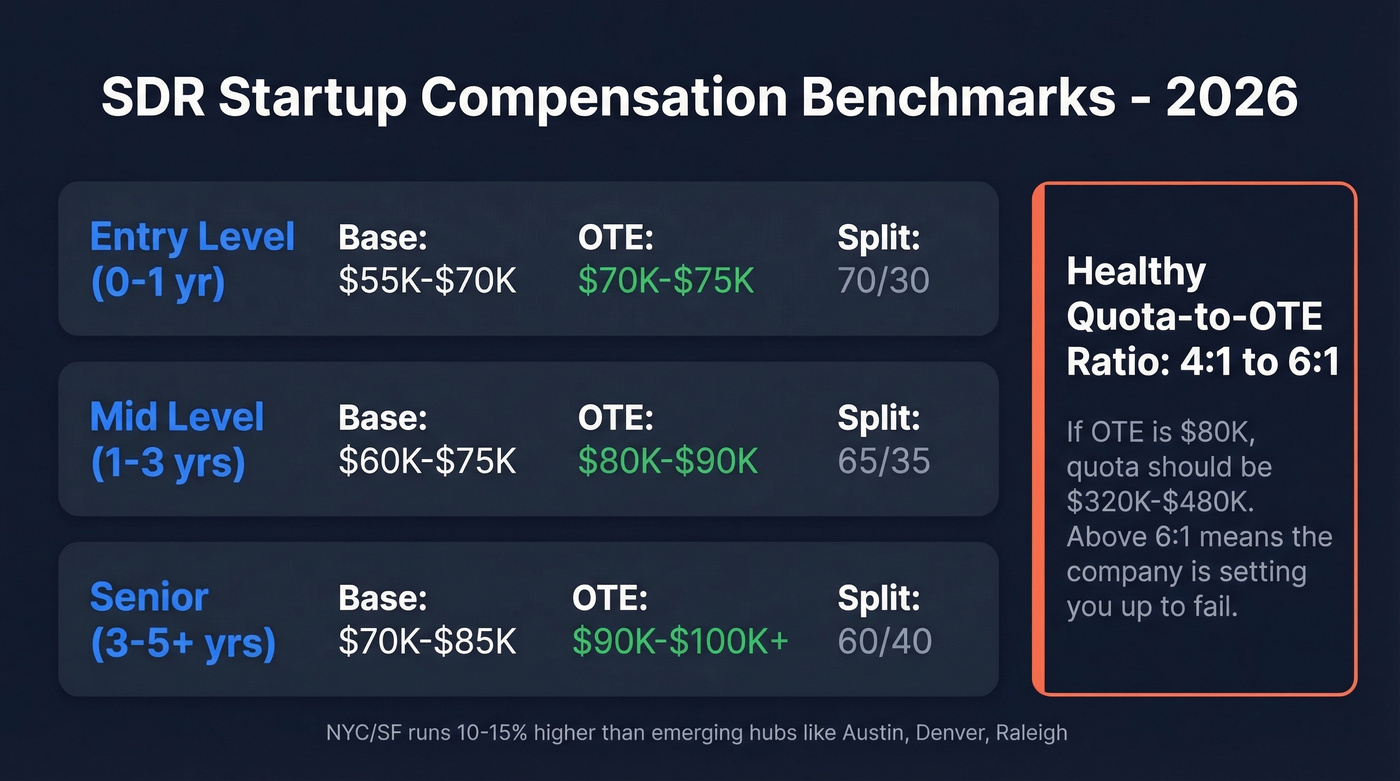
| Experience Level | Base Salary | OTE | Typical Split |
|---|---|---|---|
| Entry (0-1 yr) | $55K-$70K | $70K-$75K | 70/30 |
| Mid (1-3 yrs) | $60K-$75K | $80K-$90K | 65/35 |
| Senior (3-5+ yrs) | $70K-$85K | $90K-$100K+ | 60/40 |
Geography still matters. NYC and SF entry-level roles run $50-70K base with $80-90K OTE. Remote roles trend slightly lower. Emerging tech hubs like Austin, Denver, and Raleigh come in 10-15% below traditional markets.
A real offer comparison from r/salesdevelopment illustrates the tradeoff: a startup offered $50K base with 8% commission on first 225 units (realistic OTE $85K-$115K+), while an established company offered $55K base at 4-4.75% commission - but paid only after project completion and client payment. The startup had more upside. The established company had more certainty. That's the core tension every candidate faces.
One number to keep in your head: a healthy quota-to-OTE ratio is 4:1 to 6:1. If your OTE is $80K, your annual quota should be $320K-$480K. Anything above 6:1 means the company is setting you up to fail.
Equity - What the Numbers Look Like
Early data from seed-stage and Series A companies shows SDR equity grants ranging from 0.09% to 0.8% at seed stage and 0.15%-0.2% at Series A. The spread is wide because it depends on company valuation, your experience level, and how desperate the founder is.
Equity dilutes 10-25% per funding round. That 0.5% at seed becomes 0.3-0.4% after Series A, and keeps shrinking. Treat equity as a lottery ticket, not compensation. Negotiate your base and OTE first.
Startup vs. Enterprise SDR
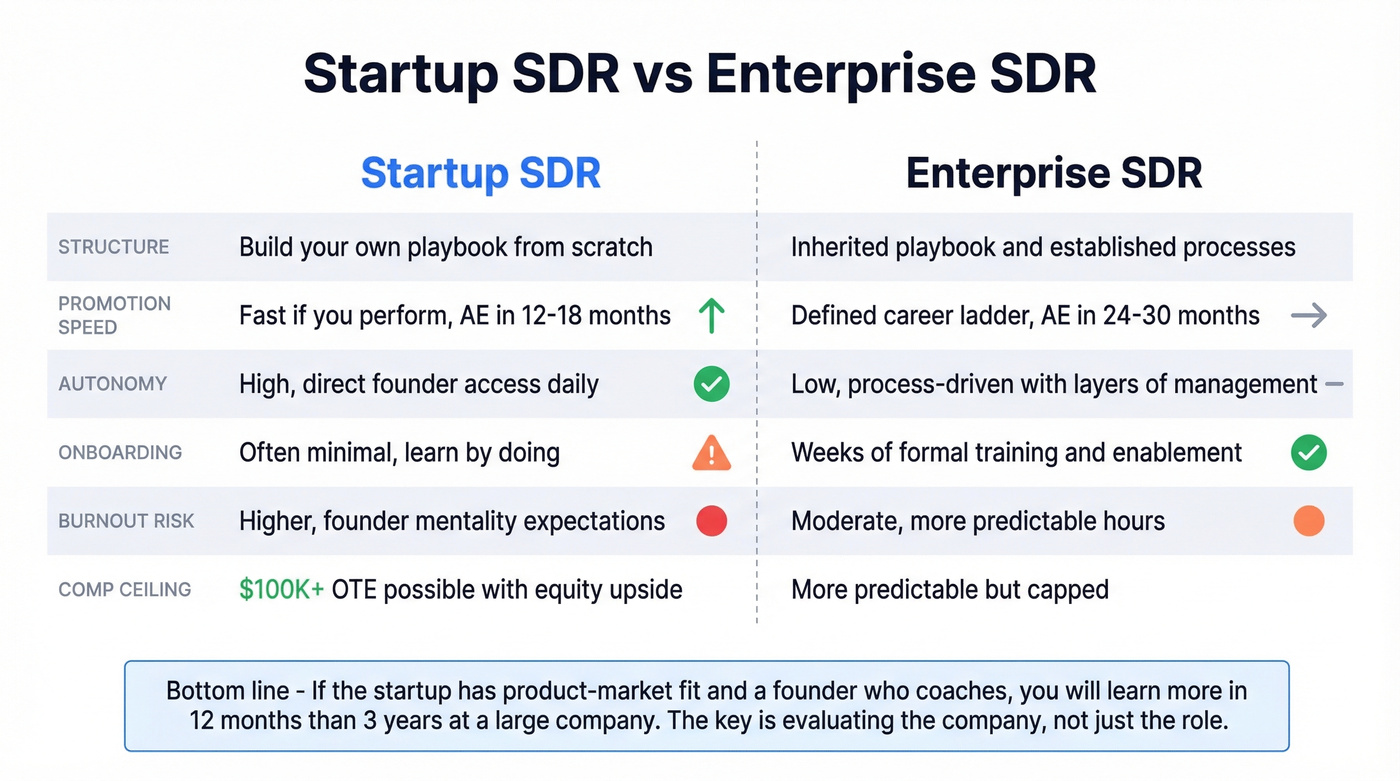
| Factor | Startup SDR | Enterprise SDR |
|---|---|---|
| Structure | Build your own | Inherited playbook |
| Promotion speed | Fast if you perform | Defined career ladder |
| Autonomy | High - direct founder access | Low - process-driven |
| Onboarding | Often minimal | Weeks of formal training |
| Burnout risk | Higher | Moderate |
| Comp ceiling | $100K+ OTE possible with equity upside | More predictable |
The Reddit threads on this topic are consistent on one thing: burnout is real. One poster on r/sales described a "founder mentality" expectation - late nights, weekends, harsh feedback - with no structure or guidance. They burned out in nine months. That's not every startup, but it's common enough that you should ask pointed questions in the interview about onboarding, management style, and expectations around hours.
The flip side is genuine. If the startup has product-market fit and a founder who coaches, you'll learn more in 12 months than you would in three years at a large company. The key is evaluating the company, not just the role.

The article says budget $0.01/lead for verified prospecting data - that's Prospeo. 300M+ profiles, 98% email accuracy, and a 7-day refresh cycle so your new SDR never burns through stale lists. No contracts, no sales calls. Under $200/month for your entire startup stack.
Give your first SDR data that actually books meetings.
When to Hire Your First SDR
Here's the thing: an SDR is a scaling function, not a creation function. If you haven't closed deals yourself as a founder, a rep won't magically create pipeline for you. They'll just burn through a list and quit.
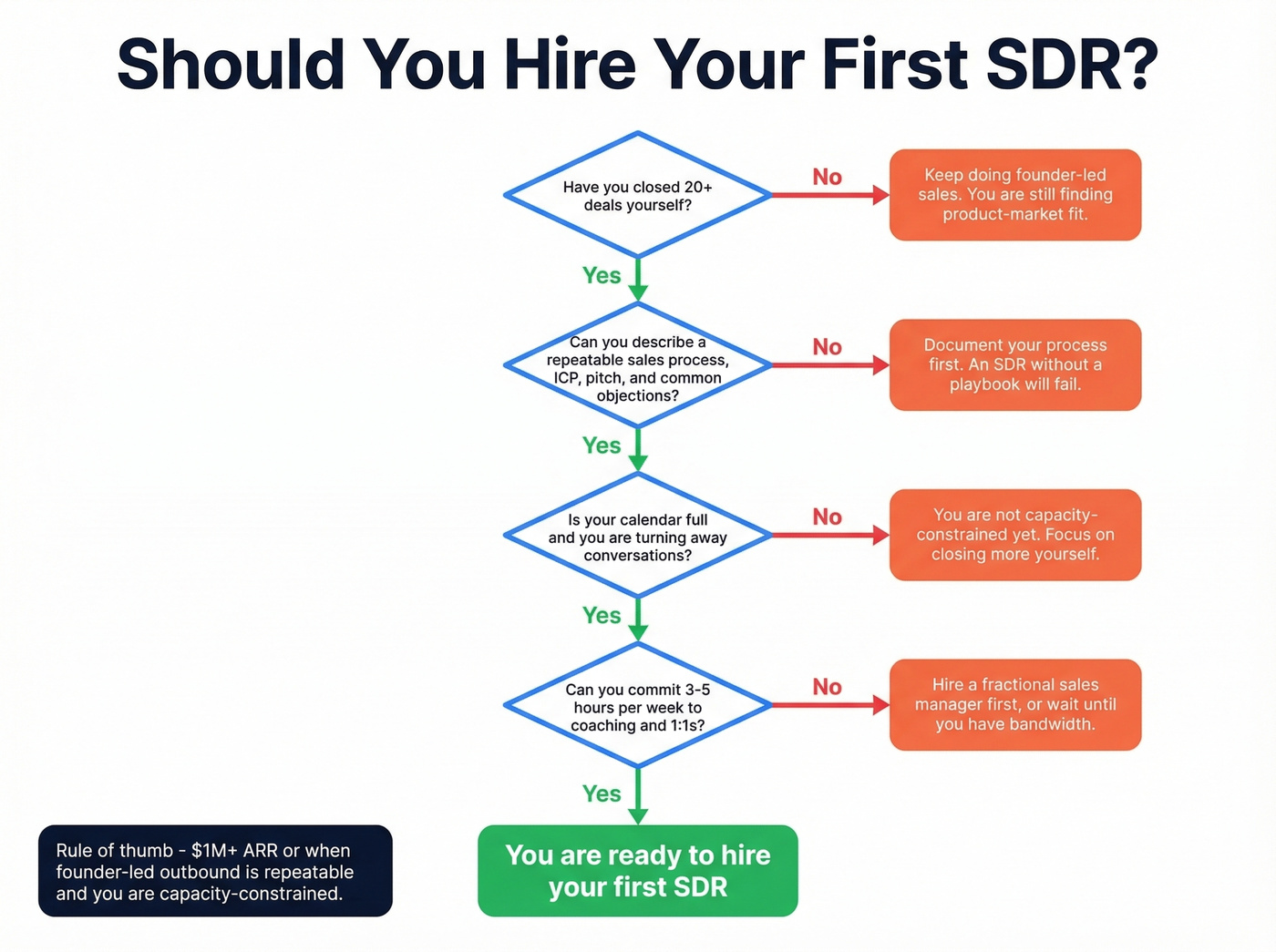
If your average deal size is under $10K and you haven't closed 20+ deals yourself, you don't need a sales development rep - you need more founder conversations with prospects. Most startups hire too early, not too late.
Four gating questions before you make the hire:
- Do you have a repeatable sales process? Can you describe your ICP, your pitch, and the objections you'll hear - and have you closed enough deals to prove the pattern works?
- Can you handle more meetings? If your calendar is already full and you're turning away conversations, that's a signal.
- Do you have management bandwidth? An SDR needs structured weekly 1:1s, call reviews, and coaching. If you can't commit 3-5 hours/week to managing them, don't hire.
- Does your GTM motion benefit from outbound? Direct sales motions benefit most. PLG and inbound-heavy motions get moderate value. Pure self-serve with sub-$5K deals? A dedicated rep doesn't pencil out.
The rough ARR threshold is $1M+, or whenever founder-led outbound is repeatable and you're capacity-constrained. Below that, you're still figuring out what works - and that's the founder's job.
How to Hire and Onboard
What to Look For
Forget the "hunter mentality" cliche. The traits that predict success are more specific.
Writing ability matters more than phone presence at early-stage companies. Your rep will write cold emails, follow-ups, and probably help draft sequences. Give them a prospecting exercise in the interview - ask them to research a target account and write a cold email. Then give feedback and see how they respond. Coachability shows up in that feedback loop more than in any behavioral question.
Curiosity separates reps who plateau at month three from reps who keep improving. Ask candidates what they've learned recently about your industry. If they haven't done the research, they won't do it on the job either.
Grit matters because startup reps face rejection at higher rates with less support infrastructure. Ask about a time they stuck with something difficult when quitting was the easier option. The answer tells you more than any role-play exercise.
Don't hire before you have a playbook. Even a rough one - ICP definition, target personas, messaging framework, objection handling - is better than nothing. Without it, you're paying someone $70K+ to guess.
The 30/60/90-Day Ramp Plan
Strong onboarding correlates with 82% greater retention and 70% better productivity. Given that replacing a rep costs up to $100K, the ramp plan is the highest-ROI investment you'll make.
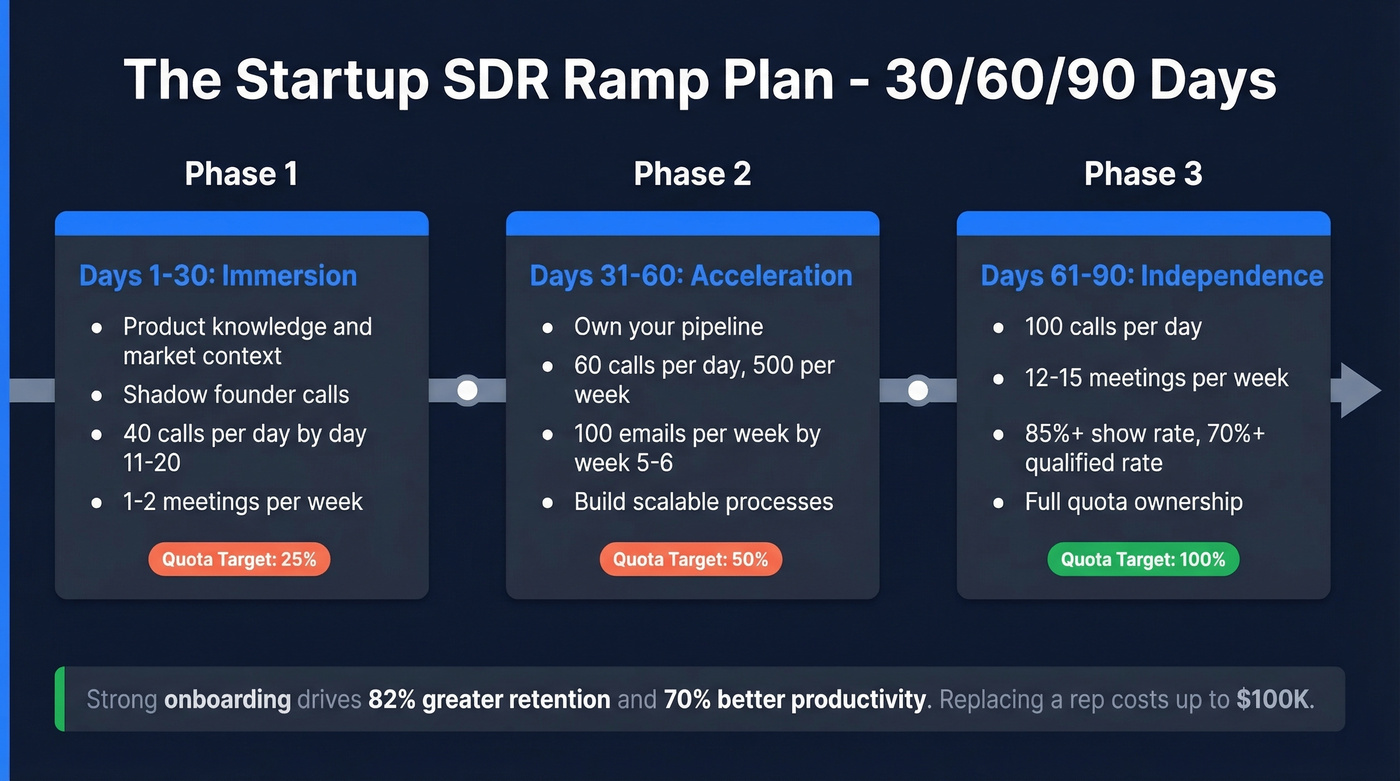
Days 1-30: Immersion. Product knowledge, market context, ICP deep-dives, shadowing founder calls. By day 11-20, the rep should be making 40 calls/day with a 15-20% contact rate, booking 1-2 meetings/week. Quota target: 25%.
Days 31-60: Acceleration. 60 calls/day, 500 calls/week plus 100 emails/week by weeks 5-6. The rep should own their pipeline and start building scalable processes. Quota target: 50%.
Days 61-90: Independence. 100 calls/day, 12-15 meetings/week, 85%+ show rate, 70%+ qualified rate. Full quota. If they're not there by day 90, the problem is usually the playbook or the coaching - not the rep.
We've seen agencies using Prospeo cut rep ramp time from 8-10 weeks to 4 by eliminating manual list-building entirely. When reps spend their first month learning the product and market instead of scraping contacts from the web, they ramp faster and stick around longer.
Entry-level hires need 8-12 weeks of structured ramp. Experienced hires can compress to 4-6 weeks. Either way, don't skip the structure. The 30-35% industry turnover rate is largely a function of bad onboarding, not bad hires.
Metrics That Actually Matter
Most founders track the wrong things. They obsess over calls made and emails sent. Those are inputs. Here are the outputs worth watching:
| Metric | Benchmark | Context |
|---|---|---|
| Activities/day | 94.4 (35.9 calls, 32.6 emails, 15.3 VMs, 7 social) | Average across industries |
| Meetings booked/month | 15 | Outbound; 80% show rate |
| Cold call to meeting | 1 in 59 | Keller Center research |
| Cold email reply rate | 1-5% (12% optimized) | GMass / Outreach benchmarks |
| Leads to opportunities | 58% | TOPO benchmark |
| Opportunities to closed-won | 22% | SDR-sourced pipeline |
| Quota attainment | 54-60% | Tenbound; only about half hit number |
| SDR:AE ratio | 2.6 AEs per 1 SDR | Industry average |
| Time on revenue activities | 28-39% | Rest is admin and CRM work |
2026 BDR reality check: A 6sense survey of 262 BDRs found that reps average 21 attempts per contact (up from 17 the prior year), run cadences for 53 days before giving up, and split their attempts across roughly 5 social touches, 8 calls, and 8 emails. Average quota attainment hit 88% - higher than the broader industry number, likely because the survey skewed toward more mature orgs. 60% of BDRs now use AI tools, primarily for call transcription and email writing.
The stat that should worry every founder: reps spend only 28-39% of their time on revenue-generating activities. Admin tasks eat 41% of the day. If your rep is spending more time updating Salesforce than talking to prospects, you have a process problem, not a people problem.
The Right Tech Stack
Stop building a 15-tool stack. The average team uses 12-15 tools at a cost of $2,000-$5,000 per rep per month. That's unsustainable for a startup. Your first sales hire needs three tools and a playbook. Everything else is a distraction until you hit a specific bottleneck.
| Category | What It Does | Startup Pick | Monthly Cost |
|---|---|---|---|
| CRM | Pipeline + contacts | HubSpot (free) or Close | $0-$139/user |
| Prospecting + Enrichment | Find and verify contacts | Prospeo | ~$0.01/lead, free tier available |
| Sequencing | Automate outreach | Instantly or Smartlead | $30-$99/mo |
| Dialer | Call at volume | Close (built-in) | Included or $50-$200 |
| Conversation Intel | Coach from calls | Gong | ~$100-$200/user - add later |
That's ~$100-200/month for the core stack. Compare that to ZoomInfo at $14,995+/year (most teams spend $20-50K/year), Cognism at $15,000-$40,000/year, Apollo at Free-$79/user/month, or Sales Navigator at $79.99-$139.99/user/month. For a startup, those numbers are disqualifying.

Let's be honest about why data quality matters more than tool count: bad data costs businesses $9.7M/year on average. If a third of your emails bounce, the problem isn't the rep - it's the stack. A 7-day data refresh cycle versus the 6-week industry average means your rep isn't calling people who changed jobs two months ago. B2B companies that adopt advanced sales technology grow revenue 2-3x faster than those that don't. But the tech only works if the data underneath it is clean.
If you want a broader shortlist beyond the basics, start with a ranked list of SDR tools and then cut ruthlessly.
Human SDR or AI SDR?
The AI SDR market is estimated at $5.81B in 2026, and it's projected to grow fast through 2030. The question isn't human vs. AI - it's which tasks to automate.
| Human SDR | AI SDR (Replace) | AI SDR (Augment) | |
|---|---|---|---|
| Annual cost | $60-85K salary + $24-60K tooling | $10K-$50K/yr | $360-$950/yr |
| Examples | - | 11x, Artisan | AiSDR, Instantly |
| Ramp time | ~3 months | 3-7 days to 4-8 weeks | Immediate |
| Best for | Conversations, qualification, complex deals | High-volume cold email at scale | Boosting human rep output |
Full replacement AI tools like 11x run ~$50K/year and Artisan charges $30-60K/year. Augmentation tools are far cheaper - AiSDR at $900/month, Instantly at $30/month. 60% of BDRs already use AI in some form. Automation saves roughly 12 hours/week per rep and delivers a 10-15% immediate productivity boost.
The smart move for most startups isn't choosing between human and AI - it's using AI to handle research, email drafting, and sequence management so your human rep can focus on calls and qualification. Whether you hire a person or deploy an AI agent, both need clean, verified contact data feeding into your sequencing tools. Dead email addresses waste sends regardless of who - or what - is pressing the button.
Skip the "full replacement" AI agents if you're pre-Series B. They're expensive and still struggle with nuanced qualification. For most early-stage companies, the augmentation path - a human rep armed with AI writing tools and verified data - delivers better results at lower risk.
Startup SDRs spend 1-2 hours daily on list building and enrichment. Prospeo's 30+ search filters - buyer intent, technographics, headcount growth, funding - let reps build targeted lists in minutes instead of hours. 40,000+ reps already use the Chrome extension to prospect from any website or CRM.
Cut your SDR's research time from hours to minutes.
FAQ
What does an SDR do at a startup?
A sales development representative at a startup prospects for new business, runs outbound outreach through calls, emails, and social touches, and qualifies leads before passing them to the founder or AE. Expect 50-100 activities per day and 15-30 qualified meetings per quarter. Unlike enterprise roles, you'll own the process end-to-end with direct founder access.
How much do startup SDRs make in 2026?
Entry-level OTE runs $70-75K, mid-level $80-90K, and senior $90-100K+. Base salaries range from $55K to $85K depending on experience and geography. Equity at seed stage typically falls between 0.09% and 0.8%, with a standard 70/30 base-to-variable split for early-stage hires.
When should a founder hire the first SDR?
Hire when you have a repeatable sales process, more inbound meetings than your calendar allows, 3-5 hours/week for coaching, and a GTM motion that benefits from outbound. Most companies reach this point around $1M+ ARR. Before that, keep running founder-led sales until the pattern is proven.
What tools does a startup SDR need?
Three essentials: a CRM like HubSpot's free tier, verified prospecting data (75 free emails/month on Prospeo, $0.01/lead on paid plans), and a sequencing tool such as Instantly or Smartlead. Total cost: ~$100-200/month. Add conversation intelligence or a standalone dialer only when you hit a specific bottleneck.
Is being an SDR at a startup worth it?
Yes - if the company has a playbook, a ramp plan, and a manager who coaches. It's the fastest path to full-cycle sales skills and AE promotion. But burnout risk is real without structure. Evaluate the company's readiness, not just the title and comp. Ask about onboarding cadence and what happened to the last person in the role.