

Stop Selling to Developers. Let Them Buy.
A devtools startup rep sends a "personalized" cold email to a backend engineer. The subject line references the engineer's GitHub commits. It doesn't feel helpful - it feels invasive. The email gets shared internally, mocked publicly, and the brand becomes "that company" engineers warn each other about.
Selling to developers like this doesn't just fail to convert. It costs the engineer roughly 30 minutes of deep work and costs the company its reputation with everyone who sees the screenshot.
The problem isn't that developers are difficult. It's that the traditional sales playbook is fundamentally incompatible with how they evaluate and adopt tools.
What You Need (Quick Version)
- Kill the "Request a Demo" gate. Give developers self-serve access with docs they can follow in under 5 minutes.
- Don't cold-outreach engineers. Watch for usage signals - API calls, dashboard engagement, multiple users from one company - and reach the decision-maker only when those signals fire.
- Publish your pricing. If developers can't find it, they assume you're overcharging and move on.
Why Traditional Sales Motions Fail
According to 6sense research, the average B2B buying cycle runs 10-13 months. Buyers define requirements and often have a preferred vendor before they ever talk to a salesperson. For developer tools, this dynamic is even more extreme - engineers don't enter a funnel. They ask a colleague, scan a subreddit, clone a repo, and run the thing themselves.
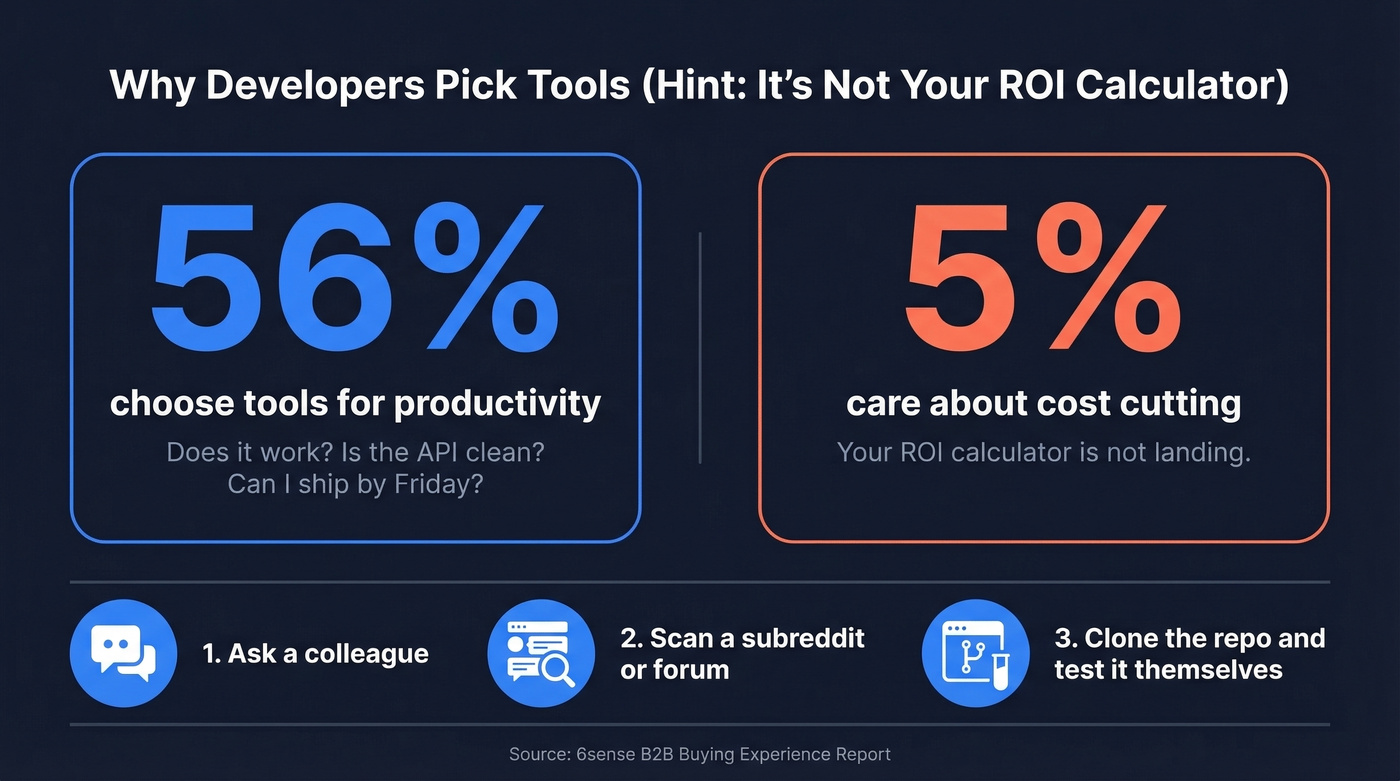
Here's the stat that should reframe your entire pitch: 56% of developers select tools primarily for productivity, while only 5% care about cost cutting. Your ROI calculator and your "save 20 hours a week" landing page aren't landing. Developers want to know: does this work, is the API clean, and can I ship with it by Friday?
Community recommendations and hands-on testing drive adoption - classic bottom-up motion. Not MQLs. Not nurture sequences. Not webinars. The developer buying journey is non-linear, community-driven, and self-serve by default.
What Not to Do
In our experience, the "Request a Demo" gate is one of the biggest conversion killers for developer products. But it's far from the only mistake we see:
- Overhype your product. Developers will test your claims within minutes. If reality doesn't match, you're done.
- Gate your content. Requiring an email to read docs or access a sandbox is a trust-killer. Developers will find an alternative with fewer barriers.
- Use marketing-speak. "Revolutionary AI-powered platform" gets you mocked. Developers on r/webdev describe this kind of copy as "snake oil" - and they spot it instantly.
- Ship before you're production-ready. Developers try your tool once, hit a wall, and never come back. There's no second first impression.
- Ignore communities. If you're not present in the forums, Discord servers, and GitHub discussions where your users hang out, you don't exist.
- Cold-email engineers. The consensus on r/sales is blunt: developers hate salespeople, especially ones who pretend a cold email is personal.

Cold-emailing engineers kills deals. The smart play: wait for usage signals, then reach the decision-maker who controls the budget. Prospeo's 300M+ profiles with 98% email accuracy let you bypass the IC and land in the CTO's inbox - without bouncing off bad data.
Stop guessing email formats. Start reaching the buyer who signs the contract.
Developer Experience Is the Sales Process
80% of developers say clear documentation is the single most important factor when adopting an API. Not pricing. Not features. Docs.
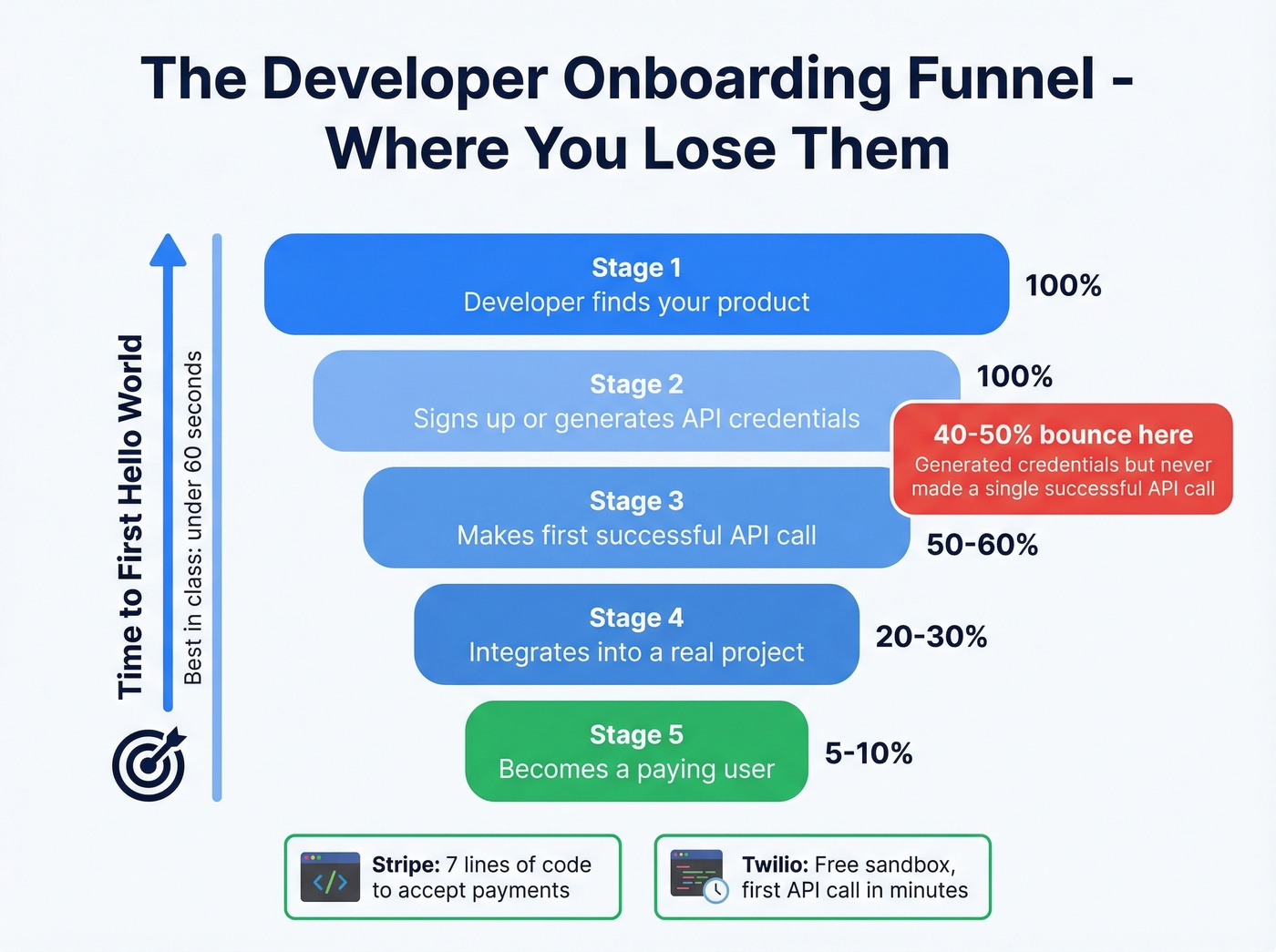
And yet, API onboarding bounce rates - developers who generate credentials but never make a single successful call - run as high as 40-50%. That's half your signups lost to friction before they even experience your product. Let's be honest: if your quickstart takes more than five minutes, you've already lost most of them.
Stripe understood this from day one. The pitch was "seven lines of code" to accept payments. Patrick Collison's early "give me your laptop" integrations became known as the "Collison Installation" - integrating Stripe on the spot while the prospect watched. Twilio took a similar approach with its sandbox and free credits, letting developers make their first API call fast.
The metric that matters isn't time-to-demo. It's Time to First Hello World - and the bar keeps dropping. Some product-led growth leaders now target first value in under 60 seconds.
When You Actually Need a Sales Team
Pure self-serve doesn't scale to enterprise. At some point, you need sales. The question is when - and the answer is never "before the developer has experienced value."
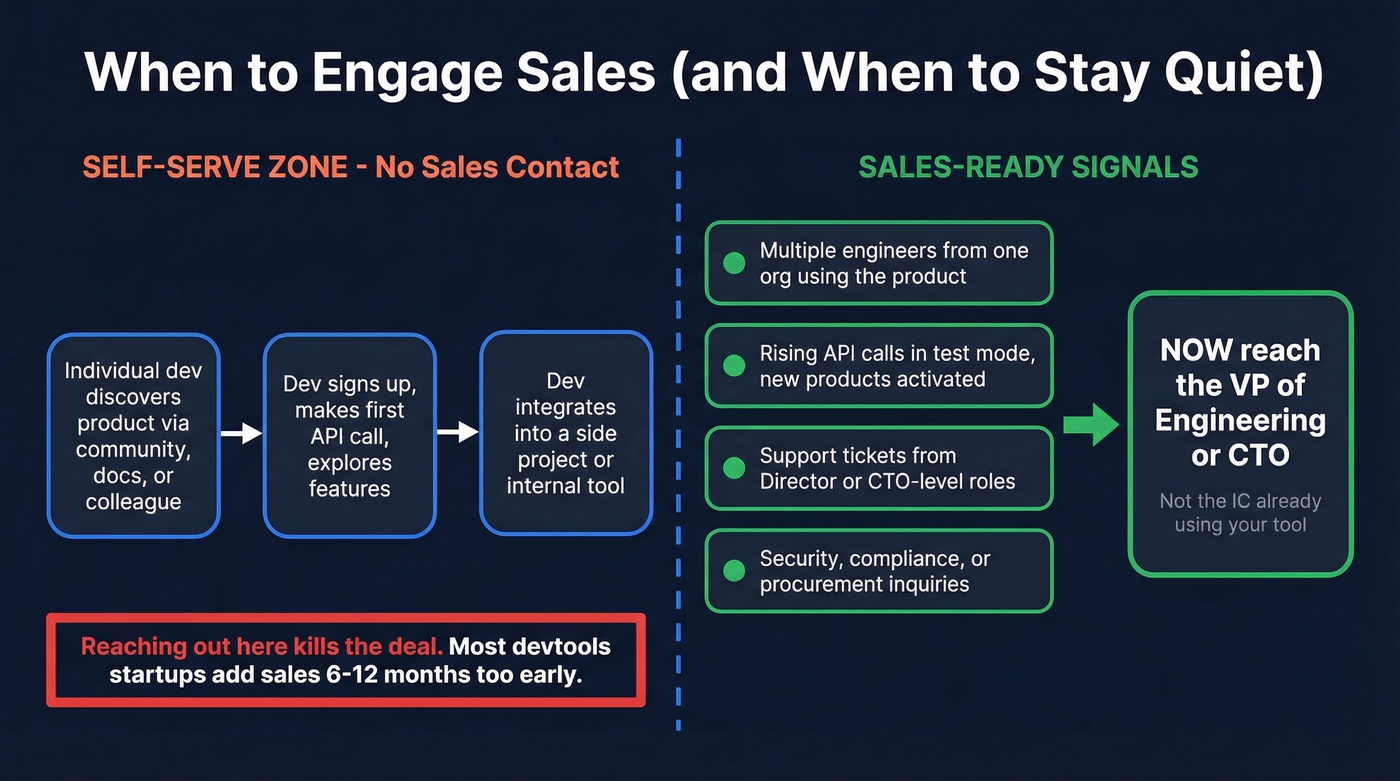
Stripe's sales team watches for usage signals: rising API calls in test mode, new products activated, increasing dashboard engagement velocity. They don't reach out to say "hey, want a demo?" They reach out to say "looks like you're scaling - here's how our enterprise features handle that." Blake Bartlett at OpenView Partners coined the term "product-led growth" to describe exactly this motion - the product does the selling, and sales amplifies what's already working.
Postman learned this the hard way. In their early years, premature sales outreach disrupted self-serve adoption and actually lost deals. We've seen this pattern repeatedly across devtools companies we work with - premature outreach kills deals that would have closed themselves. Postman introduced sales only once organic usage created enterprise demand: multiple developers from the same company, support tickets from director and CTO roles, security and compliance inquiries. Today they serve 35M developers and 98% of the Fortune 500.
Most devtools startups add sales 6-12 months too early. If individual developers aren't already adopting your product organically, a sales team won't fix that. It'll just burn your reputation faster.
So what signals should trigger sales involvement? Multiple engineers from one org hitting your product, support requests from architect or VP-level roles, and compliance questions. When those fire, you need verified contact data for the VP of Engineering or CTO - not the individual contributor who's already using your tool. Prospeo's database covers 300M+ professional profiles with 98% email accuracy, so you can reach the right decision-maker without guessing at email formats or bouncing off bad data.
Pricing That Developers Respect
Stripe published 2.9% + $0.30 per transaction from day one. No "contact sales." No custom quotes. Developers could calculate their costs before writing a single line of code.
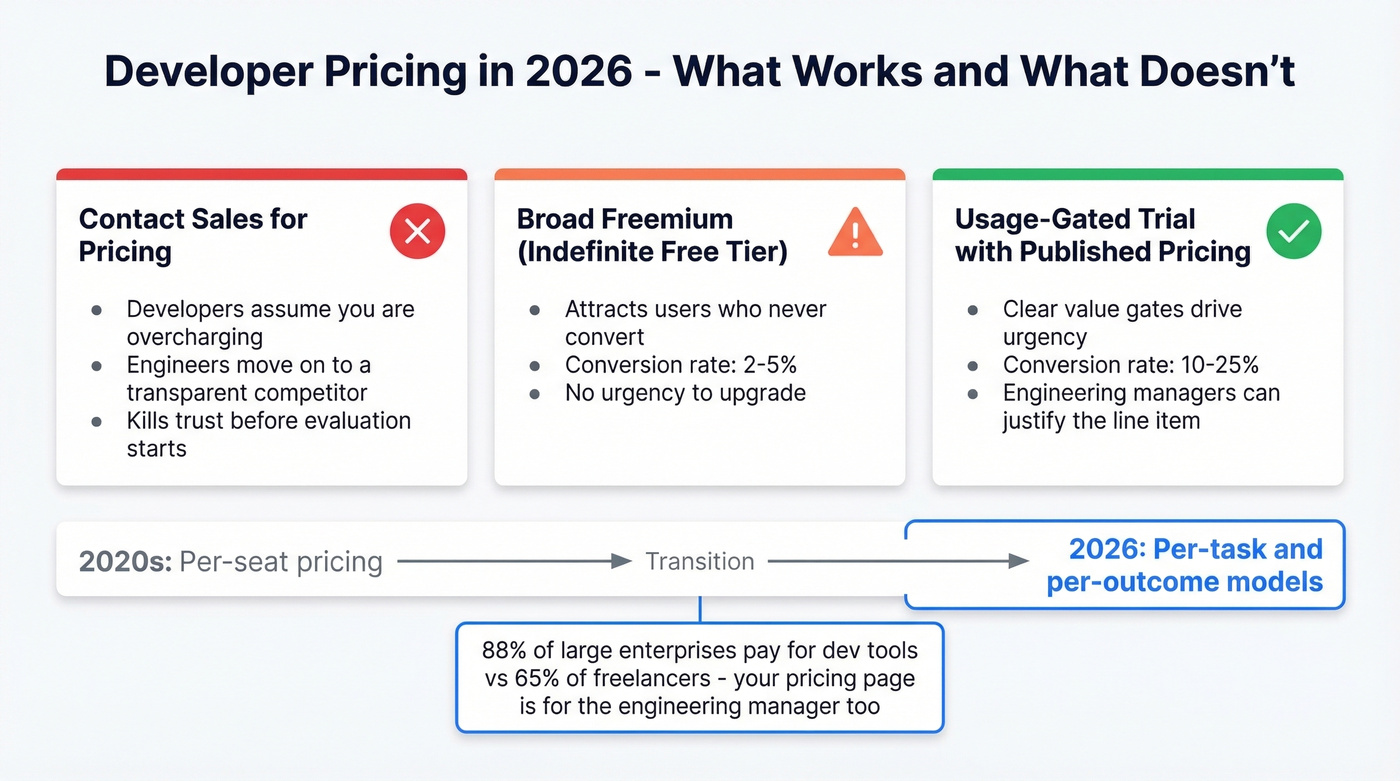
That transparency is a competitive advantage - and it's one we take seriously at Prospeo too, which is why our pricing is public and credit-based with no annual contracts.
The direction in 2026 is clear: per-seat pricing is giving way to per-task and per-outcome models, especially for AI-native products. Time-boxed trials are replacing indefinite freemium. Companies are learning that an open-ended free tier attracts users who never convert, while a focused trial with clear value gates drives urgency. Broad freemium models convert at 2-5%; usage-gated trials push that to 10-25%.
One more thing worth knowing: 88% of large enterprises pay for developer tools, compared to just 65% of freelancers. Your pricing page isn't just for individual developers - it's for the engineering manager who needs to justify the line item. Make that easy.
The Checklist
Do:
- Offer self-serve signup with no credit card required
- Get developers to a working API call in under 5 minutes
- Publish transparent pricing on your website
- Layer sales onto usage signals, not cold outreach
- Show up in the communities where your users already hang out
- Measure Time to First Hello World, not MQLs
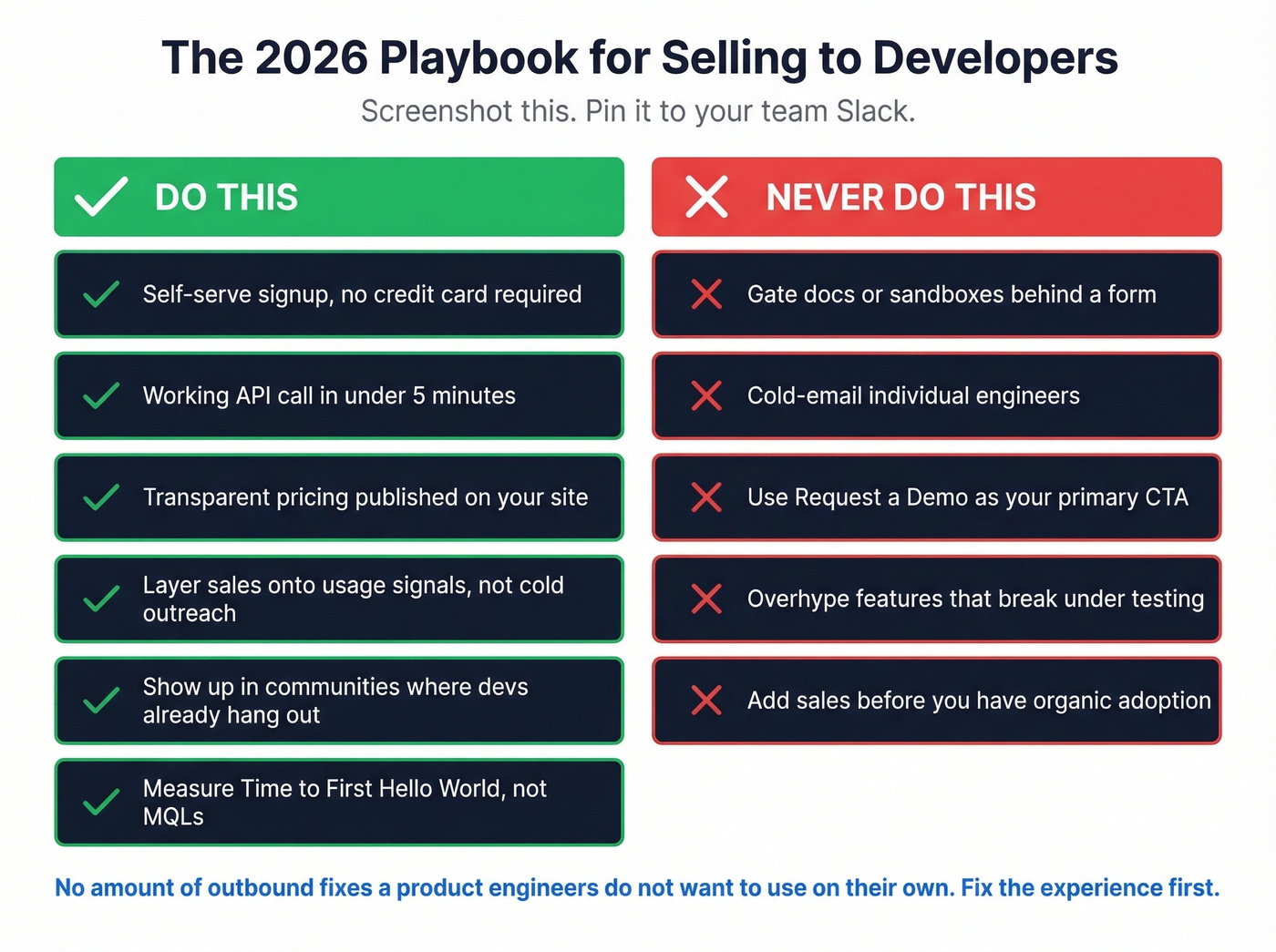
Don't:
- Gate docs, sandboxes, or quickstarts behind a form
- Cold-email individual engineers
- Use "Request a Demo" as your primary CTA
- Overhype features that don't hold up under testing
- Add sales before you have organic adoption signals
Skip the traditional playbook entirely if your product doesn't have organic developer adoption yet. No amount of outbound will fix a product that engineers don't want to use on their own. Fix the developer experience first, watch for real usage signals, and then - only then - bring in sales to help those signals turn into enterprise contracts.
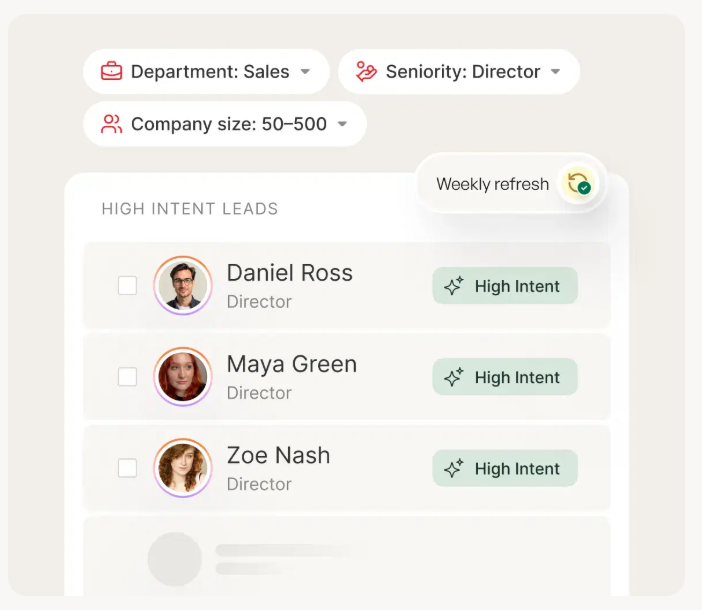
Multiple devs from one org hitting your product? That's your enterprise signal. Use Prospeo's 30+ filters - including department headcount and job title - to find the VP of Engineering at that company with a verified email for $0.01.
Turn organic developer adoption into enterprise pipeline in minutes.