

Signals Marketing: How to Build It and What Most Teams Get Wrong
Your marketing team identifies 200 accounts showing buying signals. Sales fires off outreach. Forty-seven emails bounce, 30 go to people who left the company six months ago, and pipeline from the whole initiative rounds to zero. The signals were real - the data underneath them wasn't.
That's the core tension of signals marketing in 2026. Less than 5% of your ICP is in-market at any given time, so you need to find and prioritize that sliver instead of blasting the whole TAM. But most teams get stuck on the signal layer and ignore the foundation: clean, verified contact data that actually lets you act on what the signals tell you.
Here's the thing - you don't need a $50K intent platform to get started. Start with one high-signal trigger like champion job changes, not ten. Master it before layering. Build on clean contact data so your emails actually land. A composable stack gets you 80% of the value.
What Is Signal-Based Marketing?
Signal-based marketing uses behavioral, firmographic, and engagement data to identify which accounts deserve attention right now - and what kind of attention they need. It's not a tool. It's an operating model.
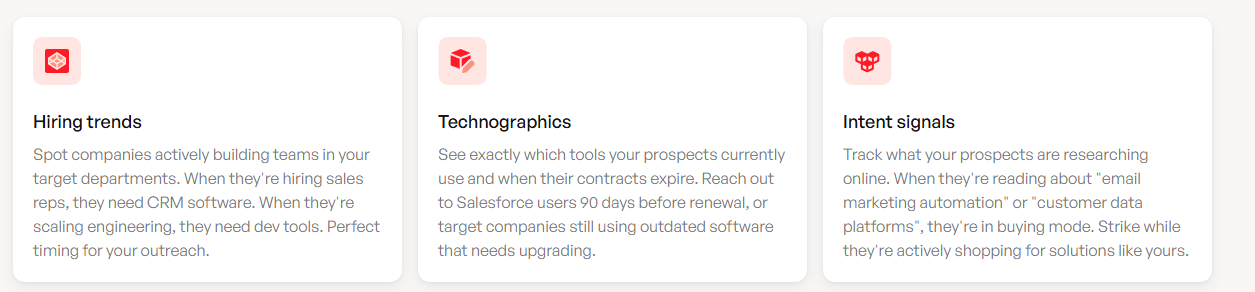
Most people hear "signal-based marketing" and think "intent data." Intent data is one type of signal. The full picture combines intent with fit signals that tell you whether the account matches your ICP, engagement signals showing how they interact with your content, and contextual triggers like job changes, funding rounds, and tech stack shifts. With 10+ stakeholders per B2B buying committee, you can't rely on one person's one action to trigger a play.
The critical reframe, articulated well by Forbes: signals aren't leads. A pricing page visit isn't a hand-raise. A content download isn't purchase intent. Signals are data points that, when layered together, tell you who's worth pursuing and when.
Why Signals Marketing Matters Now
The tracking infrastructure that powered B2B marketing for a decade is eroding. Safari and Firefox block third-party cookies by default. Chrome - holding roughly 65% of global browser share - shifted to a user-choice model that still reduces addressable audiences. About 40% of web traffic is already unaddressable through traditional tracking. On the measurement side, teams are moving from user-level attribution to modeled approaches, and GA4 plus Consent Mode v2 are becoming baseline upgrades rather than nice-to-haves.
Contact data degrades at roughly 2% per month. Over a year, that's nearly a quarter of your database going stale. If you're running signal-based plays on top of a database you haven't refreshed in six months, you're building on sand.
Less passive tracking data, more need for active signal collection, and a contact data foundation that rots without maintenance. The signal-driven approach isn't optional anymore - it's the replacement for the attribution-heavy, cookie-dependent playbook that's breaking down.
Three Types of Marketing Signals
Demandbase's taxonomy is the cleanest framework we've seen for organizing signals. Three categories, each valuable alone but dangerous in isolation.
| Signal Type | What It Tells You | Examples | Risk If Used Alone |
|---|---|---|---|
| Fit | Account matches your ICP | Industry, headcount, tech stack, revenue | Targets right-looking non-buyers |
| Intent | Account is researching your category | Search behavior, competitor visits, review sites | False positives from non-buyers |
| Engagement | Account is interacting with you | Website visits, webinar attendance, email replies | Over-indexes recent activity |
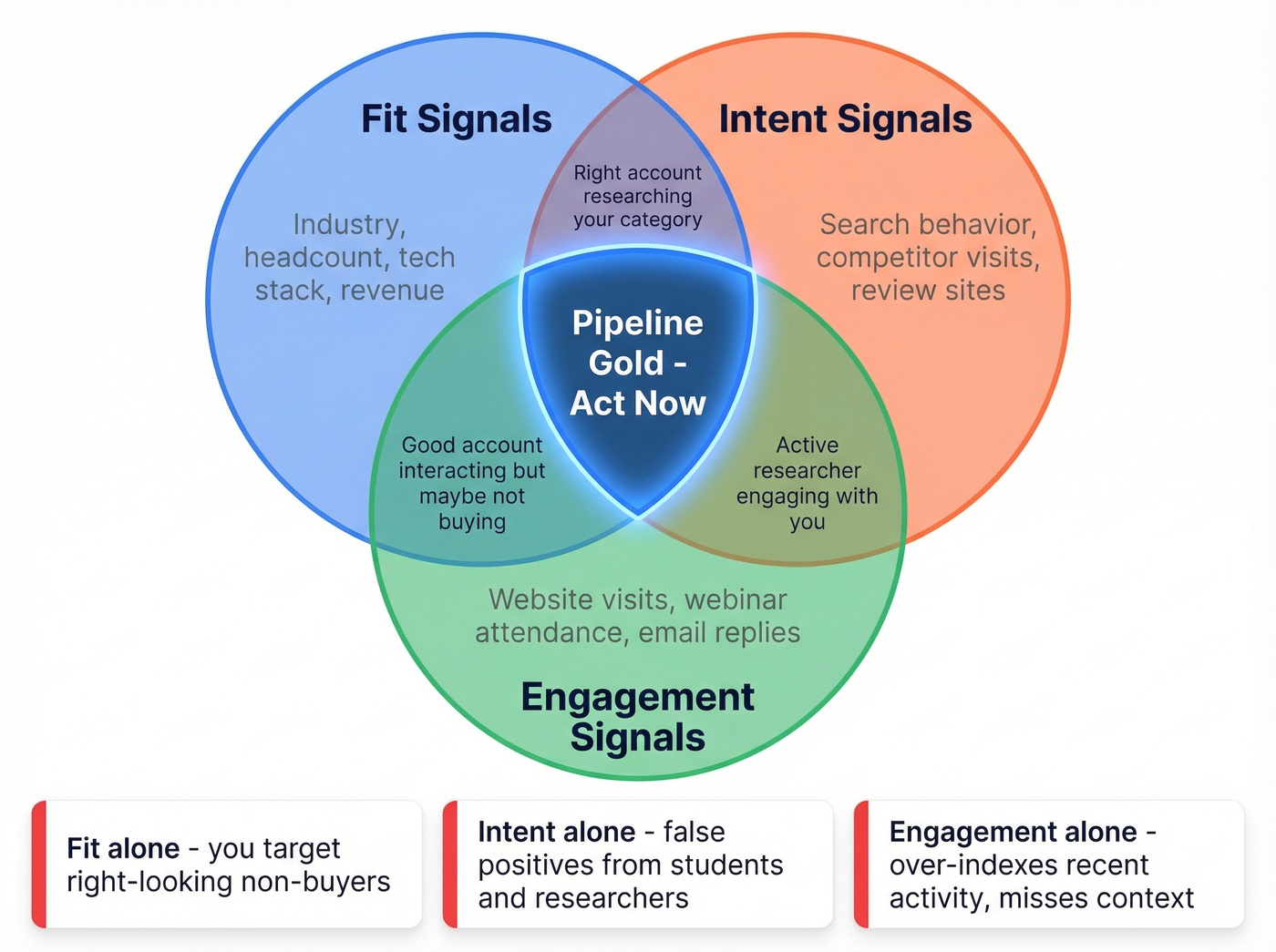
The student-downloading-an-ebook example is worth sitting with. That "engagement signal" looks identical to a director of IT downloading your integration guide. Without fit and intent context layered on top, your SDR team can't tell the difference.
This is why single-signal thinking kills pipeline. You swap one magic metric for another and wonder why conversion rates don't improve.
How to Build a Signal-Based System
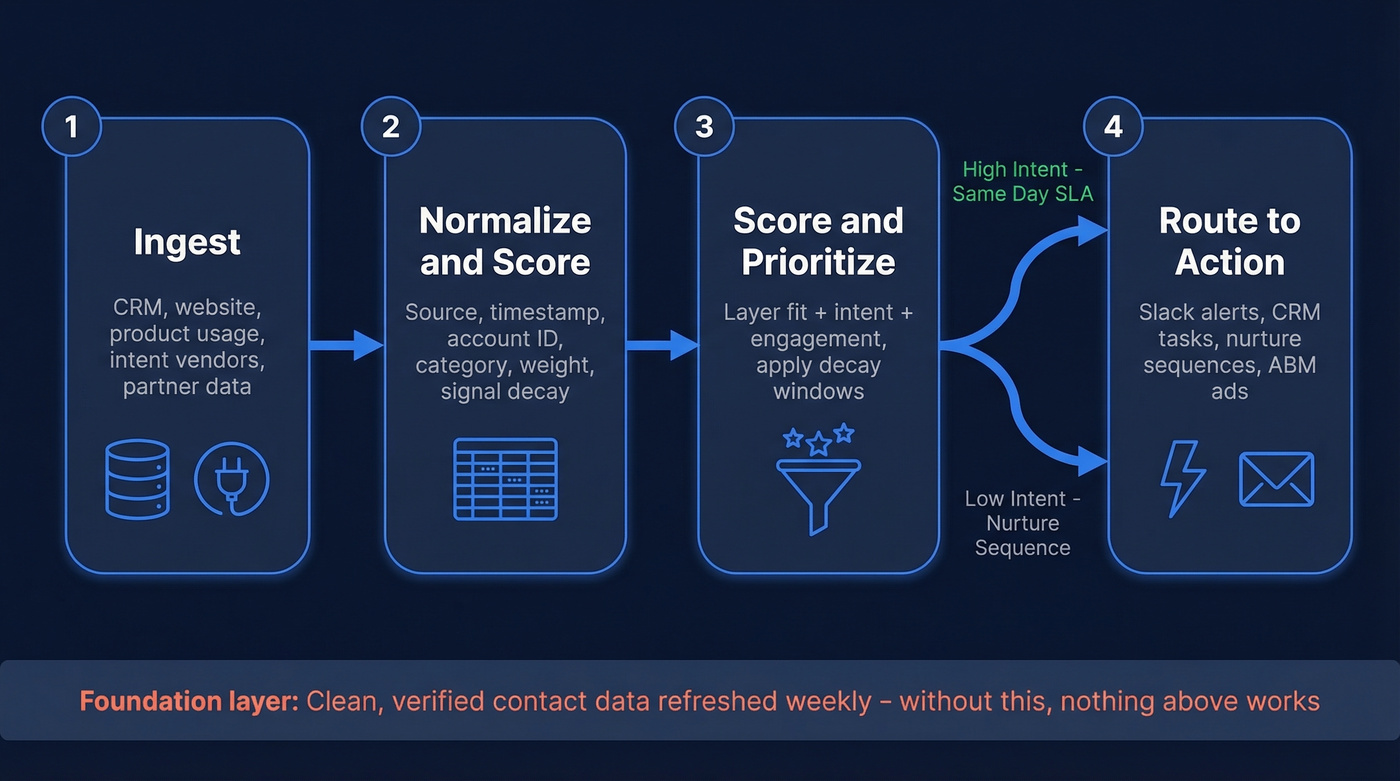
The architecture is straightforward: Ingest, Normalize, Score, Route. The execution is where teams stumble.
Ingest Your Signals
Connect your first-party sources - CRM, website analytics, product usage data - alongside second-party partner ecosystems and third-party intent vendors into a single system of record. This can be your CRM, a CDP, or a data warehouse; what matters is that signals don't live in silos. For most mid-market teams, Make.com, Zapier, or Fivetran handles the integration layer without requiring a custom data pipeline on day one.
Normalize and Score
Every signal needs a source, timestamp, account ID, signal category, event type, and weight. Without this structure, you can't compare a pricing page visit to a job change to a content download.
Scoring introduces signal decay - the concept that signals lose value over time at different rates. A pricing page visit loses most of its value the same day. A champion job change stays relevant for 30-60 days. Your scoring model needs to reflect these windows, or you'll treat a three-week-old website visit the same as one from this morning.
Route to Action
High-intent signals - pricing page visit combined with ICP fit and recent engagement - should trigger Slack alerts or CRM tasks with a same-day SLA. Lower-intent signals can feed nurture sequences or ABM ad campaigns. Set suppression rules too: one outreach attempt per account per 1-2 weeks prevents signal-triggered spam that burns relationships.
The routing layer is where most implementations stall. Teams build beautiful signal ingestion but then dump everything into a dashboard nobody checks. Automate the routing. If a signal is worth collecting, it's worth acting on automatically.
The consensus on r/b2bmarketing is simpler than vendors want you to believe. A composable stack - Make.com for automation, a verification tool for contact data, your existing CRM for routing - gets you most of the value. Enterprise platforms make sense at scale, but they aren't prerequisites.

Signals marketing fails when 47 emails bounce and 30 go to people who left. Prospeo's 7-day data refresh and 98% email accuracy ensure the contact data under your signals is actually current. Track 15,000 intent topics via Bombora, layer in job changes and technographics, and reach verified contacts - all from one platform at $0.01/email.
Stop building signal plays on a database that rots every month.
A Real Signal-Based Workflow
One practitioner on r/b2bmarketing shared a workflow using Make.com, Apify, Apollo, and ChatGPT that generates 4-8 new B2B customers per month:
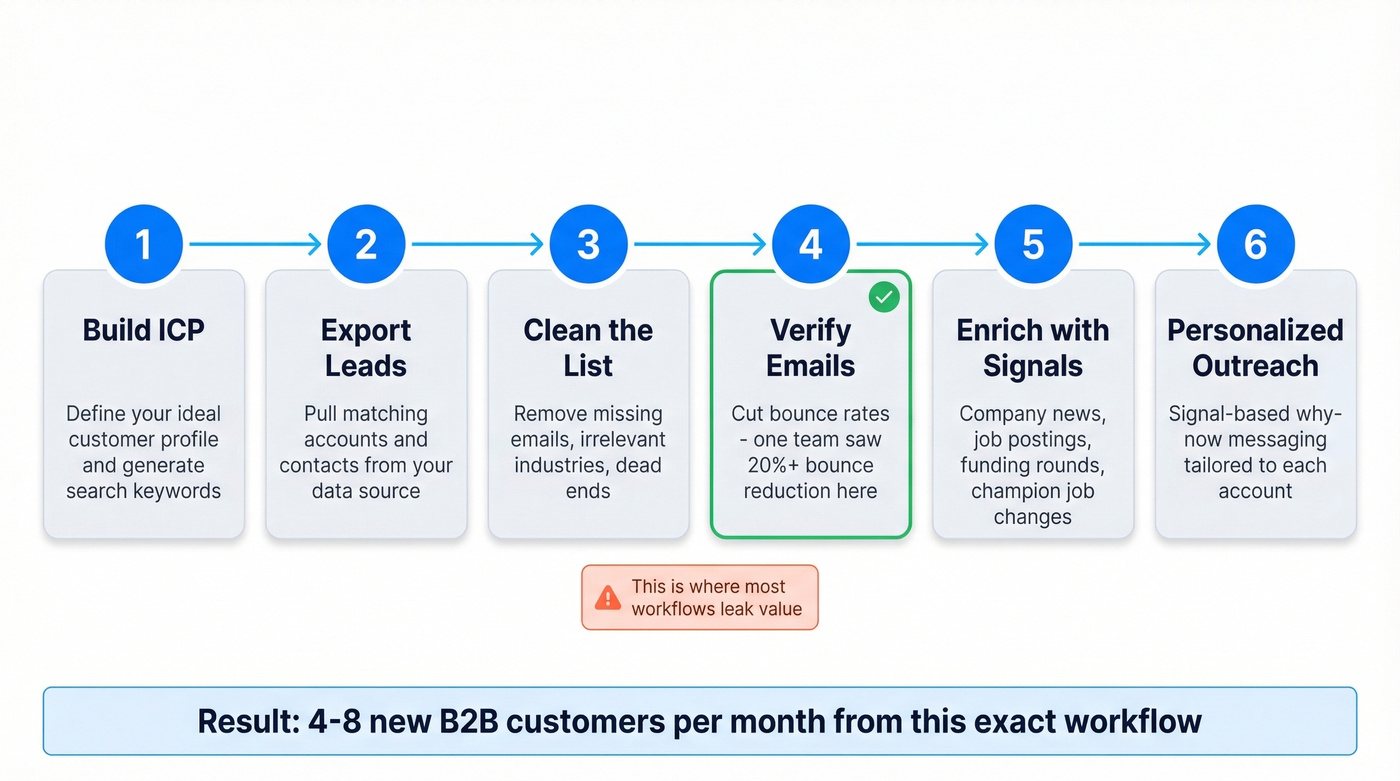
- Build your ICP and generate search keywords via ChatGPT
- Export matching leads from Apollo
- Clean the list - remove missing emails, irrelevant industries, dead ends
- Verify emails to cut bounce rates (the poster reported 20%+ bounce reduction from this step alone)
- Enrich with signals - company news, job postings, funding rounds, job changes
- Use Make.com + ChatGPT to generate personalized outreach with signal-based "why now" messaging
The verification step is where most workflows leak value. We've seen this pattern repeatedly: teams invest in signal infrastructure but skip the contact hygiene that makes it actionable. Prospeo fits here with 143M+ verified emails on a 7-day refresh cycle and 98% accuracy - so when a signal fires, you actually reach someone. One customer, Meritt, dropped their bounce rate from 35% to under 4% after switching. That's the difference between a signal-based workflow that generates pipeline and one that burns your domain reputation.
Let's think about the champion job-change scenario. A VP who loved your product just moved to a company 3x the size. That's a high-value signal. But do you have their new email? If your data provider refreshes monthly - or worse, quarterly - you're reaching out to a dead address while a competitor with fresher data books the meeting.
Signal-Based Advertising: 5 Plays
Signal-based marketing isn't just outbound. Paid media gets dramatically more efficient when you use intent-driven audience segments instead of static lists built from outdated firmographic data.
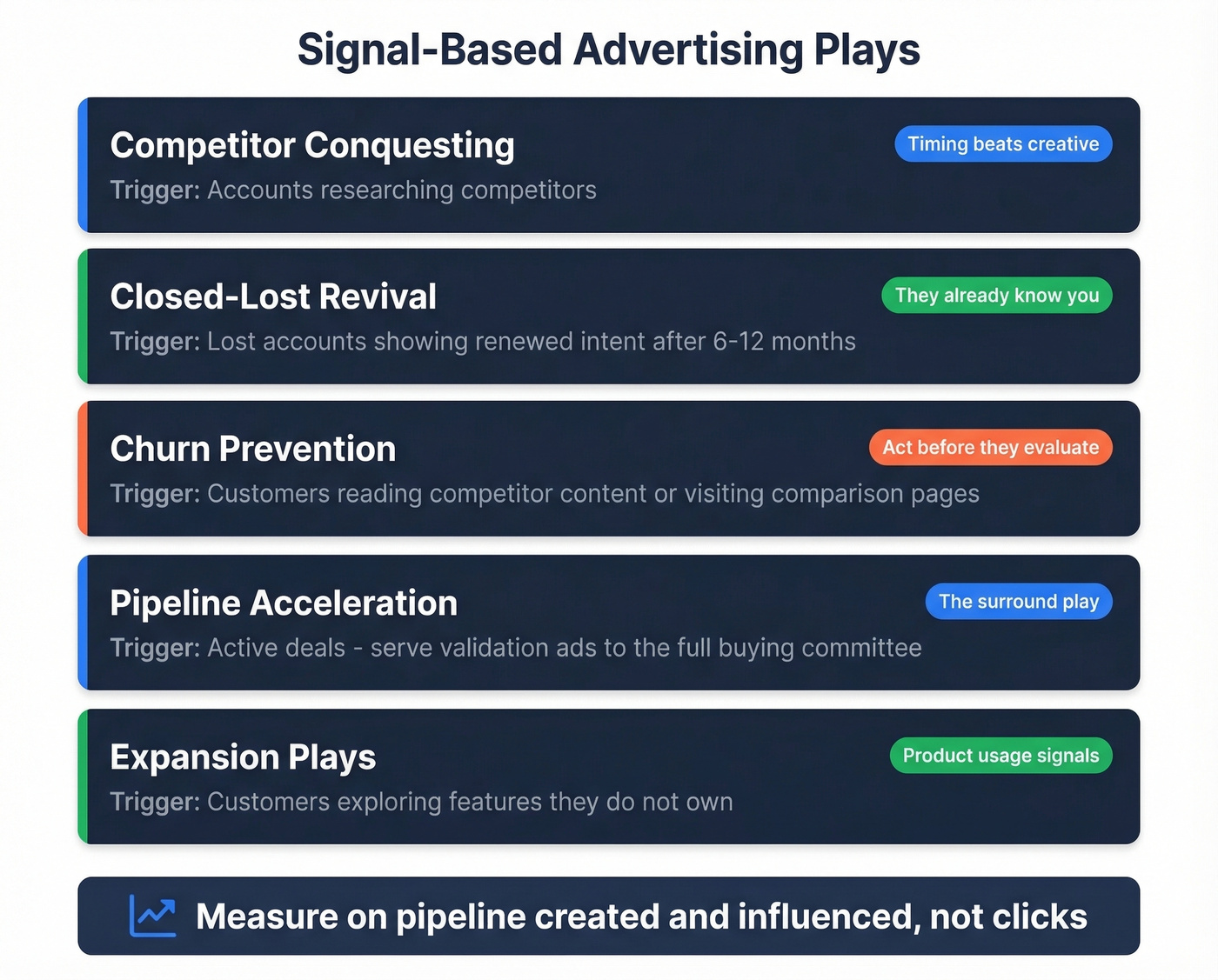
Competitor conquesting. Accounts actively researching competitors get ads positioning your differentiation. Timing matters more than creative here.
Closed-lost revival. Accounts you lost 6-12 months ago showing renewed intent signals. They already know you; the ad just needs to re-open the conversation.
Churn prevention. Current customers reading competitor content or visiting comparison pages. Surround them with case studies and ROI proof before they start evaluating.
Pipeline acceleration. Active deals get validation ads served to the broader buying committee. This is what Emily Kramer at MKT1 calls the "surround" play - customer stories, analyst reports, and ROI calculators reaching every stakeholder, not just your champion.
Expansion plays. Customers exploring features they don't own get targeted upsell content. Product usage signals trigger the campaign.
Measure these on pipeline created and influenced, not clicks. A signal-based ad that gets zero clicks but accelerates a $200K deal through committee is worth more than a thousand click-throughs from unqualified traffic.
The Tech Stack for Signal-Based Teams
The tool landscape maps to five jobs. You don't need a tool in every category on day one - but you need to know what exists.
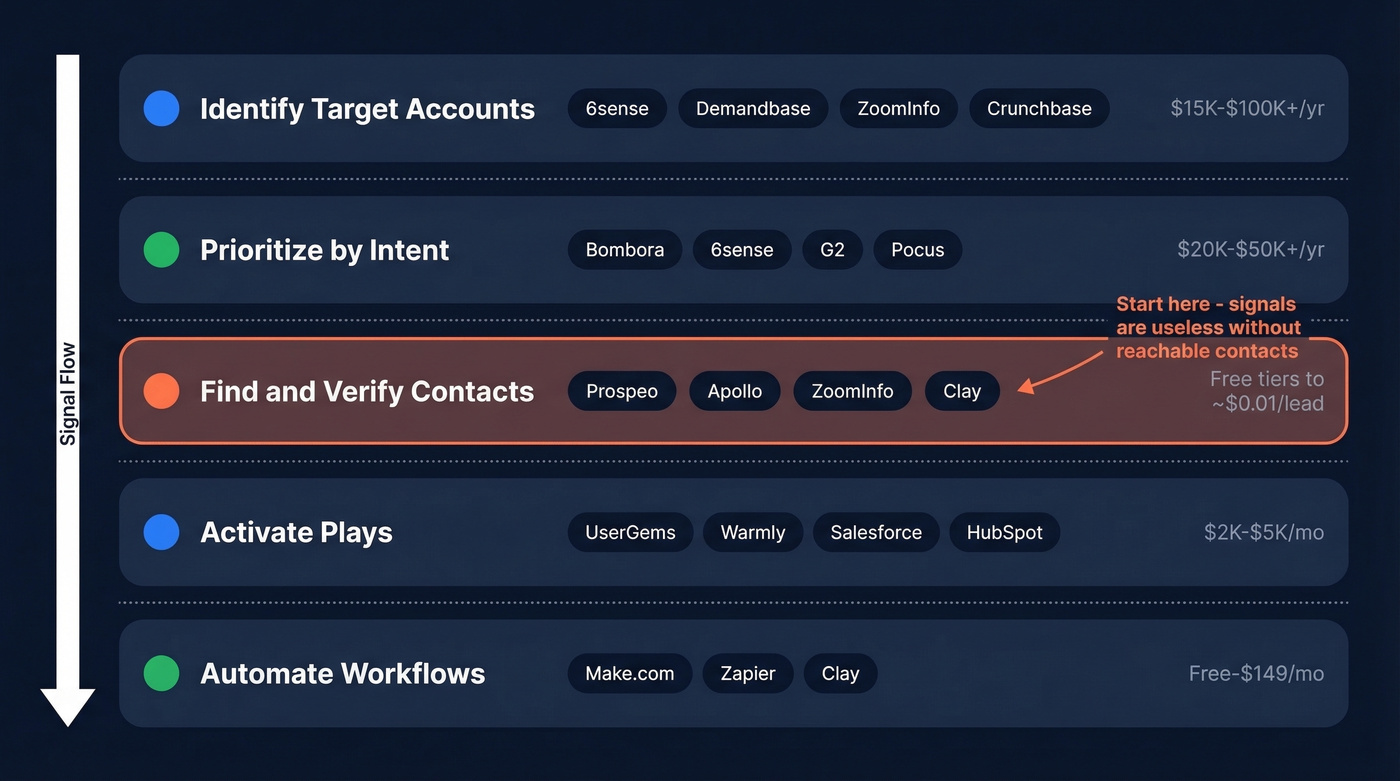
| Job to Be Done | Tools | Ballpark Pricing |
|---|---|---|
| Identify target accounts | 6sense, Demandbase, ZoomInfo, Crunchbase | $15K-$100K+/yr |
| Prioritize by intent | Bombora, 6sense, G2, Pocus | $20K-$50K+/yr |
| Find & verify contacts | Prospeo, Apollo, ZoomInfo, Clay | Free tiers; ~$0.01-$1/lead |
| Activate plays | UserGems, Warmly, Salesforce, HubSpot | $2K-$5K/mo |
| Automate workflows | Make.com, Zapier, Clay | Free-$149/mo |
6sense and Demandbase are the heavyweights for account identification and intent, but they're enterprise commitments - typically $30K-$100K+ annually. UserGems owns the champion job-change signal category and is typically a $30K-$60K/year mid-market investment. Bombora powers intent data for many platforms in this space. Apollo offers a strong free tier for getting started, though dedicated verification tools typically deliver higher accuracy rates.
The "find and verify contacts" row is where most teams should start spending. The fanciest intent signals in the world don't matter if you can't reach the people they identify.
5 Mistakes That Kill Pipeline
Signal substitution syndrome. You replaced "MQLs" with "intent signals" and changed nothing else. Different label, same broken process. Signal-based marketing requires a new operating model, not a new dashboard metric.
Treating all signals equally. A pricing page visit from an ICP-fit account isn't the same as a blog visit from a non-fit account. Without weighting and scoring, your team chases everything and closes nothing.
Ignoring data quality. You're running a $30K intent platform on top of a database where 20%+ of emails bounce. That's not a signal-driven strategy - that's expensive guessing. Contact data is the foundation, and most teams under-invest in it dramatically. (If this is your bottleneck, start with email deliverability and email bounce rate fundamentals.)
The "more is better" fallacy. In our experience, teams that ingest 15 signal sources end up with so many "high-priority" accounts that the designation becomes meaningless. Start with 2-3 signals. Add more only when you've proven the first ones convert.
No action SLAs. Signals decay. A pricing page visit actioned three days later is worthless. A job-change signal actioned two months later means someone else already booked the meeting. Define response windows for each signal type and hold your team to them.
What Signal-Based Marketing Delivers
The benchmarks from teams running mature signal-based programs are compelling:
- Behavioral Signals: ~$7M pipeline sourced through signal-based plays
- BigID: 5.9x higher win rate on signal-identified accounts; 88% of wins were pre-identified as high-quality
- Metadata: $3.5M pipeline in 150 days, 927% ROI, 13% human conversation rate vs. 6% benchmark
- Champion job-change leads convert at roughly 3x the rate of cold outreach
These aren't just case-study metrics to cherry-pick. The directional signal is clear: teams that layer fit, intent, and engagement data and act on it with clean contact data consistently outperform static list-based outbound. The gap isn't marginal. It's multiples.
That composable stack the Reddit poster built? Replace the weakest link. Prospeo gives you 300M+ profiles with 30+ filters - buyer intent, job changes, tech stack, funding - plus built-in email verification that cuts bounce rates below 4%. No $50K platform required.
Layer real signals on clean data and watch pipeline actually convert.
FAQ
What's the difference between signal-based marketing and intent data?
Intent data is one type of signal. Signal-based marketing combines intent with fit signals like firmographics and technographics, engagement signals from your own touchpoints, and contextual triggers such as job changes and funding rounds. A complete system tells you who, why, and when to act - across the full buying committee, not just one researcher.
Do I need an enterprise platform to start?
No. A composable stack - a verification tool for contacts, Make.com for automation, and your existing CRM - gets you 80% of the value of a $50K+ platform. Start with one high-signal trigger like champion job changes, prove pipeline, then expand.
How do first-party content signals differ from third-party intent data?
First-party content signals come from your own properties - blog visits, whitepaper downloads, webinar attendance. Third-party intent data tracks research behavior across the broader web via providers like Bombora. First-party signals are higher fidelity but only capture accounts that already know you. The strongest systems combine both.
How fast do marketing signals decay?
A pricing page visit loses most value the same day. A job-change signal stays relevant for 30-60 days. Contact data decays at roughly 2% per month - meaning a quarter of your database goes stale annually. Match your response SLA to each signal's decay window and refresh contact data on at least a weekly cycle.