


Simplescraper Review 2026: Pricing, Pros, Cons, and Honest Verdict
You need data off a website, you don't write code, and you don't want to spend a weekend learning Scrapy. That's the exact moment Simplescraper looks like a gift. With 90,000+ downloads and a free Chrome extension that lets you point, click, and export, it's one of the fastest ways to pull structured data from a webpage. But "fast to start" and "reliable at scale" are very different things - and we've spent enough time testing this tool to know where the line is.
Quick verdict: Best for quick, one-off scrapes by non-technical users. Not the right tool for large-scale recurring workflows or anti-bot-heavy sites.
Pricing Breakdown
Simplescraper runs on a credit-based model. Credits only apply to cloud scraping - local browser scraping is unlimited on every plan, including free. Recent comparisons put the Plus plan at $39/mo, though some older directories still list $35.
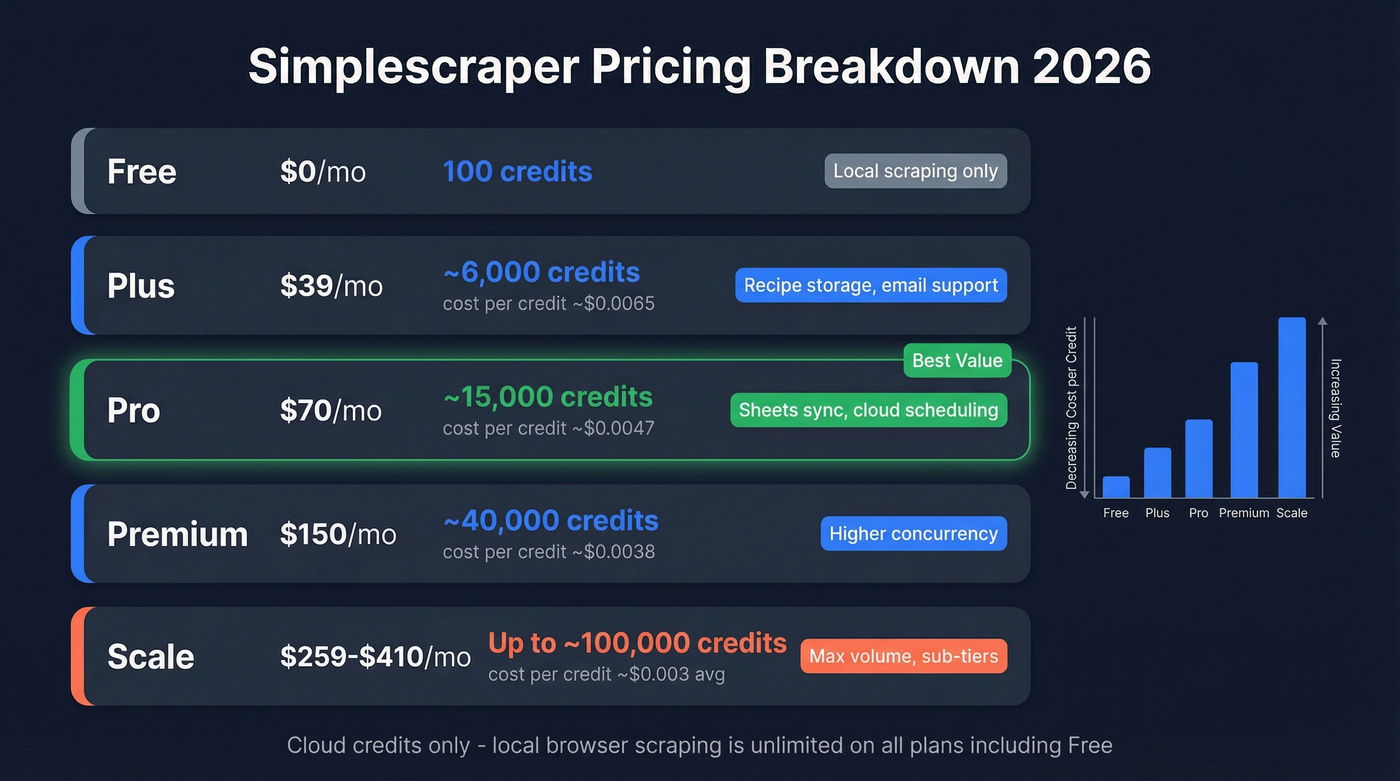
| Plan | Price/mo | Cloud Credits | ~Cost/Credit | Key Unlocks |
|---|---|---|---|---|
| Free | $0 | 100 credits | $0.00 | Local scraping, basic export |
| Plus | $39 | ~6,000 | ~$0.0065 | Recipe storage, priority email support |
| Pro | $70 | ~15,000 | ~$0.0047 | Real-time Google Sheets/Airtable sync, cloud scheduling |
| Premium | $150 | ~40,000 | ~$0.0038 | Higher limits and concurrency |
| Scale | $259-$410 | Up to ~100,000 | ~$0.003 avg | Max volume, multiple sub-tiers |
The free tier's 100 credits sound generous until a multi-page scrape burns through them in minutes. You'll know within an hour whether you need to upgrade.
The real value inflection happens at Pro ($70/mo), where you unlock cloud scheduling and real-time spreadsheet sync - the two features that make Simplescraper more than a toy. Below that tier, you're basically paying for a slightly fancier version of what free Chrome extensions already do.
Key Features Worth Knowing
- Cloud scraping with scheduling. Set hourly, daily, or custom schedules. Recipes run in the background with your browser closed.
- Concurrent recipe execution. Run tens or hundreds of recipes simultaneously on paid plans - useful for bulk URL lists.
- Integrations. Native sync with Google Sheets, Airtable, and webhooks. Zapier and Make connections extend it further.
- API with async support. Trigger recipes, poll results, paginate with cursors, and use a smart-extract endpoint that generates reusable CSS selectors via AI. We found the smart-extract endpoint genuinely useful for unfamiliar page structures - it saved us from manually inspecting DOM elements on several test sites. If a scrape exceeds 90 seconds, it returns a results ID you can poll instead of blocking.
- Unlimited local scraping on every plan, including free. Great for testing recipes before burning cloud credits.
Pros
- Point-and-click simplicity. No code required. Click an element, Simplescraper generates the CSS selector, and you're scraping in seconds.
- Generous free tier for testing. 100 cloud credits plus unlimited local scraping means you can validate recipes before spending anything.
- Cloud scheduling. Hourly and daily schedules turn one-off scrapes into automated data pipelines - a feature most free extensions lack entirely.
- API + AI smart-extract. The smart-extract endpoint uses AI to generate selectors, which is a real differentiator for unfamiliar page structures.
- Spreadsheet sync. Real-time Google Sheets and Airtable sync on Pro and above.

Simplescraper gets you company data off websites. But what you actually need are verified emails and phone numbers for the decision-makers at those companies. Prospeo gives you 300M+ profiles with 98% email accuracy - no selectors to break, no proxies to manage.
Turn scraped company lists into actionable contact data in seconds.
Cons
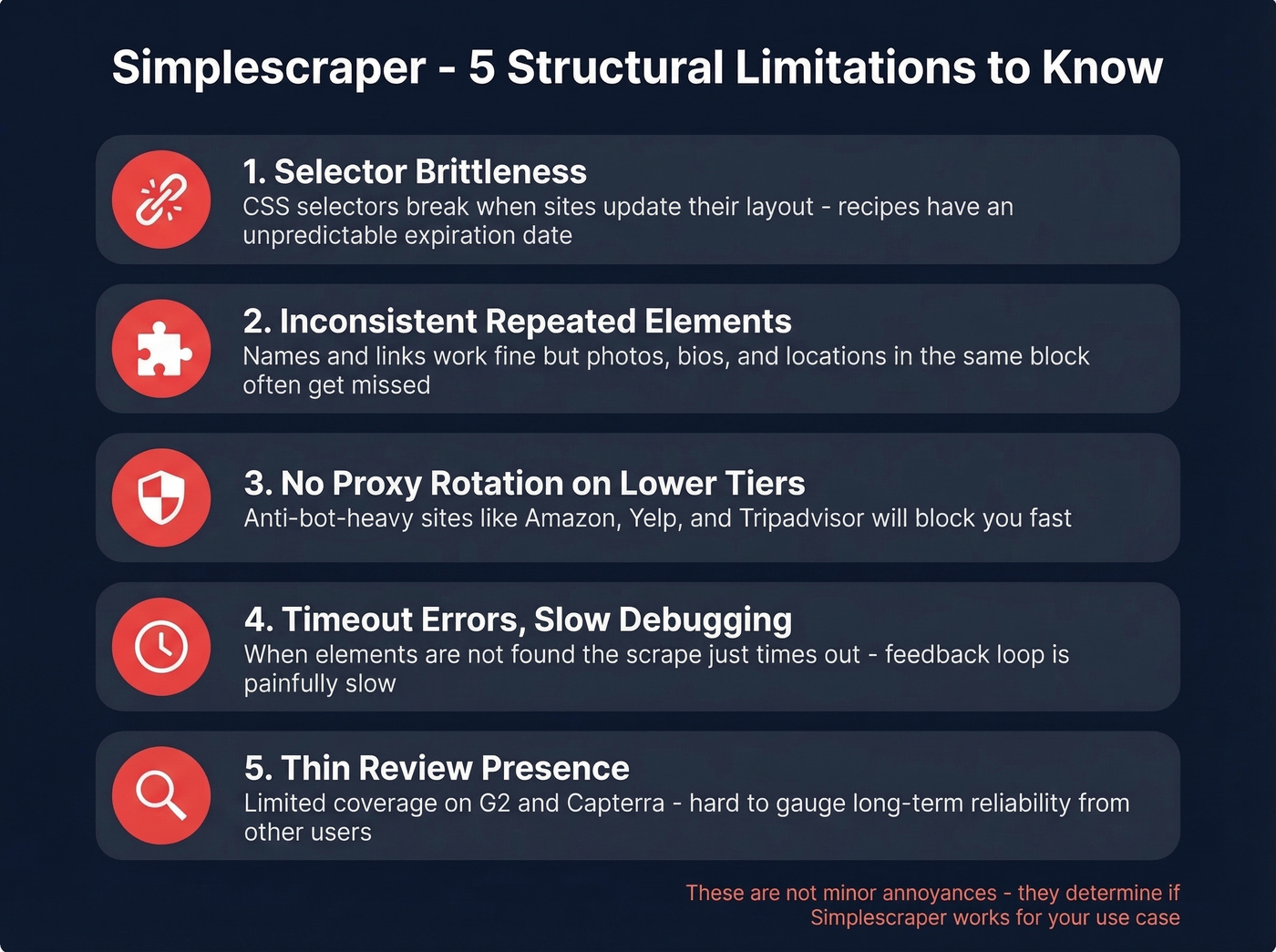
Here's the thing: the cons aren't minor annoyances. They're structural limitations that determine whether Simplescraper works for your use case at all.
Selector brittleness is the core frustration. CSS selectors break when a site changes its layout. One Reddit user put it bluntly: "worked before but now it won't." Even the creator acknowledged early on that the CSS selector "still ain't 100%." This isn't a bug - it's the fundamental limitation of selector-based scraping, and it means any recipe you build has an expiration date you can't predict.
Repeated element extraction is inconsistent. Names and links get captured fine, but photos, bios, and locations on the same page often get missed. In our testing, mixed element types in a repeating block were the most common failure point.
No built-in proxy rotation on lower tiers. Try scraping Amazon, Yelp, or Tripadvisor and you'll get blocked fast. Anti-bot-heavy sites need proxy infrastructure that Simplescraper doesn't provide.
Timeout errors with limited debugging. When an element can't be found, the scrape times out. The troubleshooting docs help, but the feedback loop is slow compared to code-based tools.
Thin review presence. Simplescraper has limited coverage on major review platforms like G2 or Capterra, so independent evaluation often comes down to Reddit threads and a handful of blog posts. That makes it harder to gauge long-term reliability from other users' experiences.
Who Should (and Shouldn't) Use It
Simplescraper is a strong fit if you need quick, one-off scrapes from relatively simple websites, you're non-technical and prefer point-and-click over Python, or you want structured data landing directly in Google Sheets or Airtable without manual CSV imports. It's also a solid way to test whether a scraping workflow is even viable before investing in heavier infrastructure like web scraping lead generation.
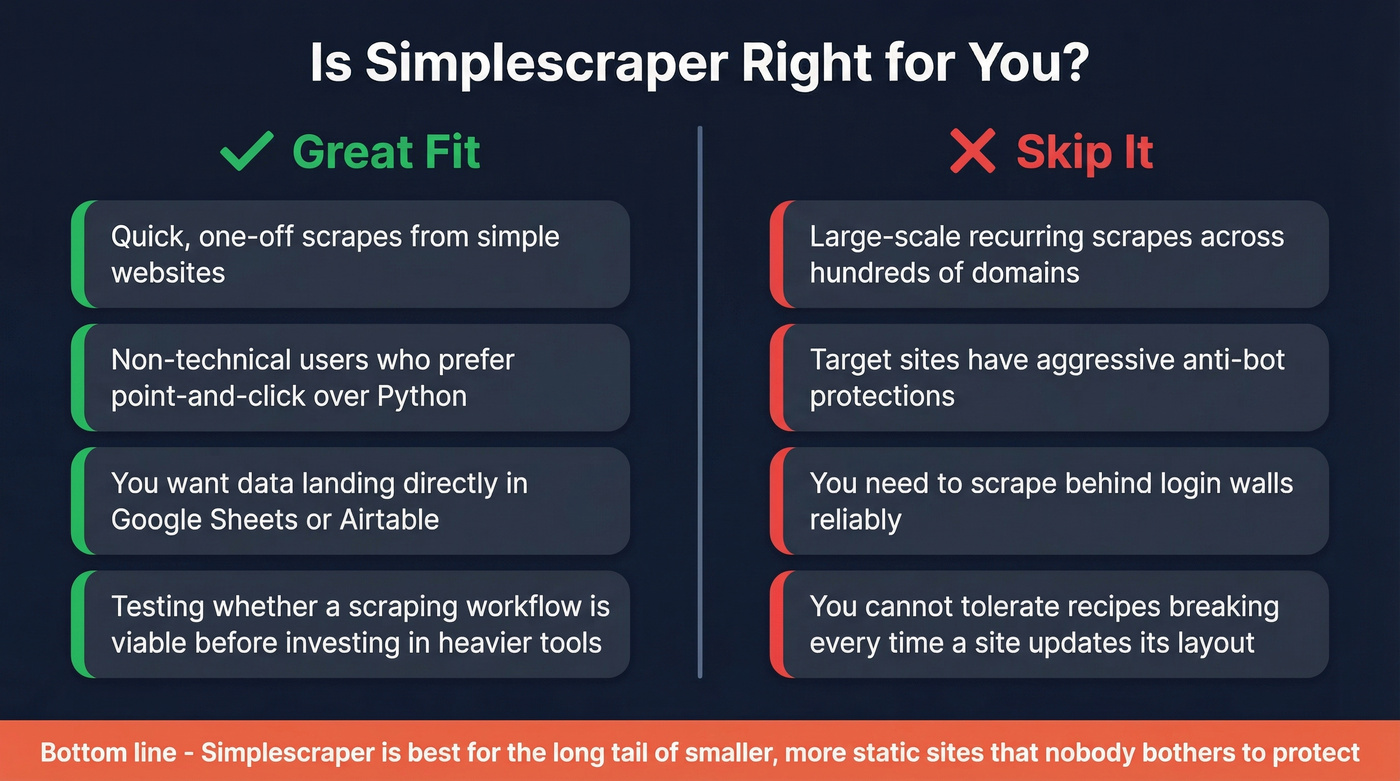
Skip it if you're running large-scale recurring scrapes across hundreds of domains, your target sites have aggressive anti-bot protections, you need to scrape behind login walls reliably, or you can't tolerate recipes breaking every time a site updates its layout.
Let's be honest: if your scraping target is a well-maintained SaaS directory or major platform, the site will update its layout faster than you can fix your selectors. Simplescraper is best for the long tail of smaller, more static sites that nobody bothers to protect.
Alternatives Worth Considering
Apify
The platform-level option. Prebuilt "actors" handle common scraping jobs - Google Maps, e-commerce, social media - and the infrastructure scales well beyond a Chrome extension. Starts around $39/mo. The consensus on r/automation is that it's solid infrastructure but heavier than needed for small jobs. If you've outgrown Simplescraper's limits, Apify is the natural step up (and you can also compare Apify vs Octoparse if you're deciding between the two).
Octoparse
A desktop no-code scraper with built-in login handling and strong support for dynamic patterns like infinite scroll. Plans start around $89/mo - more than double Simplescraper's Plus tier, but substantially more capable for anti-bot sites. For teams scraping e-commerce or review platforms, Octoparse handles the headaches Simplescraper can't.
Prospeo
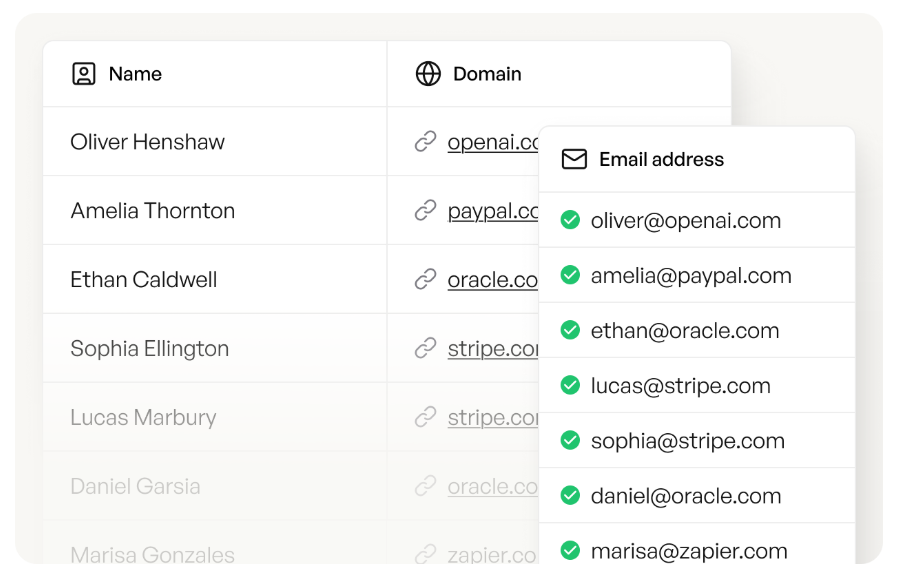
Not a scraping competitor - it's what comes after scraping. Simplescraper extracts company data from websites; Prospeo finds verified emails and phone numbers for the people at those companies. With 98% email accuracy, 300M+ professional profiles, and a 7-day data refresh cycle, it bridges the gap between raw scraped data and actionable outbound lists. Free tier available with 75 emails and 100 Chrome extension credits per month.
Instant Data Scraper
A free Chrome extension with zero cloud capabilities, no scheduling, and no API. For truly one-off jobs where you don't need automation, it does the job at no cost. Don't expect anything beyond that.
A Workflow That Ties It Together
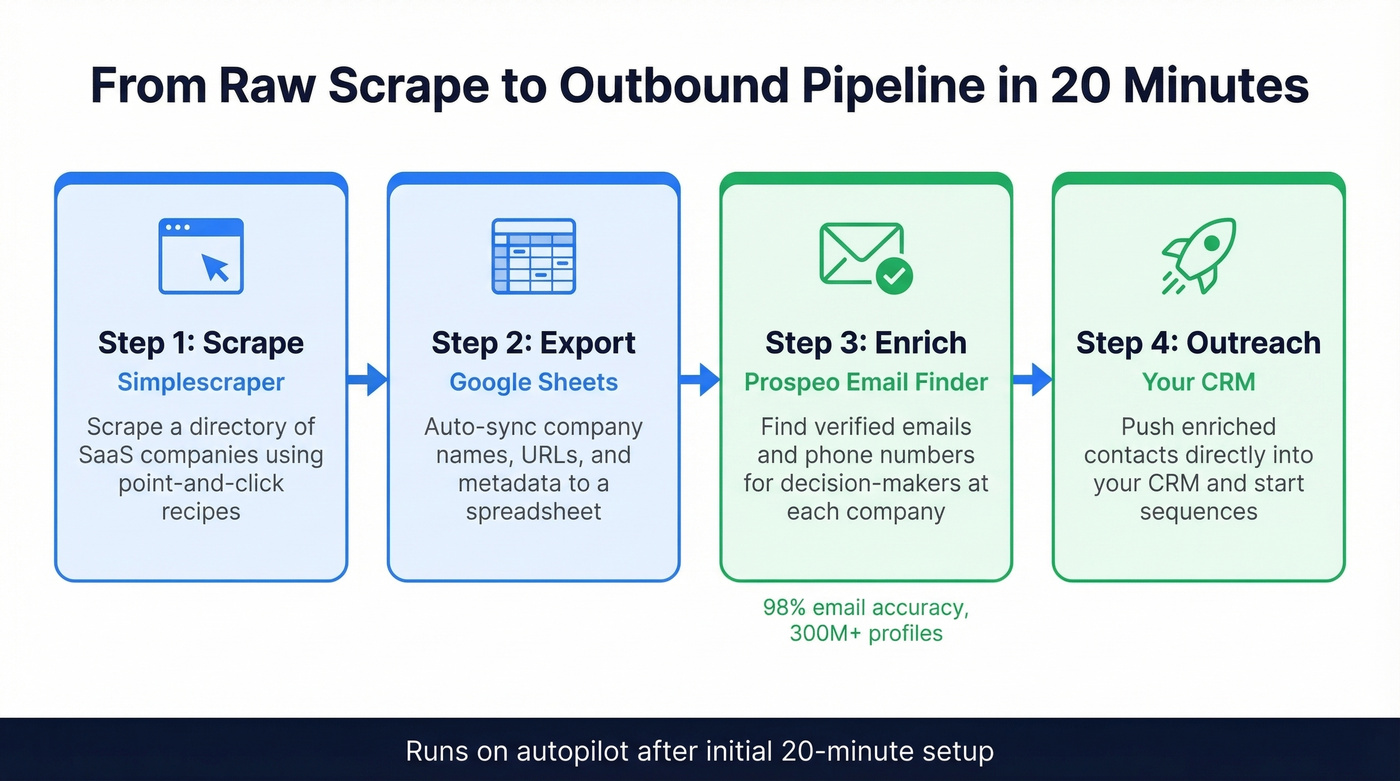
A concrete pipeline we've seen work well: scrape a directory of SaaS companies with Simplescraper, export to Google Sheets, enrich with Prospeo's email finder, then push to your CRM (see data enrichment services if you're comparing options). That pipeline takes about 20 minutes to set up and runs on autopilot from there.
Verdict
Simplescraper is great for the first scrape and frustrating by the fifth. The point-and-click experience is genuinely impressive for quick jobs. But the moment you need reliability - recurring schedules, anti-bot sites, complex page structures - the selector brittleness and missing proxy support start to bite.
Our recommendation: test your recipe at least 3 times over 2 weeks before committing to a paid plan. If the selectors hold and the data comes back clean, the Pro tier at $70/mo is solid value. If you're fighting timeouts and missing elements, move to Octoparse or Apify instead. And if your end goal is turning scraped company lists into verified contacts, layer Prospeo on top - the accuracy difference between raw scraped emails and verified ones is the difference between deliverability and domain damage (use an email deliverability guide and email bounce rate benchmarks to sanity-check results).
Scraping is step one. Reaching the right people is the whole point. Prospeo's 7-day data refresh means your contact data never goes stale - unlike CSS selectors that break overnight. At $0.01 per email, it costs less than a single Simplescraper cloud credit.
Skip the scraping headaches and go straight to verified contact data.
FAQ
Is Simplescraper's free plan enough to evaluate the tool?
Yes, but barely. The 100 cloud credits can disappear in a single multi-page scrape. Unlimited local scraping lets you refine recipes without spending credits, though. Give yourself a full week of testing across different sites before deciding on a paid tier.
Can Simplescraper handle JavaScript-heavy websites?
The Chrome extension handles JavaScript-rendered pages since it runs in your actual browser. Cloud scraping also supports JavaScript-heavy pages, but dynamic content with infinite scroll or login walls often requires workarounds. For heavily dynamic sites, Octoparse handles those edge cases more reliably.
How does Simplescraper compare to code-based scrapers?
It's dramatically faster to set up - minutes vs. hours - but far less flexible. Code-based tools like Scrapy or Puppeteer let you handle anti-bot measures, custom pagination, and error recovery. Simplescraper wins on speed-to-first-result; code wins on long-term reliability and scale.
What's the best way to turn scraped data into sales leads?
Scrape company names and URLs with Simplescraper, then enrich them with a B2B data platform. Prospeo's email finder returns 98%-accurate verified emails from 300M+ profiles, and the enrichment API matches 92% of records - turning a raw company list into a ready-to-use outbound pipeline.