

SMART Goals for Sales: Real Benchmarks, Not Guesswork (2026)
A RevOps lead we know sat through a January kickoff where the CRO announced a 25% revenue increase - no new headcount, no new territory, no math. Just vibes. The room nodded along, and by year's end, 84% of reps missed quota. That's not an ambition problem. It's a math problem, and it's why smart goals for sales need arithmetic, not applause lines.
Let's fix that.
What You Need Before Setting Goals
Before you write a single SMART goal, gather three things:
- A baseline. Your current close rate, average deal size, and cycle time - pull 6-12 months of historical data, not last month's snapshot.
- A benchmark. Where does your performance sit relative to the market? We've compiled the numbers below.
- Pipeline math. The standard planning heuristic is 3x coverage. If your quota is $250K, you need $750K in pipeline.
Research from Dominican University found that writing goals down makes you 42% more likely to achieve them. But writing down the wrong goals doesn't help anyone. You need three goals, not fifteen. More than that dilutes focus and kills accountability.
What SMART Actually Means
George Doran coined the SMART framework in 1981. It's been recycled in every management book since, usually with generic examples that don't help salespeople. Here's what each letter looks like when you're actually selling:
| Letter | Stands For | Sales Example |
|---|---|---|
| S | Specific | Win rate: 19% → 24% |
| M | Measurable | CRM stage conversion, weekly |
| A | Achievable | 21% industry avg win rate |
| R | Relevant | Directly impacts quota |
| T | Time-bound | By end of Q3 2026 |
The "A" is where most leaders fail. Achievable doesn't mean "sounds reasonable in a planning meeting." It requires a baseline - actual historical performance data. Without that, you're guessing. And guessing is how you get the 25% increase with no math behind it.
Set Your Baseline First
Here's the thing: almost nobody asks "what's our close rate right now?" before setting a target close rate. They skip straight to the aspirational number.
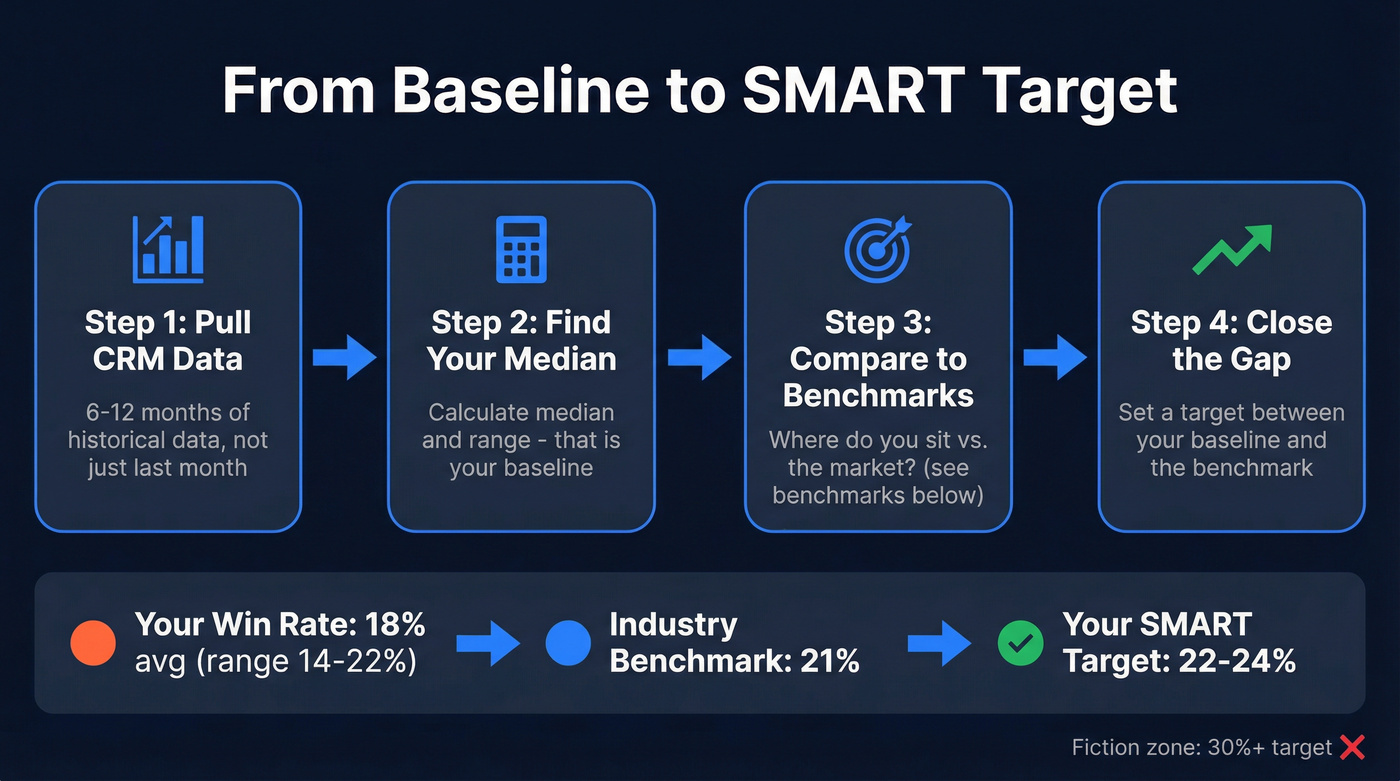
Stacey Barr, a measurement strategist who's written extensively on KPI methodology, recommends 6-12 months of historical data for any baseline. Routine variation exists in every sales org. One great month doesn't mean you've found a new normal.
The process:
- Pull 6-12 months of CRM data for the metric you're targeting.
- Calculate the median and the range. That's your baseline.
- Compare it to external benchmarks in the next section.
- Set a target that closes a specific percentage of the gap between your baseline and the benchmark.
If your win rate has averaged 18% over nine months with a range of 14-22%, setting a goal of 30% isn't ambitious - it's fiction. A target of 22-24% is aggressive but grounded in reality.
Benchmarks to Ground Your Targets
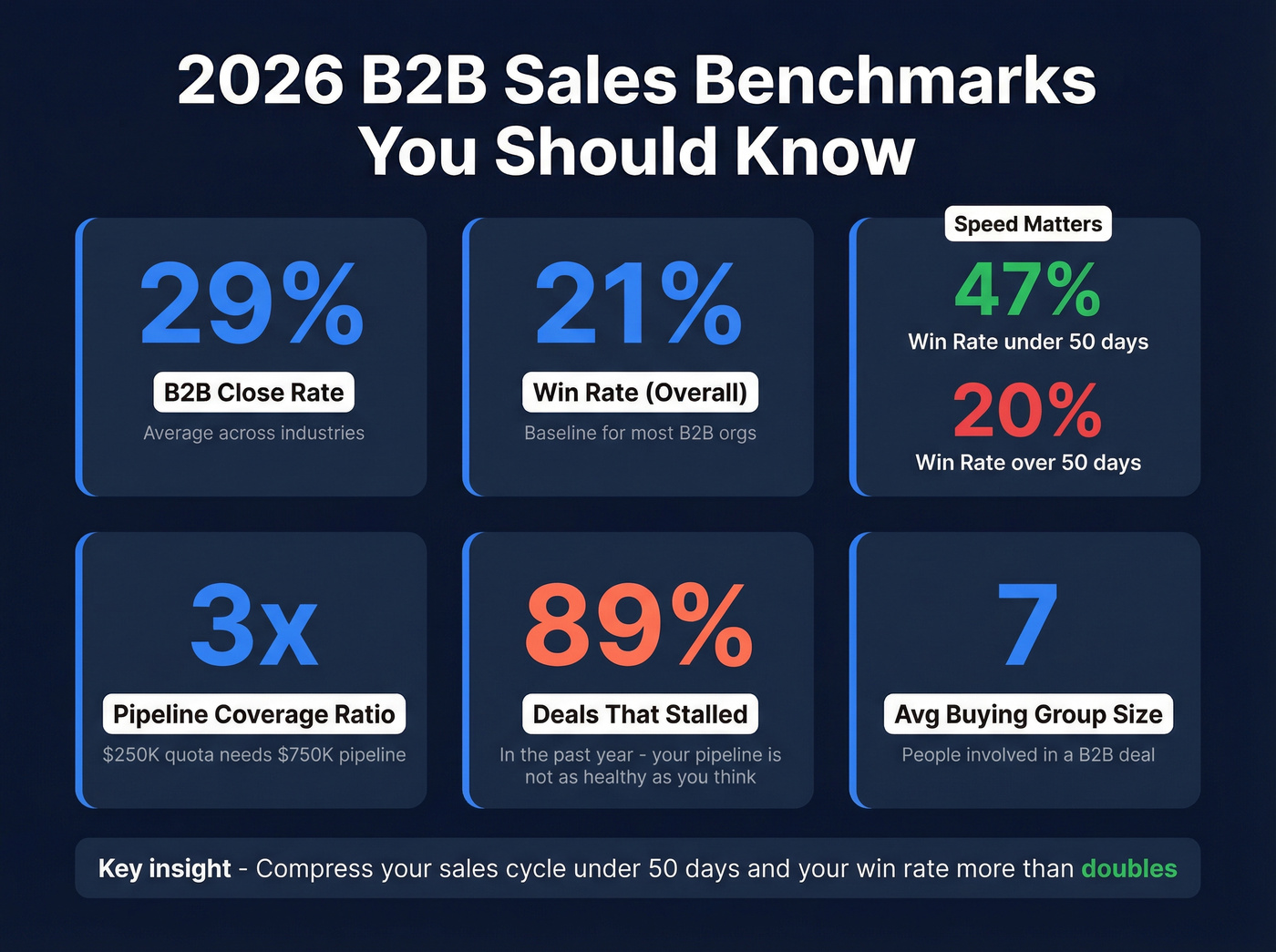
These are the numbers you should compare against, pulled from recent industry data so you don't have to dig through ten vendor reports.
| Metric | Benchmark | Source |
|---|---|---|
| B2B close rate | 29% | Kondo |
| Win rate | ~21% | Kondo |
| Win rate (≤50 days) | 47% | Outreach |
| Win rate (>50 days) | ≤20% | Outreach |
| Quota attainment | 71% hit "usually/always" | Pipedrive |
| Pipeline coverage | 3x quota | Industry standard |
| Avg buying group | ~7 people | Kondo |
| Avg B2B sales cycle | 1-3 months | Kondo |
| Deals stalled (past yr) | 89% | Kondo |
Two numbers jump out. Deals that close within 50 days have more than double the win rate of deals that drag past that mark - if you aren't setting cycle-time goals, you're leaving money on the table. And 89% of B2B buyers reported a deal stalling in the past year, which means your pipeline isn't as healthy as your CRM says it is.
Company size matters too. Reps at companies with 100+ employees are 11% more likely to hit quota than those at companies with 10 or fewer. If you're running a small team, your benchmarks should reflect that reality.
The 3x pipeline coverage ratio is the most useful planning heuristic we've found. Quarterly quota of $250K? You need $750K in qualified pipeline entering the quarter. Work backward from there.

Pipeline math only works when your reps reach real people. Prospeo delivers 98% email accuracy and 125M+ verified mobile numbers with a 30% pickup rate - so your SDRs hit their qualified meeting targets instead of dialing dead numbers from a stale database.
Stop setting SMART goals on top of bad data.
SMART Sales Goal Examples by Role
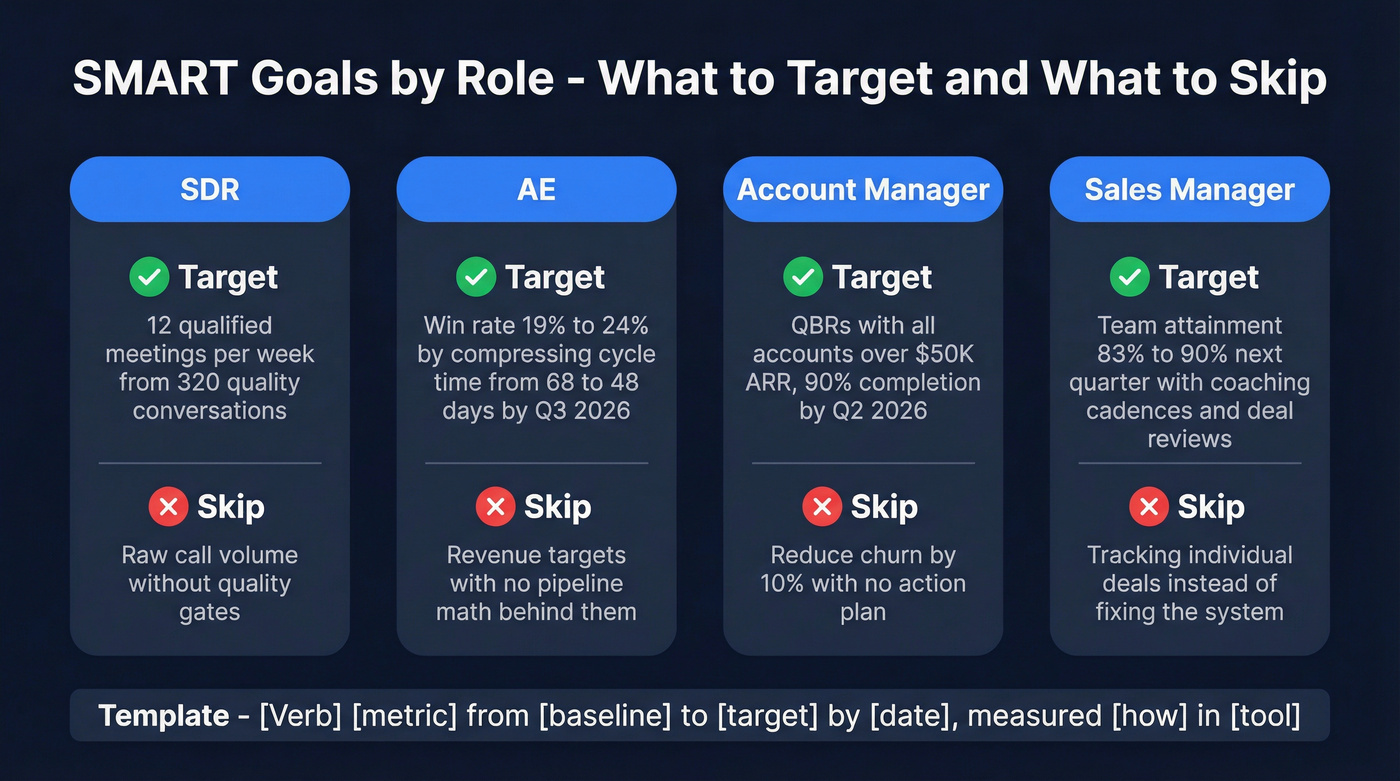
Not every role should chase the same metrics. Here's what to target - and what to skip - for four common sales roles.
SDR Goals
Target: Qualified meetings booked, not raw activity volume. An SDR who books 12 qualified meetings from 200 calls outperforms one who makes 500 calls and generates 15% less pipeline.
Skip: "Make X calls per day" as a standalone goal. Activity goals without quality gates produce busywork. We've seen teams where call volume went up 40% and pipeline went down because reps were dialing bad numbers from a stale database.
The reverse-engineering approach works well here: if the team needs 40 qualified meetings per month and your meeting-to-conversation rate is 1 in 8, that's 320 quality conversations. That math only works if reps are reaching real people at real numbers - which is where data enrichment makes or breaks the equation. Prospeo's 98% email accuracy and 125M+ verified mobile numbers mean your SDRs spend time selling instead of chasing disconnected lines.
45% of teams now use a hybrid AI-SDR model for initial outreach. If your team is one of them, set goals around the conversations humans handle, not the volume AI generates.
AE Goals
The Outreach data tells the story here. If your average deal takes 70 days and your win rate is 18%, the goal should be compressing to under 50 days - where win rates jump to 47%.
A solid SMART goal: "Increase win rate from 19% to 24% by reducing average cycle time from 68 to 48 days, measured weekly in Salesforce, by end of Q3 2026."
Skip revenue targets without pipeline math behind them. An AE can't control how many opportunities they receive. They can control how fast they move deals and how well they multi-thread across the average 7-person buying group.
Account Manager Goals
A 5% increase in customer retention can boost profits by up to 95%, according to Bain & Company's long-running research on the retention-profit relationship. That makes net revenue retention and expansion revenue the highest-leverage AM metrics.
The trap is setting "reduce churn by 10%" as a goal - that's a wish, not a plan. "Conduct quarterly business reviews with all accounts over $50K ARR, achieving 90% completion rate by Q2 2026" is a goal. It specifies the action, the scope, the measure, and the deadline.
Sales Manager Goals
| What to track | Why | Example target |
|---|---|---|
| Team quota attainment | Your primary output metric | 83% → 90% next quarter |
| Pipeline coverage ratio | Predicts future attainment | Maintain 3x; intervene at 2.5x |
| Rep ramp time | Efficiency of onboarding | 10 weeks → 7 weeks |
Salesforce provides a clean example: if your team's quota is $3M and they closed $2.5M, that's 83% attainment. The SMART goal is moving that to 90% next quarter with specific interventions - coaching cadences, deal reviews, pipeline audits. Your job is the system, not the individual deals.
Which stakeholders care about which goals:
| Role | Primary Goal | Secondary Goal |
|---|---|---|
| CRO | Revenue growth rate | Market share |
| Sales Manager | Team attainment % | Pipeline coverage |
| SDR Manager | Pipeline created | Meeting quality |
Template - copy this for any role:
[Verb] [metric] from [baseline] to [target] by [date], measured [how] in [tool].
When SMART Goals Fall Short
SMART goals assume a stable environment. Sales in 2026 isn't stable. Gartner's projection that 80% of B2B sales interactions would move to digital channels has largely materialized. Buyer behavior shifts quarterly. New competitors appear monthly.
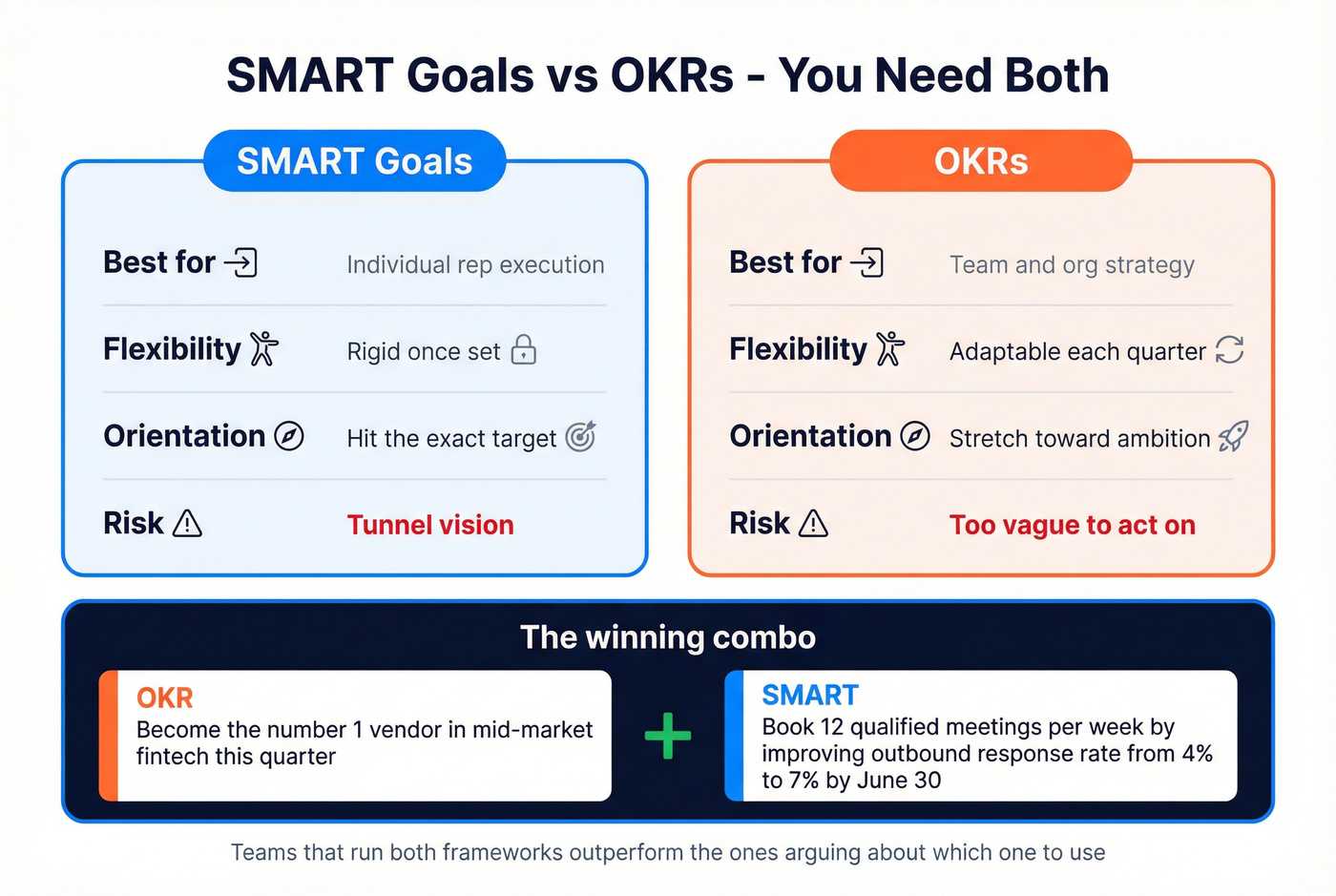
An MIT Sloan analysis points out that SMART attributes "say nothing about the context" in which goals are set. The Perdoo team takes this further, arguing that SMART goals conflate outputs and outcomes - "make 500 calls" is an output, "create $200K in qualified pipeline" is an outcome. When you lock into the output, you keep executing a failing tactic instead of adapting.
| Dimension | SMART Goals | OKRs |
|---|---|---|
| Best for | Individual execution | Team strategy |
| Flexibility | Rigid once set | Adaptable quarterly |
| Orientation | Hit the target | Stretch toward ambition |
| Risk | Tunnel vision | Vagueness |
Look, most sales orgs don't need to choose between SMART and OKRs. They need both. OKRs for quarterly team objectives like "Become the #1 vendor in mid-market fintech." SMART for individual rep execution plans like "Book 12 qualified meetings per week by improving outbound response rate from 4% to 7% by June 30." The teams that run both outperform the ones arguing about frameworks.
Common Mistakes That Kill Sales Goals
Four mistakes kill SMART goals before they start:
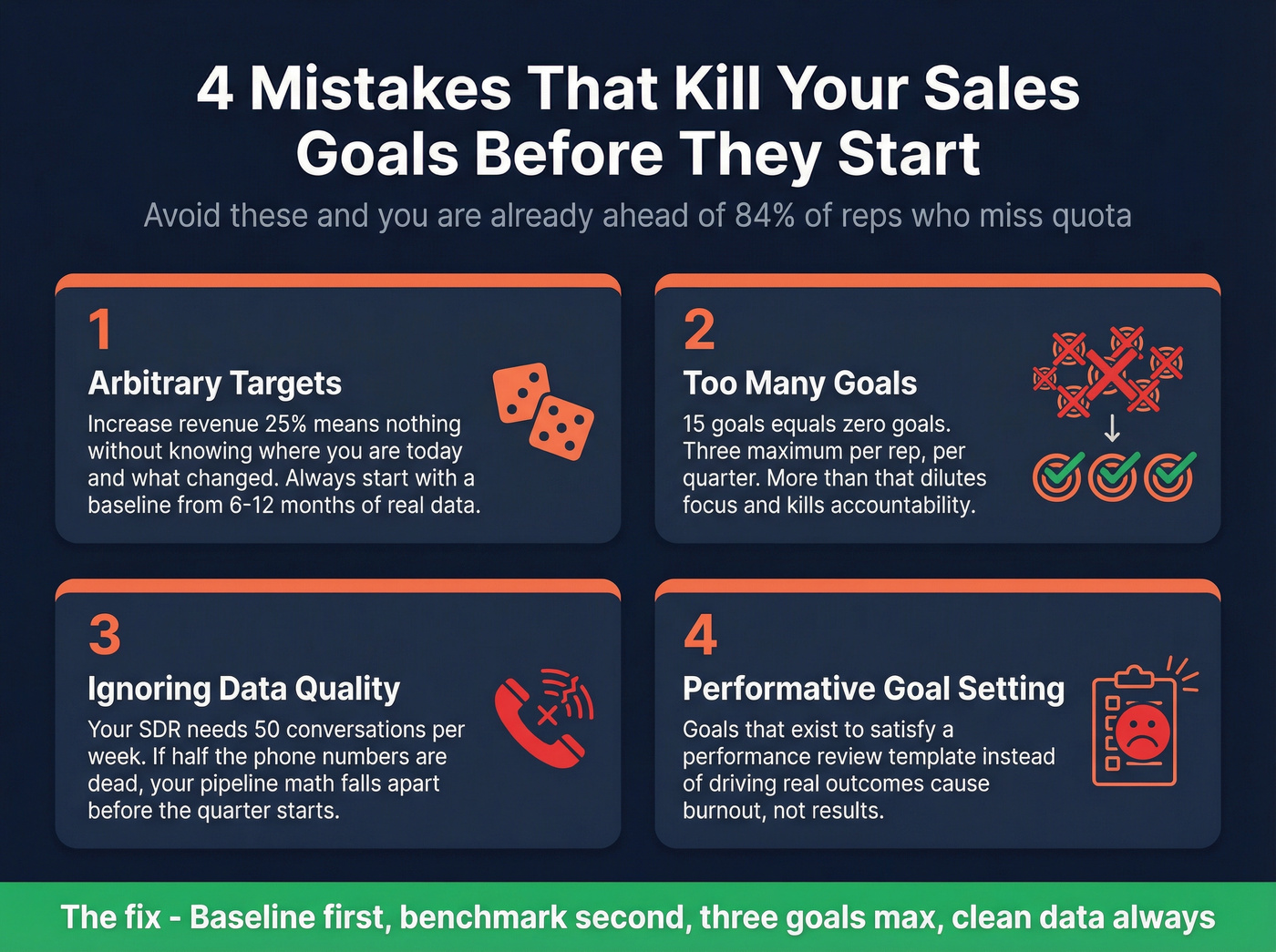
Arbitrary targets with no baseline. "Increase revenue 25%" means nothing without knowing where you are today and what changed to make 25% possible. Remember our CRO from the January kickoff? That's exactly what went wrong.
Too many goals. Fifteen goals equals zero goals. Three maximum per rep, per quarter. Highspot's research confirms goal overload is one of the most common planning failures.
Ignoring data quality. Your SDR's goal is 50 qualified conversations per week. That requires verified phone numbers and accurate emails. If your database hasn't been refreshed in months, half those dials go nowhere - and your pipeline math falls apart before the quarter even starts.
Performative goal-setting. Reddit threads on SMART goals consistently flag burnout from goals that exist to satisfy a performance review template rather than drive real outcomes. If the goal doesn't change behavior, it's paperwork.

Compressing deal cycles from 68 to 48 days requires reaching all 7 buyers in the group - fast. Prospeo's 300M+ profiles with 30+ filters let your AEs multi-thread into every account with verified direct dials and emails, refreshed every 7 days.
Hit your SMART goals with data that's actually current.
How to Track and Review
Separate your leading indicators from your lagging ones.
Leading indicators - pipeline coverage ratio, stage conversion rates, activity-to-meeting ratios, average deal velocity - tell you if you're going to hit the number. Lagging indicators - revenue, quota attainment, win rate - tell you if you did.
Review cadence should match your sales cycle. Short cycles under 30 days need monthly reviews. Longer cycles of 60+ days need bi-weekly pipeline reviews to catch problems before they compound. And don't keep reviews siloed to sales leadership - Highspot's research shows that aligning stakeholders across marketing, enablement, and RevOps on shared metrics prevents the finger-pointing that derails Q4 every year.
FAQ
How many SMART goals should a sales rep have?
Three maximum - one revenue goal, one activity goal, one development goal. Research consistently shows that more than three dilutes focus and tanks accountability. Pick the three that move quota, drop the rest.
What's a realistic revenue growth target?
For the same headcount and territory, 10-15% year-over-year is aggressive but achievable. Anything above 25% without new resources, expanded TAM, or a product change is fantasy math - check your baseline first.
Should SDRs have revenue goals?
No. SDRs control inputs - conversations started, meetings booked, pipeline created - not closed revenue. Set goals they can actually influence and tie comp to qualified pipeline generated, not deals they never touch after handoff.
Are OKRs better than SMART goals for sales?
They solve different problems. OKRs work for quarterly team-level objectives like "Win 30% of mid-market fintech deals." SMART goals work for individual rep execution like "Book 12 qualified meetings/week by June 30." Run both.
How does data quality affect sales goal attainment?
Bad data breaks pipeline math entirely. If 30% of your phone numbers are disconnected, an SDR needs 40% more dials to hit the same conversation target. Clean, frequently refreshed contact data keeps activity-to-outcome ratios honest so your goals stay grounded in reality, not inflated by bad records.
Three goals. Real baselines. Pipeline math. That's how you set smart goals for sales that actually get hit. Everything else is decoration.