

What Does SMB Mean? Business, Tech, and Slang Definitions Explained
Three letters, three completely different worlds. The SMB meaning changes entirely depending on context: it's Small and Medium-sized Business if you're in sales, Server Message Block if you're in IT, and "somebody" if you're on TikTok. Getting it wrong in a meeting is awkward.
Reddit threads about "SMB" routinely get derailed when someone in r/homelab answers a networking question and someone from r/smallbusiness chimes in about payroll software. Same acronym, zero overlap.
SMB at a glance:
- In business: Small and Medium-sized Business - typically 25-500 employees, though thresholds vary by country and industry
- In tech: Server Message Block - a network protocol for sharing files and printers across Windows, Linux, and Mac networks
- In texting/TikTok: "Somebody" - shorthand that went mainstream around 2023
The business definition is the most common, so that's where we'll spend the most time.
What Does SMB Stand for in Business?
SMB stands for Small and Medium-sized Business. It's the catch-all label that B2B software companies, government agencies, and investors use to describe the vast majority of companies on the planet - SMEs make up 90% of all companies globally and account for more than half of all employment worldwide.
These aren't just corner shops and freelancers. They range from solo consultants to 400-person manufacturers, and the definition shifts depending on who's doing the defining.
SMB vs SME vs SOHO vs Enterprise
These terms sit on a spectrum, and the lines between them are blurrier than most people realize.
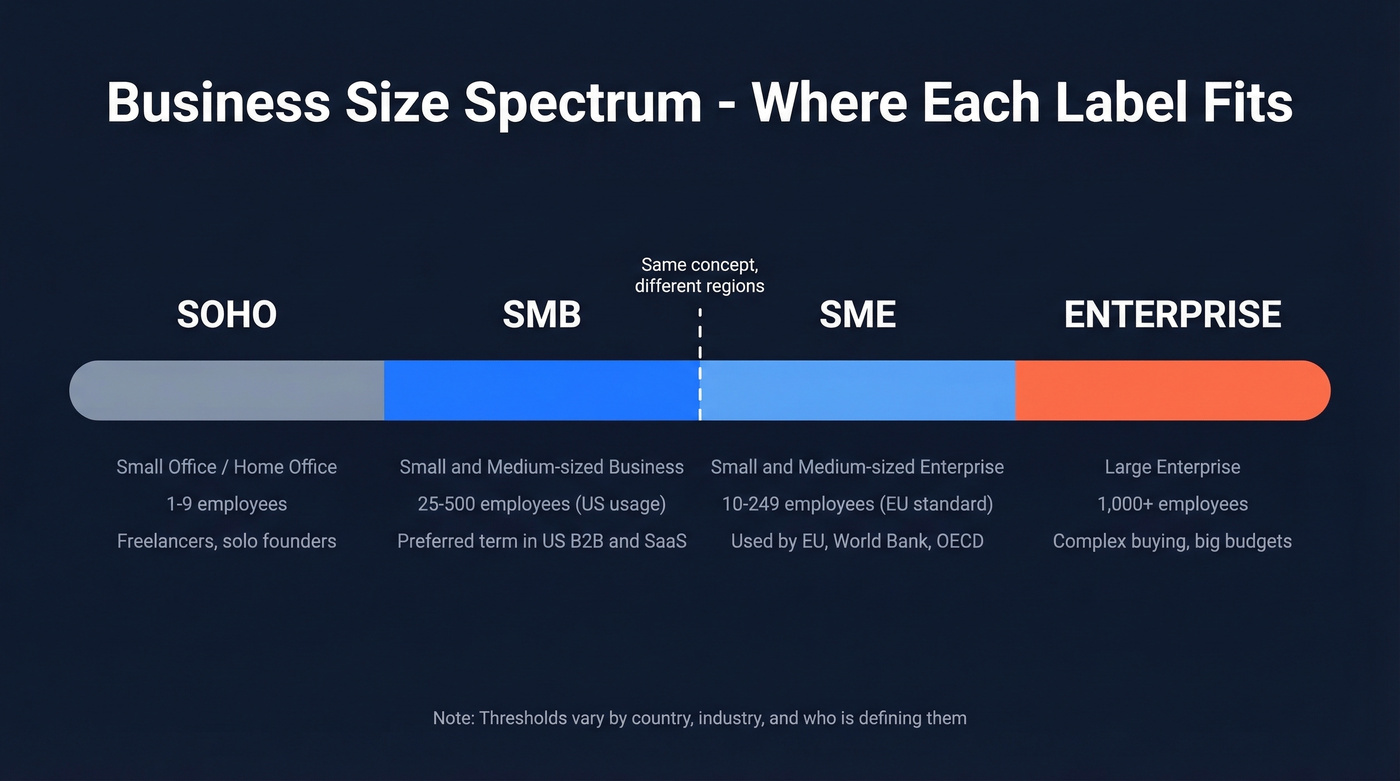
SOHO (Small Office/Home Office) covers the smallest end - the SBA normally identifies businesses with fewer than 10 employees as SOHO. Think freelancers, solo founders, and micro-agencies.
SMB is the preferred term in US B2B contexts. SaaS companies, sales teams, and VCs all default to it when they mean companies roughly in the 25-500 employee range. SME means the same thing but is the standard term used by the EU, World Bank, OECD, and most international organizations. If you're reading a European policy document, it'll say SME. If you're reading a SaaS pricing page, it'll say SMB.
Enterprise generally kicks in around 1,000+ employees, though plenty of software vendors draw the line at 500 or even 250. Some definitions use an upper limit of 5,000 employees in IT contexts. There's no universal standard, which is part of the problem.
How the US Government Defines "Small Business"
Here's the thing: there's no single number. The SBA doesn't say "under 500 employees = small." Instead, it sets industry-specific size standards using NAICS codes, codified in 13 CFR Part 121.
Some industries measure by employee count, others by average annual receipts. The thresholds vary wildly. Ice cream manufacturing? You're "small" up to 1,000 employees. Solar electric power generation? The cap is 500. Furniture wholesalers? Just 100.
For employee-based standards, the SBA averages headcount across pay periods over the latest 24 months. For revenue-based standards, it averages total income over the latest five fiscal years. Affiliates count too - if a parent company owns 50%+ of your business, their employees get rolled into your total.
These standards aren't static. The SBA reviews them every five years, and a proposed rule published in August 2025 (90 FR 41168) targeted revisions to monetary-based thresholds. The comment period closed in October 2025, so check whether the final rule has been published if your company sits near a size boundary.
SMB Definitions Around the World
| Region | Employee Threshold | Revenue Threshold | Notes |
|---|---|---|---|
| US | Generally <500 (varies by NAICS) | Varies by industry | SBA sets per-industry standards |
| EU | Micro 0-9, Small 10-49, Medium 50-249 | Up to €2M / €10M / €50M | Clearest structured system |
| UK | <499 (raised from 249 in 2022) | Often aligns with EU | Recent threshold change |
| China | Varies widely by sector | Industry-specific revenue caps | Most complex system |
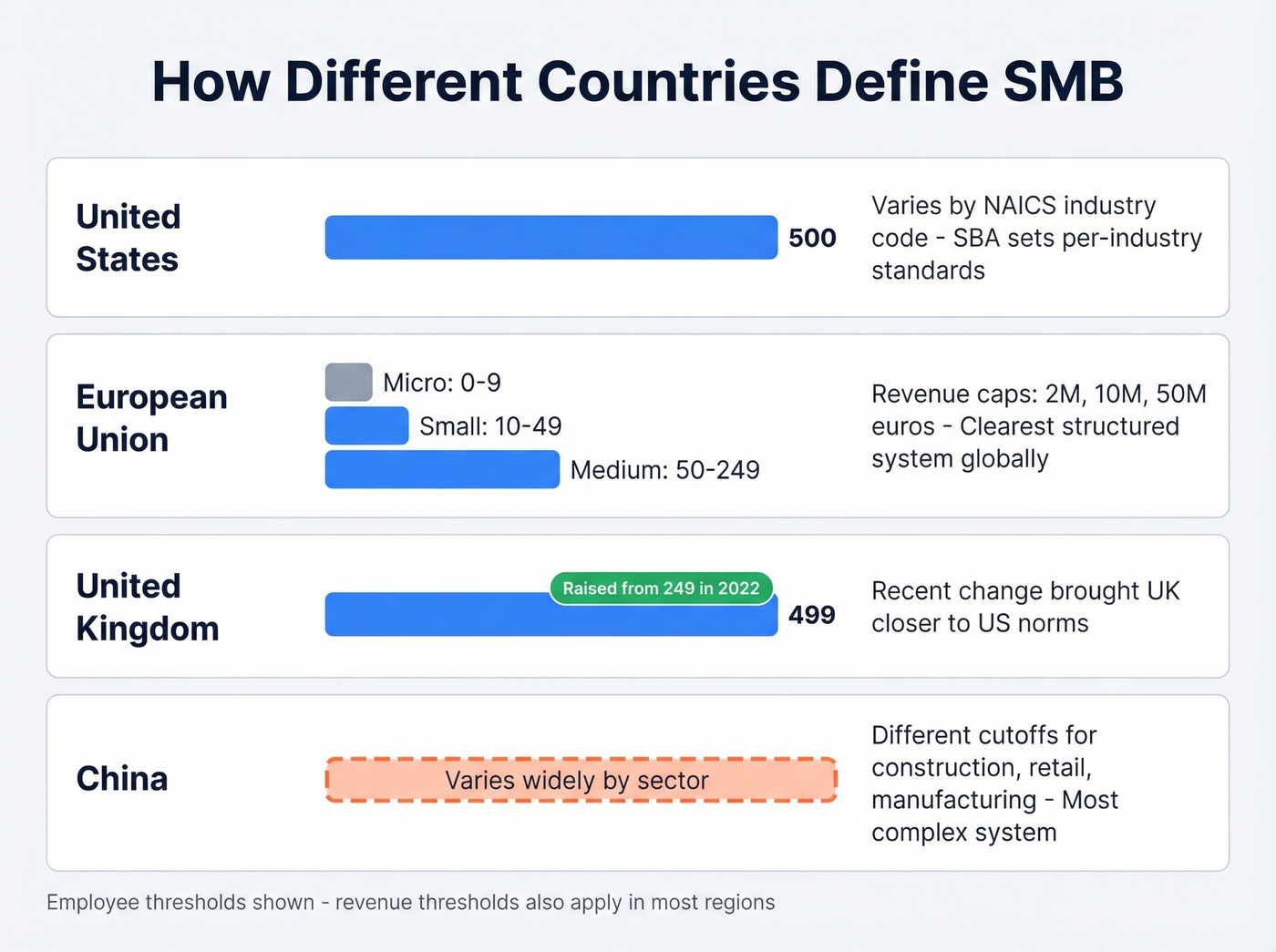
The EU has the most structured framework - three clean tiers with both employee and financial thresholds. China's system is the most complex, with different cutoffs for construction, retail, manufacturing, and other sectors. The UK raised its SME employee ceiling from 249 to 499 in 2022, a significant shift that brought it closer to US norms.
Small Business by the Numbers
In the US alone, the numbers are staggering:
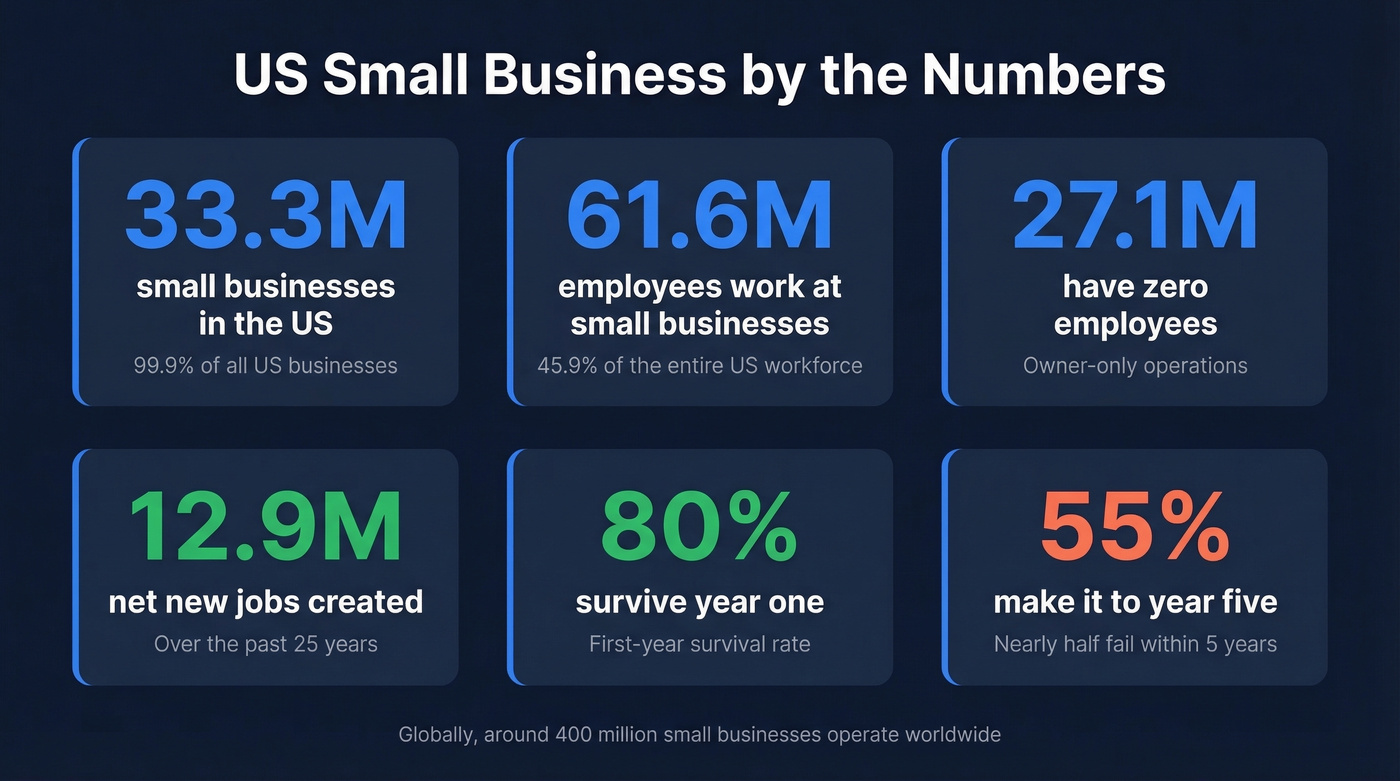
- 33.3 million small businesses, representing 99.9% of all US businesses
- 61.6 million employees - 45.9% of the entire US workforce
- 27.1 million of those businesses have zero employees (owner-only operations)
- Small businesses created roughly 12.9 million net new jobs over the past 25 years
Survival rates tell the other side of the story. About 80% of small businesses survive their first year, but only 55% make it to year five. That brutal attrition rate is one reason the market is constantly churning - new companies forming, old ones closing, and the ones in between trying to scale past the danger zone.
Globally, around 400 million small businesses operate worldwide, and SMEs account for more than 50% of total employment across most economies.
Why the SMB Label Matters
The term is used so loosely in B2B that it's almost meaningless without context. A 10-person digital agency and a 400-person manufacturer are both "SMBs," but they have nothing in common operationally - their buying processes, budgets, tech stacks, and decision-making structures are completely different.
Let's be honest: if your average deal size is under $15K, you probably don't need ZoomInfo-level data infrastructure. Most small and mid-sized companies are better served by lightweight, self-serve tools that let them move fast without six-figure annual commitments. The "enterprise data stack for everyone" pitch is a trap that burns budget and adds complexity most lean teams can't absorb.
Still, the label matters in concrete ways. Government contracting eligibility hinges on SBA size standards - get classified as "large" and you lose access to set-aside contracts worth billions annually. Software vendors use segmentation to set pricing tiers, so your employee count directly affects what you pay for CRMs, data platforms, and security software. And go-to-market teams build entirely different playbooks for small businesses versus enterprise: shorter sales cycles, lower ACVs, and self-serve onboarding.
In our experience, the most useful way to segment is by buying behavior, not headcount. A 50-person company with a VP of Sales who owns a budget behaves more like a mid-market firm than a 50-person company where the founder makes every purchase decision. When a SaaS company says they "serve SMBs," ask them what they actually mean - a company targeting 5-person startups and one targeting 300-person mid-market firms are playing completely different games, even though both claim the same label.
SMB in Technology: Server Message Block
In IT, SMB stands for Server Message Block - a network protocol that has nothing to do with business size. It's the reason you can access shared drives and printers on a Windows network, and it's been around since the early days of PC networking.
What the SMB Protocol Does
Server Message Block is an application-layer protocol that enables file sharing, printer sharing, and inter-process communication across a network. It operates over TCP port 445, or ports 137-139 when running over the older NetBIOS transport.
Barry Feigenbaum created the original protocol at IBM in 1983, and it initially ran over NetBIOS. Microsoft adopted and extended it heavily, renaming it under the CIFS (Common Internet File System) name in the 1990s - though the industry largely reverted to calling it SMB. Today it isn't just a Windows thing. Mac and Linux systems use it through the open-source Samba project to access Windows file shares. If you've ever mapped a network drive on a Mac to a Windows server, you were using this protocol.
Protocol Version History
| Version | Introduced With | Key Changes | Security Notes |
|---|---|---|---|
| SMB (original) | IBM, 1983 | Original protocol | Legacy dialects are risky |
| SMBv2 | Vista / Server 2008 | Reduced chattiness, better performance | Enhanced security |
| SMBv3 | Windows 8 / Server 2012 | Encryption, multichannel | Secure dialect negotiation |
| SMB 3.1.1 | Modern Windows | Newest dialect | Most secure current version |
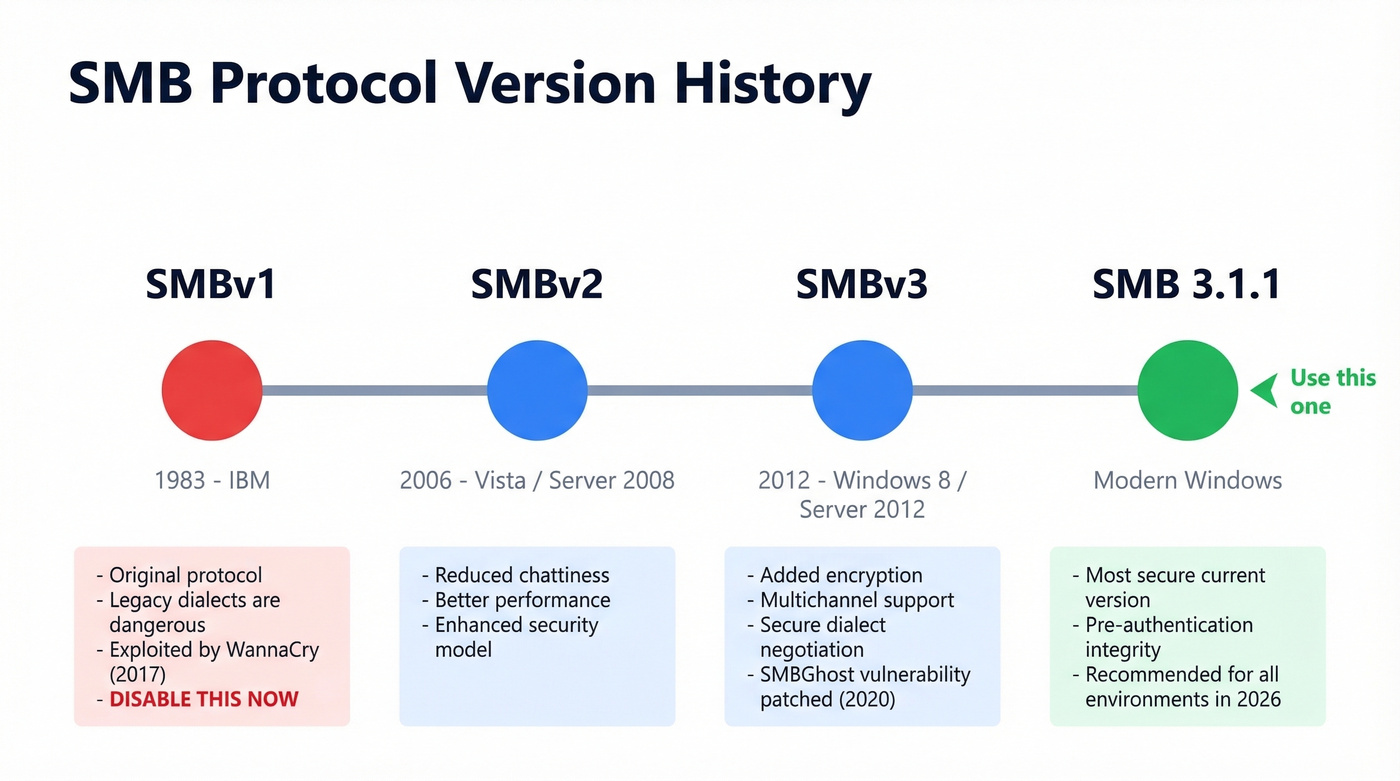
The version history matters because SMBv1 is genuinely dangerous. The WannaCry ransomware attack in 2017 exploited an SMBv1 vulnerability called EternalBlue. Microsoft has deprecated SMBv1, and if it's still enabled on your network, disable it immediately - there's no reason to keep it running in 2026. Later vulnerabilities like SMBGhost (CVE-2020-0796) targeted SMBv3 itself, reinforcing the need to keep systems patched even on newer protocol versions.
SMB 3.1.1 is the current standard and the most secure dialect in common use. If you're managing Windows infrastructure, make sure your systems are negotiating modern versions and that older ones are disabled. Microsoft's documentation covers the configuration details.

If you're targeting SMBs, you already know the buying cycle is short and the margin for error is thin. Prospeo gives you 98% accurate emails at $0.01 each - no enterprise contracts, no sales calls required. Built for lean teams selling into the exact segment this article describes.
Stop overpaying for enterprise data tools when you're selling to SMBs.
What SMB Means in Texting and Social Media
On TikTok and in text messages, SMB simply means "somebody." The abbreviation started appearing on TikTok around 2020 and became mainstream by 2023, particularly in captions and comments. You'll see it in posts like "smb come get their mans" or "smb explain this to me."
There's also a cruder usage - "suck my b*lls" - which predates the TikTok era and shows up in gaming chats. Context usually makes the intended meaning obvious.
For the gamers: SMB has meant Super Mario Bros. since 1985 and Super Meat Boy since 2010. Neither will cause confusion in a business meeting, but they're worth knowing if you're parsing acronyms in a gaming forum.
Other Uses of the Acronym
A few niche uses round out the acronym:
- Sorry My Bad - casual texting shorthand, similar to "mb"
- Surface Marker Buoy - a safety device in scuba diving to signal a diver's position to surface boats
- Small Minus Big - a factor in the Fama/French financial model measuring small-cap vs large-cap stock returns
How SMBs Find and Reach New Customers
If you're running a small or mid-sized business, the biggest challenge isn't understanding the label - it's growing despite limited resources. Enterprise companies throw $30K-$100K/year at data platforms. Most smaller companies can't justify that spend, but they still need to find decision-makers at target accounts.
We've seen three-person sales teams outperform 20-person enterprise SDR floors when they have accurate data and skip the manual research. Prospeo gives small business sales teams access to 300M+ professional profiles with 98% verified email accuracy, starting with a free tier - 75 emails per month, no credit card required. Paid plans run about $0.01 per email, which means a team prospecting 1,000 contacts per month pays roughly $10. Compare that to enterprise data contracts and the math is obvious.
The self-serve model matters too. No annual contracts, no mandatory sales calls, no six-week implementation. You sign up, search using 30+ filters including industry, job title, company size, and buyer intent, then export verified contacts directly to your sequencer or CRM. For a founder or a lean sales team, that's the difference between spending a week on manual research and spending an afternoon building a pipeline.
If you're building outbound, start with proven sales prospecting techniques and a clean lead generation workflow so you don't leak leads after you find them.
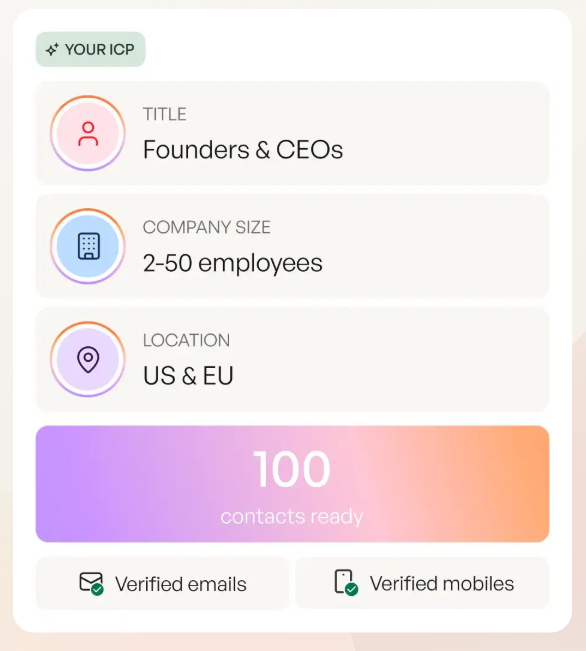
Whether your ICP is a 25-person startup or a 400-person mid-market firm, segmenting by headcount alone won't cut it. Prospeo's 30+ search filters - including department headcount, funding, revenue, and buyer intent - let you find the right SMBs showing real buying signals, not just the ones that fit an arbitrary size bracket.
Filter 300M+ profiles by the signals that actually predict a deal.
FAQ
What's the difference between SMB and SME?
Same concept, different geography. "SMB" is the default term in US B2B sales and SaaS contexts. "SME" is the standard used by the EU, World Bank, OECD, and most international organizations. Both refer to small and medium-sized businesses - the distinction is purely regional preference.
How many employees does an SMB have?
The most commonly cited range is 25-500 employees, but the US SBA sets different thresholds per industry - from 100 employees for furniture wholesalers to 1,000 for ice cream manufacturers. The EU caps "medium" at 249 employees. The UK raised its limit to 499 in 2022.
What does SMB mean on TikTok?
On TikTok and in text messages, SMB means "somebody." The abbreviation became mainstream around 2023 and is used casually in captions and comments - completely unrelated to the business or technology definitions.
What tools help SMBs find new customers on a budget?
B2B data platforms like Prospeo let small business sales teams find verified emails and direct dials without enterprise-level budgets. The free tier includes 75 emails per month, paid plans cost roughly $0.01 per email, and there are no contracts - ideal for teams that need accurate data without a five-figure commitment.
Is SMB the same as a startup?
No. A startup is defined by its growth stage and business model - typically venture-backed and seeking rapid scale. An SMB is defined by size. A 50-year-old family plumbing company with 30 employees is an SMB but definitely not a startup. Some startups qualify as SMBs, but most SMBs aren't startups.