

SMB Sales Process: A 6-Stage Playbook for 2026
A founder asked us last quarter why only 3 deals closed from 40 qualified leads. The answer wasn't the product, the pitch, or the market - it was the process. There wasn't one. Reps were freelancing every deal, and the pipeline was a black box nobody could diagnose.
Here's what the data says: when teams hit >75% adoption of a structured sales methodology, quota attainment jumps 21%, win rates climb 15%, and revenue grows 6%. That gap between "we have a process" and "we wing it" is the gap between hitting plan and missing it by a mile.
The Quick Version
- SMB deals under $15K ACV close in 14-30 days
- Your process needs exactly 6 stages - not 12
- Use BANT for qualification
- Budget $50-$150/rep/month for tools
- Teams with >75% process adoption see +21% quota attainment
How SMB Sales Differs in 2026
SMB sales isn't enterprise sales on easy mode. It's a fundamentally different motion - fewer stakeholders, faster timelines, and buyers who'd rather self-serve than sit through a discovery call. The cycle is compressed by design, which means every wasted day has an outsized impact on close rates.
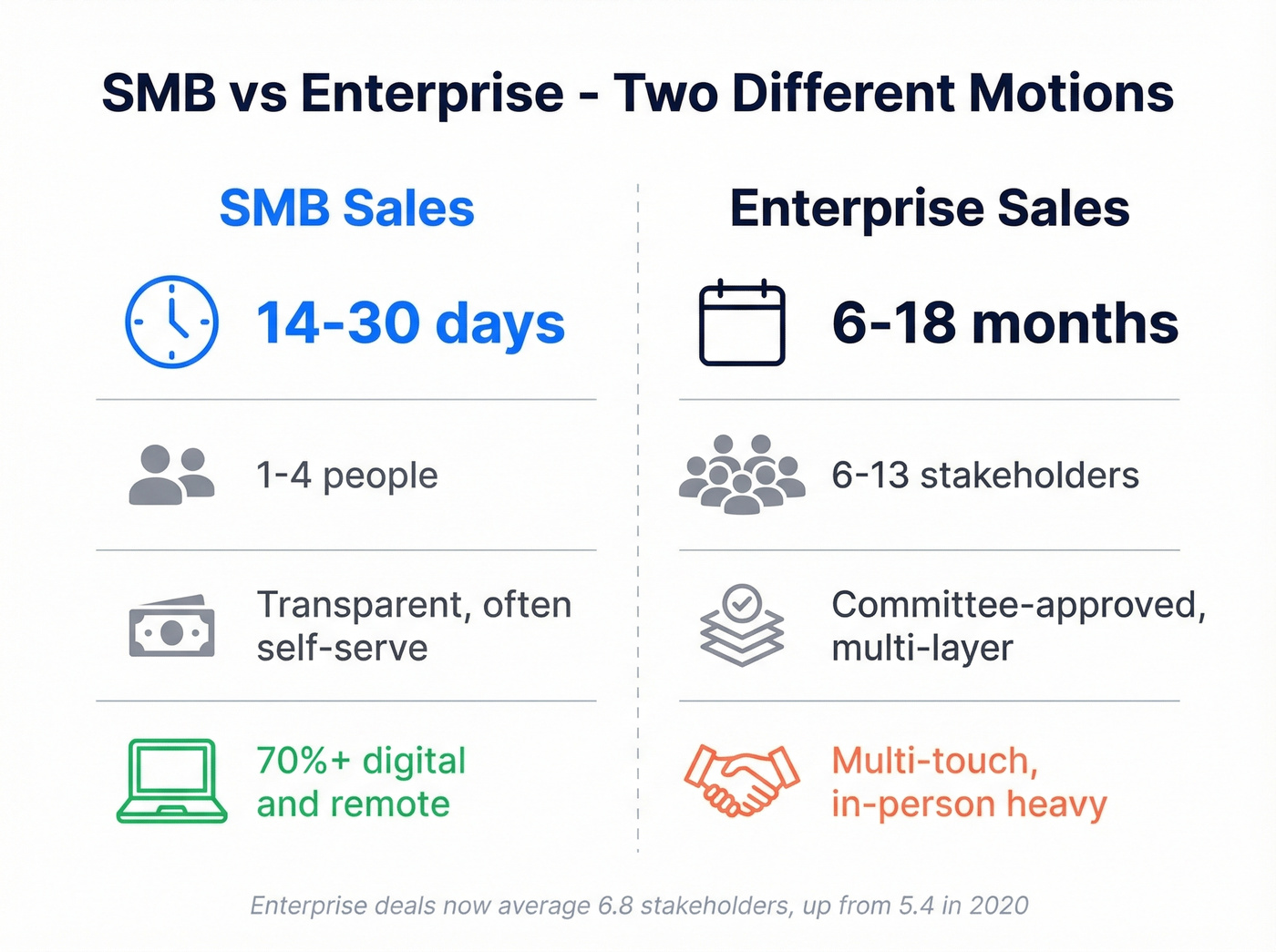
| Dimension | SMB | Enterprise |
|---|---|---|
| Cycle length | 14-30 days | 6-18 months |
| Decision-makers | 1-4 | 6-13 |
| Budget process | Transparent, often self-serve | Committee-approved |
| Buying preference | 70%+ digital/remote | Multi-touch, in-person |
Enterprise deals now average 6.8 stakeholders, up from 5.4 in 2020. That's exactly why enterprise frameworks don't translate when you're selling to SMBs. You're pitching an owner or a small buying group that moves fast - or doesn't move at all.
The 6 Stages That Close Deals
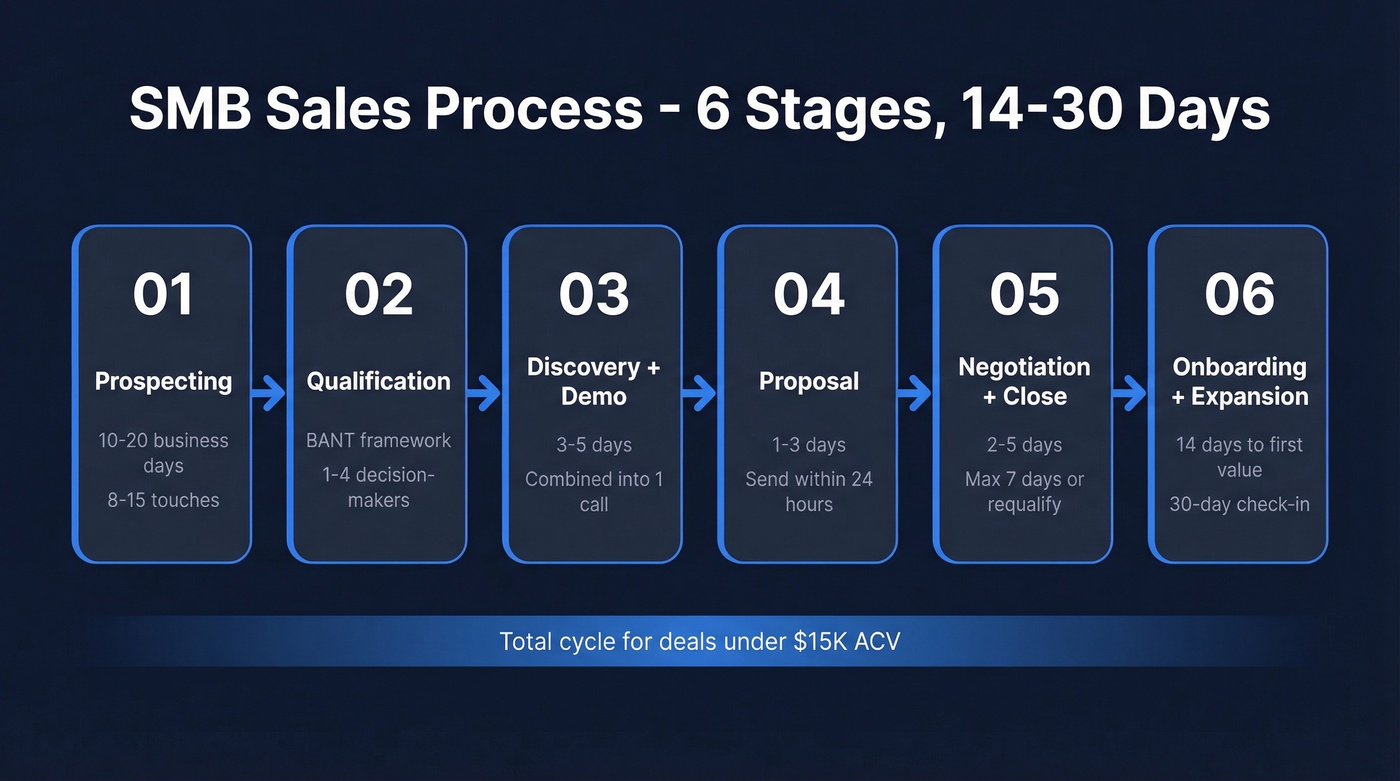
Most process frameworks list 7-12 stages. That's overhead for deals closing in under 30 days. Here's how cycle length scales with deal size and prospect headcount before we break down each stage:
| ACV | Avg. Cycle | Employees | Avg. Cycle | |
|---|---|---|---|---|
| <$1K | ~25 days | 1-10 | ~38 days | |
| $1K-$5K | ~40 days | 11-50 | ~57 days | |
| $5K-$10K | ~55 days | 51-200 | ~77 days | |
| $10K-$50K | ~75 days |
Prospecting & Lead Generation
Every deal starts with a name, an email, and a reason to reach out. Your prospecting stage is only as fast as your data - stale lists with 35-40% bounce rates kill outbound sequences before they start.

Target 8-15 touches over 10-20 business days. Mix email, phone, and one social touchpoint. Exit criteria: the prospect replies or books a meeting.
Qualification
Use BANT - Budget, Authority, Need, Timeline. It's fast to teach, matches SMB buying speed, and works when you're dealing with 1-4 decision-makers. MEDDIC adds overhead that slows down short-cycle deals under $15K.
Exit criteria: prospect confirms budget range, you've identified the decision-maker, and there's a timeline inside 30 days. If any of those three are missing, the deal goes back to nurture - not forward to demo.
Discovery & Demo
Combine these into one call. SMB buyers don't want a 45-minute discovery followed by a separate demo next week. Show the product, ask the hard questions, and qualify simultaneously. Stage duration: 3-5 days from first contact to completed demo.
Proposal
Send it within 24 hours of the demo. Deals where proposals go out same-day close 35% faster than those that wait even 48 hours. Keep it to one page for deals under $5K - nobody's reading a 12-page SOW for a $3K annual contract. Stage duration: 1-3 days.
Negotiation & Close
If this stage drags past 7 days, you don't have a negotiation problem - you have a qualification problem. SMB negotiation is usually about timing, not terms. The prospect either has budget now or they don't. Stage duration: 2-5 days.
Onboarding & Expansion
A deal that closes in 25 days and churns in 90 was never really won. Most SMB teams treat close as the finish line, but smooth onboarding in the first 14 days drives retention and expansion revenue. Document a 3-step sequence: kickoff call, first value milestone, 30-day check-in. Skip this and you'll spend more acquiring replacements than you earned on the original deal.
Funnel Benchmarks to Track
We've found that the diagnostic thresholds below represent the point where a problem is severe enough to prioritize fixing - not just underperformance, but a genuine red flag.
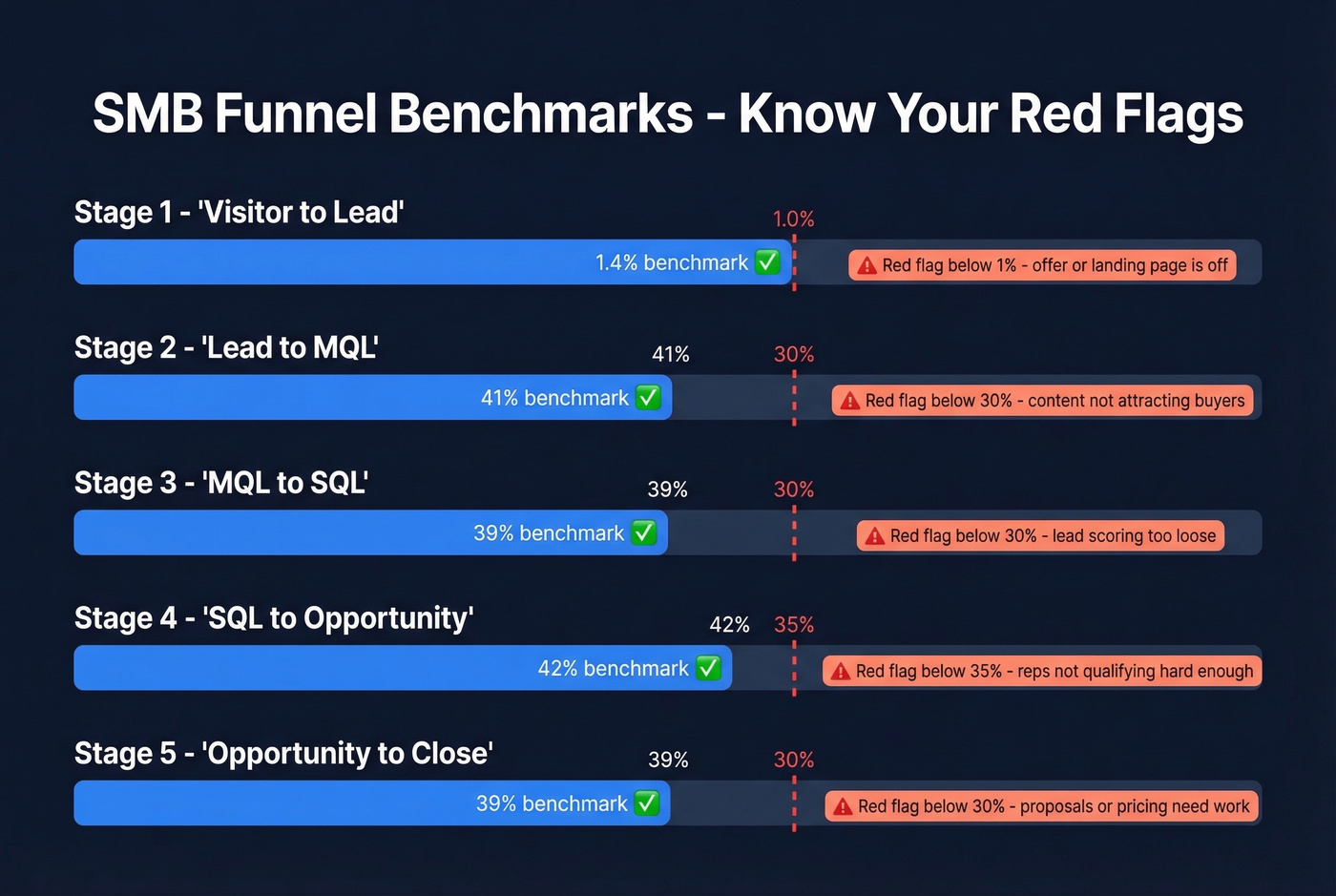
| Stage | Benchmark | Red Flag |
|---|---|---|
| Visitor -> Lead | 1.4% | Below 1% - offer or landing page is off |
| Lead -> MQL | 41% | Below 30% - content isn't attracting buyers |
| MQL -> SQL | 39% | Below 30% - lead scoring is too loose |
| SQL -> Opportunity | 42% | Below 35% - reps aren't qualifying hard enough |
| Opp -> Close | 39% | Below 30% - proposals or pricing need work |
If your SQL-to-Opportunity conversion sits below 35%, the fix is almost always upstream. Either your lead scoring criteria are too generous, or reps aren't enforcing BANT rigorously enough during qualification. We've seen teams recover 10+ points on this metric just by adding a mandatory "budget confirmed" checkbox before a deal advances.

Bad data is the #1 silent killer of SMB outbound. Meritt dropped bounce rates from 35% to under 4% and tripled pipeline to $300K/week with Prospeo's 98% accurate emails. At $0.01 per verified email, your 14-30 day sales cycle stays on track instead of stalling at stage one.
Stop burning your first 8-15 touches on dead addresses.
Mistakes That Kill SMB Deals
No defined process at all. The most common failure mode. Reps improvise, managers can't coach, and forecasting is guesswork. Even a rough 6-stage framework beats nothing.
Bad contact data breaking outbound. I've watched SDRs send 200 emails, get 47 bounces, and waste an entire week chasing dead addresses. One team we work with, Meritt, saw bounce rates drop from 35% to under 4% after switching to Prospeo - and pipeline tripled from $100K to $300K/week. The consensus on r/sales is pretty clear: bad data is the silent killer of outbound, and most teams underestimate how much it costs them.
Over-engineering with 12+ stages. If your CRM pipeline has more stages than your deal has days, you've built a reporting tool, not a sales process. Six stages. That's it.
Never iterating. Your process isn't a document you write once. Review it on a 6-week cadence, look at stage conversion rates, identify where deals stall, and adjust. HubSpot's guide to sales pipeline management is a solid reference for structuring these reviews.
Building a Low Touch Sales Motion
For deals under $5K ACV, a low touch approach often outperforms high-touch outreach. These buyers expect self-serve demos, automated email sequences, and frictionless checkout - not a four-call sales cycle.
The key is designing your process so reps only intervene when a prospect stalls or the deal size warrants it. Automate everything below the intervention threshold: lead nurture, proposal delivery, and follow-up reminders. Reserve live rep time for qualification calls and negotiation on deals above $5K. Gartner's research on B2B buying behavior confirms that 70%+ of SMB buyers prefer digital interactions - your process should reflect that, not fight it.
Let's be honest: if you're running a four-call cycle on a $2K deal, you're spending more on the sale than the deal is worth.
Lean SMB Sales Tech Stack
If you're pre-$500K ARR, you need exactly three tools - a CRM, a sequencing tool, and a verified data source. Everything else is optional until you're past 10 reps. Budget $50-$150/rep/month total.
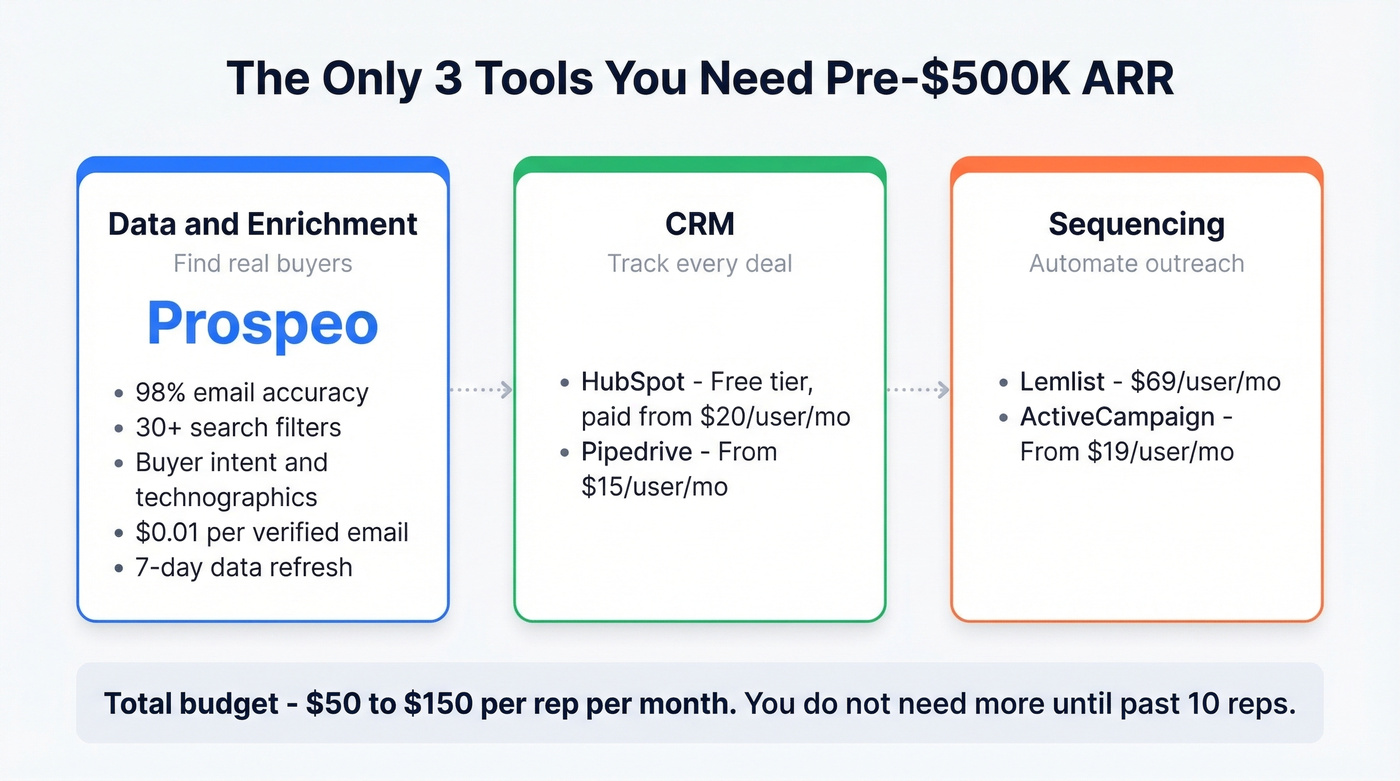
| Category | Tool | Starting Price |
|---|---|---|
| Data & Enrichment | Prospeo | Free tier; ~$0.01/email |
| CRM | HubSpot | Free tier; paid from $20/user/mo |
| CRM | Pipedrive | From ~$15/user/mo |
| Sequencing | Lemlist | $69/user/mo |
| Sequencing | ActiveCampaign | From $19/user/mo |
| Proposals | PandaDoc | Free trial available |
For data, the math is straightforward: Prospeo gives you 30+ search filters including buyer intent and technographics at $0.01/lead, with 98% email accuracy and a 7-day data refresh cycle. ZoomInfo runs $15-40K/year. For SMB teams, that's not a close call - it's a 90% cost difference with better accuracy.
Skip PandaDoc if you're under $3K ACV. A clean Google Doc or Notion template works fine at that deal size.
Your Playbook Checklist
Before you launch, make sure you've documented:
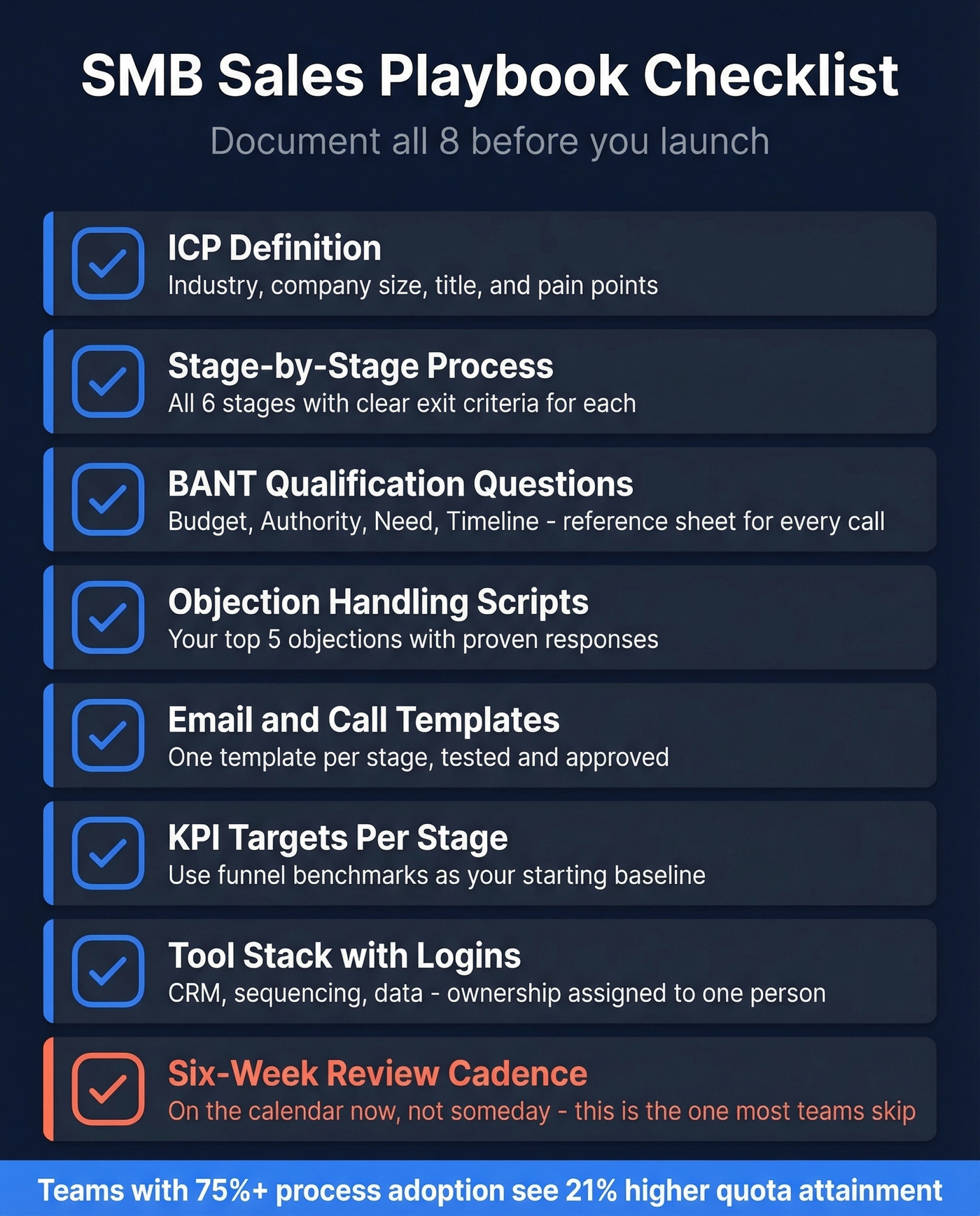
- ICP definition covering industry, size, title, and pain
- Stage-by-stage process with exit criteria for each
- BANT qualification questions your reps can reference on calls
- Objection-handling scripts for your top 5 objections
- Email and call templates per stage
- KPI targets per stage using the benchmarks above
- Tool stack with logins and ownership
- 6-week review cadence on the calendar
Real talk: most teams skip the review cadence. Don't. It's the difference between an SMB sales process that improves and one that quietly decays until someone notices pipeline is down 30%.
A lean SMB tech stack needs data that actually connects reps to buyers. Prospeo gives you 300M+ profiles with 30+ filters - buyer intent, headcount growth, funding - so qualification starts before the first call. 7-day data refresh means your BANT criteria hit real prospects, not ghosts.
Close in 14-30 days when every lead is real.
FAQ
How long is a typical SMB sales cycle?
14-30 days for deals under $15K ACV. Under $1K closes in ~25 days; $5K-$10K in ~55 days. If sub-$10K deals consistently take longer than 60 days, revisit your qualification criteria - something upstream is broken.
What's the best qualification framework for SMB?
BANT works best for deals with 1-4 decision-makers and cycles under 30 days. MEDDIC adds overhead that slows short-cycle deals. Pick one framework and enforce it consistently across every rep - the framework matters less than the consistency.
When should I use a low touch model?
When ACV is under $5K and the product is straightforward. Automate nurture, proposals, and follow-ups. Reserve high-touch motions for complex use cases or deals above $5K where a rep's involvement meaningfully increases win rate.
What tools do SMB sales teams actually need?
Three: a CRM (HubSpot's free tier works), a sequencing tool (Lemlist at $69/mo), and a verified data source (free tier with 75 emails/month, paid plans at ~$0.01/email). Budget $50-$150/rep/month total - you don't need more until you're past 10 reps.