

What Does SMB Mean? The Complete Guide to Small and Midsize Businesses
You're filling out a vendor pricing form and it asks: "Are you an SMB, mid-market, or enterprise?" You pause. Your company has 140 employees but $12M in revenue. Are you small? Medium? The answer depends entirely on who's asking - and that's the core problem with this term.
Quick answer: SMB stands for small and midsize business. A common rule of thumb is small = under 100 employees, midsize = 100-1,000 employees in B2B contexts. But official definitions vary by country, industry, and who's defining the term. A manufacturer with 1,400 employees can qualify as "small" under US federal rules.
There's no single correct definition. We've seen companies with 300 employees classified as SMB by one vendor and enterprise by another - on the same day. What follows is how the term actually works: by region, by context, and by the numbers.
What Does SMB Stand For?
SMB stands for small and midsize business, sometimes written as "small and medium-sized business." As a rule of thumb, small businesses have fewer than 100 employees, and midsize businesses fall in the 100-1,000 range in B2B segmentation. Those numbers aren't universal, though - official definitions shift by country, industry, and even which government agency you're dealing with.
Outside the US, you'll see SME (small and medium-sized enterprise) everywhere, especially in EU policy and international business writing. The terms are functionally interchangeable in conversation, but the thresholds don't align perfectly across regions. The EU caps "medium" at 250 employees, while US usage often treats under 500 employees as "SMB."
In practice, SMB is less about a single headcount number and more about buying motion - faster decisions, fewer stakeholders, less process. When a SaaS vendor, a government program, or a sales rep uses "SMB," they're each applying their own internal definition. The label is contextual, not standardized.
SMB vs Mid-Market vs Enterprise
These segments show up constantly in B2B sales, but the boundaries are blurrier than most people realize.
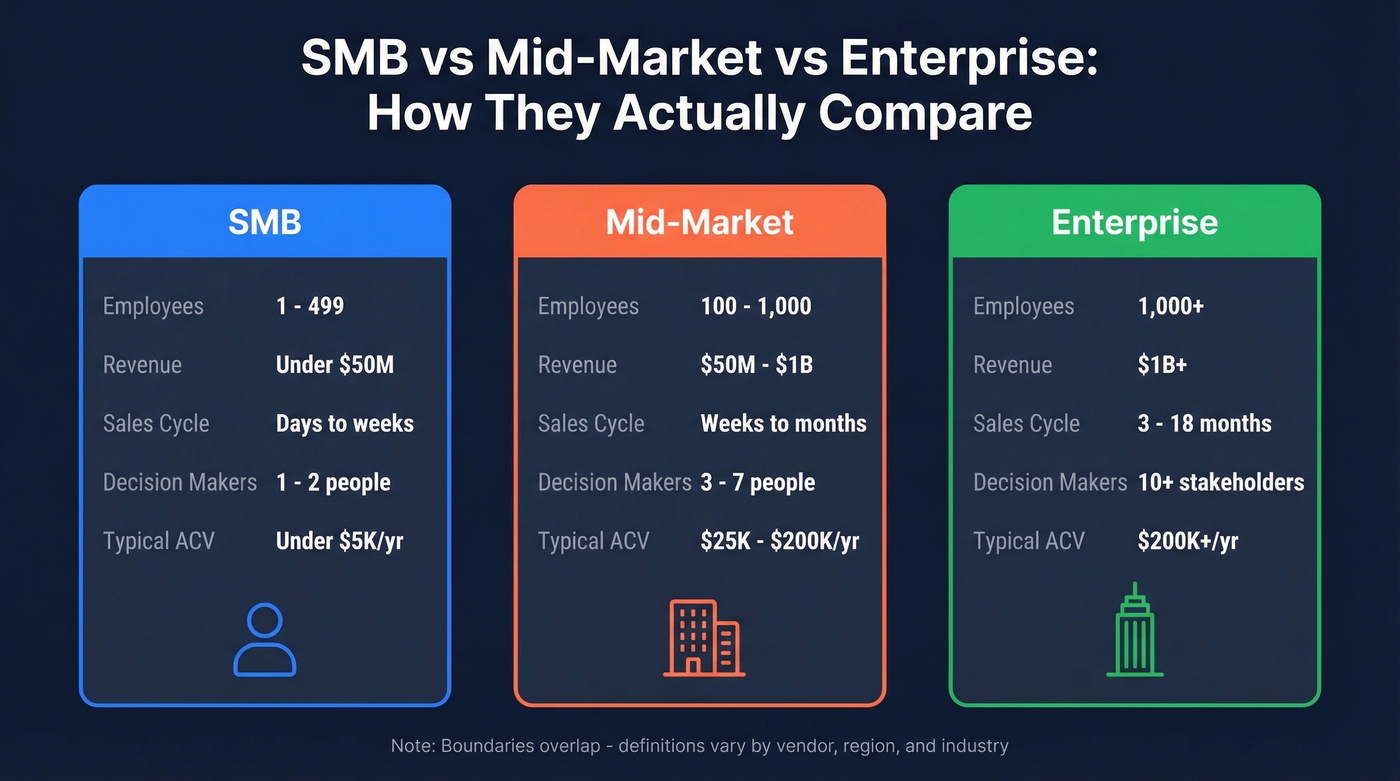
| Segment | Typical Employees | Typical Revenue | Sales Cycle |
|---|---|---|---|
| SMB | 1-499 | Under $50M | Days to weeks |
| Mid-Market | 100-1,000 | $50M-$1B | Weeks to months |
| Enterprise | 1,000+ | $1B+ | 3-18 months |
A note on SME: In practice, SME usually maps to the same row as SMB. The EU's "medium" threshold caps at 250 employees, while US B2B segmentation often stretches "midsize" up to 1,000. The buying behavior and sales motion are more similar than the labels suggest.
Close's B2B segmentation guide puts it well: most small businesses are run by the owner, typically in the 5-to-25 employee range, with faster decisions and often a single decision-maker. Mid-market, in Gartner's framing, is $50M-$1B in annual revenue or 100-1,000 employees. Enterprise deals can take up to 18 months to close.
Sales teams often define these segments by annual contract value rather than headcount. On r/sales, SMB AE roles typically handle deals around $5K/year and below, while mid-market AEs work $25K-$200K deals. The employee count is a proxy - what really changes is the buying motion, the number of stakeholders, and the length of the sales cycle.
What about startups? Startups are defined by stage - growth trajectory, funding rounds, product-market fit. SMBs are defined by size. A 10-person bootstrapped consulting firm is an SMB. A 10-person VC-backed SaaS company is a startup. Some companies are both, but the terms describe different dimensions.
Official SMB Definitions by Region
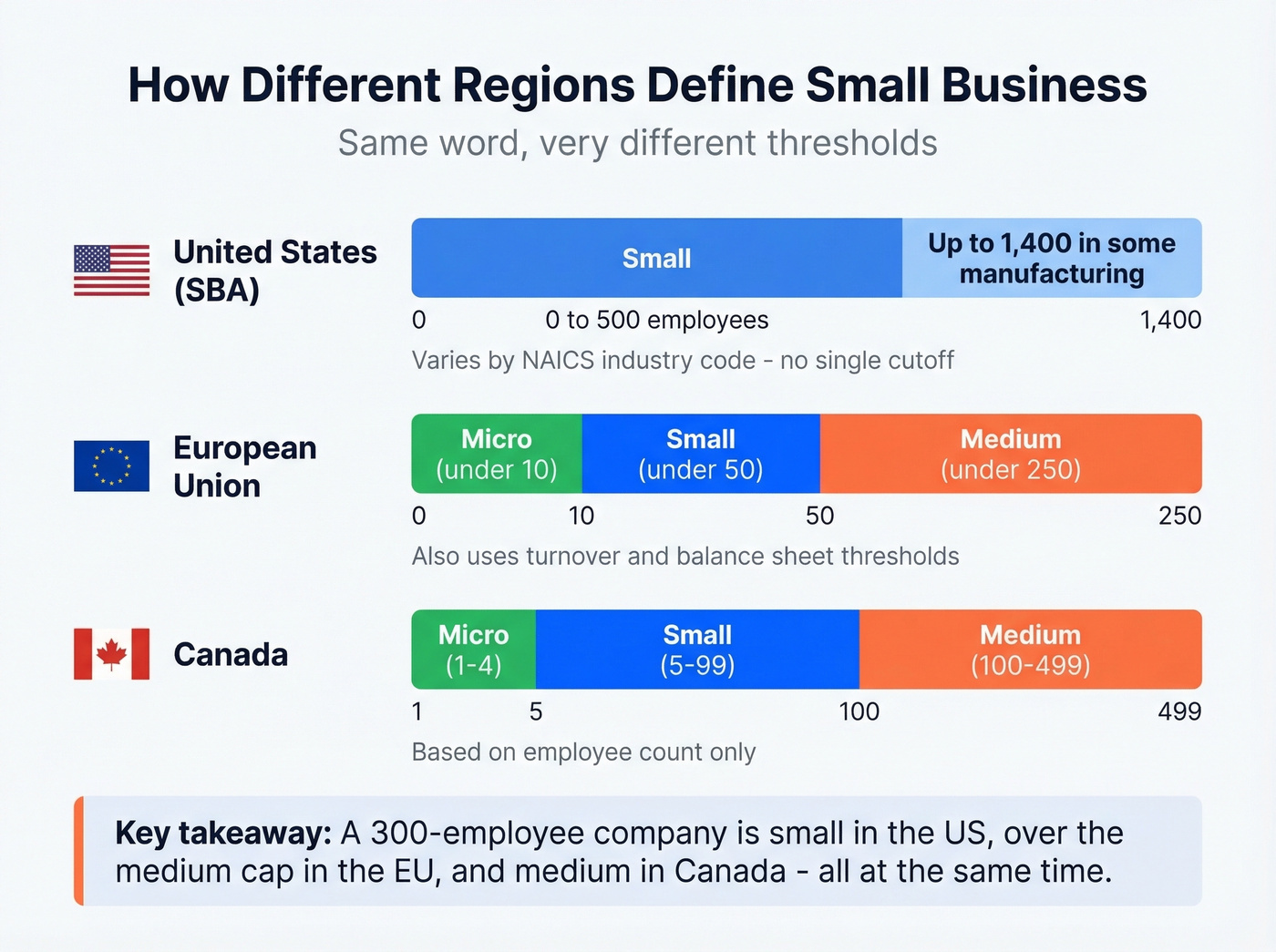
Every major economy defines "small business" differently, and even within a single country, the definition can shift depending on which agency or program you're looking at.
United States (SBA)
The US Small Business Administration doesn't use a single employee or revenue cutoff. SBA size standards vary by industry, tied to NAICS codes. A manufacturing company can qualify as "small" with up to 500 employees - and in some manufacturing subsectors, the threshold goes as high as 1,400.
Size standards rely on either employee count or annual receipts. Employee count is averaged over the latest 24 months and includes anyone on payroll regardless of hours worked. Annual receipts - total income plus cost of goods sold - are averaged over five fiscal years. Affiliate rules add another layer: you must include the employees and receipts of affiliates, and affiliation can exist at 50%+ ownership or even below that when control exists through other arrangements. The full legal framework lives in 13 CFR Part 121.
The IRS uses a different lens entirely - $10M or less in assets qualifies as a small business for tax reporting purposes.
These definitions aren't static. A proposed rule published August 22, 2025 is actively updating monetary-based size standards. The SBA periodically reviews and revises these thresholds, which means the definition of "small" is literally a moving target.
European Union
The EU uses a cleaner framework, codified in EU recommendation 2003/361. Classification depends on staff headcount plus either annual turnover or balance sheet total - you only need to meet one financial threshold.
| Category | Employees | Turnover | Balance Sheet |
|---|---|---|---|
| Micro | <10 | <=EUR 2M | <=EUR 2M |
| Small | <50 | <=EUR 10M | <=EUR 10M |
| Medium | <250 | <=EUR 50M | <=EUR 43M |
SMEs represent 99% of all EU businesses, employ approximately 100 million people, and generate more than half of EU GDP. The Commission is also introducing a new Small Mid-Caps category for companies that outgrow SME status but aren't truly large - acknowledging the cliff-edge effect where a company loses SME benefits the moment it crosses a threshold.
One important distinction: EU "company size" thresholds for accounting and audit obligations have had their financial thresholds updated separately in recent years. Don't conflate those with the SME program eligibility thresholds above - they serve different regulatory purposes.
Canada
Canada keeps it straightforward. The common Government of Canada classification uses employee count: micro (1-4), small (5-99), medium (100-499), and large (500+). In 2023, firms with fewer than 100 employees made up 97.9% of all employer businesses. Small and micro businesses employed 10.9 million people - 62% of the total workforce.
Developing Economies
Definitions vary even more widely in emerging markets. Many countries use lower thresholds that reflect their economic structure. The World Bank estimates that SMEs generate 7 out of 10 formal jobs in emerging markets, yet unmet MSME financing needs exceed $5 trillion per year - a gap that constrains growth across these economies.
Why There's No Single Definition
Here's the thing: "SMB" isn't a technical term with a precise meaning. It's a label that shifts depending on context, and in our experience, the gap between how different organizations use it causes more confusion than the term itself resolves.
The SBA's NAICS-based system illustrates this perfectly. A manufacturer with 1,400 employees can be "small" by SBA standards. The same company could be an SMB for one government program and mid-market for a vendor's pricing page.
Sales teams make it even murkier. One company on r/sales defines SMB as 1-200 employees because that's where their product fits. Another segments by annual spend - $5K/year deals are SMB, $25K+ is mid-market. A thread on r/PPC captures the confusion well: nobody outside the company knows exactly how they draw the line.
The factors that determine whether you're an "SMB" include employee count, annual revenue, total assets, industry via NAICS code, annual contract value to the vendor asking, and sometimes just the gut feel of whoever built the pricing page. The right question isn't "am I an SMB?" It's "what does this specific organization mean by SMB?"

Whether your target is 10-person startups or 500-employee midsize companies, Prospeo's 30+ search filters let you segment by exact headcount, revenue, department size, and funding stage. No more guessing who counts as an SMB - build precise lists from 300M+ profiles with 98% email accuracy.
Define your SMB segment once, then fill your pipeline in minutes.
Small Business Statistics in 2026
The scale of the SMB economy is staggering.
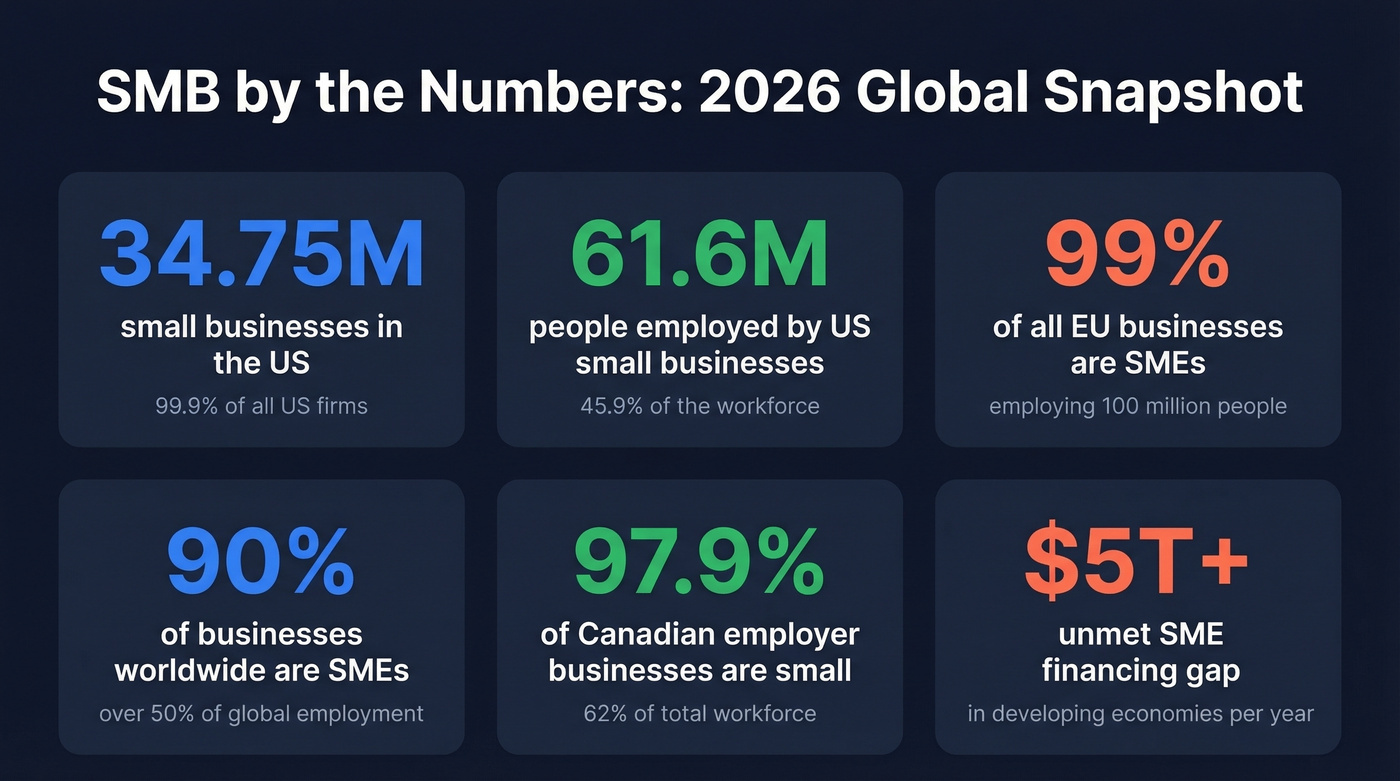
United States: The SBA Office of Advocacy counted 34.75 million small businesses as of July 2024 - 99.9% of all US firms. About 82% have no employees at all. Small businesses employ 61.6 million people, accounting for 45.9% of the US workforce, and have created roughly 12.9 million net new jobs over the past 25 years. They also represent 97.4% of all US exporters.
European Union: SMEs make up 99% of all businesses, employ approximately 100 million people, and contribute more than half of EU GDP.
Canada: 97.9% of employer businesses have fewer than 100 employees. Small and micro firms employ 10.9 million workers - 62% of the total workforce.
Globally: SMEs account for roughly 90% of businesses and more than 50% of employment worldwide. In developing countries, they contribute about 50% of employment and 40% of GDP.
Common SMB Characteristics
Beyond the numbers, small and midsize businesses share operational traits that distinguish them from larger organizations - and these traits shape how they buy, hire, and adopt technology.
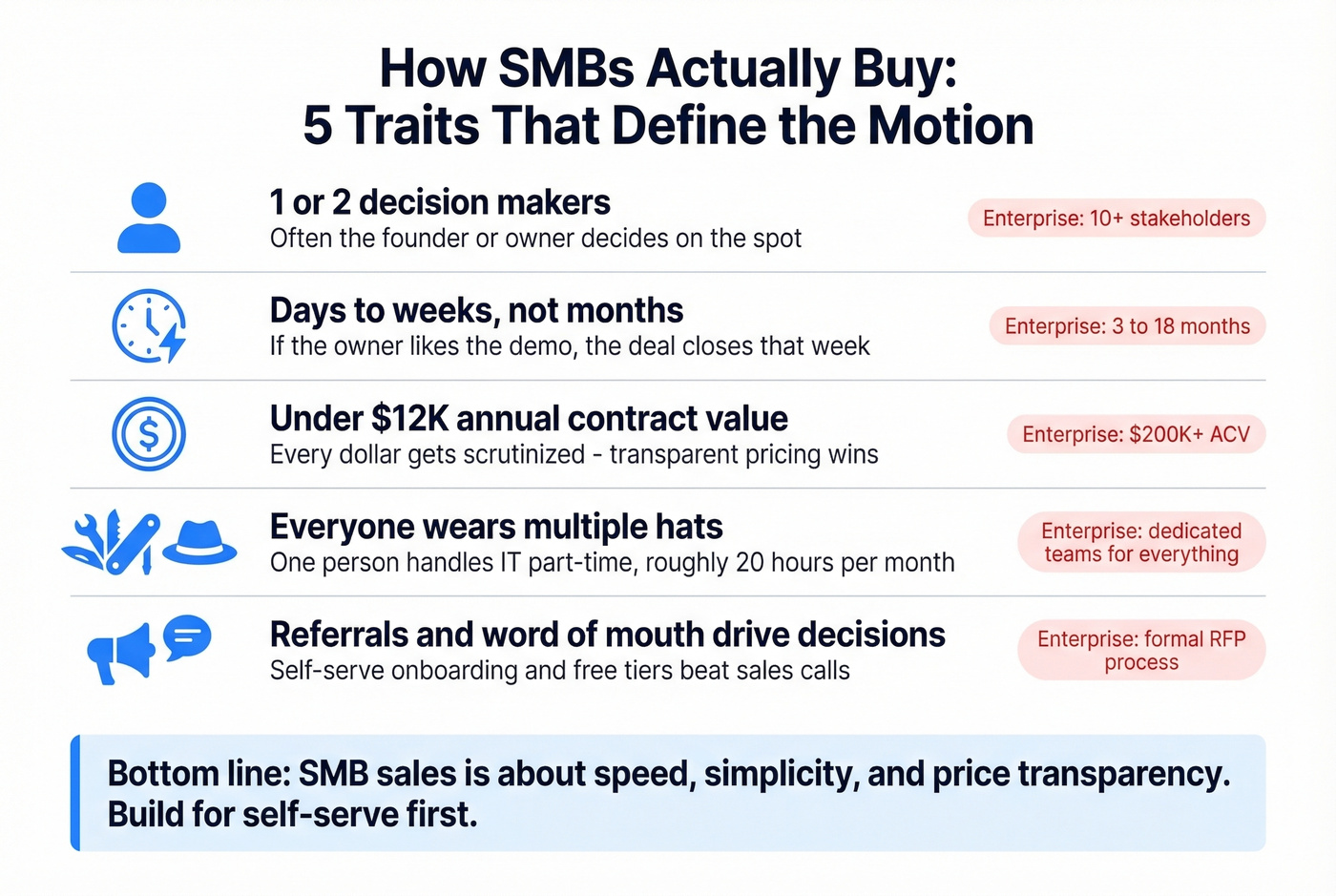
The defining features of most SMBs:
- One or two decision-makers, often the founder or owner
- Fast buying cycles - days or weeks, not months
- Tight budgets where every dollar gets scrutinized
- Employees wearing multiple hats - a single person often handles IT part-time, spending roughly 20 hours per month on tech-related tasks
- No formal procurement process - if the owner likes the demo, the deal closes that week
The buying motion reflects this reality. SMBs gravitate toward self-serve products with transparent pricing. They rely heavily on referrals and word-of-mouth. That's why tools built for small businesses offer self-serve onboarding and free tiers instead of requiring a sales call.
Lightspeed Venture Partners' SMB software benchmarking guide defines SMB-focused software companies as those with $12K or lower annual contract value. That $1K/month ceiling tells you everything about how price-sensitive this segment is.
Let's be honest: if your average deal size is under $12K annually, you don't need enterprise-grade complexity in your tools. You need enterprise-grade data at SMB pricing. Most small businesses overpay for features they'll never use and underpay for data quality that actually drives revenue.
SMB Challenges in 2026
The macroeconomic environment is putting real pressure on small businesses, and the data from recent quarters paints a clear picture.
Inflation remains the dominant concern. The US Chamber's Q3 2025 Small Business Index found that 46% of small businesses cite inflation as their top challenge. In response, 55% are raising prices and 36% are adjusting supply chains - neither of which addresses the underlying cost pressures.
Hiring is equally painful. The NFIB's April 2025 jobs report showed 34% of small business owners had unfilled job openings, and 47% couldn't find qualified applicants. That's not a labor shortage headline - it's a daily operational reality for nearly half of SMBs trying to grow.
The Federal Reserve's April 2025 survey of 143 small business resource organizations reinforced the pessimism: over half reported that small businesses were less optimistic than six months earlier about revenue growth, capital investment, and hiring plans. A majority said it had become harder for small businesses to pay operating expenses and obtain financing. Tariffs, rising prices, and tighter lending standards were recurring themes.
On the technology front, there's a paradox worth noting. An August 2025 C_TEC report found that 96% of small business owners plan to adopt emerging technologies including AI. But 65% simultaneously fear that new AI and data privacy regulations will harm their operations. SMBs want the efficiency gains but worry about the compliance burden - a tension that'll define the next few years.
Tools and Technology for SMBs
SMBs don't have the luxury of six-month implementation cycles or $50K annual software contracts. They need tools that work on day one, price transparently, and don't require a dedicated admin.
For CRM, most small businesses start with free tiers - HubSpot's free CRM or Salesforce Starter. The real differentiator is what happens upstream: how do you fill that CRM with people worth talking to?

Enterprise data platforms like ZoomInfo typically run $15-40K/year - completely out of reach for a 20-person company. But sending cold emails to unverified addresses tanks your domain reputation and wastes your team's time. We've watched small teams burn through months of pipeline because they trusted a cheap data provider with 60% accuracy.
Prospeo closes this gap with 300M+ professional profiles, 98% email accuracy, and 125M+ verified mobile numbers. Pricing starts free with 75 emails/month, paid plans run about $0.01 per email with no annual contracts, and the Chrome extension lets you pull verified contact data from any website in one click. For a small or midsize business building outbound pipeline, it's enterprise-grade data without enterprise pricing.
If you're building outbound from scratch, start with proven sales prospecting techniques and a repeatable lead generation workflow before you scale volume.
SMB sales cycles move fast - days, not months. You need verified contact data the moment you identify a target. Prospeo refreshes every 7 days (not 6 weeks) so you're never reaching out to someone who left three months ago. At $0.01 per email, scaling outreach to thousands of small businesses won't break your budget.
Reach SMB decision-makers before your competitors even find them.
Other Meanings of SMB
If you've landed here from a tech search, SMB also stands for Server Message Block - a network file-sharing protocol used in Windows environments for accessing files, printers, and other resources across a network. It runs on TCP port 445 and has been the target of notable security exploits like WannaCry.
And in gaming culture, SMB is shorthand for Super Mario Bros. Probably not what brought you here.
FAQ
What's the difference between SMB and SME?
SMB (small and midsize business) and SME (small and medium-sized enterprise) describe the same concept. SMB dominates US business language; SME is standard in EU policy and international writing. The EU caps "medium" at 250 employees, while US usage often treats under 500 employees as SMB - similar concept, slightly different thresholds.
How many employees does an SMB have?
There's no universal number, but under 500 employees is the most common US benchmark. The SBA's thresholds vary by industry - some manufacturing sectors qualify as "small" with up to 1,400 employees. In practice, most small businesses have fewer than 100 employees, and many fall in the 5-25 range.
What percentage of businesses are SMBs?
In the US, 99.9% of all businesses qualify as small per the SBA Office of Advocacy as of July 2024. In the EU, SMEs represent 99% of all businesses. Globally, SMEs account for roughly 90% of businesses and more than 50% of employment worldwide.
What's the difference between an SMB and a startup?
Startups are defined by growth stage - venture funding, product-market fit, rapid scaling. SMBs are defined by size. A 10-person bootstrapped accounting firm is an SMB. A 10-person VC-backed SaaS company is a startup. Many companies are both early on, but the terms describe fundamentally different things: stage versus scale.
What tools do SMBs use for B2B prospecting?
Most small businesses need self-serve tools with transparent pricing and no long-term contracts. For lead data, Prospeo offers 300M+ profiles with 98% email accuracy starting free at 75 emails/month - roughly $0.01 per email on paid plans. HubSpot and Salesforce Starter cover CRM. The key is avoiding enterprise-priced platforms that charge $15K+ annually when you're running a 20-person team.