

Smiling and Dialing: What It Really Takes to Make Cold Calls Work in 2026
A BDR on r/techsales put it perfectly: "Cold calls are the quickest and easiest way to get a meeting. Smile and flipping dial." He's right - but only if your numbers actually ring and your script doesn't sound like a hostage reading a ransom note. Smiling and dialing works. The gap between reps who book 2 meetings per 800 dials and reps who book 18 isn't talent, though. It's data, structure, and reps.
The Short Version
Smile and dial is the practice of making high-volume cold calls with genuine energy - literally smiling as you speak, because prospects can hear it. It works in 2026, but the "spray and pray" version doesn't. You need three things: verified phone numbers (not a stale list from six months ago), a script framework that earns permission instead of demanding attention, and awareness of TCPA/DNC rules that can cost you $500-$1,500 per violation. The average cold call conversion rate sits at 2.35%. Reps who train daily hit 9.03%. That's the difference between a method and a grind.
What Does Smile and Dial Mean?
The term emerged with the rise of telemarketing - shorthand for picking up the phone, plastering on a grin, and hammering through a call list. The core claim is simple: if you smile while you talk, your voice sounds warmer, more confident, and more human. Prospects respond better even though they can't see your face.
Today, smile and dial has evolved beyond pure volume. The smile part - genuine energy and positivity on the phone - still matters enormously. But the dial part now means targeted lists, verified numbers, parallel dialers, and multi-channel follow-up. The reps who treat it as "call everyone in the spreadsheet" are the ones calling it outdated. The reps who pair the energy with precision are the ones booking meetings.
Can Prospects Actually Hear You Smile?
Yes. And there's real research behind this, not just sales floor folklore.
Amy Drahota at the University of Portsmouth ran a study where speakers answered the same phrase while researchers tracked their facial expressions - Duchenne smiles (the real ones), non-Duchenne smiles, suppressed smiles, and neutral faces. Listeners heard voice-only clips and consistently identified when the speaker was genuinely smiling. Duchenne smiles were the easiest to detect.
Frederic Basso and Olivier Oullier expanded on this in a Cambridge commentary, framing "smile down the phone" as embodied cognition - your physical state changes your vocal output, and listeners decode it unconsciously.
Try this yourself: record yourself saying "I can do 2 PM or 4 PM - which works better for you?" once with a straight face, once with a full smile. Play them back. The difference is obvious, and it's the difference your prospects hear on every call.
Cold Call Benchmarks for 2026
Let's look at what the numbers actually say.
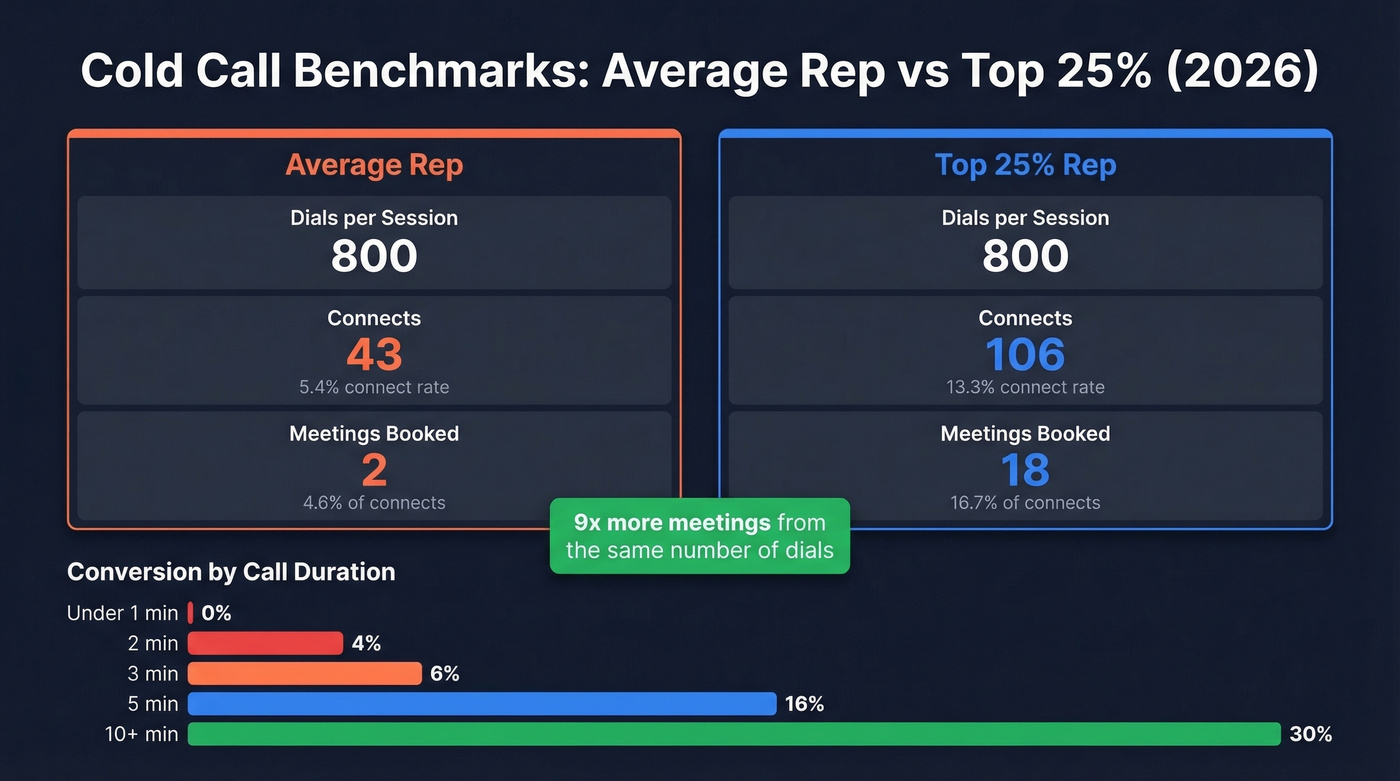
| Metric | Average Rep | Top 25% |
|---|---|---|
| Dials per session | 800 | 800 |
| Connects | 43 (5.4%) | 106 (13.3%) |
| Meetings booked | 2 (4.6%) | 18 (16.7%) |
That's a 9x gap from the same number of dials. The difference comes down to list quality, opener effectiveness, and call duration. Calls under one minute convert at 0%. Two minutes gets you to 4%. Three minutes, 6%. Hit five minutes and you're at 16%. Push past ten and conversion climbs to roughly 30%.
Conversion by Industry
Not every vertical responds the same way. Set your expectations before you build your list:
| Industry | Conversion Rate |
|---|---|
| Janitorial services | 2.85% |
| Business services | 2.61% |
| Financial services | 1.54% |
| Tech / software | 0.95% |
| Industrial equipment | 0.88% |
Deal size matters too. Reps selling into the $500-$10K range convert at 2.64%, while $1M-$5M deals convert at 1.16%. Bigger deals take more touches.
The buyer side confirms the channel works: 57% of C-level and VP buyers prefer phone contact, and 82% have accepted meetings from sequences that started with a cold call.
The training stat should change your behavior. Reps with daily call coaching convert at 9.03% versus 1.89% for reps with no regular training. That's not a marginal improvement - it's a completely different job. We've seen this pattern repeatedly: teams that add daily 15-minute call reviews see results shift within two weeks.
Is This Approach Outdated?
The criticism on Reddit is fair. One r/sales thread called it "the telephone equivalent of spray and pray." And if you're dialing unsorted lists with no ICP targeting, no trigger events, and no research - yeah, it is spray and pray. That version deserves to die.
But here's the context most critics miss: quality conversations per rep per day dropped 55% between 2014 and 2022, from 8 to 3.6 according to Bridge Group data. Every dial matters more now than it did a decade ago. That's not an argument against cold calling. It's an argument for doing it with precision.
Rippling generates 50% of its demos - roughly 650 per month - from cold calls, at a $32,266 average deal size. That's not a team spraying and praying. That's a team with clean data, sharp openers, and relentless follow-up.
Here's the thing: if your average deal is under $5K, you probably don't need a parallel dialer or a $30K/year data platform. A verified list, a good framework, and two hours of focused dialing will outperform most overcomplicated tech stacks. The reps booking 18 meetings per 800 dials aren't doing something fundamentally different. They're doing the same thing with better inputs.

The gap between 2 meetings and 18 meetings per 800 dials isn't your script - it's whether the phone actually rings. Prospeo gives you 125M+ verified mobile numbers with a 30% pickup rate, refreshed every 7 days. At $0.10 per mobile, you pay only when a number is found.
Stop smiling into voicemail. Dial numbers that connect.
The Script Framework
Memorized scripts sound memorized. Frameworks sound human. Here's the four-part structure that works:
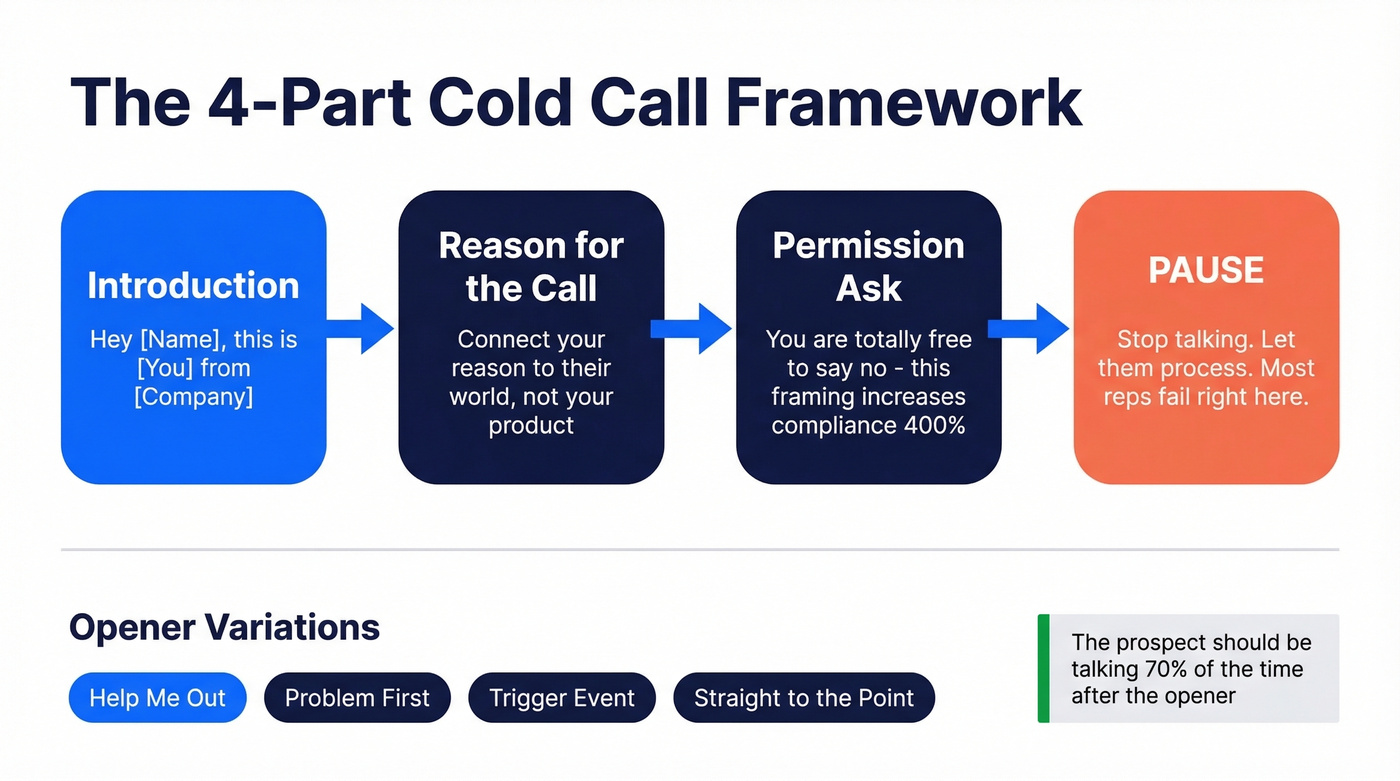
Introduction -> Reason for the call -> Permission ask -> Pause
The pause is where most reps fail. They fill silence with more talking. Don't. Let the prospect process and respond.
Opener Variations
- Help-me-out: "Hey [Name], you might be able to help me out. I'm trying to reach the person who handles [function] at [Company]..."
- Problem-first: "[Name], most [title]s I talk to are dealing with [specific problem]. Is that on your radar right now?"
- Trigger event: "I noticed [Company] just [raised a round / hired 10 AEs / opened a new office]. Usually when that happens, [relevant challenge] comes up..."
- Straight-to-the-point: "[Name], this is [You] from [Company]. I'll be brief - we help [type of company] do [outcome]. Worth a 15-minute conversation?"
End your permission ask with language like "you're totally free to say no." This framing is credited with a 400% increase in compliance when people feel they have explicit permission to refuse.
Handling the Top Objections
"Not interested" - "Totally fair - most people say that before they hear the specific number. Can I share one stat and you tell me if it's relevant?"
"Send me an email" - "Happy to. So I send you something useful, what's the biggest challenge you're dealing with on [topic] right now?"
"We already have a solution" - "Good - that tells me you take this seriously. Most of our customers switched from [competitor category]. What would need to be true for you to even consider an alternative?"
For softer objections, the Feel-Felt-Found structure works: "I understand how you feel. Others felt the same way until they found [specific result]." It sounds formulaic on paper, but delivered naturally it redirects without confrontation.
How to Run a Call Block
A call block is a focused, time-boxed session where you do nothing but dial. Calculate the cash value of each dial before you start - divide your sales turnover or quota by your total yearly dials. Knowing each call is worth $X keeps you dialing when motivation dips.
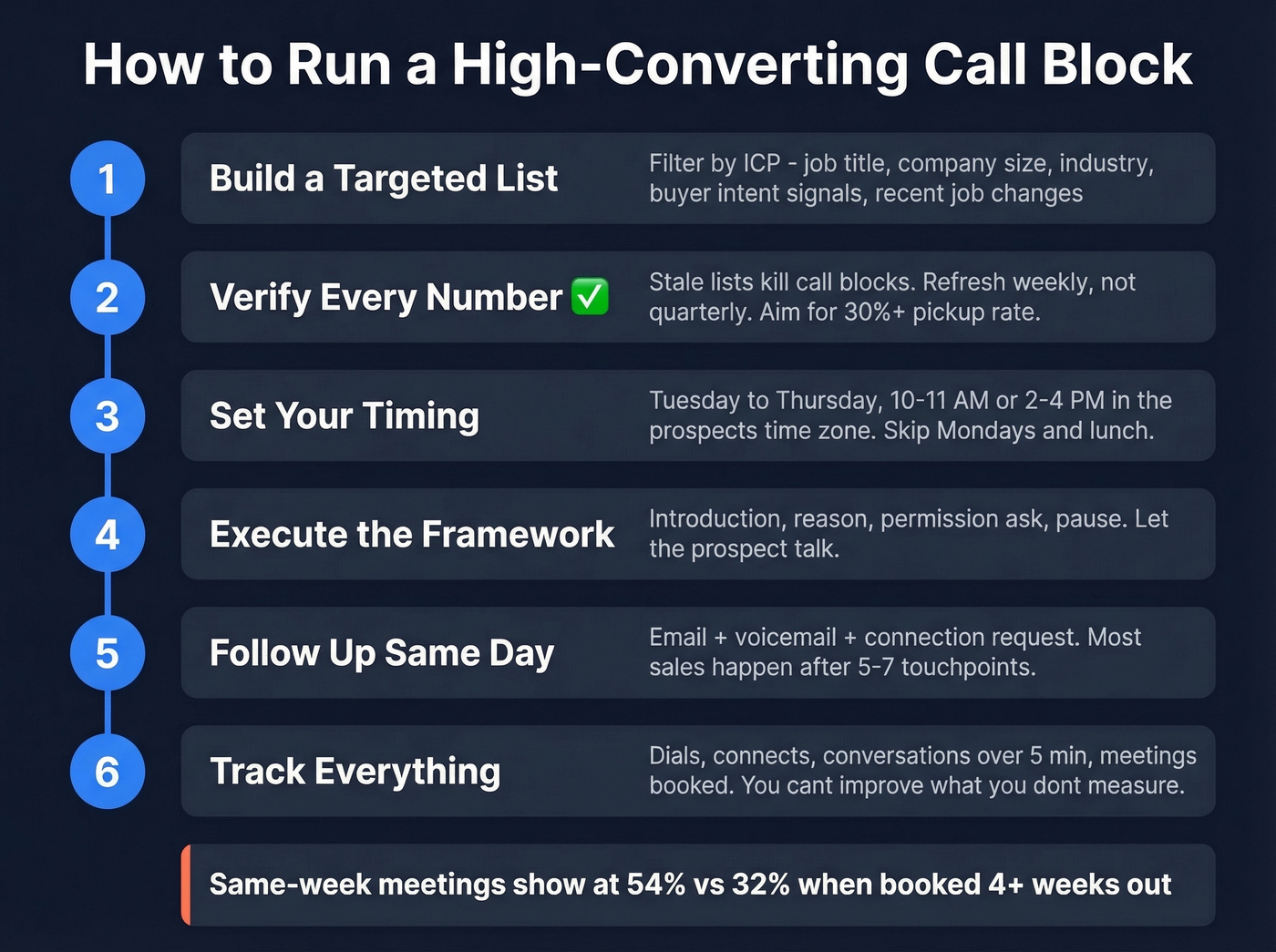
Build a targeted list. Use ICP filters: job title, company size, industry, buyer intent signals, recent job changes. Don't dial random contacts.
Verify every number. Stale lists are the #1 call-block killer. Prospeo's B2B database with 30+ filters including buyer intent and job changes lets you build a targeted list and verify every mobile number before it hits your dialer. The 125M+ verified mobiles refresh every 7 days - compared to the six-week industry average - so you're calling numbers that actually ring.

Set your timing. Tuesday through Thursday, 10-11 AM or 2-4 PM in the prospect's time zone. Avoid Mondays and lunch hours - connect rates drop significantly.
Execute with the framework. Introduction, reason, permission ask, pause. The prospect should be talking 70% of the time once you're past the opener.
Follow up the same day. Multi-channel: email, voicemail, and a connection request. Most sales happen after 5-7 touchpoints across a 10-14 day cadence. Book meetings for the same week when possible - same-week show rates hit 54% versus 32% when booked four or more weeks out. If you need copy, steal from these sales follow-up templates.
Track everything. Dials, connects, conversations over five minutes, meetings booked. You can't improve what you don't measure.
Sales reps spend only about 35% of their time actually selling. A structured call block protects the other 65% from eating your pipeline.
Mistakes That Kill Your Call Blocks
Without verification, most teams see connect rates in the 3-10% range - meaning 90-97% of dials don't connect. That's not a cold calling problem. It's a data problem. We've seen teams double their connect rate just by switching from quarterly to weekly list verification.
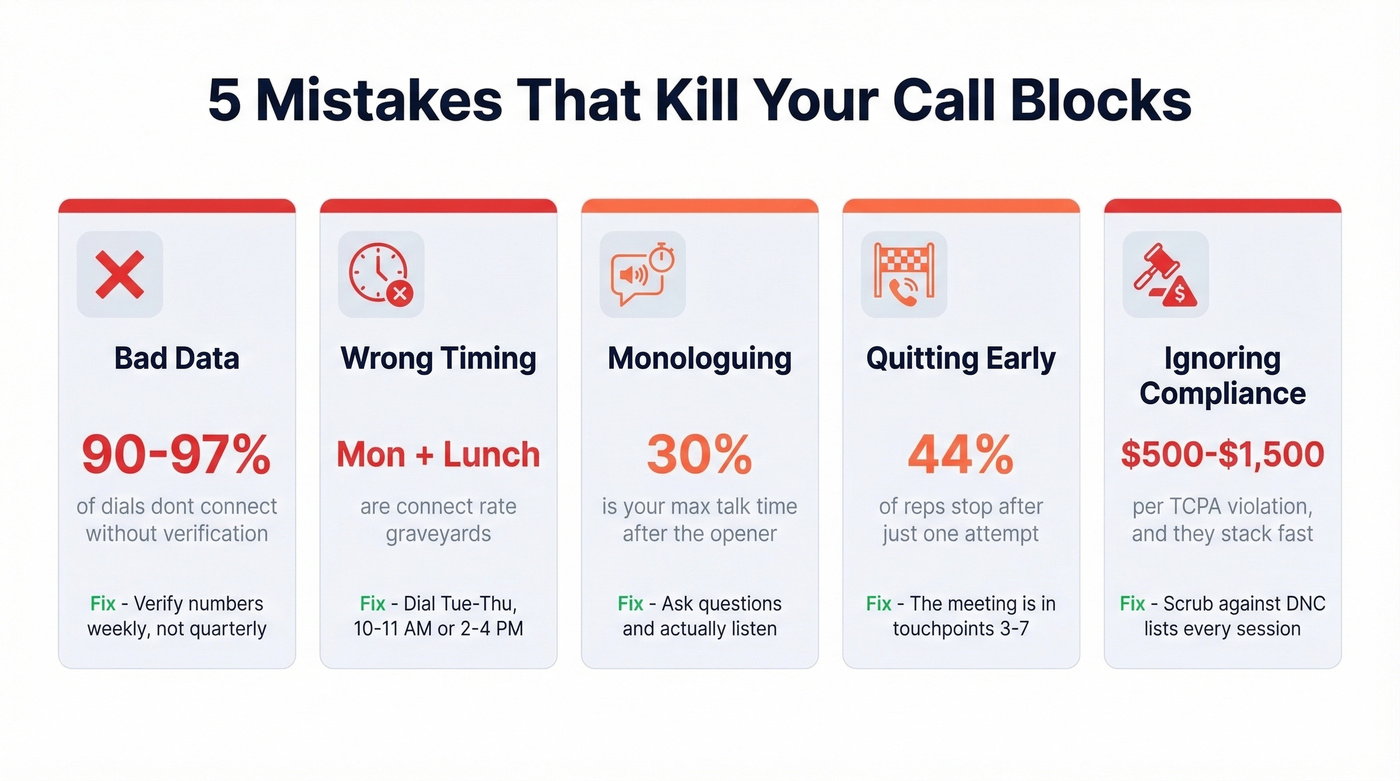
Beyond bad data, four other mistakes consistently tank call blocks. Wrong timing is the most common: Monday mornings and lunch hours are graveyards, so stick to the Tuesday-Thursday windows. Monologuing is the second killer - if you're talking more than 30% of the conversation after the opener, you're pitching, not selling. Ask questions and listen. Third, 44% of reps quit after one attempt, but the meeting is usually in touchpoint three through seven, not touchpoint one. And finally, ignoring compliance: a single TCPA violation costs $500, willful violations hit $1,500, and they stack fast at volume.
If your team struggles with the mental side, build a process for cold call rejection so reps don’t spiral after a bad block.
The Modern Cold Calling Stack
| Category | Tool | Price Range |
|---|---|---|
| Data & verification | Prospeo | Free tier; ~$0.01/email, 10 credits/mobile |
| Parallel dialer | Nooks | ~$100-200/user/mo |
| Parallel dialer | Mojo | ~$100-150/mo |
| Standard dialer | RingCentral | $20-35/user/mo |
| Standard dialer | CloudTalk | $25-50/user/mo |
| LinkedIn automation | Heyreach | ~$79-199/mo |
| CRM | HubSpot | Free tier; paid from $15/user/mo |
| Email sequencer | Instantly / Smartlead | ~$30-97/mo |
Verified data sits at the foundation of this stack. Without accurate numbers and emails, every other tool in the chain underperforms. Pair a data layer with a parallel dialer like Nooks to 3-5x your dial volume per hour, and push follow-up emails through Instantly or Smartlead.
Skip the parallel dialer if your team is under five reps - the ROI doesn't justify the cost until you're running enough volume to fill the queue. A standard dialer with clean data will get you further than a parallel dialer with garbage numbers. If you’re building a full workflow, start with a cold calling system instead of random tools.
Quality conversations per rep dropped 55% in eight years. Every dial matters more now. Prospeo's 30+ filters - buyer intent, job changes, headcount growth, technographics - let you build lists where every number is a real prospect who fits your ICP. Not a stale spreadsheet from six months ago.
Turn smile and dial into smile and connect. Free tier included.
Compliance Checklist
Real talk: B2B doesn't mean you're exempt. Courts treat mobile numbers on the National DNC list as residential regardless of business use. Here's what you need to know:
- TCPA penalties: $500 per violation, $1,500 if willful. These stack fast at volume.
- DNC fines: Up to $50,120 per illegal call.
- Federal calling window: 8 AM to 9 PM in the recipient's local time zone. Not yours.
- Scrub your lists: Check against the National DNC registry at least every 31 days. No exceptions.
- Consent tiers: Prior Express Written Consent (PEWC) is required for automated or prerecorded marketing calls to cell phones. Prior Express Consent (PEC) covers informational messages. An Established Business Relationship may exempt some live calls from DNC rules but doesn't replace PEWC for autodialed marketing.
- State mini-TCPAs: Florida, Maryland, Oklahoma, and Washington have stricter rules with no B2B exemptions in many cases. Connecticut can hit $20,000 per violation. Know the states you're dialing into.
- Ringless voicemail and AI voice calls: Both are treated as prerecorded messages and require consent.
This isn't legal advice. But it's the checklist we've seen keep teams out of trouble.
FAQ
What does smiling and dialing mean?
It's a cold calling technique where reps physically smile while making high-volume outbound calls. Research from the University of Portsmouth confirmed that listeners can detect genuine Duchenne smiles in voice-only interactions, which is why the technique improves vocal warmth and prospect receptivity.
What's the average cold call conversion rate?
The average cold call conversion rate is 2.35% - roughly one meeting per 43 calls. Reps who receive daily coaching reach 9.03%, nearly four times the average. Industry matters too: janitorial services convert at 2.85% while tech/software sits at 0.95%.
When's the best time to cold call?
Tuesday through Thursday, between 10-11 AM and 2-4 PM in the prospect's local time zone. Mondays and lunch hours consistently show the lowest connect rates. Book meetings for the same week - show rates are 54% versus 32% when booked four or more weeks out.
How do I get verified phone numbers for cold calling?
Use a B2B data platform with weekly refresh cycles instead of static purchased lists. Prospeo's database includes 125M+ verified mobiles with a 30% pickup rate and 30+ filters for ICP targeting - compared to the 3-10% connect rates most teams see on unverified lists. A free tier lets you test before committing.
Does this technique still work in 2026?
It works better than ever - if you update the method. The reps who pair genuine phone energy with verified data, ICP-filtered lists, and multi-channel follow-up are booking 9x more meetings than average. The technique isn't outdated. Dialing without precision is.