

Soft Follow-Up Email Samples: Templates, Data, and the Framework Behind Every Reply
You had a great discovery call. Real engagement, genuine interest, maybe even a verbal "let's do this." Then - silence. Most follow-up advice tells you to "just check in," which is exactly the kind of lazy email you're trying to avoid sending. You don't need 57 templates. You need one soft follow-up email framework and the discipline to add value every time you hit send.
What You Need (Quick Version)
Every effective soft follow-up email has three ingredients: new value, a soft CTA, and an easy out. A study of 2M+ cold emails found that informal, low-pressure emails get a 10.36% positive reply rate vs. 5.83% for formal ones - 78% higher. Below: 12 ready-to-use templates, the phrases that kill your chances, and the exact cadence to follow.
What Makes a Follow-Up "Soft"?
A soft follow-up isn't just a polite email. It's a specific structure designed to reduce friction and give the recipient a reason to reply that isn't guilt.
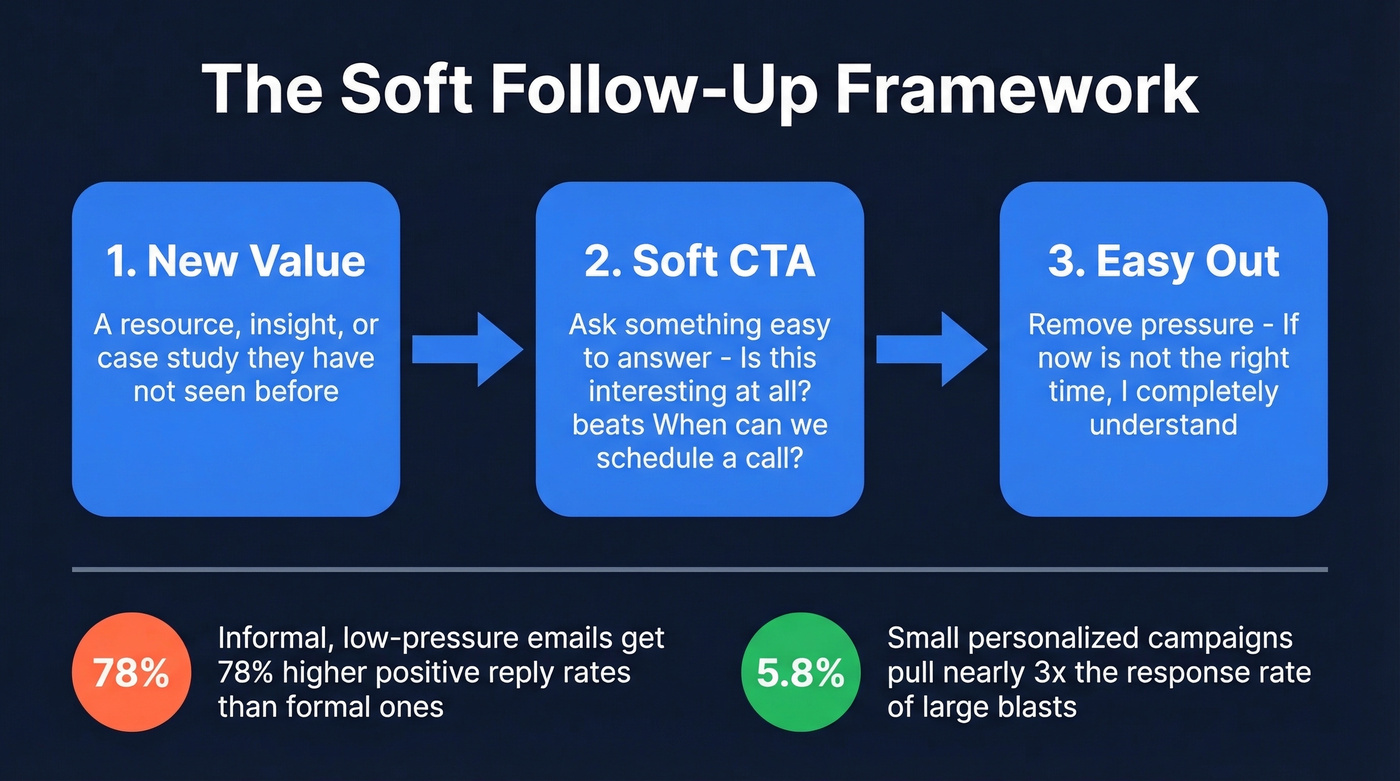
The formula is simple. Add new value - a resource, an insight, a case study they haven't seen. Close with a soft CTA that doesn't demand anything ("Is this interesting at all?" beats "When can we schedule a call?"). Then offer an easy out ("If now isn't the right time, I completely understand"). That last piece is counterintuitive, but it works because it removes the pressure that makes people avoid replying altogether. We've tested dozens of variations over the years, and the ones that work all follow this pattern.
The data backs it up. Smaller campaigns under 50 recipients pull a 5.8% response rate - nearly 3x the 2.1% from large blasts. Tone and personalization matter more than volume. And before you craft the perfect gentle nudge, step zero is making sure it actually reaches someone. Run your contact through Prospeo's email verification so your carefully written message doesn't bounce into the void.

The Passive-Aggressive Translator
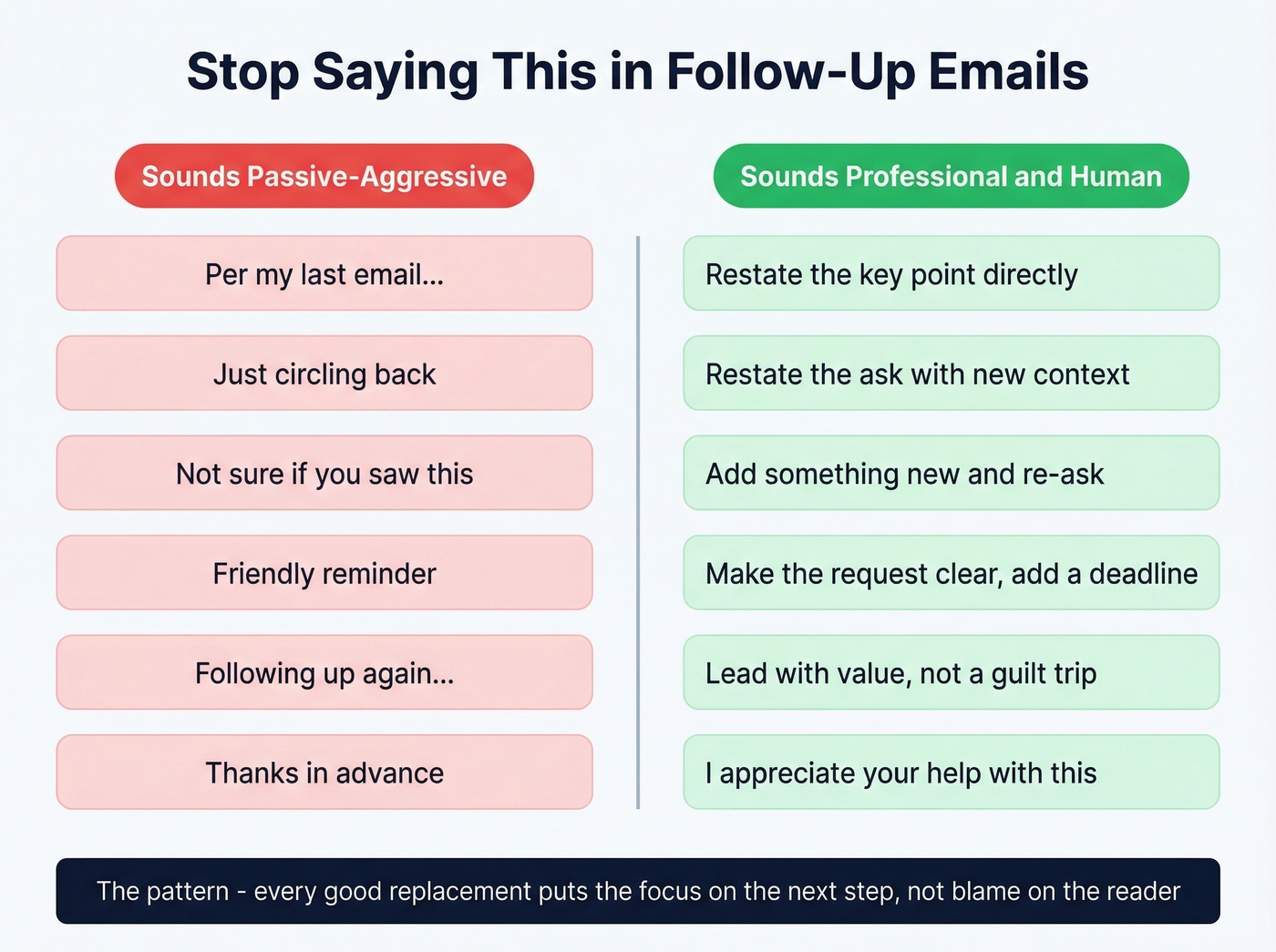
Many common follow-up phrases read as passive-aggressive - even when you don't mean them that way.
| Don't Say | Say Instead |
|---|---|
| "Per my last email..." | Restate the key point directly |
| "Just circling back" | Restate the ask with new context |
| "Not sure if you saw this" | Add something new and re-ask |
| "Friendly reminder" | Make the request clear and add a deadline: "I need X by Friday" |
| "Please advise" | Ask a question they can answer in one line |
| "Thanks in advance" | "I appreciate your help with this" |
| "As you are no doubt aware..." | State the fact - skip the sarcasm |
| "Going forward" | Make the request now, not a lecture |
| "Copying [name] here" | "Adding Sarah - she'll approve the budget" |
| "Following up again..." | Lead with value, not a guilt trip |
The pattern: every passive-aggressive phrase puts the blame on the reader. Every good replacement puts the focus on the next step.

You just spent 15 minutes crafting the perfect gentle nudge. If that email bounces, it was 15 minutes wasted - and your domain reputation takes the hit. Prospeo verifies emails at 98% accuracy with a 5-step process that catches spam traps, honeypots, and catch-all domains before you send.
Verify your prospect's email before you send that follow-up.
12 Polite Follow-Up Email Templates
Each template follows the framework: new value + soft CTA + easy out. Placeholders are in [brackets]. Keep these short - 50-125 word emails hit the highest reply rates.
After No Response (Cold Outreach)
Hi [Name],
I came across [specific resource/case study] that reminded me of what you mentioned about [their challenge]. Thought it might be useful regardless of whether we work together.
Worth a quick conversation, or is this not a priority right now? Either way, no pressure.
After a Meeting or Demo
Hi [Name],
Thanks again for the time on [day]. You mentioned [specific pain point] - I pulled together a quick breakdown of how [your solution] handles that for [similar company].
Worth a follow-up call, or would you prefer I send more detail over email?
After Sending a Proposal
This "scheduling framing" trick - positioning the follow-up as logistics rather than a nudge - comes straight from r/sales and works because it gives the recipient a concrete action instead of a vague ask.
Hi [Name],
I'm finalizing my schedule for next week and wanted to see if [Tuesday or Thursday] works to walk through any questions on the proposal. If you're still reviewing, happy to circle back later in the month.
After a Networking Event
Hi [Name],
Great meeting you at [event] - your point about [specific topic] stuck with me. I found [article/resource] that builds on that idea. Would you be open to grabbing coffee sometime? No agenda, just enjoyed the conversation.
Send this within 24-48 hours while the interaction is fresh.
Job Application Follow-Up
This "add value" structure - one sentence referencing the application, two sentences sharing something interesting, one soft CTA - lifts response rates from ~5% to ~30% compared to the generic "just checking in on my application."
Hi [Name],
I submitted my application for [role] last week and wanted to share something relevant - [brief insight about their industry/a competitor move]. It connects to [how you'd add value in the role].
If the timing isn't right, I completely understand. Just wanted to put this on your radar.
Interview Follow-Up (No Response)
Hi [Name],
Since we spoke on [date], I [completed a relevant project/learned something about their space] and thought it was worth sharing: [one sentence of new info].
Happy to discuss further or wait until you have an update - whatever works best.
Client / Project Check-In
Hi [Name],
Quick check-in on [project/deliverable]. Which works for next steps?
- Option A: [specific next step]
- Option B: [alternative]
- Option C: Push to [later date]
Just pick whichever fits - I'll adjust from there.
Internal Stakeholder Nudge
Hi [Name],
I need [specific input] by [date] so we can [business reason - e.g., "hit the board deck deadline"]. If that timeline doesn't work, let me know and I'll adjust the schedule.
After a Voicemail
Hi [Name],
Just left you a quick voicemail about [topic]. The short version: [one sentence summary + value]. Would [day/time] work for a 10-minute call, or would you prefer I send details over email?
After Providing a Resource
Hi [Name],
I sent over [resource] last week - curious if it was helpful or if you need something more specific to [their situation]. Happy to dig up something more targeted.
Re-Engagement After Long Silence
Hi [Name],
It's been a while - no guilt trip, just wanted to share [new development/case study] that's relevant to [their challenge]. If the timing is better now, I'd love to reconnect. If not, no worries at all.
The Breakup Email
Hi [Name],
I've reached out a few times and haven't heard back, so I'll assume the timing isn't right. I'm going to close out my notes on this for now. If things change down the road, I'm an email away.
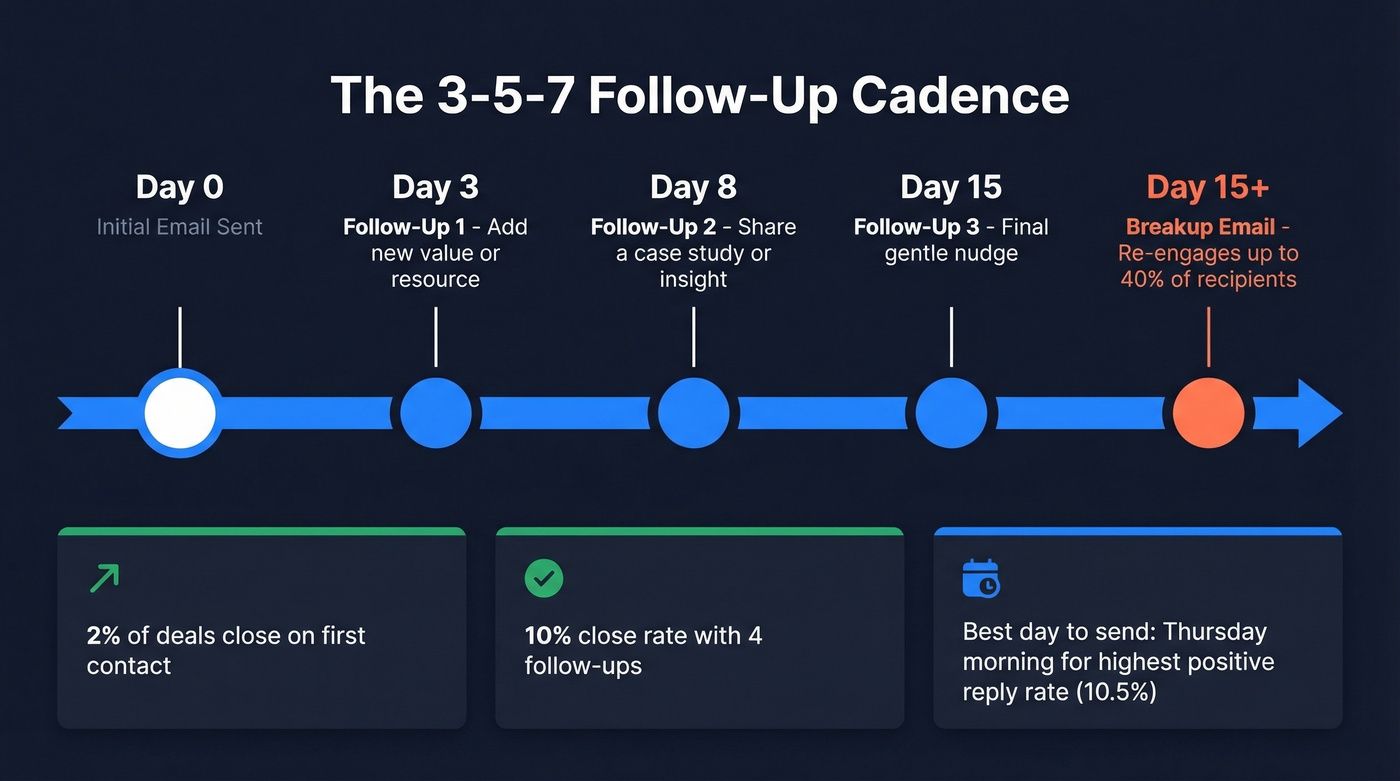
Here's the thing about breakup emails: they re-engage up to 40% of recipients. The transparency and lack of pressure actually triggers a response when nothing else did. In our experience, the breakup email is one of the best-performing templates in this entire list - use it after 3-5 unsuccessful follow-ups.
If your follow-up sequence doesn't include a breakup email, you're leaving the highest-converting message on the table. Most people are too afraid to "give up." But giving up is what gets the reply.
Soft follow-ups only work when they reach real inboxes. Most bounced emails come from outdated contact data that hasn't been refreshed in weeks. Prospeo refreshes every record on a 7-day cycle - not the 6-week industry average - so the email you're following up on is still valid.
Stop following up with dead addresses. Get verified contacts at $0.01 each.
Subject Lines That Get Opens
47% of recipients decide whether to open based on the subject line alone. Questions in subject lines increase opens by up to 50%, and personalized subject lines boost opens up to 14%.
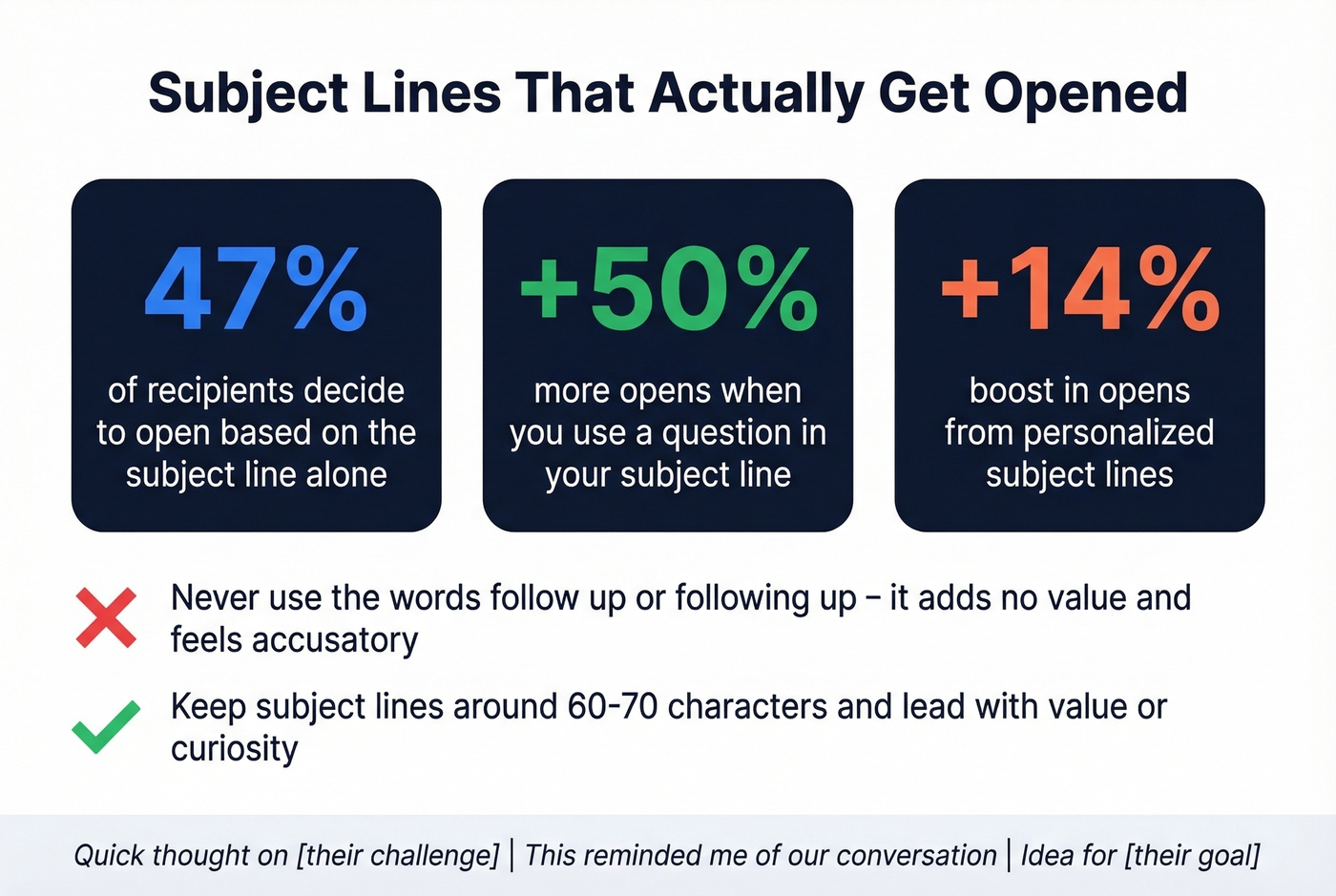
Two rules: don't use the words "follow up" or "following up" in your subject line - it adds no value and feels accusatory. Keep it around 60-70 characters. If you want more options, pull from these subject lines and adapt them to your context.
- Quick thought on [their challenge]
- [Resource] for [their company name]
- This reminded me of our conversation
- Question about [specific topic from last interaction]
- Idea for [their goal/project]
- [Mutual connection] suggested I share this
- Still relevant? [One-line value prop]
- [Their company] + [your company] - next step?
When to Send Your Follow-Up
The 3-5-7 cadence works for most situations: first follow-up after 3 business days, second after 5 more days, final after 7 more days. Only 2% of deals close on the first contact - that number jumps to 10% with four follow-ups.
| Situation | Follow-Up Window |
|---|---|
| Scheduling / approvals | 24-48 hours |
| Standard outreach | 3-5 business days |
| Proposals / strategic decisions | 1 week |
For day-of-week timing, data from 2M+ emails shows Monday drives the highest reply rate (1.96%) while Thursday delivers the highest positive reply rate (10.5%). We've found Thursday mornings to be the sweet spot - people are past the Monday chaos but haven't mentally checked out for the weekend yet. For a deeper breakdown, see our guide on the best time to send.
Same thread or new email? Reply in the same thread for follow-ups 1-3. It gives the recipient context without making them search. Start a fresh thread only if you're changing the subject entirely or re-engaging after 30+ days of silence.
When NOT to follow up: Don't send a follow-up before a promised timeline has passed - if they said "I'll get back to you next week," wait until the following week. And after you've sent the breakup email, stop. Anything beyond that crosses from persistent into annoying. If you want a decision rule, use this follow up timing framework.
Closers That Reduce Pressure
The best soft CTA does two things: it makes replying easy, and it makes not replying feel okay too. That paradox is exactly why they work.
For low-commitment asks, try "Is this interesting at all to you?" or "No pressure - just wanted to put this on your radar." When you need to move toward a meeting, "I'm mapping out my week - does [day] work?" or "Would you be open to a quick call?" give the reader a concrete action without demanding one. And for situations where you genuinely want to give them space, "Happy to circle back in a month if that's better" or "Either way, no hard feelings" signal that you respect their time more than you need their reply.
Let's be honest - the difference between a follow-up that gets a reply and one that gets archived usually isn't the words. It's whether you gave the person a reason to care and the space to say no. Nail those two things and the templates above will do the rest. If you want more examples, compare these with our sales follow-up templates and cold email follow-up templates.
FAQ
How many follow-ups should I send before stopping?
Send 3-5 follow-ups over 2-3 weeks using the 3-5-7 cadence. If you still hear nothing, send a breakup email - they re-engage up to 40% of the time. After the breakup, move on completely.
What separates a soft follow-up from a regular one?
A soft follow-up email adds new value, uses a low-pressure CTA, and gives the recipient an explicit easy out. A regular follow-up typically restates the original ask ("checking in on this") without giving the reader a new reason to respond.
How do I make sure my follow-up reaches the right inbox?
Use an email verification tool before sending. A perfectly crafted message is worthless if it bounces, and invalid addresses damage your sender reputation for every future email you send. Tools like Prospeo verify in real time with 98% accuracy and offer a free tier of 75 emails per month - enough to test before committing.