

Solution Selling Methodologies: Frameworks That Work in 2026
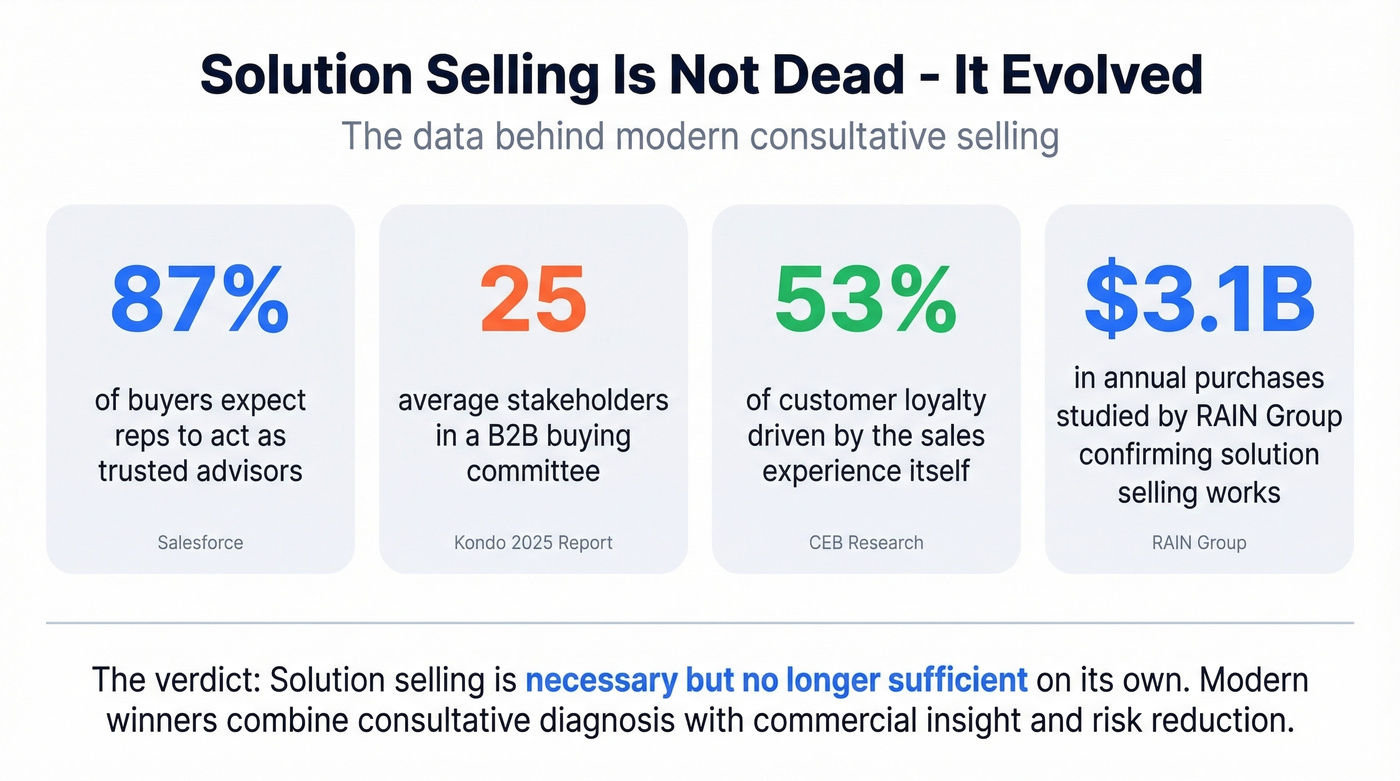
87% of business buyers expect reps to act as trusted advisors - not product pushers, not demo jockeys, not walking feature lists. Meanwhile, buying committees have ballooned to 25 stakeholders on average, sales cycles stretch to 6.5 months, and win rates hover around 20%. The gap between what buyers expect and what most sales orgs deliver has never been wider, and that's exactly why solution selling methodologies have evolved from nice-to-have training into survival-grade infrastructure.
Most methodology guides list 10+ frameworks and treat them like a buffet. That's academic tourism, not sales enablement. You need 2-3 frameworks that interlock, and you need to practice them on hundreds of live calls before they become instinctive.
What You Need (Quick Version)
If you're building a methodology stack from scratch, start with three:
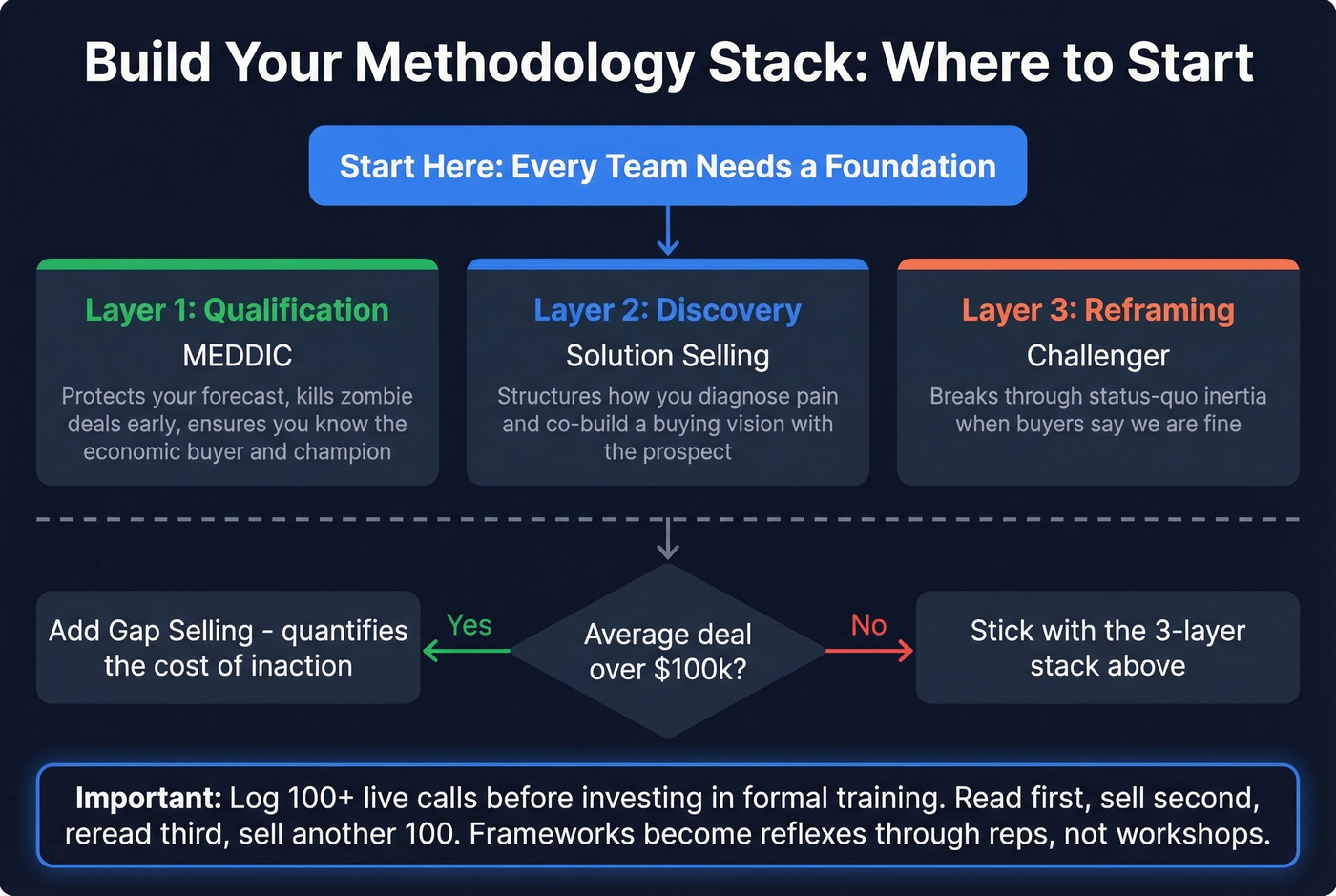
- MEDDIC for qualification - it protects your forecast and kills zombie deals early
- Solution Selling for discovery - it structures how you diagnose pain and build a buying vision through a consultative approach
- Challenger for reframing - it breaks through "we're fine" status-quo inertia
Add Gap Selling if your average deal exceeds $100k. And here's the contrarian take most enablement leaders won't say out loud: don't send reps to a $5k methodology workshop until they've logged at least 100 live calls. Read first. Sell second. Reread third. Sell another 100. That's how frameworks become reflexes.
What Is Solution Selling?
Solution Selling was originally developed in the mid-1970s by Frank Watts at Wang Laboratories. Michael Bosworth later founded the Solution Selling sales training organization in 1983 after receiving Watts's training, and his customer-centric philosophy - that reps should focus on the buyer's world rather than their own product - became the foundation for an entire generation of consultative frameworks.
The core premise: diagnose the buyer's pain, create a shared vision of a better future state, then map your capabilities to that vision. You're co-building an answer to a real business problem with the buyer, not reciting a feature list.
The methodology works best in complex B2B environments with high-value, long-cycle deals - enterprise software, IT consulting, industrial equipment, and regulated industries like pharma and finance. Modern teams use structured artifacts like pain chains, power sponsor maps, and mutual success plans, plus value quantification tools like ROI/TCO and Economic Value to the Customer (EVC) models. Advanced teams extend the framework into commercial execution with price waterfalls, give-get negotiation structures, and price fences that protect margins during procurement.
Where it doesn't fit: commodity sales, transactional deals, and product-led growth motions where the buyer wants to click "Start Free Trial" and figure it out themselves. In a PLG model where users self-serve, this approach adds friction. It belongs in sales-led growth motions where the deal requires human guidance.
6 Frameworks That Actually Matter
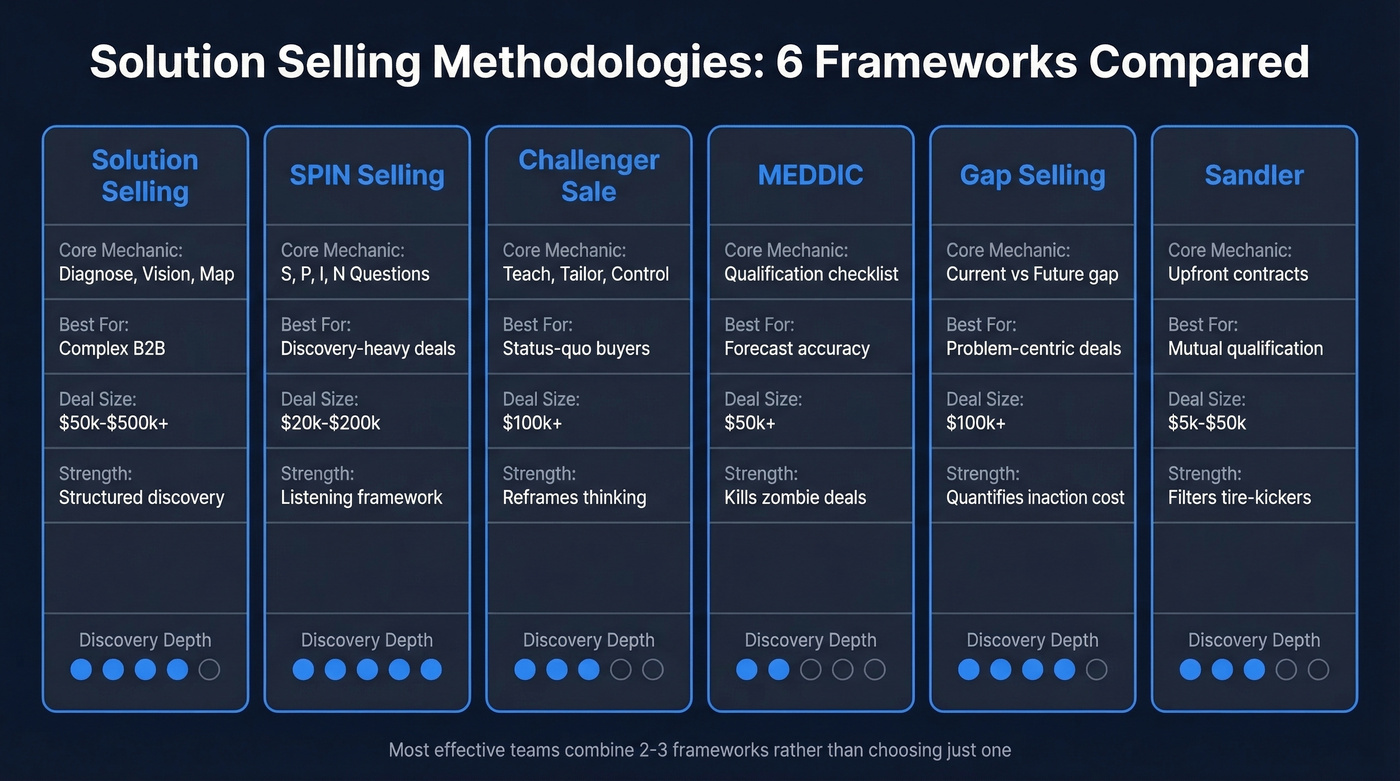
| Framework | Research Base | Core Mechanic | Best For | Ideal Deal Size |
|---|---|---|---|---|
| Solution Selling | Bosworth | Diagnose → Vision → Map | Complex B2B | $50k-$500k+ |
| SPIN Selling | 35,000+ calls, 12 yrs | S→P→I→N questions | Discovery-heavy | $20k-$200k |
| Challenger Sale | 6,000+ reps (CEB) | Teach, tailor, control | Status-quo buyers | $100k+ |
| MEDDIC | Enterprise SaaS | Qualification checklist | Forecast accuracy | $50k+ |
| Gap Selling | Keenan | Current → future gap | Problem-centric | $100k+ |
| Sandler | Sandler Training | Upfront contracts | Mutual qualification | $5k-$50k |
Solution Selling
The original consultative approach. Its strength is structure: the 9-box vision process model and a clear sales process from diagnosis to proposal. Modern teams blend it with MEDDIC for qualification rigor and Challenger for insight delivery. On its own, it drifts toward feature comparisons when reps skip the impact-quantification step and jump straight to capabilities.
SPIN Selling
Neil Rackham's team analyzed 35,000+ sales calls across 20+ countries over 12 years to build this framework. The question sequence - Situation, Problem, Implication, Need-Payoff - remains the best discovery scaffolding for reps who talk too much and listen too little.
SPIN is fundamentally a pain-based model. The Implication questions force buyers to confront the real cost of their problems before any solution enters the conversation. It doesn't handle qualification or closing mechanics, so it pairs well with MEDDIC downstream.
Challenger Sale
CEB studied 6,000+ reps and found that "Challengers" - reps who teach buyers something new, tailor their message, and take control of the conversation - outperformed relationship builders in complex sales. 53% of customer loyalty is driven by the sales experience itself, not the product or price. Xerox saw a 17% sales uplift and $65M in contract value after implementing Challenger principles.
Here's the thing: Challenger overcorrected. It convinced a generation of reps that teaching means lecturing. The best Challenger reps teach by asking questions that reframe, not by delivering TED talks on discovery calls. The approach works because it forces reps to sell the problem before the solution - once the buyer sees a risk they hadn't considered, they're far more receptive to change.
MEDDIC / MEDDICC
MEDDIC is the best qualification framework in B2B SaaS. Full stop. The acronym breaks down into six checkpoints:
- Metrics - what quantified outcomes define success?
- Economic Buyer - who signs the check?
- Decision Criteria - what are they evaluating against?
- Decision Process - what steps, approvals, and timelines exist?
- Identify Pain - what's the business problem driving urgency?
- Champion - who inside the org is selling for you when you're not in the room?
The second C in MEDDICC adds Competition. We've seen teams cut their pipeline after implementing MEDDIC and close more revenue because they stopped wasting cycles on deals that were never going to close.
Gap Selling
Keenan's framework is the evolution of consultative selling. Where traditional approaches can devolve into "sell to the acknowledged need," Gap Selling forces reps to quantify the gap between current state and desired future state before discussing solutions at all. This problem-centric model keeps the focus on the magnitude of the gap, not the specs of the fix. Best for high-ACV deals where the cost of inaction is the real competitor.
Sandler Selling System
Skip this if you're selling into 25-person enterprise committees. Sandler shines in mid-market.
Sandler flips the power dynamic. Upfront contracts set mutual expectations before every meeting, and the buyer qualifies themselves as much as the rep qualifies them. Before Sandler, reps waste hours on demos for prospects who were never serious. After Sandler, tire-kickers self-select out. The framework is less suited to enterprise deals where you can't get a single upfront contract that covers the whole buying group.
The 9-Box Vision Process Model
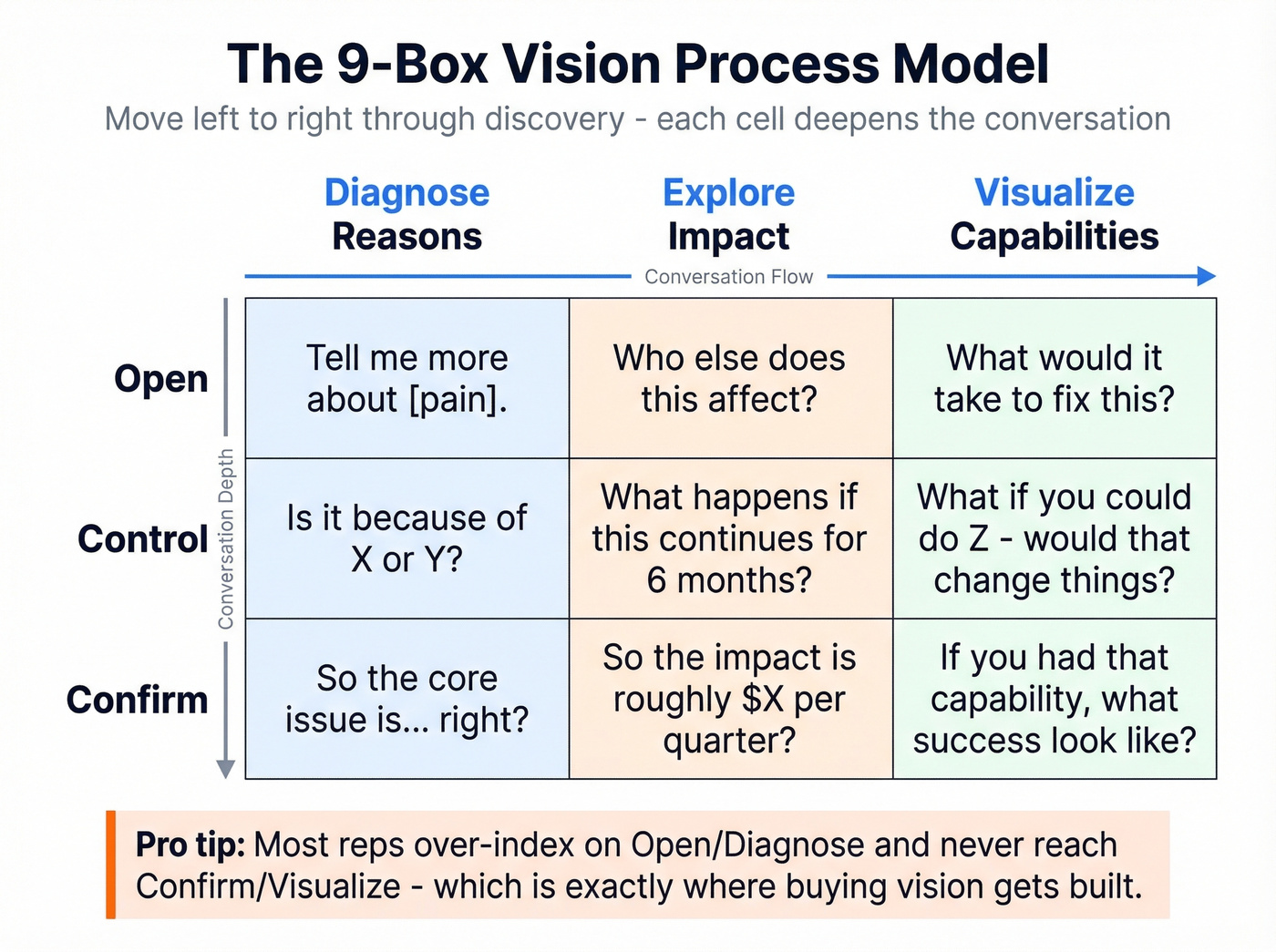
This is solution selling's most tactical artifact - and most guides skip it entirely. The 9-box model combines three question types (Open, Control, Confirm) with three discovery phases (Diagnose Reasons, Explore Impact, Visualize Capabilities) to create a structured conversation framework. It's the backbone of how to execute consultative discovery in practice.
| Diagnose Reasons | Explore Impact | Visualize Capabilities | |
|---|---|---|---|
| Open | "Tell me more about [pain]." | "Who else does this affect?" | "What would it take to fix this?" |
| Control | "Is it because of X or Y?" | "What happens if this continues for 6 months?" | "What if you could do Z - would that change things?" |
| Confirm | "So the core issue is... right?" | "So the impact is roughly $X/quarter?" | "If you had that capability, what would success look like?" |
The model works by moving left to right: first you diagnose why the problem exists, then you explore its ripple effects across the org, then you help the buyer visualize what life looks like with a solution. Each row controls the conversation's depth - open questions surface information, control questions steer toward specifics, confirm questions lock in agreement before moving forward.
Bonus questions worth stealing: Try "Walk me through what happens when [problem] occurs - step by step" in the Diagnose column. In Explore Impact, ask "If you could wave a magic wand and fix this overnight, what would your team do differently tomorrow?" And in Visualize Capabilities, push with "What's the cost of doing nothing for another quarter?" These three questions consistently surface deeper pain than the standard set because they let the buyer articulate the problem in their own words.
How to practice: Record your next five discovery calls and map each question you asked to a cell in the grid. You'll immediately see which cells you default to and which you skip entirely. Most reps over-index on Open/Diagnose and never reach Confirm/Visualize - which is exactly where buying vision gets built.
The 9-box shines in complex deals with ambiguous pain, emerging product categories, and situations where the buyer can't easily articulate what they need. It falls flat on low-price, short-cycle products with concrete use cases. If someone's buying a $500/month tool to solve a well-understood problem, walking them through a 9-box grid will feel patronizing.

Every methodology above depends on one thing: getting in front of the right decision-maker. Prospeo's 300M+ verified profiles with 30+ filters - including buyer intent, job changes, and department headcount - let you pinpoint the economic buyer and champion MEDDIC demands. 98% email accuracy means your outreach actually lands.
Stop perfecting your framework on prospects you can't reach.
Is Solution Selling Dead?
The "solution selling is dead" narrative took off in 2012 after a Harvard Business Review critique argued that conventional approaches - aligning your solution to an acknowledged need and proving it's better than the competition - no longer work because buyers arrive pre-educated.
They had a point. But they overstated it.
A RAIN Group study of 700+ B2B opportunities from buyers responsible for $3.1B in annual purchases found that solution selling is "necessary but no longer sufficient." Their three-level model - Connect, Convince, Collaborate - shows that modern winners still diagnose and solve, but they also demonstrate deep understanding of the buyer's world and actively reduce perceived risk.
Keenan's Gap Selling critique adds another layer: when reps "sell to the need," conversations drift toward feature comparisons. Problem-centric selling keeps the focus on the magnitude of the gap, not the specs of the fix.
The resolution is simple. Solution selling isn't dead - it's incomplete. It's one layer in a stack, not the whole stack. Pair it with MEDDIC for qualification rigor and Challenger for insight delivery, and you've got a framework that handles the full complexity of a 2026 enterprise deal.
Real Deals: Methodology in Action
These examples show how different frameworks play out in live deals - and where they break down.
MEDDIC saves a forecast ($72k ITSM SaaS, Southern Europe). The deal looked solid - the technical team loved the product. But MEDDIC exposed four gaps: no access to the economic buyer, no quantified metrics, an unknown decision process, and no internal champion. The deal didn't close that quarter. But it didn't blow up the forecast either. MEDDIC's value isn't always closing - sometimes it's knowing when to walk away.
Challenger reframes status quo ($350k MVNO billing SaaS, 6-7 month cycle). The prospect's existing system "worked fine." Instead of diagnosing pain they didn't think they had, the Challenger approach taught the buyer something unexpected: revenue leakage from slow plan launches and scalability limits that would cap growth within 18 months. Reframing the cost of inaction - not the cost of the product - closed the deal.
Sandler cuts wasted demos ($8-10k EdTech SaaS, India). Upfront contracts - "If we show you X and it solves Y, are you prepared to make a decision by Z?" - eliminated tire-kickers early. Close rates went up. More importantly, rep morale went up because they stopped feeling like free consultants.
SPIN makes the buyer sell themselves ($20k chatbot SaaS). The Implication and Need-Payoff questions did the heavy lifting. By the time the buyer had articulated what slow response times were costing them in lost leads and customer churn, they'd essentially built the business case themselves. The rep barely had to pitch.
When It Goes Wrong
The most common failure mode isn't picking the wrong methodology. It's executing the right one badly.
A rep on r/sales described sitting through 6 hours of consultative selling training, then using a canned discovery line on the next call - "What's keeping you up at night?" The buyer's response: "Are you reading from a script?" Click. Robotic discovery is worse than no discovery at all because it actively destroys trust.
Then there's methodology fatigue. As one Reddit thread put it, Sandler, BANT, Challenger, and MEDDIC "all boil down to need, budget, stakeholders, timeline." That's reductive, but the frustration is real. When orgs push frameworks before reps have mastered basic conversation skills, everything feels like overhead.
Other failure modes compound from there: misdiagnosing pain because you're following a script instead of listening, scope creep from over-customizing solutions during discovery, and the classic training-to-application gap - the $5k workshop that produces a binder nobody opens again. Methodology without practice is just theory. And theory doesn't close deals.
One pitfall worth calling out: teams that start with end users and hope adoption bubbles up to decision-makers often stall at the executive level. The champion can't articulate ROI to the economic buyer. Solution selling methodologies work best when you multi-thread across the entire org chart from the start.
How to Build Your Methodology Stack
Stop collecting frameworks. Start stacking them deliberately.
Layer 1 - Qualification: MEDDIC. Run every deal through it. No exceptions. If you can't identify the economic buyer and champion, you don't have a deal - you have a hope. (If you want a deeper checklist, use these MEDDIC discovery questions on live calls.)
Layer 2 - Discovery: Solution Selling's 9-box model or SPIN. Pick whichever feels more natural to your team's selling style. Both create a personalized process where every conversation adapts to the buyer's specific situation.
Layer 3 - Insight: Challenger. Use it when the buyer thinks they're fine. Teach them something that reframes their status quo as a risk.
Layer 4 (optional) - Gap quantification: Gap Selling. Add this for deals above $100k where the cost of inaction is the real competitor.
Let's be honest about what matters most here: the practice loop beats the framework selection every time. Read the book. Run 100 calls. Reread the book. Run 100 more. Outreach's data shows deals closed within 50 days hit a 47% win rate versus 20% after that threshold. Fluency comes from reps, not workshops. (To operationalize the practice loop, build it into a 30-60-90 day plan for new reps.)
Why Methodology Fails Without Good Data
You can run a perfect MEDDIC qualification and a flawless Challenger reframe - and still lose because you couldn't reach the economic buyer. With 25-person buying committees, executing any of these solution selling methodologies is a multi-threading exercise. You need verified contact data for the champion, the economic buyer, the technical evaluators, and the end users.
Here's the scenario that kills deals every quarter: a rep builds a beautiful 9-box discovery plan, targets 200 prospects, and discovers 40% of the phone numbers are disconnected and half the emails bounce. The methodology was right. The data was garbage. In our experience, "right methodology, wrong data" kills more deals than bad discovery ever will.
Tools like Prospeo solve this specific problem - 143M+ verified emails at 98% accuracy and 125M+ verified mobile numbers refreshed every 7 days, so you can map an entire buying committee and actually reach them. If you're evaluating vendors, compare categories like data enrichment services and sales prospecting databases to see what fits your motion. At roughly $0.01 per email with a free tier to start, it removes the data bottleneck that makes even the best-trained reps look incompetent.
Gap Selling and Challenger both require deep account intelligence before the first call. Prospeo enriches every contact with 50+ data points - technographics, funding, headcount growth - so you walk into discovery armed with the context consultative selling demands. At $0.01 per email, enterprise-grade data doesn't require enterprise budgets.
Diagnose the gap before the call, not during it.
FAQ
What's the difference between solution selling and consultative selling?
Solution selling is a specific methodology within the broader consultative selling approach. It adds structured frameworks - the 9-box vision process model and buying-vision discovery - on top of the general consultative principle of diagnosing before prescribing. Consultative selling is the philosophy; solution selling is one implementation of it.
Which sales methodology works best for SaaS?
Most high-performing SaaS teams blend MEDDIC for qualification with Challenger or Solution Selling for discovery. A $15k self-serve deal needs a lighter touch than a $350k enterprise contract with a 7-month cycle - deal size and buyer maturity determine the right mix.
Is solution selling dead?
No. A RAIN Group study of 700+ deals worth $3.1B found it's necessary but no longer sufficient alone. Layer it with MEDDIC for qualification and Challenger for insight delivery, and it handles the full complexity of modern enterprise sales.
How long does it take to learn a sales methodology?
Reading takes a weekend. Competence takes 100+ live calls - typically 3-6 months of deliberate practice before a framework becomes instinctive rather than scripted. A two-day workshop alone won't produce results.
How do I reach all stakeholders in a large buying committee?
You need verified contact data across the entire org chart, not just the person who took the first meeting. Prospeo provides 98%-accurate emails and verified mobiles for 300M+ professionals, refreshed weekly, so you can multi-thread into every decision-maker that matters.