


Sortd Review 2026: Pricing, Pros, Cons, and Whether It's Worth It
Sortd's pricing page says one thing. G2 says another. And half the AI features plastered across the site are tagged "Launching soon" with no date attached.
We dug through the official pricing, cross-referenced G2 and Capterra reviews, and checked Reddit threads to give you the full picture - what Sortd actually costs, where it shines, and where it falls short.
30-second verdict: Sortd is a decent lightweight Gmail organizer for small teams, with annual plans at $10-29/user/month. It's worth it if you just need kanban boards layered over your inbox. Skip it if you need a full CRM, deep automation, or consistently smooth performance under load.
Sortd Pricing in 2026
Sortd runs four tiers, all billed annually per user. Business Plus is marked "upcoming" and requires contacting sales.
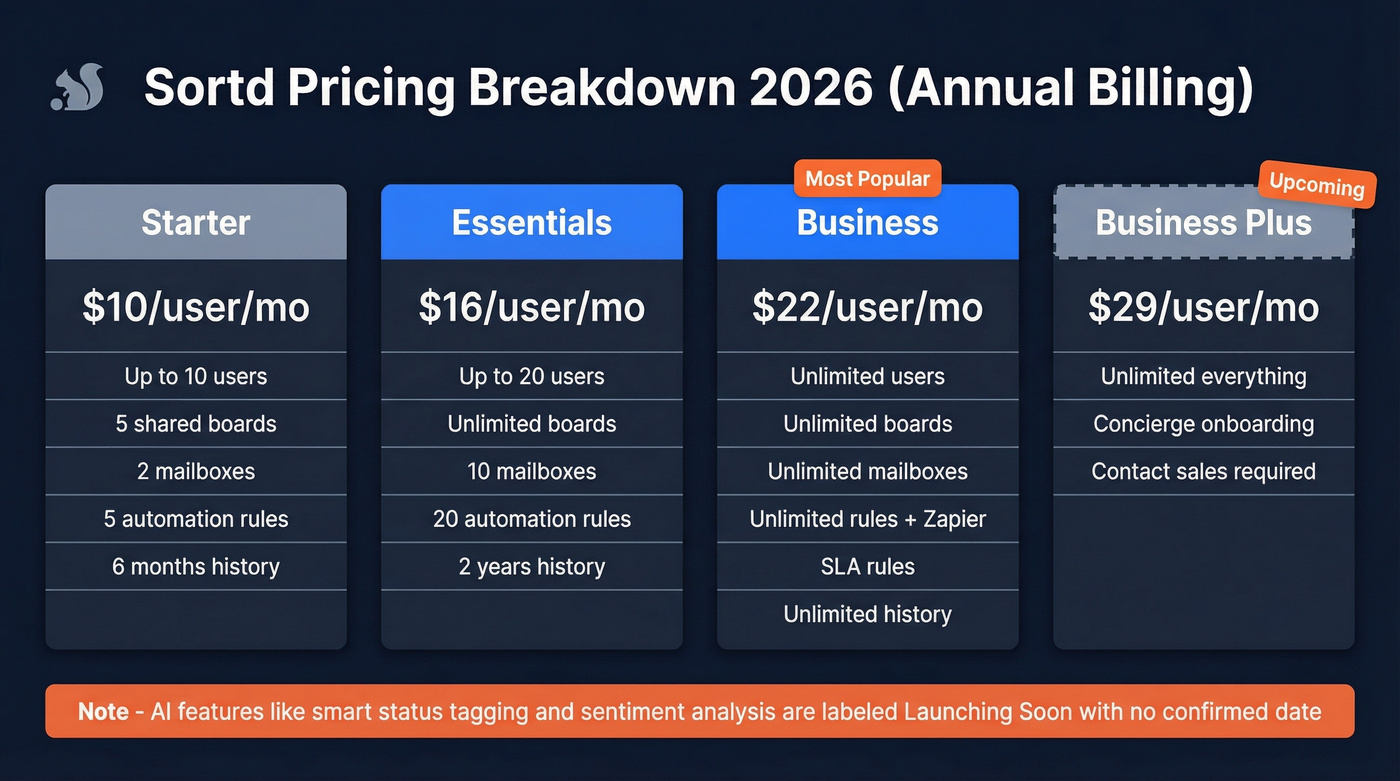
| Tier | Price (Annual) | Max Users | Shared Boards / Mailboxes | Key Limits | History |
|---|---|---|---|---|---|
| Starter | $10/user/mo | Up to 10 | 5 boards / 2 mailboxes | 5 automation rules | 6 months |
| Essentials | $16/user/mo | Up to 20 | Unlimited / 10 mailboxes | 20 automation rules | 2 years |
| Business | $22/user/mo | Unlimited | Unlimited / Unlimited | Unlimited rules + Zapier + SLA rules | Unlimited |
| Business Plus | $29/user/mo | Unlimited | Unlimited / Unlimited | Unlimited + concierge onboarding | Unlimited |
The Starter plan's 6-month history limit is tight for any ongoing sales workflow. Essentials bumps that to 2 years, which is more reasonable. Business is where you unlock built-in CRM pipelines, SLA rules, and Zapier integration - and honestly, that's the tier most teams should evaluate against competitors.
Monthly billing typically runs 20-30% higher than annual. Standard SaaS markup.
Here's the thing about those AI features splashed across the pricing page - smart status tagging, urgency detection, sentiment analysis - they're all labeled "Launching soon." Don't buy a plan expecting every AI item to work today.
One more note: G2 still shows Essentials at $12 and Business at $18. Those numbers don't match Sortd's official pricing page, so use the site directly for current rates.
Key Pros Worth Knowing
- Gmail-native with zero context switching. It's a Chrome extension that runs inside Gmail, so you're not bouncing between separate apps. Install it, and your inbox becomes a kanban board.
- Visual organization that clicks fast. Drag-and-drop boards for emails and tasks. If you think visually, you'll pick this up in minutes.
- Affordable entry point. $10/user/month on annual billing is genuinely cheap for a team productivity tool.
- Strong Product Hunt traction. Sortd earned a "#1 App for Gmail" badge with 3,620+ votes - real community validation, not manufactured hype.
- Fast setup. Install the extension, connect Gmail, start organizing. No onboarding calls required.

Sortd's kanban boards are great for organizing emails you already have. But if your pipeline is thin, organization won't fix it - better data will. Prospeo gives you 300M+ professional profiles with 98% email accuracy, 30+ filters for buyer intent and technographics, and a free tier with 75 verified emails/month.
Stop organizing an empty pipeline. Fill it with verified contacts first.
Cons and Limitations
Let's be honest - the cons list here is longer than we'd like to see for a tool at this price point.
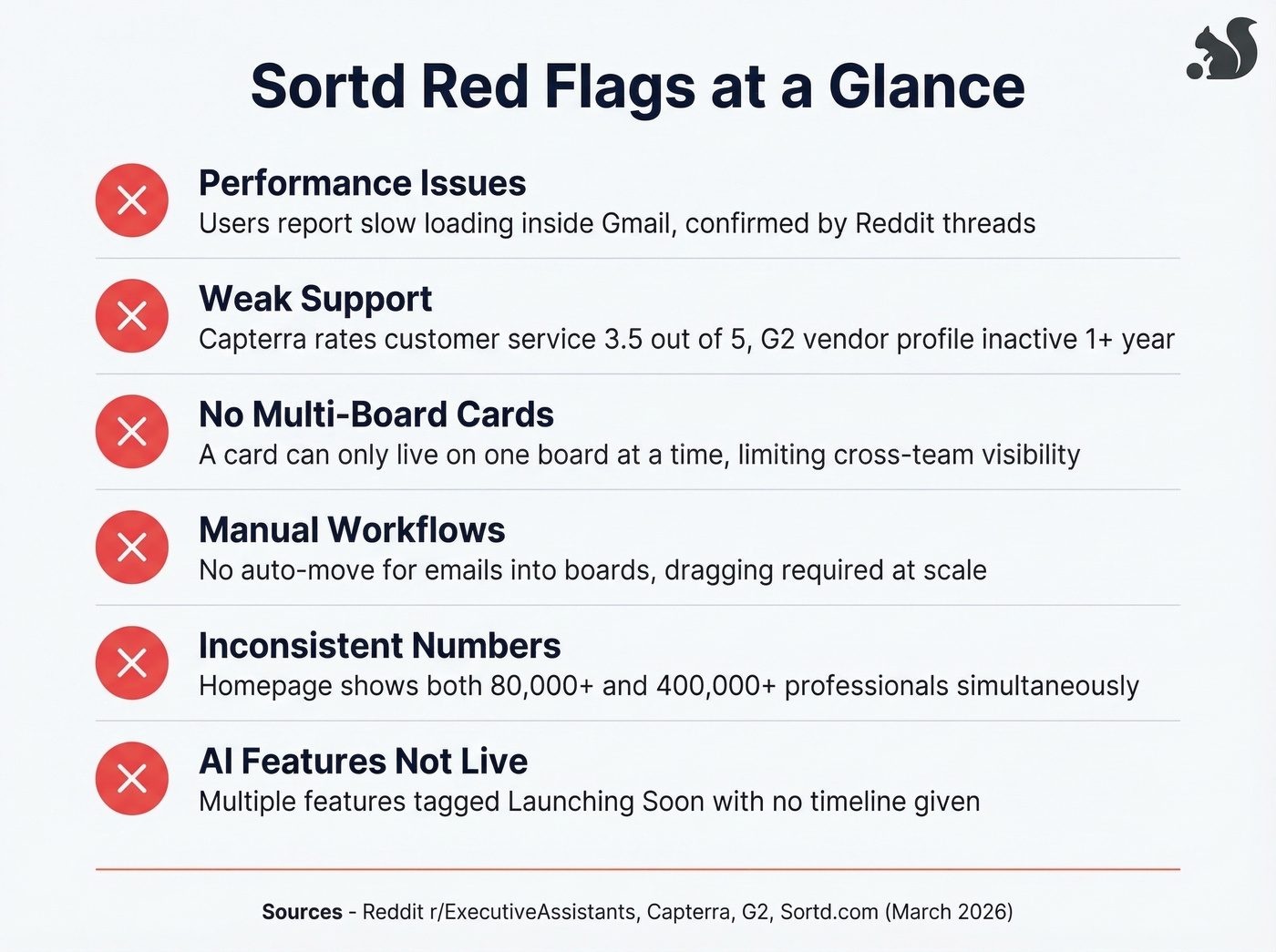
Performance issues are real. A Reddit user in r/ExecutiveAssistants put it bluntly: "We tried Sortd, and it was slooooooow." Sortd's own homepage shows a banner about intermittent issues affecting some users, which lines up with that complaint. For a tool that lives inside your inbox, lag is a dealbreaker.
Customer support is a weak spot. Capterra reviewers rate customer service at 3.5/5, and G2 notes the vendor profile hasn't been active for over a year. That's not a great signal if you're betting your team's workflow on this tool.
Cards can't live on multiple boards. You can move a card between boards, but it can't exist on two simultaneously - a real limitation for cross-functional workflows where sales and support both need visibility into the same conversation.
Automation gaps persist. There's no "auto-move emails into boards" workflow, so at scale you're still manually dragging messages. That defeats the purpose of a productivity tool once volume picks up.
Inconsistent trust signals. Sortd's homepage shows both "80,000+ CEOs and Professionals" and "400,000+ professionals" on the same page. Pick a number.
AI features aren't fully live. Multiple items are tagged "Launching soon" with no timeline. We've seen this pattern before with smaller SaaS tools, and it doesn't always resolve quickly.
Who Should (and Shouldn't) Use Sortd
Sortd works best for small Gmail teams - especially under 10 people - who want lightweight visual inbox organization without leaving their browser. If you're happy with basic automation rules and don't need deep workflow logic, the $10/month entry point is hard to beat.
Skip it if you need deal tracking with reporting, multi-channel support across email and chat and phone, or consistently strong performance at scale. The vendor's inactive G2 profile is also worth weighing if you want a tool you can grow with for years. In our experience, tools with quiet vendor profiles tend to have slower feature development and patchier support.
Sortd occupies an awkward middle ground. It's too limited to be a CRM and can feel too slow to be a power-user inbox tool. If you're running structured outbound, you'll likely outgrow it within a quarter - especially once you start tracking pipeline health and see where deals actually stall.
Sortd Alternatives Compared
| Tool | Starting Price | Best For | Free Trial |
|---|---|---|---|
| Sortd | $10/user/mo (annual) | Gmail kanban | Yes |
| Drag | $12/user/mo (annual) | Shared inbox + automation | 7 days |
| Gmelius | $19/user/mo (annual) | Team inbox + SLAs | 7 days |
| Streak | $49/user/mo (annual) | Full CRM in Gmail | 14 days |
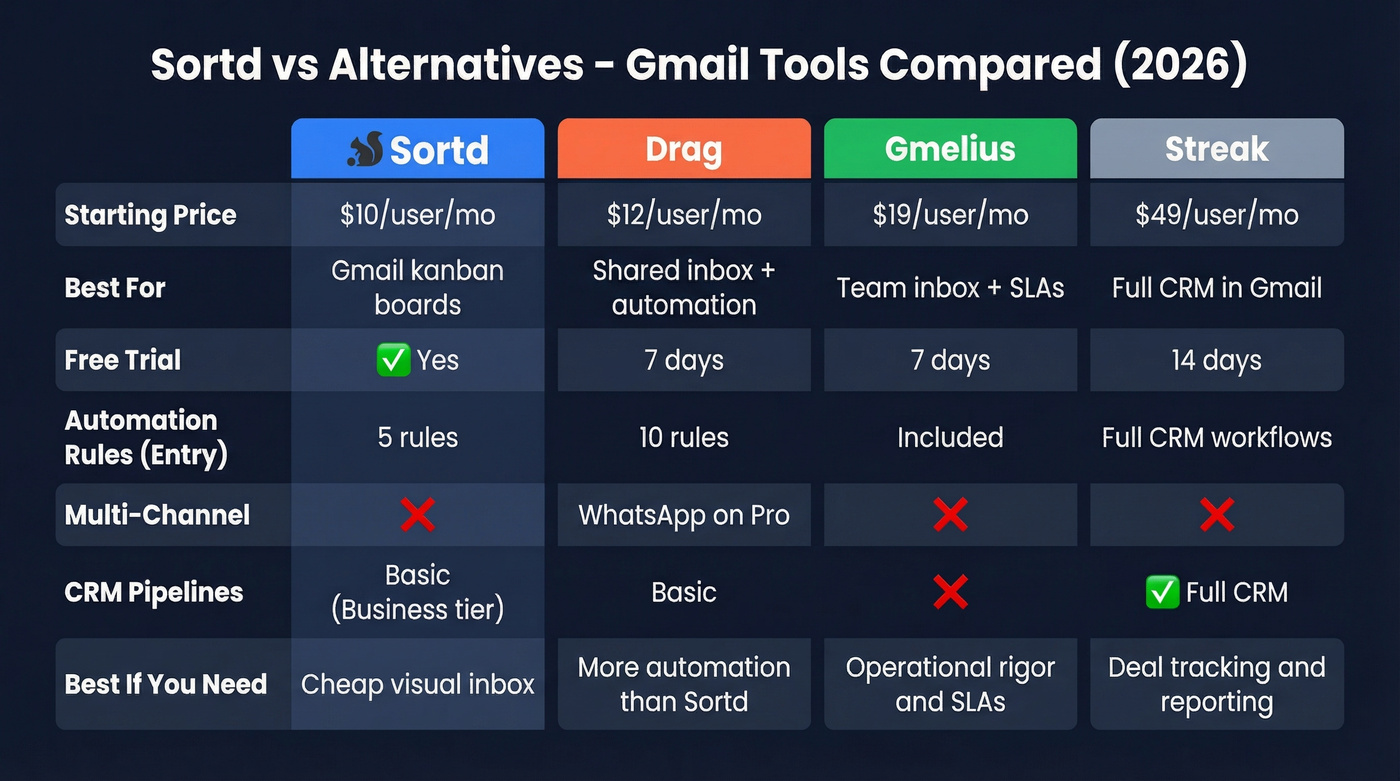
Drag is the closest competitor at $12-24/user/month on annual billing. If Sortd's manual workflow is slowing you down, Drag's Starter plan includes 10 automation rules versus Sortd Starter's 5, and Drag Pro adds WhatsApp channels. The consensus on r/gmail leans toward Drag for teams that need more than basic board management.
Gmelius targets teams needing shared inbox operations with SLAs and collision detection at $19-40/user/month. More expensive, but built for operational rigor that Sortd simply doesn't offer.
Streak is a different animal entirely at $49-129/user/month - a full CRM inside Gmail with deal pipelines and reporting. Overkill for inbox organization, but the right call once you've outgrown kanban boards and need actual pipeline management (or want to compare against other examples of a CRM).
For teams that have outgrown Gmail-native tools, HubSpot CRM (free tier available) and Copper (paid plans starting in the low $20s/user/month) are common next steps.

All four of these tools organize emails you've already received. If your real bottleneck is finding the right contacts to email in the first place, that's a data problem, not a workflow problem. Prospeo finds and verifies B2B emails across 300M+ professional profiles with 98% accuracy - the free tier gives you 75 emails/month to test whether your pipeline issue is organization or data quality. If you're building lists at scale, it also helps to understand lead enrichment and when to use data enrichment services.
If you're evaluating Gmail tools at $10-49/user/month, consider where your real bottleneck is. Teams using Prospeo book 26% more meetings than ZoomInfo users and 35% more than Apollo - because 98% accurate emails mean fewer bounces and zero domain damage. Emails cost $0.01 each with no contracts.
Your inbox tool is only as good as the contacts inside it.
FAQ
Is Sortd free?
No. There's no permanent free plan on the current pricing page. Sortd offers a no-credit-card trial that starts you on Business features. After the trial, Starter begins at $10/user/month billed annually.
Does Sortd work outside Gmail?
Sortd is built exclusively for Gmail and runs as a Chrome extension inside your inbox. There's no standalone web app, desktop client, or Outlook version.
Is Sortd worth it for sales teams?
Only for very small teams doing basic email triage. Once you need deal tracking, reporting, or multi-channel outreach, you'll hit Sortd's ceiling fast. Streak or a standalone CRM is a better fit for structured sales workflows.
What if I need contacts, not inbox organization?
That's a data problem. Prospeo's email finder delivers 98% verified emails from 300M+ profiles with a free tier of 75 emails per month. Pair it with whichever Gmail tool handles your conversations.