

SPIFF Program: How to Build, Budget & Measure One in 2026
A RevOps lead runs a two-week SPIFF offering $100 per qualified demo booked. Reps crush it - 40% more demos than the prior month. Then she checks the data: 28% of those "demos" came from bounced emails and bad contact records that never reached a prospect. The spiff program worked. The data underneath it didn't.
That's the gap most guides ignore. They'll tell you what a SPIFF is. They won't tell you how to make sure the activity it incentivizes actually produces pipeline.
What Is a SPIFF?
SPIFF stands for Sales Performance Incentive Fund. You'll see it written as SPIF with one F, and sometimes SPIV - a closely related term that different companies use differently. The core idea is the same: a short-term cash or non-cash reward that redirects sales behavior toward a specific product, action, or timeframe. Days to weeks, not quarters.
SPIFFs aren't niche. The incentive market runs $176B annually in the U.S. alone, and 84% of U.S. businesses use some form of reward-based incentive strategy. If you're running a sales team and haven't deployed one yet, you're in the minority.
The reason SPIFFs exist alongside commissions and bonuses is precision. A commission rewards every sale. A bonus rewards hitting a milestone. A SPIFF says: "This week, I need you to sell this specific thing - and here's an extra $50 every time you do."
Short on Time?
Here's the operating framework:
- Payout range: $25-$250 per action for frontline roles; $500-$2,000 for complex B2B outcomes
- Budget: 0.5-2% of the relevant product-line gross margin
- Duration: 2-4 weeks for internal teams; 1-3 months for channel partners
- Structure: Simple enough that an 8-year-old could explain it
- Measurement: Always use a control group or at minimum a year-over-year comparison
- Tax: Cash and gift cards are taxable wages. Non-cash awards taxed at fair market value. New 1099 threshold of $2,000 applies to payments made after December 31, 2025.
Everything below unpacks these numbers with formulas, examples, and the mistakes that kill most programs.
SPIFF vs Commission vs Bonus
These three get conflated constantly. The differences are structural, not semantic:
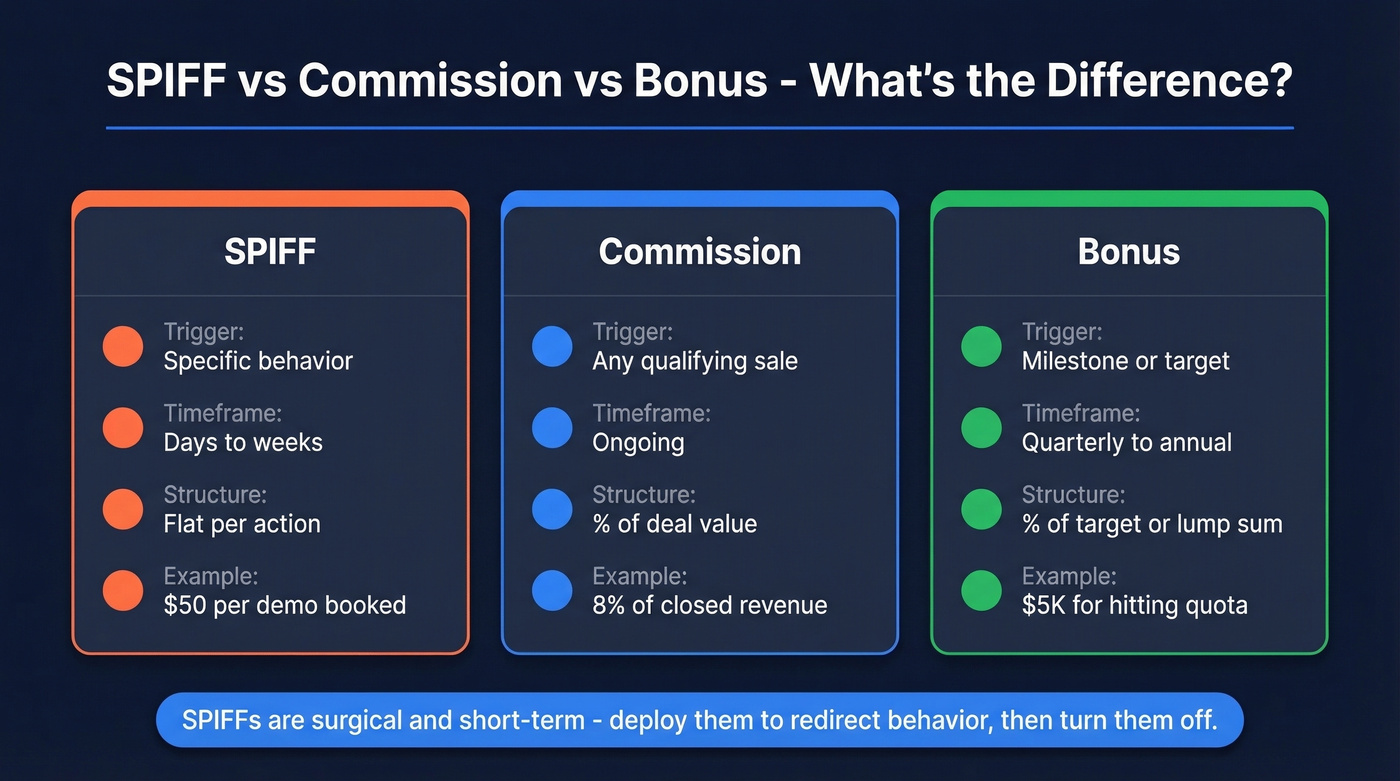
| SPIFF | Commission | Bonus | |
|---|---|---|---|
| Trigger | Specific behavior | Any qualifying sale | Milestone or target |
| Timeframe | Days to weeks | Ongoing | Quarterly to annual |
| Structure | Flat per-action | % of deal value | % of target or lump sum |
| Example | $50 per demo booked | 8% of closed revenue | $5K for hitting quota |
Commissions are transactional and linear - they pay out on every sale, every time. Bonuses are conditional, tied to broader milestones like quarterly targets or annual revenue goals. Most sales-based bonus pay ranges from 5% to 30% of total sales revenue.
A spiff program sits in a different category entirely. It's surgical. You deploy it when you need to shift behavior right now - push a new product, clear inventory, hit a launch window. Then you turn it off.
Why SPIFFs Work (and When They Don't)
SPIFFs don't motivate. They redirect.
That distinction matters. If your reps are disengaged, underpaid, or burned out, a $50 per-unit bonus won't fix anything. But if you've got a team that's already performing and you need them to prioritize Product X over Product Y for the next three weeks? That's where SPIFFs shine.
The numbers back this up. 88% of firms with goal-driven SPIFFs see a 15% short-term sales lift. CaptivateIQ benchmarks put average quota attainment at 74%, and SPIFFs give managers a lever to push the middle performers closer to target.
Here's the thing: if reps only perform during incentive windows, your base comp plan is broken. Fix the foundation first - then use SPIFFs as a scalpel, not a defibrillator. We've seen teams run monthly SPIFFs for six straight months and wonder why baseline performance keeps dropping. The incentive became the expectation, and the comp plan became irrelevant.
The lesson from the best incentive campaigns isn't "pay more." It's "make the reward memorable." Trophy-value rewards - merch, experiences, status - can outperform a larger cash payout because people talk about them. That social proof keeps the campaign alive long after the payout hits.
Structures & Payouts
Not all SPIFFs look the same. The structure you pick should match the behavior you're trying to drive.
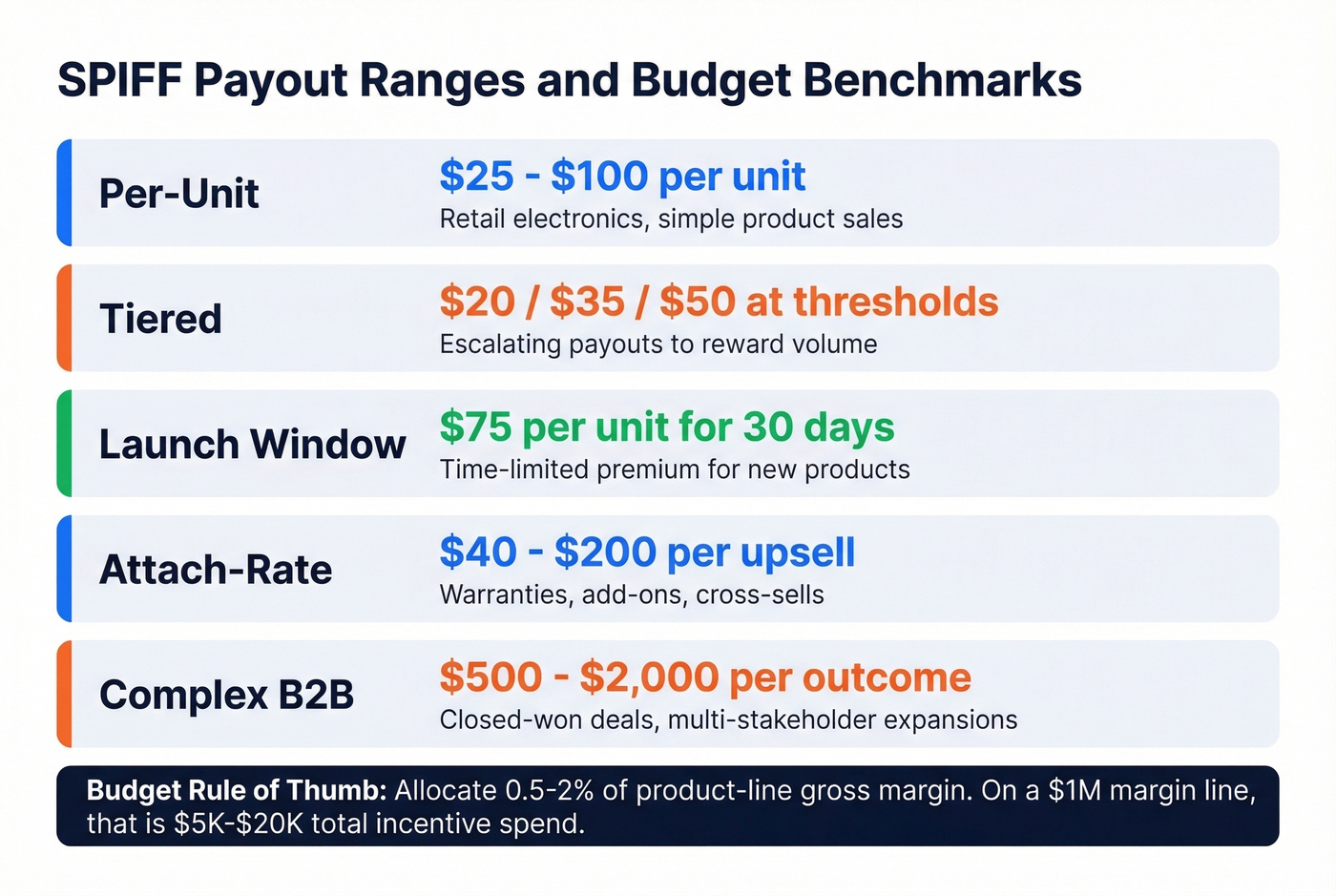
| Structure | How It Works | Example Payout |
|---|---|---|
| Per-unit | Flat $ per sale | $25-$100/unit |
| Tiered | Escalating payouts | $20/$35/$50 at thresholds |
| Launch window | Time-limited premium | $75/unit for 30 days |
| Attach-rate | Upsell/cross-sell | $40 per warranty sold |
| Short campaign | Sprint incentive | $50/sale for 2 weeks |
Real-world examples: $25 per headset during a 4-week promo window in retail electronics, $200 per extended warranty attachment at auto dealers, $150 per subscription sold in the first 60 days for B2B software partner motions. Inside sales teams often see $100-$250 per qualified outcome - like a sourced deal that converts and hits a revenue threshold. For complex B2B outcomes like closed-won deals or multi-stakeholder expansions, payouts can reach $500-$2,000.
For budgeting, plan on 0.5-2% of the relevant product-line gross margin. On a $1M margin product line, that's $5K-$20K in total incentive spend. Go above 2% and you're eating into the economics that make the product worth selling.

A SPIFF program is only as good as the data underneath it. If 28% of rep activity bounces, you're paying incentives on phantom pipeline. Prospeo's 98% email accuracy and 7-day refresh cycle ensure every demo booked, every meeting set, and every outreach during your incentive window actually reaches a real decision-maker.
Stop subsidizing bounced emails with your SPIFF budget.
How to Build a SPIFF Program
The 7-step framework below works in practice. One practitioner documented this process in Notion and cut their setup time by 4x within a year.
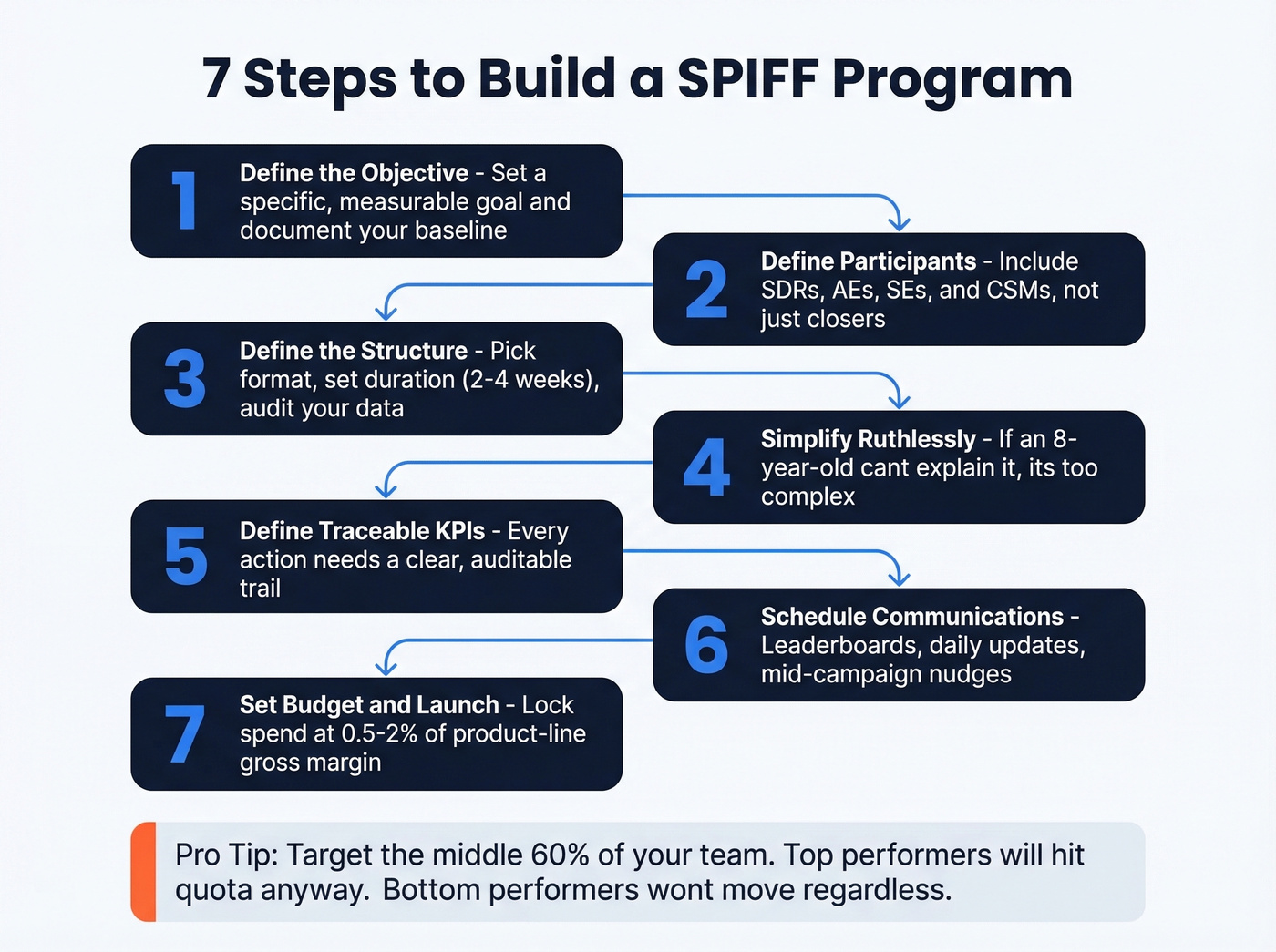
1. Define the objective - and establish a baseline. What specific problem are you solving? "Increase revenue" isn't a valid objective. "Move 200 units of the new SKU in 3 weeks" is. Before you launch, document current performance for the target metric so you can measure lift accurately.
2. Define participants. Don't limit it to closers. Include SDRs who source the meetings, SEs who run the demos, and CSMs who drive expansion. SDR-focused incentives are especially effective for top-of-funnel metrics like qualified meetings booked or new accounts contacted. A program that only rewards AEs ignores half the people who influence the outcome.
3. Define the structure. Pick your format (per-unit, tiered, campaign), set the duration, and choose a theme if you want engagement. Two to four weeks is the sweet spot for urgency. Before you proceed, audit your prospect data - an incentive that rewards demos booked or pipeline created only works if the contact data feeding it is accurate. If 30% of your emails bounce, you're subsidizing wasted effort. Prospeo verifies emails at 98% accuracy on a 7-day refresh cycle, so every rep activity during the incentive window actually reaches a decision-maker.
4. Simplify ruthlessly. If you can't explain the rules in one sentence, they're too complex. "Sell 10 units, earn $50" passes the test. A three-paragraph rules document with exceptions and qualifiers doesn't.
5. Define traceable KPIs. Every qualifying action needs a clear, auditable trail. This is your anti-cheat mechanism. If reps can game the metric, they will. (If you're tightening definitions, start with sales activities and what counts as a real outcome.)
6. Schedule communications. Leaderboards, daily updates, mid-campaign nudges. An incentive nobody talks about is one nobody remembers. Animation keeps momentum through the middle of the campaign when energy naturally dips.
7. Set budget and launch. Lock the total spend, confirm payout mechanics, build the comms, and go.
One design principle that separates good programs from great ones: target the middle 60% of your team. Your top 20% will hit quota regardless. Your bottom 20% won't move no matter what you offer. The incentive should create a reason for the movable middle to push harder.
You're budgeting 0.5-2% of gross margin on SPIFFs - don't waste it on bad contact data. Prospeo gives your reps verified emails at $0.01 each and 125M+ direct dials with a 30% pickup rate. That means every incentivized action converts into a real conversation, not a dead end.
Make every SPIFF dollar count with data that actually connects.
How to Calculate SPIFF ROI
"Revenue went up during the campaign" isn't measurement. It's correlation. You need a real formula.
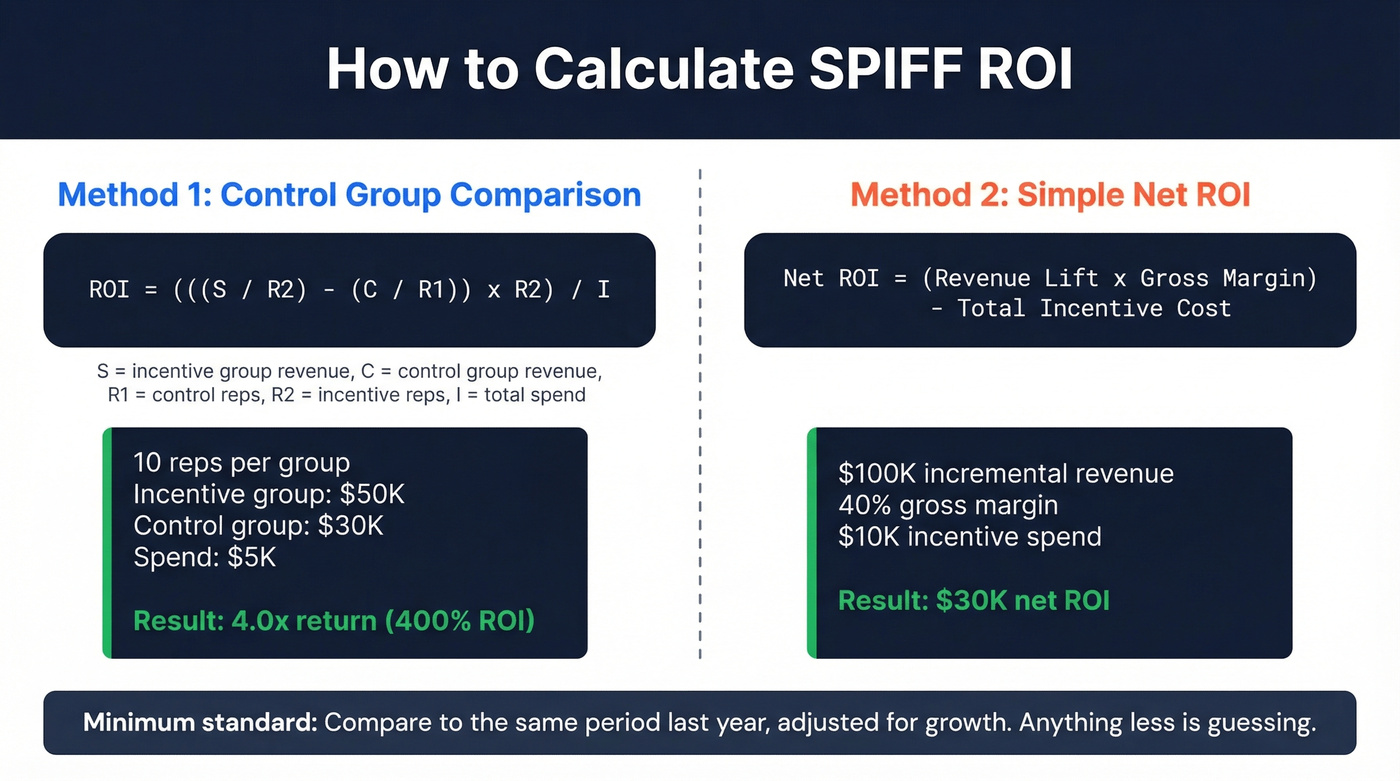
Control group comparison: Split your team into an incentive group and a control group, then apply this:
ROI = (((S / R2) - (C / R1)) x R2) / I
Where S = incentive group revenue, C = control group revenue, R1 = control reps, R2 = incentive reps, I = total incentive spend.
Worked example: 10 reps in each group. Incentive group generates $50K, control generates $30K, you spent $5K on payouts. ROI = ((($50K/10) - ($30K/10)) x 10) / $5K = ($2K x 10) / $5K = 4.0x return (400% ROI).
Simple net ROI: If you can't run a control group, use this:
Net ROI = (Revenue Lift x Gross Margin) - Total Incentive Cost
If the campaign drove $100K in incremental revenue at 40% gross margin and you spent $10K on incentives: ($100K x 0.40) - $10K = $30K net ROI. At minimum, compare campaign-period performance to the same period last year, adjusted for growth trends. Anything less and you're guessing. (If you're standardizing reporting, align it with your sales operations metrics so finance trusts the numbers.)
Channel & Partner SPIFFs
Channel SPIFFs play by different rules. Duration stretches to 1-3 months because partner adoption cycles are slower. You'll also want a dual incentive structure - reward the partner organization and the individual frontline rep. Paying only the org means the rep on the floor has no personal reason to push your product over a competitor's.
The biggest operational headache is attribution. One thread on r/managers described the exact failure mode: the manufacturer can't track end-customer purchases when the distributor owns the transaction data. You think you're incentivizing sales, but you can't verify they happened.
Three things fix this: automate claim submissions (manual processes invite fraud), require proof-of-sale documentation for every payout, and build audit trails with periodic governance reviews. Always-on channel SPIFFs lose their edge fast - run them around product launches or seasonal pushes, then pull back. (If you're building partner motions, it helps to map this to a broader go-to-market strategy so incentives don't become the strategy.)
Tax & Compliance (2026 Update)
This is the section every other guide skips, and it's the one that'll get you in trouble with finance.
For employees: Cash and gift card SPIFFs are taxable wages, reported on W-2, subject to payroll withholding. No exceptions. Non-cash awards - merchandise, travel - must be included in income at fair market value per IRS Publication 525. Employee achievement awards get a limited exclusion, but only for tangible personal property like a watch or a plaque, not cash. The exclusion caps at $1,600 per year.
For non-employees and channel partners: Report payments on 1099-NEC or 1099-MISC. A 2025 law raised the 1099 reporting threshold from $600 to $2,000 for payments made after December 31, 2025, indexed for inflation starting in 2027. If you're running partner SPIFFs with payouts under $2,000, your reporting burden just got lighter - but you still owe the tax.
Talk to your tax team before launching. Getting the withholding wrong on a $50 incentive across 200 reps creates a payroll nightmare that costs more to fix than the payout itself.
Mistakes That Kill Campaigns
We've seen these patterns repeatedly across our own campaigns and dozens of customer conversations. Six that matter most:

Vague goals. "Increase sales" isn't a goal. State the exact metric, threshold, and timeframe. "Sell 15 units of SKU-4200 in 14 days" passes the test.
Overly complex rules. If the rules doc is longer than a paragraph, you've already lost. The "Sell 10 units, earn $50" simplicity test should be your standard.
Wrong timing. Launching during summer vacations or overlapping with quarter-end pushes dilutes the signal. Check the calendar before you commit dates.
Excluding support teams. SDRs, SEs, and CSMs influence outcomes. Cutting them out breeds resentment and misses half the people who touch the deal. (If you're formalizing roles, document it in your sales enablement process.)
No measurement. Skip this if you want to keep running SPIFFs on vibes alone, but don't be surprised when finance kills your budget. If you don't run a control group or at least a YoY comparison, you don't know if the incentive worked. Build measurement into the design, not as an afterthought. (A quick gut-check is to review your pipeline health before and after the campaign.)
Running them every month. Let's be honest - if your team only performs during incentive windows, the SPIFF isn't the problem. Your comp plan is. Fix the base, not the bonus. And don't announce the campaign until it starts, or reps will sandbag deals to qualify them during the payout window. (If you're rebuilding comp + incentives, anchor it in sales performance management instead of one-off contests.)
FAQ
What does SPIFF stand for?
SPIFF stands for Sales Performance Incentive Fund - a short-term cash or non-cash reward that redirects sales behavior toward a specific product, action, or timeframe. You'll also see it written as SPIF. SPIV is a related term some companies use as an alternative label for similar incentive structures.
How long should a spiff program run?
Two to four weeks is the sweet spot for internal sales teams - long enough to drive meaningful behavior change, short enough to maintain urgency. Channel and partner programs run longer, typically one to three months, because adoption cycles are slower. Always-on incentives lose their motivational edge within 6-8 weeks.
What percentage of margin should I budget?
Budget 0.5-2% of the relevant product-line gross margin. On a $1M margin product line, that translates to $5K-$20K in total incentive spend. Go higher and you risk eroding the economics. Go lower and the payouts won't be meaningful enough to redirect behavior.
Are SPIFF payouts taxable?
Yes - cash and gift cards are taxable wages for employees, reported on W-2 with payroll withholding. Non-cash awards are taxed at fair market value. For non-employees and channel partners, 1099 reporting applies above $2,000 for payments made after December 31, 2025 under the updated threshold.
How do I prevent wasted activity during a SPIFF?
Audit your contact data before launch. If 30% of emails bounce, you're subsidizing busywork. Require proof-of-contact for every qualifying action, and verify your prospect lists with a tool that refreshes data weekly rather than monthly.