

ABM Stats for 2026: What the Numbers Actually Say
Most account-based marketing stat roundups recycle data from 2019-2022 vendor reports and slap a fresh year on the title. That's a problem when 61% of marketers believe marketing is experiencing its biggest disruption in 20 years - largely driven by AI reshaping how buyers discover, evaluate, and engage. The stats for an ABM approach in 2026 tell a more complicated story than "ABM works, invest more." You need numbers that reflect both results and the measurement reality behind them.
The Three-Stat Business Case
Three numbers tell the full ABM story for 2026:
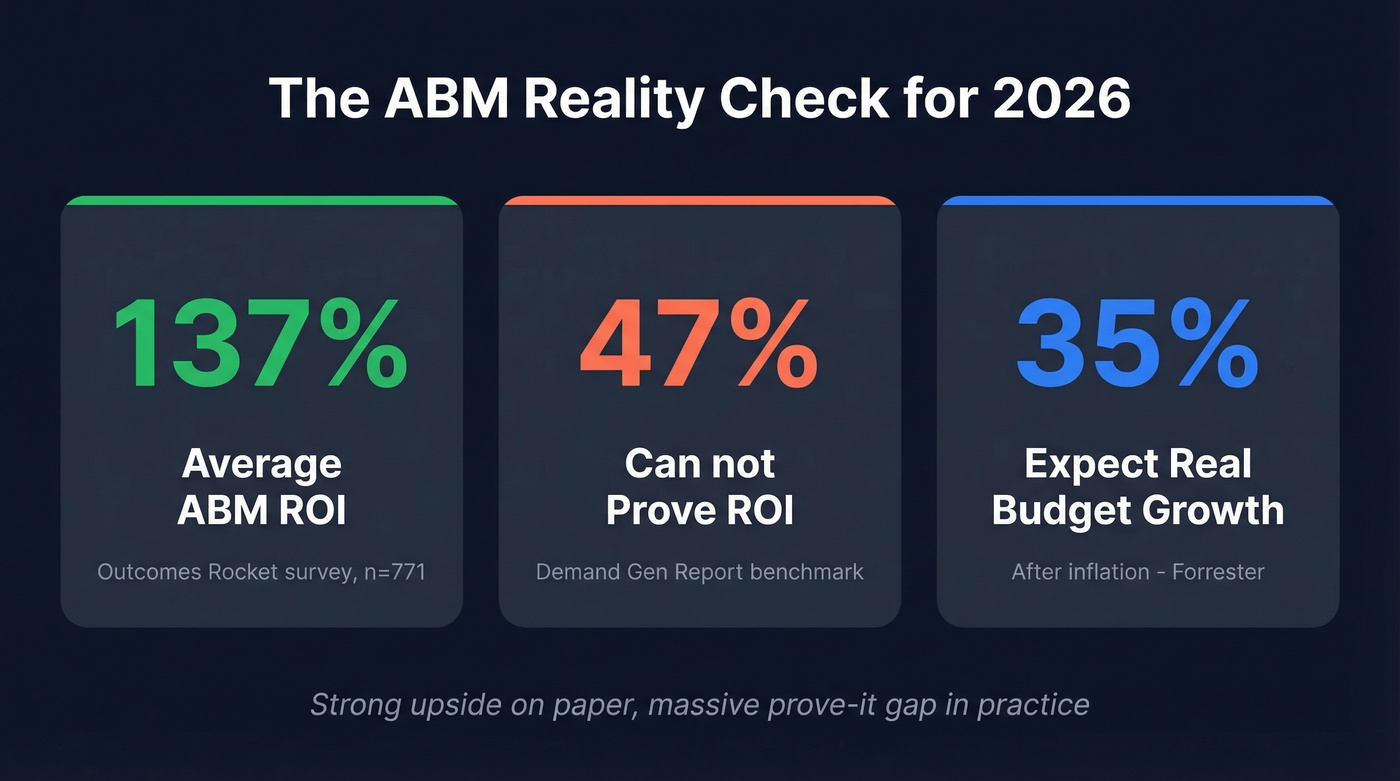
- 137% average ROI from ABM programs (Outcomes Rocket survey, n=771)
- 47% can't prove ROI at all (Demand Gen Report benchmark survey)
- Only 35% expect a real increase after inflation (Forrester)
That's your pitch deck in three lines - the upside, the measurement gap, and the budget reality. It's also the cleanest snapshot of account-based marketing statistics: strong upside on paper, but a massive "prove it" gap in practice.
ABM Adoption & ROI Benchmarks
71.2% of organizations currently implement ABM strategies, according to Outcomes Rocket's survey of 771 marketers. The Demand Gen Report puts it at 71%, with 40% integrating ABM directly with demand gen. HubSpot's State of Marketing report lands at 70%. Three independent sources, same answer - adoption clusters in the low 70s.
The ROI picture is murkier. That same survey pegs average ABM ROI at 137%, with 49.2% calling it their highest-ROI channel. And 99.3% of respondents say their ABM efforts are "successful" - that's selection bias, plain and simple. Teams that abandoned ABM aren't filling out ABM surveys. Read any of these reports as directional rather than definitive.
Performance & Pipeline Numbers
ABM programs that go deeper consistently outperform the ones running generic account lists through a platform. Here's what the data shows:
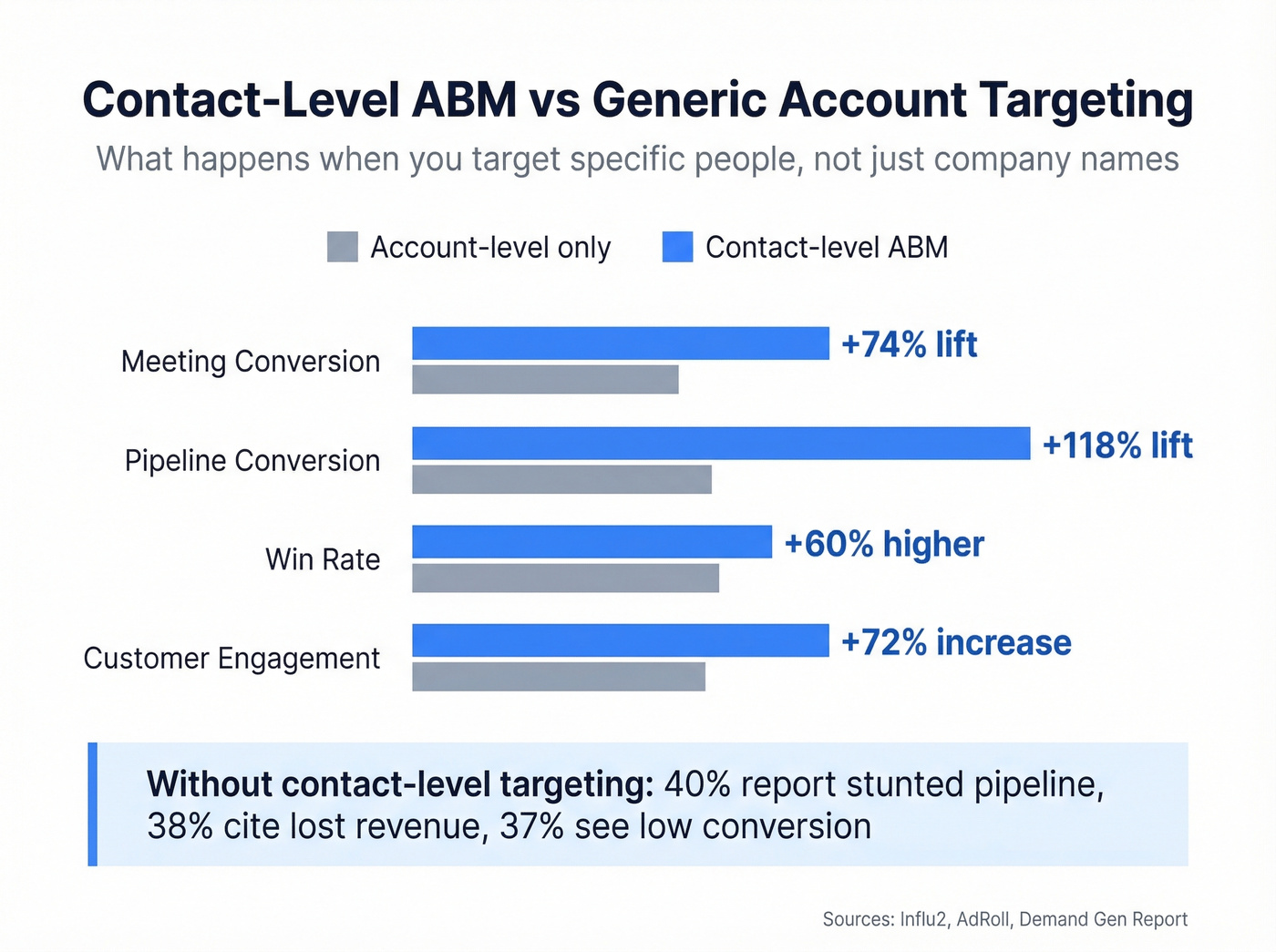
- Aligning ABM with account-based advertising yields 60% higher win rates - vendor data, so treat it as directional.
- Those same campaigns increase customer engagement by 72% and create 16% more opportunities tracking to closed-won.
- Contact-level ABM - targeting specific people, not just accounts - is associated with up to a 74% lift in meeting conversion and 118% lift in pipeline conversion. Also vendor-reported, but the direction is consistent across sources.
- 72% of marketers say contact-level ABM is an important or core differentiator. Another 24% plan to implement it within 12 months.
- When teams fail to target specific contacts: 40% report stunted pipeline growth, 38% cite lost revenue, 37% see low sales conversion rates.
- Even with ABM in place, 40% of leaders find it very challenging to generate qualified, sales-ready leads.
The channels delivering the strongest results? Email at 92% and in-person events at 72%. And one useful reference point for setting expectations internally: Payscale saw results within seven months of launching ABM, including a 500% increase in target account traffic and a 6x ROI increase in revenue. Seven months. Not seven weeks.

Contact-level ABM drives 74% more meetings - but only if you can actually reach the right people. Prospeo gives you 98% verified emails and 125M+ direct dials across 300M+ profiles, refreshed every 7 days. At $0.01 per email, you stop bleeding budget on bounced outreach and start converting target accounts.
Stop targeting accounts. Start reaching the exact buyers inside them.
The Budget Squeeze
Forget the headline numbers on ABM budgets - the inflation-adjusted reality is what matters.
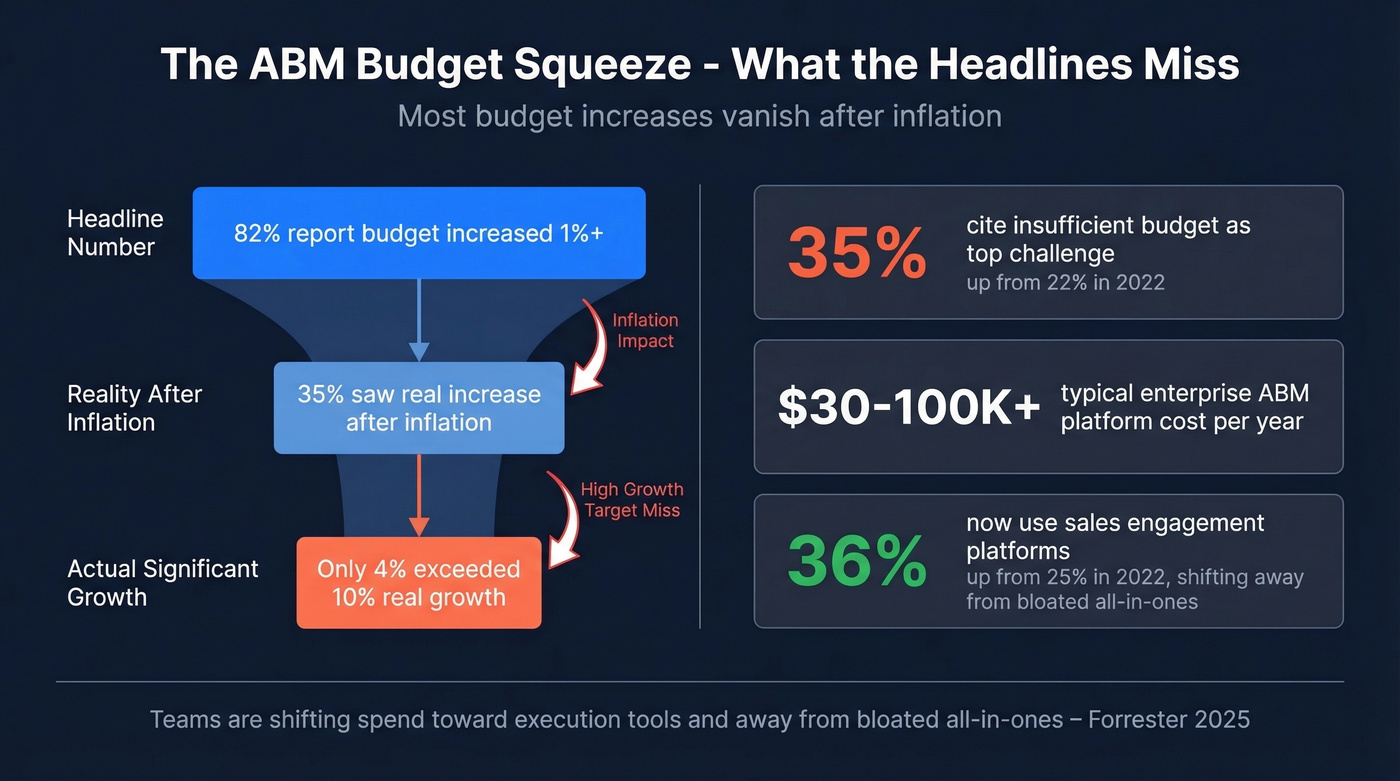
82% of global B2B marketing decision-makers reported budgets increased by 1%+ for 2025. Sounds encouraging. But only 35% saw a real increase after inflation, and just 4% of those exceeded 10% growth. Looking ahead, 49.7% of ABM teams plan to increase budgets in 2026.
Here's the thing: "insufficient budget" is now cited by 35% of ABM practitioners as a top challenge - up from 22% in 2022. Most ABM teams are being told to "do more with less" while enterprise ABM platforms typically cost $30-100k+ per year. That cost reality is one reason ABM can feel like a wasteland when teams buy software before they've nailed targeting, messaging, and measurement. Meanwhile, 36% use sales engagement platforms and would continue, up from roughly 25% in 2022 - teams are shifting spend toward execution tools and away from bloated all-in-ones.
AI in ABM: Adoption High, Results Lagging
Nearly 79% of ABM teams now incorporate AI into their programs for personalization, predictive analytics, and targeting. The optimism is even higher - 86.2% expect AI to boost ABM ROI over the next year. But nearly 70% find AI's current effectiveness limited, even as 45% see its promise for personalization.
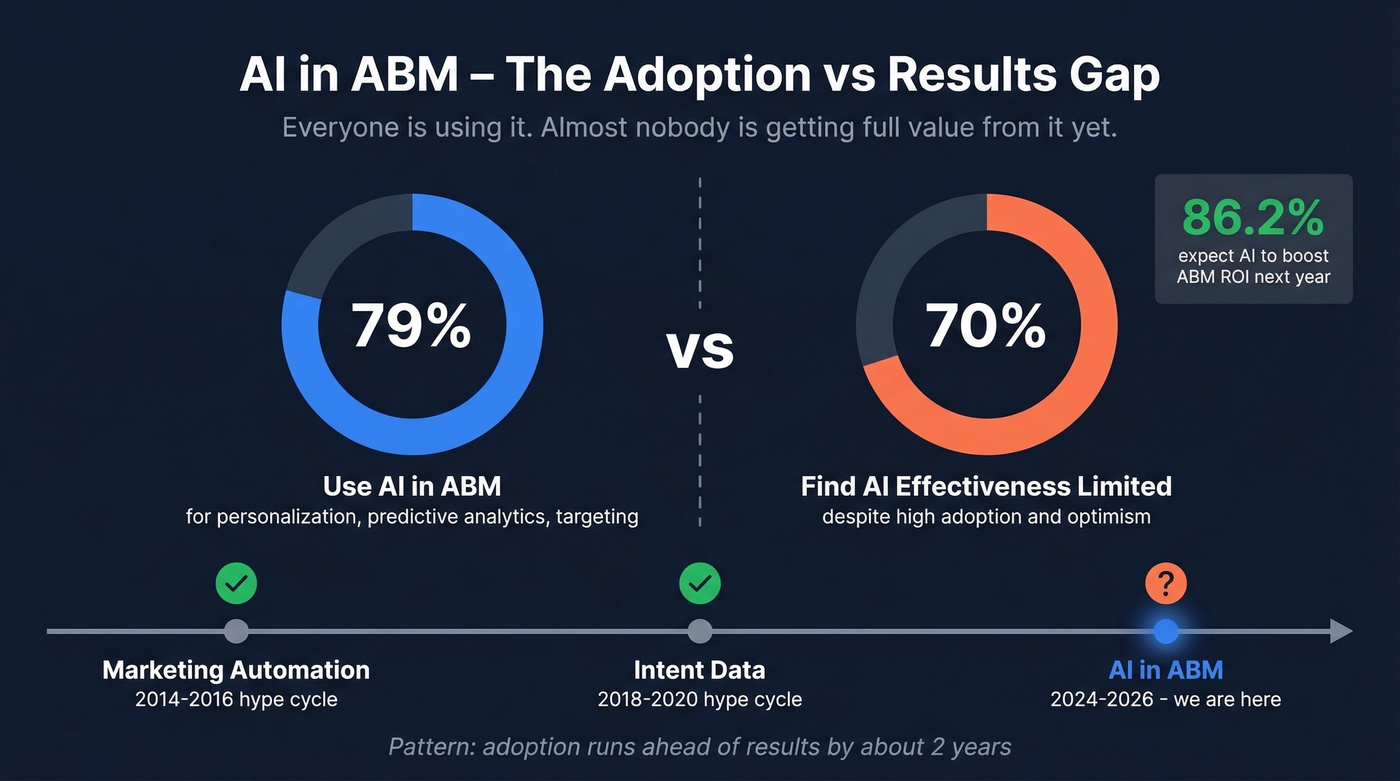
That gap between adoption and results is the defining tension of ABM in 2026.
On the buyer side, 73% of consumers now use AI-powered search to learn about brands and products, and 72% have encountered AI Overviews during research - with 90% clicking at least one cited source. We've seen this exact pattern before with marketing automation and intent data: adoption runs ahead of results by about two years. AI in ABM is in that awkward middle phase right now, and the teams treating it as a magic button are the ones most disappointed.
Stats That Should Shape Your ABM Approach
The challenges facing ABM teams have shifted meaningfully since 2022. Forrester's survey data tells the story:
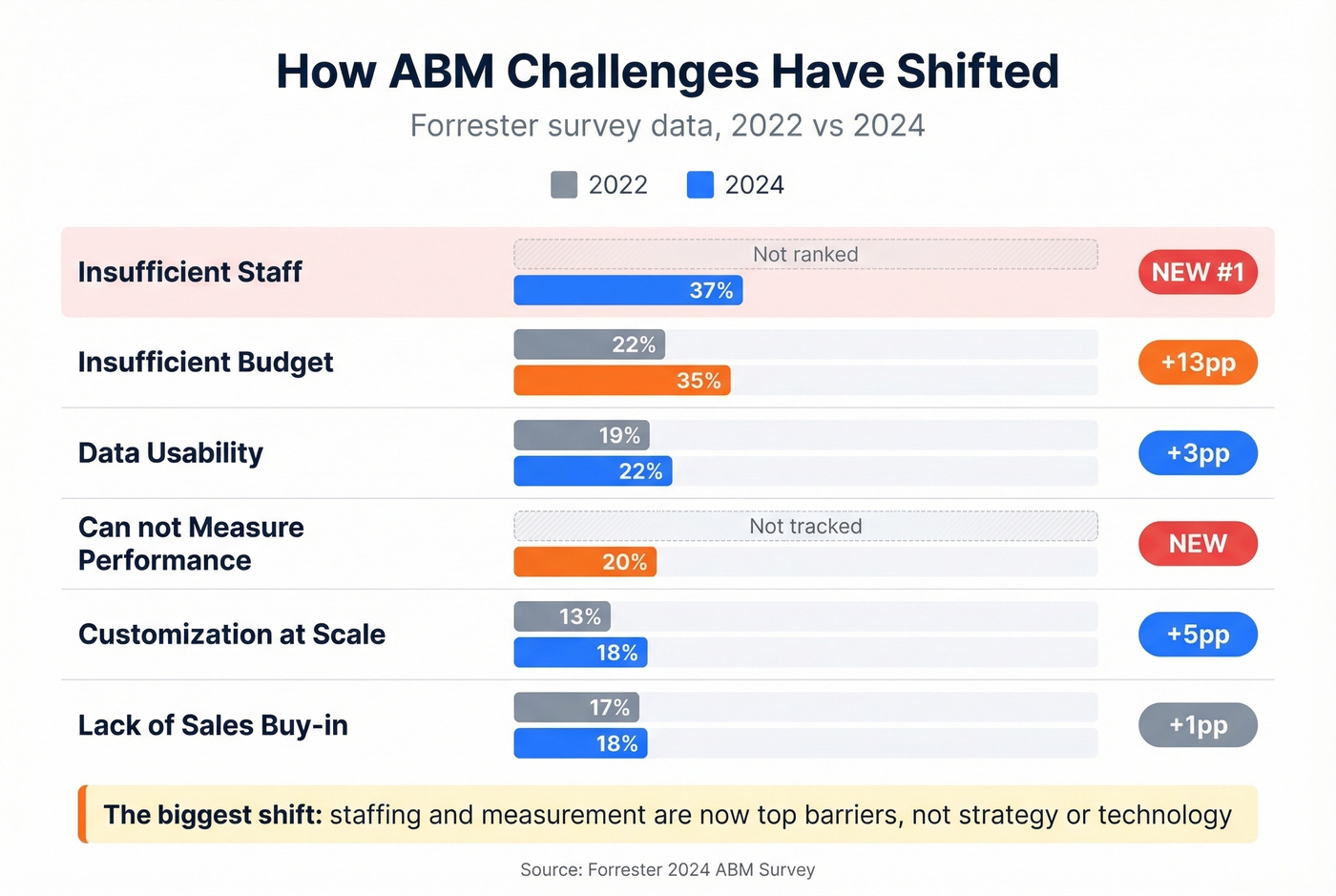
| Challenge | 2022 | 2024 | Change |
|---|---|---|---|
| Insufficient staff | Not ranked | 37% | New #1 |
| Insufficient budget | 22% | 35% | +13pp |
| Data usability | 19% | 22% | +3pp |
| Can't measure | - | 20% | New |
| Customization | 13% | 18% | +5pp |
| Lack of sales buy-in | 17% | 18% | +1pp |
Staffing is now the top challenge - a problem that didn't even register two years ago. Budget pressure nearly doubled. And the inability to measure performance is a brand-new entry, which is where platform-level attribution limitations show up in the real world: models break, account engagement gets over-weighted, and pipeline influence is hard to defend in finance reviews.
From the practitioner side, the Demand Gen Report benchmark survey surfaces slightly different pain: proving ROI (47%), aligning sales and marketing (43%), and scaling programs (40%). Only about 20% of ABM teams track lifetime customer value or post-sale metrics - which partly explains why proving ROI is so hard and why customer retention is chronically under-measured even when it's a major driver of long-term account value. Meanwhile, 31% of marketers say they lack the resources to personalize outreach at scale, and just 13% actually hyper-personalize.
Let's be honest about what these numbers mean for planning: the ceiling is high, but execution and measurement maturity decide whether you get "dashboard activity" or results you can defend in a board meeting.

What These Stats Don't Tell You
The consensus on r/b2bmarketing is blunt: ABM tools feel "incredibly expensive" and overbuilt, and too many programs produce "busy dashboards but not pipeline." Practitioners asking for ABM benchmarks get told the same thing - results are so company-specific that external benchmarks are nearly impossible to contextualize.
Forrester's observation that a "surprising percentage" of firms practice ABM "in name only" - without account selection criteria, sales alignment, or measurement frameworks - explains a lot. If your average deal size is under $15k, you probably don't need a six-figure ABM platform. You need a tight target account list, verified contact data, and a disciplined outreach sequence. Skip the platform evaluation entirely until you've proven the motion works manually. The stats above describe what's possible. Whether your program gets there depends on execution, not software.
35% of ABM teams cite insufficient budget as a top challenge, yet most pay $30-100K+ for bloated platforms with stale data. Prospeo costs 90% less than ZoomInfo, delivers higher accuracy, and layers intent data across 15,000 Bombora topics so you prioritize accounts actually in-market - not just on a list.
Do better with less. Enterprise ABM data without the enterprise invoice.
FAQ
What's a good ROI for ABM?
The average reported ABM ROI is 137% according to a survey of 771 marketers, but 47% of teams can't prove ROI at all. Focus on pipeline metrics and tighten attribution before benchmarking against headline numbers.
What percentage of B2B companies use ABM?
Around 70-71% across three independent surveys. Adoption has plateaued at this level, which is why current account-based marketing statistics focus more on measurement maturity than adoption rates.
How does AI impact ABM effectiveness?
79% of ABM teams use AI, but 70% find its current effectiveness limited. Adoption far outpaces results - treat AI as an assist for targeting and personalization, not a replacement for solid account selection and verified contact data.
Why does ABM fail even with good stats?
The top reasons are insufficient staff (37%), inability to prove ROI (47%), and poor data quality (22%). Forrester notes many firms practice ABM "in name only" without account selection criteria or measurement frameworks - execution gaps, not strategy gaps.
What's the cheapest way to run ABM with accurate data?
Skip six-figure platforms if your deal sizes are under $20k. Build a focused target account list, verify contacts with a tool like Prospeo (98% email accuracy, 75 free credits/month), and run disciplined outbound sequences through a sales engagement platform.