

Strategic ABM: The Practitioner's Guide for 2026
Your CEO came back from a conference last quarter convinced the company needs strategic ABM. Now there's a Slack channel, a vague mandate, and zero clarity on what that actually means. You're not alone - 90% of B2B organizations now run some form of ABM program, but most of them are running glorified outbound with a few personalized subject lines. Real 1:1 account-based marketing is something else entirely.
The Short Version
Strategic ABM is 1:1 marketing for 1-5 high-value accounts, built around a detailed account strategy plan - not a campaign brief. It requires sales-marketing co-ownership, custom-built content, and months of patience. You don't need a $100K platform to start. A CRM, verified contact data, and a shared Slack channel will get you further than most enterprise stacks. If you're targeting dozens of accounts, you're doing ABM Lite, not 1:1 ABM.
What Is Strategic ABM?
ITSMA coined "account-based marketing" back in 2003, defining it as a strategic approach to designing and executing highly targeted, personalized marketing programs for specific named accounts. The term got diluted fast. By the time ITSMA ran its 2016 benchmarking survey, they'd documented three distinct tiers - and the differences between them matter more than most practitioners realize.
Here's the thing: this isn't a campaign type. It's a management philosophy. Marketing programs are components of a multi-faceted plan for a single customer account, customized entirely for that account. In mature organizations, it's essentially key account management with marketing embedded directly into the account team. The account plan - not the campaign brief - is the operational centerpiece. And this applies to existing high-value accounts just as much as net-new logos. Some of the best programs we've seen are expansion plays, not acquisition plays.
Agencies like strategicabm.com have formalized this into structured methodologies - objective setting, ICP development, account selection, messaging, playbook design, and delivery - but strategic account planning remains the foundation everything else hangs on.
The skeptics on r/b2bmarketing aren't entirely wrong when they call ABM "detailed, data-driven targeting repackaged." That's a fair description of programmatic ABM. But 1:1 ABM is fundamentally different - marketing serves the account team's plan rather than running parallel campaigns.
The Three-Tier ABM Pyramid
Strategic ABM (1:1) sits at the top: 1-5 accounts, fully custom-built, with ROI measured in years. You're building dedicated account pods, producing original content, and coordinating executive-level engagement.
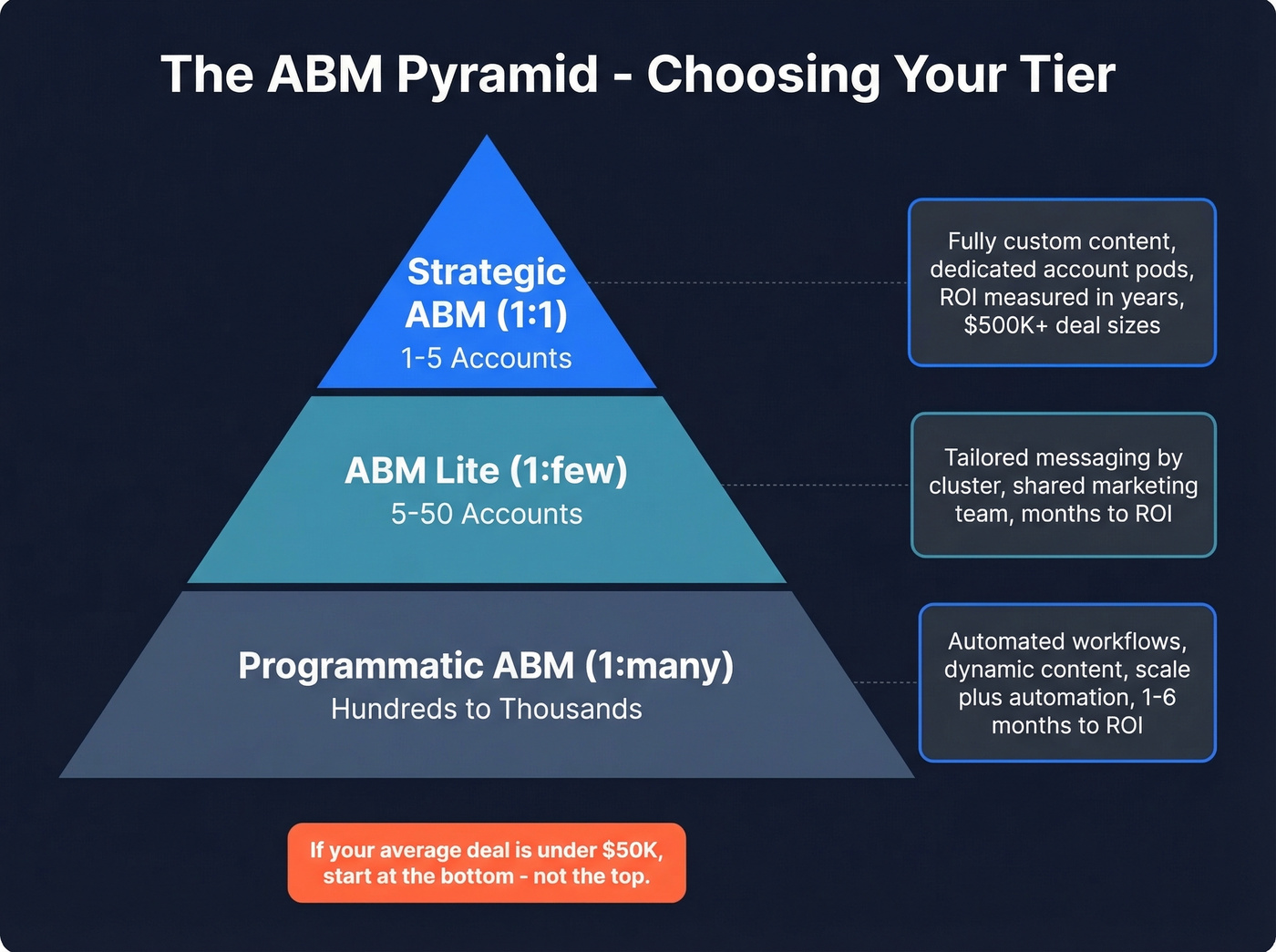
ABM Lite (1:few) targets roughly 5-50 accounts clustered by shared pain points. The messaging is tailored but not built from scratch - you're adapting templates, not creating net-new assets per account.
Programmatic ABM (1:many) scales to hundreds or thousands of accounts using automation, dynamic content, and intent-based targeting. Tools like HubSpot, [Marketo](https://experienceleague.adobe.com/en/docs/marketo-measure/using/advanced-marketo-measure-features/account-based-marketing/account-based-marketing-overview, and Pardot live here.
Let's be honest: if your average deal is under $50K, programmatic ABM will give you better ROI per dollar. The 1:1 tier makes sense when individual accounts represent $500K+ in potential annual value. Most teams jumping into it don't have the deal sizes to justify it, and they'd be better served by a disciplined ABM Lite program.
1:1 vs. ABM Lite vs. Programmatic
| Dimension | Strategic (1:1) | ABM Lite (1:few) | Programmatic (1:many) |
|---|---|---|---|
| Accounts | 1-5 | 5-50 | Hundreds-thousands |
| Personalization | Fully custom-built | Tailored by cluster | Dynamic by segment |
| Team structure | Dedicated account pod | Shared marketing team | Automated workflows |
| Timeline to ROI | Months to years | Months | 1-6 months |
| Budget per account | $$$$ | $$ | $ |
| Key differentiator | Account plan | Shared pain points | Scale + automation |
Why the Account Plan Matters
The account plan is what separates strategic ABM from everything else. It's not a campaign brief with a logo swapped in. It's a business-plan-level document that covers the customer's business landscape, your current relationship, specific relationship objectives, and the threats and barriers standing in the way.
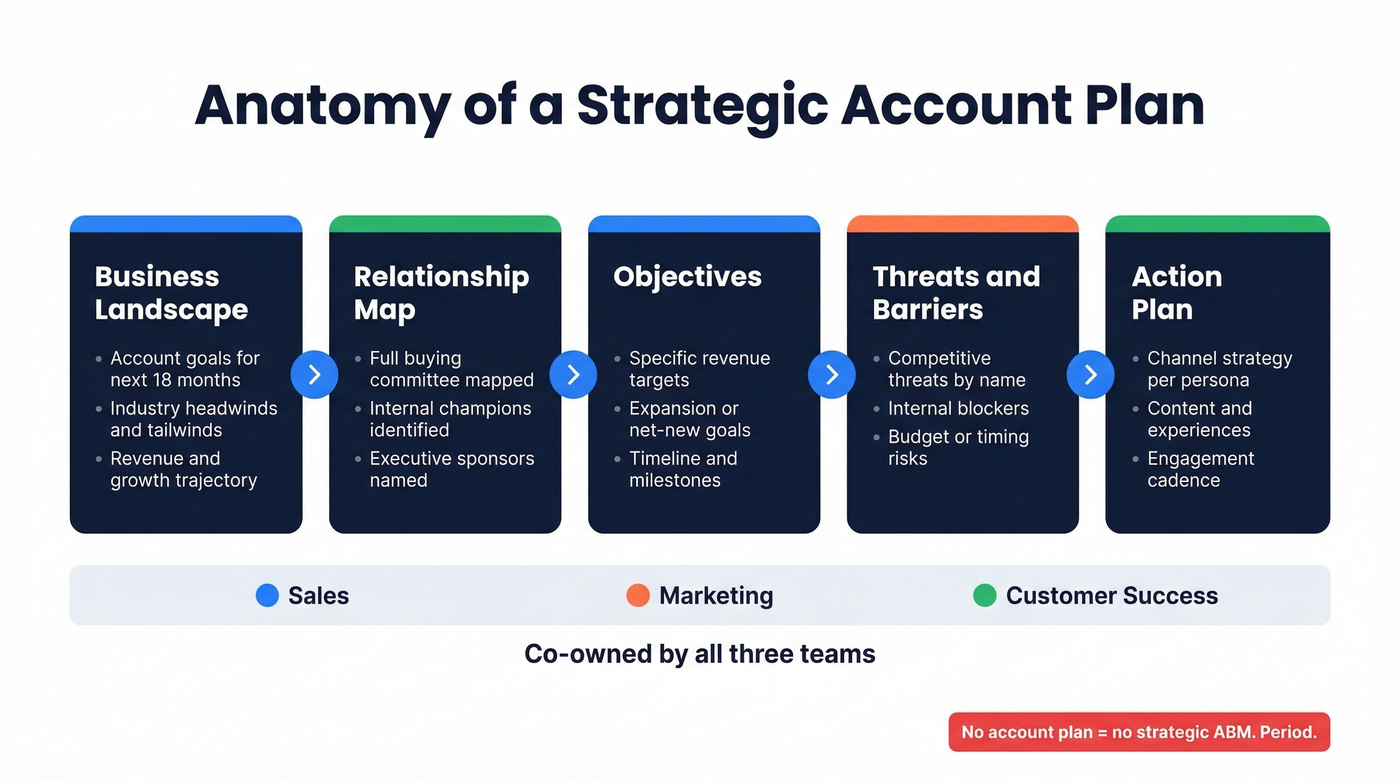
Think of it as a living strategy document that sales, marketing, and customer success all contribute to. It should answer: What does this account's business look like in 18 months? What are they trying to achieve? Where do we fit? What's blocking us? A smart account plan also maps the full buying committee, identifies internal champions, and documents competitive threats specific to that deal.
We've seen teams burn through $50K in platform fees before closing a single account - and in every case, the root cause was the same: no real account plan. They had campaign briefs with logos swapped in. Skip the platform purchase if your program doesn't have a dedicated plan per account. You're running ABM Lite with extra overhead.
How to Tier and Select Accounts
Account tiering isn't the same as segmentation. Demandbase draws this distinction clearly: segmentation groups accounts by shared characteristics like firmographics, technographics, and behavior, while tiering ranks specific accounts by value and potential to prioritize resources.
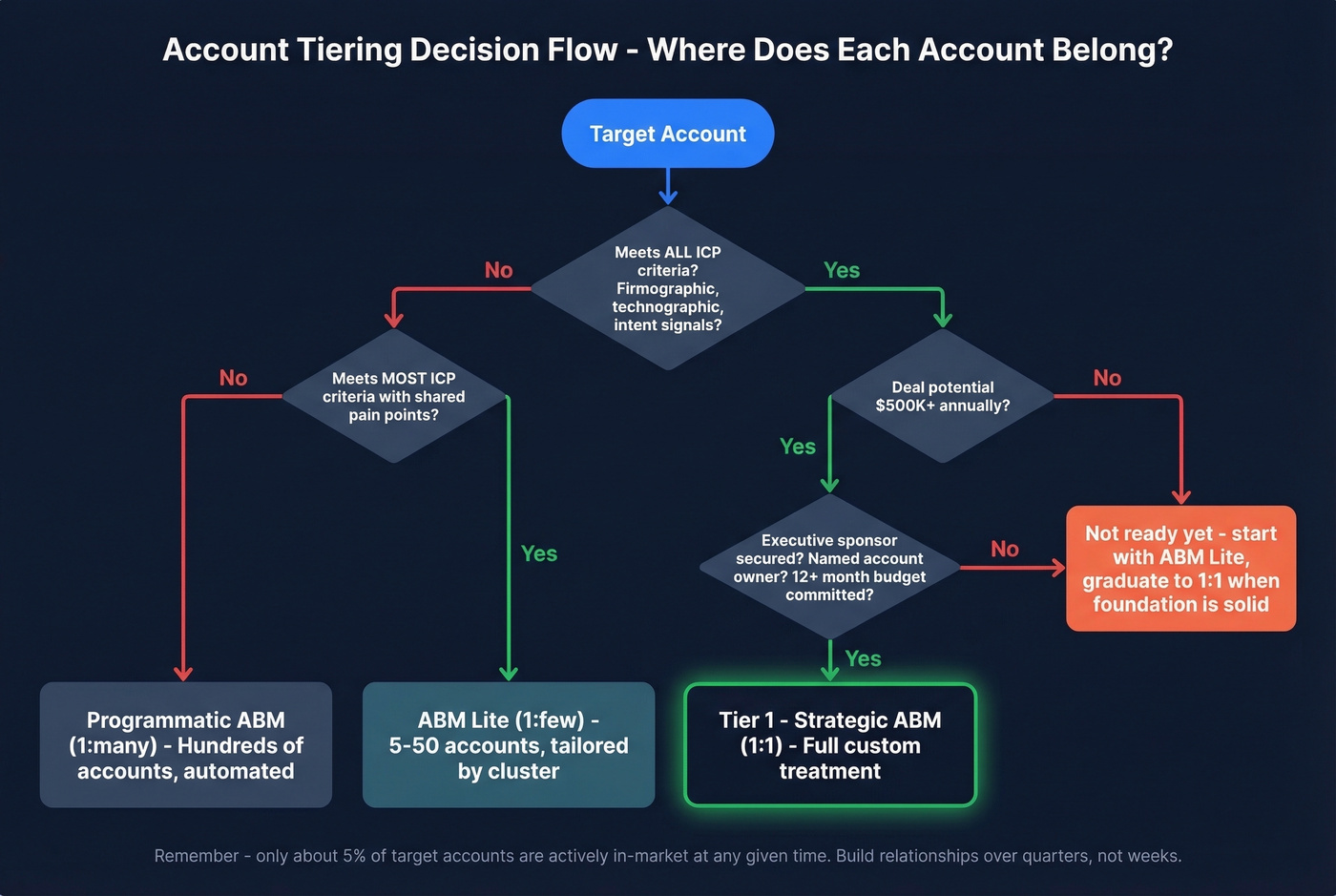
Your Tier 1 accounts - the ones that get the full 1:1 treatment - should meet every ICP criterion you have: firmographic fit, technographic alignment, intent signals showing active research, and a realistic path to significant revenue. Layer in intent data and AI-driven scoring to dynamically assign tiers based on engagement and buying signals rather than gut feel.
One critical reality: at any given time, only about 5% of your target accounts are actively in-market. That means 95% of your Tier 1 list isn't ready to buy right now. Strategic ABM accounts for this by building relationships over quarters, not sprinting toward a demo. If you're measuring success in weeks, you've picked the wrong methodology.
When your VP of Sales hands you 200 accounts and calls it "strategic," push back. That's programmatic territory. The power of 1:1 ABM comes from constraint - you can't deliver tailored account strategies to 200 accounts simultaneously, and pretending you can dilutes everything.
Before committing resources, run a quick readiness check: Do you have executive sponsorship? A named account owner for each target? Budget for 12+ months without pipeline pressure? If the answer to any of those is no, start with ABM Lite and graduate to 1:1 when the foundation is solid.
Building Your ABM Tech Stack
Most guides say buy a platform first. That's backwards. Prove the model manually with three to five accounts before you spend $50K on software you don't know how to use yet. In our experience, the teams that start with a simple stack and graduate to enterprise tooling outperform the ones that buy Demandbase on day one and spend six months configuring it.
Starter Stack ($500/Month or Less)
| Category | Tool | Est. Cost |
|---|---|---|
| CRM | HubSpot CRM | Free |
| Contact enrichment | Prospeo | From ~$0.01/email |
| Sales intelligence | Apollo or similar | ~$49-99/mo per user |
| Analytics | Google Analytics | Free |
For Tier 1 accounts, you need verified emails and direct dials for every member of the buying group. When you're targeting a handful of high-value accounts, every contact matters - a single bounced email to the CFO isn't just wasteful, it's a missed quarter. Prospeo's 30+ search filters, including buyer intent powered by Bombora and technographic signals, let you zero in on the exact decision-makers inside your target accounts.
Growth Stack
| Category | Tool | Est. Cost |
|---|---|---|
| Intent data | Bombora, 6sense | $20-200K+/yr |
| ABM ads | RollWorks | $10-30K+/yr (plus ad spend) |
| Sales engagement | Outreach, Salesloft | $100-150/user/mo |
| Personalization | Mutiny | ~$10-40K/yr |
Enterprise Stack
| Category | Tool | Est. Cost |
|---|---|---|
| Core ABM platform | Demandbase, 6sense | $20-200K+/yr |
| Orchestration | Terminus | $20-100K+/yr |
| Contact data | ZoomInfo | $15-40K+/yr |
| Content delivery | PathFactory, Uberflip | ~$10-40K/yr |
A common failure at this tier: teams buy the enterprise stack but never configure account-level tracking properly. The platform becomes an expensive dashboard that nobody trusts. Make sure your CRM, intent data, and engagement tools all resolve to the account level before you start measuring anything.

Strategic ABM lives or dies on reaching the right people in the buying committee. Prospeo maps 300M+ professionals with 98% verified emails and 125M+ mobile numbers - refreshed every 7 days, not 6 weeks. Layer 30+ filters including intent data, technographics, and job changes to build your Tier 1 account plans on data that actually connects.
Stop planning accounts around stale data. Start with contacts that pick up.
Channels That Actually Work
Direct Mail (The Contrarian Winner)
In a world where the inbox is, as one Reddit poster put it, "completely broken and pretty much unusable," physical mail has become the surprise performer. Direct mail ROI hits up to 20x returns, with an average ROI around 30% - higher than paid search at 23%. Campaigns with a direct mail component are 27% more likely to deliver top-ranking sales performance.
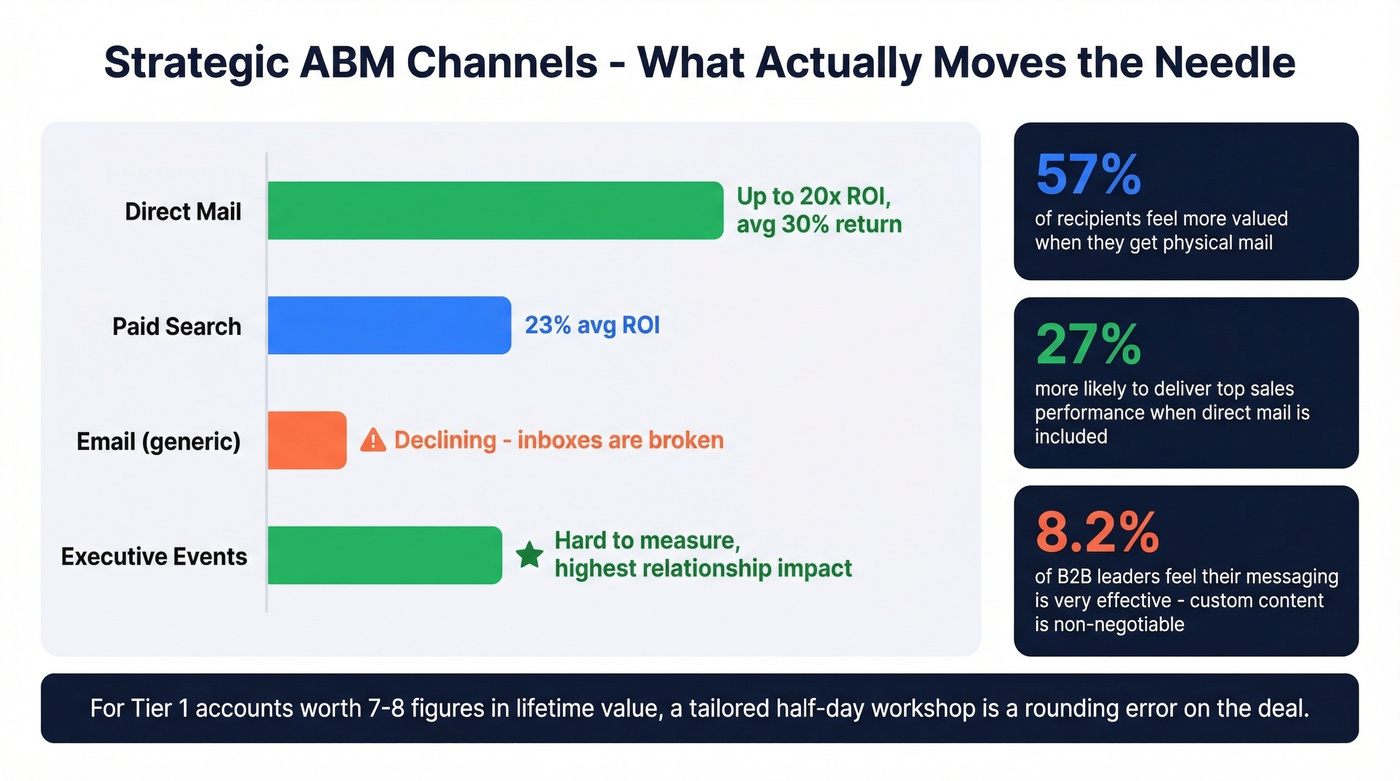
The best 1:1 direct mail isn't a branded mug. One team sent a guide locked inside a physical safe to CIOs, then sent the combination code to the security managers - forcing internal coordination and guaranteeing the CIO heard about it. That's the level of creativity this tier demands. 57% of recipients say they feel more valued when they receive physical mail, which matters when you're selling into key accounts at the C-suite level.
Executive Events and 1:1 Experiences
Intimate dinners, custom workshops, on-site briefings - these aren't scalable, and that's the point. For a Tier 1 account worth seven or eight figures in lifetime value, flying three executives to a tailored half-day workshop is a rounding error on the potential deal.
Custom Content
Only 8.2% of B2B leaders feel their messaging is very effective. Generic whitepapers with a logo swap won't close that gap. You need content that references the account's specific challenges, competitive landscape, and strategic priorities - built from the account plan, not from a content calendar. If your "custom" content works for any account in the same industry with a find-and-replace, it's not custom.
Aligning Sales and Marketing
This is where a huge share of ABM programs break down. The fix isn't cultural - it's structural. You need a shared scorecard with joint KPIs: target accounts engaged, opportunities created, pipeline generated, revenue closed, and account penetration depth.
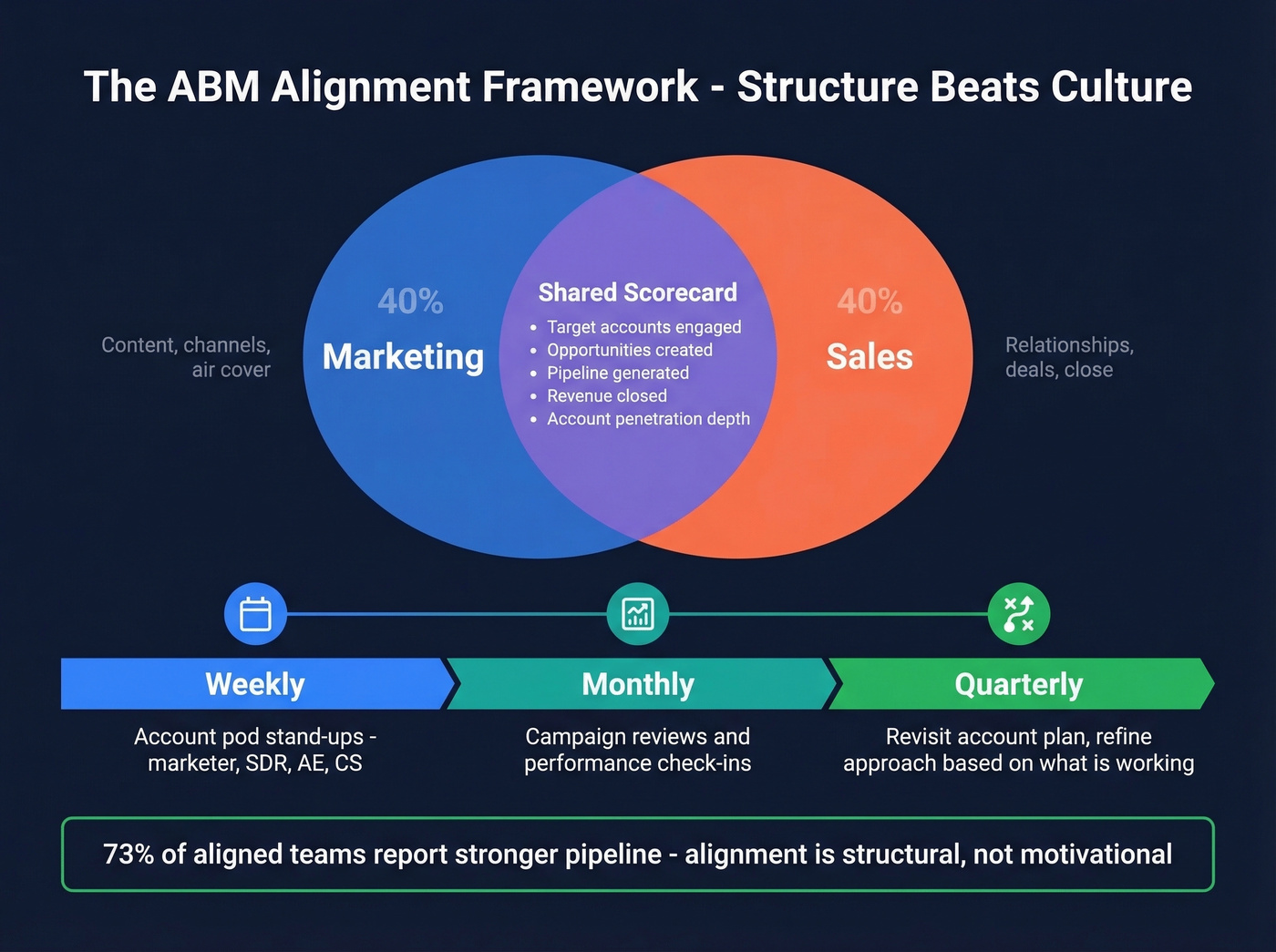
The operational cadence matters just as much. Weekly stand-ups between the account pod - marketer, SDR, AE, CS. Monthly campaign reviews. Quarterly strategy sessions where you revisit the account plan and refine your approach based on what's actually working. 73% of aligned teams hit their targets, compared to the industry average that's significantly lower.
Look, if sales and marketing are reporting to different VPs with different dashboards and different definitions of "qualified," your program is dead on arrival. Get leadership alignment first, then build the program. Without a unified account strategy, even the best content and tooling won't move the needle.
Strategic ABM in Action
What happens when you go high-touch with cold accounts? LiveRamp found out: deeply researched outreach converted 33% of cold target accounts to meetings in four weeks. That's the compression effect of thorough research - when you know the account inside out, cold becomes warm fast.
Snowflake ran premium direct mail paired with tailored digital experiences across 200 target accounts and saw 85% open rates on direct mail pieces, generating $50M+ in pipeline. Adobe took a different approach entirely, deploying AI-driven personalization for Fortune 500 accounts with account-specific content experiences - deal sizes jumped 60% and retention improved 40%, a reminder that 1:1 ABM is as much about expansion as acquisition.
DocuSign built industry-specific content hubs tailored to vertical pain points, driving 60% higher engagement and a 22% pipeline uplift across target accounts.
Why These Programs Fail
Wrong accounts. Marketing picks aspirational logos without sales input. Or worse, someone dumps 200 accounts into the "strategic" tier. If sales doesn't co-own account selection, you're building campaigns for accounts that'll never close.
Sales-marketing misalignment. Different KPIs, different dashboards, different definitions of success. Marketing celebrates "engagement." Sales wants meetings. Neither is wrong, but if they aren't on the same scorecard, the program fragments.
Leads over buying groups. The biggest mindset shift in ABM is moving from individual leads to buying group engagement. Forrester data shows that shifting from MQLs to buying groups drives a 200% increase in win rates and 800% increase in opportunity progression. Yet most teams still disqualify accounts because one contact went cold - ignoring the other six people in the buying committee.
Superficial personalization. A company name in a subject line isn't 1:1 ABM. Neither is swapping a logo into a case study template. If your content works for any account in the same industry with a find-and-replace, it's not personalized.
Bad contact data. You spend weeks building an account plan, craft personalized content, coordinate sales and marketing - then send it to a bounced email. One team we worked with saw bounce rates drop from 35% to under 4% after switching to real-time verified contacts. When you're targeting five accounts and every touchpoint matters, data quality isn't a nice-to-have. It's the foundation.
You don't need a $50K platform to run 1:1 ABM - you need accurate contact data for every stakeholder in the buying committee. Prospeo delivers verified emails at $0.01 each and direct dials with a 30% pickup rate. Teams using Prospeo book 26% more meetings than ZoomInfo users, at 90% lower cost.
Map the full buying committee with data you can actually trust.
ROI and the Business Case
The numbers make the case. 87% of B2B marketers say ABM outperforms every other marketing investment. 81% report stronger ROI than other tactics. 80% report higher win rates in ABM-engaged accounts. And 74% of B2B marketers expect to increase ABM budgets, per Forrester's planning guide.
Strategic ABM's ROI takes longer to materialize than programmatic - months to years versus one to six - but the deal sizes and retention rates more than compensate. When you're targeting accounts worth $500K+ in annual contract value, the math on a dedicated account pod paying for itself isn't hard.
FAQ
How many accounts should a 1:1 ABM program target?
One to five accounts maximum. If you're targeting dozens, you're running ABM Lite. The discipline of constraint is what makes this tier work - you can't deliver custom-built experiences to 50 accounts without diluting quality to irrelevance.
How long before strategic ABM shows ROI?
Expect 6-18 months for meaningful pipeline impact on enterprise accounts with complex buying committees. Quick wins come from ABM Lite or Programmatic tiers - the 1:1 approach is a long game with outsized returns on deals worth $500K+.
Do I need a platform like Demandbase or 6sense to start?
No. Prove the model manually with three to five accounts using a CRM, verified contact data, and coordinated sales-marketing execution. Buy a platform after you've validated the approach and understand what you actually need from the tooling.
What's the difference between strategic ABM and key account management?
In mature organizations, they converge. Strategic ABM embeds marketing into the account team's plan, while KAM focuses on relationship management. The account plan is the shared artifact - both disciplines rely on it to coordinate every touchpoint across the buying committee.
What contact data matters most for 1:1 ABM?
Verified emails and verified mobile numbers for specific individuals in buying groups - not bulk lists. Accuracy and freshness matter more than volume. A 7-day data refresh cycle versus the 6-week industry average prevents wasted outreach to stale contacts when every touchpoint counts.