


The Best SuiteDash Alternatives in 2026 (Picked by What You're Replacing)
If you're searching for suitedash alternatives, you're not "tool shopping." You're trying to stop running a client portal like a side project. SuiteDash's flat pricing is great; the setup burden is what breaks teams. Below are the replacements that win based on the exact module you're ripping out: portal, billing, automations, or compliance.
Why people replace SuiteDash (even if it's "good")
SuiteDash is strong. On G2 it sits at 4.8/5 with 595 reviews.
People still replace it for one reason: friction.
The recurring negatives in review patterns line up with what we've seen in real deployments: SuiteDash gives you a lot of knobs, and you pay for that in admin time. The G2 theme tags make it plain: Learning Curve (24) and Steep Learning Curve (18) show up as repeat complaints.
Here's what actually triggers a switch:
- They wanted a portal, not a platform. The client-facing portal is the visible part; the hidden work is maintaining CRM logic, automations, billing rules, and permissions.
- They outgrow the DIY admin model. SuiteDash shines when one ops-minded person owns it. When nobody owns it, it becomes a "don't touch it" system.
- They don't want to rebuild everything to change one thing. Updating onboarding, forms, and automations feels like refactoring a codebase.
- They need a different center of gravity. Some teams want billing-first (HoneyBook/Dubsado). Others want requests/proofing-first (ManyRequests). Others want compliance-first (Clinked).
Hot take: if your team doesn't have a dedicated ops owner (even part-time), SuiteDash is the wrong bet.
You'll either underuse it or overbuild it. Both end the same way: "We should switch."
Our picks (TL;DR) - 4 tools to trial first
I'd start here because these four cover the real reasons people leave SuiteDash: speed, adoption, compliance, and pipeline quality.
Plutio - best fast all-in-one replacement
- Best for: You want proposals + contracts + invoicing + projects + a client portal, and you want it live this week.
- Skip if: You need deep white-label portal customization (menus/dashboards) like SuiteDash.
- Pricing (typical): $19/mo (Pro $49/mo, Max $199/mo)
ManyRequests - best for agencies selling packaged services
- Best for: Creative agencies where the "portal" is really requests -> proofing -> approvals.
- Skip if: You need unlimited-staff economics; it's seat-based and adds up.
- Pricing (typical): $59/mo (Core) or $99/mo (Pro) + extra seats
Clinked - best compliance-first client portal
- Best for: Secure external collaboration, permissions, audit trails, and enterprise-style access control.
- Skip if: You want the cheapest portal; SSO lives on Enterprise.
- Pricing (starts): $77/mo
Prospeo - best data layer if you're simplifying ops but still need pipeline
- Best for: You're replacing SuiteDash with a simpler portal/billing tool, but you still need clean lead data for outbound, renewals, and expansion.
- Skip if: You want a client portal (it's a data platform, not a portal).
- Pricing (typical): Free tier, then ~$39-$249/mo credit-based self-serve
Decide what you're replacing (not "SuiteDash, but simpler")

- Client portal (white-label, dashboards, file exchange, messaging)
- CRM (contacts/companies, pipelines) - if this is your focus, also see deal management options.
- Billing (invoices, subscriptions, payments)
- E-sign (contracts, audit trail, multi-signer)
- Scheduling (booking pages, reminders)
- Automations (triggers/actions, onboarding flows)
- LMS/community (courses, memberships, community areas)
If you don't name what you're replacing, you'll pick the wrong alternative and rebuild SuiteDash complexity somewhere else.
Quick replacement scope checklist
Check what you actually use today:
- Portal login + file exchange
- Client onboarding forms + checklists
- Proposals/contracts + e-sign
- Invoicing + recurring billing
- Scheduling + reminders
- Internal projects/tasks/time tracking
- Automations across the above
- Courses/community
Now pick one of these four scopes (this is the decision that matters):
Portal-only You need a clean place for clients to log in, upload/download, and message.
Portal + billing You want the portal plus proposals/contracts/invoices/payments in one flow.
Full ops replacement You want CRM + projects + billing + automations in one tool (SuiteDash-style), but with a different UX.
Regulated portal You need security/compliance posture: permissions, audit trails, SSO, retention controls, and a vendor that's comfortable in that conversation.
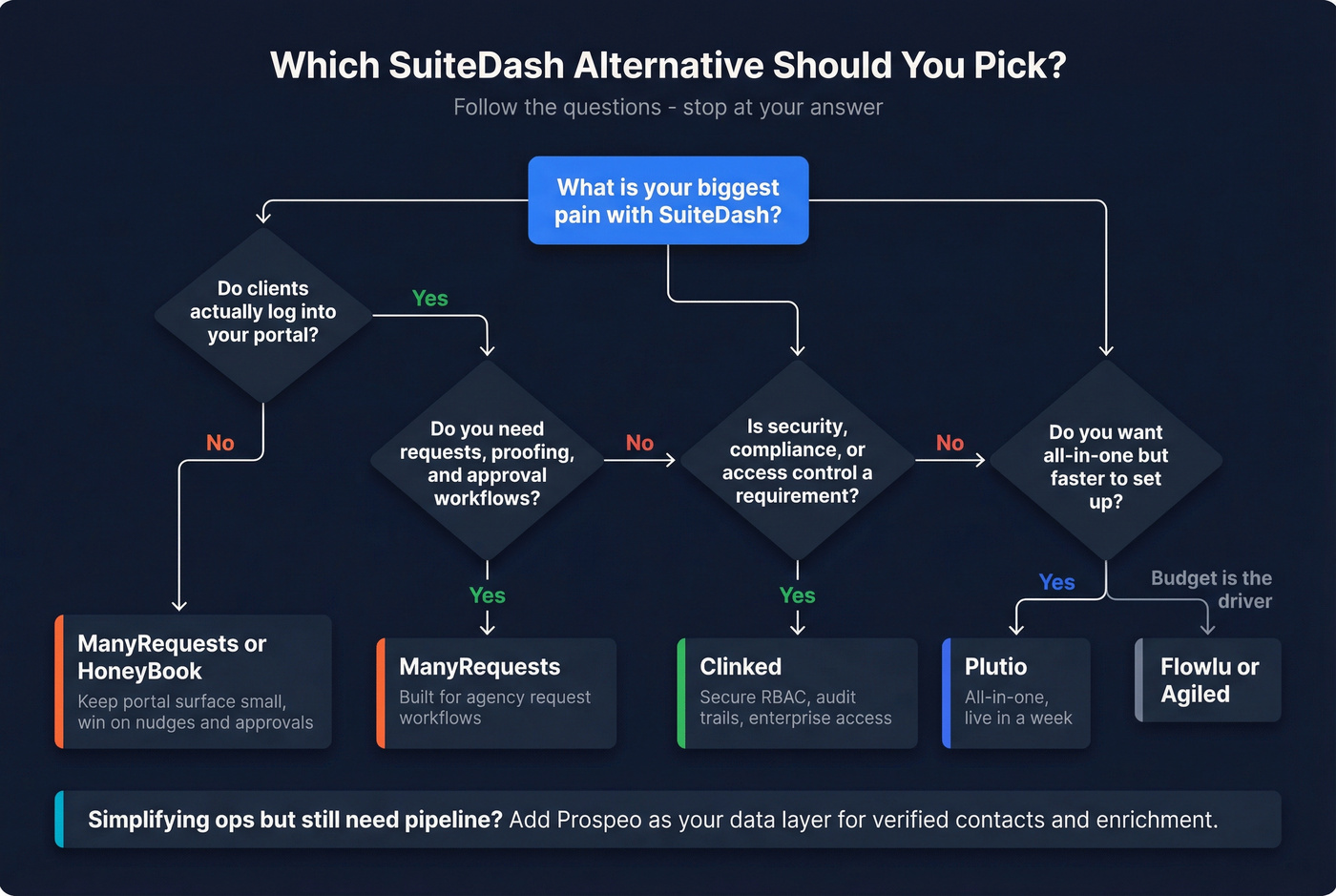
Mini decision tree (use this and you'll save a week)
- If clients won't log into portals -> pick a tool that wins on nudges + simple approvals (ManyRequests or HoneyBook) and keep the portal surface area small.
- If you need requests + proofing -> ManyRequests.
- If you need secure external collaboration with real access control -> Clinked.
- If you need all-in-one but faster to deploy -> Plutio (or Flowlu/Agiled if budget's the driver).
- If you're simplifying ops and still need growth -> add a dedicated data layer for verified contact data and enrichment (see data enrichment strategies).
One more opinion from the trenches: portal adoption is a product problem, not a training problem. If clients don't love the first two clicks, they won't use it, no matter how many features you packed behind the login.
Feature-by-feature replacement matrix (top 4 picks)
This is the fastest way to stop feature-guessing. SuiteDash is a suite; most alternatives are opinionated.

Legend: ✅ strong / ⚠️ workable / ❌ not the point
| SuiteDash module you rely on | Plutio | ManyRequests | Clinked | Prospeo |
|---|---|---|---|---|
| Client portal login + branded workspace | ✅ | ✅ | ✅ | ❌ |
| File exchange + client collaboration | ✅ | ✅ (agency workflow) | ✅ (secure) | ❌ |
| Messaging / client comms in-portal | ✅ | ✅ | ✅ | ❌ |
| Requests intake + proofing + approvals | ⚠️ | ✅ | ⚠️ | ❌ |
| Proposals + contracts + e-sign | ✅ | ⚠️ | ❌ | ❌ |
| Invoicing + payments | ✅ | ⚠️ | ❌ | ❌ |
| Scheduling | ⚠️ | ⚠️ | ❌ | ❌ |
| Automations across ops | ⚠️ | ⚠️ | ⚠️ (governance-first) | ❌ |
| CRM / pipeline | ⚠️ | ❌ | ❌ | ✅ (data + enrichment) |
| Lead enrichment + verification + intent | ❌ | ❌ | ❌ | ✅ |
How we'd use this matrix in a real evaluation:
- If you want one tool to replace the "client ops loop" (proposal -> contract -> invoice -> project) pick Plutio.
- If you want clients to actually submit requests and approve work, pick ManyRequests.
- If you want security posture you can defend in procurement, pick Clinked.
- If you're splitting "delivery ops" from "pipeline quality," add Prospeo as the data layer (and keep your list hygiene tight with an email verifier).

Replacing SuiteDash's CRM doesn't mean losing your pipeline. Prospeo gives you 300M+ profiles with 98% email accuracy and a 7-day refresh cycle - so your outbound stays clean while you simplify ops. No contracts, no setup burden.
Split delivery ops from pipeline quality - starting at $0.01 per verified email.
Comparison table: SuiteDash alternatives (pricing + portal + scaling)
Use this table like a risk scan. "Starts at" is marketing. The real cost is how pricing scales when you add seats, brands, portals, or payment volume.
| Tool | Pricing model | Portal strength | Scaling risk (real) |
|---|---|---|---|
| Plutio | Flat tiers | All-in-one portal | Reporting ceiling |
| ManyRequests | Base + per-seat | Agency proofing | Seat creep |
| Clinked | Tiered users | Secure RBAC | Enterprise-gated SSO |
| HoneyBook | Tiered + fees | Payment flow | Fees at volume |
| Dubsado | Annual + add-ons | Forms + workflows | Add-ons stack |
| Flowlu | Per-user (seat) | Suite portal | Portal tier gate |
| Agiled | Flat tiers | Budget suite | Limits early |
| Bitrix24 | Tiered suite | Broad portal | Admin burden |
| 17hats | Flat plan | Simple portal | Multi-brand limits |
| Bonsai | Flat tiers | Light portal | Stack required |
| Copilot | Tiered | Modern UX | Needs extra tools |
| Accelo | Per-user + impl. | PSA portal | Implementation drag |
Mini-table: "Best for" vs "Skip if" (hard calls)
| Tool | Best for | Skip if |
|---|---|---|
| Plutio | SuiteDash-but-faster | You need deep white-label dashboards |
| ManyRequests | Agencies selling retainers | You're growing headcount fast |
| Clinked | Compliance + access control | You need SSO on a starter budget |
| HoneyBook | High-conversion billing flow | You're outside US/Canada |
| Dubsado | Form-heavy service workflows | You hate annual + add-ons |
| Flowlu | Ops suite on a budget | You want a cheap portal tier |
| Bitrix24 | "One suite" with a free start | Nobody'll own admin/governance |
| Copilot | Premium portal experience | You want built-in billing/PM |
Best SuiteDash alternatives by scenario (quick shortlist)
If you only read one section, read this.
Creative agency (requests + proofing + approvals): ManyRequests Teams love how "product-like" the client experience feels; the common complaint is seat pricing once the team grows.
Regulated client portal (permissions, audit trails, SSO conversations): Clinked Buyers praise access control and security posture; the common complaint is enterprise features living on enterprise tiers (normal in this category).
Solo operator / small service business (simple, stable ops): 17hats or Bonsai People like the "set it and forget it" vibe; power users complain about the ceiling and customization.
SuiteDash replacement without the maze (fast all-in-one): Plutio Users praise speed to launch and straightforward setup; the common complaint is advanced reporting/governance.
High-volume payments-first workflow: HoneyBook Teams love the client flow and getting paid; the common complaint is fees once volume climbs.
Multi-brand / multi-entity complexity: Suite tools (Flowlu/Bitrix24) only if you've got an admin Teams like breadth; the common complaint is "we bought a system, not a tool."
Migration reality check (exports, rebuild time, and "no undo" risk)
Switching off SuiteDash is doable, but it's not "export -> import -> done." The danger is recreating years of workflows in a weekend.

What you can export cleanly (and what you can't)
SuiteDash exports you can count on:
- Contacts/companies to CSV, including tags + custom fields (contact and company).
- Deals export to CSV with selectable fields.
SuiteDash import gotcha that bites teams: imports have no undo. If you import 5,000 contacts with the wrong mapping, you're cleaning it up manually. I've watched a team lose two full days to this because they treated the import like a reversible step, then realized too late it wasn't.
The 3 migration gotchas that actually blow up timelines
Gotcha #1: Files are the time sink (not contacts)
Contacts move in an afternoon. Files eat your week.
Concrete steps that save you:
- Inventory first: export a list of projects/clients and estimate file volume per client (small/medium/huge).
- Decide your source of truth: if you're moving to a portal that isn't meant to be a file system, keep files in a dedicated storage tool and link from the portal.
- Preserve structure: download in a way that keeps folder hierarchy intact; don't dump everything into one folder and promise you'll "organize later." You won't.
Gotcha #2: Invoices/subscriptions don't migrate the way you think
Even when you can export invoices, you often can't recreate:
- payment processor history
- subscription state
- tax edge cases
- partial payments and credits
Concrete steps:
- Freeze recurring billing changes during cutover week.
- Export invoice history for reference, but plan to start subscriptions fresh in the new system.
- Tell clients upfront if invoice numbers or portal history will change. Surprises create support tickets.
Gotcha #3: Automations aren't portable
Automations are usually the reason SuiteDash felt "powerful." They're also the least transferable asset.
Concrete steps:
- Write an automation spec before you touch a new tool: trigger -> conditions -> actions -> owner -> failure mode.
- Rebuild only the top 20% that drives 80% of outcomes (onboarding reminders, payment follow-ups, request routing).
- Create a manual fallback for every automation during the first month ("If X fails, do Y").
Practical rebuild checklist (the "don't regret this" version)
- Freeze changes: pick a data freeze window (even 24 hours helps).
- Export contacts/companies CSV + deals CSV.
- Clean your CSVs: dedupe, normalize company names, standardize tags.
- Rebuild the minimum viable portal: login, one dashboard, one upload area, one message path.
- Recreate billing flows: invoice templates, payment methods, recurring rules.
- Recreate onboarding: 1-2 core forms, 1 checklist, 1 reminder automation.
- Run parallel for 2 weeks: new clients on new system, old clients finish in SuiteDash.
Treat migration like a deployment, not a settings change. That mindset prevents most self-inflicted pain.
The best SuiteDash alternatives (reviews by scenario)
(Formats vary on purpose: one tool gets a workflow story, another gets "who shouldn't buy this," another gets pros/cons. That's how real evaluations work.)
Plutio (Tier 1) - fastest path to "SuiteDash-lite" without the maze (workflow format)
If you want the SuiteDash loop - proposal -> contract -> invoice -> project -> portal - Plutio is the fastest way to get there without hiring an admin.
Day-in-the-life (what it replaces well):
- Client asks for work -> you send a proposal
- Proposal accepted -> contract signed
- Invoice sent -> payment collected
- Project kicks off -> tasks + updates live in one place
- Client logs in -> sees progress, files, and next steps
What users consistently praise: fast setup, clean UI, and "we were live quickly." Common complaint pattern: reporting and governance hit a ceiling as complexity grows.
Pricing signal: $19/mo / $49/mo / $199/mo.
Compared to SuiteDash: Plutio trades deep configuration for speed. That's a good trade for most small teams.
Prospeo ("The B2B data platform built for accuracy") (Tier 1) - keep delivery simple, fix pipeline quality (tight spec + workflows)
Prospeo isn't a client portal. It's the clean data layer you add when you stop forcing one platform to do everything.
We've used tools like this in the exact moment a team simplifies ops: they move from "one suite" to a lighter portal + billing tool, then realize their outbound lists are a mess, renewals are stuck in stale contact info, and nobody trusts the CRM enough to run a real pipeline review.
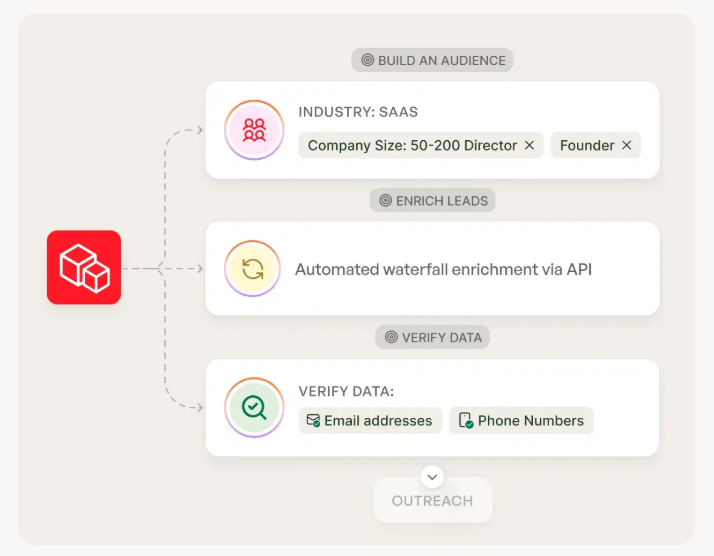
Prospeo fixes that part, fast, and it's built for accuracy: 300M+ professional profiles, 143M+ verified emails, and 125M+ verified mobile numbers, used by 15,000+ companies and 40,000+ Chrome extension users. You get 98% email accuracy, a 7-day data refresh cycle (industry average: 6 weeks), 30+ search filters, and 15,000 intent topics.
What it's best at (real workflows):
- Build targeted lists with filters + intent, then export clean records (see account-based marketing tactics).
- Verify emails and find mobiles before outreach to protect deliverability (use an email verification checker if you're comparing tools).
- Enrich CSVs/CRMs with 50+ data points per contact (great for cleanup after a SuiteDash export) - especially if you're doing lead enrichment for CRM.
Pricing signal: free tier, then credit-based self-serve plans that typically land around ~$39-$249/mo depending on volume. Useful links: Pricing, Chrome Extension, Data Enrichment, Integrations.

ManyRequests (Tier 1) - the agency portal clients actually use (use/skip format)
Use this if:
- You sell packaged services or retainers and need a clean request intake -> proofing -> approval loop.
- Your portal success metric is "clients submit requests and approve work," not "clients explore dashboards."
- You want a portal that feels like a product, not a back office.
Skip this if:
- You're trying to replicate SuiteDash's unlimited-staff economics. ManyRequests is seat-based.
- You need deep CRM + project accounting. It's agency workflow-first, not ERP.
What users consistently praise: client adoption, clear request queues, and approvals that don't require training. Common complaint pattern: seat pricing and storage constraints for heavy media teams.
Pricing signal: $59/mo (Core) or $99/mo (Pro). Extra seats are $20/mo (Core) or $30/mo (Pro). Enterprise concierge onboarding starts from $1,000/mo. Storage: Core 1TB, Pro 2TB, add-on storage $25 per 500GB, 10GB/file limit.
Clinked (Tier 1) - compliance-first external portal (pros/cons format)
Clinked is what you pick when "client portal" means permissions, auditability, and controlled external collaboration - not just a branded login. It's built for environments where you need to explain access models to clients and security teams without hand-waving.
Pros
- Strong access control and external collaboration model
- Clear "members vs guests" approach that matches real client work
- Built for security conversations (not "trust us" security)
Cons
- SSO/Active Directory is gated to Enterprise (budget for it if required)
- Not a billing/proposal suite; pair it with separate ops tools
Pricing signal: Lite from $77/mo, Standard $194/mo, Premium $389/mo. SSO/Active Directory sits on Enterprise.
HoneyBook (Tier 2) - billing-first client flow (US/Canada only) (who shouldn't buy this format)
HoneyBook is the cleanest "get paid and keep clients moving" replacement when your SuiteDash usage is mostly proposals/contracts/invoices.
Don't buy HoneyBook if:
- You're outside the U.S. and Canada (availability is geo-blocked).
- You need a deep portal platform with complex permissions.
- You process high volume and hate variable fees (you'll feel them).
Buy it if:
- You want a polished lead -> proposal -> contract -> invoice -> payment flow.
- You care more about conversion and speed than portal depth.
Pricing signal: Starter $29/mo (annual), Essentials $49/mo, Premium $109/mo. Lead form limits are a real gate: 2 vs 10 vs unlimited.
Fees: 2.9% + 25c card, 1.5% ACH, 1% instant deposit.

Dubsado (Tier 2) - forms + workflows, priced annually (migration effort score format)
Dubsado wins when your business runs on forms, templates, and repeatable workflows.
Migration effort score (from SuiteDash): Medium
- Easy: forms/templates mindset maps well
- Hard: add-ons and annual pricing force upfront decisions
What users consistently praise: flexible forms, templates, and workflow automation for service businesses. Common complaint pattern: annual pricing feels heavy; add-ons creep in as you scale brands/users.
Pricing signal: $335/yr (Starter) or $525/yr (Premier). Add-ons: $10/mo per additional brand plus user packs ($25/$45/$60 depending on user count).
Scaling gotcha: Starter includes 1 active lead capture form; Premier is unlimited.
Flowlu (Tier 2) - ops suite with a portal tier gate (straight talk format)
Flowlu is for teams that want a broader ops suite (CRM + PM + finance-ish) and accept per-user pricing.
Here's the thing: Flowlu is only "cheap" if you don't need the portal. If you need the portal, you're on the tier that includes it.
Pricing signal: Free for up to 2 users, then Essential $12/user/mo, Advanced $22/user/mo (or $17/user/mo annual). The company switched to seat-based pricing on September 18, 2026 (per their update post).
Scaling gotcha: the client portal is included at Advanced, so Essential isn't the portal plan.
Agiled (Tier 2) - budget all-in-one that's fine until you hit limits (pro/con + who it's for)
Agiled is the "I want SuiteDash features, but I'm cost-sensitive" option. It covers a lot for the money and works as a starter suite while you're still standardizing process.
Who it's for: freelancers and small teams who want an all-in-one without enterprise pricing.
Pricing signal: free plan (tight limits), then $30/mo / $59/mo / $99/mo paid tiers with included users.
Scaling gotcha: the free plan caps you at 2 clients. That's not realistic for a SuiteDash migration.
Bitrix24 (Tier 2) - the "free forever" suite that demands an admin (anecdote format)
Bitrix24 is broad, and the free tier pulls people in. Then reality hits: you didn't buy a tool - you adopted a system.
I've seen Bitrix24 succeed exactly once in a small services team: someone owned it like a product manager. Permissions, pipelines, automation rules, and "where work lives" were all enforced. Without that owner, it turns into the place where work goes to disappear, and everyone blames the tool instead of the lack of governance.
Pricing signal: Free tier available; paid plans for small teams often land around ~$49-$199/mo, with higher tiers depending on users/modules.
17hats (Tier 2) - simple, stable, and priced like a utility (pros/cons format)
17hats is the opposite of SuiteDash: fewer knobs, fewer surprises.
Pros
- One all-inclusive plan keeps decisions simple
- Trial + money-back guarantee reduces switching risk
- Great fit for solo operators and small service teams
Cons
- Add-ons exist (small, but they're there)
- Portal experience is functional, not premium
Pricing signal: $60/mo or $600/yr. 7-day trial and a 30-day money-back guarantee. Bank connect add-on is $5/mo.
Bonsai (Tier 3) - best for freelancers who don't need a heavy portal
Bonsai is great for proposals, contracts, and invoicing without a complex portal.
Pricing signal: typically ~$25-$40/mo depending on tier and billing cycle.
Copilot (Tier 3) - premium portal experience-first
Copilot is about giving clients a clean, modern place to interact.
Pricing signal: typically ~$99-$499/mo depending on client counts/features.
Accelo (Tier 3) - PSA-style delivery ops (heavier than SuiteDash)
Accelo is a PSA-style tool for service teams that want deeper delivery ops.
Pricing signal: typically ~$30-$80/user/mo, plus implementation overhead that can range from ~$1,000 to $10,000+ depending on scope.
Pricing traps & scaling math (what "starts at" hides)
SuiteDash's pricing is blunt: flat tiers, unlimited staff/clients. Most alternatives aren't. Here's where teams get surprised.
Seat creep (ManyRequests, Flowlu)
ManyRequests looks like $59/mo until you add seats:
- Core: $59/mo includes 1 seat
- Add 4 more seats: 4 x $20 = $80
- Real monthly: $139/mo for a 5-person team (before storage add-ons)
Flowlu is per-user, and the portal is gated to Advanced. A 6-user team on Advanced is 6 x $22 = $132/mo (or $102/mo annual at $17/user). That's fine. Just don't budget like it's a $12/user portal tool.
Add-ons that become mandatory (Dubsado)
Dubsado's base pricing is annual, and it's reasonable. The trap is thinking you're "done" at $335/yr:
- Need multiple brands? $10/mo per additional brand
- Need more users? user packs $25/$45/$60 per month depending on size
It's not evil. It's just math you should do before you migrate.
Fees that dwarf subscriptions (HoneyBook)
If you process meaningful volume, HoneyBook's fees are the real price:
- Card: 2.9% + 25c
- ACH: 1.5%
- Instant deposit: 1%
At $50k/mo card volume, 2.9% is $1,450/mo. That's the cost of a payments-first platform.
Security & compliance for client portals (when it's non-negotiable)
If you handle sensitive client data, portal security isn't optional. IBM's 2024 Cost of a Data Breach report puts the global average breach cost at $4.88M, and the U.S. average at $9.36M.
And if you touch HIPAA-adjacent workflows, HIPAA penalty caps can reach up to $1.5M annually per violation category. Even if you're not a covered entity, your clients might be, and they'll push requirements downstream.
Use this checklist when you evaluate portals:
- Permissions model: role-based access, folder-level controls, per-project visibility
- Audit trail: who accessed what, when, and what changed
- SSO: required for many mid-market clients; confirm tier (Clinked gates SSO/Active Directory to Enterprise)
- Guest access: secure guest links vs full member accounts; expiration controls
- Data retention: exportability, deletion policies, and retention windows
- MFA & session controls: timeout policies, device/session management
- Vendor posture: DPAs, incident response process, and admin logging
Real talk: if security is why you're switching, don't start cheap and "upgrade later." Buy the tier that includes the controls you'll be judged on.
Adjacent tools that aren't true SuiteDash replacements (and when they still win)
These show up in SERPs for SuiteDash alternatives, but they aren't full replacements unless you build a stack. They still win in specific situations:
- Softr - best when you want to build a lightweight portal on top of Airtable/Sheets and you're okay owning the build.
- Moxo - best for secure client interaction workflows (especially financial services style handoffs); not an all-in-one ops suite.
- Clientjoy - best for proposals + invoicing + simple client management; lighter than SuiteDash.
- SuperOkay - best for a clean client hub and onboarding; you'll still need billing/PM tools.
- Monday.com / Asana - best for internal delivery; clients won't love logging in unless you design a client-facing layer.
- FreshBooks - best for invoicing/accounting-first; it won't replace portal workflows.
- Zapier / Make - best as glue when you intentionally choose a stack; don't use automation to patch a broken process.
My calls on suitedash alternatives (do this / don't do this)
If you want a decisive answer, here it is:
- If you want SuiteDash-but-faster: pick Plutio.
- If you're an agency selling packaged services: pick ManyRequests.
- If you need regulated portal + SSO: pick Clinked (budget for Enterprise if SSO's non-negotiable).
- If you're simplifying ops but still need outbound pipeline quality: add a dedicated data layer for verified contact data and enrichment (start with building a B2B sales pipeline).
FAQ (SuiteDash alternatives, 2026)
Which SuiteDash alternative is best if clients won't use the portal?
ManyRequests and HoneyBook are usually the best picks because they optimize for 2-3 core client actions (submit a request, approve work, pay an invoice) instead of hoping clients explore dashboards. If portal adoption's low, choose a tool that wins on reminders and approvals, then keep the portal surface area small.
Is HoneyBook available outside the U.S. and Canada?
No. HoneyBook is only available for businesses in the U.S. and Canada, and the signup/pricing flow blocks other regions. If you're elsewhere, shortlist Plutio, Dubsado, ManyRequests, Flowlu, or Clinked depending on whether you're billing-first, ops-first, or compliance-first.
Which tools offer SSO for client portals (and what tier is it on)?
Clinked offers Active Directory and SSO, and it's gated to the Enterprise tier. That's normal for secure client portals because SSO comes with higher security expectations, admin controls, and procurement requirements.
If I replace SuiteDash with a simpler portal, what should I use for lead data?
Use a dedicated data layer like Prospeo: it delivers 98% verified email accuracy on a 7-day refresh cycle, plus 125M verified mobile numbers, 30+ search filters, and 15,000 intent topics. For most outbound teams, that's the fastest way to improve deliverability and list quality without rebuilding a heavy all-in-one.
You're ditching SuiteDash to reduce complexity, not add it. Prospeo is self-serve with 30+ filters, intent data on 15,000 topics, and CRM enrichment that returns 50+ data points per contact. Plug it into HubSpot or Salesforce in minutes.
Stop rebuilding what you should be outsourcing to a dedicated data layer.