The 2026 Playbook for Deal Management and Team Selling
A $150K deal went dark last quarter. The champion who'd been shepherding it internally changed jobs - and nobody on the selling team had a relationship with anyone else in the account. No backup thread, no executive sponsor, no technical evaluator on speed dial. The deal didn't die because of pricing or product fit. It died because one person left and took the entire relationship with them.
That's the gap between assigning people to deals and actually running deal management and team selling as a coordinated discipline. Let's close it.
The Short Version
- Team selling lifts win rates only when sellers actively coordinate - not just when they're assigned to the same deal.
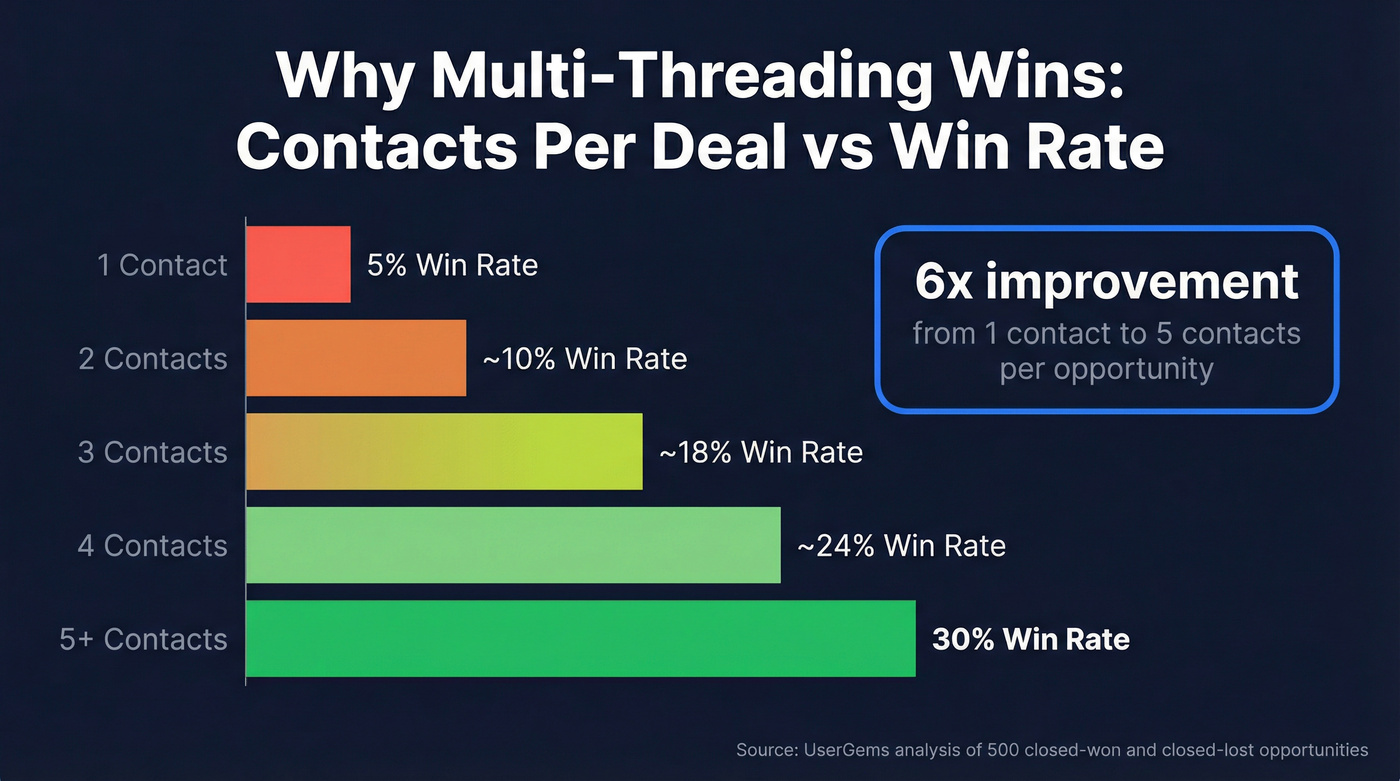
- Multi-thread into 5+ contacts per opportunity. Data shows a 5% win rate at 1 contact vs 30% at 5.
- Run deal reviews on a fixed cadence: weekly 1:1s, biweekly team reviews, biweekly exec reviews.
- Your CRM manages the deal. Your contact data powers the multi-threading. Both must be accurate.
Where Deal Management Meets Team Selling
Deal management is the discipline of moving an opportunity from qualification to close - tracking stakeholders, next steps, risks, and timelines in a structured way. Team selling is the coordination model that determines who from your side engages which people on the buyer's side.
Gartner's research shows the typical B2B purchase now involves 6-10 decision-makers. No single rep can cover that buying committee alone. Deal management without team selling is a spreadsheet exercise. Team selling without deal management is chaos - overlapping outreach, conflicting messaging, and coverage gaps that let deals stall.
Why Team Selling Outperforms Solo Selling
The performance gap is measurable. Outreach's Insights Group published benchmarks that break team selling impact into two distinct layers:
| Level of Coordination | Win Rate Lift | Cycle Time Reduction |
|---|---|---|
| Multiple sellers assigned | +2 pp | -51 days |
| Active coordinated outreach | +6.2 pp | -16 more days |
| Deals >$50K with coordination | +9 pp | - |
The gap between "assigned" and "coordinated" is the whole story. Assigning bodies without coordination is theater - it looks like team selling on a dashboard but doesn't move the needle. The real lift comes when reps actively coordinate calls, emails, and meetings across the buying committee.
There's also a velocity dimension. Outreach's sales benchmarks analysis found that opportunities closed within 50 days have a 47% win rate, compared to 20% or lower after that threshold. Coordinated selling compresses cycles because multiple reps engage multiple stakeholders simultaneously instead of sequentially.
Here's our take: most teams that say they're "doing team selling" are really just cc'ing their manager on emails. If your reps aren't independently running separate threads with separate stakeholders, you're doing multi-assignment, not team selling. And the data says multi-assignment barely moves the needle.
The Framework: Assign, Align, Engage, Measure
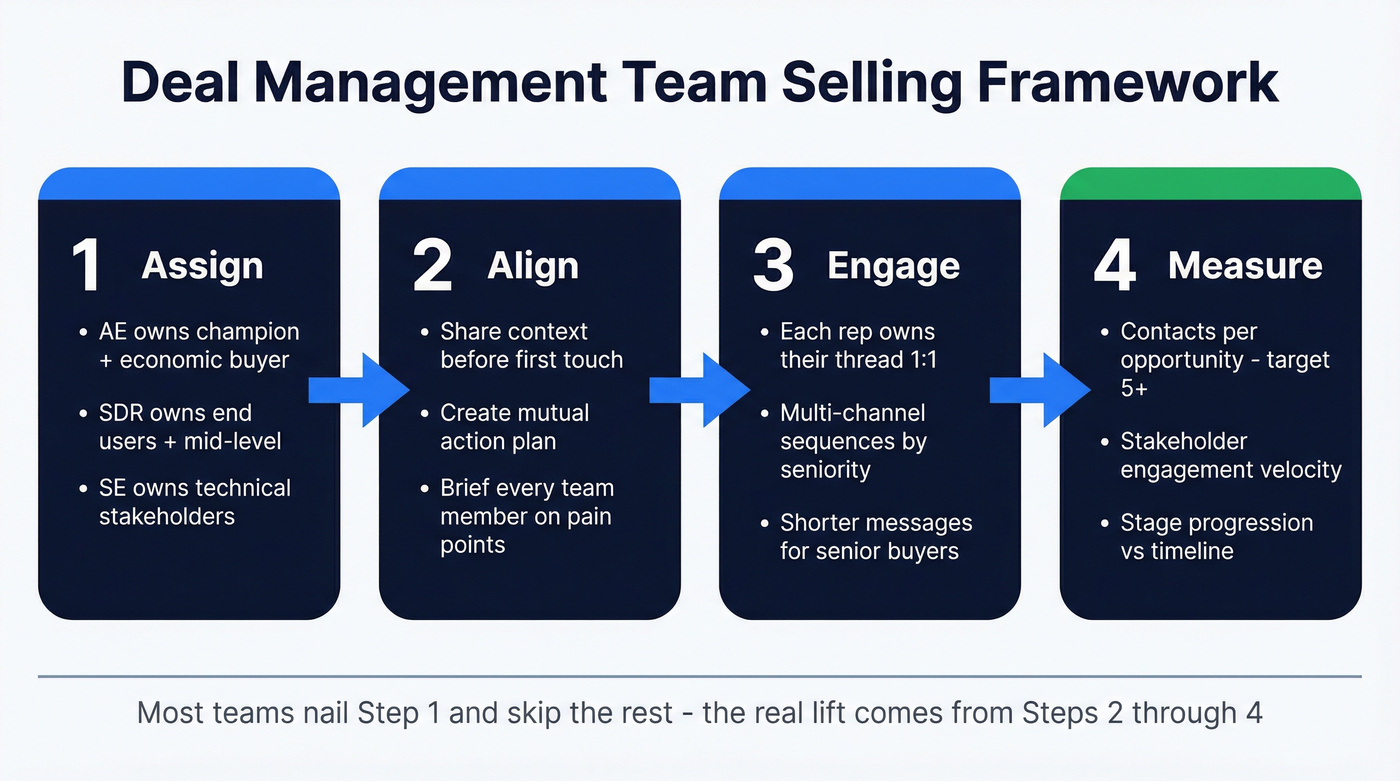
Most teams get the "assign" part right and skip the rest. A repeatable structure keeps everyone honest.
Assign Roles to Stakeholders
Map roles to stakeholders before the first coordinated touchpoint:
- AE owns the champion and economic buyer
- SDR/BDR owns end users and mid-level managers (see BDR performance management)
- SE or RevOps owns technical stakeholders and IT (tighten your Revenue Operations alignment)
- Director/VP owns the executive sponsor
Align on Context
Share context so nobody walks into a call blind. Create a mutual action plan as the shared artifact - a Google Doc, a deal room, whatever, as long as it's one source of truth. A mutual action plan also signals professionalism to the buyer; it shows you've done this before and respect their time.
Brief every team member on the prospect's pain points, timeline, and political dynamics before they engage. An executive deal briefing - a concise one-pager covering the account's strategic context, key stakeholders, and open risks - ensures your VP or CRO walks into the room fully prepared. We've all seen the scenario where your VP joins a call with zero context, asks a question the champion answered two weeks ago, and credibility evaporates. We've watched this kill momentum on deals that were 80% closed.
Engage Across the Buying Committee
Execute coordinated outreach across the buying committee. Each rep owns their stakeholder relationships 1:1. Use multi-channel sequences tailored to seniority - email, phone, video. Shorten messages as you go up the org chart. A CRO doesn't need a three-paragraph email. (If you need a baseline, start with a proven sales cadence example.)
Measure What Matters
Track three things at the deal and portfolio level:
- Contacts per opportunity - target 5+
- Stakeholder engagement velocity - are all threads active?
- Deal stage progression vs timeline - is the deal moving or drifting? (Build this into your sales management dashboard.)

Multi-threading only works when your contact data is real. Prospeo gives you 98% accurate emails and 125M+ verified mobile numbers for every stakeholder on the buying committee - refreshed every 7 days. Filter by company, department, and seniority to map the full decision-making unit, then push contacts straight into your CRM or sequencer.
Stop single-threading deals because you only have one verified contact.
Multi-Threading: The Highest-Leverage Tactic
Multi-threading is the single highest-leverage tactic in any deal management team selling motion. UserGems analyzed 500 closed-won and closed-lost opportunities and found that single-threaded deals win just 5% of the time. At five contacts, win probability jumps to 30%. That's a 6x improvement.
Here's the tactical playbook distilled:
- Map the hierarchy of influence - identify the budget holder, technical gatekeeper, political blocker, and end-user champion separately (use buying group personas to standardize roles)
- Keep outreach 1:1 - avoid group threads that let stakeholders defer to each other
- Use multi-channel - email, phone, and professional messaging; different stakeholders prefer different channels (see AI multi-channel prospecting)
- Shorten messages for senior stakeholders - your VP-level outreach should be 2-3 sentences, not a case study
- Track contacts-per-deal as a leading indicator - if a rep has one contact on a $100K opportunity, that's a red flag worth raising in deal review
Remember the $150K deal from the intro? That's the risk of single-threading in a sentence. Champions change jobs, go on leave, or lose internal influence. When that happens, your deal doesn't stall - it disappears.
Multi-threading fails when contact data is wrong. You need verified emails and direct dials for the entire buying committee, not just the champion. Prospeo covers 300M+ professional profiles with 143M+ verified emails at 98% accuracy and 125M+ verified mobile numbers, all on a 7-day refresh cycle. Filter by company, department, and seniority to build out the full buying committee, then push verified contacts into your CRM or sequencer. (If you're fighting decay, start with B2B contact data decay.)
Deal Storming: Unsticking Stalled Opportunities
When a high-value deal stalls, a structured deal storming session can break the logjam faster than any solo brainstorm.
Gather the AE, SE, SDR, and a manager for a focused 30-minute session. Lay out the current stakeholder map, identify gaps in coverage, surface objections that haven't been addressed, and assign specific next actions with owners and deadlines. Deal storming works because it brings diverse perspectives - technical, strategic, relational - to bear on a single problem at once. Reserve it for deals worth the collective time investment, typically $50K+ opportunities that have stalled past their expected close date. We've run these sessions on our own pipeline and they consistently surface at least one blind spot the AE missed.
Deal Review Cadence That Works
A deal review cadence prevents the two failure modes we see constantly: deals that stall because nobody noticed, and meetings that exist because they've always existed.
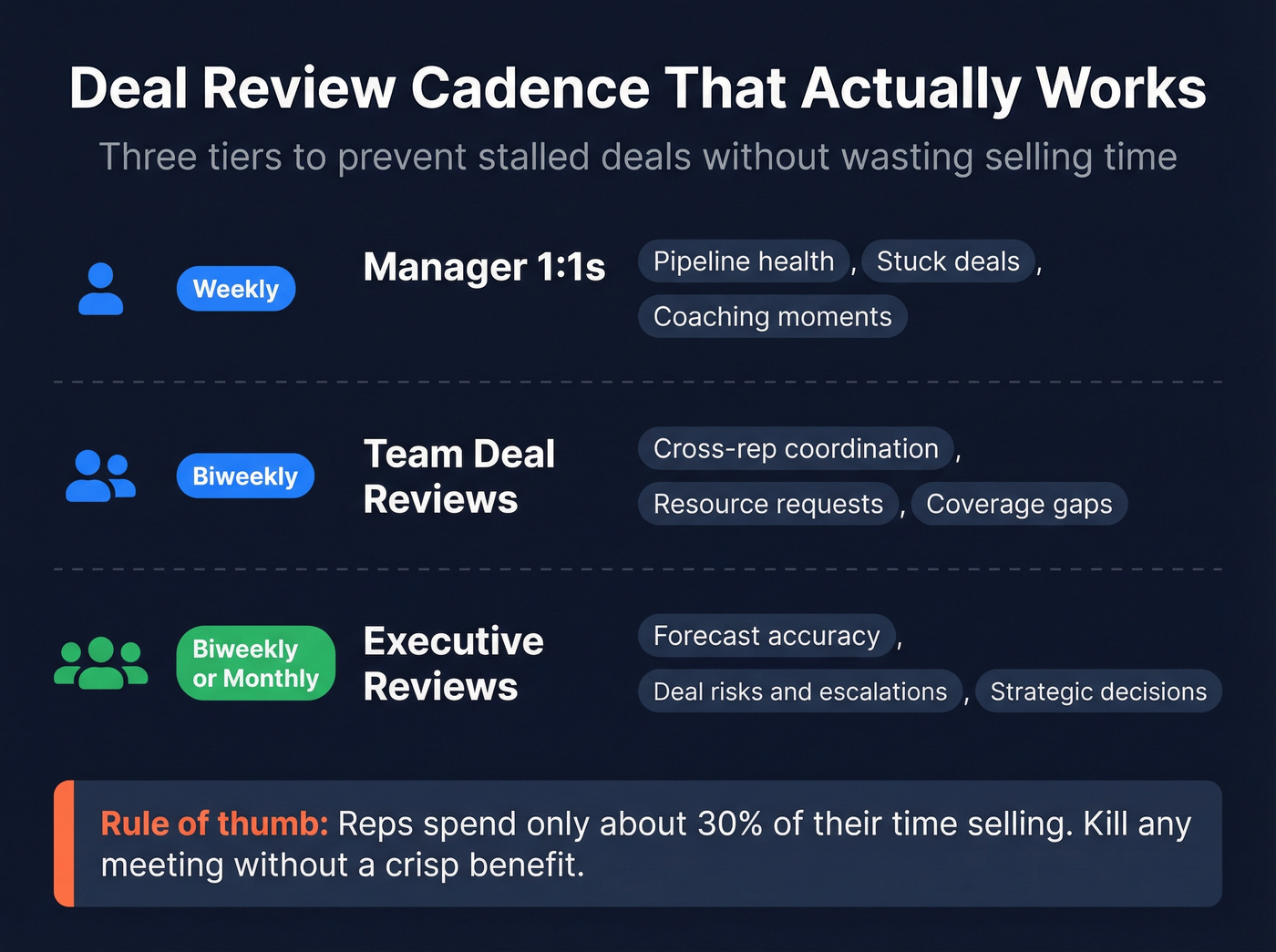
Lucidchart's framework recommends three tiers:
| Review Type | Frequency | Core Agenda |
|---|---|---|
| Manager 1:1s | Weekly | Pipeline health, stuck deals, coaching |
| Team deal reviews | Biweekly | Cross-rep coordination, resource asks |
| Executive reviews | Biweekly or monthly | Forecast accuracy, deal risks, escalations |
The principles matter more than the exact cadence. Travis May's operating cadence framework offers three rules worth adopting: prefer positive process over negative process, use minimum viable attendees, and kill meetings without crisp benefit. Positive process means meetings that accelerate decisions. Negative process is checkpoint theater where everyone recites pipeline numbers and nobody leaves with a better plan.
A simple weekly outcomes tracker keeps things tight: top 3 priorities for next week, 3 wins from last week, 3 losses or risks. Reps already spend only about 30% of their time selling - don't eat more of it with bloated reviews. Top performers spend 18% more time updating their CRM than average reps, and the discipline pays off in deal visibility, not busywork. (If your CRM is messy, fix CRM hygiene first.)
When NOT to Team Sell
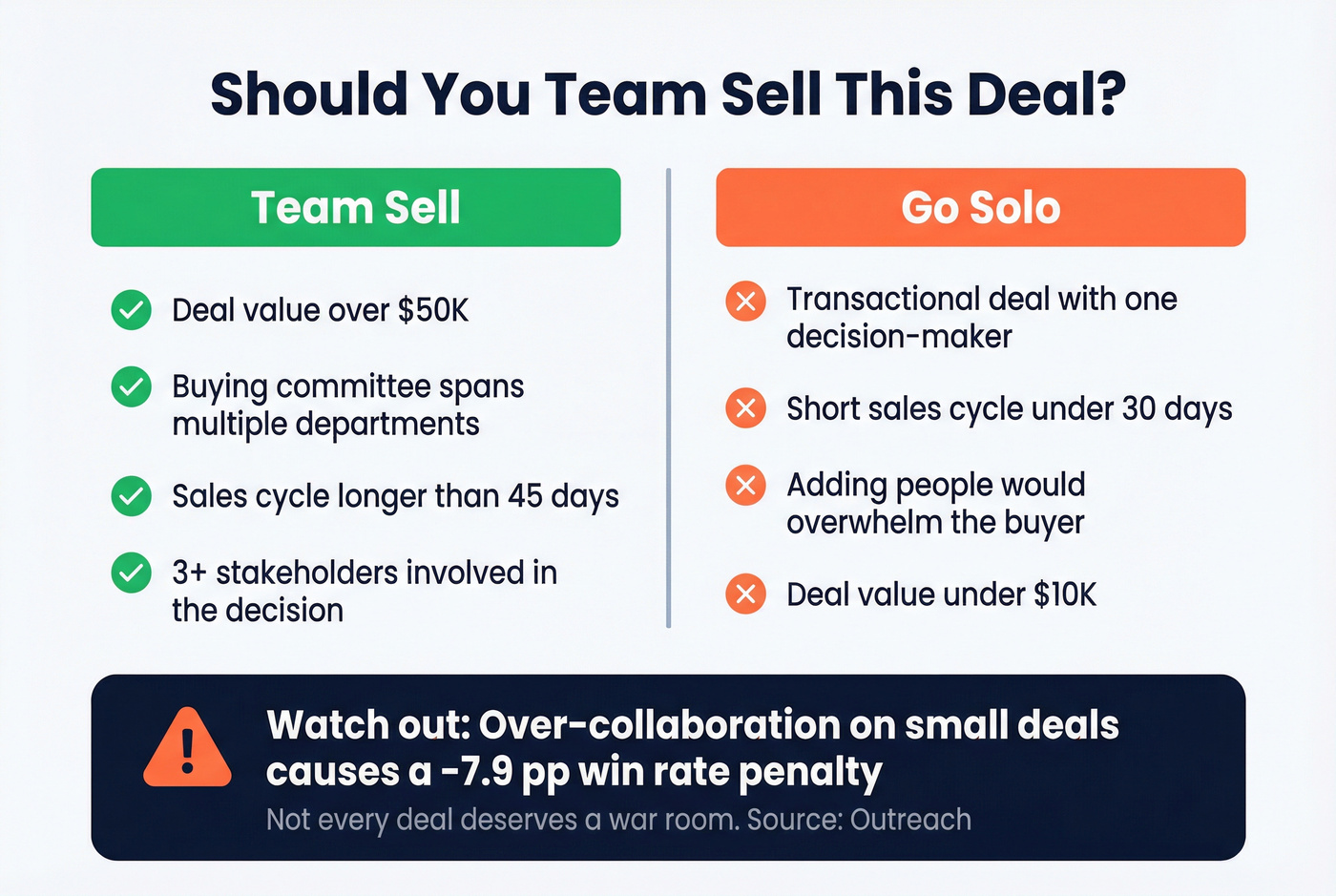
Team sell when:
- Deal value exceeds $50K and involves multiple stakeholders
- The buying committee spans departments
- The sales cycle runs longer than 45 days
Skip team selling when:
- It's a transactional deal with one decision-maker and a short cycle
- Adding people would overwhelm the buyer - Salesforce flags this explicitly as a common B2B mistake
Look, the data backs this up. Outreach found a -7.9 pp penalty from over-collaboration on smaller deals where coordination overhead exceeds the benefit. Not every deal deserves a war room. Throwing three reps at a $5K deal doesn't make it close faster - it makes the buyer feel swarmed.
Tools That Support the Process
Reps spend 10-20 hours per week on admin, and CRM data accessibility alone can shorten sales cycles by 8-14%. The right tool stack reduces friction without adding complexity.
| Tool | Category | Starting Price | Team Selling Strength |
|---|---|---|---|
| Prospeo | Contact Data | Free tier; ~$0.01/email | Verified emails + mobiles for full buying committees |
| HubSpot Sales Hub | CRM | $15/user/mo | Shared deal plans |
| Salesforce Sales Cloud | CRM | ~$25-$165/user/mo | Multi-owner opportunities |
| Pipedrive | CRM | $14/user/mo | Simple pipeline visibility |
| Zoho CRM | CRM | $14/user/mo | Deal split support |
| Monday CRM | CRM | $12/user/mo | Visual collaboration |
| Outreach | Engagement | ~$100/user/mo | Multi-channel sequences |
CRMs manage the deal. Engagement platforms coordinate outreach. Neither works if your contact data is stale - and stale data is the default when your provider refreshes on a 6-week cycle instead of weekly.
Your deal review flagged single-threaded opportunities. Now you need verified contact data for 5+ stakeholders per deal - fast. Prospeo's 300M+ profiles with 30+ filters let you map budget holders, technical gatekeepers, and executive sponsors in minutes, not hours. At $0.01 per email, scaling multi-threading across your entire pipeline costs less than one lost deal.
Turn every red-flag deal into a multi-threaded opportunity in minutes.
FAQ
What's the difference between team selling and account-based selling?
Team selling is the internal coordination model - who from your team engages which stakeholders on a specific deal. Account-based selling is the go-to-market strategy of targeting specific accounts with personalized campaigns. Team selling is how you execute ABS at the individual opportunity level. You can run ABS without team selling, but you'll leave win-rate points on the table.
How many contacts should we have per opportunity?
Five contacts per opportunity yields a 30% win rate versus 5% with a single contact, based on UserGems' analysis of 500 opportunities. For enterprise deals with 6-10 decision-makers, aim for at least five verified contacts across different roles and seniority levels. Use 30+ search filters to map an entire buying committee by department, seniority, and company - then verify every email and phone before outreach.
How do we handle deal splits and compensation?
Define credit rules before launching team selling - ambiguity kills adoption faster than anything. Common models give the primary owner full quota credit while supporting roles receive assist credit, typically 25-50%. Zoho CRM supports deal splits out of the box. Document the model in your comp plan and communicate it before the first coordinated deal.
What is an executive deal briefing?
An executive deal briefing is a one-page document summarizing an opportunity's strategic context, stakeholder map, competitive landscape, and open risks so a senior leader can engage without a lengthy ramp-up. Use one any time a VP or C-level exec joins a call on a deal worth $50K+. It prevents the credibility-killing moment where your executive asks a question the buyer already answered.