

TCV Meaning: What Total Contract Value Actually Is (and Why Your Team Disagrees)
Ask your VP of Sales and your FP&A lead to define TCV for the same deal. You'll get two different numbers. The TCV meaning is simple - total contract value is the full revenue a contract generates over its entire term. The disagreements about what counts are where it gets interesting, and expensive.
Quick Definition
Total Contract Value (TCV) is the total revenue from a contract over its full term.
The formula:
TCV = (MRR x Contract Months) + One-Time Fees
A worked example: $500/mo x 24 months + $2,000 setup fee = $14,000 TCV.
One-line distinction to keep in your back pocket: TCV = total commitment. ACV = annualized view. ARR = recurring revenue across all customers.
Other Meanings of TCV
What does TCV stand for outside of SaaS? If you're here from a venture capital context, TCV also stands for Technology Crossover Ventures - a growth equity firm founded in 1995 by Richard H. Kimball and Jay Hoag, based in Menlo Park, California, managing $25B+ in assets with investments including Airbnb, Spotify, Netflix, and ByteDance. Different world, same acronym. The rest of this article covers the SaaS metric.
TCV Formula - Worked Examples
The math is trivial. What goes into the math is where teams get tripped up.
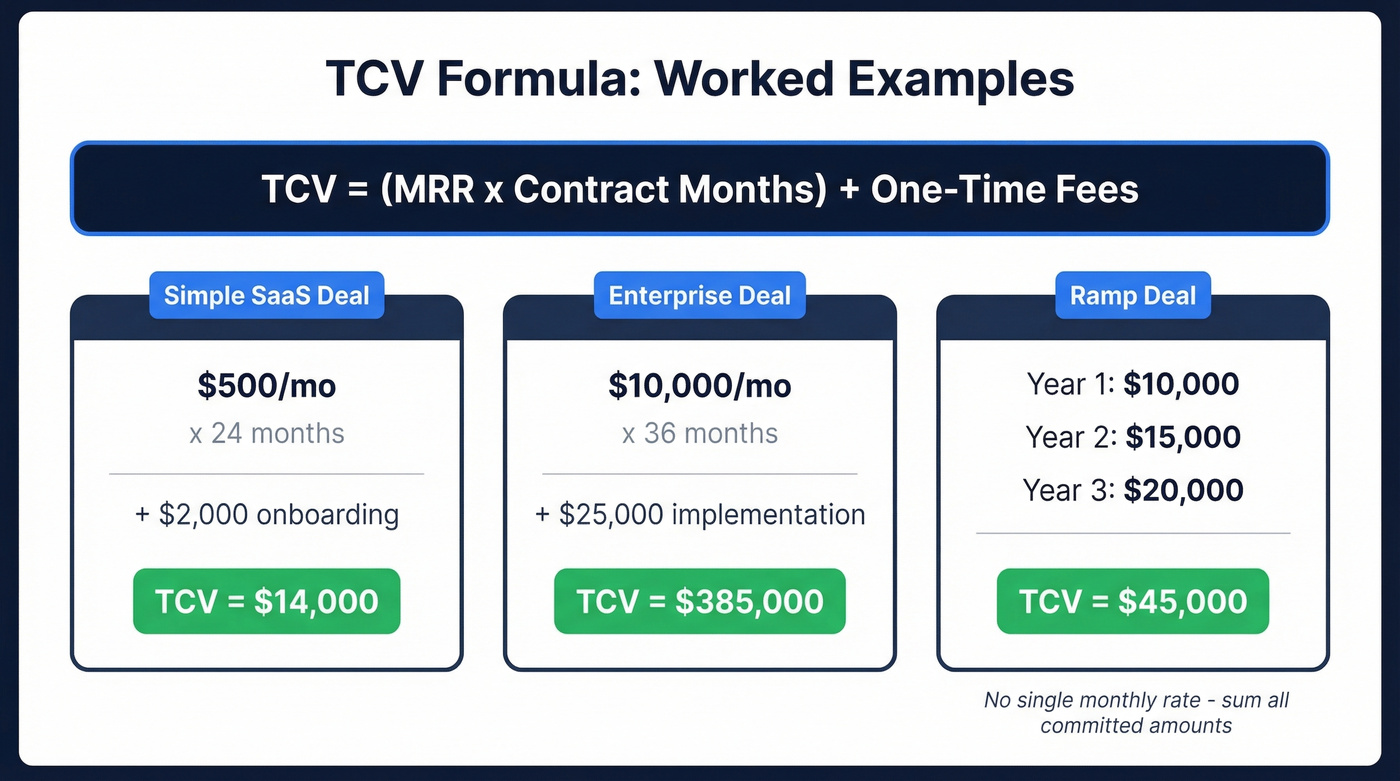
Example 1: Simple SaaS deal $500/mo x 24 months + $2,000 onboarding = $14,000 TCV. Most SMB deals look like this.
Example 2: Enterprise with implementation $10,000/mo x 36 months + $25,000 implementation = $385,000 TCV. Some teams exclude one-time fees from their "official" number. Pick a policy and apply it consistently.
Example 3: Ramp deal with escalating pricing Year 1: $10K. Year 2: $15K. Year 3: $20K. TCV = $45,000. No single monthly rate - you're summing contractually committed amounts across each period.
TCV vs ACV vs ARR vs LTV
These metrics get conflated constantly. Here's how they actually differ.
| Metric | Definition | Includes | Best For |
|---|---|---|---|
| TCV | Total contract value | Recurring + one-time fees | Total commitment |
| ACV | Annual contract value | Recurring only (excludes one-time fees) | YoY comparisons |
| ARR | Annual recurring revenue | Recurring only | Company-level health |
| LTV | Lifetime value | Projected revenue over relationship | Long-term forecasting |
| Bookings | Value signed in period | Everything signed | Period performance |
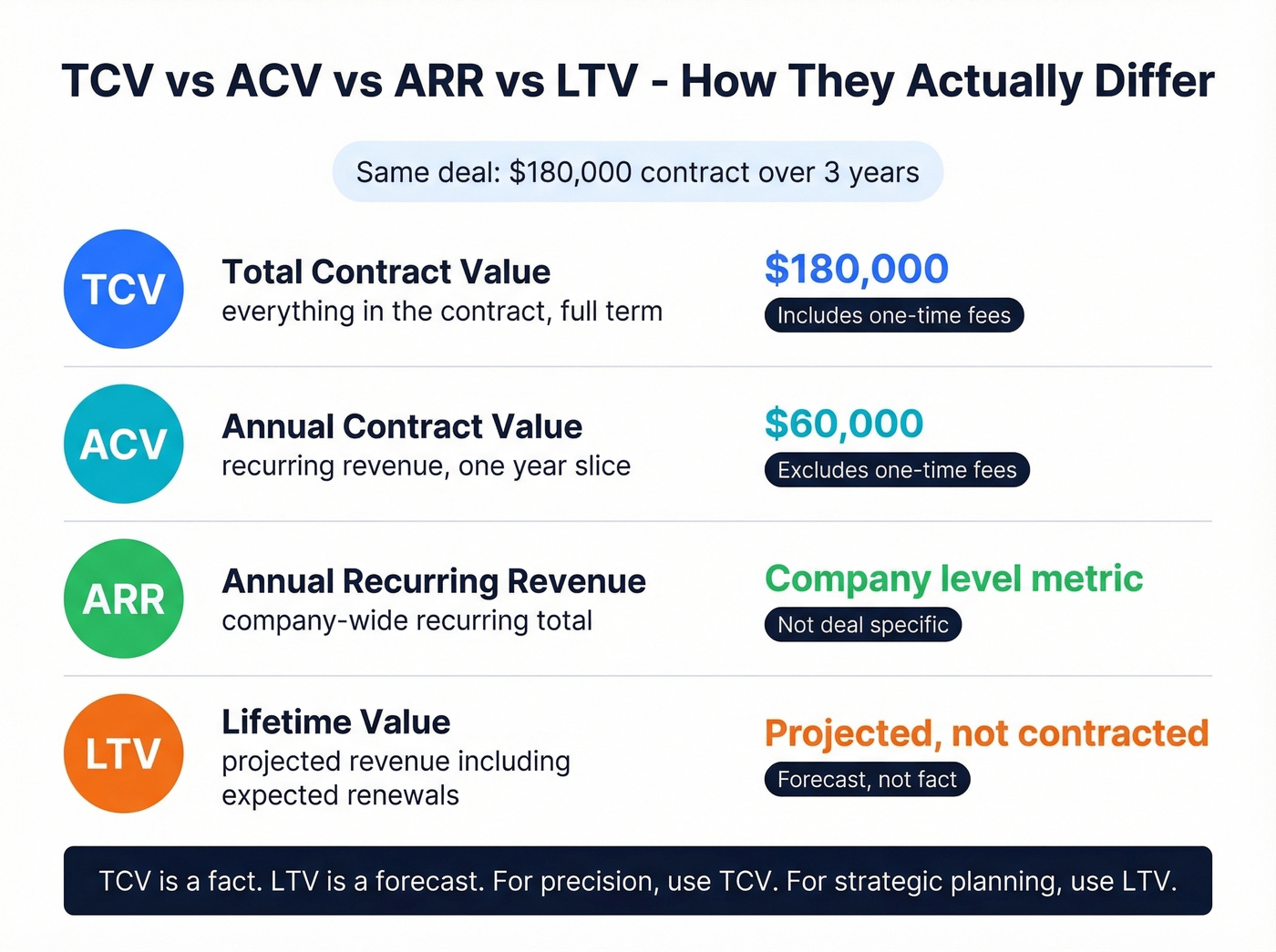
A $180,000 contract over 3 years gives you a TCV of $180K and an ACV of $60K. Same deal, different lens.
Scale that up: a $10M contract over 10 years has a TCV of $10M but an ACV of just $1M. If you count TCV for YTD reporting, that single deal makes your quarter look incredible. This is exactly the debate that plays out when teams try to define "closed dollars" on multi-year contracts - and there's no universal right answer.
The LTV distinction matters. TCV is based on what the contract commits to. LTV is a projection that includes expected renewals and expansion. TCV is a fact; LTV is a forecast. Use TCV when you need precision, LTV when you need a strategic planning horizon.
For YTD reporting, use ACV. For total pipeline commitment, use TCV. For board decks, show both - your board wants to see the size of commitments and the normalized annual run rate, and giving them only one number invites the wrong questions.

Your TCV only matters if your pipeline is full enough to close those deals. Prospeo gives sales teams 300M+ profiles with 98% email accuracy and 125M+ verified mobiles - so every contract in your forecast has real buyers behind it.
Build the pipeline that makes your TCV numbers worth celebrating.
What to Include (and Exclude)
Include in TCV:
- Recurring subscription fees
- One-time fees: onboarding, implementation, training
- Contractually committed usage minimums
- Professional services specified in the contract
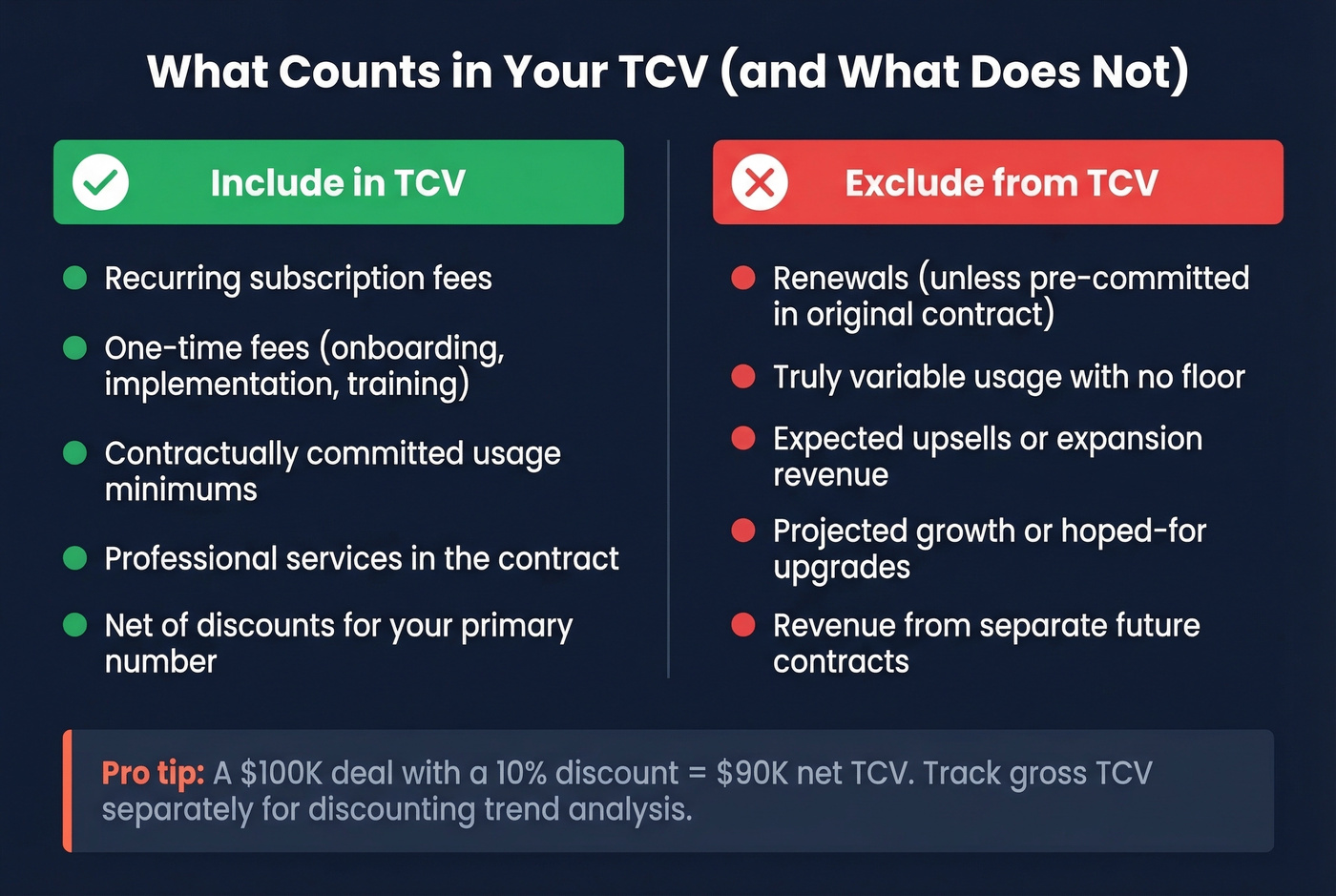
Exclude from TCV:
- Renewals (unless pre-committed in the original contract)
- Truly variable usage with no floor
- Expected upsells or expansion revenue
Discounts: Net them out for your primary number. A $100K deal with a 10% discount = $90K net TCV. Track gross TCV separately for discounting trend analysis.
Total contract value covers only the original contract term. A 2-year deal that renews for another 2 years doesn't retroactively become a 4-year TCV. Track renewal value separately.
Why Your Team Disagrees
Sales says the deal is worth $385K. Finance says $360K. RevOps pulls a third number from the CRM. Everyone's technically right - they're just using different definitions.
Here's the thing: a common flashpoint is one-time fees spanning multiple years. A contract with $10K in professional services in Year 1 and $15K in Year 2 creates a genuine ambiguity. One stakeholder counts only first-year one-offs, another counts every dollar. Both have a logic. Neither is wrong - but they can't both be the "official" number.
Then there's the attribution timing problem. Does TCV get attributed to the opportunity creation date or the closed-won date? For pipeline reporting, the answer determines which quarter gets credit.
If your Sales team and Finance team can't agree on the same deal, you have a governance problem, not a math problem. Document the rules. Make them boring and explicit.
Edge Cases That Break Your Spreadsheet
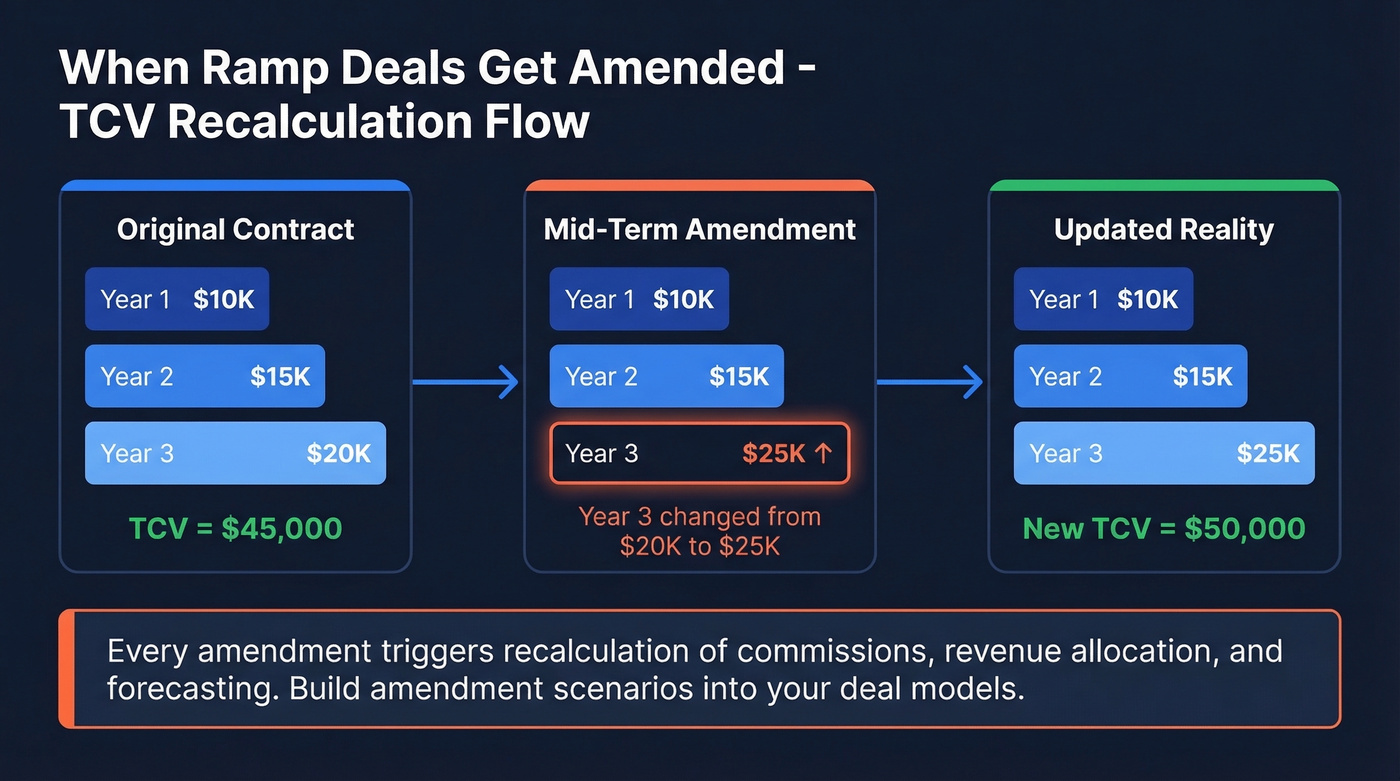
Ramp deals get genuinely complex. Year 1 at $10K, Year 2 at $15K, Year 3 at $20K = $45K TCV. Now imagine a mid-term amendment changes Year 3 from $20K to $25K. Your TCV jumps to $50K, and everything downstream - revenue allocation, commissions, sales forecasting - needs recalculation. This is why TCV often needs to be calculated in segments where net pricing is constant, with each amendment creating a new version of the subscription record.
Early cancellation is where ramp deals really bite. If a customer cancels mid-contract during a multi-phase ramp, calculating refunds and recognizing the correct revenue becomes a mess. Cancellations can turn "signed contract value" into something much smaller in realized value, so build cancellation scenarios into your deal models, not just the happy path.
Invoice-based rev rec can misstate revenue under ramp pricing. If you're invoicing at the initial $4.99/mo rate but ignoring the $9.99 step-up in month seven, your revenue recognition is wrong. TCV captures the full picture; your billing system might not.
Let's be honest: a high TCV number means nothing if it's built on heavy discounting and a 5-year term with no exit clause. We've seen teams celebrate $500K TCV deals that were really $300K in net value spread over five years with a customer who'd churn at first renewal. The number on the contract isn't the number that matters - the quality of the commitment is.
TCV Isn't Revenue
TCV is a commitment. Revenue is earned over time. A $12,000 annual contract is $12,000 in TCV but only $1,000/month in recognized revenue. If the customer pays upfront, that cash sits as deferred revenue until you deliver the service.
Under ASC 606, the transaction price can differ from TCV due to variable consideration, significant financing components, and constraints on revenue reversal. Your contract says $100K. Your accountant might recognize $94K. Both are correct in their own context.
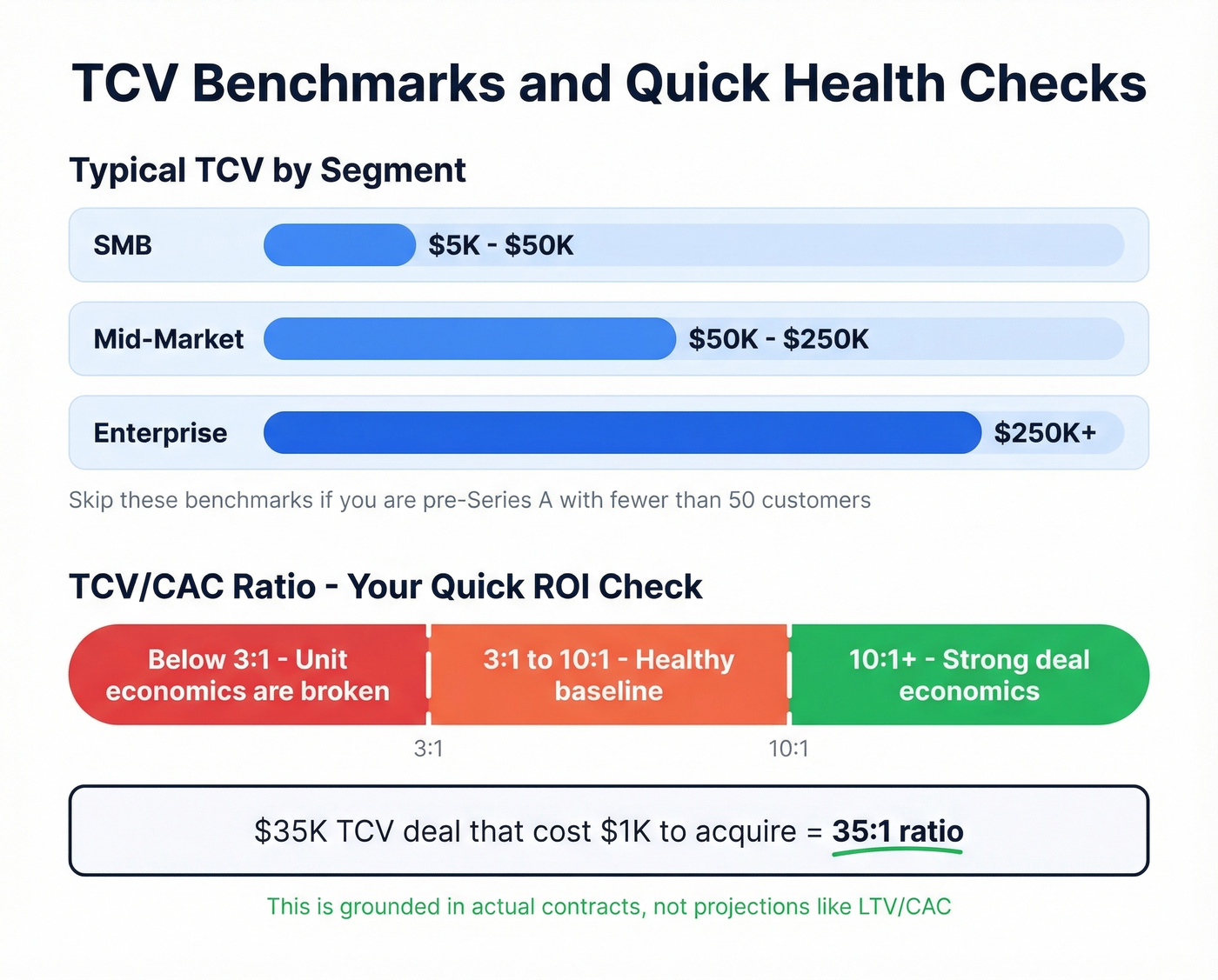
TCV/CAC as a quick ROI check. Divide total contract value by your customer acquisition cost. A $35K TCV deal that cost $1K to acquire gives you a 35:1 return on that deal alone. This is a rougher metric than LTV/CAC, but it's grounded in actual contract commitments rather than projections. Use 3:1 as a baseline benchmark - if your TCV/CAC ratio is below that, your unit economics are broken regardless of what your LTV model says.
The booking stage is the single largest source of downstream revenue data errors. The most common CRM mistakes we see:
- TCV entered as ACV (or vice versa)
- Start dates defaulting to close date instead of service commencement
- Multi-year deals booked with wrong term lengths
- Discounts entered in the wrong fields
Every one of these compounds through billing, rev rec, and audit. Fix them at the source or pay for them later.
How to Operationalize TCV
1. Document your TCV policy. Write down whether renewals are included, how usage-based components are handled, and how amendments update TCV. Consistency matters more than perfection here.
2. Lock attribution timing. Use the contract execution date, not the opportunity creation date. This prevents deals from floating between quarters.
3. Enforce CRM hygiene at booking. Validate that TCV doesn't equal ACV at the booking stage. A 5-minute review at deal close prevents a 5-hour reconciliation at quarter end. The RevOps Co-op community has solid templates for booking validation workflows if you need a starting point.
4. Normalize for term changes. If you shift from 1-year to 2-year defaults, your average TCV doubles overnight - but nothing changed. Track normalized values to spot real trends.
5. Set segment benchmarks. Typical SaaS deal sizes as a sanity check:
| Segment | Typical TCV Range |
|---|---|
| SMB | $5K-$50K |
| Mid-Market | $50K-$250K |
| Enterprise | $250K+ |
Skip the benchmarks if you're pre-Series A with fewer than 50 customers - your sample size is too small for the ranges to mean anything useful yet.
Once you know your target TCV range, the next step is filling the pipeline with accounts that match. Tools like Prospeo let you filter by company revenue, funding stage, headcount growth, and buyer intent so you're targeting accounts likely to close at your ideal contract value, rather than spraying outbound at everyone.
Teams using Prospeo book 26% more meetings than ZoomInfo users and 35% more than Apollo. When you're chasing high-TCV enterprise deals, every conversation counts - and bad data kills momentum. Get 98% accurate emails at $0.01 each with a 7-day refresh cycle.
Close bigger contracts faster with data that actually connects.
FAQ
Does TCV include renewals?
No. TCV covers only the original contract term. Renewals are tracked separately unless they're pre-committed in the initial agreement. This keeps your pipeline reporting clean and prevents double-counting committed revenue.
What's the difference between TCV and bookings?
For a single deal, they're functionally identical. "Bookings" is typically a period-level aggregate - the sum of all TCV closed in a given quarter. Use bookings for team performance reporting and TCV for deal-level analysis. SaaStr's breakdown covers the nuances well if you want to go deeper.
Should I report TCV or ACV to my board?
Report both. ACV normalizes for contract length - a 3-year $180K deal = $60K ACV - while TCV shows total commitment size. Presenting only one metric invites misinterpretation, and boards need the full picture to ask the right questions.
How do ramp deals affect TCV?
Sum each period's contractually committed amount. Year 1 at $10K + Year 2 at $15K + Year 3 at $20K = $45K TCV. If a mid-term amendment changes any period, recalculate from that point forward. Don't average - sum.