


Tethr Pricing, Reviews, Pros and Cons: An Honest 2026 Breakdown
Tethr doesn't have a pricing page. It doesn't have a ballpark on its website, a useful Reddit thread, or even a proper G2 profile. We spent the time digging through Gartner listings, competitor analyses, and market data so you don't have to sit through a discovery call just to learn whether this tool fits your budget.
30-second verdict: Tethr works well for large contact centers that want prebuilt conversation analytics without building custom models. Expect $30K-$80K+/year on an enterprise contract. The catch? Public reviews are nearly nonexistent - Gartner Peer Insights shows two ratings, and there isn't a usable Tethr profile on G2 (the "Tether" page is a completely different product). If transparent pricing or deep customization matters to your team, Observe.AI or Level AI deserve a look first.
What Is Tethr?
Tethr was founded in 2012 and is headquartered in Austin with 51-200 employees. The platform uses machine learning and natural language processing to analyze customer conversations across calls, chats, and emails, then surfaces insights through dashboards.
The real differentiator is Tethr's prebuilt insight library. It ships with hundreds of pre-built insight categories, so you're not spending the first three months building everything from scratch. For contact centers that want day-one analytics, that's genuinely appealing. Tethr also claims it can recognize and track thousands of distinct moments within conversations - things like customer frustration signals, compliance language, and upsell opportunities - which means your QA team isn't manually tagging calls anymore.
The headline stat: Tethr analyzes 100% of interactions, replacing the roughly 1-2% manual QA sampling most contact centers still rely on. Expect a 2-8 week implementation depending on your CCaaS/CRM integrations and QA rubric complexity.
Tethr Pricing: What to Expect
Tethr doesn't publish pricing. At all. Based on market positioning - enterprise conversation intelligence, custom contracts, seat-based licensing - expect somewhere in the $30K-$80K+/year range depending on volume, channels, and seats.
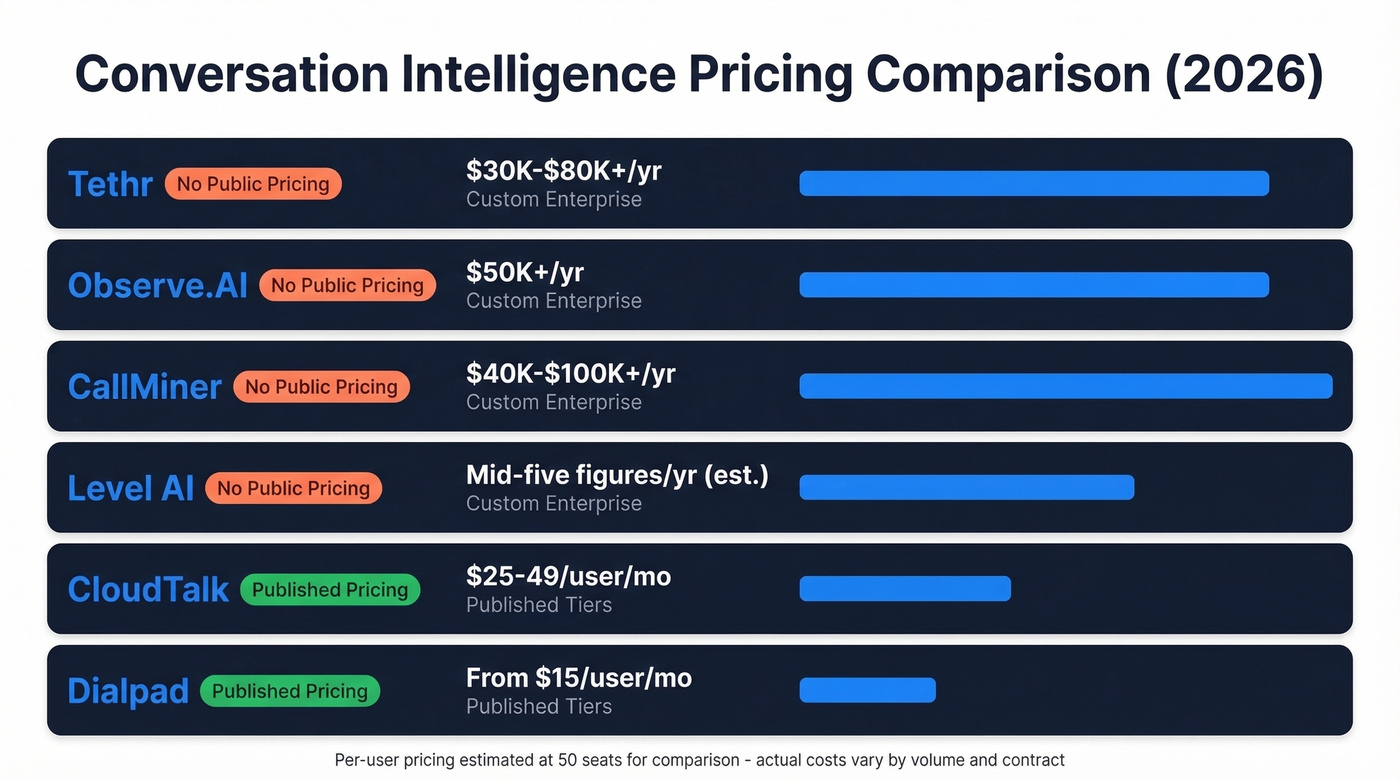
Here's how Tethr stacks up against tools that are more transparent about what they charge:
| Tool | Pricing | Model |
|---|---|---|
| Tethr | ~$30K-$80K+/yr | Custom enterprise |
| Observe.AI | ~$50K+/yr | Custom enterprise |
| CallMiner | ~$40K-$100K+/yr | Custom enterprise |
| CloudTalk | $25-49/user/mo | Published tiers |
| Dialpad | From $15/user/mo | Published tiers |
Let's be honest: the entire enterprise conversation intelligence category has a transparency problem. But Tethr is especially opaque - no tiers, no "starting at" language, nothing.
What Users Actually Say
This is where things get thin. Gartner Peer Insights shows Tethr rated 4.5/5, but that's based on exactly two ratings, both from 2022. Sub-scores look strong on paper: Product Capabilities at 5.0, Service & Support at 4.5, Customer Experience Evaluation & Contracting at 4.5, and Integration & Deployment at 4.0. Two data points don't make a trend.
If you search G2 for "Tethr," you'll land on a page for "Tether" - a completely different bug-reporting widget. That's not Tethr's fault, but it means there's no reliable G2 review footprint for this platform. TrustRadius has a listing and surfaces at least one rating, but overall coverage is still thin.
Two Gartner ratings. No usable G2 profile. Little to no public sentiment. You're flying blind on social proof, and that should factor into your evaluation.

Spending $30K-$80K/year on conversation analytics means nothing if your reps are calling disconnected numbers and emailing dead addresses. Prospeo's 125M+ verified mobiles hit a 30% pickup rate, and our 98% email accuracy keeps bounce rates under 4% - so your conversation intelligence platform actually has real conversations to analyze.
Fix the data upstream before you spend six figures analyzing silence.
Pros and Cons
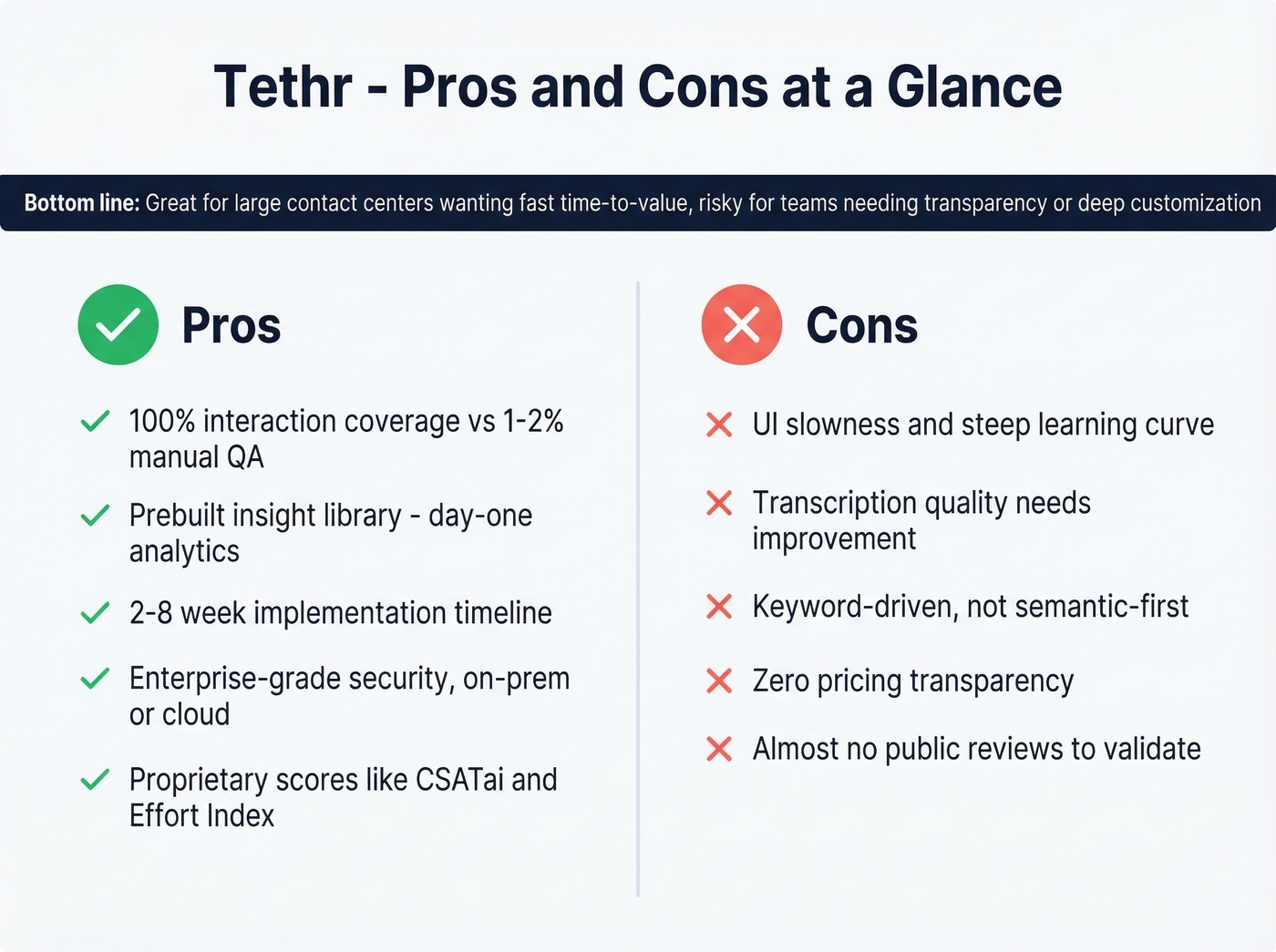
Pros:
- Prebuilt insight library with hundreds of categories - genuine day-one value without months of configuration
- Analyzes 100% of interactions vs. the typical 1-2% manual QA sample
- Faster time-to-value than custom-build platforms, with 2-8 weeks being the typical implementation window
- Ingests conversational data from network, cloud, or on-prem environments with enterprise-grade security
- Proprietary scores like CSATai and the Tethr Effort Index add analytical depth beyond basic sentiment
Cons:
- UI slowness and a steep learning curve flagged in the limited Gartner reviews
- Transcription quality is a recurring improvement request
- Often positioned as more keyword/phrase-driven than semantic-first platforms
- No public pricing - completely opaque sales process
- Near-zero public review coverage makes independent validation almost impossible
Who Should (and Shouldn't) Use Tethr
Use Tethr if you run a large contact center and want out-of-the-box analytics without building custom models, your team prioritizes prebuilt CX research categories and automated QA scoring, and you're comfortable with enterprise procurement cycles that take weeks.
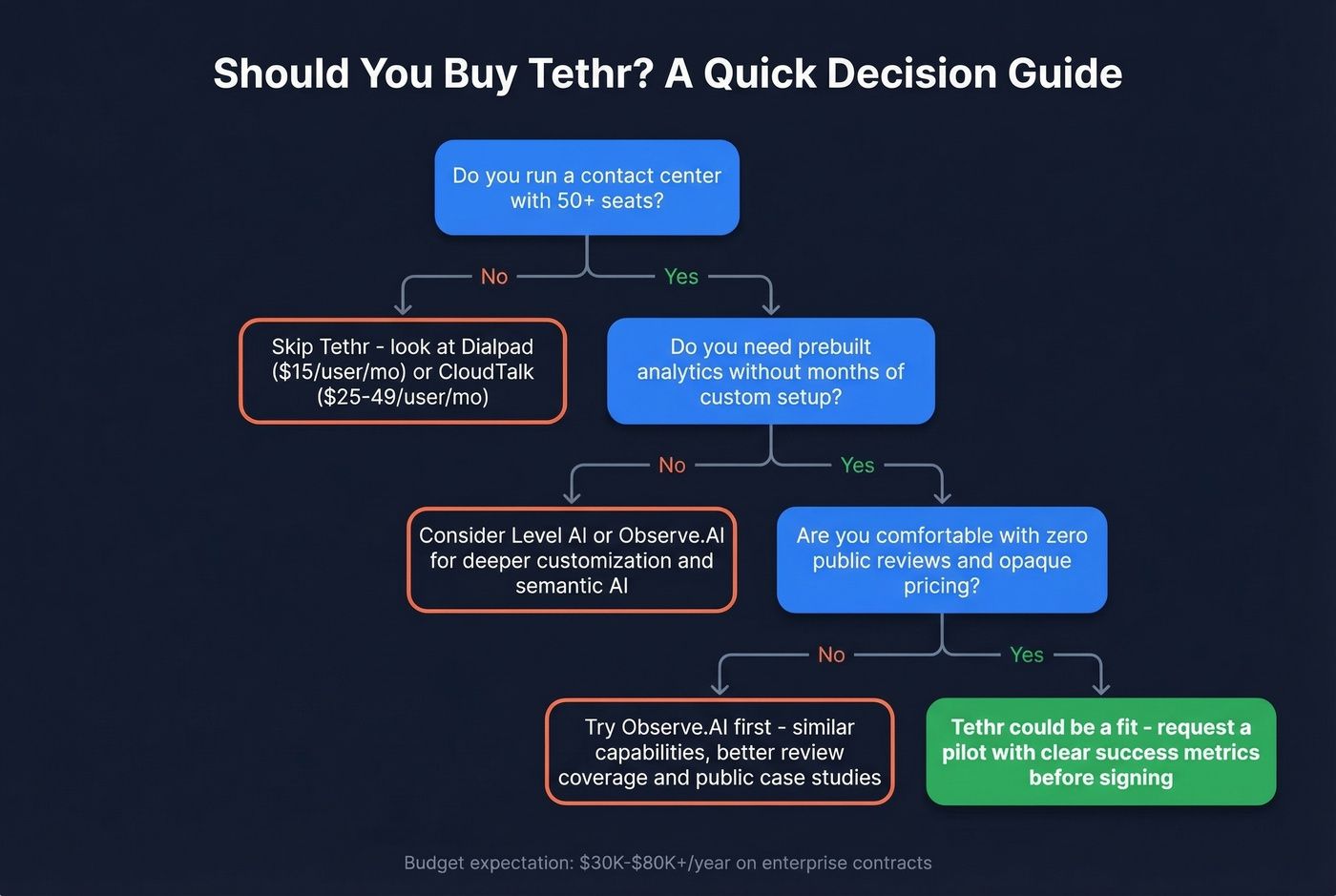
Skip Tethr if you need pricing transparency before engaging sales, you want semantic or generative AI-level conversation detection, deep customization of scoring models is a priority, or you're a smaller team with a budget under $30K/year. In our experience, teams under 50 seats almost always get better ROI from published-pricing tools like Dialpad or CloudTalk.
Here's the thing about Tethr's prebuilt library: it's simultaneously the strongest selling point and the biggest limitation. You get fast time-to-value, but you're locked into someone else's framework for what "good" looks like. For most contact centers, that tradeoff is fine. For teams with unique workflows or niche verticals, it's a dealbreaker.
Alternatives Worth Considering
Observe.AI is the strongest alternative if you want more AI sophistication. With $214M in total funding, they're investing heavily in generative AI for real-time agent coaching. Contracts typically start in the mid-five-figure range annually - comparable to Tethr, but with a more modern tech stack, better review coverage, and actual public case studies you can reference. We'd put this at the top of most shortlists.
If you're also comparing calling platforms for smaller teams, start with our breakdown of Dialpad alternatives.
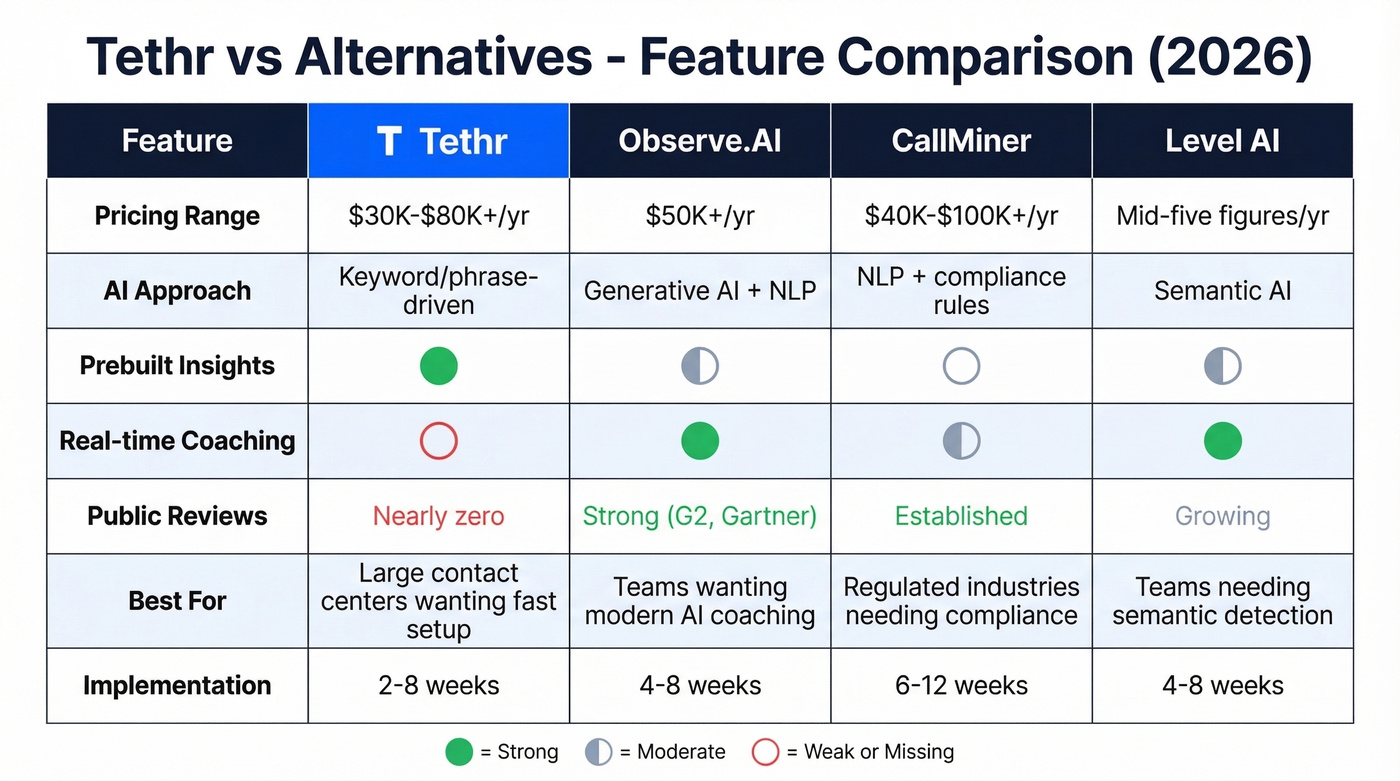
CallMiner is the legacy enterprise player with deep compliance features and a longer track record in regulated industries. Expect $40K-$100K+/year. The safe choice for risk-averse procurement teams in financial services or healthcare.
Level AI positions itself as the semantic AI alternative to keyword-based tools. Custom enterprise pricing runs in a similar range to Observe.AI. Worth a demo if keyword-based detection feels limiting.
Dialpad starts at $15/user/month and works best for SMBs or teams under 50 seats that don't need enterprise-grade conversation analytics.
One thing most teams overlook when evaluating conversation intelligence: the platform is only as good as the conversations feeding it. If your outbound data is stale - wrong emails, disconnected numbers - you're spending five or six figures to analyze failed interactions. We've seen teams fix this upstream with Prospeo's 98% email accuracy and 125M+ verified mobile numbers on a 7-day refresh cycle, so their contact center actually analyzes real conversations with real prospects instead of voicemails and bounces. If you're building a cleaner pipeline, data enrichment services can also help fill gaps before outreach, and an email deliverability guide can keep your domain healthy as volume scales.
Tethr's lack of public reviews makes it hard to validate. You know what you can validate instantly? Whether your contact data actually connects. Prospeo refreshes 300M+ profiles every 7 days - not every 6 weeks - so every call and email your team sends is a real conversation worth analyzing, not a bounce or voicemail.
Stop feeding stale data into expensive conversation intelligence tools.
The Bottom Line
Tethr is a capable platform for prebuilt conversation analytics, and the insight library is a genuine differentiator for contact centers that want fast time-to-value. But the lack of pricing transparency, near-zero public reviews, and keyword-based detection positioning are real concerns when you're weighing it against the competition. Before committing, request a pilot with clear success metrics and a defined evaluation period. Don't sign an annual contract based on a demo alone. If you need a tighter evaluation framework, use a product demo checklist and align success metrics to your sales operations metrics.