

To Sell Is Human by Daniel Pink: Full Book Summary & Review
Every summary of To Sell Is Human teases the same thing - "six successors to the elevator pitch!" - and then never actually names all six. Or it lists the new ABCs without explaining what you're supposed to do with them. Daniel Pink wrote a ~270-page book packed with frameworks, research citations, and practical exercises. Most summaries give you a paragraph and a link to Amazon.
Here's the full breakdown: every framework, every pitch type, the research that holds up, the research that doesn't, and an honest verdict on whether this book is worth your time in 2026.
Quick Verdict
Rating: 3.87 out of 5 from 26,550 Goodreads ratings - solid, not spectacular.
Best chapters if you're short on time: Chapter 7 (Pitch) and Chapter 5 (Buoyancy). Read these even if you skip the rest.
Core thesis in one sentence: Everyone sells, whether or not "sales" is in their title - and the old playbook of manipulation, information hoarding, and Always Be Closing is dead.
Who should read it: SDRs, founders, managers, teachers, anyone who persuades for a living.
Who should skip it: Anyone wanting a tactical sales methodology (try SPIN Selling) or rigorous persuasion science (try Influence by Robert Cialdini).
One framework to steal right now: The Pixar pitch template - works for sales decks, fundraising, job interviews, and internal proposals.
What the Book Is Actually About
Pink's argument starts with a number: one in nine Americans work in traditional sales, per Bureau of Labor Statistics data. That's the obvious part. The less obvious part is what the other eight in nine are doing.
Pink surveyed those other eight-in-nine white-collar workers and found they spend roughly 40% of their time on what he calls "non-sales selling" - persuading, convincing, influencing. Not exchanging goods for money, but exchanging time, attention, and effort for cooperation. Many respondents, especially managers, reported spending 70-80% of their time this way. That Wharton interview featuring both Pink and Adam Grant is worth reading in full for the back-and-forth on this data.
The deeper argument is about why selling changed. Pink frames it around information asymmetry. In the old world, the seller knew more than the buyer - caveat emptor, buyer beware. The car salesman knew the transmission was shot. You didn't. The internet flipped this. Buyers now have access to reviews, competitor pricing, and Reddit threads trashing your product before your SDR even picks up the phone. We've moved to caveat venditor - seller beware.
This shift makes the old ABCs of selling (Always Be Closing) obsolete. You can't manipulate someone who has more information than you do.
The New ABCs of Selling
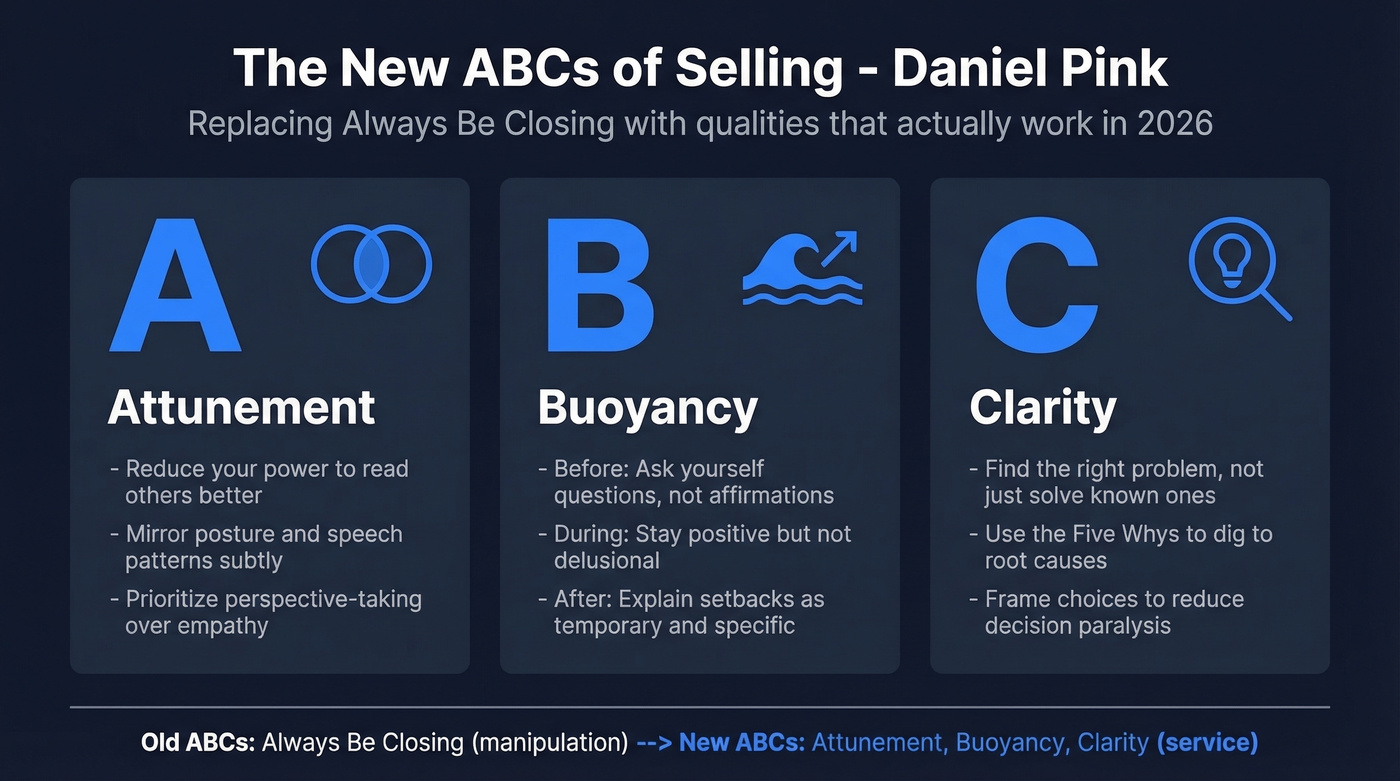
Pink replaces "Always Be Closing" with three qualities: Attunement, Buoyancy, and Clarity. Each gets its own chapter, its own research base, and its own set of practical exercises.
Attunement
Attunement is Pink's word for getting on the same wavelength as the person you're trying to move. It's part empathy, part perspective-taking, part social calibration.
The tactics are specific. First, reduce your own power - not in a doormat way, but in a "stop assuming you know what the other person needs" way. High-power individuals are worse at reading others because they don't feel the need to. Second, practice strategic mimicry: subtle mirroring of posture, speech patterns, and gestures builds rapport without the other person noticing. Third, prioritize perspective-taking over empathy. Feeling what someone feels is nice. Understanding what they think is more useful in a sales context - account for their situation, their group dynamics, their constraints.
Then there's the ambivert advantage. Adam Grant's study, published in Psychological Science in 2013, assessed salespeople on a 1-7 introversion/extraversion scale and tracked performance over three months. The finding: the best outcomes sat in the modulated middle. The gregarious backslapper isn't the ideal salesperson. Neither is the quiet wallflower. The person who can dial up or dial down wins.
Buoyancy
Buoyancy is about surviving rejection. Pink structures it as a before/during/after framework.
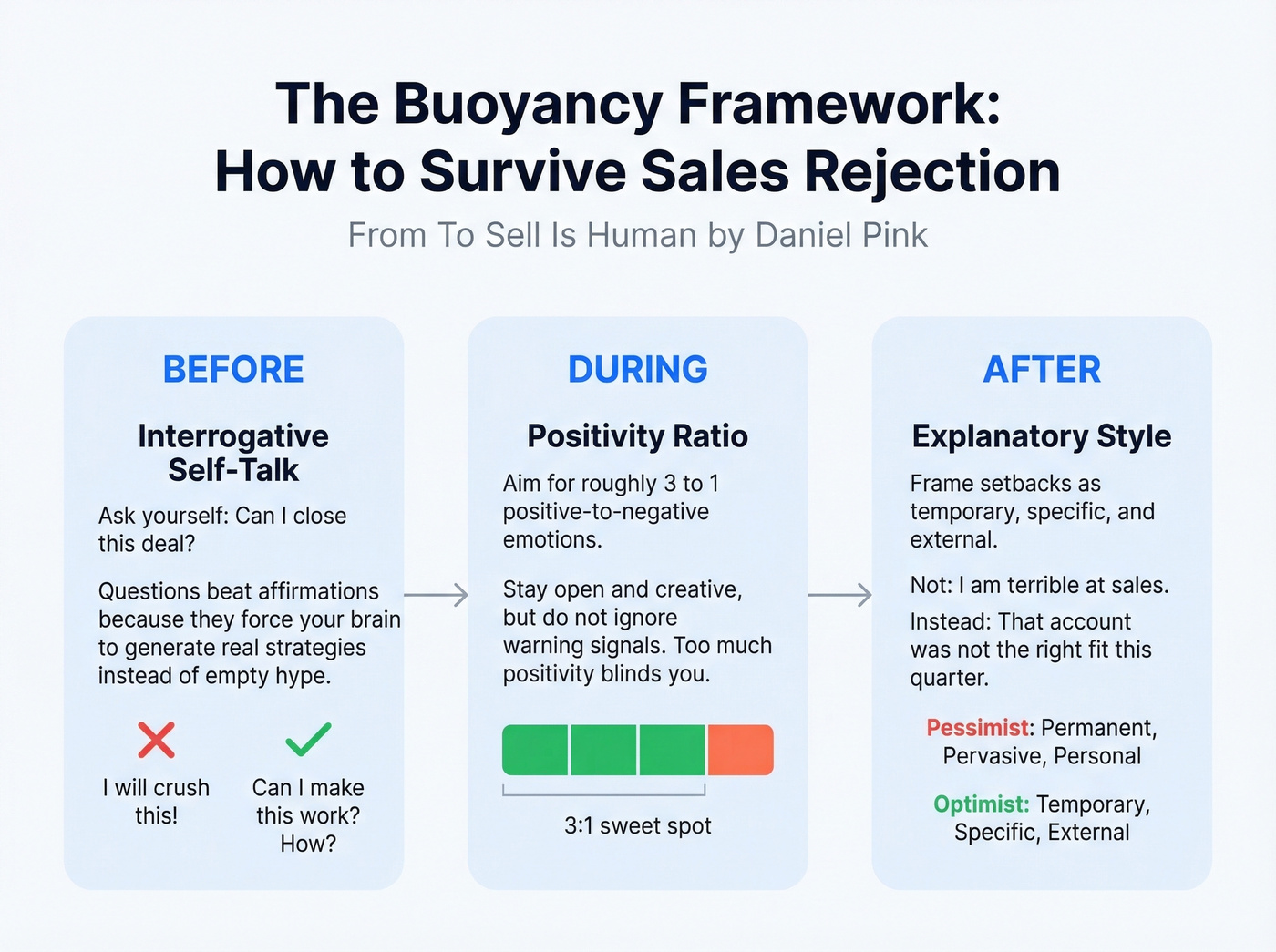
Before: Interrogative self-talk. "Can I close this deal?" outperforms "I can close this deal." The question form activates deeper reasoning - your brain starts generating concrete strategies instead of just pumping itself up. Declarative self-talk feels good but doesn't prepare you. The question forces preparation.
During: The positivity ratio. Pink cites research suggesting an optimal range of 3:1 to 11:1 positive-to-negative emotions during interactions. Enough positivity to stay open and creative, but not so much that you lose the ability to read negative signals. Note: this ratio was later challenged in the academic literature - more on that in the critique section below.

After: Explanatory style. This comes from Martin Seligman's research on optimism. When something goes wrong, pessimists explain it as permanent ("I'll never be good at this"), pervasive ("everything is falling apart"), and personal ("it's my fault"). Optimists frame the same event as temporary ("this quarter was rough"), specific ("that particular account wasn't a fit"), and external ("the timing was off"). Seligman and Schulman (1986) found that insurance salespeople with optimistic explanatory styles sold significantly more and were far less likely to quit.
Pink's practical exercises here: enumerate your rejections (track them - they're less overwhelming when counted), write yourself a rejection letter (forces you to articulate worst-case scenarios, which defangs them), and deliberately allow some negativity as a feedback mechanism rather than suppressing it.
Clarity
Clarity is about helping people see their problems differently. Pink argues the premium has shifted from problem-solving to problem-finding. In a world of information parity, the person who can identify the right problem is more valuable than the person who can solve a known one.
The diagnostic tool: the Five Whys technique. Ask "why?" five times in succession to drill past surface symptoms to root causes. Borrowed from Toyota's manufacturing process, it works surprisingly well in sales discovery calls.
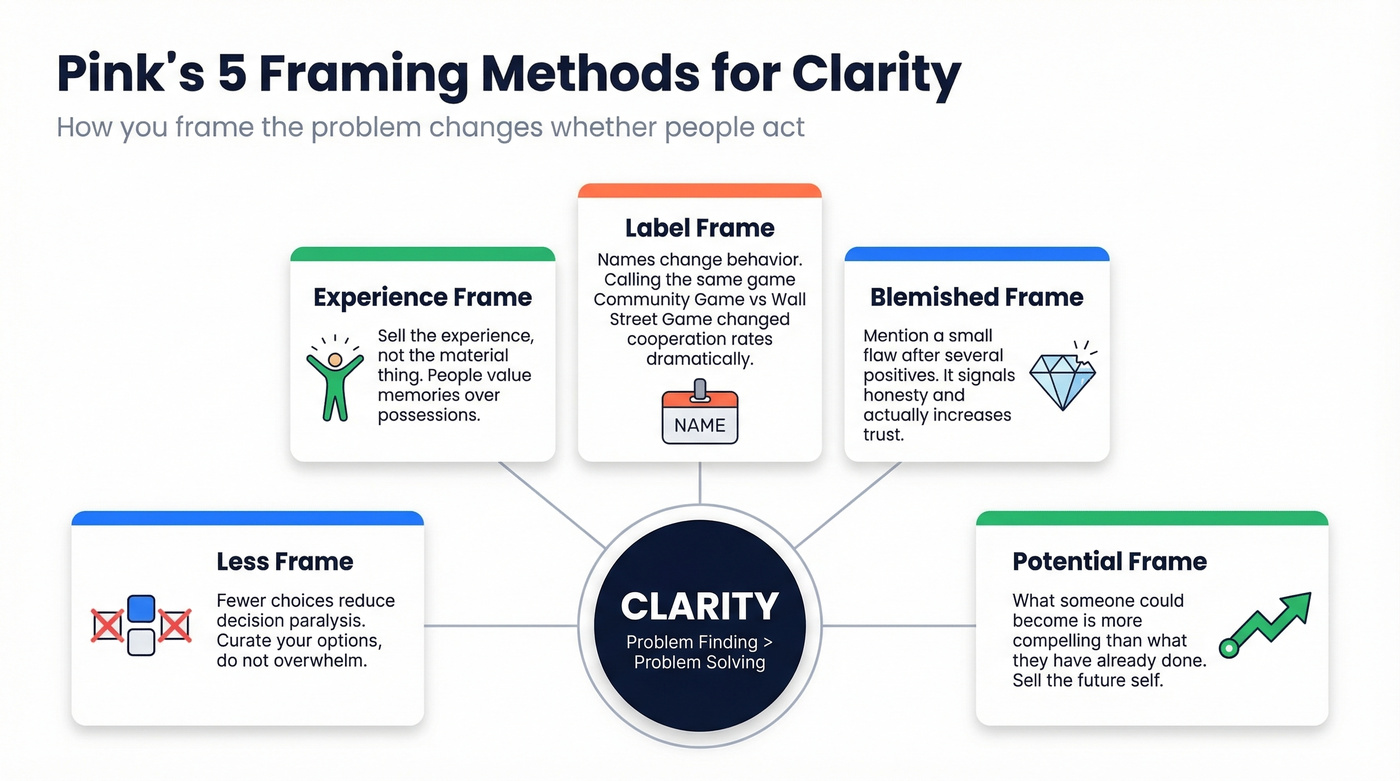
Pink also introduces five framing methods:
- Less frame: Fewer choices reduce decision paralysis. Curate, don't overwhelm.
- Experience frame: Frame offerings in experiential terms rather than material terms.
- Label frame: Naming changes behavior. Calling the same game the "Wall Street Game" vs. the "Community Game" dramatically changed cooperation rates in studies.
- Blemished frame: Introducing a small negative after several positives actually increases persuasion. It signals honesty.
- Potential frame: Emphasizing what someone could become is more compelling than emphasizing what they've already done.
The Six Pitch Types
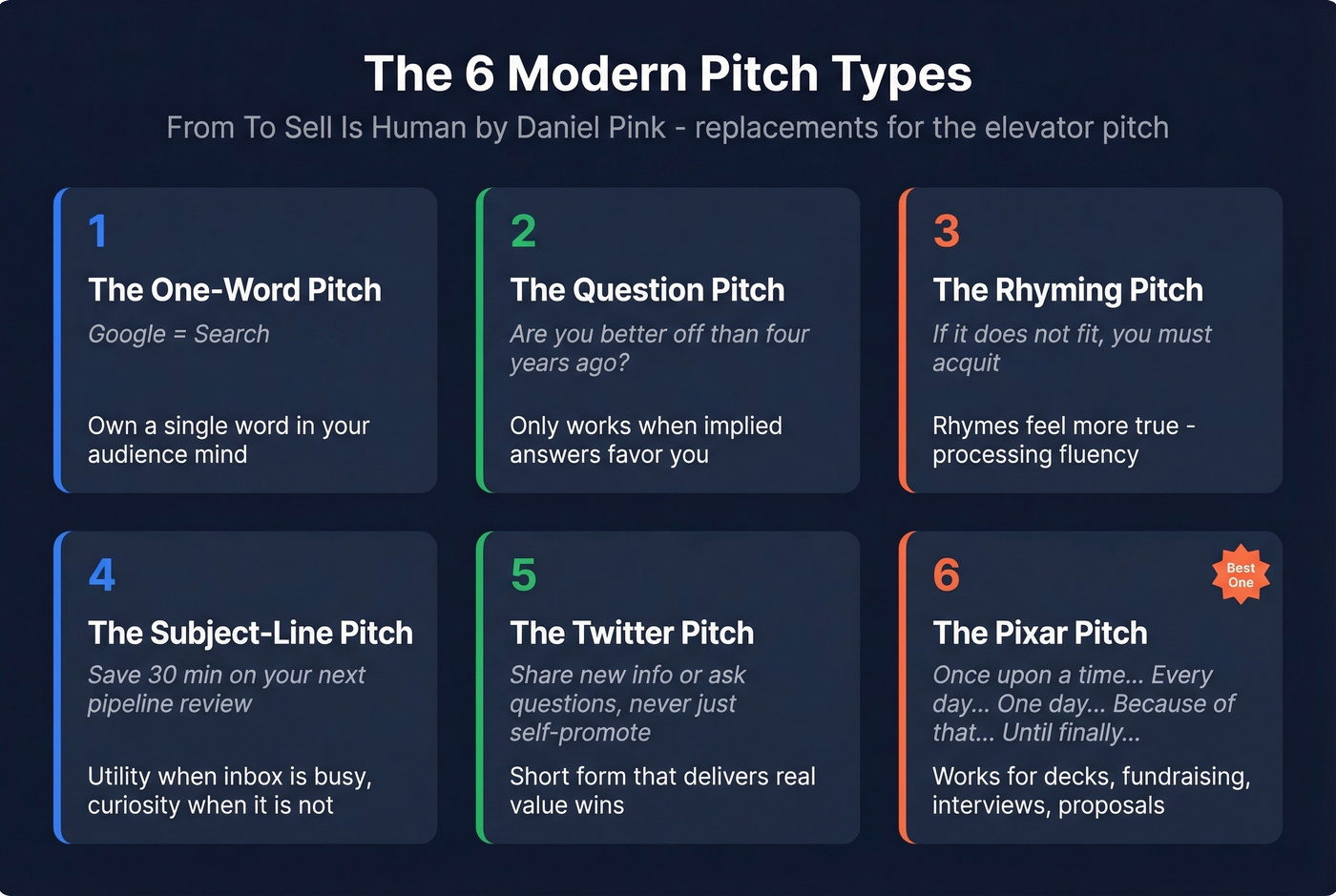
Chapter 7 is the chapter most readers remember, and for good reason. Pink defines pitching as the ability to distill your point to its persuasive essence, then offers six modern alternatives to the elevator pitch. Think of them as six tools in a toolkit - each designed for a different job, a different audience, a different moment.
Before the six types, a key insight from Hollywood pitch research: success depends on both the pitcher and the catcher. Effective pitchers don't just present - they invite the catcher in as a collaborator early. The best pitches feel like co-creation, not performance.
1. The one-word pitch. Own a single word in your audience's mind. Google owns "search." MasterCard owns "priceless." If you can't name the word your product owns, your positioning isn't sharp enough.
2. The question pitch. Ask a question that prompts the audience to generate their own reasons for agreeing. Reagan's "Are you better off than you were four years ago?" is the canonical example. Critical caveat: this only works when the implied answers favor you.
3. The rhyming pitch. Processing fluency makes rhymes feel more believable. "If it doesn't fit, you must acquit" isn't just catchy - it's cognitively easier to process, which the brain interprets as more true. Weird but well-documented.
4. The subject-line pitch. Two approaches work: utility and curiosity. Utility-driven subject lines ("Save 30 minutes on your next pipeline review") work better when inbox demand is high. Curiosity-driven lines ("The metric your board isn't tracking") work better when demand is low. Directly applicable to cold email - A/B test both.
5. The Twitter pitch. Dated in its 140-character framing, but the principle holds: effective short-form messages either ask questions, share genuinely new information, or self-promote with useful content attached. Pure self-promotion without value gets ignored.
6. The Pixar pitch. The one framework worth memorizing:
"Once upon a time ___. Every day ___. One day ___. Because of that ___. Because of that ___. Until finally ___."
It works for sales decks, fundraising pitches, job interviews, and internal proposals. The structure forces narrative arc - status quo, disruption, consequences, resolution. We've seen teams use this for everything from cold email sequences to board presentations, and it consistently outperforms feature-dumping.
Pink also recommends granular numbers - not "$1 million" but "$1,043,287," because specificity signals credibility. And sequence strategically: if you're the incumbent, go first; if you're the challenger, go last.

Pink's right - selling is about finding the right problem, not pushing the wrong solution. But even the best pitch dies if it hits a dead inbox. Prospeo's 98% email accuracy and 7-day data refresh mean your carefully crafted message reaches a real human, every time.
Stop perfecting pitches that bounce. Start reaching real buyers.
Improv Principles for Sales
Pink's final toolkit borrows from improvisational theater. Three principles that sound soft but, in practice, separate discovery calls that open up from ones that shut down.
Hear offers. Most people in conversations are planning their next line instead of listening. In improv, everything the other person says is an "offer" - raw material to build on. In sales, this means actually hearing the objection instead of mentally queuing your rebuttal.
"Yes, and." Build on what the other person says instead of blocking it with "yes, but." The difference is small linguistically and enormous in how collaborative a conversation feels.
Make your partner look good. The sale isn't won at the buyer's expense. The best outcome is one where the buyer feels smart for choosing you, not one where you "won" the negotiation. I've watched reps tank deals by making the prospect feel stupid for using a competitor - the opposite of this principle.
What Doesn't Hold Up
Let's be honest about the book's weaknesses. Three matter.
The overstretched "sales" definition. Pink argues that persuading your kid to eat vegetables is selling. Convincing your boss to approve a budget is selling. If you define selling this broadly, the word loses meaning. Persuading a toddler to eat broccoli and closing a $50K enterprise deal aren't the same skill. As one Goodreads reviewer put it bluntly: if everything is sales, nothing is sales.
The Losada ratio controversy. Pink cites a 3:1 to 11:1 positivity ratio as optimal. That specific ratio was later challenged and partially retracted. The directional insight - that some balance of positivity and negativity matters - is probably right. But the specific numbers Pink presents as science are built on shaky foundations.
Dated examples. The book was published in 2012 by Riverhead Books. The "Twitter pitch" references 140-character limits. The examples are pre-AI, pre-remote-work, pre-Zoom-fatigue. The frameworks themselves are mostly timeless, but the packaging feels like it's from a different era.
Applying Pink's Frameworks in 2026
The frameworks hold up better than the examples. Here's how to actually use them.
For SDRs and outbound reps: Use the Pixar pitch template to structure your cold email sequences. "Once upon a time, your team spent 4 hours building prospect lists. Every day, 30% of those emails bounced..." - it forces narrative, which outperforms feature-dumping every time. A/B test subject lines using the utility-vs-curiosity insight (or pull from these email subject line examples). In our experience, utility subject lines consistently outperform for high-volume outbound, while curiosity lines win for targeted, account-based sends. Apply interrogative self-talk before call blocks: "Can I book three meetings today?" primes your brain to strategize rather than just hope.
For founders and managers: The Five Frames are gold for investor pitches and internal presentations. The Blemished frame is especially underused - leading with a small weakness before your strengths signals honesty and increases trust. Try "Yes, and" in team meetings instead of reflexively shutting down ideas you disagree with. You'll get better ideas and more engaged teams.
For anyone who persuades: The ambivert insight is liberating. You don't need to become an extrovert to sell. You need to modulate - dial up energy when the room needs it, dial back when listening matters more.
Here's the thing: To Sell Is Human isn't really a sales book. It's a communication book wearing a sales dust jacket. And that's fine - because most people who need to get better at selling don't think of themselves as salespeople. If your average deal size is modest enough that a formal methodology feels like overkill, you probably just need Pink's frameworks and the discipline to apply them.
But theory without execution is just entertainment. Pink's frameworks assume your message reaches the right person. Clarity and attunement mean nothing if your email bounces or lands in the wrong inbox. Before you craft the perfect Pixar pitch, make sure you've got a verified email to send it to - tools like Prospeo handle that execution layer so the frameworks actually work (and if you're troubleshooting, start with email bounce rate and an email deliverability guide).
Is This Book Worth Reading?
The numbers say yes, with caveats. 67% of Goodreads readers rate it 4 or 5 stars. Recurring praise centers on the six pitch types - readers call them the most memorable, immediately usable toolkit in the book. Recurring critique is the overstretched definition of selling, plus complaints that it's more pop-psych than rigorous research.
If you're choosing between this and Cialdini's Influence, read Influence first. It's more rigorous, more broadly applicable, and the six principles of persuasion are foundational knowledge for anyone in sales or marketing. Read Pink's book second for the pitch frameworks and the buoyancy toolkit.
Pink's broadest claim - that everyone sells - is his weakest argument but also his most useful insight. Once you accept the reframe, even partially, the toolkit becomes relevant to anyone who needs to persuade another human being. The Pixar pitch works for fundraising. Interrogative self-talk works before job interviews. The Five Frames work for internal proposals. For a ~270-page read, the ROI is solid if you actually apply two or three frameworks. If you just read it and nod along, you'll forget it in a month.
Books to Read Next
- ***Influence* by Robert Cialdini** - More rigorous persuasion science. The six principles (reciprocity, commitment, social proof, authority, liking, scarcity) are foundational. Read this first.
- ***Drive* by Daniel Pink** - Pink's stronger book. Better research, tighter thesis. Along with A Whole New Mind, it shows his thinking at its sharpest.
- ***Never Split the Difference* by Chris Voss** - Tactical negotiation from a former FBI hostage negotiator. Complements Pink's softer approach with harder-edged techniques.
- ***SPIN Selling* by Neil Rackham** - For readers who want a real sales methodology, not a communication framework. Situation, Problem, Implication, Need-payoff. Battle-tested in B2B.
- ***The Challenger Sale* by Dixon & Adamson** - The B2B counterpoint to Pink's "serve the buyer" philosophy. Argues the best reps teach, tailor, and take control rather than just attune.
Buoyancy is easier when rejection isn't caused by bad data. Teams using Prospeo book 35% more meetings than Apollo users - not because they pitch better, but because 143M+ verified emails and 125M+ direct dials connect them to actual decision-makers.
Replace data-driven rejection with data-driven pipeline.
FAQ
What are the main points of To Sell Is Human?
The new ABCs - Attunement, Buoyancy, and Clarity - replace "Always Be Closing." Everyone spends roughly 40% of their time in non-sales selling. Six modern pitch types replace the elevator pitch. The core shift: information parity killed manipulation-based selling, so finding the right problems beats pushing solutions.
Is To Sell Is Human worth reading in 2026?
Yes, specifically for the Pixar pitch template and the buoyancy toolkit in chapters 5 and 7. Some examples feel dated - pre-AI context, 140-character Twitter references - but the core frameworks are timeless. Budget two to three hours and skip chapters 1-3 if you already accept that persuasion is part of modern work.
What is the Pixar pitch from Daniel Pink?
A six-sentence storytelling template: "Once upon a time ___. Every day ___. One day ___. Because of that ___. Because of that ___. Until finally ___." It forces narrative arc into any pitch - sales decks, fundraising presentations, job interviews, internal proposals. It's the single most reusable framework in the book.
How do you apply Pink's sales frameworks to outbound?
Start with the Pixar pitch for your next cold email sequence, use interrogative self-talk before call blocks, and A/B test subject lines using the utility-vs-curiosity split. Pair these frameworks with verified contact data so your message actually reaches the right person - the best pitch doesn't matter if it bounces.